Cindy, Carlos and Daniel at Guanabe report on a serious proposal in a less than serious manner.
The Environment Department of Mexico has released a report asking the United States to think twice about helpless migratory species before going forward with its proposal to erect a 370 mile super-barrier along the border. (To clarify, said migrant species do not include the homo undocumentado.) Government environmentalists have outlined measures like live cactus fences, removable fences, and permeable fences to allow the following things to cross the border without admitting those pesky humans: water, insects, pollen, jaguars, black bears, and the highly endangered Sonora Pronghorn.
There already is something of an environ-wall down this way, though, and we really don’t need to import security guys:

Oacaca — PRI giving up?
My very loose translation from an article in today’s Jornada suggests the PRI is already trying to make excuses for a very possible defeat in Sunday’s Oaxaca state elections:
México, DF. The (PRI) admits it is a target in next Sunday’s Oaxaca elections, in light of the PRD (Partido Revolucaionario Democratico)’s strategy of “hauling” voters into the region, and the return to the streets of the.
Beatriz Pagés, PRI (Partido Revolucionario Institucional) Chamber of Deputies spokeswoman admits her party is a “target” for defeat in next Sunday’s Oaxaca state elections, and blames the rival PRD (Partido Revolucionario Democratico) for the renewed demonstrations by the Asamblea Popular de los Pueblos de Oaxaca (APPO) and dissident teachers.
Pagés said her party could not help but notice that the return of the APPO was having a political effect, turning out voters who were likely to favor PRD over PRI.
She underlined that one goal of the APPO was to throw out PRI Governor t Ulises Ruiz.
Although Pagés added that she could not predict the electoral outcome, it was evident that PRD would do well in Oaxaca, one of the states with the most electoral districts in the country. She added that the PRD has a strategic advantage in Oaxaca, and that the party has been consolidating its power in the southeast part of the country.
“The PRD’s political transformation is behind the renewed street demonstrations by the APPO,” she said.
I don’t expect Oaxacan results will be available until a week or two after the election (for state legislature and local offices, but not for Governor). There are several districts that vote not by secret and free ballot (as the Mexican constitution mandates) but by the conflicting constituional right of communities to maintain their “usos y cosumbres” — they vote by consensus.
Much as some starry-eyed foreign observers would like to believe there’s something genteel and “natural” about “usos y costumbres” in practice it means that dissent or free though — whether political, religious, sexual or otherwise — is not tolerated. In elections, the practice has been to “persuade” these voters to fit whatever results are needed by the ruling party. There usually is some violence in Oaxacan state elections, and all kinds of chincanery. I expect it will be brutal.
Marvin Zindler signs off
You gotta respect a guy who turns to a weird career like journalism in when he was 51, especially with the emotional and physical baggage that seems wrong for the job. Vanity (he had 17 plastic surgery procedures over the years), deafness (and so he yelled), and a taste for high living aren’t what you’d expect from a consumer reporter, defender of the poor, the immigrant and the unfortunate.
But, what would Houston have been without Marvin Zindler, who died last Sunday at the age of 85? A former high-end haberdasher, Marine, and deputy sheriff, he claimed he was screwed over after a car dealer pulled strings with the local sheriff, following Marvin’s investigation into an always popular odometer roll-back scam. Crooked sheriff’s, used car dealers, and any one else screwing the little guy would regret that. Marvin dusted himself off and reinvented himself as, what else, a journalist and crusader.
A little old for the standard TV talking head, Zindler created a uniquely Texas personality — and made his investigative reports instant classics. Every obituary mentions his role in exposing the famous (or infamous, depending on your sense of things) “Chicken Ranch” — the rural whorehouse that served Texas A & M and U of Texas students for several generations (and was the basis for “The Best Little Whorehouse in Texas”), in Houston, he combined “Sixty Minutes” and Jimmy Swaggert in his on-air personality as he gleefully browbeat bureaucrats into resolving housing and immigration problems — and, sweet-talked the rich and beautiful to support charitable work in Mexico.
 Zindler, and Houston plastic surgeon Joseph Agris, regularly arranged to fly medical teams and equipment to Puerto Vallarta (who said you can’t have fun while doing good), correcting cleft palates and other congenital deformities for poor Mexican children. Through the Agris-Zindler foundation, the Houston based charity has expanded to provide free reconstuctive work and distribute medical equipment throughout the world.
You have to respect a guy who didn’t become a journalist until well into middle-age, and who made outrage enjoyable, especially when the outrage was something as something as simple as …. SLIME IN THE ICE MACHINE!
Mercosur… details at 11
I’ll have more to say on this later, but it’s something I’ve thought for a long time would be a positive direction for Mexico — looking south instead of north. Having gone spectacularly broke trying to do business outside of NAFTA, yeah, there’s a now-dead vested interest in seeing Mexico move away from an imbalance in their trade with the U.S. and Canada. The PRD and the “legitimate presidency” were pushing for more Latin American ties, so I get the feeling FeCal is once again being dragged by the majority in a direction he really didn’t plan to go.
The Argentines are an odd people. As Jorge Luis Borges once put it, his countrymen “are Italians and Germans who think they’re French, wish they were British, but speak Spanish.” But, for all their weirdness, they and the Brazilians have been moving in the right direction (ok, the “left” direction, or at least their governments are supposedly “leftist”) since coming up with the idea of a Latin Common Market.
Brazil and Mexico are essential, and though there’s nothing concrete here, this is an excellent start.
I’ll have more to say later. This editorial is from the Buenos Aires Herald:
Calderón says Mexico will “move closer” to Mercosur, but does not say he’ll join. Mexico’s entry to Mercosur is “essential,” President Néstor Kirchner insisted yesterday after a meeting with his Mexican peer Felipe Calderón in Mexico City. He later added that “all those who make up Mercosur” felt the same way.
President Calderón replied that his country “looked kindly on Argentina’s leadership within Mercosur,” and that he planned to “move closer to Argentina and to all the countries that make up Mercosur.” He refrained from saying that Mexico, a partner with the US and Canada in the NAFTA treaty, would seek participation in the southern trade bloc.
President Kirchner is in Mexico on a state visit accompanied by his wife, presidential candidate Cristina Fernández.
The remarks by the presidents were made after they signed a deal, the Strategic Association Accord, aimed at strengthening the ties between the two countries. The signing at Mexico’s National Palace heralds the “taking shape of a new era”, Kirchner stressed. He said he was sure the deal represented “a point of reference” that will be “very important for the integration of Latin and South America.” The agreement, Kirchner said, made the relationship between the two countries “deeper and stronger” and would promote bilateral trade and investment.
The presidents discussed working together within international bodies, such as the UN, and agreed on “mutual backing,” in effect to support each other’s candidacy for one of the rotating seats on the Security Council. Mexico will launch its bid for the 2009-2010 period. Argentina hopes to join the Council for 2013-2014. Both countries would “continue to contribute to a comprehensive integral reform of the United Nations,” Calderón said.
Well, she looked Mescan
UPDATE (2 August, 12:30 A.M.) Mark Friedl in his commnet says that Ms. Rodriguez is HONDURAN, not Mexican. His comments are worth reading, but there is something fishy about posting links that if you access them give you more information, but also a disturbing message saying an email was sent Homeland Security to tell them you read the text. The text may indeed be true, and one may be in their rights to complain to Homeland Security about this situation, but it is nobody’s business what I — or you — read.
XicanoPwr posed the story of deportee-to-be Emelina Ramirez Bojorquez of Carrollton, Georgia, who was thrown into detention as an “illegal alien” after a domestic disturbance. Ramirez was the VICTIM of the attack. One of her young children called 9-1-1.
Ms. Rameriz is indeed illegal… her legal status was thrown into doubt when she divorced her U.S. citizen husband who had abused her. By the way, did I mention he was a cop, too?
Georgia’s Security and Immigration Compliance Act lets local coppers check immigration status — even of victims.
The officers held Ms. Ramirez because “both body language and verbal language that led me to believe they might be illegal,” in the words of one officer.
How the hell do you look illegal? She also looked (and is) pregnant..
Imperialism, traffic tickets and pay toilets
In Fort Lauderdale, Florida, pay toilets have become a cause celebre. The City Manager wanted to install robo-toilets on the beach that automatically open their doors after a period of time, supposedly to prevent gay men from having sex… or I guess anyone from taking a leisurely crap. While the citizens argued over whether the idea was bigoted or just plain-old stupid, what they thought wasn’t nearly as important as the theoretical effect on the tourism trade:
I think my biggest “beef” at this whole thing was that while people were indeed outraged and did protest, the ones with the real “voices” in the community were more worried about the almighty GAY $$ than the abuse being heaved upon the citizens of the area…by citizens of the area.
It’s a bizarre story, alright, but what the tourists think seems to be the deciding factor in Mexican decision making too.
Richard Marosi of the Los Angeles Times writes about the new special rights for Californian drivers in Baja California.
TIJUANA — Baja California sees a lucrative future in the luxury residential towers sprouting up along its coast, and officials are hoping developments by the likes of Donald Trump will bring Southern California prosperity south of the border.
But there’s a problem: The 5-mile highway from the border to the beaches is notorious for police who pull tourists’ cars over in search of bribes.
Now Tijuana police say they’re cleaning up the route and targeting corruption elsewhere in an effort to make the border area more inviting.
…”I’ve told my officers it is strictly prohibited to stop vehicles with foreign plates, especially from California,” said Victor Manuel Zatarain, Tijuana police chief.
If this is a crackdown on bribery, why the special concern for California drivers? There’s nothing new in targeting out of town drivers for tickets. Maybe the Californians have the disadvante of too many episodes of Dragnet and movies about “honest” policemen, while those of us in the “real America” expect cops to target outsiders – it’s been the the plot of every movie set in the rural south (except those with Sidney Portier in them).
Not that it excuses corruption. Of course it exists, and Tijuana’s police have been notorious for years, and overcoming years (heck … centuries) of abuse isn’t going to happen overnight. Still,
… the latest crackdown, even with its gimmicky touches, seems to be being taken seriously, say border experts and real estate professionals.
I didn’t notice anything in Marosi’s article about changing the police culture, or cleaning up the traffic police in general… just about real estate:
Along the 70-mile stretch of coast from Tijuana through Rosarito Beach to Ensenada, 25 condominium and hotel high-rises are planned or are under construction, some with golf courses and private beaches. The Trump Ocean Resort Baja, set to break ground this year on a 17-acre oceanfront bluff, is pitched as the new standard for Baja California luxury.
Potential buyers, many from Southern California, are treated to sales events with open bars and gourmet food. At one event in Del Mar, Calif., buyers got to meet Trump’s 25-year-old daughter, Ivanka. Sales agents said she bought a unit in one of the three towers.
It doesn’t take much reading between the lines (the rest of the article just rehashes old corrupt cop tales) to see that all that’s being done is channel the police towards harassing local drivers. Who, being voters and taxpayers, may not stand for it, and might demand real change, but that’s another story.
Who is corrupt… the copper making an extra 20 US dollars, or the Trumps and their ilk, demanding (and getting) special legal rights for Californians?
The gringos are coming… they want those luxury homes, but at Mexican prices. San Miguel Allende’s city council has found itself besieged by the foreigners who want the city to meet their demands, and David Agren has been more than a little bemused by the “cosmopolification” of Guadalajara and Lake Chapala where the English language papers and chatrooms are mostly about where to find U.S./Canadian good and services — and advice on how to cheat the maid.
For now Mexico is dependent on tourists — and the retirees are making the whole country a new Florida or Arizona. About a million live in Mexico (officially), and it’s changing everything. For the better, I can’t say. If not for their health or sanity, then for what had been lower living expenses. Though, of course, that’s why Arizona and Florida pretty much look like, and cost the same, as everywhere else in the U.S.
What happens when the boomer boom goes bust? What happens when Mexico becomes less dependent on tourism and finds other ways to profit off the gringos?
At Wing Nut Daily they’re fuming about plans to process U.S. traffic tickets in Mexico. Naturally, these tickets are coming from southern Californians. Data entry jobs – the “pink collar ghetto” — have been moving to the lower cost regions for years, and this is no surprise.
What’s going to be interesting in Mexico is what happens when the citizen’s “usos y costumbres” run up against the foreigners with money. Living where I do, I’ve come to appreciate tourism as a source of amusement for us local yokels. Being a relative newcomer, I don’t always like the local ways, and sometimes get annoyed that folks don’t do things MY way. The local governments spend half their time trying to meet the demands for change, and the other half trying to limit it. That’s the problem when the tourists stay.
I’m one of those people who wants Mexico to stay Mexican… though I accept that things will change, and I’ve used my status as a “privileged foreigner” on occasion. And, I expect the recent wave of Mexican immigrants into the U.S. to change this country. What will happen to Mexico I don’t know. Good, bad… or imperialistic is an open question.
Will there be a backlash, especially once Mexico lessens its dependence on tourism, though things like data processing? I don’t think there will be, but as more gringos move into Mexico, especially if they start demanding playing by OUR rules, don’t be surprised if in a few years some town passes a “Zapotec Only” regulation.
Plan Mexico… or Plan Roger Noreiga?
Plan Mexico? Riiiight.
There has been some mention of a Plan Mexico in the Mexican press, but mostly in the form of denials by the government. The conservative Latin American news blog, Bloggings by Boz, tipped me off to this story (from the Houston Chronicle, with a by-line by Pablo Bachelet):
WASHINGTON — Mexican President Felipe Calderon, locked in a bloody confrontation with drug cartels, is negotiating a massive counter-drug aid package with the Bush administration worth hundreds of millions of dollars, several officials say.
Officials on both sides are working out the details of a package that resembles a U.S. aid plan for Colombia. The talks have been taking place quietly for several months and will be a central item on the agenda when President Bush and Calderon are expected to meet in Quebec Aug. 20-21.
Mexican officials have been reluctant to go public with the discussions, mindful of anti-U.S. sentiments harbored by many Mexicans.
But the conservative Calderon believes he has little choice but to enlist U.S. help given the cross-border nature of drug trafficking and the ruthlessness of Mexico’s drug gangs, officials and observers said.
U.S. officials would say little other than to acknowledge the discussions.
…officials view the talks as a bold initiative by Calderon that underscores his resolve to tame drug-related violence — most of it between rival cartels — that has cost the lives of 3,000 Mexicans in the past year alone and forced the intervention of 20,000 federal troops.
“I think the Mexicans realize it’s going to get worse before it gets better,” said Roger Noriega, a former assistant secretary of state for the Western Hemisphere and now with the American Enterprise Institute think tank.
“They can’t do this alone, and should not have to do this alone,” Noriega said.
…
People familiar with the talks say Mexico drew up a list of needs that included equipment, training and technology, including Black Hawk helicopters, which are difficult to come by given the U.S. wars in Iraq and Afghanistan.
The price tag on the more ambitious aspiration is $1.2 billion, but a more modest proposal has emerged in recent weeks in the area of $700 million, said one person familiar with the talks.
Roger Noriega might ring a bell:
Roger Noriega, the former assistant secretary of State for Western Hemisphere Affairs known for his meddling in the internal affairs of many Latin American and Caribbean nations, now issues proclamations about U.S.-Latin America policy from his perch at the neoconservative American Enterprise Institute (AEI). Noriega, who coordinates AEI’s program on Western Hemisphere affairs, is an outspoken proponent of free trade and U.S. hegemony in Latin America and the Caribbean.
In his description of U.S.-Latin American affairs, Noriega strikes an alarmist note. According to Noriega, we are witnessing “a battle for the heart and soul of the Americas”—between those on one side “who treat democracy as an inconvenience and see free markets as a threat” and those on the other side of this hemispheric contest “who see democratic institutions and the rule of law as indispensable to prosperity and liberty.”
Note that for Noriega, “free markets” (i.e., U.S. sales) and democracy are one and the same. Noriega made himself odious in the State Department by screwing up U.S. relations with Haiti and Venezuela (the #3 oil exporter to the U.S.) by objecting to democracy in those countries and subverting their elective governments.
Given that the Mexican “war on drugs” was more smoke than fire, and only a short term rationale for using the military as police, the trend in all of Latin America away from U.S. economic and social control, the Calderón administration’s very old-fashioned “neo-liberalismo” and the questionable activities of U.S. drug agents in Mexico, there is no support for this within the Republic. The only reason I can see this being pushed is to sell military equipment, and to shore up Calderón’s dubiously elected – but pro-U.S. — government .
If I find credible support from other than Noriega, I’ll let you know. I’m looking.
U.S. hospitals send patients south of the border
I’m usually reading complaints about how the Mexican elite (usually said as the “white, Spanish elite”) export their poor to the U.S. Here, it sounds like the U.S. — rather than provide for their citizens at home — is exporting their poor to Mexico, and trying to turn a profit at the same time.
Posted on General Health News:
Two North Texas-based hospital chains, Christus Health of Irving and International Hospital Corp. of Dallas, are tapping into a need and an opportunity by providing in their hospitals in Mexico what their executives say are the best of both worlds – U.S.-quality health care and relatively low Mexican prices.
“Our goal is to have the safest hospitals in the international market,” said Cliff Orme, CEO of International Hospital Corp. “We’re implementing U.S. standards into these hospitals so you won’t notice the difference going to a hospital in Dallas than one in a Latin American country.”
Some experts, including Peter Maddox of Christus Health, see Mexico as an answer to the complex question of how to treat aging and underinsured Americans at a time when the retirement of baby boomers will further tax the U.S. health care system. An estimated 43 million Americans, about 15 percent of the population, are uninsured, according to a Census Bureau study.
…
Although care in Mexico may not be as inexpensive as care in some Asian nations, the proximity to the U.S. is a big advantage to patients. Some U.S. companies are now sending employees to Mexico for their annual checkups.
Underscoring the trend, Mexican state governments are spending money to refurbish communities near these hospitals, hoping visiting patients will stay there while receiving medical care or even move there permanently.
David Warner, a health researcher at the LBJ School of Public Affairs at the University of Texas at Austin, said the hospitals run by U.S. companies are primarily for Mexicans, but they also hope to attract medical tourism, Americans without insurance and Mexicans living in the U.S. “And they’d like to get some U.S. insurers to cover them,” he added.
…
A bill in the Texas Legislature sponsored this year by Senator Eddie Lucio, a Democrat, would have allowed U.S.-based insurers to cover health services in Mexico with the goal of making policies affordable for uninsured groups like the working poor. There was also a House version of the bill.
Honestly, I don’t see a particularly “complicated question” involved in providing medical care. Mexico — and every where else — just pays doctors and nurses and orderlies to do their job. If they want to earn extra money, they do private care.
Call out the international food peace-keeping forces
There actually is a “Tex-Mex” restaurant in Colonia Tabacalera, but even they don’t serve burritos or chimichangas. They did have some of those weird hard-shell “tacos” though.
Sunday, July 29, 2007
MEXICO CITY — Worried by the global proliferation of deep fat-fried chimichangas, fajitas, margaritas and fried ice-cream, the Mexican government is recruiting U.S. and Canadian restaurateurs to set the world straight on what is real Mexican food.
So proud is Mexico of its cuisine that the government has lobbied UNESCO to declare Mexican food a “cultural patrimony of humanity.” And the government recently flew in 50 Mexican restaurant owners from the U.S. and Canada to teach them what’s authentic and what’s not.
…
Officials, however, have their work cut out for them. Mexican food often is misunderstood, from Bahrain to Birmingham, Ala.
For example, the California-based Chevys restaurant chain, which has locations in 15 U.S. states, offers “Classic Fresh Mex Combos” such as chimichangas _ beef or chicken deep-fried in flour tortillas. The El Torito chain, also based in California, offers deep-fried ice cream on its “autentico” menu.
And Taco Bell’s vision of Mexico is something entirely alien south of the border. When the fast-food chain tried to establish a presence in Mexico City in the 1990s, consumers were so perplexed by the “burritos” that a leading newspaper helpfully included a definition.
…
Clean votes
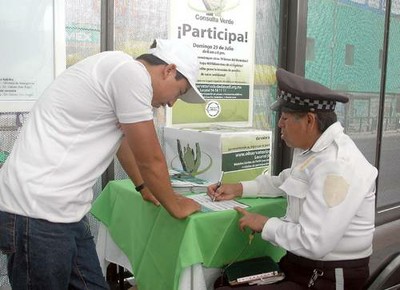
Vote for trees!
The Federal District is holding a non-binding “consulta” — a cross between a referendum and an opinion poll — on environmental initiatives. Officially, the idea is to measure citizen support for various initiatives — and to test alternative voting methods — e-voting and telephone voting. (The ballot is here, but you have to have an IFE card to get actually vote.)
Unofficially, it is the post modern version of the old pro-governing party demonstration (and, having people only go to their local polling station or sending an email is more environmentally friendly than busing in a few thousand folks to march around, and then busing them back home after serving them lunch). It tests the governing PRD’s ability to turn out the vote, and forces opposition parties to either buy off on the governing party’s lead, or mount a losing campaign against it. I can’t say for certain, but with the Greens allied with the PRI, this looks like a great way to undercut at least one rival party within the Federal District.
The PRD-controlled District Assembly is probably going to pass these measures anyway, but all are bound to be somewhat controversial and cause someone some hardships. And they are all probably necessary measures. Consultas give some cover to the assembly. They incidentally “test drive” not just new voting methods, but party organizers as well. You might move up in your own faction by backing your guy in the next general election, but if you want to move up in the party itself, you have to prove you can turn out the votes. It’s probably less destructive and wasteful than those referendums you have every once in a while to do something like limit marriage to one man and one woman or make English the official language or rent restrictions on non-citizens. Which are immediately followed by lawsuits and do nothing but give jobs to political consultants, ad agencies and lawyers.
Anyway, pretty much like school board votes in a lot of the U.S., this is an exercise in letting the voters approve what’s gotta be done regardless. Several of the measures deal with cutting auto traffic (one I never though of — private schools are everywhere in Mexico City, and the parents all show up to pick up their kids every afternoon. One measure would allow the district to provide school buses for private schools), using alternative fuels for buses and taxis and expanding the Metro and Metrobus.
Others call for improved water treatment, restoring wetlands (don’t forget Mexico City was once ALL wetland) and waste disposal.
The most interesting to me is an idea I had a long time ago. A lot of people put gardens on their roof, or at least a plant or two. What if every building in the Federal District had a few plants? The place would certainly smell a lot better and the air would be a lot cleaner (and the roof dogs could snooze in the shade and have a real tree to pee on) . One proposal will require all new construction to include rooftop gardens.
The proposal is based on a Tokyo ordinance. Which looks more like a Mexican pyramid — Rem Koolhaas’ proposed giant coffin, or the ACROS Fukuoka from Japan? And which looks like a place you’d want to work?

$205 million in milk money…
This Ye-Gon case is getting weirder by the minute. The only solid result so far has been that Mexico is going to require a prescription to buy cough medicine with pseudoephenidrine. The D.E.A. originally claimed it was entitled to a cut of the loot recovered under the argument that they had provided training materials later used by Mexican police investigators. Ye Gon released through his lawyer a letter claiming PAN officials and the former Fox Administration forced him to act as banker for them. The lawyer later claimed that the letter wasn’t from him, and the Mexican government (the one in Los Pinos, that collects taxes, not the one depending on donations) got a little miffed. They started wondering – as was everyone else – why Ye Gon was considered a drug “kingpin” — but was allowed to walk around free in the United States. When he was finally picked up earlier this week (on a minor drug misdemeanor) court papers revealed yet another twist.
The DEA wasn’t just operating in Mexico (as they said they weren’t), they were up to their eyeballs in this case. Edward Chavez, a D.E.A. agent in Mexico City said in court documents that he personally, and a DEA lab confirmed, that the Ye Gon was in possession of ephinedrine.
In other words, the D.E.A. is NOW saying they had a claim to the loot, but – oops – their rationale was nonsense, and what they were doing was violating treaties and operating illegally in Mexico. Details, details … though this interesting detail might mean Ye Gon might off. A Mexican judge is going to have to sort this mess out in September.
There’s more than enough that doesn’t make sense about this case – who was actually doing the investigation, why the Chinese and U.S. ports didn’t detect the massive quantities of chemicals coming through their ports, and why was the 205 million dollars seized moving around from bank to bank?
El Sentir de Coahuila “follows the money”, and comes up with more questions than answers (my translation):
It is not at all clear why the Mexican government announced with such fanfare the distribution of more than 205 million dollars found last March in Chinese-born Zenli Ye Gon’s residence to the Federal Prosecutor (PGR) and the Secretariat of Health (Ssa): it could have been an attempt to make a media sensation, or to try to partly deflect U.S. claims, or to put an end to the confusing legal situation, and public speculation over the precise location of these funds. As it is, the the present administration is facing a public relations disaster over their handling of the alleged delinquent, who was detained today in the United States on a minor possession charge.
You need to remember that, from the very beginning, the amount of cash disclosed to the public by the PGR didn’t agree with photographic evidence numbers of the piles of bills. The PGR had to adjust the amount of the announced seizure. Days later, the same agency said the money was deposited with the Secretariat of the Treasury and Public Credit (SHCP); that it was then moved to the Soldiers and Sailors’ Bank (Banjército), which was asked about. Then, when asked about it, it turns out the bills were transferred to the Federal Reserve of the United States, and the actual bills were distributed throughout the international financial system.
Moving this much cash around arouses suspicion. It reminds one of the procedures used by organized crime to launder ill-got gains. And, there is the questionable practice of removing paper money, which was potential criminal evidence, with such alacrity, as if someone wanted to cover up a crime.
In order to cut off all discussion, at yesterday’s press conference at Los Pinos, Attorney General Eduardo Medina Mora, and Secretary of Health, José Angel Córdova, together with the SHCP chief financial officer, Luis Mancera, announced the the funds would be split between the PGR and Ssa. They know full well that there are judicial procedures that are followed to legalize moving seized assets into the public coffers, and that there are pending claims by the D.E.A. Despite this, as early as April, Felipe Calderón Hinojosa had announced that the resources seized from the industrialist were destined for drug addiction treatment programs. Such haste could be the beginning of a bitter disappointment for Caderonismo, especially if the courts don’t dole out the “milk money” as promised.
How Zenli Ye Gon’s seized dollars have been handled is only one of several murky aspects of the public administrator’s handing of this incident. Slowly, other indications of serious irregularities are coming to light. Why did the Customs Service (part of SHCP) allow the import of several tons of pseudoephedrine to a wanted – and fugitive – narotics trafficker; why did the Secretariat of Foreign Affairs on the personal recommendation of Vicente Fox and the Secretary of the Interior (Gobernacion) take such an personal interest in Ye Gon’s naturalization?
If we add at this point the conflict with the United States that the Zhenli case caused, the premature disposal of the actual cash makes sense. The present administration has nothing more than slogans to get itself out of trouble and to answer the incongruities and contradictions brought to light. And it is an alarming exhibition of the failure of government action.
I guess we will get fooled again
I shouldn’t feel guilty about asking for a few hundred bucks (and a few thousand over the next several months). I don’t (besides, I gave up guilt for Lent — in 1987 — and never took it back). This isn’t some high tech operation running a huge overhead… just phone bills and electricity (and keeping the duct taped Dell running). The expenses are real, and I’ll be happy to show anyone my bills… especially if they offer to pick up some of them.
Thanks to wreckingboy today, and those who’ve given previously. There’s still an urgent need to catch up the phone and electric bills, though.
I can’t guarantee my phone will still be on Monday at this point. I have $600 in overdue bills that need to be cleaned up and on-going expenses of 800 to 1000 a month from the Mex Files.

If you prefer to send a check, money order or make other arrangements, please write me at “richmx2 -AT- excite -DOT- com” and include “Mex Files” in the subject line.

The Great Texas Spy Cam Scam, in which the State asked for … ahem… pubic assistance (I guess it was a bad attempt to write bilingually… they wanted us to be pendejos) in catching illegal aliens crossing the border, was one of the stupider ideas ever to come out  of what the late Molly Ivins called “the laboratory of bad ideas” .
Stupid, yeah. But then, we’ve got a governor who makes the previous fool look like a genius. This must have been too embarrasing idea for the Texas media. The only place I’ve seen it mentioned was El Universal:
Luis Carlos Cano/ Corresponsal
El Universal
Ciudad Juárez, Chihuahua
Jueves 26 de julio de 2007
16:52 El gobernador de Texas, Rick Perry está gestionando recursos extras, a pesar de no tener la facultad de ley, para echar a andar un proyecto de colocar cámaras de vigilancia en la frontera.
La gestión la realiza después de que los legisladores estatales rechazaron su petición de cinco millones de dólares para poner en marcha el programa vecino vigilante cibernético, tendiente a que cualquier persona, desde cualquier lugar, monitoree la línea divisoria a través del Internet.Katherine Cesinger, vocera del gobernador Perry, dijo que “todo es cuestión de contar con los fondos necesarios para el funcionamiento de las cámaras, sin operar desde el año pasado, ya que los congresistas declinaron fijar una cantidad monetaria en el presupuesto estatal de 153 mil millones de dólares para la adquisición de cientos de cámaras solicitadas por Perry para un sitio de Internet a efecto de que los cibernautas puedan patrullar virtualmente la zona fronteriza para detectar cualquier actividad ilícita”.
(Even if you don’t read Spanish, the only thing you need to figure out is a lot of money is being spent. In the test last year, the state spent a mere 20,000 dollars per “capture”… not including salary and overhead. Now the state wants 153 million dollars.


