Passing gas
It’s particularly rich that Felipe Calderón (remember him… used to be President) is whining about “collateral damage” from the crackdown on gasoline theft here.
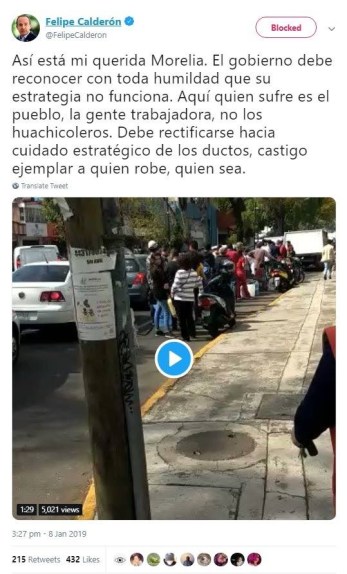
Calderón after all, was the guy who … ridiculous as he looked in a military uniform… went all John Wayne (though he personally looked more Radar O’Reilly) when it was the US supported “drug war”… sending the military out to “wipe out” the leaders of the various narcotics export businesses. When innocent people were killed in the process, he wrote it off as “collateral damage”. Oh, but when people are inconvenienced by the government’s use of the military to crack down on wholesale gasoline theft (gas thieves are know as “huachicoleros”), it’s a whole other matter.
The ex-president is, of course, seeking to gain some legitimacy among the fractured opposition to the new government. As it so, so far, it is what is now the opposition… the former majority parties, PRI and PAN, who have the most to lose in the crack-down. Since 2000, and the beginning of the PAN-PRI duopoly on state power, PEMEX … the people’s oil company… has lost something on the order of 66 billion pesos just to people siphoning off gasoline. This was more than a few poor slugs drilling into a duct here or there (and getting themselves blown to kingdom come occasionally… the cost of doing business) or hijacking a delivery truck, but robbing the nation on a massive scale.
I don’t know how much money is estimated to be in the narcotics export trade, and “get” that criminal enterprises are socially undesirable and that people who get in the way end up dead, but I do know that the narco money was never expected to pay for state expenses… you know, for things like building highways, or paying nurses, or providing old age insurance, or health inspections, or… whereas PEMEX revenue was. It is, after all, the single largest source of government income.
But, with creeping privatization, begun under the Fox Administration, PEMEX revenues dropped precipitously. Mexfiles has always assumed that during the Fox, Calderón, Peña Neito administrations, PEMEX was mismanaged by design, the better to sell the need for privatization. But, it appears that those mismanagers had something even bigger in mind. Actively neglecting security (and, it appears, profiting by it), they allowed the huachicoleros free rein. Not the little guys stealing a few thousand liters of premium here and there, and selling it from “pop up” gas stations, but wholesale theft, requiring the cooperation of PEMEX executives, state and federal officials, and some sophisticated bookkeeping.
Those on the right who have noticed that the worst shortages are in areas where the still have control are quick to scream “Venezuela!!” as if the government is somehow devious enough to cut their area’s gas deliveries while managing to keep gas in stock in other areas… perhaps it has something to do with huachicoleros having been tolerated (and perhaps encouraged) in the old party controlled areas, but not where the new party has come to power? Maybe it’s just that where stolen gasoline was available, consumers naturally took advantage of the lower prices, and with the supply cut off, those consumers are having to compete with the honest consumers for a limited resource?
Or, as Cécile Boulnois (a particularly astute Breton who happens to live here, and knows what’s she’s talking about) pointed out, it’s something I should have already known… I wrote training documents for what was then Exxon, for controlling gasoline deliveries to stations. A pretty simple scam… normally a station sends orders for its anticipated monthly needs to a central computer, which calculates what is in the distribution center, and schedules deliveries. But, if a station is buying off the books, it just lowers its orders over time, enough to keep it profitable on paper, but not enough to draw attention by having high volume sales. WHich it does, making up the difference with supplies coming from huachicoleros… the same gasoline, so the customers don’t notice the difference. And, PEMEX doesn’t notice, because so many gas purchases are cash, which the station can easily under-report.
The consumer isn’t hurt by the scam, but the state is. Besides the gas being siphoned off (wholesale… just yesterday, the Army found a two kilometer “side duct” on a major pipeline, leading to a clandestine storage center), it was purchased at below market cost and without being taxed. Several hundred stations around the country have been closed for pulling this stunt, or have only been reopened under new management, or after changing their order processing to reflect real sales.
Major fleet buyers have also, apparently, been … er… tapping into the huachicolero market, probably under-reporting actual purchases, and submitting false invoices to the tax authorities to account for the difference. Or just under-reporting… and are said to be in a heap of trouble.
Yeah, there is a gasoline shortage right now. It may last longer than anyone anticipates, but in the end, it should mean more revneu for the state, without much affecting the consumer cost for gasoline. He can whine all he wants, but Calderón’s crack-pipe dreams of the days when the state went after Sinaloan hill billies who were (until he came along) more a danger to each other than to the state itself, and provided a sizable second income to favored state employees are done.
Millard Fillmore: “America deserves good shit”.
I’m afraid I got tied up yesterday with preparing to move yesterday, and completely missed Millard Fillmore’s 219th birthday. FIllmore, born in a log cabin on the edge of civilization (in the Finger Lakes of New York), a self-educated lawyer, and frontier politician. As a Whig member of the 30th United States Congress (1846) he was a leader in his party’s opposition to the Mexican War. Like the freshman congressman from Illinois, Abraham Lincoln, opposition to the war would cost Fillmore his seat, but… like Lincoln… he would emerge from defeat to become President of the United States.
Fillmore, chosen as his party’s Vice-Presidential candidate not only to balance the Whig ticket geographically (the Presidential Candidate, Zachary Taylor, was from Lousiana; Fillmore… about as far from Lousisiana as you can get, called Buffalo, New York his home) but also ideologically (Taylor was the hero of that unheroic war in Mexico, and opposed slavery, whereas FIllmore … to his discredit… was neutral on the subject) when Taylor was felled by a bowl of cherries (9 July 1850).
Fillmore’s has a reputation as one of the worst U.S. presidents, mostly because he signed the Fugitive Slave Act (which, somewhat like laws proposed today requiring local governments to assist in tracking down “illegal aliens”, required local governments in free states to assist in returning escaped slaves to their owners in other states), but is being reassessed based on his administration’s foreign policy successes.
 Although the actual transfer of the almost 30,000 square miles of what is now southern Arizona and New Mexico did not take effect until after he left office, Fillmore does get the credit for seeing through the diplomatic initiatives that led to the The Gadsden Purchase. As Santa Anna, who was the Mexican president who approved the sale, noted, there was a very real danger of the region becoming another Texas — overrun with U.S. squatters who would simply seize the region, and as much of the surrounding area as they could — and Mexico was broke after the US invasion a few years earlier. That the 10 million dollars for what was then seen as marginally worthless desert was seen as “too generous” by Fillmore’s opponents, but on the other hand, the United States’ mere 17 million for the third of Mexico seized during the war was more symbolic than anything else… writing down “debts” supposedly owed the United States (for supporting Mexico’s own invasion). That the 10 million is said to have disappeared into Santa Anna’s pockets is another story altogether. At least it avoided another war and put some ready cash back into Mexico.
Fillmore’s term also saw the United States opening relations with Japan (the first “western” nation to do so since the 17th century) and, something of an anomaly in U.S. history, he sought to treat the governments to the south of the United States as the south as equals and partners. His administration took a particularly dim view of “filibustros”… those free-lance practicioners of “Manifest Destiny” who sought to grab chunks of usually Mexico, but Central America was also a favored target… going so far as to apologize to the Mexican government for William Walker’s crack-pot scheme to set up the Republic of Sonora (which was never able to get into Sonora for more than a few days, though it lasted in Baja California for a week or two) and to state that, as policy, the United States had no designs on Mexican territory.
He devoted a good portion of his first”state of the Union” address to South American affairs, particularly those of Peru and Chile? Why? The British, Spanish, and French were all vying to control the governments of those nations, seeking the most important new commodity on the market… guano. Peru and Chile had the best guano deposits in the world. Ever since Alexander von Humbolt had alerted Europeans to the value of bird shit as a fertilizer (and better yet, as a source of nitrates for explosives… useful stuff in a continent addicted to blowing up their neighbors on a regular basis) there’d been a shit-rush of interest in acquiring guano.
The British, French, and Spanish were, by 1850, worried as much about a “guano gap” as the U.S. and Soviets worried about the “missile gap” a century later. The United States was a guano crazed as any other up and coming power (and it would need that nitrates for explosives the following decade when everything went ot shit) and, in a fit of guano-mania mixed with a dose of Manifest Destiny, the Senate passed a bill automatically annexing any island covered with bird crap not claimed by some other country as part of the United States. Wisely, FIllmore never gave any support to the bill, and it quietly died. But, with Chile and Peru the primary guano suppliers of the time, and the Brits, French, and Spanish doing everything they could to subvert the two governments and impose administrations more amiable to their country’s own guano buyers (which would lead to the first great proxy war for resources, the South Pacific War — involving Chile, Bolivia, and Peru… as standins for Spain and England), the United States for the brief few years of Fillmore’s presidency, approached the guano supplying nations with open offers to buy. Not so shitty a free trade agreement, considering such agreements usually involved gunboats in the harbors of the coutries being solicited to join in those days.
Maybe because he focused his energy on foreign affairs, or more likely because of the Fugitive Slave Act, Fillmore as not even nominated to run for a full term of his own. WIth the Whigs in northern states being absorbed into the new Republican Party, he attemped a comeback via the American Party, the “know-nothings” (his defenders say he wasn’t so much anti-Catholic or anti-immigrant as he was just looking for an alternative for southern Whigs and others outside the dominant Democratic Party, and not comfortable with the Republican’s “radical” abolishionist wing).
Out of politics, he shuffled off to Buffalo… about the only place that remembers him and that brief shining moment when an American President stood up and defended the shit-holes.
Cranky old man yells at clouds?
I erased my response to this post, but oh… how tempting… it was!
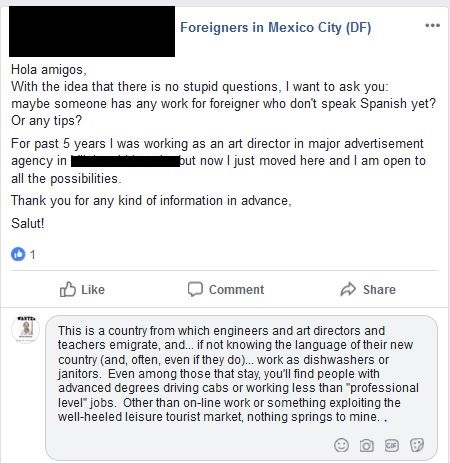
I’m the first to admit that I didn’t know as much as I should have when I first moved to Mexico, though I knew quite a bit (including at least rudimentary Spanish). And, back then (when I was still in the throes of a creative mid-life crisis) I realized that my former job wouldn’t be available to me, but that my degree and background could be turned into something that would at least keep me fed and housed, but not much more than that.
I go back and forth on the question of whether or not to encourage or discourage would-be emigrants. I have no particular love for “expats”… those that just show up here expecting to be well paid and well-received simply because… because they aren’t Hondurans or Guatemalans, just to mention a large cohort of potential additions to the labor pool that has recently shown up. But I understand the attraction of potentially moving here. A little money goes a long way, but one can’t expect to earn more than a little money; and usually it’s very, very little. “Safer” than say Guatemala, but a bit more expense (and, in the Capital, substantially more). Which doesn’t guarantee anything.
Back up and move forward.
 This site was started on the premise that in Mexico history matters… and that our politics and political discourse is a continual recycling and repackaging of our history. It’s so obvious, even Jude Weber finally gets it. (I don’t have a Financial Times subscription, so stolen, and google translated from El Financiero):
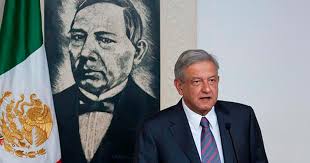
The portrait and the presence of Benito Juárez are so ubiquitous in Mexico these days that one can almost forgive anyone who thinks that he, not Andrés Manuel López Obrador (known as AMLO), is the one who has just assumed the presidency of the country.
The image of the 19th century lawyer and former president of Mexico is at the center of the new government logo. His huge black and white image was the official backdrop of AMLO during the transition between his election and his inauguration on December 1. His face also appears on the new 500 peso bill ($ 25).
López Obrador, who often says that his dream is to be a president as good as his hero, has moved his office to the National Palace where Juarez worked and, as some newspaper articles suggest, he might even be imitating Juarez’s hairstyle.
However, although López Obrador is a somewhat clumsy public speaker, he is a clever political communicator and his use of history improves the effectiveness of his messages: the past is the prologue.
In his second week of work, he was embroiled in a dispute with the Supreme Court over insisting that no official should be allowed to earn more than his own salary as president, a level he had already set at 60 percent less than that of his predecessor, Enrique Peña Nieto. To emphasize this point, he read a decree of 1861 in which Juarez announced cuts to his own salary.
Investors are worried about another historical parallel: their desire to place the state oil company, Pemex, at the center of the national oil industry. The intention evokes the image of Lázaro Cárdenas, the former president who expropriated American and British companies in 1938 and created Pemex, and who is next to Juarez and other heroes of independence and revolution in the new logo.
López Obrador has already limited Peña Nieto’s historic energy reform – which put an end to Pemex’s monopoly and opened the sector to private investment for the first time in eight decades – by suspending oil auctions. Meanwhile, a capital injection of 75 billion pesos (3.7 billion dollars) for Pemex, has the purpose of financing the exploration to resuscitate the glory days of the past. But Pemex’s production has been in decline for the past 14 years and has well-deserved its reputation for bloated bureaucracy, corruption and inefficiency.
The story shows pitfalls and lessons for a leftist nationalist president that critics fear will lead Mexico to the economic crisis of the 1970s, and according to an executive director of the oil company “to the decisions of the past that did not work” .
López Obrador has faced financial markets after announcing that he will discard the new partially built airport in Mexico City, which has a cost of 13 billion dollars, after it was rejected in a referendum. But, as the historian Andrew Paxman points out, even Cardenas had to answer to the business elite after the nationalization caused the peso to lose a third of its value from March 1938 until the end of 1940.
López Obrador is a man with a vision. The president has embarked on an anti-corruption crusade, the central axis of what he grandly calls the “fourth transformation” after Juarez’s liberal reforms; the independence of Spain in the 19th century; and the Mexican revolution more than 100 years ago.
López Obrador has called another popular consultation for next year on the creation of a new national guard and on whether the last five presidents should be judged for promoting the neoliberal policies that he blames for impoverishing Mexicans. The date is surely not a coincidence: Juarez’s birthday on March 21.
The historical references of the government clearly have the purpose of being suggestive. But, in the end, López Obrador can arrange things as he wants. You just have to keep your promises.
The Incredible Profesor Zovek… for reals!
Only in Mexico, that land of cross-bred culture, would you find a personality like “Profesor Zovek”… a seeming cocktail of a man, made of equal part Harry Houdini, Charles Atlas, and Deepak Chopra… with a pinch of Teddy Roosevelt… a la Mexicana.
Born into a upper-middle class Torreon family in 1940, Francisco Xavier Chapa del Bosque was a sickly child even before he contracted polio. His parents somewhat regretting his fondness while laid up for months at a time to neglect his studies (although he was described as a unusually intelligent boy) in favor of mythical heroes like Hercules and comic books, especially those featuring super-heroes, and with the advertisements in the back, which usually included those of former “98 pound weakling” Charles Atlas. Encouraged by his cardiologist uncle, he began a rigorous routine of physical training of his own design, based somewhat on what he’d read about Charles Atlas, and perhaps having been trapped so long in his own, inadequate body, incorporating challenges to his own limitations… like those Houdini mastered.
 Hey, it was the 60s… and Francisco — always a voracious reader — devoured the mystics, East and West. What emerged was a character, based partially on the Mexican comic strip hero Kalimán, and partly on Superman. THough what “Profesor Zovak” fought for was truth, justice, and the Mexican way… and the Red Cross. He came to national attention during a televised fund raiser, escaping from a straight-jacket. In demand not just as a physical trainer (his day job), he moonlighted as a novelty act, coming to national attention when he did 8,350 sit-ups in less than an hour on a television variety show in 1968.
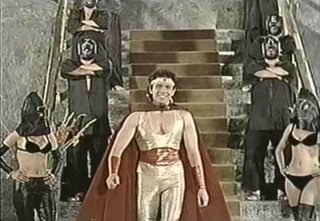 With he training method focused as much on mental as physical development, he was sought out as an expert in his field… both as a physical trainer and as a motivational speaker. With his quasi-guru persona, he attracted clients ranging from schools to rehabilitation clinics to the Mexican army… and the secret police: a conservative nationalist, he was dismayed by the student movements of the 1960s, which seemed a rejection of his own campaign for a physically and mentally disciplined Mexico. East European police and military officials looked favorably on Mexico’s crack-down on dissent, and began to express an interest in Zovek’s techniques, making him… briefly… international recognition.
Alas, his self-created image killed him. René Cardona Sr., a master of schlock films, the brains behind such movies as “Night of the Bloody Apes” and “Batwoman” (not Mrs. Batman… not by a long shot!) convinced the eccentric, but quite serious, Chapa del Bosque to star in a film based on his stage character in 1972. The film was made (The Incredible Profesor Zovek) but the Profesor was only around for half the film. As part of a publicity campaign for Cardona’s studio, the “Mexican Houdini” agreed to appear at a supermarket opening. He was supposed to make his entrance, sliding down a rope from a helicopter, but the pilot — believing Profesor Zovek had made it to the ground, and feeling the wind start to pick up, climbed rapidly, and dropped the body-building mystic before the horrified crowd. His death, (10 March1972) was the lead story on the television news (the broke into normal broadcasts to report it) and the lede in several dailies. And then… other than his occasional appearance in memoirs and fiction about the era (portrayed by Luche Libre perfomer “Latin Lover” in the recent film “Roma”, and mentioned in Paco Ignacio Taibo II’s mystery novel “No Happy Ending”) largely forgotten.
Sources:
Shock Cinema Magazine, “The Incredible Professor Zovek”
Mario Villanueva, “ZOVEK el ultimo escapista “, Jornada, 13 March 1998
Alfonso Cuarón (writer and director) Roma. Esperanto Filmoj, et. al 2018
Taibo II, Paco Ignacio. No Happy Ending. Poisoned Pen Press, 1981, 2003.
Opposition hopes crash?
Puebla Governor Martha Erika Alonso and her husband, and immediate predecessor in that office, Rafael Moreno Valle were killed Monday afternoon about 4 PM in a helicopter crash in Huetjotzingo. Within hours, conspiracy theories have started circulating, and President Andres Manuel López Obrador was announcing that there would be a full federal investigation of the incident.
It’s much to early to speculate on what the death of two important politicians will mean, though perhaps it might be useful to think of them as the BIll and Hillary of PAN… not the presidential Clintons, but the Clintons of Arkansas: young leaders on their way up, with influence beyond their state party, whose excesses and foibles were already raising questions within their party and elsewhere.
Alonso, 45, had a degree in Graphic Design from the Universidad Iberoamericana and a master’s degree in Public Communication from the University of the Americas in Puebla (UDLAP). Her political career began in 2009 as an active member of the National Action Party, five years after marrying Moreno Valle. As “first lady” she had been honorary president of the state’s DIF (Family Services) and state party secretary.
In January of this year Alonso was designated as a candidate for the governorship of Puebla by PAN and after an election in which she was accused of exceeding spending limits, as well as outright fraud, and fomenting general violence in the state, her narrow victory was challenged by MORENA candidate Miguel Barbosa, who requested that the Federal Electoral Tribunal (TEPJF, for its initials in Spanish) annul the election.
Barbosa along with several other opponents to Alonso charged that 80% of polling sites were compromised and 70 electoral packet were stolen on election day.
On December 8 of this year, the TEPJF ratified Alonso’s victory by a four to three vote. She was sworn into office December 14.
Her husband, Rafael Moreno Valle, during his tenure as governor was plagued by controversies including hiding the state’s 24,655 million peso debt, three times what was reported by the Superior Audit of the Federation, and by his introduction of a controversial “Ley de Bala” (Law of the bullet) that would have legalized the police use of lethal weapons against public demonstrations.
With the end of his gubernatorial tenure coming up, he campaigned ceaselessly to be PAN’s presidential candidate in the 2018 election, but was passed over in favor of Ricardo Anaya. As a consolation prize, he was given an proportional seat in the senate for his party, and served as PAN’s senate leader. With the three formerly major parties in disarray (even combined, they are a minority) and all of them split over how to position themselves to regain legitimacy with the voters (or at least come up with a coherent opposition platform) the loss of two up and coming (and possibly presidential candidate material) leaders is going to complicate any opposition plans… or, on the other hand, removing rivals within PAN for other ambitious politicians. One of the more surprising conspiracy theories is that ex-President Felipe Calderón ordered a “hit” on the pair, to clear the way for his wife, Margarita Zavala, to return to the party and for his faction to take control. Others naturally blame AMLO (usually those who blame AMLO for everything), or narcotics dealers. Me… I think helicopters are inherently unsafe.
Return to normalcy? AMLO and the crises of the day
Ever since AMLO was sworn in, the “mainstream media” has been fretting over Mexico’s “left-turn”, when it seems less a turn to the left, than a REturn to traditional governance. Never a military power, nor enough of an economic heavyweight to control affairs outside its borders, and always mindful of the economic and military power sitting just to the North, nevertheless, Mexico has played an important role in both regional and international affairs… mostly by sitting on the sidelines.
Despite what is sometimes still published as “fact” there is no evidence that Mexico had any intention of intervening in the First World War, for or against any side. It was it’s strict neutrality that led British and US sources to claim it leaned towards Germany, and gave the “Zimmerman Note” it’s seeming importance. The truth is, no one in the Mexican government ever took it seriously (it’s doubtful Carranza ever read the note) and Zimmerman himself admitted it was simply meant to confuse the Allies, and to block the United States from entering that bloodbath.
The first country in the Americas to recognize the Soviet Union (in 1924, when Alexandra Kollontai — the first woman to ever serve as an Ambassador arrived in Mexico City) despite US and British objections, and has maintained good relations with nations which are violently antagonistic to Mexican domestic policy or it’s more powerful neighbors and supposed allies throughout it’s post-Revolutionary history. The only exceptions would be the Spanish Civil War, when Mexico openly sided with the Republic, and when it later broke relations with Nazi Germany and Fascist Italy shortly before U-Boat attacks on Mexican shipping led to a declaration of war.

Traditional foreign policy. Emperor Haile Selasie may have been an absolute monarch of a dirt poor nation of no importance to Mexico, but Mexico was the only nation to stick up for Ethiopia against Italy in the League of Nations back in 1932. El Universal photo of the Emperor’s 1954 visit to Mexico.
Those exceptions, however, were in the same spirit of neutrality as were other policy decisions like opening relations with the Soviets, and, more recently (and better known), Mexico’s refusal to back the US blockade and subsequent embargo against Cuba. Mexico’s support for the Spanish Republic and its stand against the 1930s-40´s Axis nations was based on the simple precept that nations could run their own affairs without interference, and the Spanish Republic was under threat by Britain, the United States, and France… as well as Germany and Italy. Mexico led the futile efforts against the latter two to counter their aggressive actions towards other nations… Ethiopia and Austria… cobbling together what would, under the United Nations, become the “non-aligned movement”. The country enjoyed particularly close relations with India, and with Yugoslavia (which during the “Cold War” was a sort of inverse Mexico… geographically part of the Eastern Bloc, where Mexico was Western, somewhat limiting their ability to carve out an independent policy, but enough in sync with their bloc’s economic assumptions to keep the major powers from overt intervention).

Also from the 50s… Cuban dissidents in Mexico, including young Fidel Castro.
If nothing else, Mexico has always had an “open door” to political and other asylum seekers. They couldn’t change the governments of South America during the 1990s, any more than they could stop Nazi aggression against Austria, and the rest of Europe. But they could provide a haven, as they still do, not just to Central Americas displaced by years of US economic dominance and climate change, but to Congolese displaced by that country’s own internal issues (nothing to do with Mexico) even when those seeking asylum may not be amiable to Mexico’s historically leftist internal policies (like Cuban and Venezuelan dissidents).
Up until the turn to a “neo-liberal” government under Carlos Salinas… and ever increasing U.S. dominance of the economy — and, more importantly, the security and political structures needed to support that economy — Mexico’s foreign policy has become more and more an extension of U.S. policy. As evidenced by the supposedly “liberal” Tom Boggioni in RawStory a few weeks back.
Boggiono wrote that “US and Mexico military commanders are keeping the border calm by ignoring Donald Trump”. According to the story, there are reports that the U.S. Secretary of Defense… one of the so-called “adults in the room” in the Trump Administration, could be replaced by someone more likely to take Trumps’s tweets, rambling statements and bombast more seriously than Secretary Mattis is said to do. What is said is that Mattis just brushes the worst anti-Mexico statements aside, in the name of U.S. military cooperation with their Mexican counterparts. The assumption being, of course, that the Mexicans would follow the U.S. lead on military matters. as a matter of course.

A more recent change… armed US agents openly operating in Mexico 2014.
Laura Carlsen, on the 4 December 2018 (four days into what the new government calls the Fourth Transformation) Telesur-English program “Interview From Mexico” delved into the more important question of how the Mexican military ended up in a position where the assumption is that it “MUST” follow a U.S. lead, with Ted Lewis (Human Rights Director for Global Exchange). The half-hour exchange is posted here.
It appears Mexico’s “Transformational” administration will continue to rely on the military (as promoted by the United States) in domestic security, and the (unfortunately) traditionally authoritarian model of crime control will continue (although more lip service and hopefully action will be focused on human rights). HOWEVER, as Carlos Heras argues in Jacobin (“Capital Versus Peace in Mexico” 17 December 2018) organized crime in Mexico largely functions as a “service provider” for outside business interests… and changes in which criminals are pursued is likely to be less determined by outside interests and pressure, than by “neutrality”… that is, crimes like narcotics smuggling to the United States is more THEIR problem than Mexico’s whereas oil theft is Mexico’s problem and more likely to merit a military solution. That is, in the most widely reported Mexican “influence” on other nations (transshipping cocaine and opiate production) the government is taking a more neutral stand… looking out for its own interests and accepting that other nations have their own issues to deal with.
And a final sign. The United States administration has stepped up its provocations against Venezuela. Under the previous two administrations (both PAN’s Felipe Calderón Presidency, and that of PRI’s Enrique Peña Nieto), Mexican diplomacy openly opposed the Venezuelan government, the AMLO government, from the moment it took possession, has signaled its desire for normal (non-interfering) relations with that country… and may again be in the position it found itself in the 1930s: opposing the bullies, but offering to act as the honest broker and a haven in an unsafe world, This clip, from “Russian Bombers Landing in Venezuela: A Reaction to US Threats” broadcast by Real News Network (14 December 2018), nicely argues that there what seems “radical” in this one policy is nothing of the sort, but a return to normalcy.
Damned if you do, damned if you don’t
David Adler (Jacobin) on foreign media “pundit” and their reading of AMLO:
… the commentariat shows its cards. Their key concern is not the will of the people, but the will of the markets. When the Wall Street Journal warned of a “strain on the rule of law,” they were not referring to slaughtered students, disappeared women, or rampant corruption at all levels of Mexican government. They were worried primarily about property rights.
The Media Votes Against AMLO, December 2018
To beer, or not to beer.. that is the question
… Constellation Brands would prefer no one was asked about.
The US-owned beer conglomerate Constellation Brands brews Mexican labeled beer (Corona, Modelo, Pacifico, VIctoria and a couple “artesanal” brands) not for the Mexican market, but for export to the United States.
Given the huge U.S. market for Mexican beers, a new brewery is the kind of “development project” any small town city government would would fall all over themselves to bring into their community, usually offering “incentives” in the way of tax breaks and infrastructure development to pave the way for those “job creators”: Although… in Mexicali, Baja California, it seems, the citizens aren’t quite buying the usual arguments for “development”.
Given that it takes about thirty to forty liters of water to produce a gallon of beer and Mexicali is desperately short of water (it is, after all, in the desert), even in the best of times … and also has a sizeable agricultural industry, a brewery not really serving the community, but the interests of a foreign company, might not be in the citizen’s best interests.
Constellation Brands’ CEO, Daniel Baima, says he “understands” the concern, but his company cannot, and will not participate in a referendum (ordered by the state’s Electoral Institute (citizens can petition, and in Mexicali, did petition for a referendum… or rather a “consulta”… which is non-binding on the legislature or executive, but does reflect the sense of the electorate) on whether or not the company can build in their community.
For Balma, and for the Mexicali Economic Development Council, it’s awfully cheeky of those citizens to question the wisdom of their betters, and they are trying to prevent the consulta from going through. Democracy in the economy: heresy!
Eje Central: Cervecera no quiere consulta sobre planta en Mexicali (16 December 2018)
Constellation Brands: Cervezas
Thou shalt take a salary cut…
It’s a little hard for me to wrap my head around a new government which absolutely worships Benito Juarez… the “patron saint” of the separation of Church and State with a president whose inauguration held what might be construed as a religious ritual (the indigenous cleansing ceremony), but let brancthat pass. What is really a transformation is the Archbishop of Mexico City, Cardinal Aguiar Retes not just coming out in favor of AMLO’s programs, but actively urging hold-outs to the salary reduction plan to rethink their positions… for the good of the country, and their soul.
 While there are legal arguments to be made for defending the judiary’s rights to set their own compensation packages… based on various factors… when a Supreme Court justice receives a salary and benefits packing over five times that of the President, there is at least a perception of judges unjustly looking out for the good of themselves, not the good of all.
Incidentally, the Secretary of Public Finance also suggested yesterday that private business executives also could scale back their compensation packages, though her rationale is that otherwise, public sector executives will jump to the private sector.
But, as sayeth His Eminence… it’s a moral and ethical issue. By the way, his salary is about 900 US$ a month (the highest paid cleric in the country), but that doesn’t include benefits.
SinEmbargo, Once Noticas.
5774 federal employees can’t be wrong… or can they?
What price justice? For 5774 federal employees, mostly judges and magistrates, the cuts to salaries and benefits for government employees comes down to… depending on who you listen to… either feathering their own nests, or a high-spirited defense of judicial independence. The 5774 amparos (injunctions) filed against the federal government’s attempts to cut salaries in the judiciary have led to the Supreme Court, this week, abrogating any cuts in judicial salaries, at least for right now.
As a constitutional matter, no federal officer can receive a higher salary than the President… who cut his own salary by 60%. On the other hand, the Constitution also prevents judges from having their salaries cut during their tenure in office… a reasonable enough measure meant to protect the judges from being punished financially for decisions that might go against the wishes of the Executive branch.
But, it’s the Legislative branch that controls the budget… giving the whole country a classic civics lesson.
MORENA controls the legislature and the executive… both elected by a substantial margin over all the opposition parties. The latter are left claiming they’re fighting for the independent judiciary, something at least the two former main parties (PRI and PAN) were quite willing to subvert when they were in the majority (everyone forgets President Zedillo simply fired the entire Supreme Court when it became an impediment to his own programs). But, given that some justices, and not just the Supremes earn, on top of their salaries, bonus and benefits coming out to over 500,000 pesos a month, when the president’s salary tops out at a bit over 100,000 and the retired Supreme Court justice, Olga Sanchez Cordero gets almost twice that amount as pension payment (to her credit, she is donating her income as Interior Minister to a group home in Queretaro State), it is a hill I doubt the opposition parties are willing to die on.
And even the judges are starting to come around… realizing how greedy this makes them look in a country where half the people earn less that 4000 pesos a month. And, where one of their own had the temerity to post Instagram and Facebook photos of his flashy cars, Rolexes and the fine imported cigars which he favors.
My guess… the constitutional issue, what with MORENA also controlling a majority of state legislatures will be resolved fairly quickly, and while sitting justices might still be entitled to their high income sinecures, going forward, judges will still not have their incomes cut during their tenure, but that income will be more reasonable. Which is something the Supreme Court (for their own members) agreed to today… although only as a matter of policy, not of law.
I spy… an accounting error
It’s like something I’d expect in a John Le Carre novel. While the details are not forthcoming, the Mexican media reported yesterday on one victim of the new austerity push… what appears to have been an off-the-books spy operation here in Mexico City.
 As part of the promised crack-down on fraud, some local accounts receivable clerk in the Mexico City government noticed rental payments for a house in the city without any indication of what the rental was for. Checking further, the accountants found invoices (facturas) for the house rent from “Sterling Investments”. A quick check of vendors to the government didn’t show any company by that name, nor does “Sterling Investments” appear to have any papers of incorporation, a website, or … well, any presence beyond facturas for this one rental.
So… the Public Minister sent someone down to check out the rental house. Which had been hastily abandoned, leaving behind about 50 computer stations, and various electronic eavesdropping equipment. What’s up with that?
All anyone is saying for now is that yes, people were being spied upon (and have been notified that they were under surveillance) but by whom, and for what purpose, still has not been disclosed. Best guess is that this was that the previous administration was tracking potential political opponents, though whether this was just politicians, or “social activists” and journalists … or maybe, it was on behalf of the developers who wanted to track opponents to the mega-projects that have proven so problematic over the last administration… or… well, who knows?
Attn: spies. Pay more attention to the paperwork next time. Even George Smiley had to turn in his receipts.


 mexfiles.net