Chihuahua, Durango, Zacatecas elections…
Nope, I don’t have up to the minute results from the municipal elections in the three northern states. I’ve been trying to load the preliminary results from Chihuahua, but there seems to be a problem… as there have been with the ballot boxes. The Governor is saying there aren’t any problems… which means that there are problems. I expect a PAN sweep (though also expect evidence of PAN cheating to emerge), but PRI might do better than expected. Early results (2 to 6% of ballots counted) from the U. of Chihuahua site show PRI taking about 20 or the 22 districts and municipalities.
In Zacatecas, PAN is complaining that the PRD photographing one of their candidates buying votes was a dirty trick I’m expecting PRD to continue to hold the state, despite a nasty internal fight . There have been some reports of election day violence in Fresnillos (where the PT is winning, according to the SREP count) and I haven’t a clue what’s going on right now (10 P.M., local time): it looks as if PRI, PRD and PAN are about evenly split, with PT (nationally a PRD ally) holding the balance of the 23 districts.
In Durango, Archbishop Héctor González Martínez told the faithful that it was a mortal sin not to vote. 48% of the state is expected to put their souls in peril. It appears the PRI (and the PRI-Green alliance) will win about 70% of municipal and deputy elections.
Updates when I find out anything.
In Chihuahua El Heraldo is reporting an abstention rate of up to 65%, which they blame on dissatisfaction with the Federal Government and rejection of the military “war” on drugs. PREP results show PRI taking about 2/3rds of municipal elections and seats in the state legislature. PRD may have carried two or three municipalities, and maybe a sindico or two (a word I’ve never come up with a good translation for… community financial officer — not every state has them) and but wasn’t expected to do even that well.
In Durango, the PRI-PRI coaltion is carrying just about everything (though the winners are the mortal sinners… turnout being about 50% — the conventional wisdom is that the faithful vote PAN, so this could indicate a rejection of the Calderón administration). The PRD didn’t carry anything.
Zacatecas is still confusing… PRD is ahead in both municipal and delegation elections… but there is that weird Fresnillo district.
From what I can tell, there was — or wasn’t (the reports are conflicting) — an attempt to take the PT candidate hostage, which is all the more interesting, since he is the brother of former PRD leader Arturio Montiel. Most of the PREP count is completed, or nearly completed, except for this one district. Something weird is going on… but then, it’s a Mexican election, so something is always weird.
I’m still not sure what it all means, but it It looks like PAN didn’t do as well as one would expect, and PRI is still a power at least at the state level. El Heraldo may be right, that this is a rejection of Calderón’s heavy-handed approach to social problems.
For what it’s worth, the PRI fell to the third party in the 2006 National elections, and informally have allied with PAN in the Federal Congress. Where the two are competitive, PRI is more or less the “left” or center-left. Whether these three states follow the lead of Coahuila, where PRI has become the “progressive” party, I don’t know.
But, if anything is clear it’s that the reports of the demise of the PRI were extremely premature.
PAN is probably still the largest party (in Durango and Chihuahua, PRI ran a fusion ticket with Nuevo Aliaza, though PRI also ran single party candidates in most districts; PRD ran fusion tickets with Convergencia in Zacatecas and Chihuahua), but was the biggest “loser”… David, in his comment below, notes that Jerez, Zacatecas switched from PAN to PRD… boy did it ever move left. Even the Maoist PT beat the crap out of them:
 Municipal results: Jerez
 State Assembly results
It’s a cliche of course, but there are no unmixed blessings. This is one of those things where there isn’t any one right answer… everybody SHOULD see Chichén Itzá, but if everybody does, then… what happens?
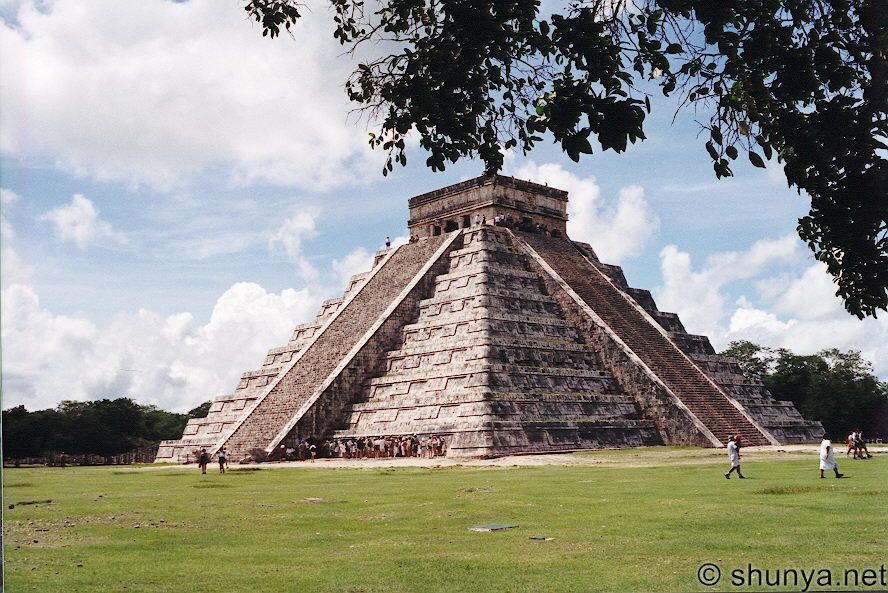
My translation is from an unattributed article in Saturday’s El Universal, “Chichén Itzá y sus pesadillas“:
Fame is nothing new for Chichén Itzá. Since the 9th century AD, when it was the political and religious center of the Itzáes until today, it has been astonishing visitors from the Spanish soldiers commanded by Franscico de Montejo to today’s hordes of national and foreign tourists.
A few days ago, the most emblematic building, the Pyramid of Kukulcán (also known as “El Castillo”) became – as the result of a market research campaign – on of the new the seven wonders of the world. The new found dreams of glory for Chichén is not free from its headaches.
Excessive and uncontrolled tourism, damage to existing structures, souvenir vendors, new infrastructure, conflict with local landowners, research at the mercy of budgetary whimsy, and growing economic inequality are the seven headaches suffered by the newest of the seven wonders, which was declared part of UNESCO’s Patrimony of Humanity in 1988.
1. Mass tourism
The first alarms about the dangers of mass tourism in the archaeological zone of Chichén Itzá were raised by archeologists Peter J. S. Schmidt and Agustín Rock, at the beginning of 1990s. Presently, Chichén Itzá receives over a million visitors a year, making it the second most visited archaeological zone in the country, after Teotihuacán.
By including Chichén Itzá as one of the “seven wonders”, the tourism sector, having already invested a million dollars in promoting the site, hopes to double the number of visitors, which implies extending the infrastructure needed to handle the visitors.
“This will bring a huge number of visitors,” Federica Sodi, of the INAH Yucatan affirms . “The plans call for handling the tourists in a controlled form, but the place is not designed to lodge huge amounts of visitors.”
Until about 18 months ago, tourists could do a quick visit to the site, which included a chance to climb well-known structures like El Castillo and to be photographed seated on the sculpture of Chac Mool.
Damage to the building, not designed for continual visits, forces the INAH authorities to prevent access, just as the New Seven Wonders advertising was coming out on the Web, prominently featuring the pyramid during an event.
“All archeological sites in the world are at risk,” complained zone archeologist Peter J.S. Schmidt. “Nothing is forever. It’s too bad we can’t cover El Castillo, as a preventative measure.”
Sodi however, says that “the structures seem very resistant; nevertheless, a restorer friend of mine says that the stone may seem strong, but is, in fact, delicate. We had to avoid damage, and closed the structures.”
3. Vendors
The corridor from the esplanade of El Castillo to the cenotes is a tiangui selling food, crafts and clothing. And, within the zone itself, there are hundreds of salesmen.
Sodi estimates 500; there are some who swear that the number is in the thousands during the high season at at the Spring Equinox. The first big wave dates from 1987 and was somewhat under control. partially was controlled. In 1994, archaeologist Alfredo Barrera Rubio complained that most sales people were not locals, but “non-craftsmen and middlemen” selling products from Puebla, Michoacán and other places, and not from the Yucatan.
Sodi and colleague Tomás Pérez agree that the ambulantaje is a phenomenon created by local people without employment. The solution lies with the INAH, the Secretariats of Tourism and Commerce, as well as the State government.
4. Economic inequality
To designate the Pyramid of Chichén Itzá as a wonder of the modern world required matching funds from a special tourism tax. The hopes of the tourism sector were reflected by Francisco Lopez Mena, president of the Council of Tourist Promotion of Mexico, when he spoke of promoting the zone as a “business” which has required an investment of more than a million dollars. ith respect to which the promotion of the zone has been a “business” in which it has been reversed more of a million dollars.
Also promoting the region is the Presidency of the Republic. Expecting to double the number of visitors within five years, the major beneficiaries are private investors and the INAH, but not the local population. In archeologist Tomás Pérez’ estimation, “Tthe benefit is going to be minimal for the local population, and maximum for the big businesses in Cancún.”
5. Infrastructure deveopment
The tourist infrastructure around and within the zone has grown over the years. In 1982, a first tourist inn was constructed. Five years later another complex was built that included a museum. Already in 1995, researcher Lourdes Guadalupe Rejón Pattern filed legal complaints based on the 1972 Federal Law of Monuments and Archaeological, Artistic and Historical Zones, which restricted development in the zone. She complained that “Powerful companies and foreign capital have achieved concessions to use zones supposedly restricted or central areas”.
In addition to construction within the zone, a freeway tying Mérida with Chichén Itzá and Cancún, was finished in 1993 to handle tourist traffic, as were additional Cancún and Cozumel. Tomás Perez indicates that the town of Tipé is growing every day and threatens to intrude on the perimeter zone.
6. Land ownership
Part of the land in the Chichén Itzá archaeological zone of is pirvately owned, specifically by the Barbachano family, owners of the Mayaland company, one of whose hotels is practically located in the zone.
“One of the priorities is to regularize the land ownership. It’s pure common sense to protect the development in the perimeter zone,” Soldi says.
Sodi adds, though, that he has no problem with the Barbachano family, “The Institute, by law has to defend the cultural patrimony. The only interference has been insitutional, the protection of personal patrimony. He adds that the INAH is negotiating with the family to acquire the land, either through donation or by expropriation.
7. Research funding
In spite of its world-wide fame, the archaeological zone of Chichén Itzá keeps its secrets, partly because of the slow progress made by researchers since 1993. At the low season, at least four archaeologists toil in the zone, according to project leader, archaeologist Eduardo Perez. In 1993, the federal government promised 4,800 million pesos for archaeological investigation in Chichén Itzá.
The 1993 plans called for three seasons of work, to open buildings to the public, restore wood murals, stuccos and other parts in the zone, as well as to open and restore buildings that are peripheral to the main ceremonial center.
Funding has not been delivered, although Sodi says that excavations have not stopped, and resources are still available. Presently, five excavation projects are underway in the zone. 47 hectares are open to the public, and one project at this time is focused on maintaining and conserving buildings, paintings and roadways.
Schmidt, who first sounded the alarm about over-use of the site, works on less well-known areas like old Chichén, which should in the future allow visitors a glimpse of the lives led by the city’s nobility.
Marisa Treviño, at Latinalista has nicely summarized the situation here along the Rio Grande/Bravo del Norte.
Homeland Security is going on with its plan to construct a double-row steel fence through the city of Laredo, Texas and over 153 miles along the Texas-Mexico border.
According to Homeland Security, and Congress, the American people want this barrier between Mexico and US. But it’s the American people in Wisconsin, Michigan, New Hampshire, etc. that think such a fence is good.
The majority of American people who actually live along this border think it’s a bad, bad idea.
Not just because Michael Chertoff, Homeland Security Secretary, promised to keep border residents in the loop as to when and where the fence would be built – he didn’t — but because such a fence would harm the special relationships that border communities have with one another.
The full post (and links) are here.
Folks outside the region get some weird idea that it’s only the Mexican-Americans who think this is nuts. No… it’s the Chambers of Commerce, the environmentalists, the health care folks, the schools, the ranchers and farmers, our elected officials …
This cuts access to our water, to our business customers, destroys the tourism industry and … unless Homeland Security is planning on buying all of us health insurance, it cuts us off from our local doctors and pharmacists.
That went well… NOT!
Manuel Roig-Franzia writes in the Washington Post (buried on page A-18):
…
In an editorial published Friday, the Mexico City newspaper El Universal said it is “highly hypocritical that the United States admits migrants as peasants, but does not accept them as citizens. A state that sends troops to the Middle East to try to implant democracy and respect for human rights does not practice such supreme values in its own territory.”
But the paper also ascribed blame to Mexico, saying the country is itself guilty of hypocrisy for not creating enough employment to entice Mexicans to stay at home.
…
Reaction to the immigration bill’s failure might have been even more intense if not for concerns here that it put too heavy an emphasis on border security and involved overly complex provisions on granting citizenship to undocumented migrants, said Dan Lund, a Mexico City pollster.
Despite some heated comments from Mexican leaders, it appears the Calderón administration has adopted the philosophy that “no bill is better than a bad bill,” Lund said in an interview.
“Life goes on,” Lund said. “Here this is a hothouse issue for a few in the media and policy wonks, but everyone else will do what they have to do to get across the border.”
…
In Guatemala, the newspaper Prensa Libre described the Senate vote as “deplorable” in an editorial headlined “12 Million Victims.” The vote, the paper said, showed that the United States is “a country hostile toward immigrants.”
Prensa Libre predicted that the decision would hurt the economies of the United States and Guatemala by restricting the flow of people between the countries. But, the paper noted, there could be a subtler, even more damaging effect.
“Little by little, the number of people who lose their appreciation of [the United States] will grow,” the paper said. “With what happened yesterday, everyone loses, sooner rather than later, and there are fewer possibilities of healing that wound.”
Of course it was buried… the only thing that matters in the U.S. is how it plays as domestic politics. Who really cares what happens to those of us who live on the border, our civil rights, or the people who immigrate here?
250 more megawatts is how many barrels of oil?
Mexico continues to drill new oil wells, but everyone knows the amount of oil available is going to decline. The country can’t go looking for new fields in… oh… Iraq for example, but there are alternatives:
Sempra Energy, owner of the largest U.S. natural-gas utility, said it agreed to buy the development rights to a wind-power facility in Mexico as part of a venture into renewable energy.
Sempra said it agreed to acquire the rights to develop a 250-megawatt wind-power project near La Rumorosa, a town in Baja California about 70 miles east of San Diego, where Sempra is based. It is buying the rights from Cannon Power Corp. One megawatt is enough to power about 750 average U.S. homes.
My electric bill went up (again!) and Texas has been talking about coal powered plants when the Big Bend is probably the best place in the United States for solar power (high altitude, low cloud cover), only slightly less promising that Zacatecas or Chihuahua.
De plane! De plane! …Ooops!
Right-wing Houston radio talk-show gabber Edd Hendee has been manufacturing positive spin for his Eyes on the Border project (which, as far as I can tell exists to seize assets from “drug dealers” and split the proceeds with the local Sheriff’s Department). As far as I can tell, it’s a couple of geezers with planes flying around the Big Bend looking for “terrorists”.
 Bill Brooks at the Marfa Sector Border Patrol office and a local rancher sure appreciate the help, I guess:
Marfa Border Patrol Sector spokesman Bill Brooks said he knew of two incidents when agents worked with Eyes on the Border.
One time, observers in the plane reported a vehicle that turned out to be a Border Patrol agent on duty.
The other time, Brooks said, the observers reported a vehicle being loaded with suspected undocumented immigrants.
“It was an RV full of Boy Scouts, and they had stopped along the road for a potty break,” he said.
Brooks said the officers appreciate the extra eyes, though.
At least one person has not been as pleased with the aerial operations. George Fore runs a wildlife ranch outside Sierra Blanca that has a large airstrip.
He asked the sheriffs to ask his permission before using the runway. They didn’t always want to do that, he said. Then, in April, a pilot ran the aircraft off the runway, through the fence and into a field.
No one got hurt, and … the sheriffs paid to fix the fence. The airplane was beat up and is in the shop, but the group has leased another one to continue watching the border.
But that was the last time Eyes on the Border used the Sierra Blanca airstrip.
“Next time I catch somebody out here, I own ’em,” Fore said.

¡Arriba, arriba… andale, andale!
I don’t need to defend Speedy Gonzales. LULAC, Mexico’s foreign ministry and Subcomandante Marcos have all spoken on behalf of el raton rapido. (And Speedy is much better cartoon character and role model that the than that other Gonzales (Alberto). You’ll see Speedy’s iconic image all over the Mexican republic.
The little guy has a lot of positive qualities. He’s resourceful, cheerful, laughs at danger, a real caballero (he’s always polite to the mousaritas) and willing to defend even his dim-witted relations like Slowpoke Rodriguez. O.K., he lives in a sort of run-down place (but, then where else do mice hang out?) and his English isn’t the best (but, hey, he’s a lot more bilingual than Sylvester will ever be) and eminently quotable. During the Friday night traffic jams in Mexico City, the police bullhorns announce to commuters: ¡Arriba, arriba… andale, andale!
Why this short was (and still is) “banned” from U.S. is a mystery. Maybe because Speedy subverts Gringo hegonomy (and political intrigue) though seemingly giving the gringo exactly what he asks for… or maybe because “Gonzales Tamale” was filmed the same year “A Touch of Evil”, and el raton rapido doesn’t go all Chuck Heston about marijuana?
Agreed
This is something I’ve tried to get across for some time. Using the military to control crime was a short-term — and possibly counterproductive — strategy. Reforming the police (as has been done with some success in Mexico City and even Nezahuacoatl) is a slow process, and changing citizen attitudes will take even longer… but is doable.
The Associated Press
Published: June 28, 2007
MEXICO CITY: Mexico announced it would overhaul training of all state and federal police chiefs Thursday as the government seeks international help to fight organized crime.
Authorities recently removed the nation’s top federal police officers and are forcing them to prove they will not be corrupted by organized crime.
Now, more than 1,000 high-ranking state and federal officers will be required to complete a yearlong course in crisis control, law enforcement techniques and the English language — as Mexico aims to work closely with U.S. and European police — said Genaro Garcia Luna, secretary of public safety.
The courses begin Aug. 13 and will be taught partly by experts from the United States, Canada, Germany, France and Spain.
“For the first time in the history of (Mexico’s) police, all new chiefs … will be selected and trained using a uniform criteria that meets international standards,” Garcia Luna said.
“Putting the best police Mexico has” in the top posts is the only way to succeed at combating organized crime, he said.
It’s no secret that police work is often shoddy in Mexico. I’ve been writing on police reforms since 2004 (Marcelo Ebrard made his political bones as Mexico City’s Police Chief, an unusual job for a social services administrator), including the still amazingly successful effort to reform from the bottom up . I had to admit the police were improving during my time in Mexico City, but it was a slow process.
I still say that using the military was always a mistake — politically and just as a matter of crime prevention.
The police are aware of their own problems (policemen have gone on strike for honest leadership and an end to politicization of their forces) — and can solve even the serious crimes if they have the leadership and training. Which… maybe… they’ll finally get.
Art news…
Some Mexican media outlets, afraid of retaliation from drug lords, have shied away from reporting on the brutality ravaging the country.
The void has been filled by an unlikely source — an artist.
Using a bundle of tattered blankets as her canvas, Rosa Maria Robles splattered it with red paint — a gruesome representation of the bloody shrouds that encase victims of the drug wars in Mexico.
The exhibit, titled “Red Carpet,” is on display at a museum in Sinaloa, the northern state plagued by gangland murders.
The artist included what she claimed were blankets from actual crimes, although she refused to say where she got them, Reuters reported.
The display is no substitute for solid reporting by the media, but it represents a grim reminder of the violence in Mexico — and the critical need for the government to address it.
Supremes 2, Governors 0
Everyone knows that Ulises Ruiz of Oaxaca is a scumbag, but outside of Mexico, you don’t hear much about Puebla’s Mario Marín Torres. Marín, a buddy of convicted pedophile Jean Succar Kuri, was mentioned by writer Lydia Cacho as one of Succar’s protectors in her blockbuster Los demonios del Edén .
On Marín’s orders, Cacho was arrested in Cancún for slander, a criminal offense. She was kidnapped off the street, driven to Puebla and tossed in the slammer, where she was raped.
In a huge victory for the press, Congress has changed the criminal code, making slander a civil matter. The Governor couldn’t hold Cacho for a criminal trial, and he wasn’t going to win in civil court. Cacho then sued the governor for violating her civil rights.
As with Ulises Ruiz, there is movement in Congress to impeach Marín, but as with Ruiz, PRI needs to protect its own, and PAN is deathly afraid of losing the majority they only enjoy with PRI-support. The FAP (PRD-Convergencia-PT-independent coalition) is the main opposition, but can’t peel off enough PAN or PRI or Green delegates to push through the measure.
PAN’s previous attempts to impeach Lopez Obradór a few years back for very minor technical violations (not filling out the right paperwork during the expropriation of a small property for a hospital access road) make it more problematic for the “de facto President’s party” to justify NOT impeaching the two governors, but so far they’re standing firm.
Into the breach has stepped the Supreme Court. Ruiz is the easy case, since another court (the Human Rights Commission) has already ruled in the matter, and the Supremes are merely upholding a lower court decision. In Marín’s case, they are breaking new ground. As of today, they haven’t made a ruling, still considering what the ground rules are for an investigation of abuse of authority are.
In the long run, the Marín case is the more historic one. Just hearing a citizen’s complaint against a sitting governor is unprecedented. As Hector Tobar wrote in last Friday’s (subscription required) Los Angeles Times, the Mexican Supreme Court is suddenly becoming a major force in the country’s governance:
MEXICO CITY — In a series of dramatic televised hearings over the last month, 11 men and women in black robes have given the Mexican people something they are unaccustomed to seeing — an activist Supreme Court.
Key rulings by the court have produced a subtle but important shift in Mexico’s political landscape. The court has reined in one of the nation’s most powerful business interests and is moving against two rogue governors.
… Several times this month, the chambers have been filled with a noise rarely heard since the modern court’s creation in 1917: the sound of applause.
On Thursday, the court agreed to create a committee to investigate the political violence and disorder in the southern state of Oaxaca, ruled by the almost universally reviled Gov. Ulises Ruiz.
On Monday, it’s scheduled to begin considering whether it should form a similar panel to investigate Puebla Gov. Mario Marin, absolved by lower courts of abuse-of-power charges in the case of an investigative journalist arrested in his state.
“Oaxaca may no longer be in flames, but it still burns internally,” Justice Genaro Gongora Pimentel said from the bench as the court discussed the chaos that enveloped the state capital last year, in which 20 people were killed. “Oaxacan society is waiting for justice…. Our intervention is necessary.”
Analysts say the court is acting because President Felipe Calderon and a divided Congress have failed to move against entrenched interests and corrupt local leaders. Though most of its members were appointed by Mexico’s previous two presidents, and all were confirmed by Congress, public outrage has forced the court to act, analysts say.
“The court is stepping up to the plate to fill a worrisome void,” said John Ackerman, a law professor at the National Autonomous University of Mexico. Ackerman said the court’s recent actions were unprecedented in Mexican history.
…
Several commentators have drawn comparisons in recent days between Mexico’s Supreme Court and the activist U.S. court led by Chief Justice Earl Warren in the 1950s and 1960s, whose landmark decisions transformed American society.
“The court is intervening to ensure that Mexico’s democratic transition isn’t stalled,” said Denise Dresser… “The court has become an instrument of last resort in the face of a political class that won’t change the status quo.”
…
The court this week formally created the panel to investigate the violence in Oaxaca city, set off by Gov. Ruiz’s attempt to quash a teachers strike and demonstrations in support of it. Despite calls for his impeachment, Ruiz has held on to power in large measure because his party, the PRI, controls the state legislature. PRI legislators in the federal Congress have used their influence to prevent Ruiz’s impeachment by that body.
“In Mexico, politicians are used to circling the wagons around corrupt leaders,” Dresser said. In years past, the very worst leaders were simply “persuaded” to leave office by PRI party leaders. Rarely were they subjected to due process because doing so probably would expose the widespread corruption from which most of the political class benefited, she said.
xxx
250,000,000 trees
Who said Mexico isn’t contributing to the United Nations?

The United Nations Environment Programme (UNEP) has launched a major worldwide tree planting campaign. Under the Billion Tree Campaign, people, communities, business and industry, civil society organizations and governments are encouraged to enter tree planting pledges online with the objective of planting at least one billion trees worldwide during 2007.
Mexico’s President, Felipe Calderon, declared that his country would plant 250 million trees in 2007. The Mexican government launched the ProÁrbol (Pro Tree) Campaign which aims to reach one fourth of the goal set by the UNEP campaign.
The Mexican government will invest over six billion pesos in 2007 with funds assigned to support nearly 400,000 inhabitants in ejidos and communities. The Pro-Tree Program will be used to recover areas amd recharge the aquifers. It will focus on four main areas: first, conservation and restoration, second, planning and forest organization, third, production and productivity, and fourth, to produce infrastructure, means of communication, country roads and all the other things required to contribute to forestry.
President Calderón explained that his government had signed an agreement with the United Nations, included in the Millennium Development Goals, pledging to incorporate the principles of sustainable development into national policies and programs and to reduce the loss of environmental resources.
AMLO is back… he never went away
Most of the foreign press thought it was some kind of joke when Andres Manuel Lopez Obradór was sworn in as “legitimate president” of Mexico, forgetting previous losing candidates (assuming AMLO really did lose) have done the same thing: the practice was started by Manuel Clouthier of PAN (Vicente Fox was his Agriculture Secretary), even though PAN clearly and decisively lost in 1988.
The 1988 election held another lesson for AMLO. That year too, a leftist coalition candidate either lost (or had the election stolen, which is more probable, and confirmed by those involved in stealing it). Cardenas backers were likely to rebel, and only systematic changes in the political and social system prevented overt violence. However, PRD (the party that came out of Cardenas’ coalition) members were killed, and there were serious frauds until it was able to make itself part of the political mainstream.
I hadn’t expected much from AMLO’s shadow government beyond a “think tank” (like Clouthier intended) and some legislative action. Cardenas made a tactical mistake by allying with the Zapatistas, who were anti-PRI, but — as traditionalists, have more in common with PAN, and generally work against democratic leftists like PRD. By avoiding the anti-democratic groups, and by focusing on party-building and realistic political change, the out-of-the-spotlight AMLO may surprise us yet again.
I’ll give AMLO this, too. He was locked out of the “mainstream media” for the last year, but he seems to have captured the geek vote… he’s all over the internet… how much “real” support he has is hard to gauge, though I suspect his urban support is much higher than thought, especially outside of the North. Unlike the Zapatistas, he’s not making a foreign appeal, so has been ignored by even the U.S. “progressives.” But, given the undercurrent of dissatisfaction with the Calderón regime, from peasant groups, the poor and organized labor, and not much reported problems in places like Puebla (where the Governor is about to be impeached), there may be more support outside Mexico City than we think.
I somewhat changed the article to fit U.S. style reporting for my translation of Rogelio Hernández López interview with the CND’s Rafael Hernandez Estrada in today’s Milenio.
Less than two weeks from now, we will mark the first anniversary of the Federal Elections. In the Capital, at Monterrey 50, headquarters of the Broad Progressive Front 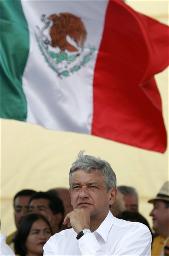 (FAP, for its initials in Spanish), Andrés Manuel Lopez Obrador is presiding at a series of meetings with federal and local legislators, party leaders and civil servants. The “legitimate president” is accompanied by members of his cabinet and leaders of the National Democratic Convention (CND in Spanish), taking in and recording testimonies of electorial fruad, the general health of the movement and “doing everything possible to bring more people to the Zocalo on July 1 than showed up March 25”.
Does it mean anything? Rafael Hernandez Estrada, general coordinator of the CND thinks it does:
“In short, this will prove that the movement is not failing.” He is not in the least disturbed by criticism of the movement, listening between sips of coffee:
The insurgency did not force Felipe Calderón to resign; state coalitions were not organized; the FAP has not coalesced into a formal aliance; State and Municipal CND chapters have not been created; the “legitimate president’s” cabinet has not so much been a people’s government as a leadership forum for the die-hards in the parties; the citizen networks have all but disappeared; and resent polls and elections indicate a disasterous fall from the coalition of July 2. Are the hard-liners the only remaining force? not become nor consolidated the electoral alliance of Progressive the Extended front; state and municipal structures of the CND were not created either; the credencializados ones of the “legitimate government” are not people who outside other people’s to the policy, but in fact are such militant of the allied parties and some others of their hard vote; the citizen networks instead of growing disappeared; the recent surveys and elections indicate a vertiginous fall of the preferences of votes that obtained the 2 of July… They are remaining only with the duros?
Rafael Hernandez is non-plussed. As in the CND meetings, he does not take notes, but considers each question separately.
“Look, in all the internal meetings which I have attended, Andrés Manuel has insisted on a balanced representation – the CND, the FAP, the legitimate cabinet and the PRD. Hernandez Estrada himself is also a leader in the PRD’s New Left faction.
“Andrés concluded this year, after meetings with tens of thousands of people in more than 500 municipalities that the decicision we made last July 2 was correct.
“First, never before in the history of Mexico have so many women and men expressed their desire to change the political system, and mobilized to do so. That is extraordinary.
“Secondly, Andrés Manuel emphasizes that under the circumstance, confirmation of the electorial frauds could lead to of generalized violence and the possibilities of virulent confrontations. The movement would have been at risk if we had succumbed to the temptation, and had to be channeled into other activities.
“Thirdly, as we all know, the way we chose to channel the people’s dissatisfaction was to create a permanent people’s front. The Broad Progressive Front has been consolidated in the legislature, and a growing coalition of unions, farmers and social organizations are contributing to the agenda for legal change. What we have to accept, though, is that we haven’t organized everywhere. It’s very difficult to establish an electorial coalition, as several of the Parties in the Front have found. But, for the most part, there is a common agenda within the Congress. The FAP will be making announcements in August regarding State organizations. That will be extremely important. W
“In fourth place , we have begun to construct a wide base for a Democratic National Convention. Starting September 16, when the civil resistence began, it provides a permanent structure for those who do not recognize Felipe Calderón as President, instead seeing Andrés Manuel as the legitimate president.. We have surveys from the capital and several important cities where 70 percent of people describe Calderón as “illegitimate.”
“Out of the CND, we have been making progress in forming operating committees in all 32 States, and in 800 munipalities.
“Fifth, the legitimate cabinet continues to fulfill it’s minimum expectations: generating public policy and alternative proposals; working with the FAP to coordinate legal strategies. There have been real gains from the close collaboration between the CND, the FAP and the legitimate government. To convert the movement into a national shift to the left, we will continue to function as a shadow government, systematically questioning the legimacy and governability of the de facto regime, and bringing up the proposals such as those Andres Manuel proposed for assisting senior citizens… fighting the sales tax on food and medicine for example. “
Asked how much weight we should still give to AMLO as the leader of the “movement”, and whether the movement won’t shrink to just the die-hards as people accept the electorial results, Hernández responds to the first, “quite a bit. Much,”
“The press has been suggesting that AMLO is imposing decisions on the left. I’d argue that his persistence and vision has been the essential factor in what the movement has accomplished so far. He is the leader. All we know it. And if he were as negative as many write, many already would have gone away. There have been no desertions by those who began this struggle, nor of any of the parties or organizations. We’ll see if it’s just the die-hards after we desseminate the data and testimony about the frauds, and when the people come to the Zocalo on the 31st.


