Legislative reforms


The Distrito Federal (Mexico City) Assembly functioned a little more smoothly this morning. The “Parlimento de los Niños” was sponsored by the District’s Elections Commission and the Assembly. No bribes were reported, no pork-barrel legislation made it though, though some candy is said to have changed hands surrupticiously.
Men in Black
Full article at mexidata.info
Nancy Conroy is the Publisher of northern Baja California’s biweekly Gringo Gazette North. She can be reached via e-mail at <nancy@gringogazettenorth.com.
In San Diego County, California, a firestorm has erupted over plans to build a Blackwater mercenary training camp in the hills behind Potrero, a remote area east of the city. The residents of San Diego are opposing the idea on the grounds that firing ranges are noisy and mercenaries would be undesirable neighbors. So far the controversy has been a localized, “not in my backyard,” type of debate involving planning commissions and citizen’s action groups.
Americans tend to think in an American way, and therefore nobody seems to have noticed that the location of this camp is right on the US-Mexico border, just a few miles from Tecate.
…
Blackwater USA is a private army based in Louisiana that has received billions of dollars in US government contracts to assist with the Iraq war. These “contractors” are highly trained ex-military specialists, many of whom come from foreign countries with poor human rights records.
…
Critics often compare them to the Nazi brownshirts.
A Blackwater camp on the border may be a covert attempt to militarize the border without going through congressional oversight or public debate. .. And Blackwater could run immigrant detention camps using the same methods they use in the Middle East. Even if this is not the plan, the Mexicans would have good reason to suspect this motivation.
The proposed training camp is located near international drug supply routes controlled by the Sinaloa Cartel. The remote, mountainous terrain is like Afghanistan, where Blackwater has years of experience running covert operations.
Six miles from the proposed Blackwater camp, northern Mexico has a serious problem with “Men in Black” who coincidentally look, dress, and act just like the Blackwater people. In Mexico, the Men in Black are kidnappers, corrupt police officers, fake federal agents, or Zetas, a narco-paramilitary group. Although Americans may still be swallowing the argument that Blackwater is a “military auxiliary” outfit, the Mexicans are not fooled about who the Men in Black are, what they do, and who they work for. That these same people are now camped out on the US border, or are somehow involved in border enforcement, will lack credibility in Mexico.
There are surely plenty of possible clients with money in the Baja California area who need special operations. Since Blackwater personnel look just like the Mexican Men in Black, they should have no trouble blending in.
What makes us think the Zetas are NOT connected to Blackwater… or that they are ONLY operating in California? Could they be supplying weapons to Mexican gangsters, or operating with them?
Trash talk…
Reprinted in the Free Republic was this story from Dudley Althaus of the Houston Chronicle:
MEXICO CITY — Mexicans have become world-class litterbugs.
Soft drink bottles, snack wrappers, used diapers and cigarette butts clog city streets, rural highways and scenic beaches. Mountains of garbage stand sentry-like in empty lots and at the edges of bucolic rural villages. Discarded plastic bags hang in trees and dangle from cactus like bitter industrial fruit.
Not every Mexican litters, of course. And perhaps no one does so all the time. But enough of them do, enough of the time, that this nation of 105 million people is choking on its refuse.
Yet, there has been no concerted long-term anti-litter campaign. Only a smattering of Mexican towns and cities have municipal garbage dumps.
For many environmentalists, litter takes a backseat to fouled water, dirty air, coastline overbuilding, widespread deforestation and severe soil erosion. To many citizens, litter is all but invisible. And in the view of some observers, there is a lack of public responsibility.
What’s interesting is that the “Freepi” use this not too remarkable story as a way of attacking Mexican immigrants (and immigrants in general) while the Houstonians wonder why the story was considered newsworthy.
Not that litter isn’t a serious problem in Mexico, but the folks who commented in Houston have traveled, and note that a lot of countries have a litter problem. And, they’re more used to Mexican social customs.
I’m wondering if Mr. Althaus has to deal with his own trash in Mexico City, or whether he has a cha-cha to clean up after him. Mexicans keep their homes spotless, and at least in Mexico City, the trash man comes twice a day (preceded by a guy walking down the street with an old fashioned hand-clapper bell… I always think of him yelling “bring out your dead stuff”). And, at least in my neighborhood, the trash men also came early in the morning to clean up the stuff that piled up on the corner.
Yeah, that was messy. People STILL pile their trash out on the street corner at night and wait for the trash men in the morning. And it attracts rats. I once had the bejeebus scared out of me when I peed on a trash pile late one night and — literally — had a very pissed off rat come out after me.
At least in Mexico City (which is 20% of the population, so you’re talking about a big chunk of the “real Mexico” here) trash is picked up, but there’s no where to put it. The trashmen’s union, which was quite powerful, and popular (people used to cheer the garbage trucks at the Revolution Day parade, and boo — or moon — the police cars) was connected to the PRI, so when the PRD took over the socialists surprisingly semi-privatized trash collection, opening up the field to more haulers… which meant those two daily collections.
Between tips, a good union and the rights to salvage, the garbage men might have lived AT the dump, but they didn’t live in a dump, nor were they down in the dumps. They had decent homes, soccer fields, good schools… and high rates of environmentally-caused diseases.
For a time, Mexico City was trying to get people to sort organic and inorganic trash, but the campaign wasn’t going well… just for the simple reason that the trucks had no way to separate the trash, and the landfills weren’t set up for it. On the other hand, plastics were starting to be recycled, and the more entrepreneural trash collectors were sorting the salable from unsalable trash.
I’ve seen a few positives. Where plastic recycling is available, entrepreneurs spring up to take advantage of it. In Mexico City, the dog poop problem isn’t nearly as bad as it used to be, both through stricter enforcement of “scoop the poop” laws and old fashioned community propaganda (I was amused that my socialist neighborhood had signs reading “For the good of the people, and the health of all, please clean up your animal’s defecations” while those in conservative Polanco said “If your dog shits here, we’ll call the cops”… whatever fits the local style, I guess).
And relative scarcity has meant people save, or reuse, what they have… or find adaptive reuses for things. You can’t go dumpster-diving for good stuff in Mexico City, just because somebody will snag up the good stuff before you get there. If you put a broken sofa on the street, somebody will take it to a reupolstery shop. Old refrigerators are gonna mysteriously make their way into … well… almost anything. The refrigerator repair guys are gonna gut the thing for every usable part, and the miscellaneous scrap is gonna end up somewhere.
It’s out of the cities that your see the trash… uncovered landfills and no one to pick up the stuff.
What’s the problem?
It’s not that people won’t clean up trash, or don’t “get it,” it’s that the problem has grown faster than the solution. Not enough landfill space, not enough money for trash collection and… the number one problem… too much stuff. Plastic bags, plastic bottles (you still return your glass beer and soda bottles to the store), disposable diapers. The same stuff we want, and the same problem we have.
But, we have illegal immigrants to pick it up for us.
At last, a sensible idea about walls…
(James Osborne, McAllen Monitor)
Steve Ahlenius, president of the McAllen Chamber of Commerce, sent out an e-mail to 140 media outlets nationwide Tuesday morning with the subject line: “McAllen, Texas calls for wall around Washington D.C.”
“We feel the need to protect ourselves from bad legislation, bad ideas and a waste of tax money,” Ahlenius wrote.
“A wall around their homes and businesses will give the legislators and Washington bureaucrats a better understanding of what kind of message this action will send.
“Let’s see if they decide to climb over it, tunnel under it, or walk over it.”
…McAllen Mayor Richard Cortez — who had yet to read the e-mail when contacted Tuesday afternoon — dropped high praise on Ahlenius for his efforts.
“I’m glad he’s taking a proactive role in bringing attention to this issue,” the mayor said. “There has not been a proper debate on the issue of the border fence and immigration yet.”
Woof…
Attention Mexican Bounty Hunters…
Dog the Bounty Hunter is coming to Halifax.
Duane Lee Chapman will appear at the Forum at 7:30 p.m. on Aug. 25. An ex-con and born-again Christian and reality TV star, Dog will talk about his life and share highlights of more than 6,000 captures over his 20-year career.
Bounty hunting is illegal in Canada (back during the Reagan Administration, Canada recalled their Ambassador over a bounty-hunting incident when one of their nationals was grabbed in Montreal for trial in Florida), but Canada and Mexico do have an extradition treaty.
Of course, so do the U.S. and Mexico, though right-wing politicians — and the low-rent racists they represent — love the guy:
Dog canceled his hometown appearance without explanation — although it might be because his oldest son, 34-year-old Christopher, just told the National Enquirer that Daddy is a “monster,” a crack-smoking bigot who hates blacks and gays.
I choose to remember the good times, like the first time I ever saw Dog. It was a couple of years ago. I wasn’t really doing anything with myself other than crashing on various floors and collecting Beanie Babies, so when two friends asked if I wanted to head to Mexico with them for a couple of months, bum around our fiery neighbor to the south and see what we could see, I figured why not?
Mexico was a hot and mysterious land full of beautiful Latinas, cold Tecate and miles and miles of ocean, and I loved every second of it. A few weeks into the trip, I picked up a Spanish-language newspaper and saw a picture of Dog. He was grizzled and leathery, haggard and angry-looking, posing in a mug shot after being arrested in Mexico. I couldn’t really understand all of the article, but I did pick up on several key words: “Fugitivo,” “Colorado” and “violar” — to rape.
“Dog”, a cheap private eye (rather mysterious though how a convicted murderer was allowed to act as a bail bondsman) “just happened” to mess up a joint U.S. Mexican arrest of a wanted rapist, damaging police and diplomatic relations between the two countries, and then… appealing to his TV audience (and the boobs who want the votes of the boobs who watch the TV show) concocting some cock-n-bull story about how the “arrest” was legal, or — even more absurd — why “Dog” should run free because the guy he kidnapped was a bad guy and, besides, it was only Mexico.
He’s not the first, nor the last fool to try “bounty hunting” in Mexico, and there shouldn’t be any reason to treat him any differently. But, the other guys were … well… brown. I’ve since tossed them out as “spam” but I got a couple of comments from some guy claiming to be named “Poncho” denying that Chapman’s supporters are not a bunch of white-trash inbred losers, but I don’t think a guy calling himself a raincoat is much of an expert on … well… anything.
“Poncho” aside, I get a lot of “hits” about the “Dog.” I couldn’t figure it out. Just lately, my post on the State Department’s caving in to pressure from 3rd Reich Representative Tom Tancredo of Colorado has been one of the “Top Posts.” Apparently, Dog has been on one of the afternoon TV talk shows recently, and, his Pavlovian followers are lapping it up.
Oh well. I don’t mind the extra “hits,” and maybe the mouth-breathers will learn something. And, I hear the Mounties always get their Dog.
Canada owes Mexico some apologies anyway... so maybe grabbing Dog would be a nice gesture. Or, if they don’t want to get their hands too dirty, just steering him to a plane going to Guadajara.
Hadrian’s Wall, and ours…
The Scots are Mexicans?
Would you believe I found this on a Tom Tancredo website.
Into the wild blue yonder…
Every tourist guidebook used to tell you (and still does) that the Mexico City Metro was “French built”. Absolutely true, but then, every metro in the world built in the 60s and 70s was French or Russian. The unspoken message was that Mexico was not an industrial country, so of course, could never build their own subway.
Please… the country has been “industrialized” since about 1900. The “real Mexico” is urban and working class. I think one of the reasons the Mexicans were particularly upset with the stupid Australian game show stunt was that it did play on the old stereotypes of a rural peasantry.
At any rate, just because poor rural folks from Mexico tend to emigrate doesn’t mean the country is primarily rural any more than it means the because Indian PdDs emigrate to the U.S., that India is a country full of math professors.
“Hecho en Mexico” does not mean cheap, or shoddy. Most North American trucks and trains are Mexican. And, coming soon… jets.
I found this in the Fort Wayne, Indiana Journal-Gazette:
Mexico’s aerospace industry comprises about 125 companies and 16,500 workers, most in the northern part of the country. Once little more than a low-cost job shop for U.S. aerospace suppliers, Mexico is handling increasingly sophisticated tasks.
A General Electric subsidiary employs 500 aerospace research and development workers in Queretero. McDonnell Douglas is manufacturing helicopter fuselages in Monterrey. Some large aircraft maintenance operations are setting up shop. U.S. imports of Mexican aerospace products totaled nearly $178 million last year, up 60 percent from 2000. Total aerospace exports topped $500 million in 2006, according to Mexico’s Economy Secretariat.
Government officials want to keep Mexico moving up the supply chain. While it has no ambitions to launch its own national program, as China is planning, it wants more high-value tasks from big companies, including structure and design work and final assembly.
“The big challenge for our country is to move toward a technology economy, toward a knowledge-based economy,” said Eduardo Solis, head of investment promotion for Mexico’s Economy Secretariat.
Mexico doesn’t have much choice. It’s fast losing basic industries such as textiles to nations with cheaper labor. So Mexico is looking to capitalize on its success at building products such as automobiles.
Aerospace carries a special cache. The industry has a huge “pulling” effect on other industries such as electronics and metallurgy. Countries that can build something as complex as a jetliner are viewed as having their industrial act together.
…
The industry is capital-intensive and highly regulated, said Richard Aboulafia, aerospace analyst at Virginia-based Teal Group Corp. He said the world’s plane builders produced fewer than 3,600 turbine-powered aircraft last year – so there’s little incentive for new competitors to jump into the business. Existing players don’t need vast amounts of cheap labor; they need highly skilled factory hands. Quality demands are relentless.
“This industry doesn’t favor mass production with lots of workers,” he said. “Productivity is the name of the game.”
…. Brazil’s Embraer has made a global splash with its small regional jets.
Embraer’s biggest competitor is Bombardier. The Canadian company is the world’s No. 3 aircraft maker behind Boeing and Airbus. Its main products are business jets, which are experiencing soaring demand, and regional jets, a segment that is struggling. The company has laid off thousands of workers in recent years and is under pressure to reduce costs. That was a major factor in its decision to put a facility in Mexico.
Bombardier’s interest in Mexico began with former Mexican President Vicente Fox, who persuaded company officials to consider including his nation in their global manufacturing network. After a lengthy search, Bombardier in late 2005 settled on Queretaro, 140 miles northwest of Mexico City.
He died with his silk undies on…
I know from experience that Mexican crabs are tough customers, forcing me to boil my underwear and seriously consider using kerosene (OUCH!!) — but I never considered turning to the Mexican Army. However, back in 1917, when fear of crabs was a convenient excuse for an outbreak of our periodic fear of Mexicans — the Mexican Army was called in to … try and Kwell the situation.
Alexander Cockburn, fascinated that Zyclon-B was part of the story, writes in Counterpunch:
The mayor of El Paso at the time, Tom Lea Sr., represented… “the new type of Anglo politician in the ‘Progressive Era’. …In Lea’s case, ‘progress’ meant he would clean up the city.” … He had a visceral fear of contamination and, so his son [Tom Lea, Jr., a well-known Western artist and writer] later disclosed, wore silk underwear because his friend, Dr. Kluttz, had told him typhus lice didn’t stick to silk. His loins thus protected, Lea battered the U.S. government with demands for a full quarantine camp on the border where all immigrants could be held for up to 14 days. Local health officer B.J. Lloyd thought this outlandish, telling the U.S. surgeon general that typhus fever “is not now, and probably never will be, a serious menace to our civilian population.”
Lloyd was right about this. Lea forced health inspectors to descend on Chihuahuita, the Mexican quarter of El Paso, forcing inhabitants suspected of harboring lice to take kerosene and vinegar baths, have their heads shaved and clothes incinerated. Inspection of 5,000 rooms did not stigmatize Chihuahuita as a plague zone. The inspectors found two cases of typhus, one of rheumatism, one of TB, and one of chicken pox. Ironically, Kluttz, presumably wearing silk underwear, contracted typhus while supervising these operations and died.
As part of the anti-lice (or, rather, anti-Mexican lice) campaign streetcars coming in from Juarez were stopped, passengers forced to strip naked and doused with gasoline. Women passengers suspected (and were later proved to be correct) that they were being photographed while naked.
17-year old cleaning woman Carmelita Torres, a Mexican Rosa Parks, refused to strip one day. David Dorado Romo, in his Ringside Seat to a Revolution (Cinco Puntos Press, 2005) picks up the story:
At 7:30 a.m. on January 28, 1917, when Carmelita was asked by the customs officials at the bridge to get off the trolley, take a bath and be disinfected with gasoline, she refused. Instead, Carmelita got off the electric streetcar and convinced 30 other female passengers to get off with her and demonstrate their opposition to this humiliating process. By 8:30 a.m. more than 200 Mexican women had joined her and blocked all traffic into El Paso. By noon, the press estimated their number as “several thousand.”
The demonstrators marched as a group toward the disinfection camp to call out those who were submitting themselves to the humiliation of the delousing process. When immigration and public health service officers tried to disperse the crowd, the protesters hurled bottles, rocks and insults at the Americans. A customs inspector was hit in the head. Fort Bliss commander General Bell ordered his soldiers to the scene, but the women jeered at them and continued their street battle. The “Amazons,” the newspapers reported, struck Sergeant J.M. Peck in the face with a rock and cut his cheek.
The protesters laid down on the tracks in front of the trolley cars to prevent them from moving. When the street cars were immobilized, the women wrenched the motor controllers from the hands of the motormen. One of the motormen tried to run back to the American side of the bridge. Three or four female rioters clung to him while he tried to escape. They pummeled him with all their might and gave him a black eye. Another motorman preferred to hide from the Mexican women by running into a Chinese restaurant on Avenida Juárez.
Carrancista General Francisco Murguía showed up with his death troops to quell the female riot. Murguía’s cavalry, known as “el esquadrón de la muerte,” was rather intimidating. They wore insignia bearing a skull and crossbones and were known for taking no prisoners. The cavalrymen drew their sabers and pointed them at the crowd. But the women were not frightened. They jeered, hooted and attacked the soldiers. “The soldiers were powerless,” the El Paso Herald reported.
More on the El Paso Bath Riots, and Ringside Seat is at National Public Radio’s “Weekend Edition” site.
Pendejos de la semana…
Boy, an embarrassment of riches this week.
There were the domestic contenders, like Governor Ulises Ruiz of Oaxaca, who tried to claim human rights abuses in his state had already been investigated, so the Supreme Court had no business looking into them (the Supremes ruled otherwise), and the usual U.S. suspects like Mississippi Senator (R-eactionary) Trentt Lott, who somehow compared Mexican immigrants to goats… or something. Lott himself doesn’t seem to know what he meant:
“Now people are at least as smart as goats,” Lott continued. “Maybe not as agile. Build a fence. We should have a virtual fence. Now one of the ways I keep those goats in the fence is I electrified them. Once they got popped a couple of times they quit trying to jump it.”
“I’m not proposing an electrified goat fence,” Lott added quickly, “I’m just trying, there’s an analogy there.”
Asked for clarification as to what exactly the analogy was, Lott spokesman Lee Youngblood said that the senator supported a variety of measures in the immigration bill, including unmanned aerial surveillance vehicles, radar and more border patrol agents, as well as a fence to reduce the flow of illegal immigration….
“I don’t worry about offending anybody anymore, ” said Lott, “because I’ve already offended everybody.”
Speaking of chingazo congress-critters, there is Illinois congressman Mark Kirk. He thinks the “answer” to the immigration problem is free condoms for the Mexicans. Uh… they already have them, and the birth rate is dropping. Immigration is only a minor factor in the drop in births, but economics is a HUGE factor in immigration.
Fun fact about Congressman Kirk: When it comes to legislation, we don’t need any protection from Congressman — he’s impotent (legislatively speaking, that is).
Mark Kirk has sponsored 62 bills since Jan 3, 2001, of which 55 haven’t made it out of committee (Average) and 0 were successfully enacted.
But the REAL PENDEJOS of the week aren’t Mexicans, and aren’t gringos for a change… it’s the Australians. Mark Stevenson’s AP story got the basics, but missed the good parts:
MEXICO CITY (AP) — An Australian production company has apologized to Mexico for a segment of a “Big Brother” reality program that showed people throwing water balloons at the Mexican flag.
Mexico’s Foreign Relations Department on Wednesday sent protest letters to the program and the Australian government, saying the country’s flag had been desecrated on the show that aired June 15.
“I apologize on behalf of the producers of `Big Brother’ for any offense suffered and assure you this will never happen again,” wrote Kris Noble, the managing director of entertainment company Endemol Southern Star, in a letter Thursday to the Mexican Embassy in Australia.
“The segment was intended as a lighthearted tribute to Mexico and its vibrant cultural heritage, which we all admire and enjoy,” the letter stated.
I’ve complained about Stevenson’s coverage before… he seems to get the superficial details right, but depends on the “official” story, and often misses what’s right in front of him, or has been widely reported in the Mexican media.
It wasn’t water balloons, but what the Australians claimed was “chile” — presumably an Australian version of the U.S. native dish (meat, beans and tomato sauce) if the same name. I think the Australians were confusing the U.S. dish, sometimes seen on Tex-Mex menus with salsa.
The salsa-bombs being thrown by characters wearing sombreros and cheezy false mustaches that got the Mexican Ambassador upset. That, and the Australian’s non-apology for an insult to …what’s supposed to be the Mexican flag, but the idiots couldn’t even get that much right.
Mexicans are known for their good manners and tolerance for stupid foreigners… but, if you are so inclined, here’s the Australian flag for you to download and smear with whatever it is that Australians consider food…

Gringo bucks — and does — for Sonora
Associated Press – June 23, 2007 2:25 PM ET
CHEYENNE, Wyo. (AP) – More than 150 American pronghorn fawns were captured on F.E. Warren Air Force Base and shipped to Mexico as part of a program that seeks to revive Sonoran and peninsular pronghorn populations.
The fawns will be kept in wildlife preserves or other protected areas while scientists determine how closely the DNA of American pronghorn match that of Sonoran and peninsular pronghorn.
If they determine that the DNA is suitably similar, then the American pronghorn will be released in the wild with the Sonoran and peninsular pronghorn to breed.
Jon Stephens of the Wyoming Game and Fish Department organized the capture. He says in addition to helping bolster Mexican pronghorn populations, the program helps control pronghorn in Wyoming through nonlethal means.
This is the fourth year Wyoming has sent pronghorns to Mexico for the recovery effort. In all, the state has sent more than 300 American pronghorn to Mexico.
Copyright 2007 The Associated Press
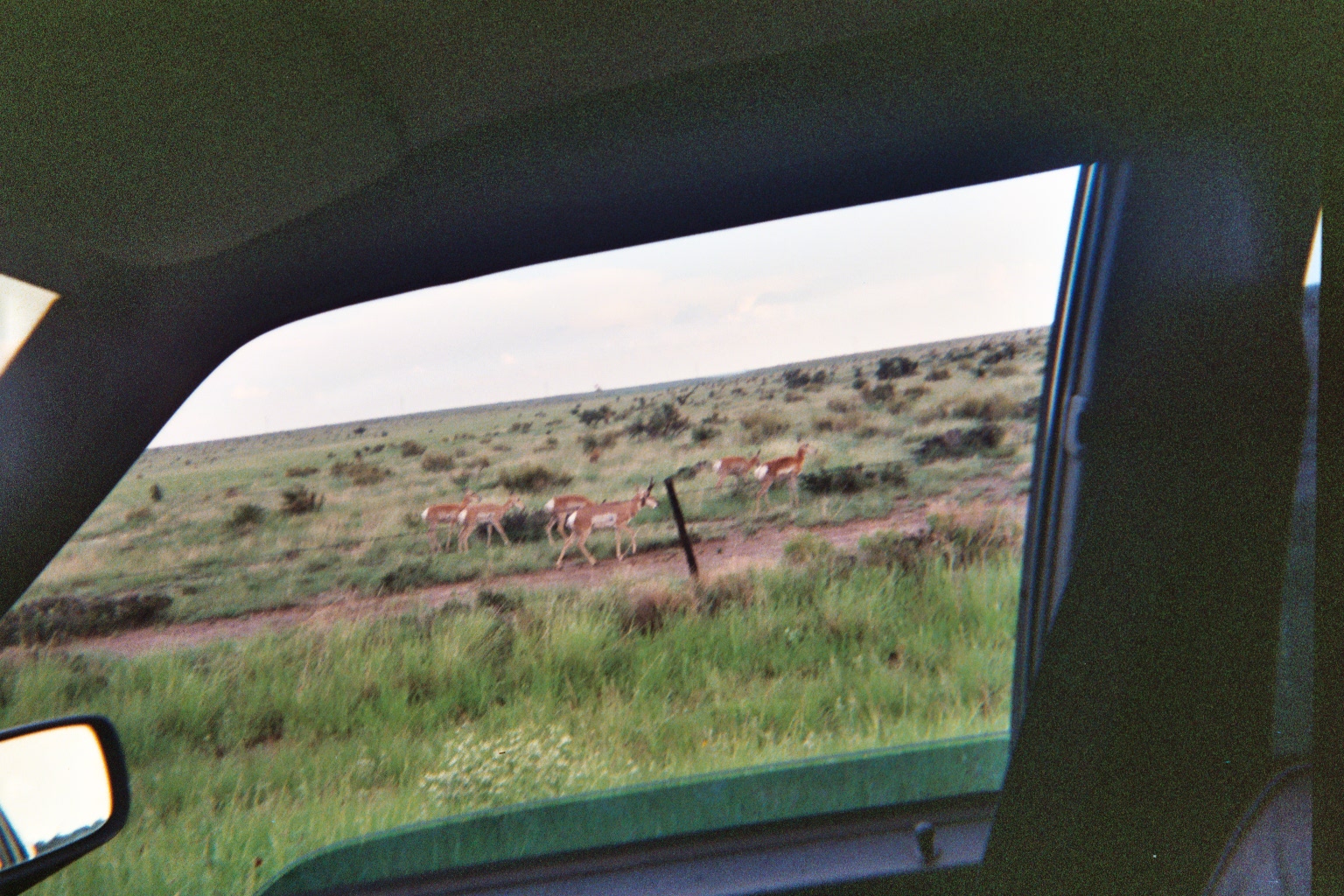
Pronghorn are one of my favorite critters… hunting them is a big business down my way, and I had to write about them, so actually learned a few things. They’re not antelope, and not goats, but the unique survivors of a family of animals that died out after the last ice age. They’re the fastest runners on earth, but have one drawback to their survival in the modern age. They can’t jump, so when they run into a fence, they aren’t sure what to do. Insert your own “illegal immigrant” comment here.
I took this photo from my car window with a disposable camera driving commuting down to Marfa… we’re a similar environment and the little guys from Wyoming should feel right at home in Sonora.
Deport Bill Gates?
Immigration Lifts Wages, Report Says (Lori Montgomery, Washington Post, 21 June 2007):
More than 90 percent of native workers benefit from the influx of low-wage labor because immigrants take jobs that complement higher-paid native workers rather than competing with them, according to the report. For example… immigrant roofers lower costs for contractors and home-builders, creating jobs for plumbers and electricians and lowering the price of houses for consumers.
The losers are native workers who compete directly with immigrants in certain job categories, though the impact on their earnings is small compared with other factors, such as technological advances, globalization and minimum wage levels, said Giovanni Peri, an economics professor at the University of California at Davis.
“There’s this aversion to immigration, but people should be much more averse to computers,” Peri said. “They are much more responsible for the bad effects” on U.S. workers.
But, but… I use an AMERICAN computer.
Safe sex
 Not just for gangsters and their molls, bulletproof rooms are the newest trend in no-tell motels…
Santa Catarina, Coahuila (just outside Monterrey, on the road to Saltillo)’s newest innovation in the adultery industry is the steel doors, instead of tarp-like curtains for the carports immediately adjacent to about half the 34 rooms at Rancho el Trueno.
Otherwise, it’s your typical “hotel garage” or motel no-tell… you enter through the carport, and lock yourself in for your … whatever. Guests can order beer and snacks through a small rectangular porthole in the door.
Wanna take bets on how many of el Rancho’s clientele are real gangsters and how many just very, very nervous businessmen who aren’t joking when then say “my wife would kill me.”?


