EXTRA! EXTRA!
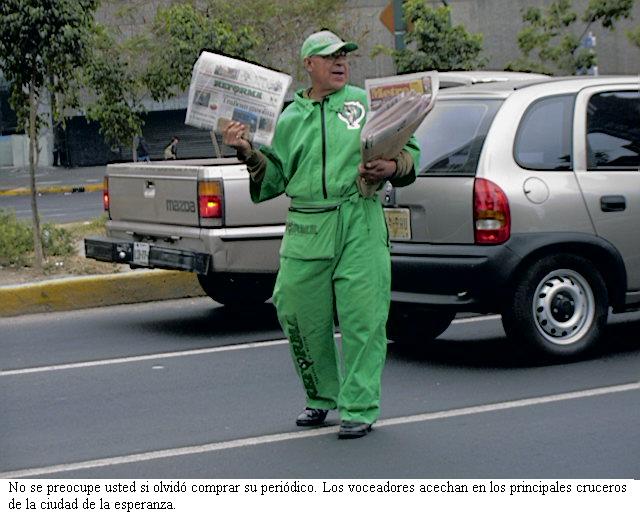
Yesterday was Dia de Vocedores… “Newsboy’s Day” when the President (Calderón, not the other one) makes nice and goes to their union hall to make a speech on the value of those hard-working, underappreciated people who are the ones who REALLY bring you the news.
The reporters and editors just write the papers. Without the voceadores, their work would go for nought. Come to think of it, that’s what bloggers do most of the time too — distribute the news and opinion of the day — but we’re not up at 4 in the AM, working out of old houses on calles Edison and Mariscal behind the newspaper offices to assemble the papers, loading up trucks and motos and bicycles to distribute the papers all over el Metropolí… and dodging traffic and commuters on their way into the Metro, getting you the dozen or so competing dailies that all contradict each other and are all perfectly true (there’s more than enough news to go around in a metropolis of 20 million. And no one newspaper has the final word on anything. It’s rare that you’ll have even the same event — unless it’s a presidential election, the World Cup or a Papal visit all making the front pages. Usually, you get to pick and chose your news… again, just like with the blogs).
I only had to toss a couple dozen Rochester Democrat and Chronicles in the morning, which I suppose was child labor. Gannett gave me a scholarship to college (in those days, Frank Gannet’s widow still met all the newsboys receiving scholarships), but the most the voceadores can expect at the end of their career is a room at the Union retirement home in Santa Maria la Ribera. On the other hand, there was a 95-year-old voceadora still working the Zocalo in 2004. She could still hustle enough to be selected to carry the Olympic Torch through el Centro.
The pay sucks, the work is hard, and how good their union is, I can’t say. They get called up to provide warm bodies for megamarches, when they probably should be home resting. The photo is from a wonderful series of Mexico City “Oficios urbanos” by “Facun”.
Even us cyber-newsies appreciate tips:

There really is a treasure of the Sierra Madres
“They lusted like pigs for gold.”
— unamed Aztec nobleman on Cortés’ troops
A friend of mine, who has got to be at least in his mid-70s now, is the son of a Scandinavian sailor who jumped ship in Veracruz and never did find his gold stake, but got lost and ended up in a Mexican village instead. That’s his story anyway and he’s sticking to it.
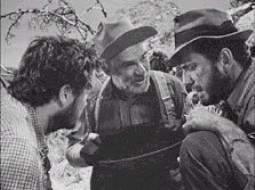
Yeah, it did make me think of Walter Huston in Treasure of the Sierra Madre, but that’s the thing about B. Traven. He really knew Mexico and his stories of foreigners in the 1920s COULD have been true. There was a report in Canadian papers about a mining supervisor being shot during a payroll robbery recently. For whatever reason, most of the foreign mining operations are Canadian.
Fred C. Dobbs was wrong when he said “nobody pulls a fast one” but I gather savvy investors are looking at gold mining in the Sierra Madres as a serious investment. The days of shootouts with payroll bandits aren’t quite over yet, but … alas… most of these operations are the kinds of things involving investors and the Canadian stock exchange and other such unromantic details as environmental regulations. Still… there’s gold (and silver) in them thar hills:
Mexico is prospective for many types of mineral deposits, but precious metals were the main attraction for most of its history. When the Spanish Conquistadors arrived in the early 1500s, the Aztecs were already sipping from golden goblets. A series of rich silver deposits were discovered in the mid-1500s that led to a silver mining boom in the central states of Zacatecas, Guanajuato , Chihuahua , and Durango , among others. Mines within Mexico ‘s Silver Belt currently produce about 100 million ounces of silver annually, and several mines have operated continuously for centuries. Mexico ‘s Silver Belt is the most productive in the world, with more than 10 billion ounces of silver and about 75 million ounces of by-product gold produced over the centuries.
Mexico was the world’s leading silver producer for many decades and was only recently surpassed by Peru . Canadian junior companies are actively exploring projects within the Silver Belt, which offers good infrastructure, an experienced mining workforce, and excellent potential for new discoveries using modern exploration techniques. The mines in this region are also benefiting from new capital investment and new technology to boost production and improve profits.
Most of the historic and recent gold discoveries in Mexico have been found in the prolific Sierra Madre mineral belt, a geological structure straddling several states in central and western Mexico . …
…
Mexico ‘s mining renaissance could continue for decades given the bullish outlook for most metals. …
I strongly recommend that anyone wishing to invest in the mining exploration/development sector take a serious look at Mexico .
“As it is”… the un-holy matrimony of PAN and PRI
Even as an outsider, I’d noticed that the 2006 election bore more resemblance to the 1988 election than to anything in the U.S. In 1988, Cuauhtémoc Cárdenas probably got the most votes, but through some fancy manouvering (and possibly some nudges from the Reagan administration which certainly didn’t want a leftist administration in Mexico), Salinas de Gotari, “won”. I always thought it was ironic that the political and social reforms forced through as a result of that shady election led to a PAN victory in 2000. Which was followed by a shady PAN victory in 2006 (when again, a U.S. administration was very worried about a probable win by the Mexican left).
Blogotitlan says it was no accident. (My translation)
The corruption of political organisms in Mexico – esspecially by the outstanding political leaders — is the Aquilles heel of this nation. Their interweaving factional interests, to the detriment of national ones, have left the country open to the depredations of its natural resources and economy by the hegomenic United States.
Without getting into the corrupt origins of the various political parties – something more a subject for psychiatry than sociology – it is sufficient to focus on the consequences of their convergence of interests, and the criminal methods, legal and otherwise, that in their short-sighted and ignorant self-interest have negatively influenced all Mexican citizens.
Of course, it has to be said that without political apathy and tolerance, none of today’s poltical parties could have obtained the positions they occupy today, or get away with what they are doing.
When in 1988 the party failed to maintain control of the electoral system and the reality of the ballots upended the systemic inertia, “honest brokers” were immediately called on to mediate the situation. Business lawyer Diego Fernandez de Cevallos, a PAN central committee member huddled with the worried PRI leaders, and managed to strike a compromise. Ultra-private talks and round the clock negotiations developed a new scenario (one favored by the U.S. trained technocrats at the Bank of Mexico) under which PAN would become the “loyal opposition”. This flew in the face of reality, and required the left to recognize as clean and unquestionable the triumph of PRI candidate, Carlos Saline de Gortari.
Obvious, there were political and economic costs, that Salinas immediately accepted, the first being that “Jefe” Diego Fernandez was allowed to win a governorship, which convinced PAN president, Luis H Álvarez to accept the deal.
When word came down from los Pinos that Salinas would win, the vote counting mechanism was suddenly suspended for several hours. When the system was restored, the miracle had occurred, and the gentleman selected as president, Carlos Salinas de Gortori, triumphed. PAN, as Diego and Álvarez had previously worked out, admitted it had lost, but it was their votes that give the slight edge to PRI.
The fly in the ointment was that the PAN candidate, Manuel “Maquío” Clouthier, was against the deal, recognizing that it was untrue. He knew the truth. Cárdenas had lead in the vote count.
Not that it mattered. The Electoral College, controlled by PRI, had the last word. And gave it. Despite the evidence of fraud, it recognized the “legal” — though illegitimate – triumph of Salinas, and at the same time saluted Jefe Diego’s victory as the first PAN governor of Baja California Norte.
Beneficiary of innumerable canonjías [SEE NOTE], PAN, and the forces of the “institutional Revolution” functioned as a battering ram against the masses that had supported Cuauhtémoc Cardenas, indignant at the frustration of the democratic will of the people. Throughout the Salinas and Zedillo administrations, Diego’s PAN was indispensible to turning back the clock, and privatizing the country, “for the public good” to the benefit of the new political business groups that had been incubated under Miguel de la Madrid and stimulated into growth under Salinas.
The only renegade was Maquío Clouthier, who — before Cardenás turned to “institutional” conformism – set up a parallel cabinet which refused to recognize Salinas’ “triumph.” A providential auto accident took care of Maquío, and Diego and Salinas no longer had to continue fighting him.
PAN’s complicity allowed that Salinas to privatize everything, and render accounts on nothing. The famous libros blancos (white papers) that supposedly audited the privatizations were a farce that concealed outright thievery and left untouched financial mismanagement. As with the “untouchable” 1988 election results, which were under armed military guard, Jefe Diego made sure they were burned, covering the tracks of anyone involved in the frauds.
Whatever vestiges of ethics were left in the PRI government were gone. Collusion between PAN and PRI allowed Salinas to reign with impunity, in return for preparing the way for “el cambio” (the change) – an extraordinary deceit that installed a government “of the industrialists, by the industrialists, for the industrialists,” true predators of the national wealth and public property, as has been verified by the recent scandal involving the public audit of state accounts.
18 years later, the Salinas scenario was repeated, though in 2006 PRI played the supporting role to PAN’s lead. The new production was updated with technocratic “modern” touches: IFE, supposedly “citizenized” when in fact it was “mafia-ized”; new software that featured subroutines to change the calculated vote count to meet agreed upon results; mass media already dependent on timely canonjías suborned by the advertisers who had benefited from previous frauds; foreign advisors openly using lies, slanders and social manipulation in the electoral process, despite specific Constitutional prohibitions; purposely myopic electoral authorities ; and dubious court decisions based on the convenience of legitimizing results and not open to appeal despite numerous Constitutional violations. In a word… corruption.
As during the Salinas era, the unsanctified marriage of PRI and PAN, with the unholy brood of brats – the Greens, PANAL and Alternativa – seek to demolish the remaining social and political structure, one that took a lot of time and effort to construct and, despite imperfections, was the source of progress in this country, that allowed people to obtain an honest job and put food on the family table. But today, PRIAN [PRI+PAN, considered by many, like Blogotitlan, as one party] seeks to undo everything, auctioning off the pieces to private interests, who seek instantaneous returns on their investments, encouraged by tax exemptions that are supposed to “stimulate” investment, but are really a cover for bribes to the government, which do little to bring in national investments or create jobs.
The indignity is that both chambers of Congress write laws harmful to the citizens with the overt support of (when not actually written in) Washington, supposedly benefitting “national” industrialists, but – as soon as they’ve received the concession (or canonjía) turn around and sell them – tax free – to foreign multinationals, as was done with the banks and other state-owned enterprises. The country not only loses a source of wealth, but also sovereignty.
What is even more repugnant is the way that this corrupt political marriage is preparing the way for the political and social annexation of the country (the economic annexation being a done deal) to American hegonomy, transgressing the most elementary notions of policy and honor, racing to approve bad laws, throw up roadblocks in the way of necessary changes, and otherwise harm the people the chambers are supposed to represent.
In short, the litany of indignities and aggressions against the citizens of the country committed by that nauseous pair that proclaims itself “decent and responsible”, or “democratic and nationalistic”, is applauded by its accomplices in the political, media and business world.
For the good of the country, and for it’s survival, we hope that the growing awareness of citizen anger will be recognized by those around Andrés Manuel Lopez Obradór – a living demon to those “Men without a country” [apátridas]. There is a need for obstinate resistance to defend Mexico against the useless couple.
[TRANSLATION NOTE] “Canonjías” are literally “artillery barrages”, but the term is used figuratively in Mexico to mean economic an political arrangements used to co-opt the opposition. It comes from Álvaro Obregón’s cynical observation that “no Mexican general can withstand a barrage of gold pesos”. Obregón consolidated the Revolution and ended the violence by basically coopting the opposition, both through power sharing arrangements, and through outright bribery.
Another travel warning… ho hum
Alfredo Corchado of the Dallas Morning News is the source for the AP wire stories on the latest warning from the U.S. Department of State:
MONTERREY, Mexico – The U.S. State Department warned Americans this week of ongoing drug violence in several parts of Mexico, including states along the Texas border. The move comes as emboldened traffickers have posted written death threats against government officials and their families – attaching them with ice picks to the bodies of murder victims, U.S. and Mexican officials said.
…
Two of the states listed in the State Department’s travel advisory are Nuevo Leon, “especially in and around Monterrey,” and Tamaulipas, “particularly Nuevo Laredo.” The travel advisory also includes the popular beach city of Acapulco.
While much of the violence is between rival cartels battling over control of drug routes into the United States and for new emerging drug markets in Mexico, the U.S. government warned that foreigners also faced risks.
…
The U.S. ambassador to Mexico, Tony Garza, added, “We ask U.S. citizens to exercise all due caution while in Mexico and remain vigilant for any situation that could become dangerous.”.
 In other words, the same thing Tony always says. He made a big fuss a couple of years ago about Texans disappearing in Mexico, til it finally got through his thick skull that the Texas were either people who wanted to disappear, or were involved in the drug and gun running business. I’ve yet to hear of any legitimate foreign traveller or resident coming to grief, other than the usual accidents or the occasional crime that happens anywhere (my friends in the Canadian press tried to spin a payroll robbery at a gold mine into an anti-foreigner incident, but I don’t think the Mexican Butch and Sundance wannabes were particularly concerned about the nationality of the guy with the loot).
The one troubling incident isn’t mentioned by either the Dallas Morning News or by the Ambassador. The murder of labor organizer Santiago Rafael Cruz is never mentioned. While I don’t advertise that I also work as a journalist when in Mexico (I list escritor as my profession on my visa form), I’m not involved in any shady business. I suppose I should worry about annoying big business interests, which is what Cruz apparently did… though, like a journalist, he was someone doing an honest job that interfered with criminal enterprises (and, — this does worry me — he interfered with the “legitimate” big businesses that depend on immigrant labor).
Besides, saying “avoid Nuevo Leon because of problems in Monterrey” is like saying that people should stay out of Texas because of problems in Dallas. Both NL and TX are huge places. And Monterrey and Dallas are huge cities (and you’re more likely to be a victim of random violence in Dallas).
I think what’s bothering the Ambassador is something else:
U.S. officials also expressed concern for U.S. citizens and American investments in Mexico, particularly in the northern region, which has been hard-hit by drug violence this year. As many as 50,000 Americans live in the Monterrey area, and 1,200 U.S. businesses have investments there, representing about half the region’s $14.4 billion in foreign investment, U.S. officials say. That makes the situation “a great national security concern for us,” the U.S. official said
Mexican business is less and less dependent on the U.S. and, U.S. businesses (or until recently U.S.-based ones) are continuing to move to Mexico and to Monterrey. Halliburton’s Energy Service Group is moving their manufacturing facilities to the Nuevo Leon city, something that barely raises a blip in the press these days, and Mexican business deals have been announced recently involving non-traditional (i.e., non-U.S.) partners like the European Union (auto exports and China (WiFi and telecom services). Agricultural exports are the one place where U.S. businesses are dominant, and even that’s under some threat. While Montsanto GM corn seed will be allowed in under very limited conditions, the overlooked rice import agreement with Pakistan suggest even the pro-U.S. Calderón administration is looking for alternatives.
While agro-business still has too much control over Mexico, even there, there are Mexican competitors waiting. In the oil and energy sector, where U.S. oil companies could reasonably expect to get back into the Mexican market, it looks like the Mexicans are going to be working with the Brazilians, the Norweigans and the French. Only the French company (Total) is corporate. Even mining is out of U.S. hands, having ended up largely in Canadian ones.
Frankly, I think Tony Garza is a hack, the worst U.S. Ambassador since James Rockwell Sheffield (who served the only President that even comes close to Bush II in terms of incompetence and political corruption — Warren G. Harding) . Sheffield and Garza both painted Mexico as dangerous for U.S. citizens at a time when the economy was changing, and not in the interests of their U.S. corporate sponsors.
For Sheffield, it was the oil business, and for Garza… it’s a little of everything. Better to say “Mexico is dangerous for tourists” than to deal with the reality. Grant-Thorton International’s latest survey of emerging economic powers notes that
Mexico, with the world’s 14th largest economy, is benefiting from its close trading ties with Canada and the U.S. through the North American Free Trade Agreement (NAFTA). “Mexico is well-placed to play a more significant role in the Americas.”…
According to Hector Perez from Salles, Sainz-Grant Thornton in Mexico:
“The reason for such an outstanding performance from the Mexican economy during 2006 was the unprecedented macroeconomic stability, a steady Mexican peso and a low inflation rate of 4%.
“Mexico is an export-oriented economy, dominated by a mixture of industry and agriculture. It is the biggest exporter in Latin America (US$250.3 billion) and the 15th in the world, as well as the only member of the Organisation for Economic Co-operation and Development (OECD) in the region. Furthermore, Mexico received the highest figure of foreign direct investment headed to Latin America and is top of the list in terms of per capita GDP. It is one of the most open economies in Latin America and has signed 12 free trade agreements with 43 countries. There is no doubt that it will be one of the top emerging markets in coming years.”
If the Ambassador were to issue a REAL warning, it should be to the U.S. that between retirees moving their assets to Mexico and more Mexican businesses looking for other markets, the U.S. is going to have to look at economic intergration differently, and stop blaming its overdependence on Mexican narcotics for all the problems it has with Mexican business.
 Woodrow Wilson, who from the Mexican view, should have stayed out of his neighbor’s family feud, felt he had a moral right to intervene in Mexico in 1914. Trained as a Presbyterian minister, the former college professor, and all-round moralist, saw it as his duty to “teach them to elect good men.” He could never understand why the Mexicans rejected him as a guide. The Mexicans resented his meddling, and moreover, what had started the Constitutionalist rebellion was U.S. meddling, specifically Ambassador Henry Lane Wilson’s role in Huerta’s coup at the behest of the dominant foreign economic interests.
Wilson dispatched a friend, his campaign biographer, William Bayard Hale, to Mexico in 1914. Hale, a New York Times reporter, spoke no Spanish and had never been in Mexico before. But Wilson trusted Hale, and Hale understood Wilson’s idealistic belief in constitutional democracy. Working undercover1, Hale unsurprisingly reported that Huerta was a tyrant with no popular support. It was control of the oil fields – and the revenues from the oil fields that let him buy foreign munitions – that kept him in power.
William Bayard Hale was right: Huerta needed ammunition if he was to maintain power. Everyone knew Britain and Germany were about to go to war. The British Navy depended on Mexican oil, and the British – not caring much who controlled the country as long as they could pump oil – kept a mercenary army under their own general, Manual Perez, protecting the oil region. But Huerta’s forces controlled the ports, and the Germans were willing to supply arms to Huerta in return for blocking oil sales to Britain. Wilson, pro-British, but desperate to keep the United States out of the coming war, hoped that if neither the German nor the British had the clear advantage, the war could be avoided.
United States intelligence officers had learned that the Germans were sending several shiploads of arms to Mexico. Carrenza and Huerta had both at various times threatened to cut off oil shipments – which would have kept the British out of the war, but also would cripple the U.S. economy (which even then was dependent on foreign oil imports). Carranza’s forces were slowly taking more and more control of the country, but were unlikely to capture Veracruz in time to stop the Germans from resupplying Huerta.
On 6 April, six U.S. sailors were arrested in Tampico, still controlled by Huerta’s administration. The arrests were a mistake, and the sailors were returned to their ship. However, the United States was a new military power in the world, and U.S. officers had not always shown good judgment in Mexico. The United States Navy wanted respect: the ship’s captain demanded an apology from the Mexican Navy … and a 21-gun salute! The Mexicans, politely as possible, apologized for the sailors’ inconvenience, but refused the salute. The “insult to the Navy” received a fair amount of press in the United States. Given the feeling in the United States, this minor incident gave the President a plausible excuse to “avenge the national insult” – and incidentally to cut off Huerta’s arms supplies, and liberate Mexico from the tyrant. Or so it seemed.
In 1914 the President of the United States was one of the few people in the world with a bedside telephone. He was still asleep at 6 A.M. on 21 April when he received a call confirming that the German ship, Yripanga, would be docking in Veracruz later that morning. Wilson had the White House operator set up a conference call between himself, his personal secretary, Secretary of State William Jennings Bryan and Navy Secretary Josephus Daniels. The operator and the President weren’t the only ones still in their pajamas that morning.
Daniels was a pacifist, and Bryan had religious objections to warfare. Still, they agreed with Wilson that the only way to stop the Yripanga was to take over Veracruz. If the French had once invaded the city over unpaid doughnuts in Mexico City, the United States could take the Customs’ House in Veracruz to avenge an insult to its navy’s honor in Tampico. Daniels had orders sent by radio (a very recent technology) to naval ships in the Gulf of Mexico.
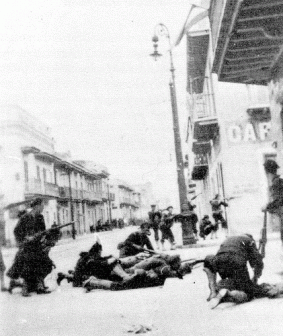 Nothing went as planned. As the Spanish found out in 1828, the French in 183, Winfield Scott in 1847, and Maximiliano von Hapsburg in 1863, the “jarochas” do not welcome foreign invasions. In 1848, army cadets had defended Mexico City from United States marines. In 1914, the Naval Academy defended Veracruz. To protect the Marines, the Navy bombarded the city. Citizens joined the cadets. There were casualties on both sides, something a visably shaken and pale Wilson announced to the press the next day. Bryan, who felt personally responsible for the disaster, later resigned. The marines did complete their mission – occupying the Custom’s House. The Yripanga was an unarmed merchant freighter. Its captain was not about to enter a war zone. He turned his ship around. Mission accomplished. 2.

Although meant to assist Carranza, even that plan went sour. What Wilson forgot was that Carranza was a very prickly nationalist and had never gotten over his boyhood meeting with Benito Juarez, who had struggled to keep all foreign governments out. Wilson, during his pajama conference, had not consulted the “legitimate” Consitituional Chief of Mexico before sending troops into the country. If the United States did not immediately evacuate Veracruz, the Constitutional Chief threatened to invade the United States, even if it meant joining forces with Huerta! He was bluffing, of course. Wilson was furious, but Carranza had made his point. He – not Huerta – was Mexico’s legitimate leader, and only he had the right to determine Mexico’s foreign policy.
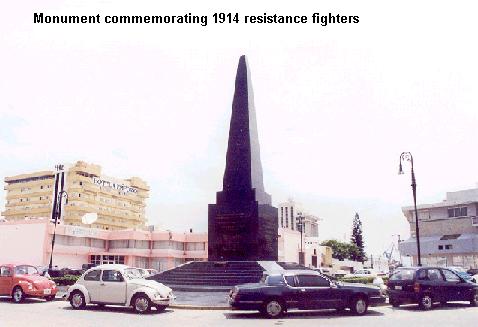
 Henry Lane Wilson, who was still in Mexico City, was finally recalled. The United States sent a representative (not an ambassador3) to the Constitutionalist government, and other countries withdrew their recognition of Huerta’s government. The Marines took their time leaving Veracruz (they didn’t withdraw until November), by which time the whole occupation was pointless. Huerta was gone. The Revolution had gone on to a new phase by then. Worse yet for the Wilson administration, the Latin American nations had all sided with Carranza, and the United States was again seen as the aggressor in Mexico. Veracruz’s official name was changed after the invasion to “Three Times Heroic Veracruz” – its citizens had risen against invaders from Spain once, and from the United States twice. Harry S. Truman laid a wreath at the memorial to the Boy Heroes of Chapultepec in 1948. Truman was applauded at the time, but no one expected an apology for what had been a tragedy of war. The Veracruz invasion was seen differently. Mexico and the United States were not at war, and the intervention was simply for Woodrow Wilson’s political benefit. Bill Clinton offered an official apology in 1998.
1 Hale was an undercover agent for more than Wilson. He was also a German agent.
2 Sort of. The Yripanga unloaded down the coast in Huerta controlled Puerto Mexico.
3 To legalists like Wilson and Carranza, the terms used in foreign relations were important. Not being president, the constitutional chief could not receive an “ambassador”, but he could receive a “representative”.
Immigration: the human cost
Cho Seung-Hui — Mexican reaction to the incomprehensible
There have been something like 700 murders in Mexico this year, mostly related to the “drug war.” Even the odd serial killer, like the “Mata vieja” (“Old lady killer”) of a few years ago made sense (the killer was a robber gaining access to little old ladies apartments by pretending to be from a visiting nurse from the Health Department) was a “logicial” killer. The country has an alarmingly high murder rate, but murder in Mexico is overwhelmingly something we can understand… business (especially shady business, like narcotics trafficking and poltics) or disputes within the dysfunctional Mexican family.
Even the Mayan cannibal a few years back only ate his mom and dad (he was too paranoid to go out to the market), not — like Jeff Dalhmer — chance acquaintances. Suicides are extremely rare. Most suicides have overwhelming financial problems and hang themselves.
As I’ve said before, in most ways I feel safer in Mexico than in the U.S. While I was once had rocks thrown at me by a crazed junkie, and there’s a good chance of being hit by a car in the city, I don’t expect to be shot by a stranger, or thown in front of a train. Perhaps the Mexican lack of personal autonomy makes for a more pacific society.
Mexican cannot understand the Virginia Tech massacre. Neither can I, but Wilbert Torre, the New York Correspondent for El Universal, tries.
NEW YORK.- Serial killers, massacres, casual crimes, snipers and knifings are frequent across the entire United States. . Those acts attract the world’s attention when they happen at a school or university – like the recent slaughter at the Virginia Technical University – but others happen every day, in cinemas, restaurants, on the metro, in the street and in parks.
Experts in the field are as concerned with the proliferation of firearms and the ease of buying them as another issue: public policies regarding mental health problems in the United States.
In this country, the most common method of committing suicide is with a firearm. 60 percent of those who take their own life use a gun. 80% of all suicides are committed by white men, according to a study by the National Alliance for Mental Illness in the United States.
In the middle of the 90s, a study undertaken by this organization determined that suicide was the ninth leading cause of death in the country. In 1995, 31,384 persons committed suicide.
A high percentage of these deaths occurred in universities and other centers of higher learning. Hundreds of students commit suicide and others commit homicides or massacres without either the governmental or school authorities having the capacity to detect or treat mental problems which are only recognized after the fact from studying the clinical histories or daily conduct of these people
Cho Seung-Hui, the young South Korean who killed 32 persons at the Virginia Tech also committed suicide. Before the massacre, Seung-Hui had written disturbing short stories. His associates and teachers describe him NOW as a solitary and very strange. In his record appear compalints by classmates, who apparently were bothered by Seung-Hui. But before the slaughter, no one thought to look into his conduct in any detail.
Eugene O´Donell, a retired New York policeman, and expert in criminology, has studied these types of crimes for years. He concludes that the problem is a lack of public policy to deal with persons suffering from mental illnesses. He mentioned that in the past, the government locked up disturbed persons, but under deplorable conditions. Now, may of the mentally ill wander the streets. Most are peaceful, but some in their madness slaughter people.
“We need to get below the surface in the Virginia massacre and not stop at simple arms contro”, said Bailey Childers, leader of the Progressive Majority organization. “It is necessary to start a debate about mental health care in the United States. He insists that the stigma against seeking treatment is keeping people from requesting assistance.
The New York Times reports that Cho Seung-Hui shares most of the characteristics and behaviors noted in a 2000 study of people who perpetrate these kinds of massacres.
The analysis of 102 rampage killings indicate that most are committed during the day by educated white men. Seven of the 102 were committed by Asians, and about a third of the killers commit suicide.
In New York, in places as different from one another as a park, the subway, a home, a tourist passage and a discoteque, there were massacres like that at Virginia Tech.
In February 2002, Ronald J. Popadich, an unemployed man living with his mother in a quiet New Jersey suburb, shot a neighbor, hailed a taxi, killed the driver, stole a car, ran down 19 people, fled, and returned the next day to run down another seven. In a final rampage, Popadich dilled four people.
“I wanted to kill as many people as I could,” Popadich declared when arrested.
In March 1990, Julio González, an unemployed Cuban, got into an argument with his date at the Happy Land Discoteque in the Bronx. After exchanging words with the bouncer, he left the club, walked to a gas station, convinced the attendant to sell him a can of gas, returned to the disco and set it on fire: 17 people died.
In 1999, a mental patient who stopped taking his medication, pushed aspiring writer Kendra Webdale in front of a train. On another occasion, a homeless man, Jesse Nettles, stabbed five people in Times Square, including a man pushing a carriage with two babies. More recently, late last summer, Kenny Alexis attacked five people with a knife, stabbing one of them in the aorta, on the edge of Central Park.
But these things don’t only happen in New York. In 1966, Charles Withman [sic] killed his mother and his wife. House later, he climbed the observation tower at the University of Texas and opened fire. He killed 14 people before being killed by the police.
The latest chapter in the the story of murders in the United States happened three days after the Virginia massacre. In Queens, Jimmy Lee Dawkins, a 20 year old with a history of mental disturbances killed his mother, his nurse girlfriend and then himself with a pistol. His mother had made complaints to the police about her son several times, but he had never been arrested.
Those remittances…
Some Mexicans manage to send quite large remittances back home… but do you really think José Lopez, sending back $20,000 a year at a few hundred bucks a week is anywhere near the source of the cash flowing into Mexico?
Retirement homes and property are a more likely candidate. Mexico — even Monterrey — seem to be the Arizonas and Floridas of the future. Alas poor Mexico!:
Last year, three major money lenders, or financial groups, were offering loans for properties in Mexico. Today, the number has increased to nine, according to IMI Group.
The firm estimates U.S. citizens own $30 billion in residential real estate in Mexico, and another $5 billion is expected to be developed during the next two years.
Roy Nelson, associate professor of international studies at Thunderbird School of Global Management in Glendale, said Mexico’s economy is growing, helping fuel rapid development of real estate.
However, he believes the overall growth is not as rapid as most international _ and Mexican investors _ would like it.
“There are a lot of people, including Mexico’s President Felipe Calderon, who would like to see the country’s economy growing a lot faster, but there are political forces that are holding it back somewhat,” said Nelson, who also teaches at several Mexican universities.
Nelson echoes IMI Group’s opinion about real estate expansion, particularly in areas like Monterrey, Mexico, a magnet for foreign companies and growing real estate.
“Monterrey’s real estate prices are skyrocketing,” Nelson said. “A lot of people from the United States and Canada are buying property in Monterrey as well as other areas that attract tourists.”
If you ever wondered “whatever happened to…” , and assuming they didn’t OD or pull a Buddy Holly, they’re probably still on the Mexican circuit. At least the music is. True story: I used to teach two nights a week out in Tlahuac, south-east of the city. I was riding a ruta that featured a disco ball hanging behind the driver, who kept us entertained with his CD collection. The route went past the Secretaría de la Marina, so after loading up with indians and construction workers, we had a complement of sailors. Just when we stopped for the bomberos — who got on collecting contibutions for a new firestation — up came Y.M.C.A…. I had to check my calendar. Yes, it was the 21st century. Ok, so life moves slower in a Mexican village, people.
I’ve been to two Jethro Tull concerts in my life… one in Syracuse New York in 1974, and another at Auditoria Nacional in 2005. Aerosmith, which is relatively youthful by comparison, was in Monterrey earlier this week and is playing at Foro Sol in DF this weekend.
And el TRI? Geeze, they’ve been together since 1968. Alex Lora isn’t quite as old as Keith Richards, but Alex hasn’t slowed down quite as much. Rock n’ roll is supposedly about rebellion, but I guess in Mexico, rebellion is part of the tradition. They sing Che Gueverra, but aso about “normal” people… truck drivers, futbol fans, prostitutes…and, as far as I know, they’re the only rock band ever to sing about the Virgin of Guadelupe… for the late John-Paul II (another old guy who kept on performing forever), who reportedly enjoyed el Tri a lot more than he did Bob Dylan.
Their secret? Alex Lora told Batanga.com a year ago:
Rock and roll is the fountain of eternal youth, that’s why I recommend everyone to never stop taking their rock and roll pills three times a day because it truly is the fountain of eternal youth and besides, it’s a meal that will never give you indigestion!
The real rocker is an adolescent all his or her life. If you look at the Rolling Stones, the Beatles, Bob Dylan, the Who, Jerry Lee, they keep on acting dressing, singing and rocking exactly as adolescents, because they suffer from many things.
Keep on sufferin’, cabrones…
Nothing to declare…
Undocumented aliens are not unheard of, but a guy tried to enter the U.S. not just without documentation, but without anything else… shirt, pants, jockey shorts…
Not exactly the sharpest tool in the shed, he was a particularly inept Cuidad Aleman (Tamaulipas) burglar who’d dropped everything (including his drawers) to try making a getaway across the river into the twin city of Roma Texas.
I know you want it… Weslaco Texas Channel 5 has the video.
Such a mean old man
 Given his tin ear, I’d suggest James T. Moore (the only e-mail address included has someone else’s name) NOT give up his day job, but he claims to be a WWII veteran, which goes to show there’s no fool like an old fool…
Thankfully, these kinds of guys are a shrinking minority… USA Today reports that
While Congress and the White House remain divided over what to do with the estimated 12 million illegal immigrants living in the USA, a new poll shows the American public appears to have reached a consensus on the question.
A USA TODAY/Gallup Poll taken last weekend found that 78% of respondents feel people now in the country illegally should be given a chance at citizenship.
But the old fuddie-duddies are going to be around for a few more years. I found this in “American Daily” — one of my favorite crack-pot websites (this loon is a regular). These guys aren’t particularly dangerous, like the VDARE.com folks (KKK tracts with footnotes… you can look them up yourself if you want, but I’m not gonna bother linking to them), just off in their own little world. Like Richard Nixon, they’re fun to kick around. I only include this batshit crazy old geezer’s ramblings to give you some idea of what the passes for intellegent discourse from anti-immigration folks.
I’ll never forget it. When I was a young nipper visiting my Uncle Jim, and Aunt Evelyn in San Clemente, California something happened that has stayed vivid in my memory for decades. Showing me the sights, they took me across the border into [sic] Tiajuana and treated me to an authentic Mexican dinner. I don’t remember what they called those Mexican “sides” except that it was multi-colored mixtures of the hottest, most palate-grinding food I ever put in my mouth. Needless to say, I got ungodly sick and began to… well, I won’t share that with you.
That first “taste” of Mexico set the stage in my mind for taking Mexico forever off my vacation itineraries. Accurate or not it it forged in my mind a picture of Mexico as a place too dirty to live, food too hot to eat, a language too inconsequential to learn, a population too suspicious of gringos (me), and at the basis of it all, too consumed with the Atzlan movement: a Mexican plan to take back America’s southwestern states, which we bought from Mexico in the mid-1800’s, but which Mexicans still think they own. Hence, Mexico’s “invasion”of the USA.
But I’m not writing this to tell you about the army of Mexicans illegally crossing the border into the U.S. every day, or …how this portends the making of America a a whole “different” nation. You already know all that. No, what I’m writing to tell you is that if you love this country and want to keep it a sovereign nation, we each have to do our part—and do it now—to force this administration to see Mexico for what it really is.
How do we each do our part? Let your talents lead you. Mine is music [sic]. We can’t get rid of sombreros and ponchos and tequilas, but we can certainly do something about the music. So without further ado THIS is my “Adios To All Things Mexican” plan.” I propose to take all those colorful and seductive songs we sing about Mexico and rewrite the lyrics of each tune about Mexico, taking the phony “beauty” and “enchantment” out of them. THAT should tell our citizens the truth about Mexicans, and how they are overrunning us.
For example, one old-time favorite song about Mexico is Mexicali Rose, so that’s as good a place as any to begin. Here are the lyrics to Mexicali Rose, that we sing with passion, fervor, and sometimes even with moist eyes.
Mexicali Rose, stop crying, I’ll come back to you some sunny day.
Every night you know that I’ll be pining, every hour a year while you’re away.
Dry those big brown eyes and smile dear, banish all those tears and please don’t cry,
Kiss me once again and hold me, Mexicali Rose, goodbye.
Lovely song, isn’t it? But in view of the realities of Mexico; its hordes of illegals sneaking into our country; our false impression of Mexico as a cooperative and friendly neighbor; Mexico’s hidden hatred of America for allegedly confiscating a part of their land; and for their sly effort to inundate our nation, thus systematically converting America from the world’s greatest nation into just another “third world” slumsville, I humbly submit my contribution to the expose’ of Mexico’s overrated Latino image.
Here is my revised version of the song Mexicali Rose:
Mexicali Rose, we made it. got across the border yesterday.
We’ll do well on their guest worker program, goodbye, Mexico, we’re here to stay
In the u.s. we’ll get food stamps, no-cost health care for our family tree
Being pregnant, now that we’re here, you can have our baby.. free.
A rewrite of other “Mexican” songs is in the works: South of the Border, It Happened in Old Monterey, and others. Will this induce Americans to force Mexicans back over the border where they belong? Probably not. But every little push helps.
Stay tuned.
James T. Moore
http://jamestmoore.us/
Sweet! Ethanol in Mexico
Between narcos trying to bump them off and guys tossing grenads into newspaper offices, I am happy there are ANY reporters working in Mexico. As if the bad guys weren’t enough to deal with, they have editors like the ones at Nuevo Excelsior who don’t seem to cut and paste two reports together without reading the paragraphs.
I know I have a lot of trouble editing THIS site, but then I’m working with a FUBAR computer that crashes regularly and an obsolete version of “OpenOffice Writer” (the free knock-off version of Word) that sometimes does strange things to my copy (the previous post took two hours to straighten out, between crashes and losing the HTML coding, which I finally just stripped out completely). Dealing with that, sometimes I just don’t even notice that I’ve changed sentences on the fly, or lapsed into my semi-dyslexic spelling mode.
So, this is no reflection on reporters Alejandro Sánchez and Carole Simonnet, who wrote the story in yesterday’s Nuevo Excelsior on a new biofuels bill… just an overly long explanation of why the translation doesn’t read anything like the original:
After a two years and four month delay, the Agriculture and Livestock Committee finally agreed on a bill that will allow the production and use of ethanol additives in gasoline, and have sent an alternatives energy bill to the full Chamber of Deputies.
In the Committee’s opinion, the bill is “needed to promote national agricultural industries by processing agricultural products that can be used into ethanol and other biofuels.”
The committee discussed the bill behind closed doors, emerging with 19 votes in favor, all from PRI and PAN. One PAN member abstained. The PRD voted against the measure, which it claims only benefits a few powerful interests in the country and in the United States.
If approved, the State would be required to set up production, distribution and sales facilities for biofuels, and to encourage their use. The Bill’s sponsors say the proposal meets the Constitutionally mandated responsibilities of the Federal government, which under Article 25, 27, fraccion XX and 28 deal with energy production, distribution and ownership.
PRI Committee member Rubén Escárcega told Excelsior that the full Chamber will still have to consider the rules under which private interests, foreign or national, can invest in ethanol production, and the percentage of ownership reserved to the Federal government. .
Adriana Díaz of PRD accused the Committee of a “surprise attack, scheduling a vote without time set aside for debate.” She said her party will try to block the bill on the floor of the Chamber. The PRD plans to introducing a motion to suspend debate and to consider an substitute bill.
The bill put before the Chamber emphasizes that sugar cane will be used to produce ethanol. Mexico is the world’s seventh largest sugar grower, and the eighth largest sugar consumer. It is the number three county in terms of the number of tons of cane produced per hectare and number four in yield per hectare.
Those voting in favor of sending the Bill to the floor argue that the legislators are assuming their responsibility to lower emissions and “joining our brothers around the world in the fight against global warming and the almost apocalyptic visions of the future which the UN scientific panel discussed two months ago in Paris.”
At the same time, they maintain that the intent of the bill is to improve national energy self-sufficiency and that using renewable energy will encourage agricultural production and create productive employment in the bio-energy related businesses.
However, the PRD legislator said that consideration of alternative energy should look at all alternatives, and not depend on separate legislation of solar, biomass, geothermal and wind energy bills, and not “just lean towards ethanol.”
While I don’t think this is a bad bill, though I think the PRD is right that alternative energy should be considered holistically, and not piecemeal, I recognize that this is a bailout for the troubled sugar industry. It had to be re-nationalized under the privatizing Fox administration, as the price for keeping the Morelos farmers from running amok in Cuernavaca, like they were threatening to do.
The farmers got screwed when the sugar mills (which were originally turned into cooperatives by Emiliano Zapata’s Ejército Liberator del Sur). Under Lazaro Cardenas, sugar mills were nationalized. Under Salinas and Zedillo, they were privatized to “save” them from going broke when they couldn’t compete against the U.S. subsidized “private” sugar companies (all owned by Republican party contibutors), then went promptly belly-up.
They were only renationalized when there were a lot of angry farmers in the streets of Cuernavaca shaking their machetes outside the state house (I lived there at the time, and though I never felt threatened, I got the “point” that some hungry, skinny guys might get tired of getting jerked around).
Then… NAFTA regulations forced Mexico to accept corn-based sweeteners (made by our friends at Cargill) which basically made sugar worthless in a sugar-growing country. It only took the Chamber two and a half years to get out of committee what seems like an obvious way to deal with all that sugar.
And, this should buy PEMEX a little time (I’m guessing PEMEX will be getting into the sugar business). And, maybe the farmers can get into the PEMEX pension plan. Plus… something I only thought of a second ago, this will shut up all the folks who insist that Mexico open the energy sector to more foreign investors. The foreign investors who are the most experienced at sugar-cane based ethanol production are the Brazilians, and they based their energy production largely on the Mexican model.
The Mexican State is going to remain in control of energy production, with maybe some inter-Latin American investment, the farmers might get a decent price and it’s a neat way around the NAFTA-thinking that insists agriculture has to be commercial enterprise.
Besides, in Mexico, candy-bar commercials always say “Azucar es un buen fuente d’energia”… “Sugar is a good source of energy.” Sure is.


