A big day for a big guy
Here’s what I like about Mexico. Manuel doesn’t see himself as a freak… and his (not so small) triumph is an occasion for a good public party…
(translated from Juan Cedillo, in el Grafico):
MONTERREY, NL.-Drinking champagne, Manuel Uribe celebrated  leaving his room for the first time in five years, as he cruised the streets of San Nicoláa in his wheeled bed.
Uribe, who is 41, weighs 540 kilos (1180 pounds), and is considered an medical anomoly. Despite his morbid obesity, he’s in good health and considerably slimmed down from his former 745 kilos (1640 pounds).
Every medical textbook states that a person at his weight should have diabetes, high cholesterol and uric acid levels, as well as arterial hypertension. Uribe is otherwise in good health.
Manuel was able to leave his home with the help of a crane. His bed was mounted on a tractor tailer for his first expedition out of his house.
The tail car followed the tractor-bed as Manuel cruised the streets. He was accompanied by a mariachi band as Manuel “danced” — or at least moved in his bed, and waved to the people. Doctors, family members and his girlfriend celebrated the occasion with champagne.
The bed is covered with a blanket reading “Fundacíon Manuel Uribe” and an inscription in Spanish and English: If I can do you, so can you.
My mistake — re: Ritmo
I make every effort, especially when I write a news post, to be accurate. Sure, I spin with the best of ’em, but that’s what blogs are for.
I made a serious mistake in my Ritmo story. I’d mixed up two facilities — T. Don Hutto in Tyler and the Raymondville facilty — both housing immigrants AND CHILDREN)…
Children being forced to wear prison garb and stay in cells without toys (or going outside, or apparently attending school) is child neglect, if not abuse. It is the job of the Texas Family and Protective Services to look out for the welfare of children, even those whose parents are “guests of the Federal Government”. It’s also the job of county sheriffs and local school boards.
I suggested calling those responsible for child welfare, but I don’t want to be calling the wrong sheriff for the wrong county.
Until I have it straightened out, I’ve taken the post down to rewrite and rethink. — I’ll try getting local numbers for the two facilities over the weekend, but in the meantime the post is “draft” and it’s been un-digged (un dugged?).
¡HOY!
 Life in blogswampia (Nezua’s exquistissimo term for life in the lower depths of progressive blogging) isn’t all bad, but keeping the lights and electricity on, the car running (an unfortunate necessity in a rural area) and the computer functional can bog the whole thing down…
The First Annual Benito Juarez’ 201st Birthday Mex Files Fund Drive doesn’t come around all that often. In Benito’s day, the dollar and the peso were interchangable… alas, not today. Writing from the north side of the river, pulling out of the morass of electrical bills, and phone/internt charge, and keeping a very old Volvo on the road and legal… and upgrading software to something a little less ante-deluvian (and maybe find a CPU that doesn’t need duct-taped together should run about a thousand Yanquí dollars …
|
100 |
200 |
300 |
400 |
500 |
600 |
700 |
800 |
900 |
1000 |
Don’t wait til mañana.
Be a Santo… and make a
  PayPal donation HOY!
El cuerpo heroica del donadores…
el_longhorn
La abogada
Juanita and Thelma at “The World’s Most Dangerous Hair Salon”
Mazatlán Books
They found paradise, and put up a WalMart…
“When the small-business owner goes out of business, the middle class gets smaller,” says Sebastian Alvarez, a 34-year-old liquor-store owner who is part of a group in the tourist mecca of Los Cabos, at the southern tip of the Baja California peninsula, seeking to block a Wal-Mart. Though opposition is small today, he said he expects criticism of Wal-Mart to grow in coming years – just as it did over time in the U.S.
Wal-Mex is already the biggest private employer in the Republic, and growth shows no sign of tapering off any time soon, writes John Lyons in the Wall Street Journal (reprinted here). While I have the usual lefty objections to WalMart (environmentally unfriendly, ugly big boxes in pedestrian-unfriendly neighborhoods), I have to admit Wal-Mex has done some things right.
I always thought Banco Azteca (the consumer savings bank owned by Grupo Electra Department Stores) was one of the best things to happen to the Mexican working class. They could get credit for very small purchases, and it gave SOME of the estimated 75% of Mexicans who don’t use conventional banks access to more credit than was available through the family network and traditional methods (I had a student with a “real” credit card, who was the investor or financer of six or seven family businesses — a bicycle for a delivery driving uncle here, a brothers’ computer there…). Sometimes alls you need is a blender or two, or a steam iron to become an entrepreneur, and without small credit, that’s not possible.
Banco Azteca was — and is — proving that micro-lending isn’t a charitable enterprise. Working people pay their loans (I once sat through a real estate buying seminar… not that I’ve ever had money… and right now I don’t have any — hey, it’s PLEDGE MONTH HERE AT MEX FILES) … where looking for pickup trucks in driveways was one of the signs of a neighborhood worth buying into. The theory back then was that pickup drivers were working guys, and working guys paid their bills). And, if granny is making a few pesos ironing clothes for their neighbors, she’s as much a member of the business community as Carlos Slim. Certainly, she won’t be as influential as Slim… but, she will have a stake in the prosperity of the community.
And… middle-class values. A Mexican small business owner is someone of importance in their community. Even if you’re only talking about your block in Mexico City. I had my apartment wiring fixed by the nephew of the lady who sold quesadillas and breakfasts to construction workers out of the local in the front of my building because… well, because la Señora was the business owner I knew and trusted. And I wasn’t acting like a lost gringo. That’s how you get things done… through local shop owners.
The middle-class values extended to things like sweeping the sidewalk every morning, the informal “neighborhood watch” committee, feeding my dog on occasion (she was a notorious mooch) and taking in the mail if I wasn’t home. The kind of things that make neighborhoods livable. And, being middle class, you can be sure her the kids were going to school, and doing their homework every day.
Not that she — or I — or anyone else in the neighborhood, had any money to speak of. Income does not make you middle-class. And that is my real problem with Wal-Mex.
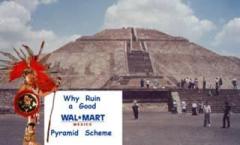 Yes, they pay better, and its a good thing to get people into the “formal economy” where they can get housing credits and pay into IMSS (Social Security). But, as employees of some big box, they don’t have neighborhood ties, and aren’t going to sweep the sidewalk just because it’s your home. And they aren’t usually living in the neighborhood (though there are some moves to encourage employers to find employees nearby residences).
I think the people who say “well, Mexicans prefer to shop at the locals because …” are whistling in the dark. Mexicans are no different than any other shopper. They’ll like the local, and the local shopkeeper, but that won’t stop them from shopping where their peso goes the furthest. They’ll complain about the crappy fruit (WalMex fruit is aweful… my favorite fruit, zapote, has to be very fresh or it turns to wood. WalMex distribution systems have no way of dealing with things like that). They’ll complain about having to take the bus to the store and wrestle their packages back on. But they won’t notice until the local is gone. Just like the U.S.
The bigger problem is the ownership. Mexico built a middle class by “going it alone”. One of the ironies of the Revolution was that by concentrating on education and development, Mexico went from almost no middle class to a relatively middle-class country, or one with middle class values. And, they were the voters who threw out the Revolutionary party in favor of the counter-revolutionary PAN in 2000.
After World War II, when the new PRI (founded in 1948) sought to consolidate the revolution, creating a national consumer base, and the national industries to support the middle-class, were priorities. Volkswagen was more a Mexican company… and “el Vocho” a Mexican car, even with its Germanic lineange, than otherwise. The others who were given special consideration and government loans or contracts to get they started — Herdez, Goya, Cemex, Commercial Mexicana and so on — were fostered to meet internal needs. Mexican consumers had access to the same stuff other advanced countries had… just not all the brands. You could buy canned soup — but there weren’t five or six brands selling the same tomato soup. You might get crappy goods for some things (old Mexican plumbing is a nightmare!), but the money you spent stayed in the country… as did the jobs.
Wal Mex is 62% owned by Wal Mart… which means the Walton family of Arkansas. Their interests are not Mexico’s interests. If I have to eat crappy fruit… and give up zapotes except for rare trips to the campo… I don’t want the money going to some bubbas who are too damn rich to begin with. Or the price of tortillas going through the roof. Or my neigbhors working for ‘da man… and not themselves.
¡Feliz cumpleaños! Gabriel Garcia Marquez

The Nobel Prize Winning Columbian-born author (and naturalized Mexican citizen) after a … ah… heated literary discussion in Mexico City with conservative Peruvian author Mario Vargas Llosa back in February 1976. Jornada photo by Rodrigo Moya
Several articles in today’s Jornada:
On the world-wide birthday party
On Diatriba de amor contra un hombre sentado.(Garcia’s one and only stageplay)
The hoopla in Aracataca Colombia
And… about that shiner.
Maybe they need bullshit detectors
Do I have this right? In the U.S., the politicians are bickering over how much port security is required… or even if it’s a requirement
While in the meantime…
U.S. offers aid to beef up security
The U.S. government will help Mexico acquire anti-terrorism equipment to ensure safety at key Mexican ports such as Veracruz, Tampico and Mazatlán, sources here told EL UNIVERSALThe value of the equipment will be around US$50 million, and U.S. President George W. Bush is expected to formally announce the measure during his visit to Mexico next week.Port security – especially regarding shipments of goods from abroad – is a central concern of the U.S. government.And speaking of Bush’s Magical Mystery Tour Michael Werbowski, who can get away with cutting through the bullshit, by writing for a Korean news service, says…
George W. Bush’s Latin American journey is notable for its timing, coming very late in his second term as president after years of neglecting what the U.S. considers its “backyard.” Perhaps it is too late.…Glaringly absent from the travel agenda are Venezuela, Ecuador and Nicaragua. In other words, the places that are right now radically redefining the South and Central America’s — if not all of Latin America’s — relationship to Washington and in turn its image in the wider world. This absence evidently underlines the United States’ diminished and waning influence in what it deems its own playground since the days of the Monroe Doctrine.…The U.S. president might be expecting the red carpet to be rolled out for him. But he may be lucky just to get a welcome mat at the door. Warm embraces historically reserved for European potentates, Vatican officials or, more recently, leaders of Mercosur, the regional trading “powerhouse,” will probably be replaced by courteous handshakes at official photo ops at best. Bush might give us a smile and pat his Uruguayan or Brazilian counterpart on the back just for good measure. Yet signs of open hostility to the American leader’s global policies from his retrograde stance on global warming to his fossilized view of Cuba and the Iraq War are likely to overshadow this visit in the form of street protests wherever he goes.…
Bush is to arrive first at the gateway to Latin America: Mexico. His presence is a blessing to Felipe Calderon, who may have won the elections (by an even slimmer margin than Bush did in 2000) but has yet to win the confidence of foreign investors in his country and abroad. He must prove that “the steady as she goes” neoliberalism adopted by his predecessor, Vicente Fox, is still “the only game in town.” He has also to convince his American counterpart that Mexico’s boutique is still open for business to U.S. corporations and investment banks despite cheaper labor being available in Asia.
Calderon, though, no matter how much affinity he may have for his American guest and however negatively he may perceive Castro, Chavez or Nicaragua’s Daniel Ortega, knows he can’t completely sacrifice Mexico’s ties with the rest of Latin America as tribute to the “gringo God” of the North. Calderon may adopt a more pragmatic, less confrontational policy toward Cuba and foster better ties with Havana strictly for business reasons. The same could be true for Calderon’s ideological nemesis Chavez. Mexico does not wish to harm the courtship process with Mercosur, of which Venezuela is a key participant, by antagonizing America’s archenemy. In view of these realities, the ambitious agenda of President Bush’s trip is unlikely to reorient Latin America and steer the region into America’s backyard.
Bishops refuse to be pawns…
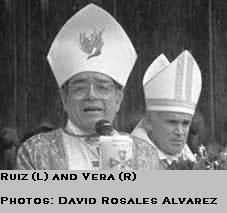 When Don Samuel, Bishop Samuel Ruiz Garcia of San Crisobal, Chiapas retired, it was assumed his co-adjuntor, Bishop Raul Vera would replace him.
Don Samuel, sometimes known as “the Red Bishop” managed to annoy the Vatican and the Mexican government with his insistance that the Church be on the side of the people… his people being the Mayan Indians. He was one of the last of the Liberation Theologians (who insisted they had the right to use social and economic analysis as tools for developing religious teachings, and who see Jesus as “liberator of the poor”) that had been around since the 1930s, but in Latin America was especially associated with the documents and actions taken by Bishops who attended a church conference in in Medellin, Colombia in 1968.
 In the tradition of the first bishop of Chiapas, Bartolomé de las Casas (America’s first investigative reporter, and the inventor of actuary sciences, las Casas used statistical data to discover what happened to economically exploited people. They died. And he wrote about it. And sent his finding to the Pope), Ruiz, too, took the “Indian” side in the 500 year old conflict between the Mayans and their economic overlords. As Bishop, Las Casas unleased the Spanish Inquisition on abusive landlords. Ruiz doesn’t have that kind of power, and the Mexican Revolution swept away the old haciendas, but abuse of the Mayans by the financial powers in the region (and, in the NAFTA era, by outsiders as well) continues to this day. Speaking, writing, and making Church-connected resources (lawyers, agronomists, meeting halls, etc.) obviously didn’t endear the Bishop to the local powers-that-be.
John-Paul II, coming to the Papacy in 1978, though thought to be fairly “liberal” as Popes go, saw Liberation Theology as a serious threat. Having spent much of his career fighting Communists in his native Poland, the Pope was determined to stamp out what he saw as “Marxist influence” in the Church.
In 1993, two constitutional changes in Mexico upped the pressure. The ejitals — the traditional collective farms that had been made given a legal basis and became self-governing communities after the Revolution — were decollectived and turned into agrian co-ops with individual owners. Indebted farmers were forced to sell off property to outsiders. Secondly, the Consitution changed the Church-State relationship, paving the way for direct Vatican control over their Mexican clerics.
After Don Samuel went too far... both in the eyes of the pro-NAFTA Salinas Administration and in John-Paull II’s anti-Marxist worldview … when he openly backed the Zapatistas after they erupted on the scene in San Crisobal in October 1994. However, given that the Zapatistas could trust Don Samuel, and his status as a high-ranking cleric made him acceptable to the conservatives, and because the Government really had no choice, the Bishop was the chief negotiator for ending the uprising and for developing the San Andreas Accords, which were added to the Mexican Consititution to legitimize the rights of Indigenous Communities.
[Personally, I disagree with the Accords. They recognize indigenous persons as members of communities, rather than as independent citizens, which seems to give some citizens more autonomy than others]
Ruiz had been forced to name a “conservative” coadjunctor (assistant Bishop), Raul Vera in 1997. To everyone’s suprise, and to the delight of some, the conservative Vera converted (if that’s the right word to use) to Ruiz’ position. He condemned the Mexican state for violence in Acteal (where 45 indigenous protesters were killed) and embarassed the Mexican government during a speech to his fellow priests in Spain.
The Vatican, meanwhile, hoping to strengthen its still new diplomatic ties with the Republic, used a murky theological dispute to force Ruiz and Vera out of their posts in Chiapas. It’s common among the Mayans for wives to share the dignity of their husband’s offices. In Chaipas, where there has been a shortage of priests for centuries, deacons — a low ranking cleric, who can perform some of the offices of the celebate (and rare) priests — stand in for priests in many communities.
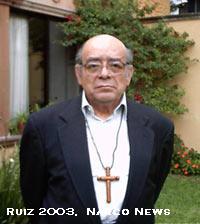 It was unclear at the time whether the Bishops could ordain deacons — AND THEIR WIVES — as co-deacons (a uniquely local position), but the two bishops did. However, Ruiz was 75 years old, which meant the Church could ask for his retirement, thus avoiding a public scandal over the matter. Now in his 80s, as “Emeritus Bishop” and shunted off the clerical stage, he is free to act as a negotiator in political/social disputes, write and otherwise make a nuisance of himself… the Zapatistas sometimes refer to him as “Comandante Samuel.”
Church protocol, and 500 years of Chiapas precedent, would have meant Raul Vera would become the new presiding bishop. Over both Mayan and international protests, however, Vera was transferred to the northern (and more orthodox, conservatively Catholic) diocese of Saltillo. In the northern city (about 4 hours from Laredo, Texas) it was “assumed” the Bishop could do no harm. Or much of anything.
At the invitation of the Bishop of Oaxaca, Vega showed up to negotiate for the APPO earlier this summer. Somewhat insulated from the Vatican (he is a Dominican priest, who answers to his own order’s Latin American superior, who in turn answers to a world-wide superior, who answers to the Pope. And his order has a long tradition of doing things their own way, and of relative independence), Vera still ministers to HIS people.
His people are now the disenfranchized of Coahuila… and beyond. In Lima Peru, where he was attending a Dominican conference, he attacked neo-liberalism and globalization, as reported by Barbara J. Fraser of Catholic News Service:
From his vantage point 170 miles south of the U.S. border, Bishop Raul Vera Lopez of Saltillo, Mexico, sees the people who pass through his diocese on their way to seek work in the United States as testimony to decades of failed economic policy in Latin America.The migrants from Guatemala, Honduras, El Salvador and places like the southern Mexican region of Chiapas, where the bishop worked in the 1990s, are victims of “a deliberately exclusive economy that makes an option for big business and excludes everyone else,” he said.“It is no longer a matter of marginalizing them — it’s exclusion,” he said.Despite decades of loans and economic adjustment packages — and more recently economic growth — more than 40 percent of Latin Americans still live in poverty.…“A new president can take office with great promises and plans but be unable to fulfill them because of the terrible conditions imposed by the global economy and requirements that macroeconomic figures be kept at a certain level,” he said. “This means favoring capital growth and generally neglecting social responsibilities.”In that sense, he said, the region has changed little — and for the worse — since the second general conference of Latin American bishops in Medellin, Colombia, in 1968, when the region’s church leaders declared their “preferential option for the poor.”
Latin America today is “in a political and social situation even worse than the one that existed at the time of Medellin,” Bishop Vera said.
The State Legislature of Coahuila, meeting within sight of the Cathedral, shocked everyone when it enacted a “Civil Unions” bill that legalized same-sex relationships. The bill came in “under the radar” and no one expected it to pass in a conservative, “Catholic” State. But then, Conservative Catholics usually don’t have radical Bishops:
While Vera insists that “two women or two men cannot get married,” he also sees gays as a vulnerable minority.“We cannot be arch-conservatives and say, ‘Don’t do that,’ ” Vera said. “Today we live in a society that is composed in a different way. There are people who do not want to marry under the law or in the church. They need legal protection. I should not abandon these people.”
Vera’s stance outrages conservatives.
“We are dealing a death blow to the family,” said Esther Quintana, state president of the conservative National Action Party, or PAN.
Nope, Esther… only the old guard. Like most writers on Mexico, I’ve adopted the anti-clerical tradition. But, within the anti-clerical tradition, there’s the anti-anti-clerical tradition that cheers on the 500 years of radical Chiapas bishops.
Felipe Calderón Obrador
Political reporter and editor Jorge Zepeda Patterson and Chilango magazine’s Salvador Camarena have co-written “El presidente electo” on the past and future Felipe Calderón. Kelly Arthur Garrett (Zepeda’s only peer when it comes to an indepth knowledge of Mexican politics) reviewed the new book for the Mexico City Herald. They recommend what I’ve suspected Calderón would be forced to do anyway… adopt AMLO’s program:
Mexican poverty is so bad that when the percentage of the poorest of the poor dropped from 22.5 percent to 20.3 percent, Fox hailed it as a vindication of his administration’s policies. The truth, of course, is that with population growth, the raw number of Mexicans living in abject poverty was and is rising.
But inequality — the dry tinder of social unrest — is even worse. Zepeda points out that European countries have nowhere near the poverty Mexico has, but they don’t have a Carlos Slim either.
The arithmetic tells us that the richest 10 percent in Mexico get 40 percent of the economic pie; the poorest 10 percent get about one percent. Zepeda provides another way of looking at that shocking statistic: If an extra million pesos were magically injected into the Mexican economy tomorrow, the richest 10 percent would suck up 400,000 of those pesos, while the poorest 10 percent would divvy up 13,000.
In that scenario, poverty would have declined a bit, since the poorest 10 million or so Mexicans would each have a few pesos more. But inequality would have increased.
Indeed, things worked that way in real life during the Fox administration. We all remember that GDP didn’t grow much during the first four years. Neither did inequality. But when GDP finally started to inch up, so did inequality. Damned if you do, damned if you don’t.
Can Calderón grow the economy? Better to ask if he can create an economy at all.
As everybody knows, Mexico has been surviving on three undependable resources — high petroleum prices, dollars sent home by emigrants, and a recently dynamic U.S. economy. Zepeda adds a fourth source — the narcodollars that flood poor communities, bringing in perhaps as much wealth as the drug cartels cost the nation in lost investment and tourism.
The current balance can’t be sustained forever, obviously, and Zepeda sees Calderón’s best course of action being to rein in, perhaps via some kind of pact, the monopolies and oligarchies that are strangling the legitimate economy. At the same time, he needs to upgrade social programs for the poor from cosmetic to high-impact.
Will he? López Obrador proposed both those things during the campaign and was called “anti-business” for the first idea and “a danger to the nation” for the second. But elections are one thing, a successful presidency quite another. If taking on the powerful, most of whom supported his candidacy, is the only path to investment, jobs, crime reduction and environmental salvation, why not do it?
Biking bureaucrats
THIS IS COOL!!!
(Hector Molina, El Universal, 4-March-2007 my translation)
Starting in April, Mexico City civil servants will have to ride a bicycle to work, at least the first Monday of every month, under an executive order signed by Federal District Governor Marcelo Ebrard.
The measure is designed to set an example for others, and to foment bicycle use in the Capital. He announced the order during the inaguaration of a new bike-rental station for the city’s “cylcpista” (bicycle road). Altogether, four “cicloestaciones” are planned, which will provide free service for civil servants in the area, or rent bikes at 35 pesos an hour or 50 pesos per day.
Next year, the city plans to construct cyclopistas throughout Mexico City. The first to be built will extend the route already existing on Paseo de la Refoma to Colonia Condessa. Preliminary plans call for connections with the Metro, and the Insurgentes and Eje 4 South Metrobus lines. In addition, plans are being drawn up to allow bicycles on the Metro and RTP buses Monday through Friday during off-peak hours. Bicycles are presently only allowed on the Metro on Sunday.
In agreement with the secretary of the Environment, Marta Delgado, the STC (Sistema de Transporte Colectivo, local transport authority) is analyzing their schedule to facilite bicycle commuters. Among the options under consideration are separate Metro wagons for bicycles, although these could not be used during peak hours. Another is to provide tax incentives to companies that locate near employee’s homes. This benefit would be available to branch operations of businesses like supermarkets and chain restaurants. One hope is that employees will be encouraged to move closer to work, cutting down on commuter traffic, or be able to get to and from work… by bike.
There are a few civil servants — the mailmen and some cops who you’re used to seeing on bikes, but you also see delivery guys carrying the most amazing stuff (trays of food, sides of beef, two or three meter stacks of magazines), the knife-grinders with their bike-powered honing wheels, kids, pedicabs and a few commuters on bikes.
Besides cutting down on the god-awful traffic and the air pollution… and doing it’s bit for global warming, anyone who has ever had to deal with a civil servant who asks, “you mean I have to get out of my chair, leave my desk, walk across the room and look in the filing cabinet?” should cheer.
I’ve wanted to run this picture forever… now’s my chance. You don’t see “bike v. car… bike wins” pictures too often:

Arizona attack #5
No wonder the feds are puzzled… the attacks are on immigrants, not smugglers. I don’t think anyone is putting together the simple fact that making it harder to work and return home means people are having to bring their relatives here… and MORE security is going to mean MORE “illegal immigants”… and, being illegal, more smugglers trying to get into the business.
UNLESS it’s something else. This latest one could be smuggers, or could be vigilantes (at least the feds have finally started to entertain the idea, which seemed fairly obvious from the get-go), or could be something else entirely. No one really seems to know.
Attacks on smugglers puzzle feds
Daniel González, The Arizona RepublicMar. 1, 2007 12:00 AM
Tighter border security is fueling a resurgence of violent attacks on immigrant smugglers in Arizona that have killed four people and put law enforcement officials on high alert.
Law enforcement officials don’t know whether the attacks are related, but the incidents underscore that violence linked to the smuggling trade remains a prevalent problem in Arizona, despite stepped-up efforts to combat illegal immigration.
There have been five incidents in the past month involving armed men attacking vehicles possibly transporting undocumented immigrants to drophouses in Phoenix. The most recent attack took place Sunday, when three armed men hijacked a van and kidnapped five passengers at a stoplight in Ahwatukee Foothills….
The attackers could be border gangs known as bajadores, who rip off loads of illegal immigrants from smugglers and hold them for ransom, Peña said. Or they could be rival groups battling to control smuggling routes.
Federal officials also are investigating whether at least one attack near Eloy was carried out by anti-immigrant vigilantes. Four gunmen, who wore military fatigues, berets and spoke English, killed the driver of a truck carrying undocumented immigrants.
Is the U.S. becoming Mexico or vise-versa?
Think Progress back in January 2006 from Bloomberg:
Federal authorities issued 21 citations last year for a build-up of combustible materials at the West Virginia mine where 12 men died, according to U.S. Labor Department statistics.
The mining explosion should call attention to the Bush administration’s inadequate enforcement of federal mining safety regulations. Mining safety in the U.S. has improved dramatically since the Mining Safety and Health Act was signed in 1977. By the time that President Clinton signed the International Labor Organization’s Convention 176 concerning safety and health in mines, mining deaths dropped from 425 in 1970 to 85 in 2000.
Phil Smith, the communications director for the United Mine Workers of America, said that while citations have been issued, the fines assessed for safety violations are too small to force large corporations to make improvements. “The problem with the current laws is enforcement.” According to an AFL-CIO analysis, the Bush administration cut 170 positions from federal Mine Safety and Health Administration (MSHA) and has not proposed a single new mine-safety standard or rule during its tenure…
The highest penalty of the more than 200 citations received last year by the Sago mine was $878. But that was the exception. Most of the others were $250 or $60. At that rate, it’s hardly a good business decision to even bother fixing anything. And the administration has shut down any new worker protection standards in OSHA and MSHA.
Mexico City Herald (26 Feb 2007):
NUEVA ROSITA, Coahuila – In the six years leading up to the explosion that killed 65 miners in the Pasta de Conchos coal mine, the federal government found 188 safety violations. It appears as though many of these violations these were never fixed.
According to files from the Labor Secretariat obtained by EL UNIVERSAL, inspectors documented numerous safety violations in the mine, from broken glass in the locker room to faulty lighting and ventilation systems and inadequate equipment for the workers.
The documents also show that federal authorities did not follow through to ensure that Minera México, a subsidiary of mining giant Grupo México, corrected the safety problems.
A year ago, an explosion ripped through the mine, killing 65 miners. The exact cause of the explosion has still not been determined.
Work to recover the bodies has been slow due to lingering pockets of methane gas that prevent the use of power tools. Only two bodies have been recovered.
Inspectors´ visits documented an ever-growing list of problems from 2001 to 2003.
Grupo México has repeatedly denied that any safety violations occurred in the mine.
“Labor officials´ visits generate a great number of observations,” read a statement from Grupo México in response to the report. “However, not all of these observations refer to unfulfilled security regulations, but rather to operation details.”
Grupo México also said it had complied with all of the government´s observations.
However, specialists from the Mexican Bishops´ Council, which is helping the families of the blast victims with legal assistance, say that the Labor Secretariat report provides no evidence that the violations were ever corrected.
A special prosecutor for the case is seeking charges of negligent homicide against 11 officials – six from the Labor Secretariat and five from Grupo México.
No word on any mine owners or Bureau of Mine Safety officials being charged with … anything.
Come fly with me
Time for the annual invasion of the gringos… don’t get stupid and tossed out of El Palladium:
ACAPULCO, Mexico, March 3 (Reuters) – U.S. spring-breakers are guzzling beers and slamming back tequilas in the Mexican Pacific beach resort of Acapulco, unfazed by a violent drug war that has killed police and left body parts strewn about town.
Famed for its cliff divers and sweeping bay, the once glamorous resort city has seen daytime shootouts between police and drug hit men who have dumped severed heads in public as part of turf battles that killed 2,000 people in Mexico last year.
Gunmen disguised as soldiers killed seven people in an attack on two police stations in February and heavily armed federal police now patrol the resort day and night as part of a nationwide crackdown by new President Felipe Calderon.
But with the beachfront strip largely unaffected by the violence, college students are packing hotels and vast dance clubs in what officials hope will be record numbers, most of them blissfully unaware of the drug war raging nearby.
“We don’t necessarily think about any of that, it’s more just coming down here and having a good time,” Western Michigan University student Caitlin Murray said at the Copacabana hotel’s pool, scene of wet T-shirt and beer-drinking contests.
Hundreds of students splashed, danced and yelled to hip-hop music behind her as youths in giant boxing gloves slugged it out in a ring for a top prize of $100 and a bottle of tequila.
Nearby, federal police with machine guns frisked drivers and searched cars for drugs and arms at one of many checkpoints aimed at keeping tourists safe from Acapulco’s darker side.
If Caitlan (and Garth and Wayne) would put down their beer googles long enough to notice, Acapulco is a seaport with ¾ million people living there, most of whom are the long-time descendants of smugglers. They go about their business — and their shady business — without ever coming into puking range of most Spring Breakers. Or tourists.
Ever since the ex-sailor turned monk, turned accidental sailor (the ship’s pilot died and he was along as chaplain) Andres de Urdaneta discovered a “back door” to the Philippines in the 1560s, the place has made its living from transshipments, often illegal ones. Until 1814, the Philippines were part of Mexico, tied to the “mother country” through the Manilla galleons out of Acapulco. A lot of the locals are of Filipino descent (which, in the totally illogical racial system of the Bourbon era, made them “negros” and not “chinos”… who, to confuse things, were Mexicans of indigenous and African descent). Mexican culture has a Spanish overlay on an indigenous one. Filipino culture and art sometimes looks Mexican, having not a Spanish, but a Mexican, overlay on its Malay culture. It’s through Acapulco that the Philippines became a Catholic country, the missionaries and monks shutting back and forth through the port.
That’s a clumsy way to run a colony, but given the transportation problems of the times, it was easier sailing out of Cadiz. There were some administrative problems. In the late 1500s, a ghost took up sentry duty in front of the Viceroy’s Palace in Mexico City. People who met the ghost said he was Filipino. SOMEBODY had to let the Viceroy know there’d been an epidemic in Manilla and the new Governor he’d sent out a few months earlier was dead. I guess protocol is pretty strict in the next world too… why the dead Governor’s ghost could just report in …. um… person (spirit?) isn’t part of the story.
The long distance from Spain (and a long-long distance from the afterlife) was an open invitation to creative business ventures. Up into the late 1700s, Spanish colonies could only trade with the mother country. But, given the chance to acquire silks, spices, gems, and knick-knacks from China at cut-rate prices, Acapulco was a smuggler’s paradise. It was such a great business opportunity that the Mexican “piece of eight” became the preferred foreign exchange medium throughout the far east.
Even after Mexican independence in 1821 (and an American pirate played an important role in Acapulco history during the War of Independence), Acapulco remained Mexico’s Pacific port… and main smuggling outlet… inlet… whatever. Until San Francisco became the main Far Eastern port, it kept its importance. And after.
 An Italian pirate sold Vicente Guerrero to dictator Antonio Bustamante when ex-President Guerrero was looking for passage out of the country, after his overthow. It was the early 19th century version of “swiftboating.’ Guerrero, who was of African and and European descent (guys like Barack Obama are no novelty in Mexico) was a little too much on the people’s side. And he’d pissed off the U.S. when he freed all Mexican slaves (and started accepting U.S. slaves who would jump ship in Acapulco and elsewhere, having their own ideas about property rights… like not being somebody else’s property). Bustamante’s supporters started a campaign to discredit Guerrero claiming that a head wound he’d received during the War of Independence left him a little wacky. The conservatives in the legislature were easily convinced to impeach Guerrero on the grounds that he was insane. Maybe he was, trusting foreign pirates in Acapulco.
In the early 19th century there were all kinds of revolutions up and down the Pacific to keep the gun trade lucrative (not to mention Mexican taxes, that made Asian goods profitable — porecelins then, cheap electronics now).
California’s enterprising trans-Pacific informal traders (i.e., pirates) had to work somewhere, especially after the gold rush led to more government control in San Francisco. During both the French intervention and the Revolution, it was a favored location for bringing guns into Mexico. And, opium had to come into the Americas from somewhere. After poppy production started in the hills of Guerrero, it had to go out somewhere, Mexico not being a particularly large market (besides, it was legal, and what was the fun in that?). During Prohibition, it shipped a lot of whisky to thirsty gringos. And now… other transshipments go through.
It’s always been a decadent place, and for a while was a favorite of the “jet set” (jets being new and all). Away from the American gossip columnists, and — unlike Las Vegas — having water, it was the place to go for sleazy affairs and cheapy Mexican divorces in the 50s. What do you think Frank was singing about, the joys of air travel?
Before we show you today’s tourists, here’s Frank and (this being a Mexican site and all) Luis Miguel flying away…
OK… now here’s what los springbreakers really come for —

Party – and smuggle on – dudes!