¡Gringos flojos!
I don’t drink, but geeze, even if you’re shit-faced, how hard is it to cut up some limes… uh, well BEFORE you start drinking, I mean…
(The Business Journal of [where else?] Milwaukee, 6 Feb 2007):
Miller Brewing Co. is set to introduce a Mexican-style beer, Miller Chill, that it intends to market to a broad audience.
“We’re trying to court the market in general, not just Hispanics,” Miller spokesman Pete Marino said.
The new brew, which is a chelada-style beer that comes infused with salt and lime, will be test marketed beginning in March.
“This will be Miller’s take on a Mexican classic,” Marino said.
…
At 110 calories, Miller Chill will be marketed as a light beer that the Milwaukee-based brewer hopes will compete with mainstream beers such as Bud Light, Budweiser and Coors Light, Marino said.
In other words, crappy “light beer” with lime flavoring. ¡Qué barbaro!
Sombrero tip to The Latin Americanist)

Diego Rivera rides again… on the Metro
 One of the greatest things about Mexican artists is that they aren’t artistes. Except for silly Frida Kahlo and a few of the 19th century academics, they’ve always been just folks like the rest of us. Folks with a gift, to be sure, but from… and of… the people. Supposedly, Siqueiros, Rivera and Orozco argued about the need for the artist to teach the masses. Orozco bought some cooking pots from a passing ambulante, presented them to his fellow muralists and said, “The artists must learn from the masses.”
Art is not for those who can afford the galleries. Why shouldn’t some of the best exhibits in Mexico City only cost two pesos? Ride the Metro. You never know what you’ll see or find. Besides the people, I mean.
 There’s the fossilized mammoth at Talismán (it’s advertised… the stop’s glyph is a Mammoth), the mosaics on Linea B (Tepito’s is fun, showing off the bravado of el barrio bravo), the scale model of Tenotichtlan in Zocalo Station (and the publisher’s tunnel between Zocalo and Pino Suarez, with parts of an Aztec temple in the corridor), the science exhibits and the planetarium at La Raza. The temporary art exhibits are sometimes better than what you’d find ducking in and out of the high falutin’ galleries in Zona Rosa or Coyoacán. There was a fun one featuring dinasours made of industrial tubing in the rotunda at San Lázaro for a time, and there were several cutting edge displays at Cuarto Caminos — featuring “Missing Person” posters that were good enough to annoy middle-class suburbanites and had to be moved.
 So, when I read this, I said… COOOLLL!
Six Artists take on Mexico’s problems (my translation)
México.- An intergeneration collective of six artists take on contemporary problems in a series of murals. Entitled “Artist’s Denunciations” the six panels by six different artists deal with rural soil degradation, underfinancing for culture, migration, illegal commerce, extreme poverty and narcotics trafficing.
Work on the project began today, and will continue through the end of the month, as the artists paint the murals in public, eventually covering the central display cases in Zócalo Station (Metro Line 2).
The three artists who started work today were the object of curious stares from passer-bys, as they donned white uniforms to began installing six blank 1.80 meter wide canvases that cover the plate glass windowes, and started to apply their first brushstrokes.
Unaware of what was planned, the public began to watch with appreciation the the serveral techniques and movements of the work in progress. The groups’ coordinator, and one of the painters, Juan Carlos Garcés, said that “Communications media have a duty to inform the public of serious problems in the country.”
He added, “ Too many artists have lost the view that painting is a resource which also serve to tell the people not to be indifferent, and which speaks to the present adversity of thousands of Mexicans.
Antonio Cruz said, “Today’s painters do landscapes. They’ve forgetten they are heirs to the great muralists of the 50s, Diego Rivera, José Clemente Orozco and David Alfaro Siqueiros, that made “portraits” of the cournty’s reality.”
For this project, the people will be able to meet with the artists, criticize the work, and exchange ideas. According to project coordinator Juan Carlos Garcés, the work is an graphic interpretation by the two generations, uniting in artistic creativitity to bring national problems into public consciousness.
Little by little, with different painters using different techniques, three of the six canvases started to take on the form, texture and composition of their chosen theme.
Isaac Holoschutz, one of the first three artists, immediately took up his brush and began drawing green, white, black and yellow human figures, part of his work on narcotics trafficing.
Carlos Estevan García, who has taken on the theme of Extreme Poverty, will use starkly outlined figures to show the present situation in the country.
Juan Carlos Garcés called on artists to join in the project, and use painting to come to know the nation’s problems.
Besides Garcés, 50, the collective includes Antonio Cruz, 52, Cristóbal Flores, 21, Bernardo Franco, 19, Carlos Estevan García, 25, and Isaac Holoschutz, 43.
Cruz’s piece, “El Campo” (“The Field”) expresses the effects of 70 years of “letting erosion turn the earth to sterile, useless dust, with harvests monopolized before planting.” Cruz said that the character and composition of the colors were meant to further his artistic ends.
Cristóbal Flores Carmona’s “El Presupuesto Bajo para la Cultura” (“The low cultural budget”) is in a lyrical style, expressing the thoughts, fears, hopes, dreams, fantasies and hopes for a time when there is a whole society. Flores’ work turns on emotion, and a strong sense of perspective and composition.
Bernardo Franco, working in a frankly fantastical mode, with stylized and imaginary figures is creating a retrospective on migration. Juan Carlos Garcés is using a combination of resins and other materials to give volume to “El Comercio Informal”.
The project is being funded by the Board of Directors of the Mexican Society of Geography and Statistics (Junta Directiva Nacional de la Sociedad Mexicana de Geografía y Estadística) in collaboration with the Collective Transit System( Sistema de Transporte Colectivo (Metro)).
Notimex
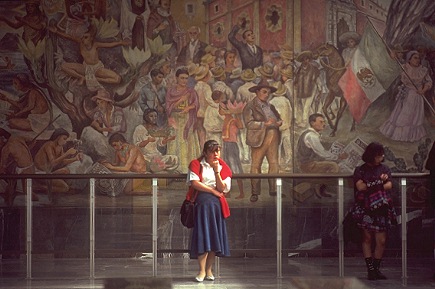
“University Station” ©2001, Edward Dawson
Another rascally gringo Mexican hero
As Waylon Jennings sang “She’s a good-hearted woman in love with a good-timin’ man…”
Retired bank robber Oscar Creighton, prized for his expertise with dynamite, joined the Revolution for love. Not of Villa, but for a good woman. The story is that Creighton’s girlfriend wouldn’t marry him unless he proved he could perform good, and selfless, deeds. The Mexican Revolution (and Pancho Villa) gave him a chance to put his particular skills to use for the betterment of humanity. He died heroically in battle, and after the Revolution was buried in the United States with full military honors.
That’s all I had to say on Oscar Creighton in my book . It’s a good story… a great story… but, apparently it isn’t history. I’d run across mention of Creighton in a few books on the Pancho Villa, I think my source must have been enamoured by the story and not fact-checked this minor player in the Revolution as carefully as he should have.
The “real story” (or, the one I found with better documentations anyway) still would make a great movie. Creighton was a run-away husband… and bank embezzler… and Mexican hero. His military burial was much against the wishes of the U.S. government, but coming from a good old New England family, Oscar’s story made it into a very nice geneological site, and will mean a little bit of rewriting for me. Of well…I’ve finally got most of the draft of that book I kept putting off out to readers (thanks Mom, and your comadres whose ample time I’m taking up) and sample chapters out for review.
So, thanks to Biography of Oscar Merrit Wheelock[alias Oscar G. Creighton] maybe I’ll have to add another paragraph or two.
Oscar Merritt Wheelock, alias Oscar G. Creighton “the dynamite devil”, is noted for his short life of intrigue and bank robbery in the United States, followed by a burst of heroism during his short but highly publicized participation in the Mexican Revolution. His feats of courage and bravery were publicized internationally, and his efforts contributed directly to the success of the revolt. Wheelock lost his life in the Mexican Revolution, having died a hero. In 1951 he was awarded the Legion Of Honor by the Mexican government; but in the United States his acts of embezzlement and bank robbery cast him as a common criminal. The facts of this man’s life can be found in archives, newspapers, and vital records of the time; but the motives that led him to abandon a middle class life for a life of crime and war will remain a mystery forever.

So… who do you think should play Oscar in the movie?
¡Cabrones oaxacaños!
Geeze, some people think I’m a little harsh on “clueless gringos (and Canadians) in Mexico. I’m Mother Theresa next to “Speed” and the “Doctor”:
I live in Mexico (I think we’ve covered that but, review is always good, right?), and I would say that the reverse of this scenario is true. In my experience, there aren’t ENOUGH arrests of gringos: the fucking honkies have the run of the place. Let me elaborate:
Walking around the centro here on a given day you might come across any one (or all) of the following scenarios:
1. An Italian woman, who, it seems, is so broke that she made her own pants out of things she found in her hostel’s garbage, is selling ugly jewelry in the andador.
2. A young American man is busking Nirvana songs to the disinterested in the zócalo. Just ten pesos away from his lithium prescription. “I feel stupid, and contagious” indeed.
3. And, my personal favourite, an Argentine is holding up traffic at a streetlight to ask drivers for money for his juggling. (The Italian chick made his pants)
What do these three hippies have in common (other than the smell)? All three are working illegally in Mexico. Police are not hassling them. No one “corrupt” is giving them a hard time whatsoever. Because, you see, Mexican authorities don’t want to fuck with tourists unless they absolutely have to. Tourism is this country’s #2 industry. (Western Union money from relatives working in the US is #1, Corona tank-top sales a distant #3). In my personal “Dream Mexico”, all three of these case studies would be locked up with Peter Kimber until Mom and Dad sent plane tickets home but, of course, who listens to me?
The two güeys who write “Sur Real Oaxaca” are a couple of jaundiced (or maybe it was the mushrooms) gringos along the Oaxaca Coast, somewhat in the same spirit as the always readable Fred Reed, who comes across as Oliver North channelling the spirit of Hunter S. Thompson in the relaxed atmosphere of Lake Chapala.
There are more important threats than Al Quaida
(Updated 16-Feb)
This is nonsense, but there is a real threat to Mexico looming (besides GM Corn):
MEXICO CITY (Reuters) – Mexico said on Wednesday its crude oil installations were safe, after a Saudi wing of al Qaeda called for attacks on U.S. oil sources around the world.
Mexico, which ships about 1.4 million barrels per day of crude to the United States, tightened security around its Gulf of Mexico oil rigs in 2005 in line with international norms, a spokeswoman at state-run oil monopoly Pemex said.
…
The Mexican border is seen as a soft point in the U.S. war on terror. Hundreds of thousands of illegal immigrants cross it annually but reports in recent years about Arab terrorists attempting to enter the United States from Mexico have turned out to be false.
Blogotitlan wonders if this “new” Al Quada “theat” doesn’t have more to do with immigration, and U.S. interests than anything in Mexico:
En preludio a la visita de Michael Chertoff, secretario de Seguridad Nacional de EU, se difundieron presuntas amenazas de Al Qaeda contra instalaciones petroleras de México. Buena ocasión para que los gringos se ofrezcan a vigilar yacimientos.
This is the real threat:
Cactus-eating moth reaches Mexico
Buena ocasión para que los gringos se ofrezcan a vigilar yacimientos.
© 2007 The Associated Press
MEXICO CITY — A non-native moth whose larvae threaten to decimate Mexico’s emblematic flat-leafed cactus has invaded the mainland for the first time, experts said Wednesday, an event that authorities have feared for decades.
Lab reports indicated that at least one moth trapped in the resort city of Cancun since January is a South American “nopal moth,” a species detected last year off the coast on Isla Mujeres, said Hector Sanchez, Mexico’s director of plant safety.
… the moths probably flew across the narrow strait that separates the island from Mexico’s Caribbean coast or caught a ride on a ferry. He added that workers have set out more special moth traps and are inspecting the region’s cacti.
Known as Cactoblastis Cactorum and native to Argentina, the moth was exported to Australia, South Africa and islands throughout the Caribbean starting in the 1920s to eradicate cacti that occupied valuable farm land.
But in countries like Mexico — where flat-leafed Opuntia cactuses known as “nopales” are a food source, an important part of the ecosystem and a national emblem — the moth poses a major threat.
About 50,000 Mexican farm families make a living from the $100 million annual market for boiled, tender cactus leaves and prickly pear fruit.
Scientists say the moths were probably carried onto Isla Mujeres by visitors or blown there by a hurricane from nearby Caribbean islands, where they have been sighted since the 1950s.
The moths — whose larvae eat away the cacti’s insides — also appeared in the United States in 1989.

(Genetically Modififed) Corn-holing
John Ross in Counterpunch:
Rodrigo had another theory: “the tortilla is Mexico but now they want us to eat white bread like the gringos.” Others see even more sinister motives behind the sudden spike in tortilla prices which the government of freshman president Felipe Calderon blames on short supply and high prices for white and yellow corn  – the opening of the Mexican milpa or corn patch to genetically modified corn.
World corn prices are currently at an all-time high due to burgeoning interest in ethanol production as a petroleum substitute. In Mexico the price of corn has been pushed upwards by the cost of diesel and petrochemical fertilizers and pesticides despite the fact that Mexico is a major oil producer. Crop failures due to drought, flooding, and even ice storms have contributed to the price surge. But whatever the immediate causes, the dismantlement of government agricultural programs and the brutal impacts of the North American Free Trade Agreement have deepened the crisis in Mexican corn production.
Competing with highly subsidized U.S. farmers is driving their Mexican counterparts into bankruptcy. Whereas south of the border, guaranteed prices for farmers’ crops is a thing of the past, corporate corn growers north of the Rio Bravo can receive up to $21,000 an acre in subsidies from their government, enabling them to dump their corn over the border at 80% of cost. The impact of this inundation has been to force 6,000,000 farmers and their families here to abandon their plots and leap into the migration stream, according to a 2004 Carnegie Endowment study.
…
A great deal of the 36,000,000 tons of corn Mexico has imported from the U.S. in the past six years is genetically modified – 40% to 60% estimates the environmental group Greenpeace, reasoning that U.S. producers, barred from dealing GMO corn in Europe and Japan are using Mexico as a dumping ground for the grain.
GMO corn began pouring into Mexico in 1998 and by 2001 was being detected in the remote sierras of Oaxaca and Puebla, a region in which maize was first domesticated seven millenniums ago – both BT and Starlink strains (Monsanto and Novartis brands) were found in Oaxaca’s Sierra de Juarez in 2001 and 2002. 11 out of 22 corn-growing regions in the two states registered readings of contamination as high as 60% in a 2002 government study that was suppressed by the Secretary of Agriculture.
Drug flash backs at the U.S. Embassy
With the Constitutional President having at one point run on the slogan “un mano duro para Mexico” (I think the U.S. spin doctors toned it down a bit), we’ve been paying attention to the military and punitive side of the “war on drugs”, something that fits OUR style.
When I started posting daily, back in May 2005, the U.S. media had lost their taste for Vincente Fox, and were desperately trying to recover from having spent years trying to paint Lopez Obrador as a “fiery leftist”… the big issues were the immigration march and an iniative from the Fox administration to restrict drug possession, misreported and stupidly spun by people who had no idea of what they were talking about as if this had something to do with the tourism industry.
That law would have tightened the restrictions on possession for medical necessity (an addict is a public health problem in Mexico, not a criminal), and given more power to local police and prosecutors. As I wrote back then:
This isn’t a particularly radical law — Colombia’s possession laws are much more lenient. And for much the same reason. Drug users are a public health problem and a public nuisance. Drug trafficers are unfettered capitalists at their worst. They weren’t much of a problem when they stuck to bumping each other off. It’s their nasty habit of tossing hand grenades at reporters and cops that make them obnoxious. As in horse-shows, “close” is too damn close when it comes to grenades.
The laws then (and now) never defined what was “medically necessary”. The proposed law did. There was concern from the left over giving more power to local police, and from the Church (and some on the right) that this might somehow “encourage” drug use. Even so, the changes actually made it through Congress… only to be faced with a rare Presidential veto:
Fox’s veto was always seen as a favor to the world’s largest consumer nation. And, overriding a Presidential veto is very rare here. Fox will be out of office in December, and it was always assumed here that the bill will be introduced in the next Congressional session.
…Mexico doesn’t have much reason to trust, or listen to Washington right now. And — although Felipe Calderón continues to support Fox’s veto — either the PANistas realize his support may be evaporting, or, being “lame ducks” themselves, see no reason not to push through the reforms sooner, rather than later.
While not having to deal (immediately) with AMLO, FeCal’s U.S. style punitive expedition against the narcos is beginning to look counterproductive (as the left warned it would be). But, given that the punative model is the only one that’s going to get past this President, I guess this is the best “sooner, rather than later” we can expect for now:
Updated version drops a clause allowing users to skirt punishment
Houston Chronicle (registration required)
By Marion Lloyd
MEXICO CITY — A new drug-abuse bill is making its way through the Mexican Senate, just months after a more liberal measure was scrapped amid pressure from Washington.
The proposed legislation, due to be voted on Wednesday by the Justice and Health committees, drops a clause that would have allowed drug users to escape punishment.
U.S. officials complained that the provision, which they viewed as decriminalization, would have inspired some American tourists to go on drug binges.
The bill, which Mexican officials said is needed to curb a soaring drug problem, would require first-time offenders caught with small quantities to enter mandatory treatment programs.
Second-time offenders would face criminal charges and could serve jail terms.
Street-level drug dealers would face years of imprisonment upon conviction, while traffickers and drug-gang soldiers would come under different laws that specify even longer sentences.
…
But people carrying small quantities of drugs for so-called “personal use” — defined in the bill as 2 grams of marijuana or 40 milligrams of methamphetamine — would escape prosecution, which officials said was a continuation of current policy.
Officials said 2 grams of marijuana would make four cigarettes, and 40 milligrams of methamphetamine is the equivalent of about one pill.
Those quantities are far lower than the amounts permitted in the original bill.
Judith Bryan, a spokeswoman for the U.S. Embassy in Mexico City, declined to comment on the specifics of the new bill but said that “it is obviously of interest to us.”

Uh… Judith, does that mean you want to cop a few joints?
Other than Mexican? Deportees, 1911
At some point, I decided the book I’d started (and abandoned, and restarted and abandoned… and have more or less in the editing process now) was about the effects of foreigners on Mexico since 1524. I’m not writing any sort of “magnus opus” or anything particuarly in-depth, but I was bothered by the lack of information on one of the more important immigrant groups in Mexico… the Chinese.
Just to dump the few notes I had, I set up a quick and dirty blog, hoping someone would pick it up. Someone has.
Scott Parks’ “Chinese in Mexico” is a nicely done site, well worth a visit, and well-worth adding the bits and pieces anyone is able to find on an otherwise nearly unknown story of the Americas.

Mug shots of three Chinese immigrants captured in a sting on smuggling across the U.S.-Mexico border in 1911. Back then, border crackdowns focused on Chinese and other foreigners barred from entering the United States — not on Mexicans and other Latinos. Photo: National Archives, on web at “1965 Immigration Law Changed Face of America” by Jennifer Ludden (National Public Radio)
The frontiers of bureacracy and the frontier bureaucrat
With people like Phyllis Shaffley against it, you can’t help sort of supporting something like The Kansas City Smart Port project. Basically, this is just a giant truck stop and train yard … shipping containers unloaded at Lazaro Cardenas would be driven straight through to Kansas City before stopping for customs and re-deployment through the United States and Canada.
OK, there are some serious corporatist concerns… the port facilities in Lazaro Cardenas are run by the Chinese and these ships will – presumably – be unloading Chinese goods, the manufacturer of which undercuts both U.S. and Mexican businesses… and unloading at Lazaro Cardenas will cut into traffic at Long Beach, the biggest U.S. Pacific commercial port. And, this probably has something to do with the Trans-Texas Corrodor (the proposed ten-lane and two-traintrack route through Texas which, if the feeder goes through the Big Bend means moving … well… basically most of the towns around here – we are where we are because it’s where the passes are, and where the trains can get through the mountains). You know, the kind of stuff we lefy types worry about.
But what’s really got the right-wing loon’s panties in a twist is that the Kansas City SmartPort would include a Mexican Customs Station… according to them, one more step in the Mexification of ‘Murica.
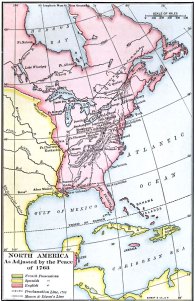 It wouldn’t be the first time the Mexicans were in Missouri. Which had something to do with the successor to the Austrian Crown, which led to the War of Austrian Succession, which somehow led to the Seven Years War, somehow involving Britain and Prussian… and France and Portugal and Saxony, and Spain and the Netherlands all squabbling over colonies around the planet. What we know as the French and Indian Wars was one part of a global stuggle for markets and access to raw materials. Winston Churchill later called it the real “FIRST World War”. It all came to an end in 1763, with the Treaty of Paris, which – among many other things — took Louisiana (at the time extending into today’s Alberta) away from France, turning over everything east of the Mississippi to the British, and the rest to Spain. That put what’s now Missouri in the middle of an overly large Nueva España.
After the American Revolution, the United States of course, controlled the former British territories east of the Mississippi, which added a player to the game. A few new United States citizens, for one reason or another, preferred to move into the Spanish territory (usually involving legal problems). And Missouri was a long, long way from Mexico City… which itself is a long, long way from Spain.
The chief legal and adminstrative officer in the area, as Missouri (and a lot of other states) today, combined the role of judge and administrator. Being a lawyer isn’t strictly a requirement for the elected position, and the royally appointed Syndics weren’t always lawyers either. Especially on the frontier.
Still, even for a rough and ready place like Missouri, a 65 year old bankrupt Protestant who barely spoke Spanish (and could barely read his native English) was an unlikely choice. But, we’re told, the Syndic did an excellent job, rendering opinions based as much on his knowledge of the frontier as on strict adherence to Spanish law. And – because of the communication problems with Spain — if Viceroys were told by the King “do what is prudent”, then the Viceroy could put up with a “prudent” Syndic up in the wild north.
Prudent meant being resourceful. A frontier bureacrat had to be resourceful. The Syndic was, supplementing his income by farming and hunting… and was a tough old geezer. He might not have read up on the nuances of the law, and he supplemented his income by collecting bear skins. His judgements were based on his long experiences with frontiermen and life in the rough backcountry, and, though he was known to be fair, probably the last guy you’d want to deal with if you faced a minor smuggling charge was somebody who once killed a grizzley armed with just a hunting knife.
 Given the huge distances and primitive communications of the time, it took a while to discover that Spain had been taken over by Napoleon. And Napoleon didn’t bother to tell his brother, who he’d made King of Spain, that he’d taken back Louisiana (including Missouri). He certainly didn’t tell the frontier Syndic, who was being paid in land, but hadn’t received clear title as yet.
When Napoleon did finally decide Lousiana was his, he didn’t bother telling the Syndic either… though he sold the whole place to the United States in 1804. While his property claims were worked out, the old guy was out of a job and spend his time hunting. He was known for it anyway… he was in his late 70s, still waiting for his land claims, when he went exploring along the Yellowstone River. He was in his 80s by the time his property claims were worked out, but he had to sell most of his land off immediately to settle old debts.
The travails of a minor Mexican bureaucrat wouldn’t be that important, but it is worth remembering that Mexican bureaucrats in Missouri are nothing new… and Mexican bureaucrats aren’t always forgettable. Walt Disney’s version of American History usually leaves out something… and one thing he never had Fess Parker do was play Daniel Boone, Mexican Syndic.

Dan’l Boone (1734-1820)
American Frontiersman, Mexican Bureaucrat
He kilt a b’ar … or ten or twenty
How long with Mexico’s “surge” last?
U.S. media is reporting on the 60% approval rating Felipe Calderón received in a recent El Universal poll. Less reported was that only 35% of those surveyed support using the military to put down the cartels.
Patrick Corcoran writes for Mexidata.info:
When discussing the violence, people like American Ambassador to Mexico Antonio Garza painted an anarchic picture of a corrupt Mexico, without saying that the violence was a result of actions that the Americans supported. A Mexican could be forgiven for seeing the United States as a fair-weather friend. If drug violence in Mexico gets worse, will Garza temper his remarks with support for Calderon and acknowledgement that he was in favor of the unsuccessful drug operations? Probably not. A basic problem with the war on drugs is that no one knows what to do. There is no combination of steps, no Washington Consensus — however maligned — that provides the strategy to fighting drugs. Calderon can relentlessly pursue druglords to all ends of Mexico, but why would any of us expect this to be anything more than the latest hard jerk in an endless tug-of-war between the government and the cartels. Regardless of changes in tactics — whether in Mexico, Colombia, or the United States — what has always remained constant is the easy availability and low price of drugs in the United States. We can defeat a cartel, but we cannot defeat the cartels.
At last — a U.S. newspaper gets it right
I might quibble with a few points (I’m still bothered by the automatic “70 years of PRI rule” — which was first said by Jesse Helms, by the way. PRI wasn’t organized until 1948, though it included the most of the same people as the previous PRM… which is like saying that the early 19th century Whig Party in the U.S. is today’s Republican Party), but the Almagordo (NM) Daily News’ Managing Editor, Michael Becker wrote what’s probably the best short overview of Mexican politics I’ve read in a long time.
My two minor points — a 60% approval rating for a new president is fairly low. This early in a new Presidency, I’d expect at least an 80% rating. This indicates that Calderón is going to have to do more to coopt the at least 2/3rds of normally leftist voters. Second point: Vincente Fox was not running for President in 1988.
The election of Vicente Fox as president of Mexico in 2000 was a watershed moment for that country. It not only signaled the end of 71 unbroken years of one-party rule by the Partido Revolucionario Institucional, it marked the beginning of serious efforts to address Mexico’s many economic and political problems.
…
As Dan Lund, president of MUND Americas, a consulting firm in Mexico City, said, the PRI was a “big tent” party, encompassing everything from free market advocates to democratic socialists.
In the early 1980s, the center-right broke off to form the Partido Accion Nacional. In 1988, the center-left spun out into the Partido de la Revolucion Democratica, or PRD.
It was the PRD that landed the first blow against the system. It’s presidential candidate and founder, Cuauhtemoc Cardenas, barely lost the 1988 presidential election. Many believe had it not been for electoral fraud, he might have won.
Then, in 2000, the PAN’s Vicente Fox took a convincing win in that year’s election. But Mexico’s Congress was divided among the PRI, PAN and PRD, and no one had a clear majority. Fox proved to be a great campaigner but a poor politician. He was unable or unwilling to make the sort of political compromises that would have ensured passage of the reforms he wanted to make.
Last year, the PAN’s Felipe Calderon squeaked past the PRD’s Andres Manuel Lopez Obrador by a razor-thin margin 243,934 votes, or 0.58 percent of the 38.5 million votes case.
His slim majority has raised questions about the security of his mandate. Calderon has responded by making some bold moves, and pushing a three-pronged platform based on security, more employment and programs to alleviate poverty.
He is starting with security….
Lund said Calderon is trying to position himself as a “war-time leader” with regards to drug trafficking. The problem, however, is that the army is a “blunt instrument” and “somewhat unreformed,” although it is less corrupt than Mexico’s police.
On the other hand, Calderon’s use of extradition was a smart move as it sends a clear message it is the one thing the cartel leaders truly fear, he said.
Rafael Vargas, a pollster who now works for the Mexican president’s office, said Calderon’s approval ratings hit 60 percent larger than his election results following his decision to deploy troops and extradite drug leaders.
If Calderon can get Mexico’s security situation under control a big if Lund believes his next move will be to address the many monopolies that control large sections of Mexico’s economy.
Carlos Elizondo, an Oxford University professor and advisor to Calderon, characterizes Mexico as a country of monopolies.
“Mexico has never been forced to compete,” he said, and the resulting inefficiencies have made it hard to create the number of jobs needed.
Calderon’s narrow victory may have created some political space to attack those privileged monopolies, Elizondo said. Lopez Obrador’s campaign focused on those privileges and ways to dismantle them. Elizondo said Calderon can now argue that his reforms, while painful, will be less painful than what would have occurred under a PRD government.
…
But reforms will take time to create more jobs. U.S. officials in Mexico, including political appointees, say privately that the United States can help by regularizing the flow of migrants seeking work.
In other words, a guest worker program.
The irony is that just as the Mexican government seems committed to tackling its economic inefficiencies, the debate to the north is focused on walling off the border and sending back all those living in the United States illegally.
U.S. officials in Mexico reject these arguments as unrealistic. Sending illegal immigrants back would be a huge blow to Mexico’s economy. There aren’t enough jobs for them, and the remittances immigrants send back are a vital source of revenue.
A poll by the Inter-American Development Bank in 2003 found one in five Mexicans regularly get money from relatives in the United States. The total was estimated at $14.5 billion that year, making remittances the second-largest source of foreign earnings behind the petroleum industry.
A study by Bendixen and Associated released earlier this month estimated remittances will reach $50 billion by 2010. Mexican officials say each dollar in remittances generates $2 in local savings.
…
Another way the United States could help would be to increase the number of border crossing points. The United States accounts for some 80 percent of Mexico’s total trade and an even higher percentage of Mexico’s economic growth
Texas Prisons in Mexico? No Güey!
Hector Chavez, writing in the Houstonist, finds a Texas politician who really is a uniter, not a divider… everyone from the right-wing lunatics to the Mexicans agree… this is fuckin’ nuts:
What could be more fun than building another Texas prison? Building one in Mexico, says Sen. Craig Estes, north Texas state senator and fertilizer magnate, in his recent Bill SB 185. The very hypothetical prisons would be intended for Mexican nationals doing time for nonviolent crimes.
… Texas is facing a squeeze in prison space in the near future. Since roughly five percent of Texas prisoners are Mexican citizens, why not keep the nonviolent ones south of the border?
…The story was also picked up a few weeks ago by the folks at Dan Patrick’s Lone Star Times, where some conservative-leaning blog readers angrily demanded to know what party was responsible for “this tripe“. As one of their readers classily suggested: “Rope and an oak tree, permanently rehabilitated. Not for the Mexican prisoners, but for the idiot that drafted this.” Oh. My. The revelation that Craig Estes hails from the G.O.P. caused some uncomfortable shifting in seats, but you can’t blame the man for thinking outside of the box.
As far as I know, private prisons aren’t legal in Mexico, and the Correction Corporation of America isn’t about to set up shop anytime soon. If they were, I’d expect they’d be like whorehouses, requiring a Mexican owner, not a foreign corporation.