Well, Texas was part of Coahuila at one time
West Texas is still “a whole other (third world) country” in some ways, but we’re not completely cut off from the real world out here. (Ok, well… George W. Bush was spawned in Midland, but … hell, we didn’t inflict him on the rest of the world.). Whatever it was that those damn Yankees in Austin (or Washington) decided we couldn’t have — liquor, cheap meds, hookers — was always just across the border.
Going to the border to get married? Why, that sounds positively wholesome… it’ll ruin the image!
Midland Reporter Telegram (and AP)
Lesbian couple from Midland goes to Coahuila to get civil union
PIEDRAS NEGRAS, Mexico (AP) – A lesbian couple from Texas became the first international visitors to take advantage of Coahuila state’s new civil union law when they registered their union on Monday in Ciudad Acuna, across the border from Del Rio.
Maria Carreon Lara, 39, and Amparo Maldonado, 24, of Midland, Texas, registered as a “civil solidarity union” under a law that went into effect in January making Coahuila the first of Mexico’s 31 states to grant recognition to such unions.
The Coahuila law allows nonresidents to register under the law as long as they are in the state legally. It is not clear if the Mexican union would have any legal standing in the United States.
The couple had been living together for five years, local media reported, and decided to register when they heard about the state’s civil union law. They did not declare joint property at the ceremony in the Civil Registry office in Ciudad Acuna.
The law is not designed to imitate a formal marriage contract, but does provide gay couples with numerous social benefits similar to those of married couples.
On Jan. 31, the first civil union in Mexico was registered in Coahuila between a lesbian couple from the northern Mexico state of Tamaulipas.
In November, Mexico City _ which as a semi-independent capital zone has some of the same powers as states _ passed a similar measure, the first in the nation’s history, but that law will not go into effect until mid-March.
I love a mystery (and a farce)…
The mystery is the Ianiero murder, back in February 2006. The Ianaro’s, from Woodbridge Ontario, were found with their throats slit in a Cancún hotel room, where they were to attend a wedding.
The alarmist Canadian press, building on the unsolved mystery and a few later unrelated incidents, was full of it … warnings about the dangers of Mexican travel. My otherwise sensible friend, Harding — who covers the heart of darkness in the blood-soaked great white north *– speculated on the need for a boycott and/or Canadian actions (beyond the annual invasion of “girls gone wild”.)
The low rent correspondent has a good review of the latest from Canada and Mexico… and the Toronto Golbe and Mail has a well-balanced five page story on the Ianiero murder that looks more and more like something out of “the Godfather, eh?” and less and less like “Under the Volcano.”
From The Globe and Mail:
“It wasn’t a robbery. There was no robbery,” said one member of the extended Ianiero family who asked not to be identified. “If nothing was stolen, how could it be a robbery?”
And, now on stupid criminals in Mexico report …
Peter Kimber, the alleged conman, thief, pimp, drug dealer and know trailer trash (ok… old school bus trash) who had been sent to prison two years ago … and became a minor cause celebre in Canada with a PR blitz February 1… has pretty much vanished from the media. Except for this amusing proposition:
John Joseph Kennedy, who claims to be running for President of the United States on — I guess, the be nice to incarcerated conmen ticket — is being petitioned to put up the 200,000 peso restitution required to spring him, and get him back to Canada. The people who were cheated, the Hunnybells, meanwhile, reportedly have no problem with Kimber being deported back to Canada. They just want their money.
Oh well… he’s incarerated in Oaxaca, so won’t be roomies with Jalisco’s Most Wanted (or unwanted) Duane Dog Chapman…convicted felon, bail-jumping bail-bondsman, publicitiy “hound” and all-round scofflaw.
One of the “Celebrity Gossip blogs” said it best:
Dog “The Bounty Hunter” Chapman is heading to Mexico after failing to obey the rules. The man who’s now famous for chasing down bail jumpers in Waikiki on his A and E TV show forget that only cops in Mexico can break into houses and arrest peop
I wonder if they offered him a cigarette & told him he needs to find god… And beat his ass as well. One can only hope. Only reason I mentioned the ass whipping is because you know damn well he gets his hits in when the camera ‘needs a new battery’.
* Out here in west Texas, it doesn’t take nearly the skill Harding needs to turn every stupid criminal (and there ain’t no other kind) into the next Hannibal Lecter… except for that guy in British Colombia, who apparently was Hannibal the Cannibal… he has to really pull out all the creative stops to write his hair-raising tales of Toronto terror.
UPDATE (22-Feb): Harding is all over this, “like white on rice,” as they say in Tejas.
Soldiers’ Pay
NOT EVERYTHING done in Mexico has something to do with U.S. (or us). Reuters is reporting — correctly — that Felipe Calderón is calling for a 46 percent raise for Mexican soldiers and sailors. But, look at how Reuters reports the story:
Mon Feb 19, 2007 3:02 PM EST
MEXICO CITY (Reuters) – Mexico gave the military salary increases of almost 50 percent on Monday to reward them for leading the fight against violent drug gangs.
President Felipe Calderon has sent thousands of troops to combat drug cartels in several states since he took office last December.
“Our armed forced are first in the line of battle, and each soldier, without respite, has faced up to this battle against organized crime,” Calderon told troops in a ceremony to mark army day.
The article goes on for eight paragraphs talking about anti-narcotics activities.
Jornada’s report (datelined Huehuetoca, Stae of México, where the Army Day speech was given) makes no mention of “drug wars.” For a simple reason. This has nothing to do with our drug habit, and everything to do with soldiers and sailors trying to make ends meet on 4500 pesos a month.
I’m not sure a 700 peso raise, and mortgage credits for veterans have much to do with narcotics… unless those tax increases the President admitted might be necessary to sell to Congress (Mexican Presidents have this odd idea that government programs have to be paid for) means a tax on narcotics exports.
Jornada is academic and “leftist”, not the kind of journal that you’d expect to be pro-military. It’s not, and is usually outraged when the Army is sent in to put down a demonstration, or used for police work. But that’s a different thing than “supporting the troops.”
Juan Soladato is not just the folk saint of “illegal immgirants”. He’s the small town kid I’d see hanging around Cuartos Caminos (across from Campo Militar #1) without enough pesos for a few extra tacos, the young farmer with a girlfriend trying to maintain some semblance of a home that commutes to his machine-gun post at the highway tollboth, the kids stuck out in the desert who used to “invade” Sanderson Texas on Saturday nights to play pool and buy a few beers. Normal young guys.
Like any other nations’ soldiers and sailors, the Mexican serviceman or woman is likely to come from a poor family. Juan Soladato’s 4500 pesos has to support him, his own kids and probably his mom and dad and Tia Chuleta back in the campo. He’d make a heck of a lot more carrying bricks in Houston, or dirty dishes in New Jersey than he can carrying a gun around Chiapas. And, he’s likely to be a draftee.
My friend Rafael, from one of the wealthiest families in the country, is probably the only wealthy Mexican I know who signed up. He wanted a little independence from his dysfunctional family, and didn’t want to end up a 41-year old maricon living with mamí, so the Army was a way out… and a way to buff up. But that’s rare. Most of the people I know had higher education, and the ones who were drafted tended to end up in clerical jobs, or doing some essential national service. Leonardo continued working on sex research at UNAM, but in a green suit (ah, Mexico… where sex research is a militarily useful activity!).
Others avoid the draft by doing national service. Other friends really enjoyed their time in Servicio Militar Nacional, which seems to be about half the National Guard, and half the Scouts. The military’s mission is to guard the nation… and its natural resources. That means, among other things, that the High School kids serving in Servicio Militar get to go camping in the summer… planting trees to protect the watershed. And, in some places, the Army shrewdly plants avocados, and manages to turn a profit from the fruit. Personally, I would have sooner volunteered signed up for the Mexican Marines and joined a suicide squad, but I met two Servicio Nacional girls working at Museo Chopo, with the dangerous mission of teaching folk dances to five year olds.
The kind of people I knew in Mexico City could still live at home while doing their service, or their families could help support them. They weren’t off in barracks somewhere, or slogging through the desert, manning a machine gun post at the highway tollbooths (and camped off at the side of the road), or doing hurricane relief in … among other places… New Orleans (the Mexican Army actually serves pretty good meals, I’m told… getting a lot of practice setting up emergency kitchens after earthquakes, floods, volcanic eruptions… I know the Revolution Day parade was the only time I’ve ever seen the people cheer for the army cooks).
Sure, Juan Solodata gets his three hots and a cot, and maybe some education. Under a disguised “nom de internet”, I troll “freerepublic” — “freepers” have a Pavlovian response to the word “Mexico”. They’ll start talking about “illegal aliens,” and drugs and corruption, no matter what the issue from Mexico is… but at least one guy knew something, and sent me an e-mail:
I gave a Mexican soldier in Estado de Mexico, who was bleeding from a terrible cut on his arm, a ride about 90 miles to a military hospital in Toluca. They were very poorly trained. I was doctor and ambulance driver. So I had this guy who had nearly bleed to death and 3 other soldiers with guns in my stationwagon with Texas plates. They were really good guys and were very appreciative of my help. They come from the poor side of Mexico. I felt sorry for the guys. The little base near I lived welcomed me like one of them after that.
Yeah… these guys need a raise. We usually only hear about Mexican military men when a General is arrested for corruption, or when there’s a political crackdown, or when there’s a shootout with narcotics smugglers. Or when they go AWOL and join los Zetas (a very small group, btw). We don’t hear about them when they’re watching the tollbooths and oil platforms, teaching in rural schools, planting trees, or getting hurt in the middle of nowhere and needing a ride to Toluca. Or, as in this picture, coming to the rescue of stranded tourists in Cancún after the October 2005 Hurricane Wilma:
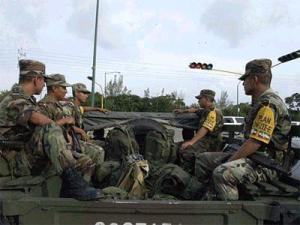
Better that than invading other oil-rich countries with armies made up of other underpaid country boys.
She’s back (Oaxaca)
Sometimes the best way to see what’s going on behind the scenes is to depend on a perceptive outsider. Jennifer Rodgers writes from Oaxaca:
My last trip ended around Christmas time, and so the city planted red poinsettias with messages thanking Governor Ulises and the federal police (PFP). Now, the plants are gone. Replacing them is simply bark and fertilizer. As much as I had problems with the messages, I prefer the poinsettias. We should remember that years ago, the zócalo didn’t look like this–covered in concrete and dirt. It used to be beautiful courtyard of greenery. This is another legacy of the governor.
I’ve stated before that I think tourists SHOULD visit Oaxaca but keep in mind that the people aren’t about to share their political opinions with tourists, and, by spending money with the people outside the “official” tourist areas, they are doing as much for democracy as they can in a difficult, “byzantine” [thanks to Harry Avery for that… he’s a long-time foreign resident of the state, and is as confused by the situation as any of us] political situation.
¡Canallas! (though I think “scumbags” works better)
Being one of the Heroic Donors, I’m pissed.
Muerte en canasto by Franciso Toledo, Interior by José Luis Cuevas (both limited run lithographs), a pencil drawing by Rafael Coronel and Guillermo Scully’s Sax “mysteriously disappeared” from the Heroico Cuerpo de Donadores’ storeroom.
We “heroic donors” put up the money for a new firehouse in Colonia Cuauhtémoc… on the site of the Lobohomo nightclub, that burned down in 2000, killing 24 teenagers. It wasn’t the fire department’s fault… there just wasn’t a firehouse that could get to the Zona Rosa in time. Having spent more time in more ZR clubs than I’d like to admit, I don’t feel particularly “heroic” in donating a few pesos for something so worthwhile, but hey, how can you not support the Heroico Cuerpo de Bomberos?
 We donadores put up the money originally just for a modest neighborhood firehouse. So much for the idea that Mexicans don’t support charities… we ended up (heroically) donating 79,362,000 pesos. The money went towards an “environmentally-smart” 1300 square meter firehouse, training center and communications center. AND… and upgrades to 14 local firehouses) and whatever else the fire department needs. By the way, donations to the Heroico Cuerpo de Donadores, A.C. can be made to HBSC account # 4037889151, Sucursal 3070 (monumento a la Madre).
There was some slight grumbling, when the firemen’s union wanted a raise a few years ago, but even then, it was only a questin of “how much?” not “do they deserve one?” Chilangos despise los Esmurfs (the cops) and like their Pependores (garbagemen), but respect los Bomberos. You’ll never hear of a scandal or shakedown by a fireman… even when he’s not pulling you out of an exploding building, dealing with earthquakes, floods and the occasional fire we have in a mostly concrete city.
Next to robbing a church, this is about as low as you can go. Whoever did this probably deserves to burn… horribly… for several millenia.
Cultural exchange program
Canadian reporter Quade Hermann writes in Half the Unknown World of her attempts to adjust to life in Mexico City, the nuances of the Spanish language (There are three ways common ways to apologize: disculpa, for when you interrupt someone else’s conversation; perdoname, for when you elbow them in the kidneys by mistake; and lo siento, for when you accidentally sleep with their husband.) and the shocking discovery that in Guadajara Chivas are not goats.
Safely back in civilization, or at least the more sophisticated clubs and restaurants of Xalapa, Roman Castañeda Cotera continues the on-going Amazing adventures of a Mexican once lost in the UK . He’s also written recently on winter in Georgia (the one in the United States), rednecks, making (and drinking mass quanities of) mojitos and the Mayans. And the Brits.
Problemah

Educating Rita (and everyone else)
 The
The
The Autonomous National University of Mexico (UNAM) and the Federal District Government (GDF) yesterday signed an agreement to provide youths in the capital who now lack an educational alternative the ability to earn their bachillarato (high school diplomas) on line. UNAM Rector Juan Ramón de la Fuente and Head of the District Government, Marcelo Ebrard Casaubón said in a joint statement that this was not the “basic solution, but a tool with enormous potential for the educational system.”
(Jose Galvin, in today’s Jornada [my translation])
My first “post-starving artiste” job (I’m in the minority that went to a Community College after graduate school… finding a two-year computer degree more marketable than a Masters in English) was writing Computer Based Training materials. My first “post-midlife crisis, run off to Mexico” job was teaching junior high school. I was amazed at the creativity Mexican teachers. Mexicans are immensely practical when it comes to resolving immediate problems, and a shortage of teaching materials sometimes called for desperate acts. For the good of the people (at least the ones who could afford private tutors, having beat a strategic retreat from el Escula Bilingüal – where I also was expected to teach computer classes to grades K – Secondaria 3°), resorted to subterfuge and chicanery on occasion. I’ve sat through more than one textbook sales promotion, just to scarf up samples (and then violate every copyright law in the world) to get my students and I the materials we needed.
I can’t see writing a general history of Mexico without talking about the most successful of the Revolutionaries… not the Generals, but the school teachers.
“Gods, Gachapines and Gringos”:
 [Alvaro] Obregón later would say “The Revolutionary Party includes everyone who fought for the Revolution”. Even though he would favor a more socialist economic system, he had no problem working with conservatives who were experts in their particular field. While still roving the country with his army, he’d put together a “think tank” from all political persuasions, charged with coming up with practical solutions to the country’s overwhelming problems.
José Vasconcelos was extremely conservative, elitist philosophy professor, but had a practical turn of mind. He served as Secretary of Education under interim president de la Huerta (between Carrenza’s death and Obregón’s election) and later under Obregón. He, and his staff, with full government support, turned to whatever innovative and unorthodox solutions they could find to what was seen as Mexico’s single largest problem – illiteracy and the “backwardsness” of the countryside.
Vasconcelos – helped immeasurably by the fact that both Obregón and Plutarco Eliás Calles had been rural teachers – began recruiting a new kind of teacher. The village maestro or maestra was a “vanguard of the Revolution” Official propaganda equated teachers with soldiers: Ignorance and poverty were the enemy. Books and knowledge the weapons. Although poorly paid, the teachers were dedicated and tough. During the Cristero War, when religious fanatics were likely to assasinate village teachers as representatives of the secular state, sometimes the village school ma’arm was armed.
In the 1947 propaganda film, Rio Escondito, the glamorous Maria Feliz played against type as a sickly recent teaching school graduate sent to clean up “the worst town in Mexico.” She does… as Maria Felix always does… but only fighting a typus epidemic and winning a wild shootout with the villians. And somehow, she manages to teach the children the story of Benito Juarez.
For most rural Mexicans, the arrival of the village schoolteacher was the beginning of the Revolution. The teacher was armed with the blueprints for a schoolhouse… Vasconellos’ staff had designed a designed a standard plan for a building that could be put up by untrained labor, of whatever the local building material happened to be – adobe, brick, or wood. The schools only had walls half-way to the roof, but windows could be added later, in warm climates before rainy season, or walls in cold climates. If there was need for more classrooms, the same plan could be used to add on to the basic model, which originally included a residence for the teacher. Within a month of arrival, a teacher was expected to have their school up and running.
Faced with designing a standard curriculum for both rural and urban students, the former philosophy professor suddenly found himself talking about saddlebags and mules in Cabinet meetings. School books were no problem in Mexico City, or on the rail lines. But Vasconcello’s team had to consider how to deliver a comparable education to the 80 percent of Mexicans who still lived in communities of less than 2500 people and were not served by roads or railroads. Everything from the weight of book covers, to the reporting forms a school superintendent needed was considered. And how much a mule could carry. Everything needed to open a primary school, from the texts to the teacher (and his or her personal belongings) was calculated, based on what one mule could carry.
The “mule school” was only the start of a tradition of innovative educational techniques. One of the few benefits given these underpaid agents of the revolution was a free subscription to the Sunday newspaper. The teachers, especially those in roadless areas, might get their paper a week or month late, they did eventually receive it. So, rather than burden the mules with lessons that wouldn’t be given for months, texts, especially for adult literacy programs, were inserted as advertisements in the paper. These on-going lessons not only included literacy, but other “revolutionary” material – the need to protecting water supplies from contamination, the importance of personal hygene and the need to eat nutritious food.
One unintended consequence of the revolutionary attitude towards education was a change in traditional women’s clothing. The newspapers, for whatever reason, ran the education department advertisements in the fashion section. Women in traditional areas, whose style of clothing hadn’t changed in centuries, adapted the latest in Mexico City haute couture to their own needs. What are today considered “traditional Indian costumes” are often partially based on 1920s urban chic.
The innovative spirit begun by Vasconcelos continued long after he was gone. Radio, television and the Internet have all been pressed into service to provide rural education. In the early 1960s, Mexico was the first country to use satellites to beam basic education into hard to reach communities. Vasconcelos himself is credited with inventing the still successful adult literacy program known in English as “Each one teach one.” By law, every literate Mexican was supposed to teach one illiterate, or pay someone else to give the lessons. Everyone fully expected people to evade the law, but it was successful enough to double the literacy rate within a few years. With innovative primary education, Mexico managed to reduce illiteracy from nearly 90 percent in 1920 to about 8 percent today. Most illiterates in Mexico are older women who speak a language other than Spanish.
Higher education was only available to the wealthy in 1920. Vasconcelos reformed the University, re-instituting the old University of Mexico as the Autonomous National University (UNAM) – constitutionally guaranteed its operating budget and self-governing, as well as other federal schools. UNAM today is the largest university in the Americas.

Lawyers, guns, and money…
For a company that claims to be “known by the largest and most successful global corporations as the ‘shadow CIA’, Stratfor isn’t saying anything we don’t know about smuggling here…
…
The Mexican attorney general’s office announced Feb. 11 that a tractor-trailer containing weapons and an armored pickup was seized by the Mexican army in Matamoros, just south of the U.S. border at Brownsville, Texas. Among the weapons seized were 18 M-16 assault rifles, including at least one equipped with an M-203 40mm grenade launcher, and several M-4 carbines. Also recovered were 17 handguns of various calibers, more than 200 magazines for different weapons, more than 8,000 rounds of ammunition, assault vests and other military accessories. A Nissan Titan pickup truck outfitted with armor and bullet-proof glass also was inside the trailer.
The semi, which was registered in the United States, entered Matamoros from the south after having passed through both Ciudad Victoria and Valle Hermoso. It is unclear where the shipment originated, though it could have come from Central America, or even the United States
Gee, you think it’s possible that the people who buy the narcotics supply the guns? I’m wondering how this made it past the U.S. Customs in Brownsville. Dare I suggest money changed hands?
Aloha, Señor Perro…
(02-16) 05:13 PST GUADALAJARA, Mexico (AP) –A federal court has cleared the way for TV bounty hunter Duane “Dog” Chapman to be extradited to face charges in Mexico, court officials said.Norma Jara, a spokeswoman for the second district court in Guadalajara, said the court rejected Chapman’s injunction request, ruling there was no reason not to try him with the charge of deprivation of liberty of Mexico.
“We only just heard about the Mexican court’s decision to continue with the extradition proceedings, and are still in shock,” Chapman and his wife, Beth, said in a statement issued Thursday night in Honolulu.
“Our attorneys have not even been formally informed of the court’s decision, as of yet,” they said. “We are obviously deeply disappointed and fearful of what will happen, and are currently absorbing the news and discussing our options at this time.”
Mexican authorities had already asked for Chapman’s extradition from Hawaii.
Chapman’s lawyers argued he would not be guaranteed a fair trial in Mexico, Jara said.
The charges against the 53-year-old star of the A&E reality series “Dog the Bounty Hunter” stem from his June 2003 capture of convicted rapist Andrew Luster, the Max Factor heir, in Puerto Vallarta, 210 miles west of Guadalajara.
Chapman was arrested Sept. 14 along with his son and another associate and released on $300,000 bail. He faces up to four years in a Mexican jail if convicted.
Luster’s capture shot the Honolulu-based bounty hunter to fame and led to the TV series. His disappearance set off an international manhunt by police, FBI and bounty hunters trying to recoup some of the bond money. Luster is serving a 124-year prison term.
“Ya can parley with a Mescan, but ya’ can’t win” (John Wayne)
When it’s “Xicanopwr” v “GayPatriot” it’s no contest.
Aztlan Electronic News Service, as the name suggests, is simply a electronic news network focusing on Mexican-American and Latin immigrant affairs. Xicanopwr.com runs a regular ad on the front page. GayPatriot, besides being a nut, isn’t smart enough to figure out that the Aztlan’s Editor, Daniel Maldonado has a very common name. He is no relation to the guy of the same name recently arrested as an alleged Al Queda terrorist.
I’ve usually checked when there’s a common name involved. Anybody with a sense of ethics would. Aztlan Electronic News Service is not “Voz de Aztlan [racist web-site warning]” the notorious neo-fascist site. My contempt for Latino homophobia and anti-semitism is matched only by my distaste for gay racists.
Only a batshit crazy right-winger would ever take GayPatriot seriously, but there’s unfortunately more than a few of those loons out there. At least one has tangled with the wrong hombre:
Edmundo rips the asshole a new one:
In order for the right wing to sustain their collective delusion, it seems, they must make shit up. For people who disliked the former Soviet Union, they really do enjoy using old Stalinistic tactics to get rid of their perceived enemies by tarring every opponent with broad accusation all for the “public good.” What do Latino immigrants have to do with Al-Qaeda? The answer is nothing at all! However, this is the same mental crap that is being peddled by the right-wing talking heads.
However, this is not new. This are the same tactics that were used by John Tanton, of US English and Federation for American Immigration Reform (FAIR), to plant the seed for English only in the 1980s; and Glenn Spencer, of the American Patrol, used to plant La Reconquista – alleged plot to turn several American states into a Mexican state or some kind of puppet government controlled by Mexico – seed in the 1990s.
The gist of the anti-immigrant sentiment is that the newcomers are up to no good, they just want a handout, they have too many babies and they are hell-bent on contaminating our precious bodily fluids and, besides, you wouldn’t want your daughter to date one. In fact, the whole anti-immigrant sentiment is starting to turn out to be anti-Brown, where some state are creatively coming up with “anybody but Brown folk” laws.


