OOPS… the drug war and economics
I once read that every Latin American nation headed by a Harvard graduate experienced huge economic dislocations (of course, I’m guessing the article was written by a Yalie). Fred Rosen wrote in last Sunday’s Mexico City Herald about the “success” of the much ballyhooed Calderón anti-narco battle:
El Universal´s always-perceptive columnist Raymundo Riva Palacio reports that aside from the extradition of a half dozen drug barons, the cartels have not taken such a hard hit. “The cost of a joint of marijuana on the streets of Mexico City,” he reports, “is 15 pesos, compared to 25 pesos in December, while Ecstasy tabs, whose producers were also supposedly targets of the crackdowns, have fallen to half of the 50 pesos they cost at the end of the year.”
If the operations had been a success, reasons Riva Palacio, the logic of supply and demand would have produced a reverse effect. The low price suggests there are more drugs on the street than before the anti-drug operations began.
Fox news — we report (some of the story), you decide
On the Freerepublic.com website, someone posted this HALF of a news item from the Arizona Daily Star (naturally, by way of Fox news, but that’s our rightwingers for you)….
Driver killed, boy wounded after illegal immigrants fired on
10:33 AM MST on Thursday, February 1, 2007
Feb 1, 3:04 AM ESTTUCSON, Ariz. (AP) — A driver was fatally shot and a boy wounded in a dispute between human smugglers in southern Arizona, authorities said.
The Pinal County Sheriff’s Department said David Norris Jr. was driving a vehicle containing a dozen illegal immigrants Saturday in an Eloy farm field when four heavily armed men in a white full-size van began firing on them.
Norris, 46, was killed and a
12-year-old boy in[19-year old Andres de Jesus of Oasaca, who was also in ] Norris’ vehicle was shot in the leg, authorities said.
The boyDe Jesus was reported Wednesday to be in stable condition at University Medical Center in Tucson.Sheriff’s spokesman Michael Minter said all 12 illegal immigrants fled from the van when the attack ended and all but one were found.
Minter said authorities were seeking the public’s help to find the shooters, who wore green camouflage pants and shirts with military-style berets.
(Another update… the original reports listed Andres de Jesus as a 12-year old boy. Interviewed at the Mexican consulate, he was reunited with his wife, who had fled the van during the shooting)
Natually, one of the “freepers” whined that “they’ll blame this on the minutemen”. Yeah, THEY will… the Freepers — and Fox news — edited out a trivial detail. That last paragraph should read:
None of the shooters has been arrested, Minter said. They were wearing green camouflage pants and shirts and wearing military-style berets — three black and one red. The shooters spoke limited Spanish.
I’ve never heard of Mexican gangsters, or even polleros who didn’t speak Spanish. And the police sketch sure doesn’t look like a Mexican bandito to me…

SCARY UPDATE (2 Febuary 2007): The Tuscon Citizen (which gave the added description that three of the attackers were “white” and one was “Hispanic”) included these comments:
Comment by Bruce D. (#4122) — February 1,2007 @ 10:42PM
Think the illegals and those who traffic in illegals and those who employ them got the message? Perhaps this is only the beginning of Arizona citizens doing something to fix the problem the politicians can only argue aboiut. I wonder what Mr. Norris thinks about it? Like what were his final thoughts on the matter? I wonder if profiteering off of cheap illegal human trade was worth it to him? Too bad he can’t tell us if he would do it again if given the opportunity.
A problem the liberals want to make permanent and legal. Amnesty for 11 MILLION is a disgrace to the country and the immigration laws it has implemented.
2. Comment by LESLIE C. (#1688) — February 1,2007 @ 11:24PM
Yes, you’re right. This is an excellent way to fight illegal immigration. Stupid ass.
At least the Citizen’s comment section lets others vote the comments up or down, and these two were way down, but it’s hard to deny that support for vigilantes is out there.
“If Texas were a sane place, it wouldn’t be nearly as much fun”
DAMN… two of the best people in Texas in a week. One famous for what she said, the other — no less remarkable — known for what she never said.
Molly Ivins, 1944 -2007
I dearly love the state of Texas, but I consider that a harmless perversion on my part, and discuss it only with consenting adults
There are some fine “in memoriums” on Molly Ivins around… The Texas Observer, which prides itself on covering the “strangest state in the union” devotes their entire latest issue to Ivins. Her last regular newspaper employer, the Fort Worth Star-Telegram laments the passing of a “difficult” writer.
“XicanoPwr” at ¡Para justicia y liberdad! expresses the thoughts of the hoarde (and we are legion) of Texas progressives who’ve lost the best — and funniest — of us.

Ivins, like me, wasn’t born in Texas, but never let that shut us up. But I didn’t get here until much later, and she grew up here, managing to even date some not-real-bright, but presentable college boy named George W. Bush during her years in Houston.
Ivins was the first “major” Texas news writer to come out and say that it was racist for papers not to have Spanish-speaking reporters. My Spanish is aweful, by the way, but I’d miss a hell of a lot of what happens around here if I didn’t hear what was said around me. And, around here, half of it is in Spanish.
When I lived in Mexico City, I kept up with what was really going on in Tejas, not from the A.P., but from Ivin’s column in Jornada. Though she was fluent in Spanish, her wit and style was that of an old-fashioned story-teller (and, covering the scoundrels and rascals that run Texas, there’s never a dearth of stories to tell), dependent on nuance and turn of phrase that didn’t always come through in a serious, academic, scrupulously edited publication like Jornada. Oh, they could deal with “el gobernador bien-pelo” without too much trouble, but quoting Ann Richard’s wisecrack about having to take the Christmas Star off the Texas Statehouse (“Nunca podremos ahora conseguir a tres hombres sabios” — “Now we’ll never find three wise men”) required one of Jornada’s specialties… a learned footnote and short essay on cultural differences, attached to a newspaper column (but, hey, that’s Jornada!).
Ivins and I agree about West Texans — “The nicest people in the world. You just don’t want them running it.” She was writing about the rich guys from Midland. Those of us in the strangest corner of the strangest chunk of the strangest state of the Union, whichever language we speak, aren’t in any position to do so. We’re the kind of people she wrote for — not the big boys, but those affected by the outside world:
The trouble with blaming powerless people is that although it’s not nearly as scary as blaming the powerful, it does miss the point. Poor people do not shut down factories … Poor people didn’t decide to use `contract employees’ because they cost less and don’t get any benefits.
… and, less known outside of the Big Bend (but, a figure in country-western music and even a British poem… though the silly twit was scared of her during his stay at a writers’ colony in Marfa back in the late 1990s), but no less an indominable Texas immigrant (everyone forgets Ivins was actually born in California), was Judy Ann Maggers.
Sterry Butcher, who has been around forever wrote a detailed appreciation for the Big Bend Sentinel in Marfa. Right now, I’m filling in as reporter of all work for the weekly Alpine Avalanche, the “big city” paper out here in the Big Bend. I end up doing all kinds of odd things, including an obituary now and again.
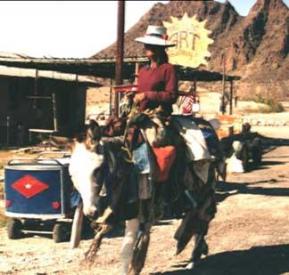
Judy Ann Maggers, “the Burro Lady”, rides into the sunset at 65
“As tough, as independent and as kind-hearted as West Texas,” is how Rebecca Pape remembers her friend, Judy Ann Maggers, who passed away Friday, Jan. 26, at her campsite in Hudspeth County near Sierra Blanca.
Affectionately known as “the Burro Lady” Maggers had been a fixture in the Big Bend and beyond, often seen riding her donkey up and down the roadways and interstate highways of West Texas. Living off the land, she became a welcomed personality and part-time resident in all communities from Sanderson to El Paso.
While one of the best liked people in West Texas, very few people even knew her name. Bill Ivey, who was a rafting guide on the Rio Grande when Maggers first came to the area in the 1980s was one. Contrary to some of the wilder rumors, Maggers was not independenly wealthy, but lived on Social Security payments. Lacking a fixed address other than “On the land, Terlingua, Texas” it was Ivey who was authorized to receive her checks and handle her modest financial transactions. Even so, he knew very little about her past, or her daily routine. Attempts to contact her only known survivor, Sue Johnson of South Dakota, have so far been unsuccessful. Pape believes Maggers was from California originally.
“She just didn’t talk about her past. When I met her, she was camping on the Colorado Canyon run-in. She wouldn’t accept charity, and insisted on paying for everything. She later moved to Lajitas, where I ran the trading post, and got to know her,” Ivey recalled. Her legal guardian, even he was surprised to learn still kept a valid drivers’ license. “She once owned a Cadillac, but removed the back seat so her donkey could ride in comfort,” Ivey said.
He didn’t know the burro’s name, but everyone at the Triangle Market did. Merle.
“She loved Merle. We all loved Merle,” said Pape.
Pape and her employees at Alpine’s Triangle Market looked foreward to visits from “Miss Judy” and Merle the Burro. As did Merle. The Triange Market was a regular stop for Maggers and Merle, who particularly enjoyed his sour-apple green lollipop. Pape added she hoped Merle received a life-time supply of his favorite treat, though not more than one a day, since sugar probably isn’t healthy for burros.
Maggers lived as she wanted. She was not anti-social, or a recluse, but rather an tough-minded free spirited woman who chose, like other Big Bend residents, to maintain her independence at all costs. She would talk to people, but not about her past. People remember her as sensible and coherent, well-spoken and polite. But fiercely independent.
“She had two sides. There was a softness and gentleness in her love for Merle, and toughness. She was as tough as the West Texas weather,” Pape said.
Her tough, gentle, free-spirited heart simply gave out. She was 65 years old when the Border Patrol discovered her, near death last Friday.
Funeral arrangements are pending. By her own request, Maggers will be buried at “Boot Hill” in Terlingua. Always scrupulous about paying her own way, Maggers insisted on paying Ivey five dollars every time he delivered supplies, or brought her cash. The several hundred dollars Ivey put away over the years, five dollars at a time, will help defray some funeral expenses, and the Hudspeth County Commissioners’ Court has also made a donation.
Hudspeth County Judge Becky Dean-Walker also took temporary custody of Merle. She is quite happy to keep him, but would be willing to give him a home where he’ll receive the care and affection he’d come to know. Ivey said “that burro ate better than Judy did,” and he apparently is used to his green-sour apple lollipops.
Donations for outstanding costs, a headstone and lollipops for Merle can be sent to the Judy Magers Memorial Fund, c/o St. Agnes Church, P.O. Box 295, Terlingua, TX 79852.

“Packin’ Up,” oil on canvas, copyrighted by Bonnie Wunderlich, 2004 TerlinguaTx
The word of the day is… caristía
It’s a new one on me… la caristía… the high cost of living:

Notimex photo. There were demonstrations across the country.
Border invasion … not what you think
Jan. 31, 2007, 4:48PM
Guard-outlaw standoff on Texas border rattles troops
By ALICIA A. CALDWELL
Associated Press
DEL RIO — A recent standoff between National Guardsmen and heavily armed outlaws along the Mexican border has rattled some troops and raised questions about the rules of engagement for soldiers who were sent to the border in what was supposed to be a backup role.Six to eight gunmen — possibly heading for Mexico with drug money — approached a group of Tennessee National Guard troops at an overnight observation post Jan. 3 on the U.S. side of the Arizona-Mexico border. No one fired a shot, and the confrontation ended when American troops retreated to contact the Border Patrol. The gunmen then fled into Mexico.
…
With 2000 deaths attributed to the drug trade in the last year (the last U.S. figures I have for the U.S. — from the Drug Policy Information Clearinghouse and the White House “Drug Czar“) is for 1998, when there were 14,088 “drug related homicides” in the U.S…. given that the U.S. population is three times that of Mexico, the drug trade kills about two and a half times more people in the United States than in Mexico). If the drug trade is the “terrorist trade” you have to ask “who is supporting the terrorists”?Who buys narcotics (hint — the CIA figures are here)?
Where do Mexican gangster get their weapons? (hint — Arizona Star, 16-January “U.S. Guns Pour Into Mexico”)
Where do Mexican gansters get their illegal cash (see story above)?
IF WE WANT TO PREVENT TERRORISTS FROM CROSSING THE BORDER, THE NATIONAL GUARD IS FACING THE WRONG DIRECTION!
Coca-Cola announced that they’re introducing Coke Zero (none of the sugar and all of the taste) in the Mexican market. I guess you can’t be too rich or too (Carlos) Slim… but you can be poor and fat.
Manuel Roiz-Franzia in the 27 January 2007 Washington Post looks at the nutritional crises that may result from the tortilla crises… and the role of the mulitnationals.
Poor Mexicans get more than 40 percent of their protein from tortillas, according to Amanda Gálvez, a nutrition expert at the National Autonomous University of Mexico. Modern-day tortilla makers such as Rosales use “an ancient and absolutely wise” Mayan process called “nixtamalizacion,” Gálvez said.
The process is straightforward. Large kernels of white corn are mixed with powdered calcium and boiled, then ground into a dough with wheels made of volcanic rock.
The resulting tortillas are more pliable and more durable than those typically found in U.S. stores. Mexicans say tortillas are their “spoons” because they use them to scoop up beans, and can serve also as their “plates” because they’re sturdy enough to hold a pile of braised meat and vegetables.
The tortilla-making process, Gálvez said, releases antioxidants and niacin, which allows them to be absorbed by the body, and the membranes on each corn kernel provide important dietary fiber. As a result of eating tortillas, Mexican children have a very low incidence of rickets, a bone disease caused by calcium deficiency that is common in developing countries.
“It is absolutely crucial for our population to keep eating tortillas,” Gálvez said.
Gálvez said she believes the price increase is already steering Mexicans toward less nutritious foods. The typical Mexican family of four consumes about one kilo — 2.2 pounds — of tortillas each day. In some areas of Mexico, the price per kilo has risen from 63 cents a year ago to between $1.36 and $1.81 earlier this month.
With a minimum wage of $4.60 a day, Mexican families with one wage earner have been faced in recent months with the choice of having to spend as much as a third of their income on tortillas — or eating less or switching to cheaper alternatives.
Many poor Mexicans, Gálvez said, have been substituting cheap instant noodles, which often sell for as little as 27 cents a cup and are loaded with less nutritious starch and sodium.
“In the short term, the people who can buy food are going to get fatter,” she said. “For the poor, the effect is going to be hunger.”
…
Some tortilla makers claim Cargill is among those unfairly raising prices, an allegation that Tamayo, the company’s spokeswoman, calls “absolutely false.”
Mexico’s corn behemoth is Grupo Gruma, owner of the Maseca tortilla brand and the world’s largest tortilla maker. Mota said the company may control as much as 80 percent of the Mexican tortilla flour market. The company has already drawn his ire by allegedly buying a competitor without the competition commission’s approval.
Mexico, which counts corn as one of its major agricultural products, now faces a shortage. As part of Calderón’s plan to combat high tortilla costs, he gave emergency approval — as suggested by large corn brokers — to import more than 800,000 tons of corn from the United States and other countries.
But just the year before, Mexico was exporting corn. The administration of Calderón’s predecessor, Vicente Fox, allowed brokers to export 137,000 tons of corn, which farming groups say should have been warehoused for future use.
Rafael Rodríguez, finance director of a farming trade group, said the contradictory decisions by the two presidents are proof of government favors to big corn companies.
Reporteros con conjones… ¡grandes cojones!
Por Esto! is the ballsy Merida daily that — after withstanding an grenade attack (blamed on environmentalists by the local authorities) — was protected by taxi drivers, housewives, shoe-shine men… the real people.
Here’s today’s front page:

And here’s a translation of the on-line text…
POR ESTO! denounces the alarming increase in narcotics consumption and the indisciminate and overt dealing in Progresso in particular, and the Yucatan in general.
Manuel “el Negro” Chalé Martínez organized the hit men who serve the organized criminal interests of “La Vaca” Patrón Laviada.
Fragmentation grenades were thrown against a police station in Progresso to distract federal forces, guaranteeing the secure delivery of narcotics to Patrón Lavida, whose ties to organized crime must be investigated.
HOLY SHIT!
¡Por Esto! may not be the world’s greatest newspaper, but they sure are the nerviest. Reporters and editors have been killed for less in Mexico, and even on this side of the border, I won’t mention — not even with the qualifier “alleged” — the names of some of our local … ahem… agricultural importers.
Anything from the Iowa gulags?
Last I heard, the indocumentados were still incommunicado. And, aren’t there a lot of national politicians tromping around Iowa these days… it’s not a very big state. Folks there can’t exactly say “Ve zee nothink, ve know nothink.”
The Dec. 12 raid at the Swift & Co plant in Marshalltown has left immigrants in the central Iowa town with a lingering sense of uncertainty and fear, said an official with a statewide Hispanic group.
The fallout from the raid has also prompted the local newspaper to organize a community summit to address immigration issues.
The raid by Immigration and Customs Enforcement agents resulted in 97 people being detained. The impact continues to be felt six weeks later, said Erica Palmer, a community organizer with Latinos in Action, a chapter of Iowa Citizens for Community Improvement.
“From what we’re hearing, a lot of people are out of work and a lot of people are moving out of town,” Palmer said.
The raids, she said, also have made some Hispanics afraid to go out in public.
“That fear is very real,” she said. “That fear of taking your children to school, or going to the grocery store, that’s a very real thing in the community.”
Meanwhile, non-Hispanics “are angry about how the raids were carried out and how the people were treated,” she said.
Ken Larson, the managing editor of the Marshalltown Times-Rebublican, said a summit is scheduled for Feb. 26 at Dejarden Hall at Marshalltown Community College.
And, once again, here’s the address for Sister Jean Feagan and the Hispanic Ministry at St. Mary’s Catholic Church who’ve picked up the ball and are caring for the disparacido’s children (or maybe orphans?):
Hispanic Ministry
12 West Linn Street
Marshalltown, Iowa USA 50158
Any similarities to recent history is intentional
What Ulysses S. Grant later called “the worst injustice one nation has ever done to another” raised an interesting constitutional question, one that an obscure one-term congressman wrote about at the time…
TO WILLIAM H. HERNDON.
WASHINGTON, February 15, 1848.
DEAR WILLIAM:–
…
Allow the President to invade a neighboring nation whenever he shall deem it necessary to repel an invasion, and you allow him to do so whenever he may choose to say he deems it necessary for such purpose, and you allow him to make war at pleasure. Study to see if you can fix any limit to his power in this respect, after having given him so much as you propose. If to-day he should choose to say he thinks it necessary to invade Canada to prevent the British from invading us, how could you stop him? You may say to him,–“I see no probability of the British invading us”; but he will say to you, “Be silent: I see it, if you don’t.”
The provision of the Constitution giving the war making power to Congress was dictated, as I understand it, by the following reasons: kings had always been involving and impoverishing their people in wars, pretending generally, if not always, that the good of the people was the object. This our convention understood to be the most oppressive of all kingly oppressions, and they resolved to so frame the Constitution that no one man should hold the power of bringing this oppression upon us. But your view destroys the whole matter, and places our President where kings have always stood. Write soon again.
Yours truly,
A. LINCOLN.
I guess it’s not just Aztec history that repeats itself…

The Great Emancipator, 1848

The Decider
I can (almost) see clearly now…
Welcome to Mexico City in 2007. With car ownership more than doubling over the last decade, the megalopolis once dubbed the world’s most polluted city should by now be almost uninhabitable, its residents gasping through oxygen masks.
The air doesn’t exactly smell sweet. But look up beyond the tops of office buildings these days and the sky is blue.
Over the past decade Mexico City has rid its streets of the most polluting cars and bounced back from the dark days of the 1980s and 1990s, when children painted the sky as black or brown and opaque air sent choking birds plummeting to the ground.
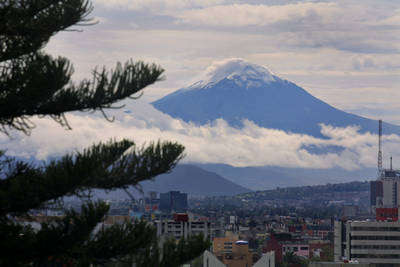
Now, for a couple of days most months, the snow-capped volcanoes that serve as a dramatic backdrop to the city are visible — after decades of being blanketed by yellow smog.
“Things have changed,” said Jose Luis Perez, 70, who has spent 50 years selling newspapers in the ever-more congested city center. “With the new cars and regulations, Mexicans don’t pollute like they used to.”

Jornada photo from October 2006. In the winter, the air is usually pretty clear, too.
Felipe Calderón = Porfirio Diaz, part II
I’ve been playing around with the idea that the Calderón administration isn’t just conservative, but a reactionary return to the “neocolonialism” that flourished under Don Porfirio in the late 19th century. In the 1880s, it was the need to industrialize and the argument that traditional farms were not “modern” that justified foreign control of agricultural and industrial production (and using Mexican troops as policemen to control dissent)…
And, as the cientificos said, these foreign developments were much more important than say, the price of tortillas.
DAVOS. – Michael D. White, president of Pepsico Group, told Felipe Calderón of his company’s interest in participating in maize production in Mexico, at a meeting in which he also spoke of Mexico’s role as the leading market for his company’s products – beverages and fructose — after the United States.
The Robert Bosch company also expressed to the President of Mexico its willingness to invest 100 million U.S. dollars on a program to create alternative fuels for diesel engine consumption, which would offer a 30% reduction in the costs of fuel, while reducing the environmental impact of emissions.
…
When meeting with directors of global companies, Calderón offered advantages to investors in Mexico, changing government policies to guarantee them security and stability, agreeing on the necessity of structural reform.
(translation from a longer article by Ivonne Melgar in today’s Excelsior)

Come meet the new boss…
same as the old boss…
Two for the road…
The Mad-dog Englishman
In the tradition of the best English travel writers… those not quite innocents abroad who set off for places out of the Empire… I’ve been immensely enjoying Simon Gandolfi’s blog. This is great travel writing:
I have read fearful accounts of foreigners’s encounters with Mexican officialdom. Those officials with whom I have dealt have gone out of their way to be helpful.
So what have I seen now that my eyes are open. A toy castle, 1660. What every kid wants: a ramp leading to a drawbridge. Gate into fierce walls mellowed by age. A square keep with a pepperpot on top. Parapets with canon in every aperture and a second pepper pot on one corner. Perfect size for a TV make-over program. Immagine the dialogue betweent the two presenter/designers!
The central square Plaza de Armas) is good rather than great – cathedral along one side has a good interior lit by chandeliers and is small enough to feel intimate rather than overbearing. There’s a good cloister dwn one side, a plush hotel opposite, a line of cafes across from the cathedral, palm trees round the sides, clump of leaved trees (must check what) in the middle round a bandstand with live music in the evening. I threaded my way thru the market today on my way to somewhere else, crowded and very friendly. Cab driver told me: “In Veracruz you can walk anywhere at half past one in the morning. Mexico City you’d be murdered.”
The city is tidy for a Mexican city. Lots of trees, masses of small shops (how do they make a living?), masses of small restaurants and ice cream parlors and ten-table cafes. Street vendors don’t bug you, are happy to give directions and like to chat.
I read in a guide book that Veracruz has a strong black influence. I haven´t seen a single black person. The standard skin colour is a rich pale golden moca – imagine a good sun tan without the red. And very goodlooking, especially the younger generation. Long trousers on the men is obligatory. Girls show their tummys. Given the heat, this seems an unfair advantage. Though I wouldn’t want to show mine.
OK – I am off to sit in the Plaza de Armas, drink a cold beer, listen to music and watch the folk dance.And I shall probably worry much of the night as to how I will handle the Honda and the traffic…
The author was 73 when he set off in May 2006 for a visit to friends in upstate New York, from which he took on a Honda motorbike for Dallas and other points south, recording the the by-ways, folkways and weirdness of life on the road from Texas to Tierra del Fuego. I’m immensely enjoying the “travels of a fat old toad on a bike – US/Mexican border to Tierra del Fuego” and sincerely hope someone options this, pays Simon an obscenely huge amount of money (though he said there’s no such thing as an “obscene” amount when you’re putting two kids through college) and fosters a few more of these eccentric Englishmen abroad.
 Cheers, mate!
Caroline and Bill’s Excellent Adventure (or… The Golf to the Gulf)
Sending back posts to The Lonely Planet Mexico Message Board, “Peche” sent nearly daily updates of the drive from Tweed, Ontario (near the east end of Lake Ontario) to Playa de Carmen, Quintano Roo. Canadian travel reports are fun. It’s a stereotype, but they are generally “homey” people… who focus in on the exotica. And come to think of it, Tennesee and Texas are as exotic as Veracruz and the Yucatan …
Caroline (an asthmatic) and Bill (a smoker, but a highly considerate one) braved snowstorms, bureaucratic mixups and the vaguaries of Mexican road signs on their 3500 mile (5600 Km) retirement odessey.
As I mentioned before, I’d been finding it hard to believe we were on the right road even when I had ample reason to think we were. This day was quite remarkable in this sense, as we repeatedly ended up in the right place, although I couldn’t have told you exactly how we got there. We bypassed Tampico successfully, which we understand is an important step in keeping one’s sanity on this journey.
When you think of a toll bypass, do you imagine a four-lane highway, quite empty, clearly marked, well-manicured? So did we. Well, you ain’t seen the Tampico bypass.
Apparently Veracruz state is the topes (speed bump) capital of Mexico. A lot of the aforementioned bypass turned out to be the secondary roads that go through the small towns, all of which have a dozen or more topes, necessitating slowing to a crawl, repeat … repeat … repeat … crawl up one side of the bump and down the other side … zzzzzz
It was so painful, I wish I could have fallen asleep. I was so glad Bill didn’t. He heroically drove all day, all 12 hours. (Mind you, it’s impossible to pry him out of the driver’s seat. Trust me, I offer all day, but he’s just more comfortable driving.)
We saw some interesting sights and I think the one that sticks most is the guy backing up, right in the flow of traffic. We had seen him barreling backwards up a side road and didn’t think anything of it – he’d changed his mind and wanted to go a different way.
Then Bill saw him in the side mirror, still backing up, on the side of the road. Suddenly, he’s in the rearview mirror, traveling at speed, still backing up! This continued for miles!
Finally, we came to a toll bridge and, thank goodness, by the time we’d paid the toll he had disappeared. We think maybe they said, “It’s our bridge and you’re not going over it backwards.”
Then there was the gas station, where we made a bathroom break (well yeah for me, but Bill smokes even more than I pee). Bill watched a horrendous crash, two pick ups, one suddenly deciding to turn into the gas station and the other one running up his tail.
We were shocked the police arrived so quickly, until we realized they were camped up the road stopping everyone for a drug check. They asked us to open the trunk but lost interest when we then produced a Spanish list of everything in there.
We’ve had a lot of help from Sanborn’s guide, as they give a lot of detail. However we discovered we can’t necessarily rely on it. In one case they said a junction would be found at K50, and it was actually at the end of the road after K1. Naturally, for 49 kilometers we were looking and looking and worrying and worrying. Thus is my lot as navigator. Feel my pain.
The Golf survived, though in a postscript, she tells us, it finally did die — temporarialy — when headed to the WalMart … I wish them the best in their (and the Golf’s) well deserved retirement to the Promised Land.