While we were sleeping (farm subsidies)
They’re not going away… but Mexican farmers are. Anyone who still believes the tortilla crisis and continued exodus of the Mexican farmer are not related to subsidies is frankly delusional.
The ultra conservative Heritage Foundation notices who really benefits:
Growers of corn, wheat, cotton, soybeans, and rice receive more than 90 percent of all farm subsidies, while growers of most of the 400 other domestic crops are completely shut out of farm subsidy programs. Further skewing these awards, the amounts of subsidies increase as a farmer plants more crops.Thus, large farms and agribusinesses–which not only have the most acres of land, but also, because of their economies of scale, happen to be the nation’s most profitable farms–receive the largest subsidies. Meanwhile, family farmers with few acres receive little or nothing in subsidies. In other words, far from serving as a safety net for poor farmers, farm subsidies comprise America’s largest corporate welfare program.
Left-leaning “Common Dreams” focusing on the impact in one country, Jamaica, noticed the same problem:
But this analysis, which is typical of many “progressive” complaints about trade and globalization, seriously missed its mark. And if you were watching last week as the U.S. Congress moved toward passage of a massive new farm-subsidy bill, the real source of Jamaican farmers’ problems became apparent.The farm bill, which the House of Representatives has approved and which the Senate could vote on this week, calls for taxpayers to fork over some $180 billion to farmers during the next decade. That’s a 70 percent hike above the cost of current farm-subsidy programs, most of which represent direct payments to wealthy farmers and agribusinesses.
Those subsidies make it possible to export millions of tons of food so cheaply that native farmers in places such as Jamaica can’t possibly compete.By guaranteeing U.S. farmers a minimum payment for commodities such as corn, rice and soybeans, the government encourages overproduction. That drives down the market price, forcing even higher subsidies and creating surpluses that can be shipped to Jamaica and elsewhere.The (London) Financial Times noticed the fancy footwork the subsidy bill is using to get around WTO rules:
Subsidy programmes that support prices, because they encourage farmers to produce more and hence push down world prices, are classified as “trade-distorting” under WTO rules and are subject to stricter limits. Despite the administration’s rhetoric that it was moving from supporting farmgate prices to protecting farmers’ incomes – the so-called “revenue assurance” principle – the proposed move was modest. The “marketing loan” programme, which subsidises farmers when the prices of their produce fall below a set level, altered the calculation of the price a little to take account of actual market prices, but the change will not be dramatic.
And… that means MORE U.S. corn will be flooding Mexico. Which means, less Mexican corn, more corn farmers coming into the U.S. to work for U.S. agribusiness, meaning…Max Correa, secretary general of a campesino group called the “Central Campesina Cardenista,” estimates that “for every five tons bought from foreign producers, one campesino becomes a candidate for migration.” The importing of the proposed 450,000 tons of white corn, he told a press conference last week, is likely to eliminate more than 100,000 jobs in the rural sector.
Consumer Protection, ca.1750
I’m sure I’m not the first person to wonder why the Mexicans can’t do business in a normal shop like everywhere else…
A friend of mine asked if I wasn’t bored reading Juan Pedro Viqueira Albán’s “Propriety and Permissiveness in Bourbon Mexico” (Sonya Lipsett-Rivera and Sergio Rivera Ayala, translators. Wilmington Delaware: Scholarly Resources, Inc. 1999). Nah… Viqueira Albán’s thesis is that for the Bourbon kings, the Enlightenment wasn’t so much about freeing you through reason, but about finding a reasonable way to keep you under control.
Sure, things like non-parking zones and one-way streets (invested by a Mexican viceroy, mostly because he was tired of stepping in horse poop when he went to the theater… and it was REASONABLE to control the situation) were good ideas (though the Mexican people, in their long resistance to authority, still don’t follow the Viceroy’s reasonable regulations), but what got me laughing were the accounts of attempts to reasonably accommodate bureaucrats at the bullfights… where, of course, you went to be seen — or better yet — not seen. If you were really, really important, you got a sky box.
The fights between the deputy recorder of deeds and the first assistant secretary of the Inquisition over who had better seats, and the rationales put forth by the Viceregal Liquor Control Board, who wanted the seats assigned to the Mexico City Tax Office still stir the muckraker’s funny bone. Geeze, wouldn’t the reflections of a Bourbon Era Menkin or Molly Ivins have been something?
This was the Enlightenment. Forget Voltaire and freeing your mind from superstition. That was for French Philosopers. What the Bourbon kings learned was Enlighened despotism. It was a rational era, so controlling the people was rational. If there happened to be a worthwhile side effect (like consumer protection, or clearing the streets of poopy horses) fine:
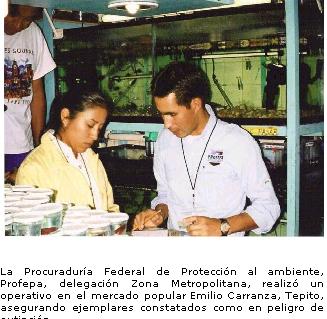
To control the artisans, for example, a series of ordinances decreed that these persons had to work and sell their products in the same location. Their workspace had to be an acessoria (annex) whose only access was directly from the street…. Inspections were therefore easier, but it was also hoped that because these artisans worked under the scrutiny of passersby, they would take greater care in their craft.
The photo is from PROFEPA. Having to work in the open makes it a lot harder to hide illegal animal sales.
Don’t like the rules — tough luck. Civil Unions in Coahuila
Every time some rational idea gets proposed in the U.S., somebody, somewhere complains. We have to craft laws to exempt pharmacists from prescibing legal drugs, and then somehow make the drug available, or let marriage licence clerks go on break when the gay couple shows up at their window…
Usually, in the U.S., you find some legal organzation to argue that you have a religious exemption from your civil service job. Not in Mexico, where church and state are still separate, even in conservative Coahuila:
Armondo Luis Canales, Subsecretary for Legal Affairs of the State Secretariat of Governance, said “It’s a simple matter: any Civil Registrar who refuses to [issue Civil Solidarity licences to qualifed applicants] or wants to give an argument is out of a job .” Canales added that civil servants who lose their jobs will never work for the State again. Yeah… he can do that.
Whoo… it’s only 3 in the afternoon and I’ve already had more hits today than I’ve ever had. I really do appreciate you’re coming down this way (and, yes, this site — which runs on donations — does accept Canadian dollars).
I can see how your alarmist press has you thinking frostbite and -30° F is somehow preferable to a libertarian society in the tropics, but c’mon … think about it. There’s million visitors from the Great White North that come to Mexico every year. It’s strange that two got their throats slashed (possibly by other Canadians), two got hit by cars and somebody get’s nicked in the foot by a riccocheting bullet… but it’s no more dangerous than a lot of Canada… maybe less dangerous.
The whole “boycott Mexico” thing is kinda bizaree to me. It wasn’t all that long ago that the hip thing to do was claim to be Canadian…
There are those who insist that smart American travelers should stow their Yankee identity and simply pretend they’re Canadians to ensure safe passage overseas.
New Mexico-based T-Shirt King, in fact, is offering a “Going Canadian” kit for $25 that includes a T-shirt emblazoned with the Canadian flag and the phrase “O Canada,” a matching maple leaf patch for luggage, a window sticker, lapel pin and a little guide called “How to Speak Canadian, Eh?”
I’m sure the fashion trend will return, and I know you’re be a little uncomfortable wearing the Stars and Stripes, so here’s a compromise solution —

(Offer not valid on London Tube)
Kiwis looking for permanent Mexican experience
As far as I know, all 34 legal Kiwis in Mexico now are alive and breathing. Given the trouble shipping their drug of choice back home, I’m sure the number of DEAD Kiwis is gonna pile up pretty quickly. Great… I’m sure the New Zealand Ambassador is just thrilled (to death) about this. I can foresee a market for unused return tickets to New Zealand ahead (and growth in the funeral parlor and shipping industries):
Elderly and sick Kiwis will travel to Mexico accompanied by the man dubbed “Dr Death” to buy powerful suicide drugs they then plan to smuggle home.
Euthanasia advocate Philip Nitschke told The Dominion Post that he was organising the first trip for New Zealanders to buy the life-ending drug Nembutal, which is used by vets to put animals down.
The powerful barbiturate is used in countries, including Switzerland, where euthanasia is legal.
Dr Nitschke said he planned to meet about eight Kiwis – who will spend an estimated $15,000 on the trip – next month in San Diego.
He would then escort them to Mexico, where the drug can be bought legally.
He would help them find the drug and buy it and said it was then up to them if they wished to risk bringing it back to New Zealand.
The Kiwis would be expected to make the return trip themselves, taking responsibility for their actions.
A Customs spokeswoman said that, if the group was found to have Nembutal, it would be seized as with other “restricted or prohibited” goods.
…
Medical Association chairman Ross Boswell has said barbiturates were previously found in sleeping tablets, but now doctors “rarely, if ever” prescribed such medication.
Death isn’t listed as one of the side effects for Nembutol, but I’m sure if you took enough of anything it’d kill ya, and its the hip new drug for the soon-to-be existentially challenged. Apparently, what the Kiwis want is veternary nembutol, which is used among other things for anesthetizing bats (really… somebody wanting to study bat parasites found that really stoned bats were more cooperative).
Workin’ for the Yankee Dollar (then and now)
Migrants may send even more money to family members back home than previously thought – as much as US$25 billion last year – according to a new study.
The report, presented Friday by the Inter American Development Bank (IDB) also suggested that the remittances are being used less for buying basic necessities and more for savings and education.
The central bank had previously estimated 2006 remittances at a record US$23 billion – a 15 percent increase over the previous year.
But Sergio Bendixen, president of U.S. polling firm Bendixen & Associates which carried out the study for the IDB, said about 99 percent of the remittances counted by the central bank were electronic or wire transfers – while the study found that about 19 percent of remittances are mailed back home or carried in person.
What has been counted in the past were bank tranfers; no one thought about the cash being carried back and forth, so the higher than estimated number isn’t that surprising. And, bank and wire transfer to Mexico include transfers by U.S. retirees, which is a much larger number than most people realize (something Lyn wrote about before her — hopefully temporary — retirement from this site).
Remittances have been important to home countries for a long time. Giovanni Gozzini of the Università di Siena (Italy) reported at an international conference on the history of migration, “in 1906 they [remittances] reached a ceiling of over 800 million lire, amounting to almost a third of the total level of exports, making a decisive contribution to the stabilisation of the balance of payments of the Italian State.”
Tiny Ireland (with only three million people during the time) was still receiving an estimated €4.4 million a year between 1950 and up into the 1970s, long after most European migration had ended.
Britain, the main superpower of the 19th century, also depended on remittances, though as a colonial power, remittances included British business owners in the colonies, or well-paid administrators. And some, like Scots immigrant Andrew Carnegie, earned fortunes abroad, and invested a good chuck back at home, but whether buying a castle is considered a remittance, I don’t know. Even so, humbler British immigrant’s remittances also had a major impact on rural and working class communities.
Money orders were invented by the British Post Office back in the 19th century to facilitate remittances. Everyone thinks of the Irish immigrant sending a few dollars back home, but tt wasn’t only the Irish (then under British occupation, and taking advantage of the new Postal Money Orders), but
Welsh colliers in Pennsylvania, Aberdeen granite masons in New England, and Sheffield steel workers in Pittsburgh, all of whom participated in seasonal migration to the United States, not only sent money to their dependent families but saved their wages to invest in local farming or to set themselves up in business in Britain. For such U.S.-based remitters, earning capacity was paramount (affordable remitting); funding future rounds of migration (required remitting) and accumulating assets in America were matters of secondary importance.
( Cambridge Journal. The Global and Local: Explaining Migrant Remittance Flows in the English-Speaking World 1880-1914. Gary B. Magee and Andrew S. Thompson).
Ireland, which has a lot common with Mexico (traditionally agrarian and Catholic, dominated — and a third of its territory annexed — by the English-speaking Protestant neighbor, and famous for lighter-weight boxers, too!) also depended on remittances from labors in England, who regularly returned home, as well as overseas migrants. No one seems to have any idea of how much money came into Ireland from England in money orders before independence (anything before 1927 would not have been counted as a foreign money transfer, and until 1979 the Irish Punt and British Pound were interchangable) or in cash afterwards.
Among the remittances to the Irish that can be counted is what was sent from the United States. It’s estimated that between 1840 and 1960, Irish in the United States sent £1.2 BILLION a year.
Ireland, since joining the European Union, has gone from the poorest, to the wealthiest nation in the EU. Not all that is due to remittances (the country still depended on them until joining the Union), but remittance-men and women laid the groundwork for their success. The Irish recognized the importance of their remittances back in the early 1970s, and began over-investing in education. They realized that a doctor or accountant going abroad sent back a lot more to mum than a ditchdigger or construction worker. So… education spending went way up.
Mexico also disproproportionatly invests in education, but perhaps not at the level it should.
And, as an added bonus… the birth rate drops in remittance countries. It makes sense. If workers are overseas, they don’t start families until they’re older. And, if the money they’re sending home pulls them — and their families — into the middle class, they’ll have fewer childen. The best birth control device is a decent income.
But don’t these remittances hurt the U.S.? Not really. U.S. Census data shows a rising number of non-workers in the economy. Over the next several years, there will be a labor shortage as the population ages, and the birth rate slowly declines (though more slowly in the United States than in the other wealthy countries). And without workers, the U.S. would not have grown in the 19th century, nor will it grow in the future.
Secondly, a wealthier Mexico means more purchases from the United States, and… who knows… maybe a need to import Guatamalan workers at some point.
Let a million money-grams flow!
“Ritmo” … a concentration camp for the whole family

Photo Credit: By Kirsten Luce For The Washington Post
By Spencer S. Hu and Silvia Moreno, Washington Post (registration required
Friday, February 2, 2007
RAYMONDVILLE, Tex. — Ringed by barbed wire, a futuristic tent city rises from the Rio Grande Valley in the remote southern tip of Texas, the largest camp in a federal detention system rapidly gearing up to keep pace with Washington’s increasing demand for stronger enforcement of immigration laws.
…
But civil liberties and immigration law groups allege that out of sight, the system is bursting at the seams. In the Texas facility, they say, illegal immigrants are confined 23 hours a day in windowless tents made of a Kevlar-like material, often with insufficient food, clothing, medical care and access to telephones. Many are transferred from the East Coast, 1,500 miles from relatives and lawyers, virtually cutting off access to counsel.
“I call it ‘Ritmo’ — like Gitmo, but it’s in Raymondville,” said Jodi Goodwin, an immigration lawyer from nearby Harlingen.
An inspector general’s report last month on a sampling of five U.S. immigration detention facilities found inhumane and unsafe conditions, including inadequate health care, the presence of vermin, limited access to clean underwear and undercooked poultry. Although ICE standards require that immigrants have access to phones and pro bono law offices, investigators found phones missing, not working or connected to non-working numbers.
…
In Willacy County, one of the country’s poorest, ICE has set up 10 huge tents on concrete pads, surrounded by 14-foot-high chain-link fences looped with barbed wire. Each “sprung structure” holds about 200 men or women, divided into four “pods.” Similar temporary buildings were used for troop recreational facilities in Iraq.
The center is part of a chain of facilities in South Texas with 6,700 new immigration detention beds. At a cost of $78 a night per bed (compared with an ICE average of $95 a bed), the Willacy facility is not only cheaper than any bricks-and-mortar prison but also faster to construct, move or dismantle, Mead said.
…
Detainees are subject to penal system practices, such as group punishment for disciplinary infractions. The tents are windowless and the walls are blank, and no partitions or doors separate the five toilets, five sinks, five shower heads and eating areas. Lacking utensils on some days, detainees eat with their hands.
Because lights are on around the clock, a visitor finds many occupants buried in their blankets throughout the day. The stillness and torpor of the pod’s communal room, where 50 to 60 people dwell, are noticeable.
Goodwin described a group of women who huddled in a recreation yard on a recent 40-degree day with a 25-mph wind. “They had no blanket, no sweat shirt, no jacket,” she said. “Officers were wearing earmuffs, and detainees were outside for an hour with short-sleeved polyester uniforms and shower shoes and not necessarily socks.”
Perhaps more troubling, lawyers said, large numbers of immigrants have been transferred from Boston, New York, New Jersey and Florida, far from their families and lawyers. Because some immigration judges do not permit hearings by teleconference, detainees are essentially deprived of counsel.
Immigration violators in the United States are held on civil grounds and have no right to appointed lawyers. But federal guidelines call for providing them law libraries, telephones and phone numbers for legal aid.
Joining a lawsuit last week, the American Civil Liberties Union alleged that severe overcrowding at a Corrections Corp. facility in San Diego poses an unconstitutional risk to detainees’ health and safety, arguing that as administrative detainees, illegal immigrants should be treated better than convicted criminals.
No wonder they scrimp on the food. Stalag L. Don Hutto L. Don Hutto Concentration Camp Residential Center is run as a profit making enterprise by Corrections Corporation of America. And, heck, the overhead is enough from fingerprinting the babies. You can’t expect them to pay for little things like heaters or telephones.
A question though. If these are OTM’s (Other than Mexican) prisioners inmates (maybe or maybe not) deportees, why are they on the Mexican border. Think it might have something to do with “looking like” they’re deporting Mexicans… or maybe that Raymondville is the middle of nowhere?
The last round-up… Operation Wrangler RIP
Gov. Goodhair’s 20-million dollar Operation Wrangler — with ELEVEN COMMAND CENTERS — and 640 National Guardsmen — and even the promise of protection from Illegal Arkansas Hillbillies… is DEAD.
San Antonio Express-News writes the obit… and catches the first turn in the spin cycle.
Touted nearly two weeks ago by Gov. Rick Perry as a continuation of Texas’ “steadfast efforts to prevent and disrupt criminal activity along the border region,” the operation has quietly ended, the San Antonio Express-News has learned.
Robert Black, a spokesman for Perry, said his office made no public announcement about Wrangler’s end in hopes of keeping would-be crooks off balance.
…
Wrangler involved 604 Texas Guard troops working in “security platoons” on patrol along the Rio Grande and elsewhere in the state as part of what Black called a “rolling surge.”
More than 6,800 people were involved in Wrangler, with personnel coming from the Guard, 133 police departments and 90 sheriff’s offices. The Texas Department of Public Safety, Parks and Wildlife Department and the U.S. Coast Guard also played roles.
The Texas Guard troops called up were in addition to 1,700 involved in Operation Jump Start, a program ordered last year by President Bush.
… in a news release issued as Wrangler began, Perry gave the impression it would run for an extended period. Citing the dangers of “an unsecured border” to the entire state, he said, “Until the federal government brings the necessary resources to bear, Texas will continue to do all we can to secure our border and protect our citizens.”
No word yet on survivors, or what this boondoggle cost the state… or what it accomplished, if anything. The original press release (22 January 2007) from the Gov.’s office is here — I saved the page, expecting it’ll be edited sometime soon.
Good thing he’s not eating tortillas… yet!
Weighing in at a 14.1 pounds (6.4 Kg), Super Toño, aka Antonio Vasconcelos Cruz, was delivered by C-section last Monday. He is his mother’s second baby, and neither the mother, father nor older sister are particularly large people.
Mexico has comprehensive pre-natal and neo-natal care (not perfect, but good). Toño was born at the Jesús Kumate Rodríguez Hospital in Cancún, and automatically received Social Security medical coverage, as all Mexican newborns now do. He’s apparently heathly (gaining 200 grams a day… yikes!), but is being kept for observation (and to give his mother a break) because of worries about higher than normal sugar levels.
Alas for the Vasconcelos family, milk prices have also gone up in recent months, though parents (or guardians) of children are usually elgible for a milk allowance, though you have to bring your own plastic bucket (early in the morning, it seems every woman on the bus, and half the men are carrying a plastic pail to get their kid’s milk)… his mother may need a trash can.
Looks like he’s already found a compade to hang with (photo, coutesy TerraCom) …

Note to Wall Street: next time, read the Mex Files first
WE know better, don’t we?
Ben Berkowitz, at AOL’s “Blogging Stocks”, should be commended for at least paying attention to how events in Mexico might affect the U.S. stock market, but it would help if he bothered to check the facts.
(… uh, Ben… why don’t you send some money this way and at least get a semi-reliable source to check).He begins with something rather startling:
This week’s story that no one read and everyone should have is about tortilla riots in Mexico. Yes, tortilla riots.
No, Ben… if you bothered to read Ione Grillo’s AP story, there were PROTESTS — not riots — in Mexico City (and elsewhere throughout the country). I guess Ben isn’t used to democracy, or street action.
Secondly, Ben buys into the usual explanation about rising ethanol prices. Yeah, that may have some effect, but then he slides into a riff on “publicly-traded corn companies like Archer-Daniels-Midland (NYSE: ADM), Bunge Ltd. (NYSE: BG) and Corn Products International Inc. (NYSE: CPO)”.
Ben doesn’t know the difference between yellow corn (used for ethanol) and white corn (the stuff we eat). Yeah, more yellow corn is being planted in Iowa and Nebraska and Manitoba… but that’s not the problem. It’s those “publicly-traded corn companies” v. José Lopez who doesn’t have access to credit or fuel subsidies, and who can’t shelter his income in off-shore accounts. José goes out of business, and you can subtract his few extra bushels from the dwindling production of the dwindling number of Mexican farmers.
Mexico could — and did — grow enough corn to meet domestic needs (and usually has since … oh, 5000 BC or so), with occasional imports needed in the 20th century. It was only after 1994 (the year NAFTA was born) that there were these serious disruptions. Yeah… as Ben notes, all food prices are likely to rise as a result, and emigration to the U.S. might accellerate if corn prices don’t come back down… but you’d think the business news editor at AOL might have talked to someone who knew something about Mexico… or agriculture or … somebody?
CURSO DE ESPAÑOL /INGLÉS Y DE INGLÉS /ESPAÑOL
(from Ana Maria Salazar):
1.Si quiere una COCA COLA diga GUIMI A COUC.
2.Si quiere un cafe y una dona diga COFIANDONA.
3.Si quiere unos huevos con jamón diga YAMANEGS.
4.Si se agarra un dedo con la puerta del Taxi diga FOC.
5. Si algo le parece muy costoso diga FOC.
6. Si se cae en el metro diga FOC.
7. Si lo asaltan en el Bronx diga FOC.
8. Si se encuentra con una mujer de esas de película diga UANA FOC !.
9. Si alguien le grita algo que contenga FOC responda FOQUIU TU.
10.Si pierde el pasaporte, detenga un policia y diga AI LOST MAI FOQUIN PEIPERS.
11.Si se pierde en la ciudad, grite AI AM FOQUIN LOST.
12.Cuando se refiera a un tercero diga DE FOQUIN GAI OVER-DER.
13.Si quiere acostarse con una morenaza dígale AI UANA FOC UIZ YU.
14.Si quiere acostarse con una rubia dígale JALOU, CAN AI FOQUIU?.
15.Si no sabe donde tomar un Taxi diga JAO TU GET A FOQUIN CAB?.
16.Si esta muy enojado NO diga REFOC, solo diga FOC varias veces(FOC, FOC, FOC,…)
17.Si le quieren tomar el pelo pregunte AR YU FOQUIN MI?.
18.Y si estas instrucciones no le sirven de mucho….” Uat da foc YU uant?”
SPANISH FOR GRINGOS (Para que los Gringos aprendan castellano)…
There’s always something to learn or to try, many times you need to say some phrase in Spanish, but you don’t know how to say it, don’t worry, your problems have finished, if your are a gringo and you don’t know speak
We took from it some common phrases, just try and you’re gonna see the difference and how easy is to speak Spanish.
(Léanlo en voz alta en inglés, está genial!)
1.Boy as n r = Voy a cenar = I’m gonna have a dinner
2.N L C John = en el sillón = on the armchair
3.Be a hope and son = Viejo panzón = fat old man
4.Who and see to seek ago = Juancito se cagó = Little John is a chickenshit.
5.S toy tree stone = estoy tristón = I’m kind a sad.
6.Lost trap eat toss = los trapitos = the little rag.
7. Desk can saw = descanso = (you) rest.
8. As say toon as = aceitunas = olives.
9. The head the star mall less stan dough = deje de estar molestando = stop bugging me.
10.See eye = si hay = yes we have
11. T n s free o ? = tienes frío = are you cold?
12. T N S L P P B N T S O = Tienes el pipi bien tieso = you have an erection.
13. Tell o boy ah in cruise tar = Te lo voy a incrustar = I’m going to insert it in you
Not front page news, but still…
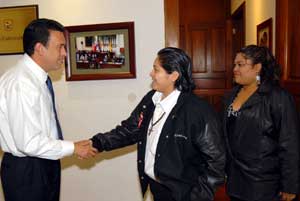
Civil Registrar Alberto Villareal of Saltillo presided at the civil union of Karla López and Karina Almaguer of Matamoros, Tamaulipas yesterday. The two become the first same sex couple to have recognized legal rights equal to marriage at a national level in Latin America.
Villareal said his office has issued at least 15 more licenses for same sex couples, many from out of state.
(Source, and photo: El Diario de Coahuila, Saltillo)
Although they have a different name than marriages between unrelated persons of different genders, “Civil Solidarity Pacts” are the same thing, obligating two persons to mutually support each other, and recognizing the two as a single family unit (extremely important under Civil Law, which sees marriage as a contract, and the family as the basic unit of society).
Civil Solidarity Pacts are not just for gay couples, but also for caregivers of aging relations, or — for example — elderly siblings living together and sharing expenses. Religious services are not recognized by the State.
What was more interesting to me is how low key this is, buried in the local section of a provincial paper.


