Lets get this one out of the way…
According to one Arizona TV station, a National Guard observation post “somewhere” between Lukeville and Nogales ( which is about a 200 Km line in the desert, so exactly where isn’t clear) had to abandon their position when approached by armed men.
The TV report includes a flack from the Goveror’s office talking about this, so I’m guessing something really happened. But what, I don’t think anyone knows. The usual suspects have all weighed in — Free Republic is probably the sanest (and that’s saying something), since when I “googled” this, what I came up with were the JAWA Report and National Vanguard (the Aryan Nations newspaper).
The Freepers are worried about “PONCO” Villa, and the rest… well… the Mexican Hezbollah is coming! EEEEKKKK!
I’m sure the Arizonia TV report is right in that SOMEBODY walked around in the desert with some guns… but by this time next week, who knows what the “spin” will be.
Mark in Mexico’s big scoop… only a bit late
Mark in Mexico seemed to find it amusing that the Mexico City police recently cracked down on replica (not toy) gun dealers in Mexico City (as even Mark’s source — the far right Cronica de Hoy reported), especially when the city is in the middle of a “crime wave.” Oh, wait a minute: the “crime wave” report is a New York Times article dated 1 May 1998 on a State Department “Consular Information Sheet.”
Let’s see. CISs aren’t taken seriously by most travellers anymore (if they ever were). At one point, when there were a few U.S. Canadian spats back during the Reagan administration, the U.S. State Dept. issued warnings about Ottawa — and not just to watch your step when it was icy!
And, back in 1998 there was “escalating crime” … or at least escalating crime reports. After all, President Zedillo’s PRI wasn’t at all pleased with the Capital’s elected PRD administration, and the Police Chief is the only high ranking Mexico City official still appointed by the President.
The Capital’s new chief executive, Marcelo Ebrard was himself fired by Vincente Fox when he was police chief (Ebrard was AMLO’s choice for the job… and an interesting one he was. Kinda baby faced, he sure didn’t look like a cop. And his education was in social work and administration. The police department improved dramatically under his tenure). As Chief Executive, Ebrard’s anti-crime drive is focusing on what Mexico City “contributes” to the narcos… money laundering facilities. (in a Notimex story dated TODAY, not several years ago).
Ebrard was (something Mark gets almost right) fired after three federal cops were lynched (back in November 2004) and police helicopters were unable to reach the scene (in a very isolated part of the city). What Mark forgets (or never knew… or just plain doesn’t want to tell us, since that would ruin his whole “story”…) was that the Feds wouldn’t provide fuel for the city heliocopters (and was more complicated than Mark remembers).
But other than those few problems (and forgetting that “all 146 of the Rudolph Giuliani team’s recommendations for cleaning up the Mexico City police forces” involved things that were either unconsitutional, or never meant to be implemented (I remember Giuliani coming to visit, touring Tepito — which I’ve walked through regularly — in an armored personnel carrier) the story’s
Otherwise, “Mark in Mexico” is upholding his usual standards.
Ve vant to zee your papers…

XicanoPwr masterfully dissects the Owellianeque “Western Hemisphere Travel Iniative” (which seems designed to keep us from travelling in this hemisphere… “war is peace”, “freedom is bureaucrats” and all that) from those fun folks over at the Dept. of Homeland Stupidity Abtielung Heimat-Sicherheit (figure it out… it sounds a little less sinister in German, ja?, aka “SHOW US YOUR PAPERS (especially if you’ve got a tan).
XP is looking at the broad picture. Some of us border ruffians comment on the specifics of OUR situation… coming soon, to a streetcorner near you. Seriously.
You folks in Iowa and North Carolina and Austin and Dallas seem damn quick to ask me to give up my freedom of assembly and movement — having to show papers to some armed bureaucrat at checkpoints (within my own country, and without even leaving my own country).
You’re dealing with bureaucrats here. Folks who have to justify their existence and budgets somehow. What’s happens once they “seal the border”?
The justification is that “terrorists” MIGHT, MAYBE, SOMEHOW, AT SOME POINT OR ANOTHER cross the border (God forbid you think it’s because so many folks are afraid they might lose what Jesus’ General calls “The War Against Brown People”). So, how long before the Abtielung Heimat-Sicherheit starts worrying about “terrorists” in Longview, or Des Moines, or Charlotte?
Be prepared to show your papers, folks.
Otra buena razón de hablar español
By KYLE ARNOLD
The Monitor
McALLEN — Some of the biggest names in conservative talk radio have been stripped of their microphones — at least in the Rio Grande Valley.
Bill O’Reilly, Glenn Beck and Michael Savage are among the radio talk show hosts who will no longer have a spot on the local airwaves after Clear Channel pulled the plug on Brownsville’s KVNS News Talk 1700 AM.
The station has switched over to a new Spanish format that will play songs from the 1970s to 1990s.
Mexico invades Nashville — or vice versa, or… (Chetes)
Chetes: Mexican sound, Nashville Accent
(elUniversal, 2 de enero de 2007)
Last October a quiet and unassuming 26-year-old musician from Mexico arrived at Nashville International Airport to meet a U.S. record producer he had known only through a few e-mail messages and a phone conversation. Neither had any idea what the other looked like.
The musician was Gerardo Garza, the floppy-haired, dirty-blond It Boy of the alternative rock scene in Monterrey, Nuevo León, who goes by his lifelong nickname, Chetes. (It´s Spanish shorthand for “cheeks”; Garza´s are noticeably pale and round.) The producer was Ken Coomer, a Nashville studio whiz who played drums for the new-school Americanists Wilco and Uncle Tupelo, two bands Garza had only recently heard.
The plan for the next month was simple, if not somewhat comical: the two would hole up in a studio with local musicians and technicians, none of whom spoke a word of Spanish, and create the new sound of Mexican pop music.
Both men come from the fringes of their respective music scenes. Garza has little to do with the sugary commercial formulas that dominate Mexican pop radio, and Coomer´s taste for rootsy indie rock and alt-country have kept him a world away from the pop country polish of Nashville hit machines.
“When I first heard him I was like, does he know how good he is?” Coomer said in a beaming and breathless Southern drawl. “I thought his music was timeless. Producers typically look for the flavor of the month, but he had something that was classic without being superficially retro. He clearly knew the history of good music.”
Friends at the Nashville alt-country label Lost Highway and Garza´s label, EMI Mexico, had sent along Garza´s demos. After hearing them, Coomer was hooked and sent back a package of albums featuring his own work.
“Once I listened to Wilco,” Garza said in Spanish. “I heard the style I was looking for: acoustic, live and natural. It was simple but not boring. Plus, as soon as I talked to Ken, I knew he was a good person. He had Elvis´ accent, and for me that was a very good sign.”
MONTH OF RECORDING
Garza stayed in Nashville for a month, recording and writing songs with Coomer and his engineer, Charlie Brocco, himself a veteran studio aid to Anglo pop-rock legends like Fleetwood Mac and George Harrison.
…
“There was no culture clash at all,” Coomer said. “We went out drinking, hit all the good local bars. He just has this aura about him. You want to put him in your pocket.”
The album-length result of their experiment is Garza´s sparkling solo debut, “Blanco Fácil.” Coomer´s organic, analog touch is everywhere (the album was recorded live to tape, on vintage microphones and amplifiers, before it was loaded onto Pro Tools).
The songs are classic 1960s and 70s sunshine folk-pop, the Brian Wilson and James Taylor kind, full of sweet and warm melodies, dreamy harmonies and perfectly placed jingle-jangle bridges that mend the hearts the verses have just finished breaking.
MEXICAN GOLD
Since its Mexican release earlier this year, the album has sold nearly 50,000 copies, the benchmark for being certified gold in Mexico. That´s not a small accomplishment in a national pop market with little patience for anything other than teen sensations like RBD and Belinda. The first single on “Blanco Fácil,” “Completamente,” has an intense melancholic charm, which led to a 2006 Latin Grammy nomination for best rock song, some heavy iTunes Latino promotion, and a much-played video that features a bundled-up Garza singing his way down the wintry streets of Beijing.
The album was just released in the United States on Dec. 26, and will no doubt face similar challenges in an equally rigid stateside Latin music market that has not typically been kind to artists who are not wholly pop, rock, tropical or traditional.
“My goal was to create a new kind of pop-rock in Spanish,” Garza said by telephone from his new apartment in Mexico City, where he, his wife and their dog have just moved from Monterrey. “Many people believe that pop is something dirty or something that doesn´t deserve artistic respect. I wanted to change that and show pop´s other faces.”
Garza didn´t have to look very far for inspiration. In industrial Monterrey, three hours south of the Texas-Mexico border, he grew up on a strict Beatles and Beach Boys diet.
…
“There´s always been a lot of American influence in Monterrey,” Garza said. “Everybody speaks English. We could always go to Texas to buy new albums and see shows. We could always turn on the TV and know what was in fashion in the U.S. and England. It´s a pretty Americanized place.”
Blanco Facil, courtesy B&G Booking and Graphics, Culiacán, Sinaloa
Zapatista attack? Probably, not proven
Bill Weinberg, at World War 4 Report, claims the GOVERNMENT was behind the almost unreported attack on Lacondon Mayans, supposedly by Zapatistas. (Jennifer had trouble linking, but the same article is on Indian Country News (December 18, 2006):
... on Nov. 13, with Marcos far away on the other side of the country in Zacatecas, a new and horrific outbreak of violence was reported from the Chiapas lowland rainforest known as the Lacandon Selva which is the rebels’ primary stronghold.
At first it seemed to be the latest in a long series of paramilitary attacks against the Zapatistas. …[T] the Zapatistas’ refusal to return to armed struggle despite both intransigence and provocation has allowed the rebels to maintain the moral high ground in the eyes of Mexican and international civil society. Therefore, hardliners in the government, who would like to crush the movement with armed force, have been effectively restrained. …
But this claim to the moral high ground, which has proved the Zapatistas’ most potent weapon, now faces a potential threat. …reports have mounted that up to 300 members of the Hach Winik people—popularly known as the Lacandon Maya—have fled their jungle settlements, saying they fear Zapatista reprisals.
Until now, the approximately 20,000 displaced persons in Chiapas have all been Zapatista supporters forced from their homes by government-backed paramilitaries. For the first time, allegations are being raised of indigenous Maya people fleeing feared Zapatista attack. The Zapatistas have been implicated in no attacks on the Lacandons or any other civilians, and these fears appear to be manipulated, the result of a propaganda campaign. But 300 indigenous persons displaced from their homes is not a matter to be dismissed. Failure to confront this situation could impact the direction of all Mexico, as the country confronts multiple converging crises, and the EZLN (as their name implies) still make a claim to the national stage….
Weinberg has no trouble with accepting that the attack occurred, but he is at pains to pain this as an isolated incident, or one provoked by “outside agitators”. Very possibly true, but I have no reason to doubt that ELZN members (with or without official approval) could attack neighboring – non-ELZN communities like the forest-dwelling Lacandon. Whether they are “late arrivals” in the area (as some Zapatista apologists claim) or even not really a “tribe” (as if there were such a thing in Mexican law, or as if that really matters, the fact is, the ELZN settlements are squtters on on the the forest dweller Lacandon’s land (part of the Monte Azul U.N. Biosphere preserve, which has always bothered me about the ELZN as much as anything).
And, to complicate things, Chiapas land disputes could have other dimensions – religious or linguistic differences that can be used by those “outside agitators” to stir up trouble and divide poor people in Chiapas, but that ELZN sympathiers tend to dismiss as somehow separate from the on-going problems in that State.
Weinberg suggests that if “Marcos” was around, none of this would have happened. My gut feeling is that “Marcos” would have spun the story differently, not that he would have stopped it.
What Weinberg suggests is that the ELZN is hierarchal, and that Marcos has some say over village decisions. That’s not what the ELZN claims… being anti-hierarchal is the raison d’etre for their political structure, and for the San Andreas Accords.
I see those accords, which were added to the Mexican Constitution, as reactionary. The Constitution grants more rights to human beings than the U.S. one does (equality between the genders and regardless of sexual orientation, for starters), but then gives “indigenous groups” the rights to their own “uses and customs” — even when those uses and customs include denying rights to individuals within the group. Call me old fashioned, but that’s a step back to the 18th century (or at least to the Emperor Maximiliano who wanted to bring back the Ley de las indias – and was supported by the ideological forebearers of the Zapatistas, including Emiliano Zapata’s father). I’m convinced the ELZN’s “other campaign” was welcomed by PAN, to keep the left fragmented. From Vincente Fox’s Presidential campaign up to now, the supposedly leftist ELZN has benefitted mostly the right. Calderón wouldn’t have been able to pull off that squeaker win without Marcos’ “other campaign” convincing people to not vote, even though the tri-party Lopez Obrador coalition and the Social Democratic Alternativa both supported the ELZN’s economic, anti-globalist agendas. It’s not PRI that the Zapatistas seek to destroy… it’s the Mexican left and 150 years of modernism.
A tight-knit community clinging to “traditional values” (and able to enforce those values on their own members) are normally the “usual suspects” when small communities of “those people” are attacked. I wouldn’t blame this one on the PRI just yet.
Coming soon, to a cantina near you… (oy vey!)
What a year it was…
Of all the unusual and unlikely sources for a good, clear, SIMPLE review of the screwed up political situation over the last year, I found Michael Werbowski (whom I don’t know) writing on a South Korean news site (When I sent Werbowski a note congratulating him on a good piece, the polite Korean email form politely replied “Success to email your message”.
Success to read: Mexico: Quo Vadis?
2006 has been without doubt a tumultuous year for Mexicans. The crisis in Oaxaca which began with a peaceful teachers’ strike and in city’s Zocalo or main square finally boiled over into a violent confrontation this fall.
Nationally, an election mired in virtually slanderous exchanges between the leading candidates descended to mudslinging in the media. Manuel Andre Lopez Obrador ( AMLO) was portrayed as a dangerous radical left-winger by his leading contender. Yet the former mayor of Mexico City who masterminded the “secundo piso” or second level which was opened just weeks before election day is hardly seen by many as a Trotskyite as the neo-conservative and neoliberal Partido de Accion Nationale spinmeisters portrayed him to be during the presidential campaign.
This distorted image fooled few of the AMLO’s supporters it seems. In fact, this less than edifying scare-mongering tactic may have backfired as the election was so close in the end. On my post electoral visit, the atmosphere in Mexico City reminded me of the deep and pervasive sense of disappointment– almost grief–many felt after Cuauhtemoc Cardenas was deprived of a victory in 1988 during my first visit to the country.
A stolen election?
Many Mexicans remain convinced that the 2006 race was riddled with vote counting “irregularities” and that official tallies were simply rigged and manipulated to favor “Uncle Sam’s man”: Felipe Calderon. In that sense this year’s campaign after a relatively clean 2000 race was a regression back to the good old days when the rule of “Herod’s law” reigned on the policial scene. This was so brilliantly depicted and satirized in a Mexican film by that same title.
Social security — they earned it, but…
You want to bet this is the next thing Lou Dobbs and his spawn start whining about?
Social Security Agreement With Mexico Released After 3 1/2 Year Freedom of Information Act Battle
WASHINGTON, Dec. 29 /PRNewswire-USNewswire/ — After numerous refusals over three and a half years, the Social Security Administration (SSA) has released the first known public copy of the U.S.-Mexico Social Security Totalization Agreement. The government was forced to make the disclosure in response to lawsuits filed under the Freedom of Information Act by TREA Senior Citizens League, a 1.2 million-member nonpartisan seniors advocacy group.
The Totalization Agreement could allow millions of illegal Mexican workers to draw billions of dollars from the U.S. Social Security Trust Fund.
The agreement between the U.S. and Mexico was signed in June 2004, and is awaiting President Bush’s signature. Once President Bush approves the agreement, which would be done without Congressional vote, either House of Congress would have 60 days to disapprove the agreement by voting to reject it…
The U.S. currently has 21 similar agreements in effect with other nations, which are intended to eliminate dual taxation for persons who work outside their country of origin.
María del Valle Cárdenas, Miss Mecha 2006

Contestant Patricia Merida models a dress made of condoms (AP photo left and below by Gregory Bull)
Prostitutes from la Merced — who have started to be recognized for their historic and cultural role in la Merced — where they have been a fixture since the 16th century, competed for prizes of up to a 1000 pesos in the first annual “Miss Meche” pagent.
First prize winner, María del Valle Cárdenas said “it’s a dream come true.” The 35 year old sex worker, said that as a “large” women, she never expected to win, but “physical beauty is fleeting. Interior beauty lasts.”
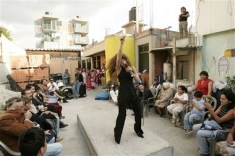
Partially designed to boost the self-esteem of the commercial sex workers (including travestis), the event was sponsored by Las Brigadas Callejeras. The group provides medical and educational services for Merced’s sex worker community.
Organizer Elvira Madrid said, “We always think of these women [beauty pagent contestants] as tall, blonde and svelte. But these are women too.”
A separate peace in Chiapas
Who knew? I’ve always known that outsiders oversimplify the causes of dissent in Chiapas… seeing it as some simple “government v. Indian” thing, or in some reductionist Marxist sense of “Good poor working people” v. “Evil capitalists.”
Both interpretations, it seems to me, are based in the (frankly) racist idea of the “Noble Savage.” It presumes all Indians are the same, and that they were somehow “pure” before evil western ways crept in.
I seldom see anything from outside Mexico on the role religion has played in the disturbances. Evangelical Protestantism, based on individual salvation (and, presumably, a sense of having to succeed on your own merits in both this, and the next, world), has created as much dissent in Chiapas as anything.
Mexican Presbyterians have been around longer (Benito Juarez once suggested importing Prebyterian missionaries, because Presbytherians — having accepted that God already made the decision of who gets saved and who doesn’t — just stick to work. Of course, Juarez also realized that Mexicans have a hard enough life, and need the drama and color of the Catholic Church, so never pushed the idea).
At least half of Chiapas is NOT Catholic — with their long sense of community, and consensus (maybe the Quakers should have evangalized in Chiapas), changing religion is a serious matter. We just don’t see — because it doesn’t make sense to us — how much of the troubles between and within communities in Chiapas have been caused by religion. Presbyterians don’t want to pay for the village fiesta in honor of the local saint, and the Catholic village’s water rights are being infringed upon by the Baptists in the next village… and so it goes. (Lyn wrote about missionaries in Mexico earlier this year, here)
Of course there are serious economic values at stake in for the indigenous peoples of Chiapas, but they aren’t a monolithic “tribe” … they’re several different groups, made up of individuals capable of making their own decisions on what is best for themselves. This community seems to have taken a radical way out… (my translation, from “Indígenas de Alá… en el corazón de Chiapas” by Santiago Fourcade in today’s Milenio).
Allah’s Indians… in the heart of Chiapas
“Precisely at nine, we pray. The Fox Hour starts at ten.” So easy-going Javier Labo explains his community’s difference from that occupied by the ex-President. Now known as Hajj Suleimán, the 41 years old is a leader within the Islamic Community of Mexico, the indigenous Chiapas muslims that are the talk of the continent.
Their story begins decades ago, when dozens of Presbyterian families were violently driven out of San Juan Chamula. Settling near San Cristóbal, the Colonia Nueva Espanza has remained a symbol of the religious disputes raging among traditional indigenous Catholics, but several years ago one aspect of the dispute has changed.
Here, Allah is God. More than 300 Tzotziles and Tzeltales embraced Islam in a region better known for iron-fisted ecclesiastical control.
It’s not difficult to see the results of that revolution, said Javier, as he led me through the streets of his neighborhood. He greeted a group of 12 Spanish muslims with a bow.
For us, Islam is not just a religion,” Suleimán explained. “It impacted the development of our basic projects. It’s a lifestyle we hope incalcates a return to our roots, while rooting out usury and capitalism.
We have faith in Allah. He is our guide on this path, though the pure teachings of the Prophet. For several years we were sustained only by the vision of our Emir Nafia, and now we’re enjoing the fruits of our labor.” Suleimán referred to the community’s leader, Eureliano Pérez Iruela, a Cordoban follower of the Sufi sect of Islam, who arrived in the early 1990s to organize the future Islamic Community of Mexico.
Many have accused the Chiapan Muslims of being dangerous or divisive. But while the community continues to complain that their rights are regularly violated, no one underestimates the accomplishments of this small community.
Every day, isolated from the hypocrisy and religious prejudices of the majority, about fifty children study basic material, as well as taking physical education and ballet classes.
Our intent is to give a sound basic education,” says Ana ‘Aisha’ López, the school’s director, while asking me to remove my shoes before entering the carpeted building. “He we bring all ages of children, from different educational levels. For now, we only have muslim children, but we hope to open to doors to anyone.”
“Yes, the children spend part of the day reciting the Koran in Arabic,” she said as we passed kitchens and classrooms. “but respect, order and cleanliness are the fundamentals. We are stricter than other schools, and have nothing to hide from the world.”
The Sufi school is in a building the sect constructed. It includes a pizzaria, a bakery, a carpenter shop and an ironworks. [Mexican churches are “religious associations” (A.R.) and cannot own business], but these enterprises can contribute to the association.
“No, it’s not easy. We’ve been persecuted, sued and accused of all kinds of things. The Catholic Church has helped us defend ourselves, but the Evangelicals and Presbyterians have been stirring the waters, seeing us as a religious target [for conversions], and the government continues to keep a close eye on the area.”
“We’re satisfied with our work,” said Suleimán. “We not destructive. Now, we accused of everything, even being [Basque separatist] ETA sympathizers.”
Emir Nafia’s second in command, Esteban López, now known as Hajj Idris, led me through the carpentry and ironwook shops, the fruits of the the Muslim community’s vision. There, young indigenes learn the a trade, while creating traditional wooden articles that are sold in San Cristóbal.
The role of the workshops is fundamental to education. The are organzied heiracharially, with the young apprentices learning from the masters, while they absord the importance of commerce and the old ways,” Idris said, adding, “ We’d like to step away from the banking system and it’s funny money. The goal is to achieve a free market with the workshops turning a small profit that would allow the collective to opt out of the credit system.”
The indigenous converts are convinced they made the right decision. While it has been years since the first five families converted to the Sufi sect, everyone I spoke with said they feel they are Muslims, and are satisfied with their decision.
There is no god by Allah, and Mohammed is his prophet. Outside this commity, that phrase written on a wall would suggest something shady. There are hundreds of muslims in the heart of Columbian evangelical country, too. A group of Spanish Muslims recently launched international protests over the treatment of the Tzotlil community. Allah akbar!
“It’s hard at the beginning, but with time, the light of Allah changes everything. For sure, people with more stuff are going to have a hard time – too many years of habits to unlearn.” 23-year old Raúl was referring to the youngest Chiapan muslims.
Born in San Cristóbal, his Chamula family fled persecution in San Juan. “My friends all talk about religion, but its a lifestyle decision I’ve taken. It’s not important that I don’t have tortillas, beer or pork. Here, I’ve developing a manual skill and I’m enjoying it.”
Like the others in the workshop, he was carving a Koranic precept on a piece of wood, one he knew by heart.
(SOMEBODY ship Raúl some vegetable shortening. Doing without tortillas because of the lard in the masa — it took me a few minutes to figure it out — sounds needlessly cruel and unusual!)
Mamas, don’t let your babies grow up to be Mescans

I knew something like this was bound to happen. Jesus’ General temporarily relinquished command of the “Offical Organ of the Glorious Christian Conservative Cultural Revolution” to Subcomandate Unapologetic Mexican — and look what happens!
¡QUE BÁRBARO!
BTW… the babies (and their mothers) at the Stalag L. Don Hutto Concentration Camp Residenial Center are being held in a private facility, but you and I — those of us who are United States taxpayers (and that includes those of you in the country without documentation, who are also taxpayers, por supuesto) are footing the bills for fingerprinting babies.
You can send your comments to:
T. Don Hutto Residential Center
1001 Welch St.
P.O. Box 1063
Taylor, Texas 76574Phone: 512-218-2400
FAX: 512-218-2450


