Mariachis of the world unite!
From today’s Mexico City Herald:
BY ALEJANDRO TORRES AND JORGE OCTAVIO OCHOA
OAXACA CITY – The Oaxaca People´s Assembly (APPO) on Friday outlined a change in strategy as a first step to transform themselves into a formal political force.
The idea is to reduce tensions and to focus their energies on positive propaganda, the APPO leadership told reporters.
The plan is still taking shape, so APPO members would only speak off-the-record, preferring to wait until the strategy is approved.
Among the measures the APPO is considering is the abandonment of the Benito Juárez Autonomous University and the removal of barricades near the campus. They may also try to “kill the enemy with kindness.”
This would entail offering cleansing rituals to the Federal Preventative Police (PFP) troops stationed in the Historic Center of Oaxaca City, preparing food for them and even serenading them with mariachis.
APPO members guarding the university campus and operating the radio station may also be withdrawn and all future marches and demonstrations would be organized so as not to disturb non-participants.
Students manning the so- called “Soriana” barricade near the university are expected to dismantle the barrier by Tuesday.
The youth stationed at these barricades are already being organized into groups whose efforts will be focused on giving attention to street kids and youngsters living on the margins of society.
The APPO leaders also expressed hope that they can begin talks with the transition team of President-elect Felipe Calderón as early as next week.
The Mexican car that never was

Ford 1922 Anhuac… this car was designed to be built in Mexico at the Ford plant near the Basilica, but never went in production. I have no information on it, but any motor heads out there are welcome to contribute.
Who’s in your wallet?
 You go through a gringo’s wallet (um… preferably not one you “found”… hanging out of some distracted backpacker’s hip pocket on the Mexico City Metro during rush hour perchance?) and who do you find? Mostly dead presidents, and generals, at that — Washingon on the one; Jackson on the 20; and Grant on the 50-dollar bill. There’s the first Secretary of the treasury on the ten and Lincoln (another president) on the five, but not until you get to the 100, do you find someone known for something other than warfare and politics. And Benjamin Franklin os better remembered for his witty reworkings of commonplace sayings, or home-improvement inventions than for any philospophical or artistic breakthoughs.
Mexico, too has their “dead presidents” (well, PRESIDENT … but you can’t get around Benito Juarez) and military heros (Morelos on the 50-peso note. But then, Morelos was the very model of a modern guerilla leader — Che Guevara as country priest. Padre Hidalgo, another cura/revolutionary is on the 1000, but you seldom see a grand), but they also have:
 Nezahuacoatl on the 100. Where are our poet-statesmen? Not that I can think of any (Lincoln’s rhetoric, good as it is, doesn’t rise to the level of poetry). But with Sor Juana Inez de la Cruz — poet, philosopher, educational reformer and scientist — on the 200, Mexico is saying something about THEIR values that we’re not.
With the currency changes in Mexico, the worthies are getting a make-over. Mexican bills, like the U.S. bills are modernizing, and coming out with new  safety features. There’s some grumbling, but the one professional miliary man on Mexican currency — Ignacio Zaragoza (who was born near Matagorda Bay, Texas, by the way) is retreating before another cultural hero. Zaragoza won the Battle of Puebla, the glorious Cinco de Mayo, and he’s a genuine hero. But… what does Mexico want to say about itself? That it once beat the French against all odds? Nah… they want to say “we’re a nation of high culture and great artists”.
PRESENTING … the NEW 500-peso note!
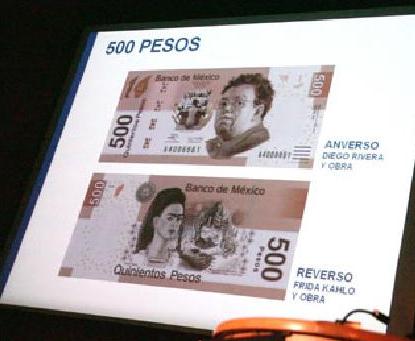
Alas, Diego Rivera was an ugly man (and Zaragosa, while he looked more like a grad student in literature than a general, looks conventionally heroic) and the reverse includes Rivera’s over-rated wife, Frida Kahlo. And, there has been a lot of criticism that the Banco de Mexico is turning its back on a worthy hero in favor of “political correctness.” So be it. But, it’s what we like about Mexico. The slight irony of a country with the National Bank controlled by foreign capitalists putting two Communists on their currency is wonderful.
Even better, it says to the world — no, we’re not a military power, and we do have money to spend… but we know what’s really important… poetry, science, art. So, when do we put Walt Whitman or Emily Dickinson on our bills?
Where was the romanticism?
THIS POST WAS WRITTEN BY THE MYSTERIOUS “LYN_2”, BUT SHE’S NOT REGISTERED ON THIS SITE YET. IT’S HER’S, NOT MINE… I DON’T WRITE NEARLY THIS ELEGANTLY ON THIS SUBJECT. (Richard)

Women who followed the armies during Mexico’s Revolutionary War didn’t look like the women in this scene. They didn’t walk along side their men. They didn’t take long walks down the streets of Chihuahua wearing their finest (clean) colorful dresses. The women were hungry, filthy, tired, overworked, neglected, generally unappreciated, and often suffering from illnesses. That doesn’t take away from the fact that they were devoted, supportive, and played a very valuable role in the fighting forces they “served” in.There hasn’t been a lot of detail written about the role of women in the Mexican Revolution, but among the lower class, many women became soldaderas, fighting soldiers, or victims. Some women actively opposed the revolution because they were strong supporters of Catholicism and the Church held views that strongly contrasted with the goals of the revolution. There were some women from middle/upper classes who lent support to various sides of the war through their intellectual endeavors. These women were often teachers/ journalists, etc. Many of this group were early feminists. The fact that they served as advisors, strategists, reformists led to many of them being beaten, harassed, imprisoned and even murdered.
The following description comes from an excellent article I found at this link:
http://www.actlab.utexas.edu/~geneve/zapwomen/goetze/paper.html
The soldadera was the most typical role women played in contribution to the Mexican Revolution. It was typical in that it involved a large number of women and that it followed the most accepted gender-based roles for women as caregivers. Although they occasionally fought in battle, these women generally traveled with the revolutionary armies to forage for food, cook meals, nurse the wounded, wash clothes, and other services not provided by the military . Although some authors do not distinguish between the Soldaderas and the female fighters, Andrés Reséndez Fuentes makes a clear distinction between those women who served as a vital support system to the combatants, and those who actually participated in the fighting. Soldaderas endured miserable living conditions, malnutrition, and even childbearing under inhospitable surroundings . Soldaderas whose husbands died in battle often continued in their roles as the soldadera of another soldier . While “no army of the revolution fought without women but each organized female participation in a distinct manner,” . Soldaderas generally remained anonymous and were never recognized for their indispensable contribution to the revolution.

Female fighting soldiers often joined on as soldaderas and moved from that role to one of a full time gun-toting revolutionary. They usually took on masculine roles in their dress, swearing, drinking, and became all around toughs. Female soldiers who showed a lot of skills and had leadership qualities actually did become officers of men and raised in the ranks of the Revolutionary Army.Victims were usually women who stayed home to tend to their children and to protect their homes. Once the armies ran low on rations, the soldiers would raid their homes for food and supplies. The girls/women who lived in those homes were often raped and if the soldiers suspected them of being connected with the enemy, they were murdered. Zapata’s men were especially famous for raping women throughout their territory.
The woman in the photo was a Yaqui scout named Hermilianda Wong Chew who served under Obregon. She was thought to be a fighting soldier/officer because of her pearl handled pistol and her binoculars. (Thanks Rich!)
Soldaderas walked behind their soldiers because officers would not give a horse to a woman. He would give it to a fighting soldier first and the women would have to carry their children and their personal supplies while their traveled by foot. When an army traveled by train, the women often rode atop or outside (the cars) the train as the cars were reserved for the soldiers. Female fighting soldiers usually provided their own horse.The role of women differed depending on who’s army they served with…. Villa, Zapata, Carranza, etc. Villa tended to resent the fact that the soldaderas slowed his men down. He liked the ability to move quickly. Zapata admired/appreciated the support offered by the women, whereas Villa was cool to the idea. Villa reportedly had one of his female soldiers shot because she accidently shot one of his men. Ironically, he had her buried with military honors. On another occasion, Villa executed 80 to 90 enemy soldaderas (including thier children) because one of them took a shot at him.
The early Maderistas and Orozquistas of the north did not bring camp followers to the battlefield because the troops generally remained close to home. Also, the Soldaderas tended to be slow moving and deprived the cavalry units of their much valued swiftness. However, this lack of Soldaderas caused logistical problems when it came to medical needs and obtaining food and ammunition. Provisional support units were often set up by only a few women and some men, to provide nursing, food and other services, but were often insufficient and diverted soldiers from fighting.
A few of the remarkable women of the Revolution:Petra Herrera became an officer or “coronela,” commanding 200 men, according to a report in The Mexican Herald on January 7, 1914. Historian Elizabeth Salas tells us that Herrera, along with 400 other women, took part in the second battle of Torreón as part of Villa’s vanguard. A villista by the name of Cosme Mendoza said, “Herrera was the one who took Torreón on May 30,1914.”
Angela Jimenez, who at 15 witnessed her sister’s attempted rape by a soldier. Her sister grabbed the officer’s gun and killed him and then killed herself. Jimenez joined her father in the army, promising herself to kill the federales. Jimenez became a spy, soldier and explosives expert.
Elisa Grienssen Zambrano of Parral, Chihuahua was a 13 yr. old teacher who commanded men and women of Parral to repel and expel a “punitive expedition” from the American army in April 1916. The American soldiers were on a mission to apprehend Gen. Francisco Villa. Elisa was so indignant that Americans would invade Mexico’s sovereign territory that she organized women and school children to surround the North American commander, Frank Tompkins. Shortly, men in the town joined her and armed only with rocks, tomatoes, and shouts of “Viva Mexico, Viva Villa”, they succeeded in forcing him and his men to retreat. When Villa asked Elisa “how did you do it?” She answered him, “We did it for Mexico”.
*** A faded oil painting of Elisa Grienssen Zambrano is still on the wall of Villa’s museum.
In 1911, Profesora Delores Jiménez y Muro founded the group Regeneración y Concordia from her prison cell. The group’s purpose was to “improve the lot of indigenous races, campesinos, obreros, unify revolutionary forces, and elevate women economically, morally and intellectually,”. In March 1911, Jiménez put together the Political and Social Plan, which was a conspiracy to bring Madero to power by a rebellion near Mexico City. Her Plan was unusual because it outlined the need for extensive social and economic reforms, rather than simply the desire for political change at the top. She specifically recognized in the Plan that the daily wages of both men and women in urban and rural areas needed to be increased, as women made up more of the “economically active” population than was acknowledged by the official census. Emiliano Zapata was very enthusiastic about Jiménez’s Plan, particularly the part calling for the restitution of usurped village lands, and invited her to join his cause in Morelos. She did so after the death of Madero in 1913, and remained there until Zapata’s assassination in 1919, well after her seventieth birthday. Although Dolores Jiménez y Muro was an active revolutionary for almost twenty years and provided significant contributions to history, she has received little attention from academics.
One of the most famous female soldiers was Margarita Neri, who became a legendary Zapatista commander. “So many legends surround Neri that she is portrayed as both commanding Zapatistas in Morelos and as cutting off the ears of Zapatistas sent to recruit her. Despite the mass of contradictory accounts, it seems that Margarita Neri was a capable and respected guerrilla commander.
additional links:
http://epcc.edu/nwlibrary/borderlands/21_soldaderas.htm http://www.sibleynaturecenter.org/essays/moseying/history/060301_liberatedwomen.html
Protests now in aisle 12…
Last week it was McDonald’s this week it’s WalMart. Ah, Mexico… the past is always with us. The McDonald’s protests go back a few years, and The Evil Empire has attracted my attention more than once
By KATHLEEN MILLER, Associated Press
MEXICO CITY – About 250 protesters chanted “Out! Out!” in front of Wal-Mart’s corporate headquarters before entering the adjacent store, where they blocked aisles for about 30 minutes before leaving. There were no immediate reports of arrests, injuries or damage.
Ruben Garcia, a Mexican citizen who works with San Francisco-based activist group Global Exchange, said the discount chain’s low prices take business away from the country’s traditional public markets and depress wages for workers and farmers.
“If a cantaloupe costs 20 cents at a Wal-Mart, imagine how much the rural farmers are getting for this cantaloupe,” Garcia said. “There is a high cost for the low prices.”
The company denied the accusations.
“Wal-Mart of Mexico generates very positive benefits for the country,” it said in a statement. With more than 140,000 workers, Wal-Mart is the largest private sector employer in Mexico.
Some protesters carried signs bearing pictures of Andres Manuel Lopez Obrador, the leftist presidential candidate who claims he was robbed of victory in July elections and plans to be inaugurated as the “legitimate president” of an alternative government on Monday.
Lopez Obrador aides have accused Wal-Mart of supporting his conservative rival and the current president-elect, Felipe Calderon. The company denies the allegation.
The Arkansas-based company has been targeted by Mexican protesters before.
In 2004, a Wal-Mart-owned discount store opened less than a mile from the ancient temples of Teotihuacan, just north of Mexico City, despite months of protests by some residents who claimed the sprawling complex was an insult to Mexican culture.
Last month, Wal-Mart won preliminary approval over opposition from some residents to build a store in Cabo San Lucas, in Baja California Sur — the only one of Mexico’s 31 states where it currently does not have an outlet.

Mr Bean — pirate, scoundrel, Mexican hero

Texans always have had a soft spot for pirates of one sort or another. The state that brought us Lyndon Baines Johnson, Halliburton, George Bush (I and II), Anna Nichole Smith and cheerleader mom Wanda Holloway, even under the relative sanity of Spanish and Mexican control attracted its share of ethically-challenged swashbucklers.
 Look at the founding fathers. A dead-beat dad skipping out on alimony payments back in Tennesee — Sam Houston — gets a city named for him (and a 50 foot statue up by the Huntsville State Penitentary). Galveston forgets it was named FOR a fearsome Mexican lawman (Juan Galvez) and remembers it was named BY a gay pirate, with a peculiar sense of humor.
Jean Lafitte needed someplace quiet between New Orleans and Veracruz — in both cities he was a “respectable” businessman… well, it was the “don’t ask, don’t tell” era of merchandizing. Naming his hideout for the chief lawman of the era was high camp — and deliciously ironic. Just the thing for a witty jeu d’esprit to liven up those FABULOUS dinner parties Jean and his cher ami, Pierre, threw for the rogues, scoundrels and fellow merchandizers. Galveston, to it’s credit, has never turned respectable… it still celebrates its scoundrels, and — in the spirit of Jean and Pierre — it’s always been a gay-tolerant place.
During the War of 1812, Lafitte and Pierre provided material assistance and contract labor to the United States Navy — in his day it was called a “letter of marque.” It wasn’t much, but it did start a tradition in Texas roguery — the spiritual descendents of Jean and Pierre are today’s unindicted Halliburton and Enron executives.
Not nearly as colorful as Lafitte, as ornery as LBJ or as rapacious as Enron or Halliburton … and only a run-of-the-mill heterosexual bigamist, Peter Ellis Bean is almost bland… and, consequently, forgotten. There’s no Bean County, no Beanville… no 50-foot statue to Mr. Bean.
 It’s a shame. He was as throughly disreputable as many a better-known Texas pioneer, and he managed to accidentally become a heroic figure in the Mexican War of Independence.
Bean traveled widely throughout Texas and what’s now northern Chihuahua. The short biography in the Handbook of Texas On-line tells us little. He was born in Tennessee in 1783 (though 1778 seems more likely, as other records suggest) and in 1800 was part of the “ill-fated Philip Nolan expedition”. He was only a teenager at the time, but he knew Nolan from his “horse-trading” (involving stolen horses — or perhaps stealing horses — from the Indians) expeditions.
Philip Nolan’s name may ring a bell if you remember your Junior High School English. Edward Everett Hale mixed up Nolan’s ill-fated attempt to invade Mexico with Aaron Burr’s attempts to grab Texas the next year. Philip Nolan became “The Man Without a Country” in the 1917 short story, who is condemned to never to hear of the United States as long as he lived.
The real Nolan had some hare-brained idea that the Spanish wouldn’t notice if he grabbed a himself a big o’ hunk of Texas. They noticed. They shot Nolan. The filibustros were dragged off to Chihuahua to stand trial, but no one was in any hurry.
Mexican justice was even less efficient then than it is now — it wasn’t until 1807 that the survivors even came to trial. In the meantime, Bean (now often called Pedro Elías Beán) acccording to an online bigoraphy compiled from several 19th century sources:
“… became a shoemaker and at Chihuahua he established a hat manufacturing enterprise. He reputation spread for manufacture of hats of such quality that he soon obtained a monopoly on the local hat trade, had several employees and gained the respect of residents of the region. After four years, discovery of plans for escape, betrayal by fellow prisoners on the Nolan Expedition and attempts to escape temporarily abrogated his success and privileges. He survived execution by a throw of the dice with one point lower than the unlucky member of the group.”
Bean and another “lucky” survivor, David Faro, were eventually given a prison sentence. They were packed off to Acapulco (believe it or not, that was punishment… ok, they were locked in the dungeon, but it was a nice sea-side dungeon) in 1811.
They were just in time for Padre Morelos’ seige of the city. With the Spanish distracted by the Insurgentes, Bean and Faro dug their way out of the prison, ending up with Morelos’ army. Although he was convenionally pious, and was considered a dedicated and honest village cura, Morelos was as tough a customer as any frontier horse-trader. He’d been a muleskinner and cowboy before entering the priesthood, and having served in rough, unsettled back country churches not only gave him the toughness to become the great guerilla leader that he was, he had an uncanny ability to pick subordinates for their qualities, overlooking their spiritiual shortcomings. 
Morelos knew he was working with scoundrels, but one of those scoundrels … our anti-hero, Mr. Bean, had somewhere acquired a more usable skill than making hats and shoes … he knew how to make cannon-balls and explosives.
Wilbert H. Timmons, who wrote what I think is the only English-language biography of Morelos (“Morelos of Mexico: Priest, Soldier, Stateman. El Paso, Texas Press Western Press. 1963, rep. 1970) has this to say about the remarkable Mr. Bean:
One Anglo-American, Perter Ellis Bean, should be included among those who joined the Morelos movement during its first year of military operations and who contributed significantly to the cause.
… Bean escaped as Morelos entered the Acapulco area, joined his insurgent army, and aidend the revolutionaries immeasuably through his knowledge of the manufacture of gunpowder. “As there were large quantities of salpeter in the country,” wrote Bean, “and I was the only one who understood the manufacture of powder, I set up a powder mill. We obtained sulpher from a mine near Chilpancingo and while the Indian women ground the material on their metates, I msade the powder.” Bean remained with Morelos until 1814, when he was sent to the United States to obrain aid for the insurgent cause.
The official on-line biographer (partially based on Bean’s self-serving 1816 autobiography) write of his activities:
Bean distinguished himself by engineering large scale defections from the Royal Forces to the Republicans and exhibited leadership in action that brought him the rank of Colonel. He was in command of the troops that captured the city of Acapulco including his former captors. In contrast to the Mexican Indian insurgents under his command, Bean insisted on humane treatment of prisoners and was admired for the trait by both sides. Bean met and became acquainted with most of the important chieftains of the Mexican independence movement including Gen. Manuel Mier y Terán and Felíx Fernández (Guadalupe Victoria).
Those 19th century biographers decorously mention that he “met” a “Spanish lady” at this time. They neglect to mention her name, Doña Magdalena Falfan de los Godos, or the possibly important detail that he married her. Why becomes obvious later.
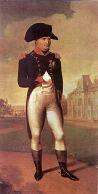 Morelos was no fool, but he had very little knowlege of the wider world. And even less maneuverablity when it came to seeking foreign aid. When the fledgling United States revolted against their British colonial masters, they could appeal to the other two European superpowers… France and Spain.
But, Morelos’ revolt was against the “French atheists” (i.e, Napoleon Bonaparte) who had occupied Spain and put Napoleon’s brother on the throne in Madrid. The army they were fighting answered to the Viceroy, who was loyal to either Carlos IV or his son Ferdinand VII, depending on which Spanish “loyalist” junta he happened to answer to that particular day. It didn’t matter — both the Carlists and the Fernandists were supplied by the British. The superpowers were fighting each other, but both were trying to hang on to the American colonies. Holland, traditionally an English business rival had provided George Washington’s rebel army with money… but Napoleon had put yet another brother on the Dutch throne… which only left Morelos with the upstart United States. The U.S. was no superpower, but at least it had a navy, which Morelos did not. And, there was money and radical revolutionaries to the north. It seemed a natural ally.
Morelos recognized that Bean was less than the ideal diplomat. But, not having a Mexican Benjamin Franklin or Thomas Jefferson around (who at least spoke the ally’s language), he had no choice but to send Bean and two other adventurers — one of whom ended up, after sending a letter to President Madison, drifiting down into Columbia, where he attempted to borrow money using a forged letter by somebody named “Joaquin José Morelos”). Bean never got to Washington etiher.
Advanced several thousand pesos in gold, Bean set off on his adventures. Again, our 19th century friends:
…Bean was sent in the fall of 1814 by Morelos as an agent to promote the Mexican Republican cause in the United States, “to bring on a campaign against the province of Texas, and …to make some provision for a supply of arms.” He found at Nautla on the coast north Vera Cruz, one of Lafitte’s vessels {you just knew our gay pirate would show up eventually, didn’t you?}, the Tigre(“Tiger”), under the command of Captain Dominic You, which had just defeated a British brig offshore. The Tigre was beached after a drunken celebration of the crew over the victory. From the crew, Bean first heard of the war between the United States and Great Britain, He rigged his own schooner and sailed to New Orleans with the Napoleonic veteran and pirate, Joseph Amable Humbert on board, as well as part of the crew of the Tigre. At Barrateria, he met Lafitte and necessarily postponed attempts to get support for the Mexican insurgent movement because of pre-occupation of the area with the war against the British. With Lafitte, Bean contacted General Jackson and offered their services at New Orleans. As the British guarded the coast, the two threaded their way through the swamps and bayous to that city. Bean was well known to Jackson, and was at once placed in charge of a battery. Lafitte, also, was given a command; and both did heroic service in the great battle.
Bean’s (or Beán’s) actions back in the U.S. are a little less heroic to later biographers. According to Timmons (page 146), Bean was seeking help from a British ship after Captial You’s drunken mishap. Discovering the British were at war with the United States — and besides, they were hunting for pirates — plans changed. Bean and a few of the soberer sailors stole a boat and hightailed it to New Orleans, where he met up with Lafitte. Joining up with Andy Jackson was apparently Lafitte’s idea… and a good way of legitimizing his own rather dubious business activities… and, incidentally, Bean’s
Bean never made it anywhere near Washington. He never bothered sending a letter to Madison, though he did try recruiting some pirates and ne-er do wells around New Orleans, for a incursion into Texas. Eventually, Bean himself, once there was an independent Mexico, drifted back into Texas, where — trading on his services to the Insurgentes, and his revolutionary connections, he was given a military commission. To his credit, he served with some distinction keeping peace between the local indian tribes and the settlers. He apparently forgot he’d acquired a Mexican wife and married (or didn’t — the record is unclear) a “Texian settler” from Tennesee, and — in violation of Mexican law, bought several slaves to work his plantation outside Nachadoches.

When the Texians (the U.S. settlers in Texas) rebelled against Mexico in 1836, Bean — as a Mexican officer — was locked up (again! — though this time for NOT rebelling) but as a personal friend of fellow rascal, Sam Houston (they knew each other from their dealings with the Kiowa and Comanches) he didn’t stay in jail very long. Out on parole, he sat out the Texas revolt, taking no real part in public affairs, and living quietly with his American wife, Canadice
In 1842, he began liquidating his assets. By this time it was obvious that the United States was going to annex Texas. It also appeared, slightly later, when Beans’s will was probated, that the property was … shall we say… overvalued, and had an unclear title? It wasn’t completely clear that Bean owned the assets that had been liquidated.
Canadice was still alive, but so was Magdalena back in Veracruz State. The old rogue wrote his will, swearing he was a widower and rode out of town. He rejoined Magdalena at her hacienda outside Xalapa. With perhaps better timing than ever before, he managed to escape the law and avoid embarrasing questions about his finances (and returning to the country he’d originally fled as a teenager, worked as a diplomat to make an ally, fought for, then fought to prevent becoming an ally, then was invaded by)…. by dying on October 13, 1846.

Pay no attention to that giant sucking sound… it’s just Homeland Security moving to Guadalajara!
New York Times (November 13, 2006)
By Elisabeth Malkin
MEXICO CITY, Nov. 12 — Ross Perot once spoke of a “giant sucking sound” of jobs leaving.
The Texas billionaire and onetime presidential candidate railed against the North American Free Trade Agreement in the early 1990s, arguing that it would create a “giant sucking sound” of good American jobs pulled to low-wage Mexico. But things change. Last week, Mr. Perot’s Texas company announced that it was hiring — in Mexico.
The Perot Systems Corporation, which manages information technology for companies, is setting up a technology center in Guadalajara where it expects to employ 270 engineers by the middle of next year. Neither Mr. Perot, who is now chairman emeritus of the company he founded in 1988, nor his son, Ross Perot Jr., the company’s chairman, was on hand for the announcement in Guadalajara Thursday. But a company spokesman, Joe McNamara, said that lower pay for engineers was only one of several reasons Perot Systems decided to set up in Mexico.
“Guadalajara is a fast-developing technology center in Mexico,” he said. “There’s room to grow.” The company is also looking at other places in Mexico to set up new operations, he said.
“Mexico is a very important strategic location for us,” he said. The Perots are hardly bucking the trend as the information technology industry has grown steadily offshore. Perot Systems, based in Plano, Tex., had sales of $2 billion last year and employs 20,000 people in more than 20 countries, 6,000 of them in India alone. The company will also announce a new operation in the Philippines and one in Kentucky soon.
At Thursday’s announcement in Guadalajara, Mike McClaskey, the vice president for infrastructure solutions, was there to invite job seekers to the company’s recruiting events, describing a “meaningful career opportunity” at a center that will be part of the company’s global network. The Mexican employees will be providing desk and engineering support to Perot Systems clients in the United States and Europe. The clients include companies in the health care and finance industries along with United States government agencies like the Department of Homeland Security.
The company does not plan to use Mexico as a base to drum up new business from Latin America, Mr. McNamara said. The arrival of Perot Systems in Guadalajara, which bills itself as Mexico’s Silicon Valley, is a small success story for the government and the local technology industry. For several years now, Mexico has tried to carve out a niche as a low-cost software developer in an effort to win a fraction of the business that now goes to India. But so far Mexico has failed to catch on, despite its growing pool of bilingual engineers and the advantage of being in the same time zones as the United States.
The new technology center in Guadalajara offers a stamp of approval, particularly because it comes from such an unexpected source. Back in 1992 and 1993, Mr. Perot’s anti-Nafta harangues made him highly unpopular in Mexico, where many had high hopes for the agreement. But a dozen years into Nafta, Mexicans are willing to let bygones be bygones.
And so, it seems, is Mr. Perot. “The whole world has changed a lot in the past 14 years,” Mr. McNamara said.
The Sounds of Silence
This is another of those posts that should be attributed to LYN_2 — when I imported from blogspot, they all carried over under my own name. We’ll get it straightened out eventually. (Richard)
Is the general population of Mexico City aging or what? Some politicos have gotten so cranky about the noise levels in d.f. that they passed a new ordinance to turn down the volume.
Antonio Olivio of the Chicago Tribune: http://www.montereyherald.com/mld/montereyherald/news/world/15999753.htm
Several wondered: Is it even possible to harness Mexico City’s carnival of sound? To quiet the roving mariachi bands-for-hire that sing about lost love until dawn? To silence the sidewalk barkers promoting the latest trendy bars? Or, in a 24-hour society that loves a good party, to undo the fact that one’s stature is often measured by the strength of his stereo speakers?
Government response is the new Environmental Standard for the Federal District, adopted in September, which cracks down on loud factories, bars, markets and other places of business in the capital.To show the government means business, higher fines associated with the new ordinance start around $90 and can climb to $900, Trujillo said.Sergio Beristain ascribed the problem to a mixture of erratic urban planning and a culture that loves to be heard. “The people, they’re used to noise,” he said with some resignation, calling the new law too limited in scope. “I’m not sure they have the resources they would need to enforce this ordinance. It would require a massive education campaign.When people write into Thorntree asking for suggestions of quiet places to stay (in Mexico) where they can relax and write a book, I just roll my eyes. There are no so such places. Mexico is all about noises!
I thought I found a quiet place to stay in Piste. It was a nah off on a dirt road. I had a thatched roof, a bed surrounded with mosquito netting, and a mirror… that was it. The only lightbulb in the room was burned out and no tv/radio or anything. I hadn’t taken into account the critter population. Dogs prowled around the nah all night and barked in unison. A rooster greeted the sun with his friendly call which woke up the mamma pig and her 5 offspring…. oink, oink. At about 6am, the church bells rang and at 6:30am, a big ol’ truck drove past with an impassioned man’s voice booming through a loudspeaker as he was trying to sell a load of mattresses (of all things).
When you’re in a Mexican city (anywhere in Mexico), your ears will be assaulted by belching buses, barking dogs (roaming gangs), honking horns, sirens, noisy vendors, jack-hammers, etc.

It’s not uncommon to be eating a meal in a local restaurant with two tv’s going, a mariachi band playing songs at the next table, a waiter trying to take your order and a cd vendor (with a sound system to rival ‘Twisted Sister’s) blasting away just outside the open doorway.
I’m ok with all of it with one big exception…. the obnoxious ORGAN GRINDER! That sound (noise) grates on my last nerve. It’s right up there with nails going down a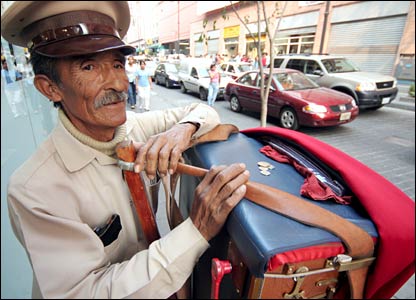 chalk board or the sound of bagpipes. One afternoon, I bought a phone card, and walked over to a payphone to make a long distance call. Right after I heard my sister say, “Hello….” an organ grinder walked up and started playing. I looked over at him (thinking he would take a hint), and he just smiled at me and kept on turning the crank. Teaches me to call home from calle de Cinco de Mayo.
The mariachi’s, the barking dogs, the jack-hammers… they’re noises of a bustling society. Coupled with the aromas of grilled onions and cooking tacos, the burning mesquite, the perfume of incense wafting through the churches, and of fields of pointsetias growing in Xolchimilco, the noises in the streets, give Mexico it’s vitality/energy.
The only instance of long silence I experienced in Mexico was when I joined a group of about 100 onlookers (on a Puerto Vallarta beach) as we watched a large sea turtle lay her eggs in the sand. For about an hour, you could hear a whisper.
Babies and working men on the buses have learned to sleep right through the daily commotion. Only old men in suits, who are trying to distance themselves from their roots, want to muffle the noise. Noise is the music of the young.

Meanwhile, let’s have a little fireworks with that marimba band!
photo by: ogal
Big Mac… attacked… again!
The teachers’ strikes have been going on for 20 plus years. Ulises Ruiz wasn’t the first Governor to steal an election, and AMLO’s loss wasn’t the first shady presidential election in Mexico. But, what convinced the Oaxacaños they could take on the powers that be? Juchitan famously resisted the State back in the early 90s and installed a PRD-led municipal council… but that was put down. The first successful modern people-power movement in Oaxaca was back in 2002 — and the fight was the Golden Arches v the golden-hued historical arches of Oaxaca… or Big Macs v. Crickets. The crickets won… and the rest is history.
TODAY:
OAXACA, Mexico (AP) — In the conflict-torn Mexican city of Oaxaca , police say four youths wearing masks tossed gasoline bombs at a McDonald’s restaurant, damaging the windows, seats and play area.Security personnel at the shopping center where the McDonald’s is located put out the blaze. The restaurant was closed during the pre-dawn attack, and nobody was hurt.
The shopping mall is near a university where leftist protesters set up their headquarters last month after police drove them out of the city’s main plaza. Those activists attacked a Burger King restaurant in the same mall with gasoline bombs last week.
However, leaders of the movement deny their members were responsible for today’s attack…
This is round two of the Great Oaxaca Burger Wars…
Back to round one… published in the NY Times, the last time a Oaxacan uprising made the news… and incidentally, the people won. The store bombed last night is the one mentioned as being “near a Mercedes dealership.”
Mexicans resisting McDonalds Fast Food InvasionMcTaco vs. Fried Crickets: a Duel in the Oaxaca Sun
August 24, 2002
By TIM WEINER
NY TimesOAXACA, Mexico, Aug. 22 – The town square in this old city is a kind of sacred space. Beside a cathedral, under ancient shade trees, people sit for hours on cast-iron benches, passing time slowly, framed by stone arches glowing golden in the afternoon light.Two new golden arches may be rising soon.
A certain corporation known throughout the world for its hamburgers – and as a symbol of American culture – plans to open an outlet on the southeastern corner of the square. The proposal has set off a lively debate about food, money and
power in Oaxaca (wa-HA-ka), where the favorite snack is fried crickets, not french fries.“This is the center of our city, a place where people meet, talk politics, shop and spend time,” said Francisco Toledo, 61, a native Oaxacan and perhaps Mexico’s best-known living artist. “It’s a big influence on art and creativity. And we are drawing the line here against what the arches symbolize.”
McDonald’s, which sold $40 billion of food last year, has faced down opposition all over the world, including American communities from Ft. Bragg, Calif., to the Bronx.
The protests have sometimes turned to political theater, most famously in 1999, when a French farmer, José Bové, dismantled a new McDonald’s in Millau, a citadel of cheese in southwestern France. But McDonald’s marches on: more than half its 30,000 branches are outside the United States.Since 1985, it has opened 235 outlets in Mexico, including one on the outskirts of Oaxaca, across the highway from a Mercedes-Benz dealership. Though Mexicans ometimes have a hard time pronouncing the name – it usually comes out as “Madonna’s” – many have no trouble downing McBurritos and jalapeño-topped McMuffins.
The fast-food giant says it will respect the cultural identity and architectural traditions of Oaxaca’s old square. But Oaxaca is a world capital of slow food, based
on recipes that go far, far back in time.It is famous for its seven varieties of mole, a painstaking sauce that can take three days to make; tamales baked slowly in a banana leaf, and those crickets, which take a long time to catch but have far more protein, fewer calories and less fat than ground beef. (They taste like grass-fed shrimp – an acquired taste, perhaps, but a very popular one.)
Public opinion in Oaxaca’s zócalo, the town square, favors those old tastes. “The zócalo’s a place with colonial arches and a colonial rhythm – not the place for
McDonald’s,” said Sara Carre~o, 39, who runs the ancient wooden telephone switchboard at the Hotel Señorial. “The difference between fast food and Oaxacan food is too great.”Mr. Toledo led hundreds of marchers to the zócalo, where they feasted on tamales, but the protests have not struck a universal chord. The State of Oaxaca may be the poorest in Mexico, and some people wonder whether they can afford to reject any form of foreign investment.
“Oaxaca was so isolated from the world for so long that any change feels like an onslaught,” said Iliana de la Vega, 42, who runs El Naranjo, an acclaimed restaurant off the zócalo. “Now, I’m not in favor of McDonald’s. But there are people who want their business. And if they follow the rules, pay taxes, give people jobs – you can’t outlaw that, can you?”
The argument now lies in the hands of the city government. But this may be less an issue of politics and power than of taste and time. Can a company that prides itself on speed and uniformity fit in a place where people value taking their time and making food by hand?
“Real food is not frozen meat,” said Jacqueline García, 24, who runs Toñita’s, a food stand in Oaxaca’s old market. “It’s fresh cheese and crickets. Fast food’s unnatural. The people who make it are incompetent. And McDonald’s belongs
in the United States, not our zócalo.”
Eaters of the world unite… we have nothing to lose but our mole!
Worrisome news from Oaxaca… not from an anarchist
A crazy on the “Thorn Tree Mexico Message Board” always claims I’m an anarchist. Moi? He claimed this guy was too, so I figured he must have something worth saying.
The Rev. George Salzmann, OSFS (the “Salesians — a rather conservative teaching order founded to counter the heresies of the French Revolution) is a Catholic chaplain at Harvard, and emeritus professor of Physics at U. of Mass, Boston. He wrote a quick article for the Canadian anti-globalization and alternative media site, Global Reseach. Father Salzmann apologized for not footnoting as carefully as he normally does in academic articles, wanting to get the material out as soon as poossible.
Revving up the dirty war in Oaxaca
Under PFP ‘protection’, and with PFP participation, the combined level of the dirty war by the Oaxaca PRI contingent of Ulises Ruiz and the PFP mushroomed — so intolerably in fact that the church offered asylum to members of the popular movement because of the threats and the jump in the numbers of dead, arrested, and disappeared. Unfortunately (and predictably), it’s not ‘just’ the state agents and allied paramilitaries who are doing the really dirty work.
There are people who were snatched by the PFP who haven’t even been identified, some of them seized at the most active large conflict area — the university campus,[3] where the radio station is located — on helicopters and not accounted for (according to some of the material I’ve read).[4] Most assuredly the PFP, or at least some of its ‘special forces’, is itself a terrorist organization.
I’m certain the so-called ‘counter terrorism’ operations discussed in the Narco News article by Diego Enrique Osorno [5] are being actively implemented by both Ulises Ruíz’s state and paramilitary agents, and by the highly-trained hit teams of the PFP, the latter undoubtedly led by officers trained at the School of the Americas. Terrorism against popular social movements is serious business for repressive governments, whether in Central America, Mexico, Iraq, Palestine, Colombia, or wherever.
DOH!
There’s a dust-up between Spanish news agecy EFE and U.S. Spanish-language Televison network, Telemundo over who is responsible for leaving the microphones on … and recording… and broadcasting Vincente Fox being, well… honest.
The story is here, on Terra. Youtube took down the clip, for legal reasons, and I can’t find another one anywhere.
Fox’s presidency ends Decebmer first. EFE was asking him “Hey, Vincente, now that you’ve been President of Mexico, what do you plan to do (besides try and save your reputation as everything seems to be falling apart around you… the questionable election of your successor, the situation in Oaxaca, in Tabasco, the never resolved issues in Chiapas, etc. etc. etc.).
Said el Prsidente:
“Ya hoy hablo libre, ya digo cualquier tontería, ya no importa: ya total, yo ya me voy”
I’m can say whatever I want now, and I can say any stupid thing I feel like. Who cares…. it’s over and I’m outta here!

Adios, Sensenbrenner and HR 4437
I guess it wasn’t that big an issue for U.S. voters…
“Republican leadership tried, but failed, to make immigration the wedge issue that would ensure their continued control of Congress after aggressively promoting an enforcement-only measure (H.R.4437) as their solution to reforming our broken immigration system. In fact, exit polling as reported by the Washington Post found that fewer than one in three cited immigration ‘as extremely important in influencing their decision, and they only narrowly favored Republican candidates. About six in 10 voters said that they believe illegal immigrants working in the United States should be offered a chance to apply for legal status…'”
Immigration Legal Resouce Center via Bender’s Immigration Bulletin


