A reliable reporter (who distrusts Mark more than I do)…
This on a travel site from a Oaxaca resident:
Yesterday afternoon (actually early evening) was a horrendous time in Oaxaca. From my rooftop, I watched the sun go down behind majestic Monte Alban. There was aspenglow at 180 degrees. I continued to watch the sky turn a rosy, comforting pink for 360 degrees. I also watched tear gas drifting from west to east in the zocalo. The sound backdrop to all of this was scared dogs barking (of course), church bells ringing, church music and chanting from the church 3 blocks from my house, ambulance sirens and gunshots (mostly tear gas as far as I can tell). I can’t distinguish between gunshots and tear gas. It was all very disturbing and surreal. But I felt no fear.I have not heard reports of deaths, but maybe they are slow in coming (the reports, not the deaths). HA! I trust my sources rather than the ones that are often posted. I don’t read Mark in Mexico, but maybe I should. Early on he wrote stuff that I KNEW didn’t happen. But we all have our sources so I’m not criticizing him. I just don’t report stuff that I don’t actually see/hear (unless I so indicate), so, from me, you all are getting a limited vision of Oaxaca.
Late in the day yesterday, the “gunshots’ got closer. This morning, I noticed several windows smashed at a bank near me, a gift shop and ADO bus terminal. The latter was busy repairing them. ADO is two blocks from me. A guest who was suppose to arrive last night couldn’t get through central Oaxaca and stayed in a hostel west of the zocalo. The protestors were blocking streets, but I think (but I don’t know for sure) that they are open now.
This morning I walked about, but not to the zocalo. There was a gathering of people, lined up peacefully, signing some kind of petition in Llano Park. They were pro-Ulises. Then about 30 minutes later, maybe at 1 p.m. or so, the copters were flying really low over my house. I assume they were checking whether APPO was going to confront Ulises in Parque Llano. Apparently not as all is quiet right now, 2:20 p.m.
It is certainly a disturbing time in Oaxaca. I doubt that it will get much mainstream press in the USA or other countries. I read a few articles by people who obviously are not here. Unless there were a number of deaths, media other than alternative presses, don’t pay much attention. But I may be behind in my media reading, since I’ve been walking around in the warm Oaxaca sun, and tending to my plants in my garden.
If you have specific questions, fire away. I am not trying to “make light” of the situation. I think it’s an IMPORTANT and historic time. In my book, it’s better to look at it as historic and TRY to understand the players than considering the media hysterics. Not an easy job and I don’t think I’m doing too well.
As a footnote: some friends of mine who didn’t know if they wanted to winter in Oaxaca this year came to “check it out” and decide. After being here a week, they bought a house!!! Go figure! Most of the people I know who winter here are coming back. However, if you’ve never been to Oaxaca, this is not a good time to come. It’s not dangerous, but your day can be interrupted and the zocalo isn’t exactly a “happy” place unless you like young, handsome preventive police!!!! 🙂
I am trying to understand the players and sort it out, but I guess I don’t have all the background and information that some people in the USA have. It’s amazing to me that people in the USA take such opiniated stances.
Oaxaca… something happened
There are plenty of reports (possibly overblown — as the newspaper reports all say, “details are sketchy”) of the confrontation yesterday between the APPO and the PFP (federal police).
El Universal reports that 80 people were injured and 100 arrested in confrontations.
Rocks were thrown, a few homemade rockets were launched (these rockets are hardly stinger missiles — they’re PVC plumbing pipe used to aim fireworks, which Mexicans use on all occasions mostly for the noise and light. Some churches still use them to announce the elevation of the Host, and small towns keep them in stock to set off the same way other small towns in the U.S. set off a fire or tornado alarms).
The reports are pretty certain a state court and the Hotel/Motel owners association were firebombed. There are some reports of molotov cocktains being thrown into the Camino Royale, but no damage reports I’ve seen (other than the usually alarmist — and unreliable — “Mark in Mexico” blog).
(Though, it looks like even Mark is starting to realize the State Government — or at least the Governor — is a hinderance, and not a help — to resolving the situation.)
Yes, this is all very worrisome, but with the Presidentical inaguaration in a couple of days, things are going to be more tense.
What caught my eye in the short report in this morning’s Mexico City Herald was the last sentence:
After 8 p.m. gunshots were heard across town, and a group of journalists took refuge in a house after police fired at them.
The reports aren’t clear on whether this was the Federal Police or the local police shooting at journalists.
What part of “illegal” don’t they understand?
| U.S. agent arrested in Mexico with shells |
El Universal Domingo 26 de noviembre de 2006 |
| An off-duty U.S. Border Patrol agent was held for more than a day by Mexican authorities after crossing the border with ammunition in his car before his release late Friday, authorities said |
| YUMA, Arizona – An off-duty U.S. Border Patrol agent was held for more than a day by Mexican authorities after crossing the border with ammunition in his car before his release late Friday, authorities said.The unidentified agent was arrested Thursday as he entered Mexico at the San Luis Port of Entry in southwest Arizona, said Raúl Berumen, a spokesman for municipal authorities in San Luis Rio Colorado, Sonora.
Mexican Customs inspectors found a bag containing 650 rounds of .40-caliber ammunition in the agent´s 2006 Nissan Altima, Berumen said. Possessing firearms or ammunition in Mexico is illegal and large warning signs are posted at border crossings. Lloyd Easterling, a U.S. Border Patrol spokesman, said the agent was released late Friday and returned to the United States. He said the agent was assigned to the Border Patrol´s Yuma sector and said officials worked with Mexican authorities to secure his release. “He was off duty and he was in his personal vehicle,” Easterling said. He declined to release the agent´s name Saturday. Berumen and Easterling said a woman and a girl were in the Nissan with the agent and also were detained. Easterling said he did not know if they were also released. Border Patrol agents are authorized to carry their firearms when they are off duty, but the agent was not armed at the time of his arrest, Easterling said. Agents also know they are not allowed to have weapons or ammunition in Mexico. “That is the law in Mexico, so certainly they´re made aware of it by several means when they move to the community,” Easterling said. A similar incident happened in April 2005, when two U.S. Border Patrol agents from the El Centro, California, station were detained by Mexican customs officials at the Mexicali Port of Entry. Mexican customs inspectors discovered boxes containing 1,286 .40-caliber bullets and 10 .22-caliber bullets. They were freed on bail after more than a week in a Mexican jail. |
|
© 2006 Copyright El Universal-El Universal Online |
650 rounds? Ever wonder how Mexican gangsters get their firepower?
Porn again… mea culpa, mea culpa
Wow, that’s bizarre. I’ve been cooped up since Thanksgiving (yes, thank you, I did cook a bird, and even stuffed it… but it doesn’t take much to stuff a quail!) trying to at least index this sucker (I’m down to about 70 left to index… put into some kind of category: what do y’all think? Does Lou Dobbs go under “Media”, “Evil Doers” or “Clueless Gringos”?
I saw on the statistics that I’ve been getting a lot of hits from people interested in some of the Mexican saints, or the Cristeros. There was a program on one of the Catholic radio services in the U.S. about Miguel Pro (about whom I may write later this week), so that may have something to do with it.
YIKES ! I didn’t realize that when I carried over my data from blogspot, it carried over the old links. Some of the photos don’t work… and one of them seemed to have floated in from cyberspace somewhere.
HEY… honest… it wasn’t even the kind of porn I like !

Just say no!… or we’ll kill you
Well, here’s one way to convince people not to do drugs…
A gang of drug hit men known as “The Family” took out a rare, half-page advertisement in newspapers in the state of Michoacán in which they claimed to be anti-crime vigilantes who wanted to stop kidnapping, robbery and the sale of methamphetamine in the western state. … (more here)
AMLO ain’t nuts (and maybe the phone rates will drop)
I wrote a while back that I thought AMLO’s parallel cabinet was going to be a “think tank” and wasn’t going to be a joke. Looks like I can pat myself on the back.
The new administration is considering an opposition proposal on an anti-trust law… the source being AMLO’s parallel cabinet’s economics team.
The Competitive Pricing Law, introduced by Andrés Manuel López Obrador and two of his top economic advisors, seeks to reduce the “exaggerated costs” of key basic commodities and services, such as cement, electricity, cellular phone service and Internet connections.
The bill should find support within the incoming administration. In interviews on Tuesday, Luis Téllez – President-elect Felipe Calderón´s choice to be the next communications and transportation secretary – said his mandate was to take on monopolies.
“We will strive to improve the quality of services, make prices affordable and control monopolies …
López Obrador, accompanied by parallel Cabinet members José Agustín Ortiz Pinchetti and Mario Di Constanzo, trotted out price comparisons indicating that Mexicans are paying considerably more for basic goods and services than those in the United States.
Mexicans, he said, pay twice as much for electricity and cable service, three times more for long-distance calls and cement, four times more in cellular phone rates, and 35 times more for some bank charges.
“This is in spite of the fact that the average salary in that country (the United States) is almost 10 times higher than in Mexico,” he said, putting the minimum daily wage in the United States at 445 pesos compared to just more than 47 in Mexico. “What we´ve found is that the prices (in Mexico) in these sectors are much higher than in almost any other country in the world.”
… “Monopolies are prohibited by the Constitution, but in practice many companies behave like monopolies because of the great economic power they enjoy,” López Obrador said.
The Competitive Pricing Law will be introduced in the Senate by legislators from to the United Progressive Front (FAP), a political coalition allied with López Obrador´s parallel government. The second largest force in Congress, the FAP consists of the same three parties under which López Obrador ran for president – the Democratic Revolution Party (PRD), the Labor Party, and Convergence.
The proposed legislation would create a Competitive Pricing Commission to operate independently of the existing Federal Competition Commission.
Kelly Arthur Garrett, Mexico City Herald (23 November 2006)
Update on the updates…
There have been two messages from “Tim Greene” wondering who “Lyn_2” is… she’s been away from her computer (unlike yours truely, she’s got a life), and when I imported from blogspot, everything came under my name. It’ll take some time to straighten that out… and to check that all the graphics carried over, as well as to straighten out the “categories” along the side.
I had too many links to handle comfortably under the “links” widget (I don’t like working with “widgets” when setting up the blog — I tried importing all those links I’ve built up over the last few years and it was just a friggin’ mess). So.. I’ve put our lunks on a page at the top that can be easily edited and added to.
I’ve heard from a few people who sometimes have something worthwhile to contribute, but for one reason or another don’t want to publish under their own “nom de internet”…
I may not quite get their reasoning, but it’s a common problem — these are people well known on other forums, can’t contribute regularly to a blog (and feel it’s a major committment — it ain’t. I’m just obsessive/compulsive), or have a public role (as a teacher or writer or reporter) that could create some difficulties for them if they’re connection with this “leftish” blog were know.
There is a solution! For our friendly ghosts, we found a contributor who no one can deny stands for truth, justice and the Mexican way … and is disguised enough to fool everybody (well, at least everyone on screen)…
Subcommandante Zorro
Last of the caiques
 There used to be a lot of guys like Cirilo Vazquez , the caique of Acayucan, Veracruz. The term, “caique” is actually Taino, the indigengous language of Cuba. It more or less means “headman”. Cortés and company, faced with controlling a country much larger than Spain (which the Castellians had only controlled since 1492), used the Taino term to mean the local puppet ruler.
In our day it’s meant something closer to political boss and/or “Godfather”… sometimes one and the same. The late Sr. Vazquez seems to have been more like Don Corleone than Jim Curley though.
And, I wouldn’t say Mexico is only “fitfully” modernizing. The new boss isn’t quite the same as the old boss…
Dudley Althaus had the story in today’s Houston Chronicle:
ACAYUCAN, MEXICO — Cirilo Vazquez did more to improve the roads and streets of this turgid corner of southeastern Mexico than perhaps anyone, but he finished life this week face down in one of them, three bullets in his head.
A rancher and businessman with a finger in many local economic pies, Vazquez, 51, was for many years the most powerful man in Acayucan and surrounding towns of Veracruz state’s oil-flush pasturelands. But he died Sunday like a common gangster, alongside a friend and three bodyguards, when assassins opened fire a few blocks from his home.
Police say the killings could be linked to drug trafficking, political rivalry or a personal vendetta. They could be tied to all of those things, police said, or to none of them.
… The caciques are supposed to be a dying breed in fitfully modernizing Mexico. Maybe they are. Cirilo Vazquez certainly was.
“He was the last cacique here in Veracruz,” Ruben Barragan, 46, an Acayucan merchant and longtime friend of Vazquez’s who came to his wake Monday. “There aren’t any more of them. They are mythology now. The world is changing.”
Cirilo Vazquez’s name had been widely known along Mexico’s Gulf Coast for nearly three decades. He rose to prominence in the early 1980s on the strength of his ambition, savvy and reputation for violence.
At least a half-dozen corridos, or folk ballads, are sung of his exploits. The legend includes a shootout with federal police more than 20 years ago that left his four companions dead and the cacique in prison.
In all, Vazquez was jailed three times — for weapons possession, drug trafficking and murder — but was never convicted. Friends and family say the charges were politically motivated.
After his release from prison early last year — he had been charged with murder in four cases dating to his wilder days a generation ago — Vazquez returned to Acayucan and devoted himself to building roads, bridges, school rooms and other public works.
Those projects were paid for from the treasuries of Acayucan and other towns, where the still-imprisoned Vazquez had helped his daughter, common-law wife and half-brother get elected mayors. Vazquez’s influence helped another daughter win a seat in Mexico’s national congress three years ago, at 21 years of age.
… A bleary-eyed Vazquez would listen to each petition, delegating assistants to attend to some, resolving others with a large wad of cash he carried in his blue jeans pocket.
“He might have done bad things in the past, but he was good to many, many people,” said Elisea Mendoza, 40, who said Vazquez paid for her nephew’s extensive hospitalization after the boy was hit by a car.
… A connection to drug trafficking couldn’t be ruled out, Lopez said, since Vazquez’s death mirrored gangland slayings across Mexico.
…Whatever the motives, Vazquez’s death “was something that was long seen coming,” Reynaldo Escobar, Veracruz state’s second-ranking official, told reporters Monday.
“He enthroned himself as a local and regional cacique,” the official said of Vazquez. “He who lives by the sword dies by the sword.”
As news of the cacique‘s death spread, people flocked to his home early this week from many miles around.
Vazquez’s daughters said they intend to continue his efforts … but they acknowledge that though they learned a lot from their father, they lack his political skills and logistical expertise.
“It’s not going to be easy because of all the political currents that are moving,” said Regina Vazquez, 25, who finished her term in September as a federal congresswoman for President Vicente Fox’s political party. “But a 20-year struggle doesn’t die with one person.”
Oaxaca… the next step
Jennifer Rogers is a PhD candidate who has been in Oxaca since October. With an MA in Sociology and a concentration in social movements, globalization, and gender:
I am fascinated with the current situation in Oaxaca. I am working on my dissertation for the PhD (in actuality, a book). My primary goal in Oaxaca was not to study the APPO, it is rather to study the movement to protect the biodiversity of seeds, particularly maize. However, a study of the effects of NAFTA, globalization, capitalism, racism, and the activism against it, is a study of many movements with many different groups involved. I am interested in these connections, the discourse around it, and particularly women´s role in this movement and discourse.
From a recent post:
The majority of the people in this movement want to see a peaceful change in the governing of their people. They want recognition of their traditional ways of governance that is representative of all people, especially the indigenous, and uses consensus. However, every meeting, event, march, and barricade is a negotiation between communities, families, businesses, organizations, ideologies and goals. If the incoming government of Calderon pushes harder, the debate over violence or nonviolence will be decided.
Life (sorta) under seige in Oaxaca
(From a post on the Mexico Branch of Lonely Planet’s “Thorn Tree Message Board” from a Oaxaca resident)
My own take on Oaxaca right now is that it resembles the story of the blind men and the elephant. Today was a perfect example of that.
I’d arranged to meet a friend inside the big doorway to Amate Books. I came up Calle Victoria from the Abastos Market, seeing nothing untoward until I got closer to the zocalo, where the PFP were much in evidence. I proceded north on Porfirio Diaz, cutting east on Matamoros & turning onto Alcala. Whoops — a barricade was under construction just in front of Amate. I stepped over it, along with several other people, finally sighting my friend on the steps in front of Sangre de Cristo. We stood around with the large crowd there, watching the barricade go up. Shortly afterwards there were several back & forth confrontations between those on the barricade and the federal cops down closer to the zocalo. There was a lot of tear gas. We saw a couple of comandeered buses brought in for use as barricades on adjoining streets, including Garcia Vigil. There were similar confrontations on that street, and a bus was burned there. We stayed well back, but a photographer friend reported later that he witnessed some fairly vicious beatings of protesters by the federal police.
One amusing note: as the crowd retreated from the advancing police and clouds of tear gas, a lady making quesadillas catty-corner in front of Santo Domingo continued serenely sprinkling epazote on her creation on the comal.
I walked my friend home, proceding west towards Crespo. Once again, a few streets away, everything seemed normal except for the huge cloud of dark smoke from the burning bus.
Going back to Abastos to catch a colectivo, I detoured through the zocalo. There are enormous numbers of PFP there, mostly hanging out, goofing around, having their pictures taken, and fooling compulsively with their cell phones. In short, except for the robo-cop garb, acting like any other group of young Mexican men. Their tents & tarps are everywhere, and the towel-drying area seems to be under the arches of the ex-Govt. palace. All of the cafes on the zocalo were open, although not at all busy. I exited via Bustamante, which was entirely filled with PFP.
Once on Las Casas, I’d entered a different world. The streets were bustling with people, and all the stores and street vendors were in full swing. As today was a holiday, Las Casas had that same busy atmosphere it always has on Saturdays. It was impossible to tell that just a few blocks away dramatic stand-offs were taking place. This normality continued all the way down to the Periferico and the area in front of Abastos. I hopped a colectivo over by the Serfin. It stopped to look for more passengers where the Periferico turns into the puente over the Parque de Amor. That whole area from the big arch over to the bridge was covered with large PFP trucks & huge numbers of PFP troops. The area behind the arch is completely filled with great big tents — it looks like a medieval jousting tournament must be in progress.
AMLO sashes the opposition…
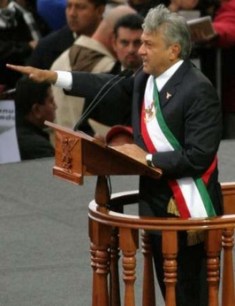
… or is he the opposition?
By just not fading away quietly, AMLO remains a force to be reckoned with in Mexico. I don’t think he really expects to support an “alternative governement” through donations… what he’s done is very creatively set up a relevant “think tank” that will pester the incoming conservative administration , and keep them — not to the “straight and narrow” but force them to deal with the 66% of the voters that did not chose Calderón. This should be… um… interesting.
MEXICO CITY (AFP) – Defeated leftist presidential candidate Andres Manuel Lopez Obrador donned a “presidential sash” before a crowd of thousands, calling himself Mexico’s legitimate leader.
Lopez Obrador called for “the start of construction of a new republic against a neo-fascist oligarchy” and announced the formation of a “parallel government” to “protect the rights of the people.”
In a symbolic “inauguration” in the capital city’s central square, he said “it is an honor to be the legitimate president of Mexico.”
Followers of his Democratic Revolutionary Party (PRD) have threatened to disrupt president-elect Felipe Calderon’s December 1 inauguration. Calderon is succeeding President Vincente Fox.
Lopez Obrador, 53, has said he is girded for battle with the incoming administration and the National Action Party (PAN), which backs Fox and Calderon. He claimed the July 2 presidential election was stolen.
Lopez Obrador and his supporters have protested for months, at times bringing central Mexico City to a halt with acts of civil disobedience.
The Vortex of Evil… José Manuel Nava murdered

This is not a good photo of my friend José Manuel Nava, who was found stabbed to death in his Zona Rosa apartment earlier this week.
The photo appears to have been taken at some conference or another. While I knew Nava moved in the higher circles of Mexican politics and business, my contact with the “captains of industry” was in an English classroom at most. The José Manuel Nava I was acquainted with could adapt the gravitas required of Excelsior’s Director when necessary, but I knew him as a good-looking, charming, witty and articulate denizem of the same Zona Rosa cafe I frequented.
It appears his charm, wit and good looks were not enough to protect him. While he knew he was an attractive man and comfortable with his age and ocial gifts — he wasn’t immune to the charms of youth. While he had little use for the street hustlers who’d come around those cafes looking for a papí, he wouldn’t be the first person to make a horrible mistake, or the first to let down our guard around some charmer.
I don’t know, and can’t speculate. Any time a journalist is murdered, especially in Mexico, we always look at what they’ve written, and who might be offended. Nava had just published a book blaming the Fox administration and Presidnet Fox himself, among others , for the downfall of the cooperative that owned Excelsior from 1917 until the Nava was appointed to oversee the forced sale to private interests. No one blames him personally for overseeing that thankless task, though some bitterness and resentment still surface. Last week, in El Sol, he had obliquely criticized everyone, warning of the dangers if the left interferes with Felipe Calderón’s inaguration, and if the Calderón administration does not heed the left’s calls for change:
Cuando se llega a la violencia es porque la política ha sido rebasada y a pesar de las claras indicaciones que tenemos esperamos que ése no sea el caso de nuestro país.
And, there was his run-in with the C.I.A.
Back at the start of the War Against Iraq, I’d see José Manuel in the cafe, playing hooky, or taking a long Mexican lunch-hour, editing a series of articles he’d written, in which he referred to the Bush Administration as “The Vortex of Evil”, into a book. He was under deadline, and under the pressure of managing a sinking newspaper, and when he was working… he was working. “Polite as a Mexican,” he could let you know he was very busy, and even the charms of Banzar would not distract him.
I liked that cafe because it had outdoor seating on calle Genova and offered great people-watching opportunities. And good coffee. And Banzar the waiter. Banzar service was one of the attractions of the place. He remembered my order (being one of the few people who put cream in their coffee, it was a running joke that I’d have to send the other waiters back every time… all us gringos looked alike, I guess). An “exotic” (he’s a black Ecuadorian), tall, althletic and extremely handsome — his barista skills maybe weren’t appreciated by the other foreign clientele. If Banzar understood English, he never let on… a good thing considering his opinion (and one I shared) of the creepy foreigners who hung out in that cafe, and who would invite the street hustlers to join them. Or flirt with Banzar, who would good humoredly accept their attentions… even if they never left a tip.
I understand English quite well, thank you. I was offended — and appalled — by those foreigners. Having told a 70-something Australian who wanted to know if I liked “that boy” (um… “no, I work in adult education” wasn’t what he had in mind — and I’m sure my lack of interests in his interests gave him some rather dull fiction to spin to his cronies, who seemed to dislike him even more than I did, though they met him every day in the same seats, and woe betide you if you took their seats. That cafe eventually went under, probably because that bunch hogged tables, yakked all day and never semed to spend much more than the price of a bottle of water. And welcomed in those street hustlers).
Gender preference is irrelevent, though I can’t help speculating that being a “known associate” of those aging expats could have marked Nava as easy prey for whomever he ran into. I once was propositioned in Parque Alameda by a youngster I’d briefly met, and promptly forgot about at that cafe. An American alcoholic who at least was entertaining when he ranted about George W. Bush, whiled away the hours between his early afternoon teaching assignments and the various bars happy hours by waiting for “students” who sometimes showed up. This kid did, and wasn’t understaning some point that the American didn’t seem to know how to put across… as if that was the point of the exercize. It happened a Mexican teacher had showed me a way of making that particular point clear to Spanish-speakers, and I shared it with the boy. Resolving the problem, was not the point. I’m sure that kid was innocuous, but who knows about the others?
The Australian and his cronies are how I came to know José Manuel and his run-in with the C.I.A. I figured out fairly quickly that the foreigners in that cafe weren’t people I really liked, or wanted to be around… but my Spanish was spotty, and I would be starved for English conversation, and so I was forced to venture out. By not taking a table with the foreigners (and in Mexico, one usually does end up sharing a table), broadened my horizons and kept my sanity (and improved my Spanish).
The jolly Cuban “double-exile” (he was a kid when his family fled to Miami in 1960, but Miami’s Cuban community is a pretty unforgiving and cold place for an adult with no taste for right-wing terrorists or reactionary attitudes frozen in the 60s) was fun, but his main interst was cuisine (he ran a Cuban restaurant in Mexico City) and his fellow Cubans would drop by… making me feel like Lucy when Ricky’s family showed up (Cubans are great fun, but they live and speak at 78 rpms in 33 1/3 rpm Mexico).
So, one dull afternoon, for lack of any alternative, I was talking to the Cuban, and the one creepy foreigner I could put up with for more than 15 minutes(at least his politics — regarding the U.S. — wasn’t reactionary. About Mexico, he was a racist pig, talking about “brownies” and “whities” and insulting the “Indian noses”. And he was an alcoholic, obsessed with both the street boys and the bar opening times), when I met José Manuel. Nata — who came from a privileged backround — was familiar enough with gringos to use the same words, but he’d never use them unless he was speaking with their regular users, and he used them ironically against the speaker, who was usually too stupid to realize he was the butt of Mexican contempt. I have no idea what party he voted for (and would never ask) but in the course of his career he’d critized the failings of all of them, and — in what outsiders found unusual, spoke of the Revolution not as destroying the upper classes, but as a relative success for Mexicans… including the “brownies” and the ones with “Aztec noses”. He was a Mexican patriot.
Nava had been a Excelsior’s Washington corresponent for 18 years. His English was perfect. And so… besides meeting someone worth talking to, I found out about “Hazley Maxwell” and the C.I.A.
As a Washington expert, Nava of course had friends in the Embassy. One of his friends, who’d been assigned to Mexico City, was back living with his mother outside Washington, and José Manuel called him. He wasn’t home, and Nava left a message. The mother couldn’t comprehend that a former diplomatic officer in Mexico might know people with Spanish names. She wrote down “José Manuel” as “Hazley Maxwell”. It was a running joke in Washington journalistic circles for years, and a few small articles in obscure publications have appeared under Hazley’s by-line. José Manuel wondered if “Hazley Maxwell” was also being investigated by the C.I.A., or if his “alias” might throw off people he found more amusing than threatening.
When the “Vortex of Evil” articles first appeared, the C.I.A. Station Chief in Mexico City called Excelsior, and got as far as José Manuel’s secretary, who has been around newsmen too long to suffer fools gladly. A mere C.I.A. Station Chief is no match for a tought secretary. There was no way she was going to give out any information on her boss. Even when the Ambassador called, demanding to speak to Nava, no way.
José Manuel’s only reaction to the whole dust-up was typical. He admitted being flattere by the attention the U.S. Government was giving to his strugging paper, but “disappointed” when, after a lot of work by attornies in Washington, the Mexican Embassy and a Freedom of Information Act request, finally discovered the C.I.A. only considered his paper “less influential than it formerly was”.
At the time, I was writing a short guidebook on Mexico City. Much of what I said about the media, I got from José Manuel. He was more than willing to share his thoughts on Mexican media, and on “Chilangolandia” in general. It surprised me that he enjoyed my crack that his paper, on slow news days “made news”. The paper, then owned by the employees, has had problems since the Echiverria adminstration engineered a coup of the editorial staff. When José Manuel took control, the paper was in the middle of a bitter strike that denegrated into a brawl between the pressmen and the reporters in the paper’s offices (talk about your “on the scene coverage — Nava joked it was the first “scoop” Excelsior had enjoyed in years)and he had the delicate, impossible task of trying to keep the paper afloat, moderize it (it didn’t help that one of the cafe-queens thought it was his task to tell the editor how to run the on-line edition, though he politely thanked the fellow for his suggestions and even took a few notes) and — if all else failed — find a buyer.
José Manuel Nava will be remembered for his good manners and willingness to deflect fools no one would suffer gladly. you could tell he was NOT HAPPY with the foreigner who insisted Mexico had to sell Pemex to American oil companies. I don’t think the American knew who he was talking to — or it would have dawned on him that the opinion of an Odessa Texas antiques broker wasn’t the one shared by the Mexican intellegencia. He appreciated that I was looking at the Mexican perspective, knew something about the country, and was more than generous with his time he’d stolen away from his impossible job to relax, have coffee and watch the world.
And I appreciated him for that and will miss him.


