Cats and Dog (Friday Night blogging)
IN what passes for tradition in the Blogosphero, you’re supposed to put up a cat picture on Friday nights.
So… being Friday, here’s “Illegal Alien Cats”:
Now, going to the Dog.
Duane Lee Chapman (the kind of name that if it’s not on a country music singer, is on either a serial killer or the guy whose family is covered in your local paper’s county police report). Dog the Bounty Hunter.
Duane Lee is in a heap o’ trouble. He’s a bailbondsman, and famous for bringing bail jumpers to justice. In a “man bites dog” story, the Dog was arrested in Hawaii by U.S. Marshalls on Thursday morning … on a Mexican warrent charging him with very, very serious crimes. Seems our boy… the famous bail jumper stopper … jumped bail.
Although something of a pariah among “respectable” bailbondsmen “Dog” has his admirers. They seem to overlook the obvious, things you can find, say, in Wikipedia:
Chapman … joined a motorcycle gang, the Devil’s Disciples, that reportedly had a distaste for blacks… According to Chapman, another gang member, Donny Kirkandall, murdered pimp and drug dealer named Jerry Lee Oliver a crime for which Chapman was found in complicity by a Texas judge. Chapman has reportedly been arrested at least 32 timesIn 1977, Chapman was sentenced to five years of hard labor on murder charges, he served just 18 months before being paroled in 1979. Before his sentencing, Chapman had married, and fathered at least one child. His wife Lafonda filed for divorce while he was in prison on the murder charges. Because Chapman owed money for child support, the judge in charge of handling the child support case asked Chapman to catch a fugitive for $200. This is considered the beginning of his bounty-huting career.
That last sentence doesn’t sound like anything that would stand up even under the laxest possible intrepretation of the Texas Code of Judicial Conduct.
“Dog”, out of prison, moved to Hawaii and set up shop as a bailbondsman… how, with his prison record, is never quite clear. Somehow. He’s a master showman.
When Andrew Luster, heir to the Max Factor cosmetics fortune and serial rapist, ended up in Puerto Vallerta, the Mexican police knew he was there. PV has its share of shady gringos. Intespersed amongst the retirees, the old queens, tthe eurotrash and the gay vacationers are the retired marijuana dealers, ponzi schemers keeping a low profile, the occasional mobster on the wrong side of a family disagreement. Not nice people, but not any particular concern to the Mexicans. Andrew Luster though. A serial rapist, already convicted in California, and facing a 124 year prison term?
Mexican prosecutors had already prepared extradition papers and were waiting for the FBI to come in and quietly pick the guy up in June 2003 when … and if this seems a tad “convenient”, you’re not alone in thinking so, but newspapers reported that a couple spotted Luster, called the FBI… and the DOG.
The Dog showed up — with a TV crew in tow — in time to get into a barroom brawl with the fugitive heir. Mexican cops threw the whole lot of them into jail. Where someone paid “bajo fianza” to spring the Dog from the pound. Luster somehow also was out of jail — presumably as a courtesy to the FBI, allowing the G-men to put Luster on a plane and fly him back to the U.S. without going through an extradition hearing.
That would not make for great drama. Or tacky television. DOG kidnapped Luster, put him on a private plane and … the rest, they say, is history.
Lest we forget, DOG is a bailbondsman. Somehow he managed to get bajo finanza for this very serious charge… and promptly fled the country. Sort of like… oh… Andrew Luster?
Dog milked that “capture” for everything it was worth. He’s a master showman who manages to appeal both to his white trash roots and to the sophisticated. In Mexican terms, he’s a naco — rich white trash, with excreable taste in jewelry and a ridiculous haircut that was a joke even when it was semi-fashionable 15 years ago. But, then, American culture since WWII has been defined by a lot of poor boys who never passed through the middle class. Though those boys had talent — Warhol, Liberace, Elvis.
 Dog had…? Good publicitiy, basically. Somehow the biker and his big-boobed foul-mouthed wife became de rigor television viewing in the U.S. While no one with any taste or culture would want to BE THOSE people — there’s a weird fascination with the Chapman family (maybe due to the fact than we’re lucky none of us know anyone remotely like them). For people who DO know people like them, there’s the satisfaction of seeing themselves as the “good” people against the bad guys.
The bad guys, more often than not, are darker skinned than Duane’s fan club. I don’t think that’s quite coincidental, as the amazing posts from The JAWA Report article on his arrest indicate. I’ll leave their names off to protect the moronic:
Fuck Mexico!! How dare those assholes take our number one well known american hero and imprision him aftrer all the crimes they committ here..Screw Mexico..Let’s go to war and blow em like we did in Iraq!!
I guess two wrongs make a right, or something like that. As to getting blown in Iraq, ok… but what does that have to do with Mexico.
he is not a criminal and he did not break any laws, because mexico has no laws, just revenge for taking out a rich man, who was pooling tons of money into mexico. i agree with military action, take the illegal mexicans out of our country or the people will one way or another.
Uh… kidnapping gets you 30 to 50 years in Mexico. Murderers only get 20. Duane was a very, very bad boy.
And, the one I love…
What is wrong with this sick world is it not bad enough we have so many mexicans taking our jobs and and their spanish on every recording and instruction mannuel we have ever gotten! Dog and Beth are good family people Bush step your sorry but in on this one.They have gotten so many bad people off the streets and helped many that would be nowhere without Dog And Beth’s and the whole Chapman family, I will be praying for them all, we can’t let them get away with this!!!!!!!!
“Instruction mannuel”… wasn’t he the translator I used to work with when I was a technical writer?
Protecting America

We’re rough mountainous terrain down here in the Chihuahua Desert. Some people say it looks like Afghanistan.
West of the Pecos, we have mountains, drugs are a big part of our rural economy, and there’s some well-armed crazies back in the hills, too. But all similarities end there. Rick Perry (and even Kinky Friedman, who is a smart guy and should know better) might be saying something different, but the National Guard is NOT here to look for some enemy. There is no enemy. There is only us.The 1200 or so Texas Guardsmen, and the units from Illinois and elsewhere are nice enough guys… young kids to me. Their job is to answer the telephones and do the filing (and man some observation stations) for the Border Patrol.. They are not looking for “terrorists”, we are not at war with Mexico, nor with its citizens, (even the drug dealers just get turned over to Judge Edwards and his one-room Federal Courthouse in Alpine). And they are not at war with American citizens.
Take young guys, a hot night along the Rio Grande/Bravo del Norte, nothing much to do but ride around and drink beer… add in never getting any time off after returning from a war zone, and give them weapons…
What do you think is going to happen?
Three Texas National guardsmen were in custody Tuesday, accused of firing guns in an Eagle Pass neighborhood, officials told News 4 WOAI.The three men were down on the U.S./Mexico border to help in the fight against illegal immigration, officials said.
The guardsmen face felony charges of deadly conduct for a shooting spree last week, investigators said. The guardsmen were drinking and driving, and taking turns shooting a gun out of the window, authorities said.
People here remember the last time we had military “assistance” with border security.

On Mexican Time….
One of the things that I’ve grown to appreciate is being on the recieving end of being on “Mexican” time. I’ve never heard of it described in positive terms before…. so this may be a first. Many people complain about slow services or of how Mexican friends or businessmen tend to arrive late, but there’s a flip side that I find wonderful.
There’s a reason why this clock has a smile on it’s face. It lives in Mexico. Nobody takes it too seriously. People in Mexico don’t yell at their clocks or throw them on the floor because nobody friggin’ cares about the minute hand or least of all… the seconds hand. 
When traveling through Mexico, I don’t feel rushed. You can take as much time as you wish to eat in a restaurant, sit and read the newspaper at the table if you want. People take the time to talk with you if you want a conversation. If it starts raining, no matter, just take it inside.
One sunny afternoon, my hubby and I took a leisurely drive down the coast from Merida to Ciudad del Carmen. We spent the night in Campeche and headed back out around noon. A short distance away, we came to the small town of Lerna where I spotted a restaurant on the beach that looked inviting. It had the typical palapa top and it sat on the edge of the Gulf with a “killer” view.
Service was sloooow, but we weren’t in any hurry. There were lots of tables, but only a few other customers. As I looked out at the water, I spotted HIM. He was Hemmingway, he was Picasso, he was to be my next photograph! He was my bald headed, dark skinned, large bellied, subject. I approached him like a school girl getting an autograph from a rock star.
“Would you mind if I take a picture of you?” He did not disappoint. Somehow, my limited Spanish rolled off my tongue and he was mine and I was his. It didn’t matter that he was about 70 or that he was clad in a pair of warn swimming trunks…. I was captivated by his presence.
Instead of an easel or a writing journal, my subject had a sharp knife and a fish in his hands. His hands were as strong as his eyes and his smile as broad as his shoulders. After taking a few photos of him, I asked him if I could watch him clean one of his fish. He not only let me watch, but he also put a fish in my hands and taught me how to clean one, too. Then, he showed me how to draw more fish up to us by throwing the guts over the railing into the water. He taught me the names of fish that swam up to eat the innards.
Before my lessons were done, he pulled a fish out his bucket that he called a toro fish. It had two small horns atop its head. He sat the fish on top of the rail and placed his cigarette between the horns and declared it an ashtray! After a good laugh, I went back to my husband and ordered lunch. 
When the plates came, there were generous portions of food on them. Halfway through our meal, our waitress brought out an entire platter of assorted cooked fish. When I told her that we hadn’t order it, she smiled and pointed to her papa. It was a platter filled with all the fish we had cleaned together. Oh, God, there was enough food for an army! What to do, what to do.
Screw getting to Ciudad del Carmen… this was gonna be a long afternoon. ‘Picasso’ came over to our table and we invited him to sit with us. He shared his stories of being a fisherman and of owning this restaurant, which supported his big family. It seems that he was a French/Mexican whose family came from Merida many generations ago. His stories were filled with his contageous humor.
When he was duly comfortable with us, he walked over to a box which was attached to a wooden post in the restaurant. He handed me a leather bound notebook which was filled with his hand-written poems. I listened as he read aloud from some of them. The joy and the enthusiasm that came from him will stay with me always.
I hadn’t gone to a restaurant that day. I had inadvertantly gone to the theater by-the-bay and I was sitting in the audience watching a one-man show. Even the family members in the kitchen were enjoying the action. You couldn’t have put a price on it.
Time didn’t exactly stand still. The sun did begin to set over the water. But no one seemed to care.
Twist and shout!
Mexicans love their Independence Day — so much so that they make it a two day holiday.
 Padre Hidalgo rang the church bell either late the 15th or early the 16th of September 1810. He called the people to church to hear a rather ill-thought out impromptu sermon on… among other things, Napoleon Bonaparte, the evils of atheism and the perfidity of the Spanish. What, exactly he blathered on about wasn’t all that important. The Padre had a boffo finish: “Kill the Spanish! Viva Mexico!” At which point the locals did kill the Spanish. And then were killed by them… and … killed the Spanish… who killed the Mexicans… who killed each other… who, ten years later, ended up with a pro-Spanish Mexicans rebelling against pro-Mexican Spaniards to join with pro-Mexican Mexicans. Quite the sermon!
 Silly Maximiliano de Absurdo… er, de HAPSBURGO… who had some strange ideas of how to get people to take him seriously (he took himself seriously),rounded up the royal court, hauled them out to Delores Hidalgo, recreated an edifying version of the Padre’s patriotic “grito” and then bored everyone with an interminably dull lecture on the need for Mexican patriotism and good relations with Spain. Ok, Max, can we go to bed now?
 OK, good idea, bad execution. Porfirio Diaz, realizing that “Hey, it’s Mexico’s birthday… well, it’s my birthday too!” had a better formula. Like Max, he wasn’t out to kill the Spanish, and — for all his faults — was a real Mexican. If you’re going to keep people up all night — HAVE A PARTY!
If you have to give a speech (and Porfirio did), get it out of the way. Porfirio learned from the Padre – the speech itself is unimportant. Just have a good closing. And no need to invent one: that VIVA MEXICO works is a sure crowd pleaser.
SO… every 15 September since then, at 11 p.m., the President (and State Governor, and Municipal President and Alcalde) goes out on the local government palace balcony, rings a bell in honor of the Padre’s churchbell, gives a (generally upbeat, “ain’t I great”) speech and starts the grito… Viva this, Viva Mexico! Viva that, VIVA MEXICO, viva the other thing, ¡VIVA MEXICO!

The best gritoistas can really string it out. You start Viva-ing along for mom, tacos and Manzana “Lift”, and before you know it, you’re shouting for the long life of… Pemex, the “Corridor al Pacifico” rail-toll road project and the Algamatated Sheet Metal Workers Union Local #345 (or the Mexican equivalent thereof). And, of course, vivaing Mexico. … or, as Vicente Fox (a master gritoista) puts it…
VEEEEE- VAAAAAAAAA MEEEEEEEEEEEEEEEEEEEEEEEEEE – HEEEEEEEEEEEEEEEEEEEEEEEEEE- COUUUUUUUUUUUUUUU!

AND then, PARTY TIME. Slaughtering Spaniards being passe, the worst any foreigner can expect is to be silly-stringed by passing patriots. Consuming mass quantities of patriotic national products — Coronoa, Dos Eqqis, Modelo… If you can’t fight em, join em… which is why you need the whole next day off as well.
What could be better than a national party? TWO NATIONAL PARTIES, of course.

The “virtual president”, Andres Manuel Lopez Obrador, never one to let a chance for a theatrical performance slip through his fingers, will be giving a counter-grito on the Zocalo the same time as President Fox. This will be … interesting.
May the grittiest gritoist win.
¡VIVA MEXICO! (twice).
Over My Dead Bank Account!

The Congressional House of Representatives wants to send them back. The Republican Kool-Aid drinkers want them all thrown in jail. But that’s not what Corporate America wants.There’s gold in them thar pockets, and we aims to scoop it out.
Protesters march in front of City Hall wrapped in American flags and carrying their “This is America, English only” signs. Minute Men, garbed in army fatigues and carrying their rifles and binoculars, cruise the dirt roads along the Arizona border. The conservative talk show hosts decry “sure they’re human beings, but they’re illleeegal! We’re a country that believes in the Rule of Law!”
Meanwhile, Corporate America is going about what it does best; making money off of them.
The following article inspired this post:
BusinessWeek online
JULY 18, 2005
“Embracing Illegals”
By Brian Grow, with Adrienne Carter and Roger O. Crockett in Chicago and Geri Smith in Mexico City
Picture this. Four or five years ago a couple crosses the US/Mexico border illegally. They had little money, no jobs, and lacked basic documents such as Social Security numbers. Guided by friends and family, the couple soon discovered how to navigate the increasingly above-ground world of illegal residency.
First they went to the local Mexican consulate, where each signed up for an identification card known as a matrícula consular, for which more than half the applicants are undocumented immigrants. Scores of financial institutions now accept the matrícula for bank accounts, credit cards, and car loans
Next, they applied to the Internal Revenue Service for individual tax identification numbers (ITINS), allowing them to pay taxes like any U.S. citizen — and thereby to eventually get a home mortgage. The IRS does not care whether you are a citizen or not so long as they can get your tax dollars.
Banks, insurers, mortgage lenders, credit-card outfits, phone carriers, utility companies, car dealerships, furniture stores, and anybody looking to make a buck have decided that a market of 11 million or so potential customers is simply too big to ignore. It may be against the law for this couple to be in the U.S. or for an employer to hire them, but there’s nothing illegal about selling to them. Yet all the while, farms, hotels, restaurants, small manufacturers, and other employers have continued to hire the undocumented with little regard to the federal laws intended to stop them.
Among the first to embrace illegals have been financial companies, eager to tap into the billions in so-called mattress money — the cash kept at home by illegals and others without bank accounts. Wells Fargo Bank and several other nationwide banks got the OK from the U.S. Treasury in 2001 to accept the matrícula. Since then hundreds of thousands of matrícula bank accounts have been opened. What’s more, 84% of illegals are 18-to-44-year-olds, in their prime spending years, vs. 60% of legal residents
With hundreds of thousands of illegal alien households earning enough to qualify for $95,000 mortgages, according to the National Association of Hispanic Real Estate Professionals, ITIN and conventional mortgages taken out by illegals could be worth as much as $60 billion over the next five years. Now, in all major US cities where the immigrant population is predominant you will see ads for ITIN Loans. For some strange reason you don’t see them in the suburbs.
All this knits the U.S. and Mexico closer together; the nation and population distinctions are melting and blending. An economic flame is forging a new 21st century reality. Now they work, set up small businesses, buy cars and houses, go to movies, restaurants, watch soccer on cable TV. And it’s all in Spanish! Furthermore, the Mexican immigrant is sending back to Mexico some 18 billion dollars to keep the pump primed. The old Pat Buchanan, Tom Tancredo, Ann Colter, and Michel Malkin tag team are lying on their backs crying foul in this economic lucha libre. Cry me a river!
On Saturday, Sept 9th, there was a demonstration against illegal immigration in front of the Houston City Hall. About 40 protesters showed up.The Houston Chronicle notes. “Illegal immigration called threat to U.S.“ By ANITA HASSAN Copyright 2006 Houston Chronicle
However, President of Texans for Immigration Reform, Louise Whiteford, who also attended the rally against illegal immigration, said those who come to the country illegally may be confused about what they are getting themselves into. “The people that are coming over here think they are coming over for the American dream,” said Whiteford, 76. “But they are just going to become a part of the cheap-labor core.”
It appears, and I am careful about this, that older white folks just don’t get it. Or they are as racially and mentally challenged as those little white poodles they carry with them.
The problem for critics of illegal immigration is that corporate efforts to sell to the undocumented weaves them ever more tightly into the fabric of American life. This pragmatic relationship may be anathema to immigration critics. But day by day, the undocumented in the U.S. are finding it ever easier to save and invest their hard-earned dollars.
Vicente Fox does Sinatra…
VERY, VERY FUNNY… though, a little sad.

A doff of the sombrero to Ana Maria Salazar’s English-language “Mexico Today” blog for this. Cartoon by Rictus, (http://elrictus.blogspot.com)
The Boob on the Tube…
The only documented terrorism arrest at the Texas border involved a U.S. citizen crossing at El Paso in 2004. Wyoming college student Mark Robert Walker was accused of trying to go to Somalia to help overthrow the Somali government. Walker pleaded guilty last year and was sentenced to two years in federal prison. (AP, September 09, 2006)
Oh well, it is an election year in Texas, the weirdest state in the Union.
(REPUBLISHED POST)
“Give me your tired, your poor, your huddled masses”… now serving #12

Check out the visa bulletin on the Web site of the U.S. State Department, and you will see the problem immigrants face. The government offers 140,000 employment-based visas a year, with 5,000 set aside for unskilled workers, and most have been allotted years in advance. The State Department has a quaint term for the unavailability of visas — they are “oversubscribed.”
Two Mexicans received visas as unskilled laborers last year, according to the New York Times. And so it goes. Anti-immigrant forces tell the workers to step “to the back of the line.” But if you are Mexican or Guatemalan or Colombian, the line for legal residency is not merely long; it is nonexistent.
“There is no line to step to the back of,” Marshall Fitz, an official with the American Immigration Lawyers Association, said. “The biggest misconception is that the reason people come here illegally is because they would rather do that than do it legally. The vast majority does so because they have no legal channel to come here. That is the reality.” (San Antonio Express-News)
Poetry and protest…
What happens to a dream deferred?
Does it dry up
like a raisin in the sun?
Or fester like a sore–
And then run?
Does it stink like rotten meat?
Or crust and sugar over–
like a syrupy sweet?
Maybe it just sags
like a heavy load.
Or does it explode?

photo: Reforma.com
The protests — and the photo (these protests were in Cuernavaca, and forced President-elect Calderón to cancel a visit to his hometown) made me think about what the people are really protesting — not the particular candidate — but the whole system they see as rigged. Mexico has done fairly well in the last century, and the poor should not be poor… but are. What AMLO and the election meant to these people was a chance to change a rigged system… to get their shot at a decent life… if not a Lexus, at least a used Vocho.
There’s the theory that what causes people to rebel is not inequality, but the perception of inequality… the frustration of seeing a wealth and a decent standard of living denied… there are academics who’ve written on this, and you can look up “think tank” position papers on it… or you can read poetry.
Wouldn’t you know it. There is a Mexican connection.
Langston Hughes was born in Lawrence Kansas in 1902. His family was middle-class, educated and distinguished. A grandfather had fought with John Brown. On the other side, his grandparents were pioneer settlers in Okahoma. His father had a law degree. But, the family had a problem — or America had a problem. The Hughes were African-American. James N. Hughes could not reconcile himself to his own “dream deferred.” Unable to practice law in the segregated U.S. of his time, he left his family behind to take up a new life running a factory in Toluca.
In Mexico, Hughes Sr. was just another gringo. He was prosperous, and — by the standards of Toluca — wealthy. When 16-year old Langston graduated from High School, his father sent for him. Langston always claimed he wrote his first poem (“A Negro Speaks of the River”) on the Kansas City to Mexico City train. Though he would travel widely the rest of his life, Mexico … and later Harlem, would remain his true home.
James was a proud, difficult man. To his Mexican workers, he was a codo pinche gringo, but they accepted his son. Langston, like so many gay adolescents, wasn’t comfortable with his father, nor his father with him. Like so many footloose gringos since, he found a job teaching English. And, he learned to write. Langston spent more time with the workers, one of the people, than with his gringo father — like most writers, more an observer than a participant, but he managed to acquire fluent Spanish that stood him well in his future life.
James had turned his back on Jim Crow America, and even if he did not quite understand his son, he did not want Langston to go back to a race obsessed country. James was a wealthy enough man to offered to pay Langston’s education, provided he study something practical, and out of the United States. But, Langston was headstrong too. He was going to be a poet. And that was that. And his mother wanted him back. James finally agreed to pay for Langston to attend Colombia University, since he and his mother could live in Harlem — a respectable “Negro” neighborhood in the segregated U.S. of his day.– if he studied Engineering.
Langston never finished his degree. He soon tired of a “respectable” academic job, as a secretary to Carter Woodson, the father of African-American history, but found he made more money (and for a young gay man, had a better time) working as a waiter and busboy… and then as a cabin boy on merchant ships.
Good-looking, bilingual, witty and intellegent, Langston got by until 1925, when he was “discovered” by Vachel Lindsay. Lindsay was white, but his poetry mixed jazz riffs and evangelical religious themes (he was the rap star of the Great Gatsby era) which made him the expert on who was — and who wasn’t — an “authentic Negro” voice. Langston was in.
Like other artists, he had to put up with patrons. Someone launched the bright idea of sending him on a speaking tour around the rural South — which during the Jim Crow 1920s, was not exactly the safest place for an African-American intellectual. With some rueful humor, he noted the absurdity of segregation. In places that wouldn’t serve “negros”, they would serve him if he was a Mexican. In Texas, where there was segregated facilities for Mexicans… he was tempted to claim to be Cuban — just to see what would happen.
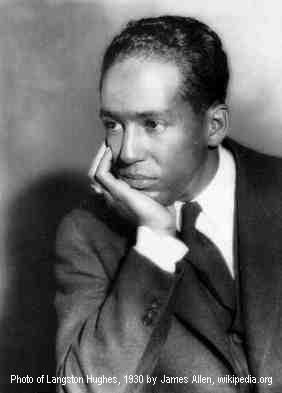
Though he could laugh at segregation and racism, like his father, he never reconciled himself to it. Unlike his father, he never saw wealth or respectabilty as a way of immunizing himself from it. He continually returned to Mexico, sharing an apartment (now gone, near Plaza Garibaldi) in the 1930s with Henri Cartier Bresson, who documented the lives of la Capital’s poor.
Hughes wrote respecfully of the poor, and of Mexican rural life for a number of publications. Like other minority writers of the time, he joined the Communist Party, but other than writing for “The Masses,” he was too much an artist to have much to do with the Party. In the 1950s, he returnrf to Mexico to avoid political persecution for his former Communist association.
By the mid-1960s, Hughes’ writings were more or less relegated to junior high school anthologies. Already dying of cancer, he gave up writing his weekly newspaper column in 1965, and died in 1967. Despite admirers like James Baldwin (himself African-American and gay), Hughes was seen as passe, a figure from the “Harlem Renaissance” and insuficiently militant for the time. He wasn’t “black enough”. Nor should do he need to be. He was human.
As his Mexican writing shows, it wasn’t “race” or place that he noticed — it was the people, their folk ways and spirt of survival, their dreams and their dreams deferred.
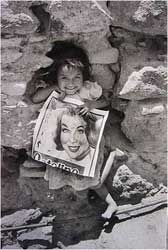 Photos, Henri Cartier Bresson, Mexico City, 1934

Damage Control….in Full Swing

The people have voted, the votes have been counted and some re-counted, TRIFE has declared the winner(Calderon). The loser (Obrador) ain’t movin’, and therein lies the problem. There is no doubt that Mexico’s Presidential election was fraught with irregularities. If Calderon is to enact his policies, he must cut into AMLO’s substantial support.
It’s an ugly business. We’ve been listening to the pundits preditions, of AMLO’s refusal to accept the new government, leading Mexico into a bloody civil war. Obrador has been labeled a “dangerous messianic mad-man” by some critics.
From the Taipei Times: http://www.taipeitimes.com/News/world/archives/2006/08/24/2003324614
“What we Mexicans want is stability, order and harmony,” Fox said. Society rejects extremist solutions, and messianic or apocalyptic visions that belong to the political culture of the past.
Opponents have frequently used the term “messianic” to describe Lopez Obrador, citing his devotion and the leftist’s belief in his own personal sense of mission. It’s another case of trash talk/demonize your opponent/attack his or her character. We witnessed these tactics in the U.S. when our administration felt threatened by John Kerry and Max Cleland. When Cindy Sheehan, mother of a dead American soldier (in Iraq), began a movement to end the war in Iraq, Pres. Bush’s associates began what Frank Rich (New York Times) called the “Swift Boating of Cindy Sheehan”. She was called a crackpot (Fred Barnes) and a whack job. For an added punch, she was accused of being a secret agent of Michael Moore.
When Rep. John Murtha addressed the Congress and called for the withdrawal of troops from Iraq, he was accused of being a “coward” by House Speaker Dennis Hastert, Rep. J.D. Hayworth and Majority Leader Roy Blunt. None of these three yahoos had had any military service. Murtha (ironically) spent 37 yrs. in the service and had been awarded 2 Purple Hearts, 1 Bronze Star with a combat “V”, and a Vietnamese Cross of Gallantry. There is no shame!
Those in power in Mexico…. or about to be in power, seem to be ready, willing and able to follow suit in the case of Obrador. No means to neutralize him will be overlooked.
The following is exerpted from the Nation article:
http://www.thenation.com/doc/20060918/ross (John Ross)
The president-elect (Calderon) will no doubt seek to split AMLO’s forces, offering members of López Obrador’s Congressional delegation minor Cabinet posts and canonazos (“cannonades” of pesos) to neutralize the coalition’s strength in the new legislature, where it is now the second-largest political force. Calderón cannot pass proposed constitutional changes such as the promised privatization of the national petroleum monopoly PEMEX without a two-thirds majority in both houses.
Calderón is also expected to pump windfall profits from $70-a-barrel oil into social programs to undercut López Obrador’s deep support among the underclass, an obligatory strophe for unpopular Mexican presidents.
As was the case with Carlos Salinas after the long-ruling (seventy-one years) PRI party stole the presidency for him back in 1988 from López Obrador’s onetime mentor and now archrival, Cuauhtemoc Cardenas, Calderón will have more support outside Mexico than inside. Both George Bush and US Ambassador Tony Garza were quick to congratulate Calderón following the July 2 balloting. Now that the TRIFE has confirmed his “victory,” Washington and European Union members–like Spain’s prime minister, Jose Luis Rodriguez Zapatero–are eager to get in on the ground floor of the PEMEX fire sale and will seek to legitimize Calderón’s presidency beyond Mexico’s borders.
But within the boundaries of this distant neighbor nation, diminishing AMLO’s immense popularity and isolating him from his political base may not be all that simple. Whenever challenged by the Fox administration, López Obrador has been able to mobilize millions. Following the disputed July 2 election he has organized the largest political demonstrations in the history of the republic. Calderón’s only option may be mano dura, the “hard hand.”
Fox’s attorney general, Carlos Abascal, has already warned that should López Obrador form a parallel government, he could be tried for usurpation of powers, a crime that carries a hefty prison sentence. López Obrador’s Party of the Democratic
Revolution is being threatened with the loss of its electoral registration for preventing Fox from delivering his State of the Union address. But in the past, such threats have succeeded only in boosting AMLO’s numbers.Indeed, López Obrador’s commitment to resisting the Calderón presidency could well come down to eliminating his physical presence altogether. Such a development has ample historical precedent in Mexican power politics. In 1994 PRI presidential candidate Luis Donaldo Colosio was gunned down after he turned against his predecessor, Salinas. Agrarian martyr Emiliano Zapata met a similar fate in 1919 when he proved too troublesome for the Carranza government. One of López Obrador’s role models, Francisco Madero, was assassinated soon after the stolen 1910 election that triggered the Mexican revolution and eventually installed him as Mexico’s first democratically elected president.
Many Mexicos… beyond Calderón v AMLO…
“This idea that there is a country split between two ideological positions is a deceptive fabrication of the political actors and the candidates.
Alberto Saracho, director of the non-governmental Idea Foundation
The way Mexicans voted in July and several opinion polls show that political preferences are not clearly split along socioeconomic, political, ethnic, age, regional or party lines.
…
According to the official vote tally, Calderón took the votes of just 20.8 percent of the 71.3 million voters registered in this country of 106 million, while abstention amounted to 41.5 percent.
Meanwhile, López Obrador of the “For the Good of All” coalition made up of his Democratic Revolution Party (PRD) and the small Convergencia and Trabajo parties, won the votes of 20 percent of registered voters. The leftist candidate earned more than 50 percent of the vote in three of the country’s 32 states, while Calderón did so in just two states.
And each of the two candidates was defeated by Roberto Madrazo of the Institutional Revolutionary Party (PRI) — which ruled Mexico from 1929 to 2000 — in several states.
…
“It is intellectually dishonest to maintain, as political leaders are doing in city squares or in private, that the country is politically divided between right and left or rich and poor, when reality shows otherwise,” political scientist Rossana Fuentes, at the Autonomous Technological Institute of Mexico, told IPS.
The simplification of the confrontation to two positions or candidates “disregards the pluralism that defines any society, and distances civil society from the political system,” said Fuentes.
In a nationwide survey of 2,100 people carried out by the daily Reforma just before the elections, 29 percent of low-income respondents said they would vote for López Obrador and 22 percent for Calderón. The breakdown, meanwhile, was 30 percent for each candidate among the lower-middle income respondents; 29 percent for each candidate among the upper-middle income respondents; and 25 percent for López Obrador and 47 percent for Calderón among the upper income respondents.
…
With regard to ideological orientation, 54 percent of those who defined themselves as left-of-centre said they would vote for López Obrador and 14 percent for Calderón, while 36 percent of those who identified with the right said they would vote for Calderón and 21 percent for López Obrador. The two candidates had the support of equal portions — 29 percent — of respondents who see themselves as in the centre of the spectrum.
(Full article, MEXICO: The Myth of a Country Divided Between Left and Right by Diego Cevallos, September 8 2006, InterPress News Service.
Fresh vegetables… pick your own…
Why immigrants come to the United States and work crappy jobs is no secret. Carolyn Lochhead, of the San Francisco Chronicle wrote an excellent article on this back in May. People go where they’re paid a decent wage. But what about the crap jobs that can’t pay very well. You listen to the blowhards at CNN or Fox, and they’ll tell you that of course there are American workers to do these jobs.
Calling Lou Dobbs, paging Ann Coulter — you’re needed right now out in the California farm fields.
Labor shortage worsens as peak harvest nears
By Kate Campbell, Assistant Editor California Farm Bureau Federation Ag Alert
Against a backdrop of Congressional inaction, California farmers wait for comprehensive immigration reform and prepare for harvest. … right now growers say labor uncertainties are their biggest worry. Members of the U.S. House of Representatives, meanwhile, are holding a series of public hearings across the nation that largely exclude agriculture.
“Right now we’re heading into peak harvest season in California when there’s the greatest demand for farmworkers,” said California Farm Bureau President Doug Mosebar. “Because we know there already are critical shortages, we are joining other agricultural groups to better track the labor supply situation. We’ll be surveying our members in coming days to get the best and most up-to-date information on labor shortages as possible.”
…Already some fields in the Pajaro Valley in Santa Cruz County are being abandoned because farmers can’t find enough workers. Farmers in that area say there are 10 percent to 20 percent fewer workers available to harvest strawberry, raspberry and vegetable crops.
Carolyn O’Donnell of the California Strawberry Commission says her organization is hearing that labor is very tight. In the Watsonville area some farms have enough and some don’t. Others blame a broken H2A temporary worker program for the shortage. Many point to tightened border security and competition from other business sectors for entry-level workers.
…“Due to shortages, guys go where they get paid the most so they keep moving. Labor contractors are short of people. Harvest scares me to death,” the grower said.
In Santa Clara County, a field crop farmer said, “Because of the lack of help, we cannot get our crops irrigated in a timely manner. We will lose about 30 percent of our alfalfa this year.”
A tree fruit farmer in the Fresno area said because of lighter than usual crops, he thinks his operation will get by with 10 percent fewer workers this season. But he expects that when the grape harvest gets going in late August, the labor shortage will become extreme.
“If we have a normal crop next year, we could experience even more crop losses because of a big shortage of labor,” he said.
Information released by the Agriculture Department’s National Agricultural Statistics Service for the first quarter of 2006 pegs the number of hired workers on U.S. farms at 718,000, down nearly 4 percent from the previous year. As the crop year progresses, these statistics from USDA suggest the labor squeeze will be greatly magnified not only in the United States, but in California, the nation’s No. 1 farm state.
The government report, which offers the most current statistical look at the national farm labor situation, shows that wages increased sharply during the same period, while the number of workers dropped.
The national average wage paid to farmworkers is up nearly 5 percent from one year ago and up 18 percent from 2001. Wage increases for hired farmworkers were reported in every region of the country where government data is collected.
Earl Hall, owner of Hall Management Corp. in Kerman, said, “Everyone is struggling for workers. It has been a struggle even for us–we’re looking for machine operators, tractor drivers and sorters. I personally got three different calls last week from people I’m not supplying farm labor to that want help because they cannot find enough workers.
“These are big companies that normally use only in-house workers and don’t use farm labor contractors,” Hall said. “They can’t find enough people for picking tree fruit, working in canneries–they’re short everyone. And for the first time I’m getting calls from growers of green and fresh market tomatoes that are short workers. Irrigators are really in short supply.
“On the Central Coast, they’re struggling to find people to harvest strawberries,” said Hall, who operates in 26 California counties and employs between 1,500 and 2,500 agricultural workers a day, depending on the season.
“And the heat a few weeks ago seriously compounded problems. Every employer I know made adjustments–working crews shorter hours while the crops were ripening faster.”But, Hall said even with cooler temperatures in the fields, the workers just aren’t out there. And, California isn’t the only place where farm labor is in short supply.
According to recent media reports, one farmer in Cowlitz County in Washington state reported one-third of his blueberry crop rotted in the field for want of enough pickers. Apple growers in Central Washington were scrambling to find someone–anyone–to do the important work of thinning the apple crop to ensure the best and largest fruit for harvest.
The Associated Press reported that some Oregon farmers contend the U.S. government’s decision to place National Guard troops along the Mexican border is contributing to a shortage of workers to pick their ripe fruit. Terry Drazdoff said farmworkers should have been harvesting 25 tons of fruit per day from his Polk County cherry orchard. Instead, he could hire only enough temporary farmworkers to pick 6 tons.
In the Bradenton Herald, Mike Carlton, director of production and labor affairs at Florida Citrus Mutual, noted, “There’s very little doubt we’ll leave a significant amount of fruit on the trees.”
Orange production in Florida has been predicted to be the lowest since 1992, in part due to last year’s hurricane damage. But even with a smaller crop, it appears the primary problem growers face now is a shortage of fruit pickers, Carlton said.
The American Farm Bureau Federation has compiled data from the U.S. Department of Agriculture, the U.S. Department of Labor and from its own studies and analyzed that information in light of legislative efforts to amend existing immigration law. The conclusions are stark.
AFBF has found, among other things, that if Congress enacts legislation that deals only with border security and enforcement, the impact on fruit and vegetable farmers nationwide would be between $5 billion and $9 billion annually. Net farm income in the rest of the agricultural sectors would decline between $1.5 billion and $5 billion a year.
“If federal legislation is enacted that fails to take into account the unique needs of agriculture, which include our increasing dependence on hired labor, our extreme vulnerability to competitively priced foreign-grown produce and our inability either to absorb cost increases or pass those on, we will all watch as Congress takes literally billions of dollars out of the pockets of American farmers and sends it to our competitors overseas,” said Stefphanie Gambrell, domestic policy economist at AFBF.
If the best the Republicans can push is a wall… don’t be surprised if there’s a consumer response…

(photo courtesty U.C. Riverside)


