14 Agosto

The Unapologetic Mexican did a great job putting together a memorial to the fall of Tenochtitlán, which, as the memorial at Tlatelolco reads in Spanish and Nahuatl — neither a triumph or a tragedy, but the birth-pangs of the Mexican people.
Not So Fast…
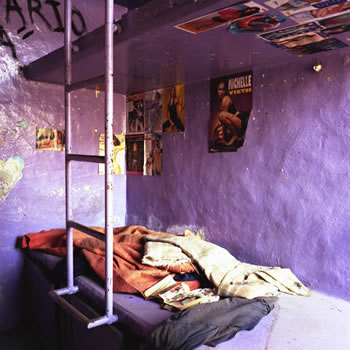
Men… you’d better think twice before you skip out on your bride… if you live in Nayarit. In the future, it could hurt you in the wallet and you might be spending your honeymoon in a cage.
Komfie Manalo – All Headline News Foreign Correspondent
Mexico City, Mexico (AHN) – The local government of Nayarit province in Mexico has passed a law seeking to protect jilted brides. According to the Terra Noticias Populares, the measure says that grooms who abandon their brides or have a last-minute change of mind, will be arrested by the police. Annonva.com reports, Alicia Santoya from Mexico’s Public Attorney’s office said the bride can also seek compensation from the groom for the moral damages and the emotional pain she suffered from being left at the alter.
image: ashleyb.org/images/20_lavat.jpg
The Apprentice

It’s a safe bet that going to Xolchimilco on any weekend of the year is a med-free prescription for fun. I just had no idea how much fun it would be. The ancient miles of canals take you past fields of flowers, and small local farms.
As we stood by the embarcadero, a teenaged boy, wearing bright yellow slacks, approached. He urged us to let him take us on one of the trajineras. It was our first trip to Xolchimilco and we weren’t sure how the whole thing worked. We wanted to get our bearings and he wanted to get the “job”. He won out… since we didn’t know what the heck we were doing.
The first clue should have been that he put us on one of the biggest trajineras. There were smaller ones for smaller parties, but we got the stretch Hummer instead. It was a beauty named “Lupita”. Our guide put his long pole into the water and we headed into the Grande Canal. I always wanted to be in a parade!
The burst of colors was intoxicating. There were hundreds of brightly decorated boats cruising along in two directions. As we passed other boats filled with partiers who were celebrating birthdays or tourists who were living it up with their friends, we were joined by vendors who floated beside us with offerings of cervezas, roasted corn, or bouquets of flowers. The carnival was on!
 Our relaxing cruise was about to get more exciting when we rudely crashed in to the rear of another boat. Ooops! The canal was extremely crowded and our guy, Carlos, had a little pole “malfunction”. It sent the drinks on the other boat toppling. A few words were exhanged between drivers. Ten or twelve “crashes” later (with other boats) ….. I was pretty sure that this was a normal part of the ride. Something like bumper cars …. Aztec style. But as I giggled, Carlos’s face told a different story.
At one point, Carlos decided to make a U-turn in the middle of the Grande Canal. He wanted us to see a big poinsettia farm on the other side. Bad idea! Carlos managed to get the trajinera going sideways and we blocked about 50 boats in the process. It took a good 10 minutes for us to get unstuck. Other drivers were coming unglued. One irate pilot even raised his pole in a menacing manner at poor Carlos. He was ordered to get off the Grande Canal.
Ever the gentleman, he took us under a foot bridge and gave us a private tour of “his” canal. We got to see his family home, and he even stopped the boat to bring me some candy from his uncle’s tienda and a sweater for me to protect me from the light rain. He had my heart!
After he regained his confidence, we headed back out to the Grande Canal and up to the mercado. We parked the boat and spent some time talking to Carlos. He told us that he was raised on the canal and had even fallen in the water when he was a small child. It was especially dangerous because kids can get caught in the roots of the many water plants in the canal. Apparently, local kids lose their lives in the chinampas every year…. they drown after being trapped in the root systems.
Now that Carlos was 18, he had only recently gotten permission from the trajinera union to begin his apprenticeship. He was clearly concerned about his future in canals after today’s screw-ups.
We bought two delicious roasted chickens, a few cups of beautiful fruits and some drinks at the mercado. We brought them aboard our boat and shared them with Carlos. As we headed back to the embarcadero, we tossed some of the chicken over to the skinny dogs on the edges of the canal. They practically did back flips as they tried to catch the tastey morsels.
Mariachi’s played on and the French tourists (in a neighboring boat) enjoyed their banquet of wines and cheeses. Damned French! They even thought to bring a white linen cloth to cover their table.
The soft rain had stopped and the sun was out. Carlos broke all the rules. Instead of a 2 hr. tour, he had given us 4 hrs. of pure delite. I’d vote to keep him because he’s exactly who you need when you’re floating down the gardens of Xolchimilco for the first time.

Non-conforma on Reforma…or, the natives are restless
(Translated from a Notimex item in Jornada)
MEXICO – Tuesday morning a citizen attacked a camp set up by supporters of the “Por el Bien de Todos” (Everyone’s Benefit) coalition, a few meters from the Angel of Independence on Paseo de la Reforma.
According to reports filed with the General Prosecutor for the Federal District Héctor Sepúlveda de Valle, 53, appeared in Public Ministry Court #61 charged with having knocked down and snatched blankets set up by some of the campers.
The event occurred late Tuesday when the detainee decided to break into the camp and dislodge protesters connected with a PRD youth group, “Flor y Canto” (Flowers and Songs).
PRD members who witnessed the occurrence requested assistance from Capital police, but the suspect escaped by running into the Sheridan Maria Isabel Hotel.
Police had to wait a few minutes for Sepúvida Valle to come out, at which time he was detained and taken to the Public Ministry.
Represented by Froylán Yescas Zedillo, the prisoner took full responsibility for his actions, agreed to pay a 500 peso fine and agreed to repair any damages he caused in the camp.

By the way, the name for these camp-outs is planton.
THIS is anothe kind of planton

(a guardhouse)….
and this is another

(where you put down roots)
Another tourist
I found this in the “Comments” section of a not particuarly informative Raw Story round-up of the latest news on the not-yet-decided, not-by-a-longshot Presidential elections…
This is a wonderful time to visit Mexico City. There are people of all ages in a festive, clean, creative, and optimistic FIVE MILE tent city that stretches from the main square through Chapultepec Park. It is deeply moving to find so many people so truly committed and hopeful.
Please visit the “plantón”, and tell people about what you see. It is not dirty. It is not disorderly. Local businesses are not failing (most businesses along Reforma are giant chain hotels, airline offices, etc.; many have access from the side lanes or perpendicular streets).
López Obrador is not a “fiery leftist”. Listen to him. He is rather dull, and not particularly left. It is simply because of the contrast with the other candidates that he is characterized as leftist.
Finally, AMLO is trying to maintain this protest peaceful. Desperate Mexicans are already reaching for their machetes.
Vic Tarugo
I sorta agree… when you come down to it… THIS brings a lot more folks into the streets of Mexico City, ties up traffic and outside of a few grumpy tourist sites, you’d never hear a complaint… and certainly not from the Mexicans.
Take Your Pick…
One man’s shit hole is another man’s compost pile. We’re talking about La Frontera (the Borderland area) which divides two very differing nations (United States & Mexico). The border is 2000 miles long and cities and towns have been settled all along on both sides. To some extent or other, there is a sharing of languages, diets, and cultures between the Mexicans, Mexican-Americans, and Anglo-Americans.
Border rats are a common species on both sides of the border. They travel comfortably from the South or North on a daily basis with great ease. A border rat may sleep in Matamoros and work in Brownsville. His wife may cross over to grocery shop in Brownsville and so forth.
“While the U.S-Mexico borderlands resemble border regions in other parts of the world, nowhere else do so many millions of people from two dissimilar nations live in such close proximity and interact with each other so intensely.
Borderlanders are singular in their history, outlook and behavior, and their lifestyle deviates from the norms of central Mexico and the interior U.S.; yet these Mexicans, Mexican-Americans, and Anglo-Americans also differ among themselves, and within each group may be found crossborder consumers, commuters, and people who are inclined or disinclined to embrace both cultures.” ~ Border People~ Oscar J. Martinez
In travel forums that I have visited, comments about border towns are liberally sprinkled with disparaging remarks and warnings. The “in the know” crowd discourages others from even going to the border towns because “they aren’t real Mexico”. Many of these towns (both sides of the border) have earned reputations as being dirty, corrupt, dangerous, filled with scoundrels, etc. Recent news articles about smugglers, drug cartels, murders of young women, the Minutemen, and coyotes loading up trucks filled with illegals have helped to keep the image alive.
“Ciudad Juarez dropped the old name of El Paso del Norte and El Paso, Texas borrowed it. El Paso was platted in 1859, but grew very slowly due to its remoteness. With the arrival of Southern Pacific railroads in 1881, the population boomed to 10,000 by 1890 census. With a tempting green valley and nearly perfect climate year-round, the town attracted a constant stream of newcomers: gamblers, gunfighters, thieves, cattle and horse rustlers, murders, priests, Chinese railroad laborers, prostitutes and followed course, entrepreneurs.” ~ Wikipedia
The borderland has always had its element of misfits and rogues, but it has also held an attraction for people with other interests and endeavors. Enter the writers and artists.
Punto Publications proclaims, “The El Paso-Juarez area is the literary center of the U.S.-Mexico border.”
“No one in Mexico acknowledges that this exists. We’re in a literary wasteland to them, yet this is one of the most productive and intellectually active regions of the country.” ~ Ricardo Aguilar Juarez professor)
“It is just these explorations, the wide poetic points of view that give border writing its scope and texture, its bulging metaphor and its literary integrity. Whether the writing is poised precariously near the edge or safely in the
center, its anchor falls squarely in the borderland. It is North America’s Middle Passage, and these writers are its witnesses” ~Writing on the Edge ~Tom Miller
Intellectuals in Mexico City do not recognize/legitimize this culture nor do their counterparts in the U.S. Mexican writers from the borderland have often had great difficulty getting their works published by their countrymen. In fact it was common practice for some Mexican (borderland) writers (in the past) to smuggle their works to writers in the U.S. in order to get them published or they had to rely on self-publishing.
In the ‘70’s and ‘80’s, writers Marco Jerez and Oscar Monroy (Nogales) formed a literary community in Nogales called Café y Arte where writers set out to destroy as much as possible the negative intellectual centrism that corrodes Mexico. There is intelligent life in and along the border! It flourishes in the works of the artists and writers who are drawn to the unique culture that exists along the edges of the river and across the deserts. Those who deny it are condemned to living with their views, which hold the border as being nothing but a malignant stretch of land which is nothing but a shit hole.
A couple of interesting reads about Borderland culture:
Writing on the Edge (a Borderlanders Reader) by Tom Miller
Border People (Life and Society in the U.S.-Mexico Borderlands) by Oscar J. Martinez
Baby, you can drive my car… or scenes from the class stuggle
John Ross write elegantly (as always) in Class War Amid Mexico City’s Gridlock(Counterpunch.org):
The car wars here are a codeword for class war. Poor people scrape by on public transportation: tens of thousands of effluvia-spewing tin can microbuses complimented by a clean, low-priced and over-saturated subway system, the Metro. But the first car is often the first step up the class ladder and lower middle class Mexicans spend a lot of time in their vehicles……when on Sunday July 30, before 2.4 million followers, Lopez Obrador encouraged his disenchanted supporters to establish 47 camps, many of them strung along one of the city’s most elegant boulevards in a move to impress upon a seven-judge panel the historical importance of ruling in favor of a vote by vote recount, Mexico City’s motorist class and the media that panders to it, rose up as one fist in mass indignation. …
Car ownership is one of the great divides between Lopez Obrador’s base, “los de abajo”–those from down below–and his right-wing rival Felipe Calderon to whom the Federal Electoral Institute (IFE) has awarded a much-questioned 243,000 vote “victory” in the July 2 balloting. While Lopez Obrador summons millions to the great central Zocalo plaza on foot, Calderon’s PAN party’s most emblematic mode of mobilization is the motorcade in which the right-wingers climb into their gleaming chariots and drive around, mindlessly beating on their horns in syncopation.
As to those pedestrians themselves…
The encampment in the Centro under a contiguous awning to fend off the incessant rain is kind of a carnival tunnel of love. Folk dancers from the Yucatan step smartly on a makeshift stage, a raucous ska band tootles on another. The booths are staffed by petitioners and political cartoons festoon the pup tents. Notes to AMLO scrawled in magic marker on rain-curled colored paper are hung on clotheslines: “Gracias Senor for existing–the Carrasco Family” and “Ya No Nos Dejan a Chingar!” (Now we are not going to let them screw us over!) Pedestrians line up for free popcorn distributed by the banda from Tepito, a tough inner city neighborhood. There are puppetry classes, chess players. “The sexual rights workshop will follow the domino tournament,” someone on a bullhorn advises.
The Mexican people are famous for their patience, but even THEY have their limits
AMLO walks a tightrope between his own defiance and trying to keep a lid on his steamed-up supporters. He often quotes Gandhi at his rallies and the film of the same name is being shown in the encampments. He counsels his people to keep “a hot heart but a cold head” and non-violence training is in the works. Hundreds of volunteer musicians have been enlisted to soothe the savage breast of the people but after the TRIFE’s decision came down and a group of musicos launched into a “rola”, the angry mob just told them to shut up and go home.
Film at 11?
From National Public Radio:
Mexican Standoff
A partial recount is underway in Mexico’s July presidential elections –the closest in the nation’s history. But that’s little consolation to candidate Andres Manuel Lopez Obrador. He’s alleging widespread vote fraud, and as evidence points to video footage collected by Luis Mandoki, a Mexican-born Hollywood director who was working on a documentary about Obrador at the time of the election. Mandoki tells Bob about being an unexpected actor in Mexican history.
I’m not sure how to attach an audio clip. The link is http://127.0.0.1:13394/template.html?nuyhtgmz475f4hpih8AzgEEgE28At6sngzeeum2qCe3mpaxfj4fbxfyEu157fjsqt6.
If that doesn’t work, the NPR article is about half way down the page at:
http://www.onthemedia.org/
A transcript will be available Tuesday.
Manifest Destiny lives!
A tip of the sombrero to Pam’s House Blend and General J.C. Christian for alerting me to this.
From the Chattanogo Tennessee Chattanooan.com
Conservative political activist June Griffin has been arrested for the theft of a Mexican flag from a Dayton business.
The 67-year-old Ms. Griffin, who ran for Congress in the recent election, is facing misdemeanor charges of theft, vandalism and harassment and felony charges of civil rights violations.
Ms. Griffin, who said it is the first time she has ever been arrested, posted a $5,000 bond.
She said on July 18 she had noticed a small Mexican flag at an Hispanic grocery in the former Rogers Drug Store.
She stated, “I went in and there was nothing English in the store. There was one man who could not speak a word of English.”
She said she was outraged about the Mexican flag, saying it was an “act of war” and it “insulted my citizenship.”
Ms. Griffin said as the Hispanic man watched, she tore off the flag from where it was suctioned to the building and left with it.
She said, “Foreigners should learn English or leave.”
Ms. Griffin, who said she will represent herself in court, said it was done openly and was not a theft. She said she later returned the Mexican flag to a police officer.
She said a much larger Mexican flag was later put in its place, but she said it is no longer there.
She said she had been to local governments trying without success to get them to ban all but American flags.
Ms. Griffin said the operator of the Days Inn at Dayton “flew a British flag on of all days July 4.” She said she went to him to protest the British flag.
She said afterwards “the British flag was torn up in a storm, but the Tennessee and American flag were spared. I took it to be an act of God.”
She denied being guilty of vandalism, denying that she damaged a hinge when she took the flag.
She also said she was not harrassing when she called the grocery owners to ask them to take down the larger flag.
She is due in court on Friday for arraignment.
AMLO can speak for himself… and does
Recounting Our Way to Democracy
By ANDRÉS MANUEL LÓPEZ OBRADOR
August 11, 2006, Mexico City
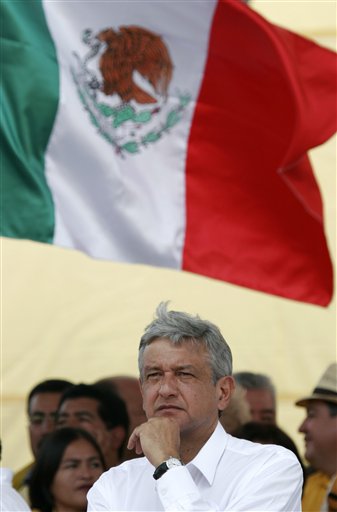 NOT since 1910, when another controversial election sparked a revolution, has Mexico been so fraught with political tension.
The largest demonstrations in our history are daily proof that millions of Mexicans want a full accounting of last month’s presidential election. My opponent, Felipe Calderón, currently holds a razor-thin lead of 243,000 votes out of 41 million cast, but Mexicans are still waiting for a president to be declared.
Unfortunately, the electoral tribunal responsible for ratifying the election results thwarted the wishes of many Mexicans and refused to approve a nationwide recount. Instead, their narrow ruling last Saturday allows for ballot boxes in only about 9 percent of polling places to be opened and reviewed.
This is simply insufficient for a national election where the margin was less than one percentage point — and where the tribunal itself acknowledged evidence of arithmetic mistakes and fraud, noting that there were errors at nearly 12,000 polling stations in 26 states.
It’s worth reviewing the history of this election. For months, voters were subjected to a campaign of fear. President Vicente Fox, who backed Mr. Calderón, told Mexicans to change the rider, but not the horse — a clear rebuke to the social policies to help the poor and disenfranchised that were at the heart of my campaign. Business groups spent millions of dollars in television and radio advertising that warned of an economic crisis were I to win.
It’s my contention that government programs were directed toward key states in the hope of garnering votes for Mr. Calderón. The United Nations Development Program went so far as to warn that such actions could improperly influence voters. Where support for my coalition was strong, applicants for government assistance were reportedly required to surrender their voter registration cards, thereby leaving them disenfranchised.
And then came the election. Final pre-election polls showed my coalition in the lead or tied with Mr. Calderón’s National Action Party. I believe that on election day there was direct manipulation of votes and tally sheets. Irregularities were apparent in tens of thousands of tally sheets. Without a crystal-clear recount, Mexico will have a president who lacks the moral authority to govern.
Public opinion backs this diagnosis. Polls show that at least a third of Mexican voters believe the election was fraudulent and nearly half support a full recount.
And yet the electoral tribunal has ordered an inexplicably restrictive recount. This defies comprehension, for if tally sheet alterations were widespread, the outcome could change with a handful of votes per station.
Our tribunals — unlike those in the United States — have been traditionally subordinated to political power. Mexico has a history of corrupt elections where the will of the people has been subverted by the wealthy and powerful. Grievances have now accumulated in the national consciousness, and this time we are not walking away from the problem. The citizens gathered with me in peaceful protest in the Zócalo, the capital’s grand central plaza, speak loudly and clearly: Enough is enough.
In the spirit of Gandhi and the Rev. Dr. Martin Luther King Jr., we seek to make our voices heard. We lack millions for advertising to make our case. We can only communicate our demand to count all the votes by peaceful protest.
After all, our aim is to strengthen, not damage, Mexico’s institutions, to force them to adopt greater transparency. Mexico’s credibility in the world will only increase if we clarify the results of this election.
We need the goodwill and support of those in the international community with a personal, philosophical or commercial interest in Mexico to encourage it to do the right thing and allow a full recount that will show, once and for all, that democracy is alive and well in this republic.
 Andrés Manuel López Obrador, the mayor of Mexico City from 2001 to 2005, was a candidate for president in 2006, representing a coalition led by his Party of the Democratic Revolution. This article was translated from the Spanish by Rogelio Ramírez de la O. and is available to subscription holders to the New York Times
Another view of Oaxaca…
A friend of Oaxaca, though I’m not sure she is IN Oaxaca right now, recommends this “Livejournal” posting and the linked photos to anyone interested in that state’s on-going situation — a teacher’s strike (which is a regularly scheduled summer event) that’s grown this year, compounded by the national elections situation and the general discontent with the PRI governor.
I know nothing about Beccaella but my “friend of Oaxaca” is one of those people you trust to sort worthy from unworthy sources, having been a librarian most of her career. If you can’t trust a librarian, who can you trust?
Sheets to the Wind….
Some people live to tour the zocalos or the museums. I live to tour the old colonial hotels. A favorite is the big Colonial Hotel in Puebla. It used to be a Jesuit monastery and as such it has a labyrinth of hallways and several staircases. The main staircase is impressive with its grand statues on the landings between the floors. But there’s another less conspicuous one which is used by the staff. During a three day stay at the hotel, I watched as the maids carried big bundles of dirty sheets up those stairs. Trip after trip.
During some down time, my husband and I decided to ask (at the front desk) if there was a place where we could do our laundry. We were directed to take our clothes up those steps to the fourth floor. Keep in mind that the typical floors in these old hotels are 12 to 16 feet high. Armed with our laundry bags, we headed onward and upward. It was a real effort to navigate the narrow and steep stairs. The switchbacks at the top were killer. By the time we made it to the top floor, we were out of breath. All we found was a lone washing machine off in the corner. We had our soap, our dirty clothes …. but were short of the right coins. We looked at each other like “Will you go get the coins?” “No.” “Will you go get the coins?” “No”. Neither of us wanted to go all the way down and come back up again. One of us gave in.
While we waited for the water to trickle (like bird piss) into the tub (of the washer), we explored the awesome adjoining rooftop. There were glass enclosed classrooms, and a large concrete rooftop area with benches, old pots, broken statuaries, views of the city, and stuff…. lots of stuff. I paused to think about how grueling and tedious it must be for the maids (old and young/tiny and large) to go about this daily task. How many sheets, pillow cases, towels and table linens must they carry up here every day? I can only hope that they have many more machines to use than this lone one in the corner.
Throughout all of Mexico, you’ll see hundreds of thousands of white sheets flapping in the wind on the rooftops of budget hotels. Everyday they greet the sun. I can only imagine that they are relishing their few hours of freedom before being stretched out tightly over mattresses and held down by blankets and bedspreads. Think of their abuse…. being crushed by backpacks, and big butts….having dirty feet and sweaty bods resting on top of them. Yet every afternoon, they get to proudly soar in the breeze soaking up the sun’s rays like so many other Mexican flags.
One night I was staying at the Canada Hotel in Mexico City. I couldn’t sleep very well, so I went to the window. The room was tiny, like a sleeper car on a train, actually. The window was up high and I had to stand on my bed to see out. The street was dark and only a few people were walking about. I watched as four men (small in stature) walked down the sidewalk each carrying two huge bundles of sheets. The dirty sheets had been thrown into the center of an outstretched sheet which was joined at the corners and knotted. I have no idea how much each bundle weighed, but it appeared to be a lot. The men were struggling as they turned down a darkened alley and made their way to an overnight laundry. There wouldn’t be any sunshine for these sheets. Pretty sad, I thought….for the bundles and for the men who carried them.
The luckiest sheets of all (in Mexico) must be the ones the ones I’ve seen from the buses in rural Mexico. Sometimes when you’re passing over a bridge, you’ll catch a view of women doing their laundry in a river. Often groups of mothers will gather together with their children in tow. They will s pread their sheets over the top of the water. The sheets flow in a serpentine motion, moving gently back and forth in concert with the current. The woman will pull the sheets toward them (inches at a time) and soap them, unfurl them again into the water before violently wringing them out with their muscled hands. The lucky ones will be hung from semi-permanent wooden frames which stand in the middle of the river. Others (perhaps the old ones) will be placed over prickly bushes along the river’s edge. Oh, the joy of bathing in a river and of flying high in the air while you dry. There must be hundreds of thousands of white sheets flapping in the wind over Mexico everyday, yet I’ve never seen so much as one photo of the scene in any ones collection. Don’t they deserve some recognition?


