Illegal aliens?
The brothers Yayo and Payo Rodríguez achieved national prominence when on the morning of August 19, 1965, at eight o’clock in the morning, they claimed having witnessed the landing of a sizeable glowing disk on an open field near the Politécnico’s campus. The otherworldly vehicle allegedly charred vegetation as it settled to the ground on its tripodal landing gear. As if the landing of this spaceship, drawn straight from My Favorite Martian, wasn’t enough, the Brothers Rodríguez also claimed that a pair of diminutive beings wearing respirators of some kind emerged from the craft and walked up to the terrified students, depositing at their feet a metallic object. The dwarfish “away team” returned silently to their conveyance, which took to the air in a matter of seconds.
The Rodríguezes delivered the putative extraterrestrial fragment to the campus laboratory, where it was apparently subjected to analysis by investigators. According to an article in Mexico’s El Gráfico newspaper (defunct) a few days later, a number of journalists and photgraphers from different media organizations visited the site, where burn marks were plainly visible and where traces of a curious liquid, characterized as “fuel” were found. Despite the good physical evidence, Yayo and Payo were not considered credible witnesses. Even Dr. Santiago García, in his landmark book OVNIS Sobre México, would headline his chapter on the Rodríguez case as “¿de cual fumarían?” (“which did they smoke?”).
Scott Corrales, “Mexico: UFOs of the 1960s ” Inexplicada, the Journal of Hispanic Ufology, 12 June 2018
By the way… a few thoughts in passing
NEW YORK (Reuters) – A lawyer for Joaquin Guzman, the Mexican drug lord known as “El Chapo,” said Tuesday that he believed US prosecutors had evidence that his client was a mere “lieutenant” in Sinaloa Cartel, not a leader as prosecutors claim.
On the one hand, the U.S. (and Mexican, and … well … everyone) has been claiming Chapo is the Lex Luthur of the narcotics export industry, and on the other that he’s just some hillbilly from backwoods Sinaloa. Nothing says that hillbillies can’t be highly intelligent and unusually gifted when it comes to cunning, but c’mon… ever been to rural Sinaloa. There’s no money there, and it’s always been doubtful that anywhere near the supposed billions (trillions?) of dollars in that branch of agrobusiness is coming back to the supposed masterminds. Sure, you see some fancy cars and gold chains, but that’s the standard uniform for gangsters everywhere, whether they have the money or not (and Chapo has never been known as a flashy type… that’d be Donald Trump’s various “business associates” over the years).
Given that a “cartel” is just a price-fixing argreement among competitors in the same line of business (think OPEC) the whole idea of labeling criminal organizations (even when they cooperate) as a “cartel” was always kind of silly…. though not wquite as silly as labeling them “Transnational Criminal Organizations”.
If you’re looking for the “head” of the “cartel”… there isn’t one. That kind of international commerce isn’t run by hillbillies, cunning or not, working with various gangs. It’s run by the same old rich white guys in offices in New York or London or Amsterdam, that have controlled the international agricultural markets for centuries.
A federal judge in Mexico yesterday barred the import of fresh potatoes from the United States on national security and biosecurity grounds.
The decision, made by José Francisco Pérez Mier of the Seventh District Court in Los Mochis, Sinaloa — a potato-producing state, overturned a 2016 decision adopted by the Secretariat of Agriculture (Sagarpa) to allow potato imports from Mexico’s northern neighbor.
The judge said that Sagarpa’s reform to the Federal Law on Plant Health was unconstitutional because it didn’t include measures to protect against the introduction of plant diseases and therefore posed a threat to national sovereignty and security and crops such as chiles, tomatoes, eggplants and tobacco.
The domestic potato industry could disappear if fresh potato imports from the United States continue, Pérez said.
This is being presented in most US reports I’ve seen (and in the English language media here) as some kind of retaliation to the Trump Administration’s anti-Latin and anti-Mexican policies. Congrats to Potato Pro News for recognizing that the issues have less to do with a fit of pique, and more to do with public health and food security. The timing is just a coincidence, and potato imports, while hardly the sexiest of issues, has been a back-and-forth legal issue here for at least the last 15 years.
En Cancún, Quintana Roo, ocurre la “desintegración de las familias porque los padres trabajan en la industria turística con horarios complicados”, señaló el director del Consejo de Promoción Turística estatal, Darío Flota.
Dario Flota, Director of the State Tourism Promotional Council, said in Cancun (more or less) that family disintergration is a result of the work schedules for tourism industry employees
Backed up by United Nations data, Flota is referring to the growing phenomenon of “latchkey kids”… unsupervised children, left to their own devises because their parents are at work. Unlike in the US… where crocodile tears over children “abandoned” by their parents to seek refuge in that country… When a tourism official is calling for changes in how tourism industry operators (hotels, restaurants, clubs, etc.) schedule work so that parents can have sufficient time to spend with their children, it shows the genuine importance Latin culture places on family, and calls into question the assumption that parents have just sent off their children to seek refuge in the United States for mere financial reasons.
Faith based voters…
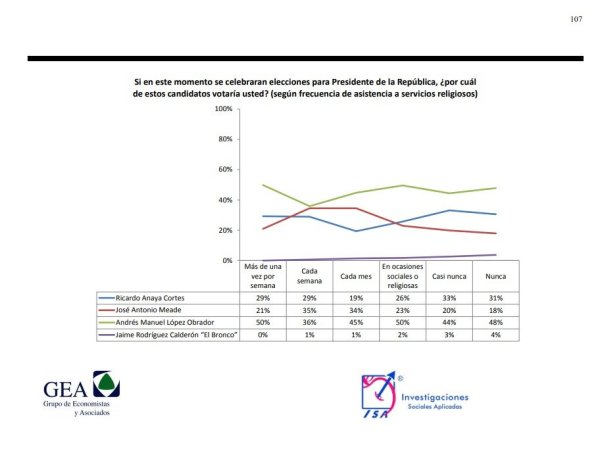
Not what I would expect. AMLO does well, very well, among the most devout (measured by the frequency of church attendance) although Anaya does better among Evangelical Protestants than AMLO, even though AMLO’s coalition includes the openly Evangelical “Social Encounter” Party. And… very surprising to me… Anaya actually gets a better percentage of the vote among the unchurched, although given AMLO’s quasi-biblical language at times (and his first presidential run, which took its name (“For the good of all, but first the poor”) directly from Liberation Theology. Perhaps Anaya comes across as “goody-goody” whereas AMLO comes across as Godly?

Sombrero tip to Rodolfo Soriano N.
The latest …
If the Mexican candidates were gringos…
Trying to explain Mexican politicians to y’all up yonder (let alone the screwy coalitions we have this year) might not be possible in less than 800 words, as I was asked to do for a Texas paper. I have to play it straight with them. But here… nah.
AMLO: If Bernie Sanders had grown up in backwoods Louisiana but had gone on to be mayor of New York.
Ricardo Anaya: the kid you shoved into a locker in junior high.
José Meade: Al Gore on downers.
El Bronco: If Donald Trump was a Texan.
20 June 1325

The founding of Tenochtitlan from Diego Durán’s ‘Historia de las Indias de la Nueva España’
Illegal aliens find refuge on an island in the middle of Lake Tezcoco. Tenochtitlan, aka Mexico City, has been taking in the world’s wretched refuse since the beginning.
The final countdown…
The Germans never took Moscow, but…
The Mexican navy at the gates of the Kremlin:
I won’t drink to that
With perhaps undue haste, a new “General Water Law” has been pushed through ahead of the change of government which, according to critics, opens the floodgates to privatization and locks in water rights for fracking and mining, at the expense of agriculture.
Restrictions on the delivery from 300 water reserves was lifted by the new law (published on 5 June) which represents 40% of all open water resources in the country. As noted by the World Wildlife Federation, and others, this will also permit mining and fracking industries to obtain “concessions” and turn control of the resource over to local water companies, many of which have been, or are expected to be, privatized. No mention is made in the new bill of indigenous water rights, although most of the affected sources are the main source for water on indigenous lands.
Water in Mexico, like oil and minerals, was considered a national resource, to be managed by the Federal Government for the benefit of the people.
Sources: Jornada, mientrastantoenmexico.mx, Gaceta Diario.
Rogues gallery

BOLO…
James Knox Polk.. 1846-1848.
The less said, the better.
Rutherford B. Hayes. 1877-1880.
According to Ari Hoogenboom (Rutherford B. Hayes: Foreign Affairs, UVA Miller Center)
Three months after his inauguration, Hayes on June 1, 1877, ordered the Army to keep “lawless bands” from invading the United States, even if it had to cross into Mexico to punish these outlaws. Porfirio Diaz, who had assumed the Mexican presidency a month earlier (and would remain dictator until overthrown in 1911), protested and sent troops to the border to protect Mexico’s sovereignty. Despite some bombastic talk, Diaz agreed to pursue bandits jointly with American troops; however, Mexico did not restore order on the border until three years later. With the incursions stopped, Hayes, on February 24, 1880, revoked his 1877 order permitting the army to follow outlaws into Mexico.
What Professor Hoogenboom overlooks is that the “bandits” were mostly dissidents fighting a losing battle against the imposition of Díaz’ regime, and the “bombastic talk” was just that. Hayes withdrew the troops, mostly because resistence to Dias had ended.
Benjamin Harrison. 1891-92.
Andrés Manuel López Obrador (yeah… that guy), in his biography of democratic revolutionary Catarino Garza Rodríguez recounts (pages 80-81, ff) the Harrison Administration’s attempts to capture the Mexican born Texas newspaper editor and radical mutualist, who had gained supporters on both sides of the Rio Grande, especially from small ranchers and businessmen, in his quixotic quest to overthrow Don Porfirio. As happened when a later US military entered Mexico to capture the “bandit” Pancho Villa (with, like in 1892, tacit approval from the government), the gringos found the locals less than cooperative. Catarino, incidentally, would eventually be forced into exile, for a time working as a police chief in Costa Rica, before he joined with other Latin exiles in a failed attempt (somewhat reminiscent of Ché Guevara’s in Bolivia about 75 years later) to bring THE revolution to one country, in the hope it would spread to the rest of Latin America. Like Ché, he was shot.
Woodrow Wilson (1914, 1916).
Gee, we just didn’t “get it” when he said he’d teach us to elect good men.
The cartels do not exist… or so he says.
I have not heard of Oswaldo Zavala before I read this article in yesterday’s El País. Obviously, I haven’t read his book either, but there is something to be said for his basic contention, that the “cartels” are largely a fictional construction. It is not that narcotics traffickers don’t exist (of course they do), nor that people aren’t killed (a lot of people in this country are), but that in creating a myth of some super-organized criminal enterprise, we suspend our critical thinking facilities in favor of simple, clean narratives… where the truth may be messier, and more disturbing than what we are told.
When US based writers about this part of the world started using the acronym TCO (Transnational Criminal Organization) a few years back (a fad that thankfully has passed), it seemed obvious to me that “drug war” apparatchiks were trying to conflate what is either a public health problem or a police matter, into a national security issue that would justify not only their existence, but the allocation of more and more resources. Also, having lived for several years in Sinaloa, and seeing the abject poverty in the “golden triangle”, the idea that a bunch of backwoods hard-scrabble farmers were somehow the masterminds of a world-wide conspiracy always seemed far-fetched. That a dirt-farmer like Chapo Guzman was repackaged in the United States media (and to a large extent, here as well) as the new Osama bin Ladin was amazing, when I didn’t find it ludicrous.
The gangsters we have to deal with do include people who traffic in narcotics… meeting the consumer demand of the country north of us that consumes a quarter of the world supply every year. No doubt. But, perhaps those gangsters are merely the foot soldiers in a war not so much to control that export, but to control resources and to maintain a crumbling status quo.
“El Chapo Guzmán es la mayor ficción de la supuesta guerra del narco”
Pablo Ferri, El País Internaciónal, 9 June 2018.
(my imperfect translation)
What do we talk about when we talk about Mexican narcos? What does it mean when we say a cartel controls a state, that there is a raging war in Guerrero, Tamaulipas, Jalisco or Michoacán? What is a sicario, a plaza, a halcón? What is this slaughter, that has bled the country for years?
They are the words that appear in official reports, in the press, magazines, novels, and on television series … And yet, what do they mean? Do we do mean anything when we talk about a “drug war”, ans speak of El Chapo, Los Zetas or Jalisco Nueva Generación “controlling a plaza”? Oswaldo Zavala (Ciudad Juárez, 1975) says no. A resounding no.
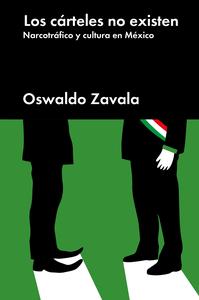 Los Cárteles No Existen (Malpaso, 2018), his latest essay, questions the official narrative built around violence in the country. There is no war among the cartels, Zavala argues, because a cartel war is simply a n understandable, digestible explanation for the tens of thousands of deaths and disappearances left by the conflict. That is why he writes “so-called”: A so-called war, a so-called cartel, so-called criminal leaders. They are simply assumptions: “My interest is to show a discourse that builds an enemy that is everywhere and that is the main actor of violence, and then to understand what lies behind it: “a political system that uses language to advance otherwise unacceptable strategies.”
Question: If the cartels do not exist then, what is there?
Answer: The cartels do not exist but the state violence does. We have to understand that these violent times are related to the history of the political system. To understand that, we need to look at the history of drug trafficking. The idea of “cartels” received idea, created by the United States in the 1980s as a way to talk about Colombian traffickers.In Mexico it became useful as a narrative which allows very quickly, very simply, to give us a concise idea about violence. And that justifies state strategies.
Q: You distinguish between three phases in the relationships between the criminal groups and the state. First, a “primitive” one, corresponding to Mexico prior to the powerful deployment of the Federal Security Directorate – the fearsome counter-insurgency body of the PRI state. The second that was born with Operation Condor in the 1970s and the organization of the Sinaloa traffickers in Guadalajara and lastly, that which followed the dismantling of the DFS and the loss of power of the PRI. Now what?
A: I would start with Operation Condor. 1975 saw the first concerted militarized action between the US and Mexico to attack the golden triangle – the poppy and marijuana growing region on the borders of Sinaloa, Chihuahua and Durango. 10,000 troops arrived in the golden triangle, burning crops and depopulating the area . There is a massive exodus of peasants to Culiacán, Sinaloa … something not repeated until the Calderón government. At least with the same force. That led the political system to develop a national drug trafficking management — marginalizing the political power of the traffickers and producrs, using the DFS and the Army as enforcers.
A second stage began when the global communist threat evaporated, leaving the United States without a security threat. The Soviet Union fell and President Reagan reprogrammed the security objectives to think now of drug trafficking as the new national security threat. And so it has been ever since. Up to then, narcos were a police matter. Although [narcotics trafficking was considered as a security matter as early as 1989] by CISEN — the secret service, which replaced the DFS —it is with Calderón that Mexico becomes Colombian. That is to say, the true Colombianization is not because of Chapo, or due to narcos attacking civil society, but to the state’s response.
Q: How then do you explain situations like the recent disappearance and murder of film students in Jalisco, or the assault on a former prosecutor in the heart of Guadalajara ? If the cartels do not exist, then how to account for events like these?
A: Part of the problem is this. We want quick answers if journalists are to do their job. We are used a reassuring explanation that will give us a logical rationale for the violence. And that is one way the official story is implanted in the public arena with so much power. There is a shooting, people are dead and immediately we are told through an official spokesperson: ‘It is the Jalisco Cartel, which also knocked down a helicopter and there is an operation to stop them’. And all the journalists write “it was the cartel” and the story is done. In a country with an extraordinary rate of impunity, I am surprised at the ease with which we accept the official account.
Q: Am I the to suppose that you see El Chapo’s story as a great work of fiction?
A: Completely. When he was arrested in a Sinaloa apartment (in February 2014), he was alone with his wife. As a The New York Times reporter embarrassingly said, “This is crazy: no tunnels, no army [of hitmen and bodyguards] and they catch him as it it was nothing. Incredible!” … No, possibly this was the reality! The amazing thing is that you think he has 300 soldiers. Who ever saw them? No one.
Q: Yes. El Chapo is the main actor in this comedy that you call the narco war, I suppose that the escape from a maximum jail prison through a tunnel. in July 2015 is your favorite story.
A: Not only is the story implausible, but it presents a journalistic challenge. Who built that tunnel? I was fascinated by the fact that everyone took pains to describe the tunnel, how it was ventilated, but nobody questioned whether Chapo’s built it or not. Yes, he said that people inside the prison helped him, that he paid bribes, but that it was his idea, and thanks to those bribes it worked. . That is to say, there is never anything outside the official narrative. It is still believed that he orchestrated the event. It seems incredible to me that it is obvious that there political interests in permitting his escape.
Q: So, is [your thesis] a theoretical construction that serves to denounce corruption? Or what is the intention? Is there one, several?
A: There is a huge disconnect in how narco narratives are used. Sometimes there are natural resources issues mixed in, sometimes a dispute between power groups. Take the case of Chihuahua. There powerful groups are allied with even more powerful business interests stripping resources from the mountains, as reported by Miroslava Breach (killed a little over a year ago). What we call the “narco powers” are actually these rapacious groups logging the forests and fucking up the environoment, allied with businessmen and politicians, PRI in the case of Chihuahua. There was a transition to a PAN governor before Miroslavas’ murder. They felt threatened, but what better way to destabilize the state that to create a new war to divert attention?


 mexfiles.net