Napoleon’s return
I don’t think anyone seriously denies that there is “corruption” on some level in all the unions here. That said, back during the heyday of the PRI, it seems the corrupt union “bosses” were not only tolerated, but openly supported … provided their loyalty was to the party first, the rank-and-file second. One notes that when Felipe Calderón forceably merged Mexico City’s union-owned and run power company (Luz y Fuerza) with the semi-privatized CFE, his rationale was to allege “corruption” in the union’s election. SME, the electrical workers’ union, while independent, was opposed to Calderón’s plans to open the country’s energy sector to private investments. It aslo, incidentally, had the underground cable rights to central Mexico City, at a time when both Telmex and Televisa were slathering for the data-line rights.
Was it really “corruption” that brought down Elba Esther Gordillo in February 2013…. or something else? While she was famously corrupt, so were other union leaders like PEMEX workers’ union boss, Carlos Romero Deschamps. He is the only one of Dolia Estivez’ Forbes list of “The 10 Most Corrupt Mexicans Of 2013” still holding office. However, as he has always given the party in power whatever they want, even to the detriment of his own rank and file, he has never seriously faced any charges. Gordillo’s error was, as a PRI hack, backing Vicente Fox (and collaborating with Fox’s wife, Marta Sahagún on “educational reforms” favored by PAN. Pushed out of PRI, she led her own party, (Aliance Nacional) which, in the 2006 election, was crucial to Felipe Calderón’s narrow victory. However, with the return of PRI in 2012, pushing for “educational reforms” that, while sold as eliminating union “make work jobs” were also impossible to sell to the rank-and-file teachers (changing the history curriculum to highlight Spanish achievements, teacher and student testing… a la “no child left behind” … and a radical change toward more career preparation at the expense of a liberal education), she was the low-hanging fruit for selling an “anti-corruption” drive. By, what some claim, the most corrupt administration in modern times.
Napoleón Gómez Urrutia, of the Mineworkers’ Union, according to most media, is just another “corrupto”… but then again, having pitted his independent union against company unions, and his union having gone up against the powerful mining mogul, German Larrea Mota Velasco… a reclusive “Citizen Kane” type figure, who stays out of the public eye, but is one of the most important political and financial figures in the country… over the Pasta de Concha disaster, it’s hard to say his indictment for corruption which soon followed was completely coincidental. Gómez denies the charges, and fled to Canada, where he was granted political asylum, and remains as head of his union.
By video, LIVE FROM CANADA, Gómez is on the campaign trail… not to keep his union presidency, but as a potential Senator of the Republic. The Mexican Senate is a strange beast. Like the U.S. Senate, there are two Senators per state, elected in first-past-the-post elections. AND, a third senate seat, awared to the party which receives the second highest state vote. AND… 32 Senators nationally chosen by proportion to the votes received in the Presidential election. Goméz is on the list for those senators that will be seated for Morena… which even in the event it’s presidential candidate loses, should stil be entitled to enough “Plurinominal” Senators to seat the exiled union leader.
While, naturally, the parties not part of the Morena coalition, are raising questions like whether a candidate has to actually live in Mexico, the bigger question is whether Morena, and their party standard-bearer, Andres Manuel López Obrador, can sell Goméz as a victim of political intrigue, or overcome the perception that a presidential candidate who has made his name condemning “corruption” hasn’t sold out in return for wider support. And whether the miners’ union will supply more votes, or whether Goméz’ inclusion on the Plurinomal list will end up costing AMLO votes.
Internationally, the United Steelworkers Union (U.S. and Canada) and Britain’s UNITE have both come out in favor of Goméz. While U.S. unions are not nearly as powerful as they once were, it does remind me of John L. Lewis of the CIO praising Plutarco Elias Calles for making the flamboyantly corrupt Luis Morones (who wore diamond rings on every finger, including his thumbs… because he could) his Secretary of Labor. The importance then was that it stayed the hand of US management interests when it came to intervening in Mexico. Although AMLO and MORENA have bent over backwards to not upset US business interests, or unduly alarm them, a little labor support couldn’t hurt.
And, yes, I realize there was a bad pun in there somewhere writing about people named Napoleon and Elba Esther.. but I just couldn’t pull it off.
You can fight city hall… in drag… for Jesus
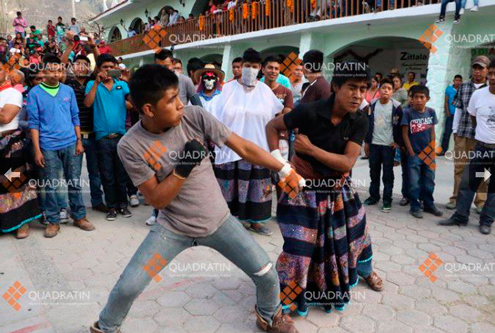 Since 1480, rural residents of Zitlala, Guerrero state have been at odds with the local government over, what else, tax rates. Back then, the tribute owed to the local government (and, in turn, to the Aztec overlords), included a set number of women. That year, the rural communes, owing a tad more than usual, objected strenously… i.e. they fought back, the woman of their community joining in the melee. Who actually won, the townies or the campesinos being lost in the mists of history, matters less than that the people of Zitlala discoved a novel way of dealing with municipal grievances.
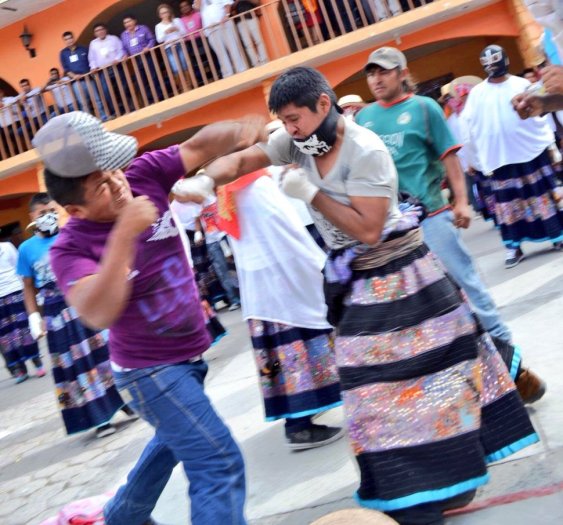
Photo: Televisa
From three in the afternoon until seven at night… the townies and the bumpkins battle each other outside City Hall… some, in honor of their ancestors, in full pre-Colombian battle dress (minus the weapons), others in full or half drag in honor of their brave ancestral women, and others… however they want. The fights are refereed by “Capitáns” chosen from both communities. Last year, for the first time in modern history, somebody was killed, so… tradition must be respected… this year, the local army unit, the police, and the rural autodefensa (the neighborhood watch/milita that guards the rural population from the depredations of narcos and other organized crime figures) stood by, keeping a watchful eye for anyone who took things too seriously, or was became too enthused after the regular between-rounds mezcal breaks.
Honor satisfied at seven, the communities troop into the local church for their Ash Wednesday to repent of their sins and promise to do better… til the same time, next year.
A not so brighter, whiter campaign speech…
“Race” and “raza” aren’t exactly synonoms, but the nuances of color in “la raza” has always been used in Mexican politics… usually ineffectively (I can remember when Lazaro Cárdenas Batal was running for Governor of Michaocán,
and his opponent took every opportunity to mention Cárdenas has an Afro-Cuban wife, as if that meant she practiced voodoo, or somehow “tainted” the candidate. Kelly Arthur Garrett with… uh… color commentary on the upcoming Presidential election.
A bitter twist in the campaign for Mexico’s next president was the work of Enrique Ochoa, the party president of the incumbent Institutional Revolution Party who last week decided to speak about the growing number of party members bolting to the opposition. Why he would want to call attention to this internal woe is anybody’s guess. Maybe it was just an excuse to make a play on words.
Superficially, what Ochoa said was that the defectors were party members who are no longer sticking. But instead of using the usual word for a member of his party — priísta (PRI being the party’s acronym, pronounced “pree”) — he substituted prieto. He did it twice, in fact, to bring the joke home.
Helping Exxon-Mobil, or helping Venezuela?
A drop of bleach in the gene pool
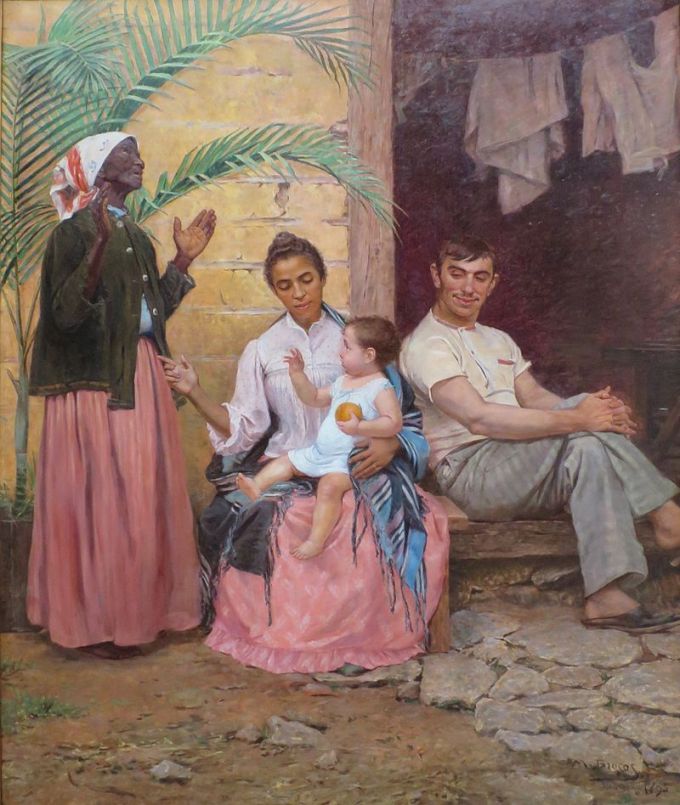
A Redenção de Cam (The Redemption of Ham), Modesto Brocos y Gómez (1895)
This 1895 painting by Brazilian artist Modesto Brocos, quite effectively illustrates the difference in how elites in the United States and Latin America tried to deal with their questions of race and national identity. At the time, both in the Anglo north, and Latin south, Social Darwinism was accepted science: there was an assumption that the more European the population (and in the United States and Canada, the more north European at that), the better off the nation as a whole.
At the time of this painting, the “one drop” theory was prevalent in the United States — the idea that a person with a single black ancestor was black. Given the then fashionable eugenics theories of the day, the “one drop” theory combined with “Jim Crow” laws, sought to — if not eliminate — at least isolate non-whites from the general population. At the same time, the elites in overwhelming non-white Latin Americans were trying the exact opposite aproach, encouraging European immigration, in hopes of “whitening” the population. In the United States, what was condemned “miscegination” was here celebrated as mestiaje (mixing). Needless to say, the Social Darwinist thinking behind both approaches was caca, but with recent discussion of mestiaje here in Mexico, one interesting development has been both a political and social movement for people who have for a century been considered mestizo to”reclaim” their heritage as Afro-Mexican, Indigenous, or even Jewish, while at the same time, in the United States, there’s an opposite trend by people of multi-racial heritage to celebrate their mixed ancestry.
Writing Gods, Gauchupines and Gringos 2.0, I’ve been wrestling on how to write about the “whitening” era in the late 19th and early 20th century here … when there was a concerted effort to attract European (or at least “white”) immigrants. I’m still stumped about what exactly to say about the whole, still maddening, question of racial identity in Mexico.
(An excellent critique of the painting by Barbara Weinstein: How does the painting, ‘The Redemption of Ham’, by Modesto Brocos illustrate ideas of whitening?” is here.)
Sombrero tip to Isaac Hunter for bringing this Brazilian painting to my attention.
(Narco) Peace be with you?
Two priests, returning from a religous festival Taxco, Guerrero, were murdered last week. The authorities were quick to blame the victims … not only had the priests been drinking (well, they were at a party, so that one didn’t fly), and — cue ominous music — were musicians, one of them was once photographed holding a firearm. So far, the OFFICIAL STORY is that the priests were targeted by (out-of-state?) gangsters who mistook them for members of a rival gang. Or maybe didn’t like their performance. Or anything, but what Bishop Salvador Rangel is telling anyone who will listen.
Guerrero, with a murder rate of 64.25 murders per 100,000 inhabitants IS a dangerous place, even for clerics. While generally considered off-limits in the “drug war”, the Diocese of Chilpancingo-Chilapa finds itself in the middle of that war, with Bishop Rangel increasingly seen as an active participant. Not that he, or his clerics, are packing heat, but that gangsters, poppy farmers, missing students (the 43 missing students were in his Diocese), and those caught up in the mayhem, are his flock.
While the state government released a photograph of the Bishop with three men and a helicopter (supposedly meaningful in some way) in an attempt to discredit him, Rangel openly admits he has met with gang leaders in hope of “opening a dialog” with at least one faction in the on-going violence. Where he is facing opposition is from the State authorities, who, Rangel says, do not by any means, control Guerrero: “”All of Guerrero is in the hands of narcotics traffickers. … There’s an official government and another (authority) that gives orders.”
“I’ve said some politicians have narcotics traffickers as their godfathers, and they don’t like this because they also act this way, with impunity (and) with protection from the police.”
If the amnesty is for those people who want to amend their lives and correct themselves, I agree. He added that many times he offered his services as an intermediary and that Mexicans now have “a great weapon that is the vote” to support, more than a party, those people who want to pacify the country.
A good shepherd, or wooly-headed?
Sources:
Agren, David. “Two Mexican priests killed in ambush” National Catholic Reporter, 6 February 2018.
“Obispo de Guerrero confiesa que dialoga con los jefe del narcotráfico” Reporte Indigo, 7 February 2018.
Not Lena Riefenstahl, but then why would it be?
Alberto Isaac’s “Olimpiada en México”, the official 1968 Summer Games film. English voice-over narration.
Yanqui go home (or at least, shut up!)
Spain has fallen to the charms of Evita
She can do what she likes, it doesn’t matter much
Can’t say the same about Rex Tillerson’s Latin American Rainbow Tour…
Originally posted on Steve Ellner’s Blog on Venezuela, Latin America and Beyond
U.S. SECRETARY OF STATE REX TILLERSON’S LATIN AMERICAN TOUR MAY BE WITHOUT PRECEDENT IN U.S. DIPLOMATIC HISTORY: But it is perfectly compatible with Washington’s world-wide strategy
Never before has a top official in the U.S. government traveled throughout Latin America in such a well-publicized trip to gain support for measures against a nation in the region. Tillerson’s Latin American tour may be well received by reactionary and conservative heads of state (Chile, Colombia, Peru, Argentina, Brazil) but it is particularly objectionable for Latin Americans for various reasons:
First, because it follows on the heels of an obviously rigged presidential election in Honduras. The Trump government refuses to recognize the legitimacy of the electoral process in Venezuela at the same time that it validates the elections in Honduras. Tillerson said in Colombia that there is no comparison between the elections in Honduras and the to-be held ones in Venezuela, without explaining why. Making no attempt to explain why the elections in Honduras were legitimate, in spite of the fact that even the OAS does not recognize the results, demonstrates a glaring aspect of the Trump administration: its complete contempt for the truth.
Second, Latinos fully agree that Trump’s blatantly racist remarks about Mexicans are not just insulting to the people of that nationality, but to all Latin Americans.
Third, because Latinos particularly object to members of the U.S. capitalist class telling them what to do. When Nelson Rockefeller undertook his 20-nation “Presidential Mission” in 1969 organized by the government of Richard Nixon, the trip turned into what a speech writer at the time called “Rocky Horror Road Show.” Anti-U.S. protests including violent confrontations with security forces followed Rockefeller throughout the continent. In Argentina 14 Rockefeller-owned supermarkets were bombed and in Venezuela, President Rafael Caldera told Rockefeller to cancel his stay in that nation. Tillerson is also a member of the capitalist class, not just a representative of it. For over 3 decades Tillerson worked for Exxon which was formerly the Rockefeller-owned Standard Oil of New Jersey. For 10 years of those 3 decades, he was Exxon’s CEO.
Fourth, neither Tillerson nor Trump has made any effort to prove that the 2018 Venezuelan presidential elections are illegitimate. Washington’s position (as well as that of the conservative government’s of Spain and Great Britain) undermines the efforts at negotiations between the Maduro government and the opposition. Many believe that an agreement between the opposition and the government is Venezuela’s best hope, as both sides lack the popular support necessary to ensure stability. Trump’s position also pressures the parties of the opposition to pull out of the presidential race, even though many, if not most, of the opposition parties are intent on participating in them.
Critics can point to aspects of the Venezuelan elections that do not accord to the spirit of democracy, such as the decision to hold them anticipatively. But there is a fundamental difference between objectionable electoral practices and rigged elections, such as those held in Honduras and the 2000 U.S. presidential elections (with regard to the decisive state of Florida). One can point to objectionable practices in many other nations as well, beginning with the U.S. In the U.S. over 6 million felons (that is, ex-prisoners who have served their prison time) are denied the right to vote; “voter suppression” affecting minority groups has been well documented: widespread gerrymandering is a well known fact; and two of the three presidents in the twenty-first century have been elected while receiving less votes than their rival for the office.
Washington’s position on Venezuela is comparable to the Trump administrations rejection of negotiations between the Afghanistan government and the Taliban in spite of the fact that the protracted civil war in that nation is at a deadlock with no end in sight. Both sides lack popular support and so it’s hard to imagine a best-case scenario of peace and stability. It would seem that Washington is not interested in peaceful resolutions of conflict anywhere in the world. Could it be that the arms industry which is a large part of the bedrock of the U.S.’s unhealthy economy has something to do with Washington’s tendency to block peaceful agreements throughout the world? In short, Venezuela is just one example of Washington’s efforts to foment discord and confrontation including armed confrontations. Just look at Syria, Afghanistan and Korea.
US exports are killing us… literally!
And nothing is being done about it that anyone can tell:
From 2014 to 2016, across 15 countries in North America, Central America, and the Caribbean, 50,133 guns that originated in the United States were recovered as part of criminal investigations. Put another way, during this span, U.S.-sourced guns were used to commit crimes in nearby countries approximately once every 31 minutes.
Certainly, many of these U.S.-sourced crime guns were legally exported and were not diverted for criminal use until they crossed the border. The United States is a major manufacturer and a leading exporter of firearms, legally exporting an average of 298,000 guns each year. However, many of the same gaps and weaknesses in U.S. gun laws that contribute to illegal gun trafficking domestically likewise contribute to the illegal trafficking of guns from the United States to nearby nations.
[…]

Case Vermillion hands a gun to a customer at the Cheaper Than Dirt gun shop in Fort Worth, Texas, Thursday, Nov. 6, 2008. (NPR)
According to data from the Bureau of Alcohol, Tobacco, Firearms and Explosives (ATF), of the 106,001 guns recovered by law enforcement as part of a criminal investigation in Mexico from 2011 to 2016 and submitted for tracing, 70 percent were originally purchased from a licensed gun dealer in the United States. These U.S.-linked guns likely represent only a fraction of the total number of guns that cross the southern border, as they only account for those guns that were both recovered by law enforcement during a criminal investigation and submitted to ATF for tracing. Other estimates suggest that close to 213,000 firearms are smuggled across the U.S.-Mexico border each year. According to the U.S. Government Accountability Office (GAO), nearly half of the U.S.-sourced guns recovered in Mexico are long guns, which include high-caliber semi-automatic rifles, such as AK and AR variants. This is a concern for Mexican law enforcement officials, who have reported that assault rifles have become the weapons of choice for Mexican drug trafficking organizations, in part because they can easily be converted into fully automatic rifles.1 The GAO also reports that, from 2009 to 2014, the majority of the crime guns recovered in Mexico that were originally purchased in the United States came from three southern border states: 41 percent from Texas, 19 percent from California, and 15 percent from Arizona.
The impact of rampant gun trafficking from the United States to Mexico has been devastating. In 2017, Mexico reached its highest level of homicides in the past 20 years, with a rate of 20.5 homicides per every 100,000 people.12 While this figure is partly driven by high levels of impunity for criminal behavior, access to firearms has also been a key driver of the increase in homicides. In 1997, 15 percent of Mexico’s homicides were committed with a gun, yet, in 2017, that percentage rose to roughly 66 percent. The use of firearms during violent robberies has also increased. In 2005, 58 percent of robberies were committed with guns; in 2017, this figure increased to 68 percent.
Read the full report (with source notes) here:
Beyond Our Borders: How Weak U.S. Gun Laws Contribute to Violent Crime Abroad (Center for American Progress, 2 February 2018)
All your elections belong to US
U.S. Secretary of State, Rex Tillerson, apparently resents other foreign powers trying to muscle in on his (perceived) colonial patch:
Tillerson’s visit, it must be said, does not augur well for bilateral relations or for links between the United States and the countries of the rest of the American continent. Last Wednesday, we were visited by three U.S. Senators (one Republican and two Democrats) who expressed their concern for what they called the malign influence of the Russian government in Latin America and, particularly, their supposed influence on the ongoing electoral process in Mexico. In his way, the Secretary of State endorsed their position, pointing to a growing and even alarming Chinese and Russian presence, which he tangentially labeled as predatatory and criticized unfair economic practices (alluding to Beijing) and for selling weapons to regimes that do not share the democratic process (in reference to Moscow). In contrast to what he called “imperial powers”, the head of US diplomacy referred to his own country as a multidimensional partner that benefits both sides.
Yeah… right.
Considering the overt attempts (often successful) by the United States to control Latin American elections over the last 200 years… going back to Joel Robert Poinsett’s Yorkista plot in the 1828 Mexican election (not to mention more recent examples, the U.S. media (and official) cheerleading for Peña Nieto, their willingness to sign off on the Honduran coup, and the recent sham election in that unhappy country, U.S. Ambassador Philip Goldberg playing footsie with Nazis in Bolivia, etc. etc. etc. and we have to wonder whether Tillerson isn’t like the donkey joking about your ears… or, as we say in English, the pot calling the kettle black.
Positively nuts
In my first edition of Gods, Gachupines and Gringos, I devoted only a sentence to Positivism when talking about immigration to Mexico in the Porfirian era. I don’t want to write a treatise on Latin Amrican Positivism, but on the other hand, I can’t get away with just saying “the Cientificos were positive they were right”, and leave it at that, either.
A couple of notes:
I’m leading up to a discussion of why “whitening” was never really successful. With the United States also in a “Social Darwinist” mood, thanks to “Jim Crow” and later the Chinese Exclusion Act, non-European migrants would often opt to immigrate to Mexico over the United States. And, with African Americans, sometimes FROM the United States.
Juana Catalina Romero is discussed earlier. Said to have been Porfirio’s first love, she was a Zapoteca street vendor who worked her way up to one of the richest women of her era. Her relationship with Porfirio was symbiotic, her behind the scenes political advice and support being a quid pro quo for her free hand in building her business empire of mining concessions, agricultural exports, and retail stores in Oaxaca.
Positivism had a much greater effect on Mexico and Latin America, in things other than immigration and racial theories, but I’ll get to that elsewhere.
Positivism and immigration
Porfirio Díaz may have presented himself (and largely remained) a simple soldier from Oaxaca, but when it came to his advisors and cabinet, his choice fell on the era’s elites: with the singular exception of his Juana Catalina Romero, he was surrounded by rich, well-born white men, while honest and well-intentioned for the most part, were out-of-touch with the masses. Díaz’ “think tank”… los cientificos (the scientists) … were, to a man, influenced by the then “modern” philosophy of Positivism.
At its most basic, the Positivists said that all human knowledge is based on the logical interpretation of natural events. In other words: What you see is what you get. Having fought both the clerical party in the Reforma, and the monarchists during the French intervention, the new elites of Porfirio’s generation naturally gravitated to a school of thought that no longer depended on either tradition or divine revelation for guidance. However, Positivism lost something in translation when it reached Latin America.
Porfirio was the great nationalist hero who had heroically fought against the French, but Positivism was for the most part a French import. Positivism had first developed in France, and Latin American intellectuals largely depended on French writers for their own understanding of the new thinking. Positivists’ experience of the world being that of France, Porfiro depended on — ironically enough — men who saw their former enemy as the source of not only the best thinking of the time, but as a nation to emulate if they wanted to turn their weak nation into one that could fend off further foreign intervention… from, among others… France!
The cientificos, like other Positivists, had adopted the best of the new scientific thinking from Europe, as well as some of the worst. Misreading Darwin’s “Origin of Species” in which “survival of the fitest” meant the survival of a species in a given place meant the successful breeding by those individuals who had best adapted to their environment to mean that those human cultures that were the most “advanced” were the “fittest”: the French, naturally, seeing France as the ideal of an advanced culture. Quite logically, the cientificos could cite statistics showing that European workers were more productive than Mexicans, not noticing the Europeans were better fed, housed, and clothed than their own people, and that western Europe was highly industrialized fifty years earlier, in large part thanks to natural resources imported from colonial possessions and countries like Mexico. All factors that were overlooked by “Social Darwinism”: France and western Europe were thriving because the people were more “developed”. The cientificos saw “whitening” the population as an imperative for national development.
And speaking of Poles in Mexico
Mexico and Poland: Centuries of Cultural Relations (Culture.PL, 13 April 2015)
The 19th century brought Polish soldiers to Mexico. After the unsuccessful November Uprising against Russia, many Polish political émigrés had to start their lives from scratch abroad in 1831.
For 123 years – from 1795 to 1918 – Poland was divided into three different territories that belonged to the Russian Empire, the Kingdom of Prussia, and the Hapsburg Monarchy of Austria.
Between 1846 and 1848, around fifty Polish soldiers located in the United States joined the U.S. army to fight against Mexico, which ended up losing that war and thus half of its territory.
An editorial in Dziennik Narodowy, a newspaper-in-exile, stated that this war was unfair and that the Polish people did not agree to be part of it:
It is the invasion of the strong against the weak.
Twenty years later, from 1863 to 1865, Polish soldiers returned to Mexico, serving during the Austrian-French intervention, a failed attempt by Napoleon III to conquer Mexico.
We can find out more about the circumstances of those years thanks to the memories of two veterans of the war: Konrad Niklewicz and Stanisław Wodzicki.
Although some of the Polish soldiers were forced to fight against the Mexicans, most of them were convinced that they were doing the right thing: they were anticipating Napoleon’s assistance in creating an independent Poland.
Only a few Poles realized that the situation that Mexico was enduring was in fact very similar to Poland’s. Some Polish soldiers were fighting against Mexico and others against Napoleon III; they were sent down to Mexico after the American Civil War to help defeat France.
Some of them identified with the Mexican republicans. Unhappy with the fact that only Germans were able to obtain higher ranks in the army, they switched sides and fought against the European interventionists. Others did the opposite and others committed suicide. Napoleon III resigned and Maximilian I of Mexico was executed in 1867.


 mexfiles.net