Anna Zarneki: refugee, artist, philanthopist (1926 -2018) D.E.P.
Being a refugee is a disaster. It’s a great tragedy and it doesn’t matter what you think about your country. You love it or hate it, doesn’t matter. Disaster. Wars should never ever happen.
But they do…
Anna Zarneki recalled the amazement of people gathered to listen to her grandfather’s radio … the only radio in Truszeliszki, Poland… in September 1939. Then a thirteen year old girl, she had only the vaguest concept of the world outside her corner of Poland, and certainly no idea she was about to embark on one of the great … but almost forgotten… odysses of the last century. The Red Army, having stripped Truszeliszki of nearly anything edible, let alone useful, began rounding up the population for transport to Siberia, and forced labor. While her grandparents were left behind, together with her parents and her sister, she worked in a gulag cutting timber.
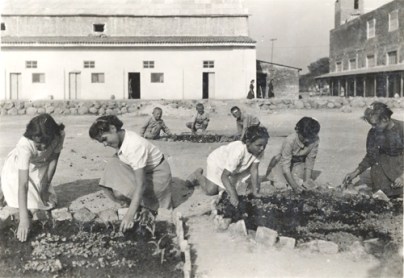
Photo: Kresy-Siberia Virtual Museum, Julian Plowy Collection
IN 1942, by which time the British were running short of troops, Stalin offered to release the Poles for military service. But the civilians? The British were reluctant to take in more civilians during wartime, although they made a token offer to resettle some in their African colonies. Mexico, however, having taken in entire communities of displaced Europeans from Spanish Republicans (the Spanish Republic in exile continued to function after being driven out of Paris in Mexico City), the entire Jewish community of Antwerp and others, almost overnight built Hacianda Rosa, to receive the Siberian Poles, and give them … if not a return to their own lives… at least a decent chance to live their lives according to Polish traditions.
Zarnaki’s father, both wanting to keep his family together, and — remembering the family had relatives around Chicago, which being in America had to be somewhere close to Chicago — took a leap of faith and decided the family would make a life for itself somewhere in the vaguely understood America.
 And, so… by train across Siberia, Khazakistan, Georgia, Azerbijan to Baka, by ship to Tehran; then onwards to Karachi, Mumbai, Sydney, Los Angeles, and… again by train to Leon, Guanajuato. In Leon, the 1439 Poles were welcomed by a mariachi band playing the Polish National Anthem. Hacienda Santa Rosa, never mind that it looked nothing like Poland, the language was Polish, the food was Polish (with a few chiles thrown), the education was Polish, life was Polish. Anna would have a Polish adolesence, discovering a talent for painting, and … Mexico. One of the few Poles would would neither opt for a new life after the war in Canada, the United States, or Great Britian (only 87 of the original inhabitants of Santa Rosa returned to Poland after the war), she married well, raised a family, pursued an art career (with exibitions throughout Mexico, Poland, the United States and elsewhere), wrote her memoirs, and joined the Red Cross.
Her survival in the gulag having depended on food packages from the International Red Cross, Zarnacki was hardly the typical “ladies who lunch” when she joined the Damas de la Cruz Roja in 1975. She took nursing training, and took her duties seriously. A refugee, and a fortunate one at that, she was an indefatigable organizer, with the energy and toughness of a survivor. From fund raising and occasional visits to the Mexican Red Cross hospital she stepped up to run the Mexican Damas, then to a position on the board of the International Red Cross, to International President of the Red Cross in 2000.
 Gratitude to the Red Cross, and her own status as a refugee, also led her to consider the larger questions of why there are wars, and what small part we can play in overcoming the cultural misunderstandings that lead to them. Her Fundacion Zarnecki, focused on international cultural exchange is her legacy to not only Mexico, but to all of us who would rather understand than fight with others.
Sources:
Dagmara Staga, “Being a Refugee Is a Disaster: An Interview with Anna Żarnecki de Santos Burgoa” Culture.PL, 20 November 2015
Piotr Piwowarczyk, “Hacienda Santa Rosa: a Polish Refuge in Mexico“, Cosmopolitan Review, 2011 VOL. 3 NO. 4
Katherine Shawver, “Colonia Santa Rosa – A Polish Refuge In Mexico” 29 June 2015
High season in the resorts?
Secretary of Tourism, Enrique de la Madrid Cordero, has come up with a startling suggestion: legalizing marijuana in tourist communities. His rationale is that it will reduce the violence associated with the marijuana export business, and reassure tourists that Mexico is “safe”. Predictably, the Secretary of Defense is opposed to the idea, and (less predictably) the Human Rights Commission is non-committal.
I happened to catch the the Azteca network news last night, and this was the lead story. Several Deputies and Senators made “well, maybe we could study the issue” comments, and perhaps they will. But I doubt the de la Madrid’s proposal is going to amount to much, or become any sort of campaign issue of significance.
Ricardo Anaya, the “left-right” PAN dominated coalition candidate for president just says “no”. I haven’t heard from PRI’s José Antonio Meade, who never says anything controversial one way or the other, and don’t expect to hear anything from him. AMLO so far hasn’t commented either… but then, being himself being suspected of having rather conventional, abstenious personal habits and ideas, is likely to suggest a citizen’s referendum, like he does with other controversial social issues.
 I doubt this will come to pass, for several reasons. First off, de la Madrid is talking about state laws, specifically in Quintana Roo (Cancún’s state) and Baja California. While tourism is essential to those state’s economy, tourism is not, by any means, the mainstay of eitther state’s workforce. And, the money in tourism comes from long-term stays, not kids on the beach smoking
Baja California is also one of the more socially conservative states in the Republic, and in Quintana Roo there has been a backlash against over-emphasis on tourism and “development”. Presumaly, under de la Madrid’s proposal, the marijuana available would be locally grown… and I’m not sure the exporters who now make their living from the illegal trade would all that thrilled by yuppie competitors. And the present … er… entrepreneurs don’t play nice.
Secondly, with Mexico turning nationalist of late, “special rights” for tourists (read gringos) is something few political leaders would be willing to openly advocate. As with the fights in Baja over water rights (and privatization of water), would a new (and probably foreign owned, or built with foreign capital, like tourist resorts are) water-intensive industry be popular with the powerful agricultural workers political organizations. A different kind of violence, but one likely to be more visible to tourists if farmers start blocking resort hotels or the airports in protest.
Finally, one forgets sometimes with most English-language reportage from Mexico coming from those of us living in tourist regions (and our acquaintances being other foreigners or those working with foreigners and used to our ways) or “liberals” in the US sense of the word, that the Mexican middle class generally sees marijuana as either tacky or decadent (or both). That marijuana for personal use is technically decriminalized only really applies if you’re “gente decente” (from a good family) and the police. Even then, the user is likely to catch hell from his or her family. As it is, those who support full legalization are quick to deny that they want to smoke dope, or have much interest in the product.*
It could happen (and probably will), but it’s not coming to a beach-front cabana near you any time soon.
* Myself included. My concerns are more about the economic impact of what would likely be an industry controlled by outside interests, and the effects on water usage, food security and local agriculture of another luxury export commodity.
(Occasional) Friday video
Toña la Negra and Agustín Lara… what more could you want?
Foreign intrigue… Cambridge Analytica in Mexico?
Via El Financiero (my translation. Original includes screenshots of Facebooks “Foreigners in Mexico City (DF)” page in which Ms. Karo solicited employees. Foreigners cannot work in political campaigns here, in case anyone was wondering).
Cambridge Analytica claims to have masterminded Donald Trump’s electoral triumph through targeted campaigns based on an analysis of user behavior on social networks, and has been accused of contributing to the polarization of American society.
The firm arrived in Mexico in 2016. Ten months ago its CEO acknowledged its interest in entering political campaigns. But the firm has not registered with INE [the Mexican elections commission] to provide services to political parties and its head of operations in Mexico has erased all traces of its recruitment effort from the Internet.
The main investor of Cambridge Analytica is the conservative magnate Robert Mercer. Steve Bannon, the polemical former Trump adviser, was vice president of its board of directors until August 2016. Recently, Mercer publicly broke relations with Bannon and reaffirmed his support for the US president.
Cambridge Analytica’s presence in Mexico only became known on 4 April 2016 when its operations chief in Mexico, Arielle Karro, presented her poetry to the Senate as the guest of PAN Senator Ernesto Cordero.
Soon after, recruitment began. Data scientists confirmed to El Financiero Blooomberg that they received invitations from Karro to join Cabridge Analytica’s team.
One of the ways that Karro used to contact the data experts was LinkedIn. In one of these messages, held by El Financiero, he points out that Cambridge Analytica will be “the brain behind the presidential election in Mexico.”
On 23 October 2017, Karro, without mentioning Cambridge Analytica or another company, posted a search on social networks for campaign managers, at 25 to 70,000 U.S. dollars a year for Tabasco, Morelos, Guanajuato, Chiapas, Yucatan, Veracruz, Puebla and Mexico City. All of these states hold local elections this year.
These posts have been deleted, but until a month ago could still be found on-line.
El Financiero Bloomberg sought to interview Arielle Karro by phone. However, she declined to comment and a man, who introduced himself as his lawyer but did not give his name, indicated that she no longer works there and that “it is past history”.
Cambridge Analyica shares an office and web address with a company called Mowasat, at Calle Bahía de las Palmas no. 1,colonia Verónica Anzures. When El Financiero Bloomberg went to the address, security personnel have contradictory information as to whether Karro was on the premises, and for which company she worked.
Mowisat was founded in 1016 as a holding company with Mexican and English capital that, according to its business model, offers internet services to marginalized communities, and electronic banking services for rural communities. One is in operation in Xochimilco .
Ulises de la Garza Valdés, senior advisor to the company’s board of directors, appears on the Mowisat payroll. Without being a member of PAN, he held positions in the Calderon administration: first as senior officer of DIF and then as general director of pension benefits (Patrimonio de la Beneficencia Pública) in the Secretariat of Health until 2011.
“WE HOPE TO BE INVOLVED IN POLITICS”
Cambridge Analytica’s CEO, Alexander Nix, in an interview last year for Vice News, revealed that his company is already worked with existing firms in this country with a view to becoming involved in political campaigns.
“We are eager to bring the technologies we developed in Europe and the United States to help commercial companies and brands, and also to help politicians and political campaigns to do some of the things we have done elsewhere,” Nix told Vice.
“We hope to get involved in politics, first, if there is an appetite to use these technologies, and second, if customers feel they need support,” he added.
NO REGISTRATION BEFORE THE INE
Although it is still unknown if they work with any political party and, if so, with which, the electoral authorities point out that the companies that decide to participate in campaigns or offer their services to campaigns have a legal obligations, which Cambridge Analytica has not fulfilled. This includes the 100,000 peso fee for registration in the offering a service have to do so in a legal manner. If they are doing 100,000 pesos or more in business, they must register with INE. So far, there is no record of the company in the Registro Nacional de Proveedores del INE.
“Operations for more than that amount with companies or with corporations that are not registered in the national registry of suppliers for a political party is an infraction to the general law of political parties and, on the part of the company, a possible crime,” said Benito Nacif, counselor of the National Electoral Institute.
Following the surprise victory of Trump, Cambridge Analytica has claimed to be an expert in political marketing through an exhausiv analysis of data to learn the affinities, affiliations, concerns and fears of the voters. Facebook is the preferred platform it uses.
“It is observing reality, collecting data from that reality, analyzing it, cleaning it, making inferences, predictions or prescriptions, and then touching reality, that is, altering it, with the new information that you have just learned about these types of analysis”, explained Jesús Ramos, professor of data integration at ITAM.
Professor Javier Santiago Castillo, a former INE adviser, explained that it is not illegal to use this type of marketing. Although it is the first time it would be used in political campaigns in Mexico, it has been used for commercial purposes for some time. The illegality would be that the parties do not report this expense and the company does not have permission.
“The penalty would be a fine for the company and a fine for the party,” said Javier Santiago Castillo.
For national security specialists, Cambridge Analytica’s role in campaigning will be under a microscope, especially given suspicions that have arisen about its role in other nations’ politics.
“You have to be following this company closely, especially because it will probably face criminal charges in the future months that in one way or another could impact their work in Mexico,” said the internationalist Ana Maria Salazar.
In the message sent by LinkedIn, Karro points out that Cambridge Analytica was also the brain behind the election of Nelson Mandela.
On its website, the firm indicates that “it was hired by a South African political party to mitigate the prospect of electoral violence.”
Alexander Nix founded Cambridge Analytica in 2013 to target the US market, after working 14 years as director of the Strategic Communication Laboratories Group (SCL), which was the company that worked on the South African campaign, although there is no detail about his exact role in that campaign.
Bloomberg Businessweek published a report in March 2017 in which it stated: “While Cambridge Analytica has faced scrutiny over whether its data models really work, a closer look at the past practices of its London-based subsidiary, SCL Group Ltd., reveals a corporate DNA less predisposed to dazzling technologies to influence voters and more towards political tricks “.
I’d add that the Spanish daily El Diaro ran an extensive investigative report on Cambridge Analytica in that country, concluding their work was “psych-ops”.
Dolia Estevez first looked at Cambridge, and Ms. Karro, back in November of last year at Sin Embargo.
Solar panels to pay for “the great wall of stupid”? It’s a wash!
The United States (or its fickle president, at any rate) announced a 30% tariff on washing machines and solar panels. While theoretically aimed at China, Mexico is a major producer of both products. According to U.S. government date, in 2016 the United States imported 278 million dollars of Mexican washing machines, and 127 million dollars worth of solar panels. Although in the U.S. media, this has been seen as an attempt to destroy or weaken the solar power industry in the U.S. … or a quixotic attempt to bolster the fossil fuel industry, it may also be the first shot in the often repeated “promise” by the sitting U.S. president to “make Mexico pay for the wall”.
Not that Mexico will… necessarily. NAFTA rules still apply, and — as Mexican Secretary of the Economy, Ildefonso Guajardo, has pointed out — the United States International Trade Commission has already ruled that Mexican washing machines are no threat to the U.S. economy. For the simple reason, U.S. washing machines are made in Mexico anyway. The solar panel ruling is also being challenged.
I can see an upside, if a stupid rule, by a stupid administration, stands. Electrical rates are going up here, and solar panels being redirected to the domestic market (at the lower domestic price) might not be a bad thing. Not that solar panels would be installed everywhere, but that it would lower rates and mean less spending on natural gas imports from … you guessed it… the United States.
Oh, and maybe with the savings, we could buy more washing machines. Nyah,nyah! Sorry, no wall.
How you gonna keep em down on the farm…
The Mixteca Poblana… the southeastern section of the State of Puebla, has been particularly affected by emigration. With young people leaving for lack of employment as well as opportunities for higher education, the mostly indigenous communities find it harder and harder to sustain their traditional agrarian economy and culture. In searching for a solution to the problem, the communites have hit upon an intriguing — and perhaps obvious — step they can take to keep their best sons and daughters at home, and involved in traditional pursuits. Over the weekend, construction official began on the Universidad Agraria en Tehuitzingo, a pan-communal project that will offer students from any of the Mixtec ejidos a chance to study agronomy or veterinary medicine, with related fields of study to be added later.
The commune of Tehuitzingo donated 45 hectares for what should be a “self-sustaning” institute which will, additionally, serve as a agricultural research and assistance center.
Mexicans Are Furious about Hat-Wearing Jalapeños from Turkey
Stealing our national stereotypes… again!

 These babies are Mexican, say Mexicans
Add jalapeños to the long list of grievances against my people (i.e. The Mexicans.)
In the latest episode of a trade war brewing between Mexico and the European Union, Mexican producers of chile peppers are asking the UE for protection of fresh jalapeño chiles –and those that undergo smoking (ie. delicious chipotles.)
The problem?
Chiles from Turkey are sold in Europe with a label showing a jalapeño pepper wearing a Mexican hat, said Jesús Murillo González, but do not state the country of origin. “They’re not saying it’s from here, but they’re riding the coattails of Mexico’s prestige.”
Hey, I’m totally cool with countries riding the coattails of Mexico’s prestige but… putting a sombrero over a jalapeño?! That’s simply unacceptable –and an insult to our 1986 beloved FIFA mascot
Via: Milenio
The Reefer Madness of Empress Carlota

The Ogden (Utah) Standard, September 25, 1915
Deadly Marihuana Rolled in Cigarettes, Becomes the Curse of the Southern Republic and May Account for the “Bravery” of “Greaser” Bandits Who Defy the United States – The Insanity of Queen Carlotta Is Accounted For in the Familiar Historical Legend of the Poisoned Tea
General Villa tells the United States it can “go to h—.” Mexican troops cross the border and shoot down American ranchers and all in all it seems that the nation south of the Rio Grande would just as soon defy and fight the mighty Uncle Sam as to continue its own internal warfare.
And why?
Are the Mexicans becoming a mightier and braver race, or in the language of Texas, are they becoming “locoed?”
Reports received here indicate that the sudden burst of bravery on the part of the Mexicans is due to an increased use of the weed known as marihuana, which has much the same effect as opium or morphine on its users.
It is believed that a dose of this weed, administered by an enemy, caused Queen Carlotta, wife of Emperor Maximilian, to lose her mind. She now is living alone in a castle in France, still hopelessly insane, 50 years after the potion was administered.
Affects of Drug
The authorities here reported that large quantities of the weed are being imported into Texas from Mexico and causing the Mexicans on this side to nerve themselves to all kinds of daring crimes. The lower-class of Mexicans and Indians are obtaining and using quantities of the drug.
When a Mexican is under the influence of marihuana he imagines that he can, single-handed, whip the entire regular United States army, while if reinforced by several other Mexicans, also under the influence of the drug, he might include a few European nations in his dream conquests.
While under the influence of the marihuana Mexicans are liable to commit murder and when arrested give the authorities great trouble. In fact, a number of Mexicans recently have been shot by Rangers when they resisted arrest, and tried to kill the officers.
In El Paso the devotees of the alluring drug are so numerous and such a menace to law and order that an ordinance recently was passed by the city council making it “unlawful for any person, firm or corporation or association of persons to sell, barter, exchange or give away or to have in his or their possession any marihuana or Indian hemp.” The ordinance further sets forth that the dangerous properties of marihuana and the increasing sale, with resultant injury to public health and public morals, creates a necessity for the law’s rigid enforcement.
Smoked in Cigarettes
The terrible effects of the weed were realized by the late President Porfirio Diaz and during the latter years of his administration an order was in effect making it an offense punishable by death for any person to sell or give away to any soldier marihuana cigarettes or the weed in any other form.
The favorite method of using the weed is to roll the particles into cigarettes. Mexicans who are addicted to the habit say that the indulgence in one cigarette places them in the “seventh heaven.” It brings to them a sense of pleasure and delight that is incomparable and indescribable.
If a limit of one cigarette were set no great lasting harm might come to the indulger, but in order to keep up the feeling of elation another and perhaps another of the paper-wrapped poison is consumed, until the victim is in a state of wild frenzy. When in this condition he often goes on a rampage that brings death to whoever crosses his path. The period of temporary insanity lasts for several hours and is followed by the victim falling into a deep sleep that lasts 24 hours or more. He awakes with no knowledge of what has transpired while the full effects of the drug were upon him. It takes only a few months of constant indulgence in the cigarette habit to bring on permanent insanity.
It is stated that the marihuana weed grows profusely over a large area of Mexico and that it is found in considerable quantities on the Texas side of the Rio Grande River. In some districts it is a menace to livestock. The animals quickly learn to like the weed and when once they have obtained a taste for it they will eat nothing else. It brings death to them in a short time.
Really a Loco-Weed
In fact, the marihuana seems to be nothing less than the loco-weed that causes insanity to both men and beast. If the devastation of the drug is so great on this side of the Rio Grande, with our jails filled with men who have committed crimes while under the influence of the drug, and with our insane asylums filled with those who have lost their minds through the use of marihuana, imagine the terrible effect of its indulgence on the people of Mexico and then ask the question: Where do the Mexican bandits get their nerve to commit their attacks on the Americans and where do leaders summon courage to defy the government at Washington?
Then think of poor Queen Carlotta in her castle in France, with the doors of her mind closed forever from the light of understanding, apparently from an overdose of the drug administered in the form of tea by one of the enemies of her husband, Maximilian. The poor queen in her castle has been for fifty years and more awaiting death. Last year when the Germans invaded France they placed signs on this lone castle warning that anyone who disturbed the mad queen, as she is called, would be subject to severe punishment.
For Queen Carlotta is an Austrian and the Kaiser desired that she be protected, and the German soldiers responded nobly to his wishes, even refusing to fight in the vicinity of her castle.
Queen Carlotta
The story of Queen Carlotta’s insanity is one of the saddest in all of history, and her fate is even worse than that of her husband, who was shot to death at the direction of the French. As retribution for this deed they have given the queen the castle in the northern part of their domain and have maintained her for fifty years or more at their expense.
Here are the events that led to Maximilian’s regency in Mexico, his tragic end and the insanity of his queen:
In 1861 the Liberals and Conservatives in Mexico, while in the midst of one of those revolutions such as we have at the present day, seized on the property of foreigners. In consequence, Great Britain, France and Spain concluded a Triple Alliance at London with a view to forcing Mexico to pay indemnities. In December, 1861, a force of the Triple Alliance landed at Vera Cruz and occupied it without resistance, the Mexican troops having evacuated. After a successful conquest of many states it became apparent that the Emperor, Napoleon III, intended to interfere with the government of Mexico and perhaps establish a monarchy. The British and Spanish troops thereupon were withdrawn and the remainder of the conquest was left to the French troops.
On June 10, 1863, the French troops under General Forey entered the City of Mexico after it had been evacuated by President Juarez and his Republican troops. General Forey established a junta of 35 Mexican citizens and permitted them to establish an assembly of notables which decreed that Mexico in the future would be an empire with a Roman Catholic prince as sovereign to bear the title of Emperor. The crown thereupon was offered to Archduke Maximilian of Austria, of the Imperial House of Hapsburg.
The French were firmly established in the heart of Mexico but the army of Juarez still were firmly established in the southern and western portion of the country; and the contest of arms continued with varying fortune until the early part of 1864 when the Archduke Maximilian of Austria arrived in the Mexican capital to be proclaimed Emperor of Mexico. Maximilian was accompanied by his iill-fated wife who became the Empress Carlotta and the first lady of the new Empire. Maximillion had been placed on the Mexican throne through the instrumentality of the Emperor Napoleon.
The year 1864 was an eventful one in the history of Mexico. The French captured the city of Matamoras and the whole Mexican army was forced to surrender and become prisoners of war.
However, when the Civil War in the United States closed, the vitality of the Maximilian Empire declined. The United States, because of its internal affairs, was unable to act before, but when peace was restored the Monroe Doctrine was cited and the French were invited to leave Mexico. The French thereupon evacuated the country, leaving Maximilian and his imperialist followers to defend themselves against the Juarists. Maximilian remained despite the warning of Napoleon III to leave the country.
In May, 1876 [sic], the Juarists captured Maximilian and he and two of his generals were shot to death on June 19.}
But before the death of Maximilian, the Mexicans had taken revenge upon his queen. Several of her servitors are said to have given her tea which contained the deadly marihuana. The potion was so strong that she soon lost her mind.
So the marihuana is more deadly today than it was in the time of Queen Carlotta, for the Mexicans now are using it in cigarettes, and with each cigarette the desire to take the United States and annex it to Mexico seems to become stronger. And so the victims of the drug sleep on with their minds wandering far into the regions of the impossible, for its marihuana after all -and not real nerve and courage – that seems to be behind Mexico.
Beer wars

Photo: Luis Arellano Sarmiento/la Jornada
This was the scene last Tuesday, during a confrontation between Baja farmers and environmentals, and police outside a Constellation Brands brewery in Mexicali. Eight people were injured, and seven arrested. The state government is blaming the Morena Party for fomenting trouble in order to “destabilize” the state ahead of the July election, although complaints about the U.S. owned brewery’s massive demand for water in the desert region has led to protests for several years now, and has been led mostly by the CNC (National Campesino Conference, for its initials in Spanish), which has normally been associated with the PRI and local consumer and environmental groups.
Breweries, of course, need water… and Mexicali never has had a lot of the stuff. While State and local officials have welcomed Constellation Brands as a “job creator”, and built an acuaduct for the benefit of what they claim will be a major source of employment, consumers and farmers point out the brewery consumes millions of liters of water for what is nearly entirely an export product, in a region where water is particularly scarce.
Last Tuesday’s confrontation was an attempt to prevent the state-financed water pipeline (running on federal property) from being connected to the brewery. After nearly seven hours of back and forth fights between protesters and police, the pipeline was laid across the federal land and onto the (fenced) brewery property.
State governor, Kiki Vega de la Madrid claims he is not pro-brewery, but pro-exports: “”I do not defend the interest of any company, I defend the interests of Baja Californians. I have shown that I am a person capable of generating investment and generating employment ” However, the various citizen’s groups see the governor as sticking for the interests of foreign capitalists against those of his own xtate’s citizens.
Cristo Rey (draft from Gods and Gringos… rebooted)
A very rough draft, but FINALLY, FINALLY, FINALLY getting down to revising my 2006 “Gods, Gachupines and Gringos”: I had only given a paragraph or so to the Cristeros in the first book, which — considering I later wrote a biography (not a very good one, but the only one in English) of Gorestieta, and I’ve come to see this late counter-revolution as much more important that I initially thought (ok, I didn’t know that much about it at the time, and… as others pointed out… it had been effectively erased from the official histories for several years). Anyway…
- Cristo Rey
One might think that, with the “cultural revolution” of the 1920s, Quezacoatl had returned. On the other hand, the Constitution hammered out in late 1916 and early 1917 showed the influence of Tezacapocapli, in that the compromises meant to satisfy one or another faction were open to interpretation and meant to resolve the overriding issues of one group created problems for another. And opened the door to Huitzapotchli.
Published in 1891, Pope Leo XIII’s Rerum Novarum had put the Church on the side of labor movements and encouraged the faithful to take an active role in politics. However, in assessing the political and social movements of his time, Leo had condemned both Socialism and Anarchism and reiteterated the traditional right to private property. While slow off the mark, by 1910, the Bishops and Catholic intellectuals were generally supportive of Madero: Archbishop of Mexico City, Jose Mora y del Rio and other bishops were supporting Catholic labor unions, social movements, and looked favorably on a new Catholic political party.
When Huerta supressed the Catholic political party (among others), activists were left out in the cold. The Revolution that followed took a radical turn, with even the otherwise devoutly Catholic Zapatistas pushing anarchist ideas. And to the victor belong the spoils. Obregón owed his success largely to Anarchist and Socialist unions who had served in his Army as the “Red Brigades”. Natually, they were favored by the new government, over the weaker Catholic unions. And constitutional land reforms meant to satify Zapatista demands threatened the livelihood of the small and medium sized hacienda owners, who provided the leadership for the Church in rural Mexico, and from which most of the clergy had come.
Obregón’s policy was to find “work-arounds” on the restrictions the constitution placed on the Church, helping both Catholic and Protestant organizations to open schools, run hospitals, and recreational programs: if no one was prostelyzing that the YMCA, or a school kept its religious instruction out of the classroom, there were no problems. Despite the relative tolerance, Catholic intellectuals and displaced politicians, as well as the Bishops, strongly resisted what they saw as socialist tendencies in the administration, and the openly anti-clerical attitudes and actions of the government leaders.
With opponents who often as not resorted to armed rebellion when they didn’t get their way, Obregon turned to a loyal subordinate, known for his ruthlessness, when chosing a successor for the 1924 election. Plutaro Elias Calles, the former schoolteacher who had mercilessly slaughtered Pancho Villa’s forces in Agua Prieta, and as the revolutionary governor of Sonora had had town drunks who disobeyed his orders against public intoxication publically executed1 , was the orphaned and abandoned son of an alcoholic, who had faced nothing but abuse from the local priests when he was growing up, Calles hated liquor and priests with about equal passion. Not a popular choice within the cabinet, but a man who would do whatever was necessary to continue the Revolution.
Following a series of escalating provocations by both the ant-clerical unions, and responses by the Church, in July 1926, Calles ordered that the anti-clerical provisions in the Constitution be followed to the letter. All schools, convents, monasteries and other church-run facilities were closed. All church property was nationalized, including the houses of worship. On July 31st, the Catholic Church responded in a way only Mexicans could respond. For the first time in its nearly two thousand year history, Catholic priests went on strike.2
The strike would last three years. Religious believers, financed by holdovers from the Porfiriate and led by the most reactionary of the clergy, launched a three year terrorist campaign that would lead to up to eighty thousand deaths, mostly among poor rural people backing the clerical side in the struggle.
By the time the priests went on strike, the Catholic intellectuals, disgusted with Calles, and sensing they had been deceived by Obregón were already moving towards violent resistance. In the Bajio… Jalisco, Aguascalientes, and Guanajuato, small bands of guerilla fighters, recruited by those small hacienda owners who saw both the labor laws and the religious restrictions as infringing on their rights, began to fight back.
There had been several minor uprisings, thoughout Obregón’s administration, and at first, the “Cristeros” did not seem any more of a threat than the others. However, with the military’s attention focused elsewhere as dissident generals and their small armies were annialated one by one, the guerillas in the Bajio, with a single cause to unite them (saving the Church from “Bolshevism”) grew. No longer just guerrila bands, it had the makings of a disciplined army. All it lacked was a general.
Enrique Gorestieta, an out of work Huerta protege, was, reportedly, an athiest, but — as one of the few anti-Revolutionary generals still young enough to serve — he was quite willing (for twice the salary of a regular general) to take on the challenge of turning Catholic guerillas into a formal miliary force. Although financially supported by American oil-men (Donahy and Buckley, the two most important oil-men in Mexico were both conservative Catholics) who were betting that trouble in the Bajio would keep the Mexican government too preoccupied to intervene in the oil region, and by the Knights of Columbus. The Knights, along with the Catholic intellectuals, attempted to smuggle weapons to the Cristeros, though with only middling success3.
With the Bishops and the Vatican having recognized that the clerical strike was counter-productive (people simply stopped going to Mass, or found other outlets for their spiritual needs) and appalled by the violence in the Bajio, they were already in negotions with the government when the Yaqui War ended.
The last major military operation in Mexico over, the Army, and… more importantly, the Air Force, was able to turn their entire attention to the Cristeros. Their only important military operation, an attempt to take Manzanillo, failed miserably when the Cristero intelligence scouts overlooked (somehow) a Navy gunship sitting in the harbor. Moreover, with Obregón elected in July to a six year term staring on the first of December 1928, there was every hope for a peaceful resolution of the conflict.
Even an attempted assassination in October did not dampen the hopes. The would-be assassins were quckly rounded up… or were they?
The Pro Suárez brothers, were executed for their connection to an attempt to assassinate Obregon with a car bomb in October 1927. The bomb was tossed from a car sold the previous week by Humberto Pro Suarez. He, and younger brother Roberto, confessed to having been part of the plot, and a third brother, Miguel, was arrested for good measure. Miguel was especially suspious, having only returned to Mexico the month before the bombing, and was a Catholic priest to boot. Although probably innocent of anything more than giving moral support to the attackers, he never received more than a summary trial and soon faced a firing squad. Allegedly he said, “Lucky me. I win a Christian martyrdom in God’s lottery.”4
If Miguel was guilty of anything, it was only of being related to Obregón’s would-be assassins and an associate of the the nun turned terrorist, Madre Conchita.
Madre Conchita, Concepcion Acevade de la Llanta, was a pioneer of sorts… the first modern woman terrorist leader. Like Osama bin Laden in the early 21st century, she dedicated her considerable fortune to violently establishing a conservative religious state. From a wealthy family, when Calles closed the convents, the former mother superior returned home to organize prayer services in the empty local churches in which she called for terrorist strikes against the government. Her Mexico City home was the center of the bombing plot. Although she was the “intellectual author” of the plot, and only regretted that it had failed, she was not executed, but instead sentenced to the prison colony on Islas Tres Marías, and her property seized. 5
When Osama bin Ladin was killed, it did not end terrorist acts by his followers. Nor did Madre Conchita’s arrest end her follower’s terrorism. On 13 November 1928, less than three weeks before he was to take office for his irregular second term6, Obregón was gunned down at a luncheon by José Torral, a part-time journalist, cartoonist, and fanatical follower of Madre Conchita.
The United States government had a considerable interest in ending the war. While the virulently anti-Catholic Ku Klux Klan had been a major force in U.S. domestic politics in that decade, especially in the Democratic Party, that party had nominated a Catholic, Al Smith, as their candidate for President in 1928. Even though Al Smith lost the election, pro and anti-Cristeros in the United States were complicating U.S.-Mexican relations, especially when oil imports were largely dependent on companies owned by Cristero supporters like Frank Buckley and Edward L. Doheny. Additionally, refugees from the war were pouring into the United States, along with exiled Bishops and clerics.
Dwight Morrow, the United States Ambassador, and Texas priest, Father John Burke, representing the Vatican, had worked out a deal with Obregón that permitted self-exiled Bishops to return to Mexico and paved the way for the churches to reopen. While the Church had given up any hope of regaining economic power, and could live with the purely symbolic limits on their activities (such as the ban on clerical garb in public), they were loathe to see their 400-year old cultural and spiritual traditions erased. With some compromise… purely religious festivals “rebranded” as cultural events, and a less militant attitude from the pulpits in political matters… church and state could live with each others’ “sphere of influence”. As one cynic put it, “The Church will be blind, and the State deaf”.
The Bishops might have been willing to compromise, but Goresieta’s ambitions had by this point gone far beyond saving traditional Catholicism. As a perceptive historian put it:
In reality, he had been bit by the revolutionary bug: like many others struck by this usually fatal disease, he elieved that only large doses of power for himself could save México from its many problems.7
Gorestieta issued a “Manifesto to the Nation” attacking the Bishops for betraying the Church, and issuing a whole new agenda for his “revolution”: a return to the 1857 Constitution, stripped of its anticlerical provisions, but adding, surprisingly enough, women’s suffrage. Incidentally, he signed it “Generalissimo” Gorestieta, although there never was such a rank in the Mexican military hierarchy.
With the Bishops,the government, the United States, and even the Pope calling for the Cristeros to lay down their arms, Gorestieta was not about to give up. As the last standing anti-Revolutionary in rebellion, Goresieta attracted a few ultra-conservatives and die-hard Porfiristas to his ranks, and continued to hold out. With reluctance, Secretary of War Joaquín Amaro – who had been seeking to depoliticize and professionalize the Army – agreed to send the “agrianistas” into the field. Led by Puebla State strongman Saturino Cedillo, the agrianistas were landless farmers willing to kill or be killed in return for the promise of their own land.
It was the end of Goriestieta, although not of the Cristeros. While the majority took advantage of a general amnesty proclaimed by interim president Eulio Gueterrez (who had to take over negotiations when Obregón was assassinated), which included free transportation home, bitterness and violence would continue for years, never completely ending, but – with the exception of a very brief attempt later by Cedillo (ironically with the support of the surviving Cristero generals) – it was the end of miltiary assaults on the government.
1 Liquor prohibition—which was written into the U.S. Constitution between 1919 and 1933—is usually associated with religious groups in the United States, but prohibition was a common cause for all manner of revolutionaries and social reformers in the early 20th century. Revolutions, after all, seek to remake society and correct its ills. Revolutionaries are serious people and generally puritanical.
2 As with any other group of Mexican workers, the priests had the right to jointly act in their own defense under the 1917 Constitution’s pro-labor clauses.
3 One wonders why, in the 1920s, when alcohol prohibition in the United States had spurred a massive growth in the smuggling business, the Cristeros and their supporters never thought to turn to people like Al Capone for assistance.
4 Ironically, or otherwise, the police station where Father Pro Suárez was executed is now the site of…the National Lottery, and the bloody clothes worn by Blessed Miguel Suarez are now an object of veneration in a Mexico City church. “Blessed” is the title given by the Catholic Church to persons who are worthy of veneration, but whose cause for declaring them a saint has not been completed. To die for your faith is one of the means of obtaining sainthood in the Catholic Church.
5 To avoid her house becoming either a political or religious shrine, her house was given to the Evangelical Lutherans. In the 1950s, Madre Conchita, having married a fellow convict and become a model prisoner, was paroled and her remaining property returned to her.
6 Obregon’s first term, following de la Huerta’s six months as “interim president” was less than four years and, although the Constitution forbade more than one presidential term, with the constitutional change from a four-year to a six-year presidential term, some creative legal interpretation allowed Obregon to run for a second term.
7Tomán de la Pedraja, “Wars of Latin America”, page 292.
Amnesty and drugs… just say maybe
Andres Manuel López Obrador’s proposal to give amnesty to narcotics trafficers is, as you would expect, controversial. An estimated 400,000 Mexicans are, to one degree or another, involved in the industry… everything from smugglers to farmers and sharecopping marijuana growers to money counters to lookouts. Obviously, they can’t all be jailed, nor perhaps,do they need to be… although opponents of the proposal (in other words, every presidential candidate who is not AMLO) will focus on more villainous types, the hit-men and “drug lords”… who have more sympathy than one might expect.
 Parametría has just released a survey of attitudes towards amnesty, and the narcotics industry, that offer several surprises. Opinion is nearly split on whether an amnesty would lessen or increment violence…30 percent of those polled taking one of those two positions. But another 30% say it would make no difference one way or the other, the rest undecided. Depending on how you chose to read those figures, 60% are not opposed to amnesty, or are.
Given the results to other questions on the survey, one suspects people would favor amnesty: 84% believe that it is not wrong to sell or produce drugs, 73% think that drug trafficking is a necessary evil and half or more than half of respondents said that drug trafficking generates jobs, and at the very least contributes to the communities in which traffickers live.
57 percent of those polled would tolerate the drug industry (legal or otherwise) if there was an end to violence, while only 23 percent support a violent continuation of the “war on drugs”.
Salvador Borrego Escalante (1915 -2018)
It’s said the good die young. Salvador Borrego was 102 years old when he died Monday.
Interviewed in 2011, Borrego was especially proud of being the first Holocaust denier… and being the author of the best selling Holocaust denialist/Nazi apology revisionist history of all time: Derrota Mundial. First published in 1953, 11 editions and 48 printings later, Borrego’s claim is that Nazi Germany was defeated not by the Allies,but by a “judeo-masonic conspiracy”. In his second edition (with a forward by the disgraced José Vasconcellos) in 1954 he first advanced the theory that Jews inflated the number of Nazi victims in order to receive a massive indemnity based on the number of victims.
While also wrote a glowing biography of Hitler (Pintor, Soldado, Fuehrer), and an apologia for the Waffen SS, Borrego’s favorite enemy was the United States. His one book in English (Puzzling Neighbors) blames Mexican Masons, in cahoots with US Masons for all ails Mexico. Jews, masons, capitalists, marxists … to Borrego, they were all part of the same conspiracy, the same forces that kept Mexico from being great again.
Borrego was not alone when he began his career in the late 1930s. The failed Cristero Rebellion, led by traditionalist Catholics, had left embittered Cristeros who were unwilling to lay down their arms into joining forces with the openly pro-Nazi “Gold Shirts” in joining Saturnino Cedillo’s doomed attempt at one last shot of overthrowing the Revolutionary State by armed uprising in 1938. Unable to win militarily, the Fascists turned to politics and the media. In politics, the hard-core joined the new Synarchist movement, or the Catholic PAN party (which did, eventually, become a bigger tent conservative and Capitalist party, presently the second largest in the Republic). In the media, young fascists like Borrego found a home in the pages of the rabidly anti-American Excelsior.
However, between the Cardenas Administration’s anti-fascism and Cardenas and his more conservative successor, Manuel Avillo Camacho both looking for better relations with the United States, Fascists and Fascist-friendly media were pressured (especially after Mexico entered the “War Against Nazi-fascism” in May 1942) to force out columnists like Borrego. While he still had something of a career, working for over 35 publications as an editor or reporter, mostly for the El Sol chain (he would later write a biography of the chain’s founder, José García Valseca), Borrega would never be the type of journalist who is invited to Los Pinos, or appears on television talk shows. His 40 or so books, self-published or under the imprint of the Catholic publisher, Editorial Jus, on Fascism, anti-masonry, anti-liberation theology, and… in his later years, anti-feminism, anti-lgbt rights… occupied the rest of his life, with occasional appearances to rightist groups (including, much to the embarrassment of its national leadership, at a PAN youth conference organized by neo-Nazis).
For most Mexicans, it was a surprise in recent years to learn he was still alive. Unfortunately he was. Neo-nazis of the usual variety found in Latin America were the intended readers of Borrego’s badly printed, cheap ouvre. They may be a danger to some of us on the streets, but the real danger to all of us comes from those who tolerated Borrego, even if they claimed to have found his traditionalist Catholicism and ultra-nationalism extreme, still have influence in public life.
Never say anything bad about the dead. He’s dead. Good.
HELL NO, I’m not going to provide links to Borrego’s works!


 mexfiles.net