This claim is lame about the reign of Spain
Via Chilanguia (my translation):
President of the Spanish public television and radio corporation RTVE, Jose Antonio Sánchez, said that regretting the destruction of the Aztec empire during Spanish conquest is like regretting at the defeat of the Nazis in World War II.
In an event organized by Casa América in Madrid, Sánchez focused on what he referred to as “Spain’s work in the Americas”, listing off several “advantages” brought by the conquistadors. “Spain was never a colonizer, it was evangelizing and civilizing,” he reiterated several times during his speech.
Sánchez included numerous references to what he considered the benefits of the Spanish conquest of America; among them, the infrastructures that Spain built in the territories conquered during the occupation of the continent, like “churches, schools or hospitals”. In this enumeration, he also emphasized “catechism and [Spanish] grammar”.
Hernán Cortés introduces Spanish grammar to the Aztecs.
The state official went futher, claiming “The discovery of America has been the most important event in the history of mankind, after the birth of Christ. And the work of Spain has been of such magnitude that for centuries the enemies of the empire have dedicated their best work to discrediting us”.
He denied any role of the conquest in exterminating the local populations of the Americas, arguing that the Spaniards “knew Petrarch or Dante”. “What goes on in people’s heads that they think the Spaniards of that time were going to dedicate themselves to the extermination of human beings”, he asked. But then added, ” Were bad things done? Let someone tell me in what conquests there were not.”
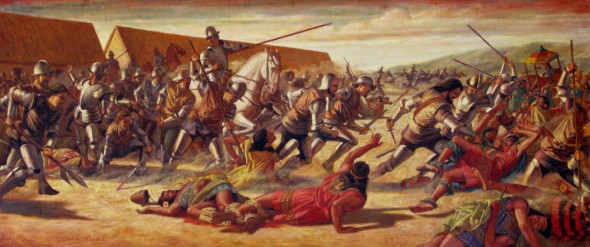

Spaniards discussing the works of Dante.
Correct me if I’m wrong, but I don’t remember reading about an Aztec Inquisition, nor of the Aztecs being particularly keen on throwing out religious and cultural minorities. Spain does get kind of a bum rap from later conquistador countries like England, but I don’t seem to remember too many of the early Spaniards being great readers of Dante or Petrach. Most were too busy with conquistador-ing the Hell out of their neighbors, enslaving them when they could get away with it, or cutting a swathe through the native population. Alas, for every Bernadino de las Casas, there were more than a few Nuño de Guzmáns and Juan Odantes.
Oh well, he’s from a country that never really came to grips with its own Fascist past.
When Nafta closes a door…
One of the biggest complaints about NAFTA way back when it was a pup was that it was pushed through (both here and in the US… don’t know about Canada) with a lot of discussion in the media, but no real knowledge of what was in the treaty itself. It had been negotiated behind closed doors, leaving citizens in all three countries unpleasantly surprised when things like outside arbitrators over-rode national policy, or a local community dependent on one major industry found their product couldn’t be sold to the other countries, or that decisions always taken at the local level depended on some policy no one had ever heard of before.
With the future of NAFTA now in question (no one really thinks, I hope, that Trump… or Trudeau… or Peña Nieto is going to control the process, or that either Mexico or Canada doesn’t have it’s own “non-negotiable demands”) and Mexico — looking out for its own interests — considering more post-NAFTA deals, keeping citizens informed of the processes isn’t all that radical a demand.
And… as I’ve said… and others have been saying for a long time, the big problem with NAFTA has been that Mexico has become over-dependent on one trading partner. So, the European Union trade deal is important, as even the unions understand:
(“Diversificar la economía, la mejor salida ante amenazas de Trump: Gómez Urrutia” Patricia Muñoz Ríos, Jornada, 4 April 2017, page 14. My translation)
Diversifying the economy is the best way to counter the threats of US President Donald Trump, according to Napoleón Gómez Urrutia, general secretary of the National Mining Union (Sindicato Nacional Minero),.
The union leader said that the round of negotiations taking place this week in Brussels, Belgium, to renew and expand the Free Trade Agreement between the European Union and Mexico (TLCUEM), while of extreme importance, have not been reported as thoroughly as they should.
Although we have heard very little about this issue in the press, and practically nothing from the federal government, these negotiations, which should be completed by the end of this year, are fundamental for the working class and for all Mexicans. He asserted that the central point of the negotiation is that Mexico must diversify both its markets and its investor pool ahead of threatened actions by the Trump administration.
Gómez Urrutia argues that Mexico must reduce the dependency on its northern neighbor, which has been maintained and deepened by the governments of the Institutional Revolutionary and National Action parties in the past three decades, adding that this change of course has been a long-time demand of progressive sectors.
Regarding the negotiations with the European Union, he explained that it is of vital importance to analyze any agreements with a clear head, paying close attention to European proposals in areas like the extractive industries (including energy and mines), agricultural production, intellectual property, the service industry, and government purchasing.
While stressing that the negotiations should not be stretched out, the Mexican government needs to provide more information to the public, and to bargain in a tranparent manner.
He also said that any agreement must incorporate international human rights and labor standards, in which the Mexican government remains weak.
God save the PRI?
Álvaro Delgado posted late yesterday in Proceso about a meeting between Enrique Peña Nieto and the Catholic Bishops of the State of Mexico, where the PRI is likely to lose the governorship for the first time ever. More troubling for the President, and his party, is that the leading candidate in Mexico’s most populous (and politically important) state is not from one of the old traditional opposition parties, but from the upstart MORENA party, which in four years has gone from a “political association” to the third largest force in the Chamber of Deputies, and whose presumed presidential candidate (and party founder) Andres Manuel López Obrador, is leading in all preliminary polls for President in 2018. A win by Morena’s Delfina Gomez Álvarez … a grade school teacher and former municipal president of Texcoco… is widely seen as an omen of both AMLO becoming Mexico’s next President, and a repudiation of the neo-liberal “reforms” of the present, and recent administrations.
The PRI’s gubernatorial candidate is Peña Nieto’s first cousin, Alfredo del Mazo Maza, meaning a loss by the PRI would not only be a rejection of what was (and still barely is) the nation’s largest party, but of the president’s family, and political clan (the “Grupo Atlacomulco”… the PRI politicans connected mostly by family and marriage ties that have run the state since the 1950s).
This, of course, cannot stand. In anticipation of the campaign (which officially opened Monday), the Federal Administration has been calling in its big guns, to unveil new programs, “stimulus packages” and make promises … all with the (wink! wink! nudge! nudge!) understanding that it is the PRI that delivers the goods…. at election time… as needed.
While leading the voters into temptation has a long and successful history in Mexico (especially in the State of Mexico), help from the other direction is not seen as amiss… thus, Peña Nieto’s open appeal to their Eminences last Friday. Although the PRI claims to be the heir to the anti-clerical Revolutionary Party of the 1920s and 30s, and has always been quick to condemn clerical interference in politics, Peña Nieto either swallowed his principals, or at least broke long-standing protocol. He knelt before Cardinal Carlos Aguilar Retes of Tlanapantla, and kissing his ring (and the rings of the other attendent Bishops, as well). Cardinal Aguilar Retes, who has close ties to the Grupo Atlacomulco and is widely assumed to named successor to the retiring Norberto Rivera as Archbishop of Mexico City, and Bishop Francisco Javier Chavolla of Toluca are said to have been receptive to assisting Peña Nieto’s cousin. The others, less so.
While technically forbidden from publically taking part in politics, the clergy (and especially bishops) have been making their “druthers” known and passed down their druthers as commands on high. Although (and it’s hard to prove given the reluctance of the clergy to openly express an opinion on electoral matters), it appears the lower clergy — parish priests — lean more towards Morena, the Bishops might stay non-commital. Not because they support the leftist Gómez… or think that Josefina Vázquez Mota — from the conservative and Catholic PAN — has a prayer… but because Peña Nieto lost the support of the prelates when he came out in support of same-sex marriage last year, in another attempt to boost his own (and his party’s) flagging popularity.
Maybe prayers will work. If not, there’s always bribery: allegedly, the prelates’ “bling bag” was not the usual coozies, tee-shirts, and hats, but included “art objects, fine clothing, and religious articles”.
No Exit.
Mexfiles has been seeing posts like this one (from an “expat” facebook page) more and more.

Once and for all…
THERE IS NO EXIT FEE…
THERE IS NO EXIT FEE…
THERE IS NO EXIT FEE…
There is a fee for tourists entering the country. Given that traditionally tourists have overwhelmingly been entering from the United States, the fee as long as I can remember has been more or less equivalent to about 25 US$. With the alarming drop in the value of the peso against the dollar, it’s been raised to today’s $500 pesos ($26.27 as of my writing this). The FMM (“Forma Migratoria Múltiple”) … the same fee covering what used to be a bunch of different sorts of temporary entry visas with different rates for people like academics, journalist, business visitors, aid workers, and tourists) is acquired when one ENTERS the country. However, Mexican border control has been rather lenient with those who lose, forget, or just blow off acquiring their entry documents, merely requiring they get a replacement when they show up at border control… i.e., when they’re on their way out of the country.
Secondly, there is an “expat legend” that’s gone around too long that foreigners are ENTITLED to a stay of 180 days. While it has been a long-standing policy to give 180 days to all entrants, border agents here — like everywhere else on planet earth — are permitted to exercise discretion. My first stay as a resident, the agent took one look at the massive amount of luggage I was lugging (including a whole collection of Junior High level textbooks) and warned me that I couldn’t work in the country on what was then a tourist visa (which I started doing the next day, but that’s another story), but gave me up to 180 days anyway.
Even then, there were well-known exceptions to the SOP. Entering Chiapas from Guatemala would usually mean a 30-day visa. At the time, there was a “Mexican stand-off” between the government and the Zapatistas. Too many revolution tourists were just showing up, expecting to be welcome with open arms (not firearms!) by the Zapatistas. And, while certainly those of us flying in from the north were known to do so as well, tourists coming from Guatemala were perceived as more likely to be those who expected to “go native” or at least on their own personal vision quest (as the expense of the local Mayans). In other words… fairly or not… those people seen as likely to cost the State considerably more than 25 US$ in added protection, services, possible health-care costs, etc.
Which brings me to my real problem with “border jumpers” and the assumed “right” to stay up to 180 days at a time. The story I hear from these people is that, while actually permanent residents (minus a few days a year), they more than pay their dues, “not using the social services network”. Unless, of course, there’s a hurricane, a flood, an auto accident, their house is robbed, or any of the other vicissitudes of life that require fairly costly state intervention. Maybe the 25 US$ is enough in the way of insurance to cover these contingencies spread over the 20 to 25 million visitors who are here anywhere from a few hours to half a year. How well it covers the costs of people who are resident “tourists”… in the way of more police protection for their neighborhoods, higher water usage than your average Mexican family, pressure on local governments for infrastructure development in “gringo ghettos” (often at the expense of development in other parts of the same community)… may not work out. While the argument can be made that the permanent tourists “create jobs” (mostly cleaning up after, or serving the whims of said permanent visitors), that argument seems to come most strongly from real estate sales people.
Nothing against the people living here, on a quirk in policy (unless they are whining that the policy isn’t generous enough for them) but it does seem as if the real estate types, selling those who otherwise don’t qualify for immigration, to settle here, are privatizing profits, while socializing expenses. They are the ones pushing for special governmental services for the “community” that claims not to live here, but merely visit, while reaping the rewards of home and condo sales, with bathrooms beyond the imaginings outside of telenovelas for the mass of us, and (subsidized) electrical rates that allow them to use every appliance known to man.
Given the recent moves by the US administration to crack down on even the most innocuous violation of immigration policy north of the border, its a wonder that border agents still allow people to enter for six months at a time at all.
Fruit flies and the Superbowl, or NAFTA by other means
This video is several years old, but as Joseph Stiglitz explains in the course of a much longer discussion of not-so-free trade agreements, NAFTA was no impediment to protectionism (especially in agriculture) and giving the wealthy nations an unfair trade advantage over nations when it comes to trade policy.
Tennis (Court Oath) Anyone?
DRAT! The “powers that be” thought they’d pull a fast one when, during the course of turning the Federal District into a State, they packed the Constituent Assembly by cutting down the number of citizen-elected representatives, and assigning more seats to the President (and, by default, his party) and our neo-liberal “mayor”. If there was a “conspiracy”, it was to weaken the Federal District’s quirky insistence on being out of step with the rest of the nation… consistently voting for the left, and passing more progressive legislation that only slowly makes its impact felt on the rest of the nation. In other words, the hope was to preserve the status quo.
Intislly, there was just a feeling that the exercise was simply a bit of legislative finagling, without much meaning to the average citizen. However, as Bernardo Bátiz V. writes, things didn’t quite turn out as expected, and that’s all to the good.
An historic break
(Jornada, 20 March 2017 My translation)
Mexico City’s new Constitution is an important and historical document., despite the lack of e interrest in the electoral process by which the 60 deputies were elected to the Constituent Assembly, in addition to those appointed, Only about a third of potential voters went to the polls. But,, once the assembly was in place, various non-governmental organizations, indigenous communities, neighborhood associations, merchants and others, together with many individual citizens, became increasingly interested in the various issues on the agenda and participated in discussions alongside the deputies.
All who asked to be heard were received; Innumerable groups and agencies presented their points of view, objections and contributions. The Indigneous Peoples’ and Original Communities committee held the most wide-ranging consultations, and was recognized for their work by the United Nations. Citizens of diverse political tendencies, from the far right to the far left, thronged Plaza Manuel Tolsá to lobby deputies as they headed from committee meeting in the Palacio de Minería to the Xicoténcatl Hall, hand us leaflets, petitions and even some drawings of late gestation fetuses…
Experts agree that it has been a very long time since a debate of this magnitude has taken place in Mexico outside of parliamentary groups; There was no coordinating comittee that took decisions behind closed doors to be simply ratified by the plenary: the consultations were just that, a place to listen to opinions and arguments, but never to make definitive decisions. Of the ten parliamentary factions in the Assembly, none cast unaminous votes. Within each, there were discussions and disagreements.
The result, celebrated by all, is a novel and advanced document, even though given the heterogeneity of the 100 participants it did not turn out to be an impeccable text from the grammatical or literary point of view. It is, instead, a signpost for what the people of Mexico expect.
The Mexico City Constitution represents a historical break with the neoliberal line of constitutional and legislative changes os the last 25 or 30 years.Indeed, the reforms to the federal and local constitutions and changes in secondary legislation during this period favored neoliberals, the most significant being the “Pact for Mexico” which gave shape to the [Peña Nieto administration’s] structural reforms.
Legislation, from Salinas to Peña, has tended to favor transnational corporate interests and the protection of private initiative The Mexico City Constitution breaks with that, moving towards a law with more social content, and restroring the concept of social law places the supreme value of society, not on the competition so dear to neoliberals, but on collaboration, solidarity and the concepts of equality and social justice.
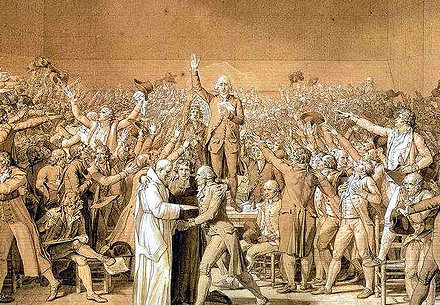 The present leaders of the system, the unreading rulers of the country, do not know history. They are unaware that the French Revolution overthrew a 900-year-old dynasty after Louis XVI summoned the Estates General never imagining it would end in the Tennis Court Oath. Louis never dreamed that the representatives of the Estates General along with some from the nobility and the clergy would assume their responsibility as representatives of the nation and would not be content to passively accept the mandates of their lords and betters. As representatives of the nation they tried the king, changed the regime, abolished the titles of nobility and changed history.
The capital’s constituent assembly also took our role seriously. We approved an advanced document only after much work, and many debates. The powerful of the regime, who fight against it now, despite the fact that it was they who called the assembly in the first place, are frightened by the change of course, an outbreak of humanism and solidarity so contrary to neoliberal legislation.
They did not expect what happened; For not reading history, did not learn that people get tired, change, correct and straighten directions. The neoliberalism imposed on us from the outside is not the best for the development and happiness of the Mexican people; The capital is giving the signal for the change of course;The constituents were only their interpreters and that can not be supported by the guardians of the economic interests of the potentates.This is the only way of explaining such an excessive and well-concerted raid against the Magna Carta of progressive Mexico City.
Saving the rain forest, one chew at a time
Chewing gum… sustainable agriculture, and tropical rainforest protection all benefitting worker-management … what’s not to like?
Why I don’t like the word ‘expat’
Calling oneself an ‘expat’ encourages a certain mentality and way of behaving, a sense of superiority and entitlement which we have to be vigilant of and challenge in ourselves and others. At a time when immigrants are being scapegoated, locked up and deported around the world, from LA to Rome to London, immigrants – regardless of the colour of our passports – have an absolute moral duty to stand up for one another.
YES!
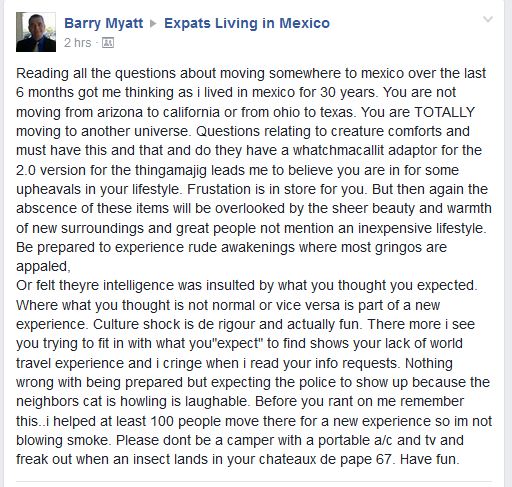
Occupational hazards…
WOW!
Mexfiles has been amused and bemused by former Chihuahua governor Patricio Martínez’ semi-quixotic (though perfectly logical) demand for the return of some lands to Mexico that appear to have been ceded to the United States through surveying error, but he’s not nearly as ambitious (or as quixotic, perhaps) as the grand old man of the left, 82-year old Cuauhtémoc Cárdenas Solózano.
Martinéz merely points out that an estimated 85,000 hectares (about 280 square miles) of Arizona and New Mexico, surveyed in the 19th century (under frontier conditions). The survey’s following the 1848 Treaty of Guadalupe-Hidalgo (which has had to be tweaked a few times because of changes in the Rio Grande/Rio Bravo river-bed) overlooked a 8,130 Ha. rectangle in the corner of New Mexico, which Martinéz holds more accurate surveys would show belong to Chihuahua. The surveys to determine the line of the Mesilla territory (sold to the United States in the Gadsden Purchase of 1855) he believes were purposely done incorrectly, to create a long triangular addition to the state of Arizona, totalling 75,636 Ha.
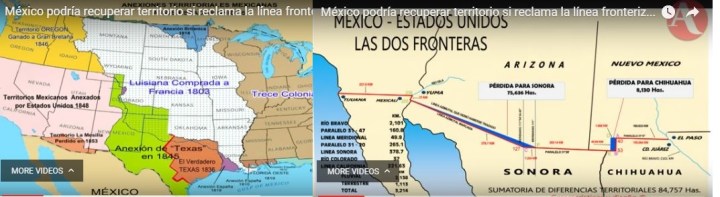
from: aristeguinoticias.com
Martinéz appears to be perfectly serious about his claims, and is actively seeking new surveys using the most advanced techniques to prove or disprove his claims. Amusingly enough, Donald Trump’s bids for a “great, great wall” presume that such surveying will become necessary, and quite possibly prove Martinéz right… vastly complicating any plans for the”Great Wall of Stupid”.
 How serious Cárdenas is, I can’t say, but he is the grand old man of gestures. Accompanied by his attorney, Cárdenas presented demands to abrogate the Treaty of Guadalupe-Hidalgo under which, according to the demand, was based on illegal actions by General Santa Anna and subsequently have never had the force of law. Returning California, Nevada, Utah, Arizona, large chunks of New Mexico, Colorado, and Wyoming to Mexico not exactly being likely, the demand proposes that the United States pay an indemnity based on 168 years of occupation, and lost income.
With interest, that’d add up to…. a zillion dollars?
To dream,, the impossible dream, to fight, the unbeatable foe….

Does money grow on trees?
The new General Law on Sustainable Forest Development, passed in the Chamber of Deputies on March 7, opens forests and “associated resources” to commerical development. The measure received the support of the center and right of center parties: the PRI and PAN majority, with support from the smaller New Alliance, Green, and Social Encounter parties.

Photo: Raul Miranda
The center-left to left parties, PRD, Citizens’ Movement and Morena objected, on the grounds that “associated resources” includes wild animals and plants, as well as water, which coexist in a forest ecosystem. Furthermore, with the legislation making “sustainable forest develoment” a priority area of economic development, it requires looking at forest ecosystems in terms of immediate value. From the opposition point of view, this opens the door to seeming forests as a source of profit, not as a ecological reserve for future generations.
Citizens’ Movement deputies also objected to wording in the bill that undoes a land use regulation passed only last year, that prohibits development of burned over forestsfor at least 20 years, meant to allow the damaged ecosystem to regenerate. Under the new bill, the Ministry of Environment and Natural Resources (SEMANAT) could simply could authorize fire-damaged forests as “regenerated” at any point, allowing for non-forest related commerical development .
 However, the majority claims the legislation will open the door to privately managed forest ecosystems, that provide a permanent income source and improve the living conditions of the owners and dependents. generating sufficient resources to meet social, industrial and export demands for forest products
The approved bill defines forestry related business to include all natural resources in a forest… presumably allowing for mining and other extractive industries, and allows for cultivation of forest species of commerical value on land set aside for agriculture.
The new law, which was sent to the Senate for discussion, grants state governments the authority to promote the participation of public, private and nongovernmental organizations in projects that directly support sustainable forest development.
Source: Regeneración, 10 March 2017
Sugar, sugar…
U.S. sugar consumption ranks third in the world behind India and the EU. The U.S. has the world’s third largest population of 274 million and the largest and most diverse food processing industry. Despite a trend toward greater self-sufficiency in sugar production, the U. S. remains one of the world’s largest net sugar importers – – only the Russian Federation and Japan are higher.
The North American Sugar Market: Recent trends and prospects beyong 200 (FAO, 1997)
 The single most important source for all that imported sugar? Why, Mexico of course: in January of this year, 110,000 metric tons of the stuff. By contrast, the second largest US foreign supplier, Brazil, exported 28,389 metric tons (USDA figures). With nearly all sugar destined for the food processing industry (although also used for producing alcohol, both for drinking and industrial use, pharamceuticals and some plastic substitutes), a sudden sugar shortage could effect food prices within a very short time.
Which is likely now to happen. Imported Mexican sugar is cheaper in the United States than domestic sugar, which was good for processors and consumers, but bad for US sugar growers. Growers complained that Mexico was subsidizing sugar exports (just as Mexico complains the US subsidizes corn exports) so…
The U.S. Commerce Department ruled in September [2015] that Mexico was subsidizing its sugar imports, allowing exporters to dump product into the U.S. at 40 percent below market prices. In order to avoid U.S. retaliatory tariffs, Mexico signed onto a “suspension agreement” that would limit Mexican shipments.
The agreement worked in the sense that overall Mexican sugar exports dropped, but it failed in another way. Mexico began exporting more sugar that could go straight to the U.S. market or to melt houses, bypassing U.S. refiners and cutting them out of the process and profits. Melt houses are able to take sugar that is not fully refined, liquefy it and then run it through a fairly basic processing to make it suitable for human consumption.
The results have been shrinking margins for U.S. refiners, according to sources who asked not to be named because of the sensitive nature of negotiations now being held between the U.S. and Mexico.
“It’s creating a problem for U.S. cane refiners that don’t get enough raw sugar,” one source said. “The consequences you can see in the market is that raw (sugar) prices have gone up dramatically because cane refiners are competing for relatively scarce raw cane supplies. And the refined price has been dropping sharply since (the U.S. market) has been inundated with Mexican sugar.” In other words, refiners are getting hit twice – first by a lack of available raw sugar to refine and then by lower refined sugar prices.
“The U.S. government regards that as a problem, so they’re looking at ways to make some modifications to the suspension agreement,” another source said.
In other words, despite the “suspension agreement” (meaning Mexico would limit sales in the United States) Mexican sugar was still cheaper than US sugar, and by refining the suger in Mexican before export, it cut into another US business. So, the suspension agreement was again modified.
To protect US sugar and refinery interests,the agreement “suspends” imports from Mexico if they exceed a 820,000 metric tons in a fiscal year. If Mexico goes over the quota, it has to cut exports by 40% and pay a high tariff that gives domestic sugar a market advantage. But given the demand for sugar in the United States, the quota for Fiscal Year 2016/17 has already been filled. So… rather than pay a tariff, Mexico is just holding back shipments. This being the harvest season for sugar in Mexico, and most sugar in the United States being beet sugar (harvested in the fall), the looming sugar shortage will leave the food and beverage industry, as well as other industries that depend on sugar, forced to compete for higher priced imports from non-NAFTA countries, or the small supply of US-grown cane sugar. Meaning higher prices for food and other commodities.
 All this could have been worked out, but in a rather neat way, Donald Trump is to blame. While his top cabinet post nominations have been controversial at best, focus on those nominations has meant overlooking the thousands of other presidential appointments that need to be made (or made by cabinet secretaries). Changes in the suspension agreement, or even working out a fine, would involve negotiations between the Mexican Secretería de Economia and the United States Department of Commerce officials. The Mexican officials are in place. Although there is a US Secretary of Commerce, no one is at home in the office the Mexicans need to talk to.
Sweet, huh?


 mexfiles.net