In 1727, perhaps because of a bad harvest that year, or perhaps because as minor Catholic nobility there was no future in their homeland, 22-year old Dermot O’Crowley and his wife, the former Mary O’Donnell of Ballymurphy. County Clare, made the decision to emigrate. Surprisingly perhaps to us now, the preferred destination for Irish emigres at the time was not the Americas, but Cadiz.
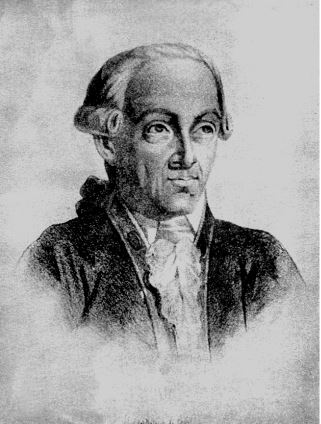 The Spanish port, with trade ties to the Mediterranean and to the Americas, was booming, and home to a thriving immigrant community. While the Spanish and British Empires generally turned away each other’s subjects, Irish Catholics were always welcome. Whether Dermot’s decision to emigrate to Cadiz was based more on the bad harvest of 1726, or on the general discrimination against Catholics (and restrictions on the business activities of Catholics), as Demetrio O’Crouley and María O’Donnell, the couple found Cadiz a congenial place to live and where they could establish a small trading company. However, as immigrants, they could not get a license to trade in the American colonies. With the birth of their son, Pedro Alonso, in 1740, they not only obtained a son and heir, but a son who could … as a “natural born Spaniard”.
Pedro took over the family business in 1765 (at the age of 15!), making his first voyage to New Spain in the same year. What exactly he did in Mexico isn’t quite known (a typically morose teenager, he merely recorded that he bought and sold “stuff”), made the usual travel route of Veracruz, Puebla, Mexico City, and returned to Cadiz… to sell “stuff”. Quite a bit of stuff apparently, as young Pedro was becoming known as an up and coming businessman, with American experience that might be useful.
And, he collected still more “stuff”… his hobby, or perhaps, obsession, being the cataloging of his various collections of miscellaneous items picked up in his travels, and in speculating on the sources of the collection.
Going into business with another young “anchor baby”, Felipe Smith, O’Crouley crossed the Atlantic several times over the next few years, traveling throughout New Spain… at least the “civilized” parts. More communicative than when he was a teenager, O’Crouley not only gathered up whatever he could sell back in Europe, but information on the sources and supply centers. Although his vendors were supplying gold, silver, hides, and crafts from “somewhere up north”, very little was known about the region. And… like any good businessman, O’Crouley was keen to cut out the middle-man if possible. He got his chance in 1774, when the merchant fleet he sailed with was accompanied by a scientific expedition, commanded by Antonio de Ulloa. Ulloa was interested in mapping the ports and bays along the Pacific, and O’Crouley wanted to know what was inland… where that gold and silver and “stuff” was coming from.
Although there was quite a bit of literature available on northwest Mexico, O’Crouley realized what he read might not reflect present realities. Most of what was in print was written by the Jesuits, who had been expelled from Spanish territory in 1754, meaning not only was the information 20 years out of date, but that it had been written while the Jesuits were the main source of administration in the region. After 1754, administration had become ad hoc… military officers ran administrative posts, but forced to leave isolated communities (as most were in the area) to their own devices. Whether the Jesuit mission posts were still operating (supposedly they were, or there were at least towns on the map that every once in a while an Army patrol might wander through) and somebody was mining the gold, there wasn’t a lot to go on. So… with no particular training as an anthropologist, a map maker, or … much of anything other than being interested in stuff, and the source of stuff, O’Crouley set out to map and record the resources and peoples of what is now Sinaloa, Sonora, Chihuahua, Durango, New Mexico, Texas, and Arizona.
Although he didn’t stop in every hamlet and town, he made a point of visiting every Bishop’s seat and Presidio (military fort), administrative center, mine and port to gather whatever statistics were available on populations and communities. What pre-conquest history was available he included, as well as observations of the daily lives of the regions inhabitants, both indigenous and colonial. His drawings of wildlife and people, together with the information on mining activities, geography, geology, history, anthropology, zoology, botany, mineralogy in the region was shared out with the “men of science” of his day.
O’Crouley’s final account,Ydea Compendiosa del Reyno deNueva España en que se comprehunden las Ciudades y Puertos principales, Cabezeras de Jurisdicción, su latitud, Rumbo y distancia a la capital México. Señalanse los principales Prsidios y Guarniciones: con cicunstanciada Descripció de las partes mas remotas y meos conocidas; Arzobispos y Virreys que ha tenido, con varias particularidades de los Indios, anitugos y moernos, de su Conquista, Curiosidades, e historia natural had a title designed to scare off all but the most dedicated wonk… but the late 18th century was an era of great wonks. Although never published in full, the Ydea Compendiosa, etc. found its dedicated audience.
The all-round scientist José Antonio Alzate y Ramirez (a sort of Mexican Ben Franklin, he published the first general interest magazine in the new world, discovered the chemistry behind magic mushrooms, and invented the ball-cock, which later was used to create flush toilets, among many other things) used O’Crouley’s notes and maps to create the first detailed maps of the region; Alexander von Humboldt — who never visited the area during his epic travels — would trust O’Crouley’s writings enough to feel comfortable using them to make his own estimates on mining potential in the region, and to guess at the population and ethnic composition of the area; and, port towns like Mazatlán (described by O’Crouley as a run down place with a few adobe shacks) which he noted were closer to mining camps were developed largely because O’Crouley recognized the commercial value of ports close to mining regions. For the next 75 years, under the crown, and then during the independence era, O’Crouley’s work would influence government policy in the region.
Considering how much of O’Crouley’s travels and work were in places now part of the United States, it’s more surprising the work was never translated into English until 1972 (with a thankfully much shorter title: “A Description of the Kingdom of New Spain”), but by an Irishman, Seán Galvin.
Galvin says of his O’Crouley, he was … “one of the many Irishmen who, either themselves or their forebears, had left Ireland to escape the dominance of an English rule… [but] had little difficulty in procuring employment for as fighters they were without equal…”
O’Crouley’s fight was against the unknown, and against the temptation to ignore the small details, to overlook the seemingly unimportant. And Ireland itself is the land of saints and scholars. A scholar… and a great one… definitely. Perhaps a saint of scholars?
Nothing to see here?
Nothing particularly new here (and MexFiles doesn’t take sides in U.S. elections… though the writer does), but there is a reason the U.S. presidential candidates worry us, one in particular.
Jesse Franzblau, writing in Foreign Policy in Focus, recapitulates the sorry story of “Hillary Clinto’s Dark Drug War Legacy in Mexico“.
Since 2008 […] over $2.5 billion [has been] appropriated in security aid through the Mérida Initiative, a drug war security assistance program funded by Washington…. [T]he plan was originally proposed as a three-year program. Yet Hillary Clinton’s State Department pushed aggressively to extend it, overseeing a drastic increase of the initiative that continues today.
Much of this aid goes to U.S.-based security, information, and technology contracting firms, who make millions peddling everything from helicopter training to communications equipment to night-vision goggles, surveillance aircrafts, and satellites.
This aid comes in addition to the direct sales of arms and other equipment to Mexico authorized by the State Department, as Christy Thorton pointed out in a 2014 New York Times op-ed. Those sales reached $1.2 billion in 2012 alone, the last full year of Clinton’s tenure. Indeed, as the Mérida Initiative has grown, Mexico has become one of the world’s biggest purchasers of U.S. military arms and equipment.
But while sales have boomed for U.S.-based contractors, the situation in Mexico has badly deteriorated. The escalation of U.S. counter-drug assistance in the country has paralleled a drastic increase in violence, fueling a drug war that’s killed more than 100,000 people since 2006.
[…]
Naturally, Clinton herself was aware of how her department’s support for the Mexican drug war would look in light of the revelations about corruption and human rights abuses.
In January 2011, shortly after the release of a huge tranche of leaked diplomatic cables, Secretary Clinton apologized to her Mexican counterpart Patricia Espinosa for any “embarrassment” caused by the WikiLeaks documents, announcing her intention to get “beyond WikiLeaks” and reaffirm the U.S.-Mexico relationship. Clinton expressed optimism that they could create a better “narrative” than the waste, fraud, and abuse revealed in the cables and regular media accounts and “explain to Congress why foreign assistance money under ‘Beyond Merida’ should continue.”
[…]
Clinton’s defense of the status quo in Mexico is “grounded in a vicious cycle of complicities between economic and political elites on both sides of the border.” Indeed, the record available for public scrutiny shows that Clinton’s State Department — rather than addressing human rights concerns over the Mérida funding — focused on ensuring that security assistance continued in the face of abuse, cover-ups, and ongoing impunity.
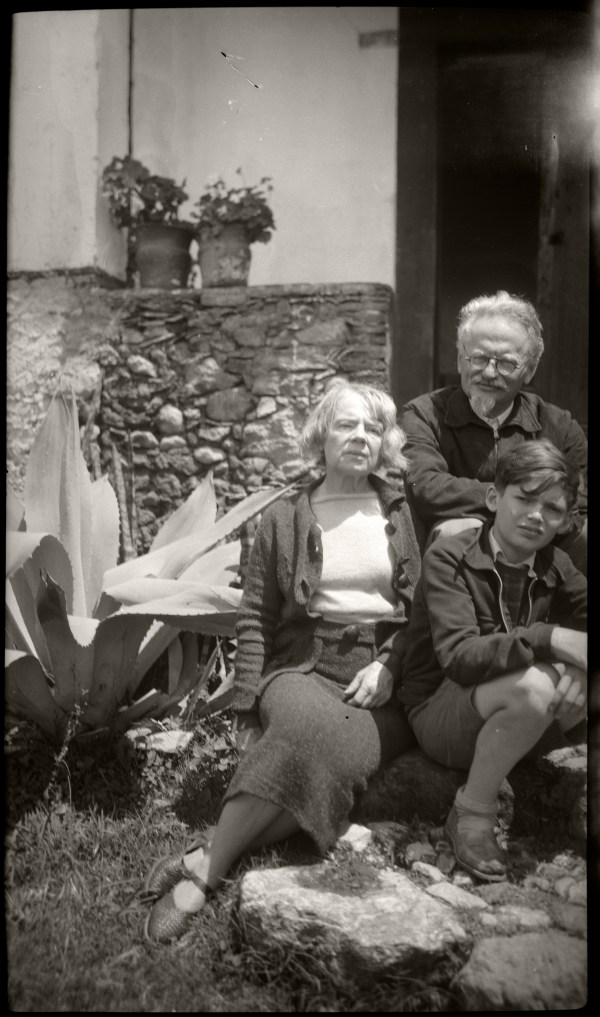
Tourists, 1939
From a collection by Gilles Walusinski, published on the French language site “délibéré, prologue” of an ex-pat’s family outing to Taxco in 1939.
While I work on a longer post

Rubén Darío, died 6 February 1916
Something I never knew about Darío was that he was “dissed” by Don Porfirio when he arrived as part of the Nicaraguan delegation sent to the centennial celebrations. Ostensibly, the reason was the Nicaraguan government had changed … “thanks” to a U.S. intervention (one of a continuing series up until the Sandanista Revolution). In reality, it seems that while the Díaz regime was playing off one great power against another, it had no intention of giving even a whiff of approval to anti-U.S. sentiment. Ironically, given Dario’s popularity — not just among intellectuals, but among the people themselves — convinced Porfirio to offer the Nicaraguan poet a sinecure with the Mexican Department of Education: as long as he worked in Europe, and away from the Americas.
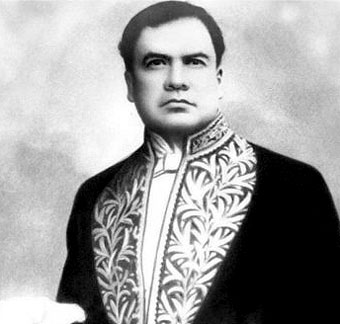 Maybe this is what bothered Don Porfirio:
To Roosevelt
(translated by Bonnie Frederick):
It is with the voice of the Bible, or the verse of Walt Whitman,
that I should come to you, Hunter,
primitive and modern, simple and complicated,
with something of Washington and more of Nimrod.
You are the United States,
you are the future invader
of the naive America that has Indian blood,
that still prays to Jesus Christ and still speaks Spanish.
You are the proud and strong exemplar of your race;
you are cultured, you are skillful; you oppose Tolstoy.
And breaking horses, or murdering tigers,
you are an Alexander-Nebuchadnezzar.
(You are a professor of Energy
as today’s madmen say.)
You think that life is fire,
that progress is eruption,
that wherever you shoot
you hit the future.
No.
The United States is potent and great.
When you shake there is a deep tremblor
that passes through the enormous vertebrae of the Andes.
If you clamor, it is heard like the roaring of a lion.
Hugo already said it to Grant: The stars are yours.
(The Argentine sun, ascending, barely shines,
and the Chilean star rises…) You are rich.
You join the cult of Hercules to the cult of Mammon,
and illuminating the road of easy conquest,
Liberty raises its torch in New York.
But our America, that has had poets
since the ancient times of Netzahualcoyotl,
that has walked in the footprints of great Bacchus
who learned Pan’s alphabet at once;
that consulted the stars, that knew Atlantis
whose resounding name comes to us from Plato,
that since the remote times of its life
has lived on light, on fire, on perfume, on love,
America of the great Montezuma, of the Inca,
the fragrant America of Christopher Columbus,
Catholic America, Spanish America,
the America in which noble Cuahtemoc said:
“I’m not in a bed of roses”; that America
that trembles in hurricanes and lives on love,
it lives, you men of Saxon eyes and barbarous soul.
And it dreams. And it loves, and it vibrates, and it is the daughter of the Sun.
Be careful. Viva Spanish America!
There are a thousand cubs loosed from the Spanish lion.
Roosevelt, one would have to be, through God himself,
the-fearful Rifleman and strong Hunter,
to manage to grab us in your iron claws.
And, although you count on everything, you lack one thing: God!
Some things to consider (re: “All Things Considered”)
I have had several computer “challenges” over the last two weeks, and this is on a different machine, with its own quirks and some unfamiliar software. Apologies in advance for the typos I know infest the piece. I can’t figure out all the editing functions yet, and some just don’t work like I think they should.
“All Things Considered”, the popular news program from U.S. National Public Radio recently interviewed Luis Ortíz Perez … about whom I know only that he worked mostly with U.S. media (and both the CBC and BBC) before becoming the CEO of an “organization dedicated to producing digital solution for socially responsable projects”. The subect was the announcement that Afro-Mexicans will be enumerated as a separate class (as Indigenous people were in the 2010 census) in the 2020 census. This seemed remarkable to the U.S. broadcaster, Ortìz noting that “The last time people of African descent were counted was in the 19th century. The Mexican federal government is arriving late to the party. ”
Two observations. “Race” itself was a northern European obsession, not one shared by Latin America. While it is true that under the French-influenced Bourbon dynasty, the Spanish colonial system had a complex racial classification system (Peninsular, Criollo, Mestizo, Mulatto, Zambo, Pardo, Lobo, etc.), our political heritage is largely anti-racial. The father of our country, José-María Morelos y Pavon, ridiculed the whole notion of “racial” designations, speaking to the Chilpancingo Convention (which wrote the first Constitution that designed all men, regardless of race, as equal) he said:
“We should do away with the picturesque jargon of black, mulatto, mestizo… and etc., and instead view ourselves geographically, calling ourselves Americans for where we are from, as do the English, and the French and that other Europ“We should do away with the picturesque jargon of black, mulatto, mestizo… and etc., and instead view ourselves geographically, calling ourselves Americans for where we are from, as do the English, and the French and that other European country that is oppressing us, and the Asian in Asia and the African in his part of the world.”
The Mexican census never included a category for “Afro-Mexico” after Independence (i.e. in the early 19th century) for the simple reason, it never mattered. With two our our early presidents (Vicente Guerrero and Juan Alvarez) being either Afro-Mexican or “mulatto” depending on how you look at it, and any number of our major figures (including Lazaro Cardenas and Diego Rivera) thinking nothing of including sub-Saharan Africans in their blood-line, it was interesting to have some Afro-Latino ancestry, but only in that it put one squarely in what 20th century Mexican philospher José Vasconcellos defined as “la raza cósmica”… the “race” of all races (White, red, black, yellow, according the early 20th century categorization).
Ortíz is right in pointing out that there were three (and maybe four) “waves” of African migration to Mexico. The first, hardly voluntary, was the slave trade of the late 16th to early 19th centuries. However, slavery was abolished at Independence, and was never as economically intergral to Mexican agricultura as it was in the United States. Given that the child of a Mexican slave and a free person was not a slave by birth, even during slave days, Africans were assimilating, marrying free women, or — following emancipation — tended to live in the general community and were not segregated as in the English-speaking world.
A second wave (overlooked by Ortíz) was in the 19th and early 20th centuries. Slaves from the United States self-emanipated not only by heading for Canada, but heading here as well. With the imposition of “Jim Crow Laws” in the U.S., and the on-going problems with segregation and prejudice in the United States, led African-Americans to move to Mexico up into the 1950s and 60s.
Ortíz considers the migration of small numbers of Africans in the latter period to be related to decolonization in Africa (true in part), but more Afro-Mexicans who trace their ancestry in this country to those years were from West Indian or South American families. And, of course, Africans are still migrating, either for political or economic reasons, along with West Indians (especially Cubans) and Central Americans of African descent.
While Ortíz sees Mexico “catching up” with the global north in recognizing “race”, I tend to see his remark as simply another example of those who insist we are “backwards” for not sharing the same obsessions as our northern neighbors. Don´t get me wrong… there isn’t anything sinister in identifying Afro-Mexicans, and in collecting data that permits the state to target certain areas for special consideration. But I think he misses the rationale, and the importance of what is being proposed.
The only questions on the 2010 census at all related to ethnicity had to do with identifying Indigenous Mexicans. Defined as those who had a cultural tie to a community dating back before the Conquest (1524), the census also asked those who were self-identified as Indigenous what language their parents spoke. Most questions on the census (other the standard ones about age, place of birth, number of persons in the household) had to do with living standards: what kind of floor the house had, what appliances we owned, educational level, etc.). But put those two together, and there is excellent data for arguing that indigneous community have a lower standard of living, and it identified those communities that required special services …. either minority language education, or housing assistance … due a long-neglected and abused community.
There are Afro-Mexican communities that share certain characteristics of indigenous communities, although they do not have an identity going back to before 1524, Some, like the well-known Afro-Mexicans of Guerrero — descendants of freed or escaped slaves who settled in isolated communities — simply were cut off from the Mexican mainstream. Others, like the “Black Seminoles” of Chihuahua, migrated en masse from elsewhere, but — like the Mennonites and Mormons — came with a communal identity based on things other than those recognized by our Constitution.
I suppose there is some value in knowing how much of the Mexican population considers itself of African descent… given that we’ve learned that medications tested only on those of north European descent don’t always work the same way on those of other ethnic heritages, but I don’t see that Mexico is so much “arriving late” to the concerns of the global north as it is a case that so much of what is newsworthy to our richer neighbors is that we sometimes do things the way they do… whether needed or not.
Jalisco: let us not admit impediments
Love is not love, which alters where it alteration finds… except in the 26 states where same-sex marriages … while legal… still require one to obtain an amparo from the federal courts. Although the Supreme Court definitively ruled that same-sex marriages are a constitutional right, and the court can (and did) order the states to change their marriage laws to meet constitutional standards, it has only limited power to force them to do so. And, for historical reasons, “state’s rights” in constitutional matters are difficult to overcome. While the ruling is binding on all federal courts, and the Supreme Court can tell the states to change their marriage laws, it can’t force them to do so. UNLESS… there are at least five rulings by federal courts within the state finding the law unconstitutional.
While in a few states, the legislatures have simply accepted that they need to change their marriage laws, the rest — to avoid the hassle, or to give cover to politicians scared to death to actually take a not-particularly controversial stand — are trying to shift the burden for making changes to the federal courts. Federal courts will automatically follow the Supreme Court’s ruling, and grant an “amparo” (injunction) for same-sex couples to marry. So, in theory, a same-sex couple can marry anywhere in Mexico… provided they can invest the time, money, and energy into filing for an amparo. Although there are any number of organizations and individuals working to bring same sex marriage cases to the federal courts, it’s a slow process.
But in Jalisco, the process has been short-circuited. While Puerto Vallarta may be a “gay mecca” and Guadalajara might show a modernist facade, the state was the heartland of the Cristero movement and has been notoriously reactionary. When the Federal District opened marriage to same-sex couples, Jalisco’s legislature was quick to pass a “one man-one woman” marriage law… too quick, it turns out.
Having overlooked the age at which one can marry, the state legislature had to revisit their marriage law and tweak it. Little noticed, and uncontroversial in itself, the change did open a window of opportunity for lawyers to question the constitutionality of what was in effect a new marriage law passed after the Supreme Court’s ruling. And for the Supreme Court to make Jalisco the sixth state (including the Federal District, which is becoming a state) to those places in Mexico that joined the 21st century.
Is Spanglish a lengua?
Sí, according to Ilan Stavans:
What was left unsaid
I’m not particularly bothered by the complaint among “professional journalists” that the video-interview with Chapo was from prepared questions: that’s not all that unusual when the subject won’t speak to the media in any other way. Nor am I all that bent out of shape by Chapo’s insistence on reviewing the story. Although unusual, Penn’s story was more about Penn than Chapo and the video-interview was what mattered… a “letter to the world” from an important and new-worthy source.
What does bother me is that the heart of the interview was not released. It’s nice to know what Chapo thinks of his mom, but left out was this part (my translation):
I am not the problem. Even if they kill me, if I cease to exist, there will have no effect on drug trafficking. I already have a replacement who will follow mean in the trade. I am not the problem: the problem is the United States clamoring for the goods. Provided there is demand, there will be people who want to be in business: you are the problem.
I did not cause problems, I only defended myself. The problem is the government that you have given all the power, the government taking their cut and pretending to know nothing, then comes searching for me. The problem is lack of work and penury, while they hoard their money. Where I come from, there was no other way to survive, no other way. Government is the problem, and those that believe in the government are the problem, not me.
The thrill that’ll get ‘cha, when you get your picture…
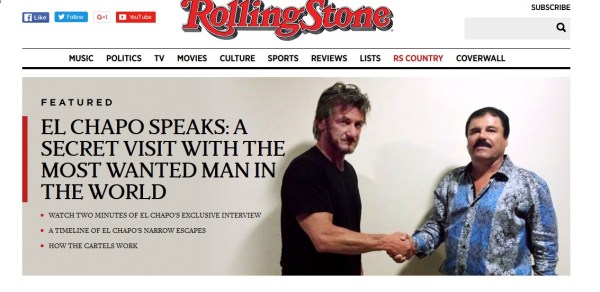
Naturally, everyone is interested in Chapo… less so in Sean Penn (who cares about his farts?), and the article in Rolling Stone seems more about Mr. Penn than about Chapo… but still, it is an important piece and attention must be paid. Although badly edited (or not edited at all) and chock full of irrelevant details (about Mr. Penn, his flatulance, his ramblings on his penis, his claims not to know how to use a computer — while at the same time using technical acronyms like BMM) and an overuse of the first person singular, there is value in what Gawker calls “A presumably edited, rambling 11,000-word account of a madman’s meeting with a criminal. ”
The squawk about “journalistic ethics” of giving the subject control over the interview (“obviously, unambiguously indefensible to give the subject of an interview/article final say over its publication” said Chris Hayes of MSNBC) seems overblown — one having to ask how else such an interview, by an actor (not a journalist) would be conducted elsewise. I am more concerned by the possible role (intentional or otherwise) Mr. Penn and The Rolling Stone played in what may have been a bloodbath in rural Badiraguato.
I know real journalist who say they’d kill for a good story, but in this instance, an amateur journalist may have gotten a lot of other people killed. As Penn (or the RS editors) note, following the interview:
There were additional reports that 13 Sinaloa communities had been ravaged with gunfire during simultaneous raids. La Comision Nacional de los Derechos Humanos (the National Commission for Human Rights) struggled to enter the area but were prohibited. Villagers protested their treatment by the military. By the time news agencies broadcast the story in the United States, the mayhem throughout Sinaloa in those days had been essentially reduced to a nearly successful raid that had surgically targeted only Chapo and his men, and claimed he had been injured in flight with face and leg wounds.
The late, legendary, Mexican journalist Julio Scherer García, famed for his saying “If I could interview the Devil, I’d go to Hell” managed a more in-depth, enlightening interview in 2010 when the then octogenarian Scherer met with “El Mayo” Zambada. Scherer, like Penn, told of the security measures he needed to interview the “irregular agricultural export trader”, but the focus of the story was on the so-called “cartel” leader, and on the business itself and not on the details of obtaining the interview.
Naturally, outside Mexico, Scherer’s coup was practically ignored: which is what gives the shallow Rolling Stone “interview” its oversize importance. Although there are plenty of narcotics/human trafficking/gunrunning organizations around, when U.S. law enforcement agencies (followed by the media) started dubbing them “cartels” (and… in an absurd attempt to make them seem more a military than police issue… “TCOs” [Transnational Criminal Organizations]), there had to be a “Mr. Big”… and Chapo fit the bill, becoming the poster boy for those who want a villain to blame for social ills. Buried in Sean Penn’s Excellent Adventures there is at least the recognition that Chapo is less a super-villain, than just a hillbilly made good. That Joaquín Guzmán Loera is even in the “drug” trade has more to do with abject poverty in the Mexican countryside than anything else; that if people buy “drugs” they are going to be sold; that foreign corporations (unnamed, supposedly by Chapo’s own preference) are eagerly profiting from the “investments” created by the trade; and that Chapo himself is rather unimportant in the scheme of things when it comes to these sort of enterprises.


 mexfiles.net