MUST READ for today…
In Mexico, however, Plan Mérida has been blamed for worsening the country’s security situation. Over 43,000 people died by homicide during Peña Nieto’s first two years in charge, compared with 14,000 during Calderón’s first two years. Disappearances have doubled from six per day under Calderón to 13 per day under Peña Nieto, according to the government’s Register on Missing Persons.
Irish reporter Tim MacGabhann for TelesurTV.net
Dorothy Day in Mexico
Dorothy Day, like her British contemporary Graham Greene, was both a recent convert to Catholicism, and a journalist in 1930. Although the two never met, both were in Mexico writing about the on-going anti-clericalism that followed the official end of the Cristiada (the “Cristero War” of 1926-29), following unhappy experiences writing for Hollywood (Greene was being sued for something he’d written about Shirley Temple; Day had been fired after three months on the job).
For Greene, Mexican anti-clericalism provided a metaphor for his subsequent literary works — the tragedy of following one’s individual morals in an immoral or amoral world. Dorothy Day, living with her daughter among poor Mexicans, while writing for the U.S. Catholic magazine, Commonweal, learned not about the individual, but about the community. Here was a support network of the poor, that to her gave dignity and provided mutual assistance — both practical and spiritual — outside the clergy, but within the arms of her Church. She also witnessed a Catholic community that engaged the state (often with hostility) to demand not just religious, but social rights.
When her daughter became ill, Day returned to the United States. Although the hierarchy in the United States had long supported the labor movement and was active in relief efforts, the Church had largely held itself aloof from involvement in protests for social justice. Day’s experiences in Mexico may have influenced her “radical” decision in 1932, when she joined the hunger strikes in Washington (protesting the inadequate relief for the poor during the depth of the Great Depression) seeing assistance not as “Communist” (as the hierarchy would have it), but as a work of Mercy… an “act of virtue” with the Catholic faith. Feeling the need to do still more led to her founding the Catholic Workers’ Movement … based at least in part on her own experiences in Mexico.

Day, daughter Tamar, and unidentified woman, Mexico, 1930
Eamon Bulfin: The Ché Guevara of Ireland
Irish, and Irish-Latinos have made their mark in Latin American history as freedom fighters for centuries. Guilermo Lombardo … born William Lamport… was the first to call for New Spain’s independence (and was one of the sources for the fictional hero, Zorro); the San Patricios’ doomed fight to save Mexico from the United States are still celebrated here; and further south, we find Bernardo O’Higgins, the founding father of Chile, and — in Argentina — Ernesto Guevara Lynch made something of a name for himself in the last century (and, looked good on tee-shirts). But, like his fellow Argentinian, Eamon Bulfin, Guevara’s battles were mostly separate from his Irishness. Bulfin took his battles to the Old Sod.

Bulfin, 1916… a terrible beauty is born, though he never got his face on a tee-shirt.
Born (1892) in Buenos Aires, Bulfin arrived in Ireland in 1914… just as the First World War had broken out, which challenged British control of their Empire, and gave the Irish the impetus (that… and the Mexican Revolution) to break free of their colonial masters. Bulfin though a teenager, was a key member of Padrick Pearce’s underground Irish Volunteers, that led the 1916 Easter Uprising… the opening act of the Irish War of Independence.
It was Bulfin who first raised the Irish tricolor in Dublin, signaling the Republic’s birth. For his trouble, the British sentenced him to death, but … like U.S. born Eamon de Valera (the long time president of the Republic)… his foreign nationality saved him from the hangman. Deported back to Argentina, Bulfin was imprisoned for draft evasion (more of less a bogus charge, but done as a favor to the British, who’d control the Argentine economy up through the Peronista era). Upon his release in 1919, he was given the post of Ireland’s consul to Argentina, returning to the land of his fathers in 1922.
More at The Irish Times about the Argentine-Irish and Ireland’s War of Independence.
The greatest Mexican super-hero: The Flea
In almost any Mexican city, you can have your photo taken with Spiderman or The Hulk, or any number of comic book heroes, but in Cuatla, Morelos, keep your eye out for a skinny octogenarian, Marcos Efrén Zarñara. Don Marcos — better known as “El Pulga” (The Flea) — unlike Clark Kent, or Bruce Wayne, was never aware of his superpowers until he was well into middle age. On the 17th of September 1985, he was operating his sandwich stand across from a high school on Calle Humboldt in central Mexico City when… at 7:17 in the morning… as students had just begun their day… the school (and much of the neighborhood) collapsed around him.
Abel Torres Chávez, who was buried for three days until The Flea could reach him, despite hearing other students die around him (and being trapped under a corpse) kept himself going by thinking of one thing… when he got out, the first thing he was going to do was buy a sandwich from that skinny little guy. THe skinny little guy was the first person to reach Torres, of course.
Over the next two weeks, Don Marcos rescued 27 people in all, just in Mexico City. In the subsequent years, he would turn from Don Marcos the Torta man into The Flea, sometimes just taking the Metro to the airport — without a ticket (or even his passport) and … because he is a superhero — getting where he was needed. When earthquakes struck in Oaxaca, Puebla, San Francisco, Los Angeles, Turkey; when tornados ripped through Oklahoma; when mudslides hit San Salvador, people don’t wait around for Batman or Superman … they call on the real superheroes. Guys like The Flea.
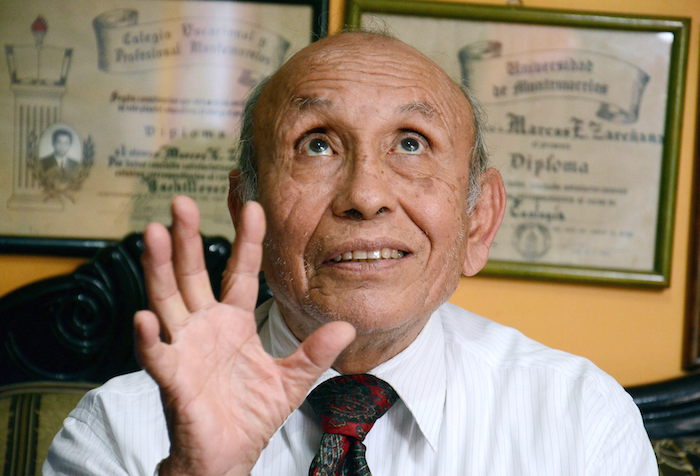
Photo: EFE/Octavio Vidal
Mexicanos al grito de ¡FUERO!
I can’t recall any president in modern times facing as much public disdain as Enrique Peña Nieto. Días Ordaz was openly villified by protesters, but that was during protests against the government, not during the well-established traditional grito, when one celebrates the nation and national unity, not its deep divisions. I’d like to think this shows that the public are less inhibited by custom and tradition in expressing democratic sentiment, but what I think more likely is just that EPN is despised by a growing segment of the public (especially by the residents of Mexico City).
Short version: “Whoopie, oh boy, we’re all gonna die!”
Un grito anti-guerra
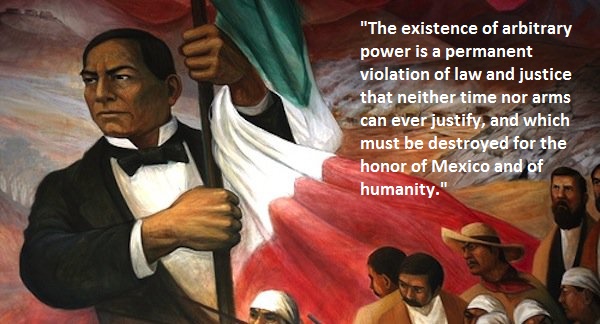
Why many are ignoring the grito tonight…
Mexican labor unions and workers are, overall, in the worst situation in decades. President Peña Nieto and the PRI, along with their allies in the equally conservative National Action Party (PAN), have succeeded in passing a series of so-called reforms—education, labor, energy, and communications—that will have devastating effects on an already weakened labor movement. And so far there seems to be no labor or broader social movement capable of resisting, stopping, and overturning these reforms.
The Agony of Mexican Labor (Dan La Botz, Dollars and Sense, Septermber-October 2015)
We’ve got the power… only if
This is amazing in a way. Morena… the left-ier of the two main left wing parties… didn’t even exist until this last election but will be the largest party in the Mexico City Assembly. With PRD (the old lefty party) Assembly member Aleida Alavez defecting to Morena, the new party now has 20 of the 66 seats, while the PRD — which used to count on up to 43 seats (a 2/3rds majority minus 1)* only has 15 seats. Even with PRD’s alliance with three small parties (two of which have lost their registration after their poor showing in the July elections) which only are entitled to one seat each, the formerly dominant party will only be the second place party.
If, as I expect, Morena allies with two other new parties — both heirs to movements that normally allied with the left wing of the PRD in the past — Social Encounter (4 seats) and Citizens Movement (3 seats) … the AMLOista faction will control 40 percent of the Assembly. While Morena is questioning the legality (and ethics) of a PRD coalition with the minor parties (the Humanista Party… holding one seat… is a ideological mystery, more Fascist than leftist), one can expect the fractious left to to control over 2/3rds of the Assembly seats.
The Morena left-wing populist control might be further solidified later this week, as more assembly members are expected to defect from PRD, and votes are recounted in one Gustavo Madero Delegacion, where there was less than a one percent difference between the PRD victor and the Morena challenger. As of today, PRD controls six of the sixteen delegaciones (but several of those only in coalition with smaller parties) and Morena five. Should the recount work on to Morena’s advantage, there is no way anyone can claim the upstart AMLOista party is not the third force in Mexican politics
Wiith a general left-ward tilt in world politics, and even New Dealers making a comeback in the United States (Bernie Sanders), IF PRESENT TRENDS CONTINUE (maybe… maybe not), the two traditional parties (and a good part of the third-place PRD) sees their mission between now and July 2018 to be to discredit, destroy or marginalize Morena’s leader, Andres Manuel López Óbrador.
SOURCES:
SDP NOTICIAS: Ordena TEPJF recuento total de votos en elección a jefe delegacional de GAM
ANIMAL POLITICO: ALDF: Morena deja de ser mayoría; PRD, PT, Nueva Alianza y el Humanista forman alianza
REGENERACION: Diputada Aleida Alavez se une a Morena, que es mayoría en ALDF
EL UNIVERSAL: Morena: la coalición con PRD es un “agandalle”
* The Federal District Assembly, by law, cannot have more than a two-thirds majority from any one party. With the mixed “first through the post” and proportional representation system used in Mexican legislative elections, if one party has a super-majority, it loses some proportional representation seats which are assigned to another party. The only time I recall this happening, the PRD lost a seat to a representative from a minor party that lost its national registration, but had managed to win enough votes in one delegacion within the Federal District to qualify for a seat.
The young and the restless
On thing that has always amazed me is how young some of the officers were in the Mexican Revolution. And how few lived to reach even middle age. Here is an overview of Pancho Villa’s generals. Very few lived into the 1930s.
Born to be … creative
With bicycles being pushed here in Mexico City as one part of the solution to gridlock (with my bike, I can get through rush hour traffic in 20 minutes the distance it would take an hour by car or bus… and I’m not one of those daredevil guys who cuts through traffic, runs lights and takes to the sidwalk… not always anyway), people are finding all kinds of creative ways of using their bikes to free up their time and get around the inconveniences of our modern conveniences… even in rural Guatemala.
Franc Contreras from Al Jazeera TV:
Mexico at its best
MEXICO CITY – The full Senate unanimously approved the motion to request that the federal government open its borders to greatest possible number of Syrian refugees who are fleeing the humanitarian crisis taking place in the middle eastern country.
The senators asked the Foreign Relations Secretariat to call on the United Nations Organization to convene an urgent and special session so that all member countries contribute to solutions to the migration crisis that Europe is suffering.
The Board of Directors of the Senate Secretary Martha Palafox Gutiérrez, Labor Party senator, read the petition that the senate sent to President Enrique Peña Nieto’s government so that the Mexican borders would be opened to give asylum to the Syrian refugees.
This is very much in the tradition of Mexican diplomacy and foreign policy. While even during the Porfiriate “unwanted” foreigners were welcome in Mexico (African-Americans displaced by Jim Crow, the Chinese after the US Chinese Exclusion Act of 1883, etc.) post-revolutionary Mexico made offers of political refuge an integral part of foreign policy. Calles, despite his approval of Hitler’s economic development plans in Germany, made sure he was quoted in the German press as saying ANY PERSON (regardless of ethnicity or religion) was welcome to emigrate to Mexico if they needed to. Cardenas famously offered refuge to the Spanish Republicans (and Leon Trotsky, along with both White Russians and Bolsheveks); Mexican diplomats in the late 30s up until Mexico’s entry in the war (and even after where they could) gave Mexican visas to anyone needing to get out of Europe (more European Jews were given asylum in Mexico than in the rest of the Allied countries combined); and we accepted both US dissidents (Communists in the 50s, draft evaders in the 60s) and South Americans in the post-war era. Other than the Central Americans (and that as much due to US pressure on the recent pro-US administrations here), this is very much the tradition.


 mexfiles.net