
Not only are Mexico City taxis hot pink and white, now at least some of them are electric…
The first twenty electric Nissans go into service today.
Although the rates are the same as other taxis, there is another difference, these taxis part of the district’s “Servicio de Transporte Eléctricos” which also operates the trolley system, so the electric taxis will only be running the same hours as the trolleys: 5:30 AM to 11:30 PM.
Taxistas, Unite…
From our friends at Frontera NorteSur, the on-line, U.S.-Mexico border news service from the Center for Latin American and Border Studies at the University of New Mexico (Las Cruces).
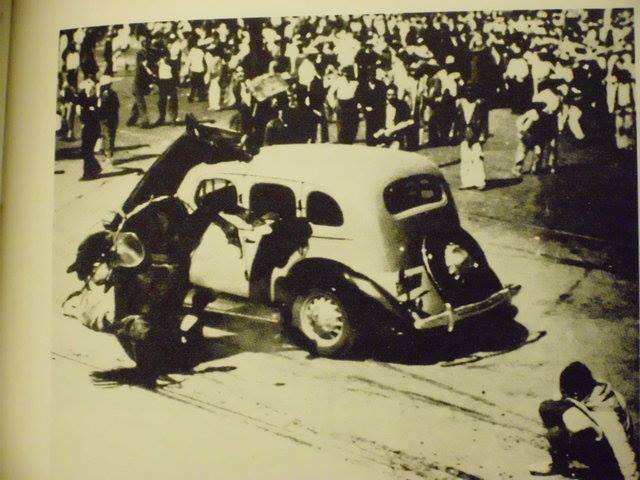
Mexico City cabbies vs. wannabe Übermensch, 1938.
Protests against Uber and other “ride-sharing” companies are spreading across Latin America and Europe. In Mexico, an active group called Mexico City Organized Taxi Drivers (TOCDMX) is intensifying a movement against the capital city government’s plans to regulate Uber and Cabify and allow the companies to legally operate.
Turning up the pressure in its demands, the TOCDMX has announced plans for a July 29 city-wide work stoppage. On the same day, while Mexico City cabbies halt work, colleagues in Spain plan to demonstrate in solidarity outside Mexican diplomatic offices in Madrid and Barcelona.
Jose Miguel Funes, representative of the Madrid Elite Taxi Association, said the protests will be part of an emerging global movement against Uber and similar firms.
“Those transnational enterprises are dangerous and together in this war,” Funes was quoted. “That’s why taxi
drivers from Colombia, Brazil, France, Spain, and Mexico are joining forces to impede their entry into the sector.”
Taxi drivers in France last month blockaded roads, choked traffic and disrupted transportation centers in a militant protest against UberPop that turned violent in some places.
The growing world-wide conflict pits Uber and other “ride-sharing” companies, which electronically link drivers and passengers for supposedly lower prices, against traditional cabbies and their employers who regard the newcomers as an unfair competition that doesn’t pay taxes and permits, sufficiently screen and train drivers, and protect passengers.
In addition to the streets, the dispute between Uber and the established taxi business is now a hot issue in the courts of Spain and other countries.
Baja: All-Exclusive
Exclusive of the rights of the citizens, their way of life, their environment, and common sense:
Sombrero tip to Scott Parks.
Eisenstein’s Mexico
Better quality than the Italian television version, still not “right”… these videos are from Russian film archives. ¡Qué viva México!
The Atlanta Cartel… worst of the bunch
It’s not “coke” that’s getting Mexican killed. It’s Coke ®
Via
Sugar-sweetened beverages such as Coca-Cola, Gatorade and homemade drinks known as “agua fresca” kill far more people every year in Mexico than criminal gangs.
A study by the Friedman School of Nutrition Science and Policy at Tufts University estimates a staggering 24,000 Mexicans die each year from diabetes, cancer and heart disease that are linked to sugary drinks.

Compare that figure to the roughly 15,649 murders officially recorded in 2014 and it’s clear which is the biggest killer in the Latin American country.
Worldwide, the total sugary-drink death toll is estimated at 184,000, with more than 70% of deaths caused by diabetes. The researchers said this was the first detailed global report on the impact of sugar-sweetened beverages.
Out of the 20 most populous countries studied, Mexico’s death rate from sugary drinks was the highest by a long way, with an estimated 405 deaths per million adults.
Words can kill
On 11 June 2014, Teniente de Infantería (Infantry Lieutenant) Ezequiel Rodríguez Martínez received a written order from his commanding officers outlining actions to be undertaken in “Operación Dragón”, a supposedly anti-crime operation scheduled to take place in Tlatlaya, State of Mexico.
On the night of 30 June (19 days later), 22 civilians were gunned down by Lieutenant Rodríguez’ troops. Having left a survivor, it was impossible for the Army to deny having been involved in the massacre. Initially, the action was described as an anti-drug operation (which wouldn’t excuse mass murder, although it would sway public opinion away from seeing this as a human rights violation. Alas, the survivor was not a drug dealer, but just another young adult out partying at five in the morning.
On her behalf, Catholic Church supported ” Centro de Derechos Humanos Miguel Agustín Pro Juárez” has been assisting in her suit against the government for violating her human rights. With suspicions of military involvement in the disappearance of the 43 Ayotzinapa students in September of 2014, the Centro Pro Juárez investigation has taken on a signficance beyond Lieutenant Rodríguez’ possible culpability, and called into question the role of the military establishment, and their civilian leaders.
The document sent to the Lieutenant, a “General Operating Order” outlined his responsibilities for the supposed anti-crime drive. Point 7 in the “General Operating Order” called on Lieutenant Rodríguez and his men to conduct “massive” night operation against “delinquents” and during the day, “reduce” (criminal) activity, and… specifically… as it reads in Spanish:
… a fin de abatir delincuentes en horas de oscuridad, ya que el mayor número de delitos se comete en ese horario.
The most benign translation of that would be to “bring down the criminals in the hours of darkness, for that is when the most crimes are committed”.
But “bring down” is not exactly what “abatir” means. To quash; to beat down; to grind into the dirt… all might be better translations, as is… to gun down.
Although the Secretariat of Governance (which is in charge of internal security) was today pointing out the various alternative meanings of “abatir” , it’s difficult to see how a military unit … sent out armed and supposedly fighting an “enemy” would read that command as not calling for violent action at the very least. Against…? “Delinquents” is not clearly defined, partying at five in the morning being — without too much of a stretch — delinquent behavior. Certainly shady to some.
As
Besides the immediate issue of wondering whether the Lieutenant exceeded his orders, and — if not — where responsibility for giving those orders lies (though, of course, “just following orders” is not a legal justification should the Lieutenant or any of the soldiers involved be prosecuted), there is the more pressing existential problem for the military of seeing the civilian population … which they are supposedly protecting… as the potential “enemy” to be quashed, ground into the dust, gunned down… and for our elected leaders in having to justify turning our national protectors into our own enemy.
“Abatir no significa matar”: Segob asegura que el ejército no mandó ejecutar a los de Tlatlaya, Emeeques (03 July 2015)
Abatir, la orden a los militares mexicanos, Proceso (2 July 2015)
El Ejército mexicano con orden de “abatir” civiles, Regeneración (2 July 2015)
Hubo orden militar de abatir civiles, previo a Tlatlaya (informe completo), Aristigui Noticias (3 July 2015)
Mexico troops in Tlatlaya slayings had orders to kill, report says, Los Angeles Times (2 July 2015)
Mr. Justice Roberts and the Aztecs
In his dissent to the recent U.S. Supreme Court ruling on same-sex marriage*, Chief Justice John Roberts carped — among other irrelevancies — that:
… the Court invalidates the marriage laws of more than half the States and orders the transformation of a social institution that has formed the basis of human society for millennia, for the Kalahari Bushmen and the Han Chinese, the Carthaginians and the Aztecs…
While I haven’t consulted my expert on the U.S. Supreme Court, I am reasonably sure this is the first time “Aztec” (or Mexica) law has ever been cited in a U.S. courtroom. And … I might add… cited incorrectly.
 While we hardly have the legal records, we have a good idea of court procedures among the Aztecs, and at least the outline of their legal code. M.C. Mirow’s Latin American Law: A History of Private Law and Institutions in Spanish America (University of Texas Press, 2004) begins its discussion of its subject with a discussion of… specifically, Mr. Roberts… Aztec law. The Aztecs had a system not all that different from ours… with a “Supreme Legal Council” which oversaw district courts, and capulli (village or “urban ward”) courts … the latter of which heard marriage cases.
Based on what court documents we have, as well as what we know of Aztec marriages, they were hardly of the “one man-one woman” and “til death do us part” variety. Polygamy (especially among the upper classes) and divorce were common, as were arranged marriages among widows and her surviving brothers-in-law (already married or not).
Homosexuality was, apparently, in the criminal code, but given that cases involving homosexuality were only taken up by the Supreme Legal Council, one is left wondering how often a case was even heard. This doesn’t mean that there were homosexuals in Aztec society. Lamentations of rampant “sodomy” among the indigenous Americans by early Spanish writers (mostly clerics) argue that the opposite was the case. As does the plethora of words in Nahuatl for gay sex acts. As I have noted before indigenous Americans (including subject people of the Aztecs) did not always define gender (and gender roles) the way we do. Among the Zapotecs, marriages between biological males, one of whom is a muxe (a “two spirit person”… biologically male, but recognized culturally as a female), would not technically be “gay marriage”, but are — to our way of thinking — “same-sex” marriages. How such marriages are treated in Mexican courts when it comes to inheritance rights, I can’t say, but being a matter of indigenous “usos y costombres”, the two parties are seen as a married couple.
Although the “Aztec” courts still functioned, at least at the capulli level, into the colonial era, they were rather informal proceedings, more like a Justice of the Peace court, and we do not have the records. While we have information based on interviews of the “one percenters” of the Aztecs, thanks to Padre Saguhan and Motolina, we really know very little about how ordinary Mexicas conducted their intimate affairs. We know they regularly resorted to prostitutes (male and female) and that the customary forms of marriage continued. But, unless the couple sought the legal recognition of the Crown, by way of the Church (which most people didn’t need), we would have no record. It’s assumed, based on other cultures of the time that given that work was often divided by gender, a family without children of one gender would simply assign the opposite gender to a child… that is, a family of girls needed someone to do “man’s work”, or a family of boys someone to make the tortillas and keep the family hearth… and, as with the Zapotecs, likely just raised the child to be another gender. Or… as people always have found… they were attracted to persons of the same gender. Such children could have married to a person of the same biological gender, or … were they to chose the opposite gender, might have been gay in our modern sense.
We know, also, that the Aztecs had gender segregated schools… with teenaged boys from the upper class, and promising lads from the capulli classes… boarded under the not-particularly-watchful eyes of the Aztec priests. From what we know of such institutions throughout history, of course, there was male bonding beyond the sports field.
Mr. Justice Roberts may or may not be correct in saying the Aztecs did not recognize same-sex marriages, but one may judiciously say, he doesn’t have a fuckin’ clue!
* Why assume two people of the same gender are marrying only because of their sexual orientation? Gays have married “straights” for centuries for reasons having nothing to do with intimacy, and everything to do with property, inheritance, security, and/or status. I don’t see anything that presumes persons of the same gender might not marry each other for the same reasons.
Outside Sources:
Aztec Family Law, Tarlton Law Library, University of Texas
de Landa, Fray Diego. Relacion de las cosas de Yucatan (1567)
Mirow, M.C. Latin American Law, pp 1-5
Joyce, Rosemary, Ph.D., “Aztec Marriage: A Lesson for Chief Justice Roberts” Psychology Today (26 June 2015)
Angel of Independence tonight

The Afectados… an object lesson if you will
There is an intimate relationship between the poor and the fragility of the planet.
With today’s release of Laudato Si — dealing, as it does, with the moral issues surrounding our dependence (or rather the global north’s over-dependence) on the resources of the poor countries… and the cost of environmental damage (in all senses, not just monetary) to the poor above all — the release of this short documentary earlier this week might be seen as a marginal gloss on the text.
A short history of Mexican neo-liberalism
Biting satire …
.
(Update 7-January-2016). Having been “prompted to blog triumphantly” on this matter, according to Allen Wall, a writer for the white supremacist VDare dot com website (no way would I link to it), a few observations for those who may have come here from his link.
— Wall, and other anti-immigrants may not like it, but the dismissal of Mr. Crespo-Cagnant’s expedited removal order has to do with U.S. officials not following U.S. law, not any “fraud” on the part of Mr. Crespo -Cagnant.
— Wall has harped for years about “white Mexicans”. He’s always had a hard-on about Jorge Ramírez’ blue eyes, though out of jealousy or just to somehow discredit the respected television newsman’s role as a prominent spokesperson for Latin American immigrants is something I’ve never understood. Wall whines that because Crespo-Cagnant “bears a certain resemblance to Bush crony and former U.S. ambassador to Mexico Antonio Garza” he is somehow less worthy of protection by the U.S. courts than others. Which kinda makes his diatribe in a “white nationalist” publication all the more bizarre. But, then, Wall is of the bizarro-land theory that lifting the expedited removal order has to do with media perception: “MSM simply wants more Third World immigration—justified by any means necessary. […] As Crespo-Cagnant is a white, urban-looking Mexican, he could fit in quite comfortably in the powerful gay subculture of Mexico City, where gay marriage has been legal since 2010.
— What’s “urban-looking”? White-ish? A lot of “white” people live in the rural north, which is — alas — still a hotbed of resistance to GLBT tolerance. And, what is a “gay subculture” and where is it written that Mr. Crespo-Cagnant has any interest in being part of that “subculture”? What evidence is there that Mr. Crespo-Cagnant is from an urban family, or that his “well founded fear of persecution” isn’t true. Yes, we do have better tolerance for GLBT in Mexico than in the United States (something true of most “Catholic” countries), but to claim… as Wall does… that “hatred for the historic American nation and its traditional, Christian culture,” is the rationale for a judge’s ruling that even the Department of Homeland Security must follow the law.
++++++++++
Finally, I would add that comments are moderated. Claiming one’s “first amendment rights” might be abrogated holds no water with me. The U.S. Constitution forbids the GOVERNMENT to censor speech, not private individuals in their own publications. Secondly, this site is published in Mexico (and hosted in Canada), so I don’t give it a second thought if I decide to edit or censor your comments or — should I feel so inclined — to mock, deride, discredit said comments, as well as publishing your ISP and email address.
What I wrote way back when:
With the election, a “small” item slipped by the media this last week of some note… quite a bit of note, actually.
With no fanfare, and while its ruling has not yet been published (possibly held off until after the election), the Mexican Supreme Court has ruled that same-sex marriages are legal everywhere in the Republic.
When same-sex marriages were first legalized within the Federal District, several states (as in the United States) amended their state constitutions to define marriage as “one man-one woman” relationships. Two states (Quintana Roo and Coahuila) have since instituted same-sex marriage and the Mexican Supreme Court already ruled (without any real discussion, or dissent) that marriages in one jurisdiction within the Republic were valid in all jurisdictions… before anyone in the US was really even aware of the Windsor case.
Last week, the Court heard, and apparently has decided, that based on Mexico’s own “bill of rights” (articulo 1° in our Constitution) that prohibits discrimination based on sexual orientation (something added years ago, also without any real fights), that those “one man-one woman” restrictions are invalid.
The rules of the court require hearing five similar cases, before it can order states to change their constitutions to conform to the federal constitution, and — having already ruled on cases from Oaxaca, Baja California, Sinaloa, and the State of México — a challenge to Colima’s marriage laws (Colima had created a form of civil partnership, that was separate, but less equal to marriage) was heard by the court with only the briefest of discussion before being voted on by the magistrates.
While it can be expected that state legislatures will drag their feed in changing their own marriage laws, and one can expect some last-ditch resistance (perhaps, as in some US states, trying to build in some “conscience clause” for civil registrars who don’t want to do their job), judges throughout the Republic will have no recourse but to order registrars to perform their legal duty, and basically, the fight that was never a fight here, but some kind of crusade up there, is over.
Strange people north of the border… with their quaint folkways and resistance to joining the modern world.
(J. Lester Feder, “Mexico Appears To Have Crossed A Major Hurdle To Marriage Equality“, Buzzfeed, 5 June 2015)


 mexfiles.net