Chutzpah, a la Mexicana
The Institutional Revolutionary Party (PRI) says it will support all public and social action that counters the attacks on freedom, human dignity and social harmony, because “violence breaks up the political system”.
…
“Our party reaffirms its support for the efforts made by the Government of the Republic in strenghtening the culture of legality in consolidating democracy, and is redoubling efforts to assist in promoting the prosperity of all, to bolster social development, and work for security, justice and peace,” the statement read.
(from a report by Suzette Alcántara in El Universal)
Oh, really? PRI and PAN … who between them have been synonomous with “impunity” for political criminals, find themselves on the Road to Damascus now that the third major party, PRD, is having its own difficulties with being embarrased by its own office holders… especially the former governor of Guerrero, who — just incidentally — was a PRI stalwart, but ran on the PRD ticket. And, of course, the dreaded AMLO, having, as a PRD leader, naturally spoken in favor of his party’s candidates, is always a tempting target for his long-time foes in the two neo-liberal parties and his frenimeis in the supposedly Social Democratic PRD.
If the PRI had come out with this statement back about… oh… 1968… we might have avoided a few of those “embarrasing” political scandals along the way… you know… the ones littered with unsighly corpses (Tlatelolco, 1968; Jueves Corpus, 1972; the “dirty war” 1970-90, Acteal 1997, and on and on and on). PAN, having less time in governance, made up for it in the body count, with the “drug war” … and with nothing but scandals during their 12 years in Los Pinos.
Not that PRD … or any party … has clean hands and everyone involved in politics here has only the purest of motives and best of intentions, but really… when has the PRI… or PAN… or PRD ever been so much abut “promoting the prosperty of all” rather than protecting themselves?
Oy vey!
Why we have Day of the Dead…
A short film by Ashley Graham, Kate Reynolds and Lindsey St. Pierre.
Romance! Intrigue! Mystery! Daniel Thomas Egerton
Apparently, it’s “National Novel Writing Month”… somewhere or another (never heard of it myself)… but for those stuck for a plot:
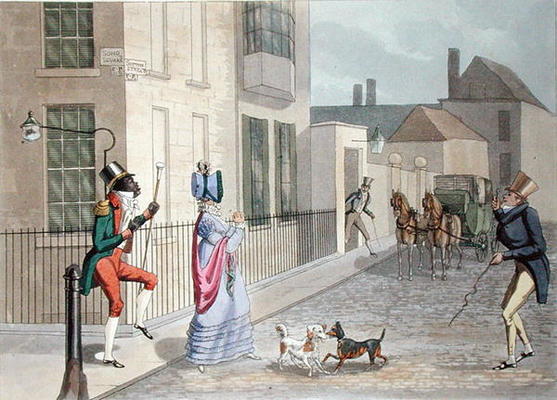
from “Fashionable Bores, or Coolers in High Life, by Peter Quiz’ 1824
Daniel Thomas Egerton (born 1797), a founding members of the Society of British Artists married Georgiana Dickens in 1818, , had three children, and by all accounts made a comfortable living producing humourous lithographs of British street life. But, like many artists of the early 19th century, he was always on the lookout for the picaresque and exotic for subject matter. In 1831, he traveled to Mexico, travelled extensively and painted his best known works. Returning home in 1836, his paintings of Mexican landscapes and city life were a critical success, as was his 184o series of lithographs, Egerton’s Views of Mexico.
And… now for you romance novelists:
In July 1841, Egerton abandoned Georgiana and took off for Mexico, accompanied by the teen-aged Agnes Edwards, his printer’s daughter.
And… for you mystery writers:
Daniel and Agnes lived a reclusive existence in Tacuba, keeping irregular hours and… despite his fame abroad… secretive about their personal affairs. Many, even in the British expat community, did not even know the artist was among them, until he and Agnes were murdered on the the 27th of April, 1842 while on the road to Xola.
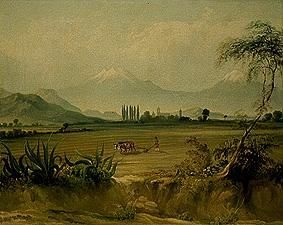 Now the plot thickens…
Egerton’s brother had also emigrated abroad… to the Republic of Texas, which Mexico still claimed was their territory in 1842. The brother was making a good living selling real estate, most of which seemed to belong to Mexicans. And, while he made a comfortable living as an artist back in Britain, Daniel Egerton certainly didn’t have the wherewithall to have paid for his previous “working vacation” in Mexico, nor to be draping 19 year old Alice in jewelry.
When demands that “something be done” about the murder were raised in Parliament back in old Blighty, the Foreign Minister was quick to assure Parliament that the matter was being looked into to the govement’s satisfaction.
The British Ambassador was quick to accept the standard Mexican official finding that this was a simple street robbery gone wrong. This, despite the fact that both Egerton and Alice were wearing expensive jewelry, and Egerton was carrying a large amount of money. Neither the jewelry nor the money was taken. And, strangely, there were eyewitnesses to Egerton and Alice being detained by four men with pistols, although both died of multiple stab wounds.
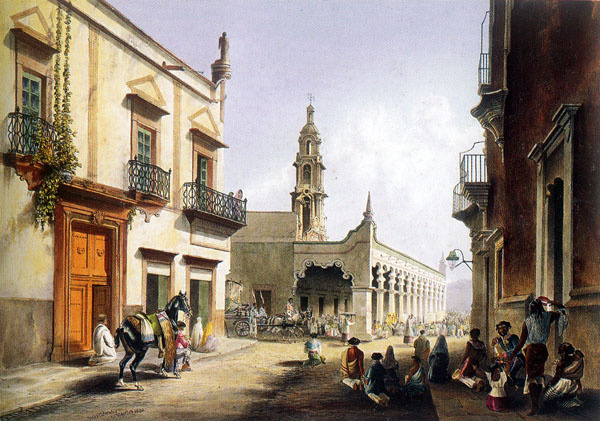
Three men were arrested and tried for the crime Despite their alibis (which were never checked), all were found guilty of murder and robbery. Two were hanged, protesting their innocence, and (some say on the personal behest of HIs Excellency Don Antonio López de Santa Anna) one simply walked out of prison and disappeared… to Texas?
Or, if your tastes run to international intrigue:
The 1820s and 30s, when Egerton first came to Mexico were also the years in which the British were doing everything possible to penetrate Latin America, seeing the collapse of the Spanish Empire as an opportunity… not to pick up more landscape, but to exploit the resources. As early as 1825, when Britian became one of the first European nations to recognize the Mexican Republic, Prime Minister Geroge Canning declared “Spanish America is free, and if we do not mismanage our affairs she is English … the New World established and if we do not throw it away, ours.” British “travelers” throughout Latin America… especially those with a good eye and a plausible reason for doing nothing but roaming the countryside… were often as not “informal” employees of His Majesty.
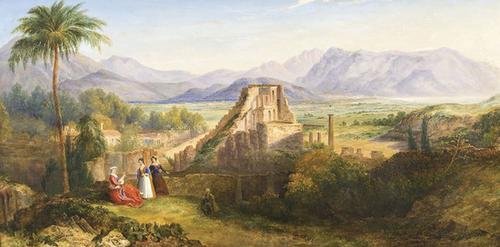
And by 1842, when it became clear that Mexico was unlikely to regain control, both Britain and France expressed an interest in creating a protectorate over the Texas Republic. Many in Santa Anna’s inner circle, especially his sometime Secretary of Foreign Relations, the conservative historian and writer, Lucas Alemán, particuarly favored the idea, as a buffer against the greater danger of an expanding United States. And there were those, in Texas, Mexico and Britian, who stood to materially gain from land sales.
And… for those who want a nice speculative romantic intrigue mystery thiller:
Alice was eight months pregnant at the time of her death. Meaning, she conceived in September 1841… after returning to Mexico. Was the 45 year old Egerton the father? A jealous boyfriend? An “auto-sequestro” gone wrong? Maybe Alice was the secret agent, who gave her all for King and Country. Or maybe a British spy investigating Texas land fraud fell in love with Alice and hoped to live happily ever after on the Texas frontier ran afoul of the jealous boyfriend who planned only to have Egerton murder. Or Alice’s dad had connections we never knew about.? Or what about Georgiana? Hell hath no fury like a woman scorned, and all that. Egerton’s two sons… what about them? the Royal Academy and the Society of British Artists were behind it…
Or…???
C’mon you novelists… get crackin’!
That went well.. not! Meeting the victims
I seldom translate news articles any more not only because I have too much to do, but because Mexico Voices more often than not picks up the same stories I would have translated, and generally does a much better job. And, is able to get them posted much sooner than I could.
Jane Brundage translated Blanche Petrich’s report that appeared in yesterday’s Jornada on the meeting between the parents of the disappeared Ayotzinada students, the widow of the student killed (and skinned), and a few other victims of state-tolerated (or perhaps state-sanctioned) terrorism. What appears from the article is that while the adminstration attempted to spin this as an “message: we care” moment, bringing in those survivors and victims are a tougher lot than was anticipated.
There was not a single moment of relaxation during Wednesday’s (October 29) meeting at Los Pinos. Not one smile, not a single “thank you, sir.” The gap was not bridged between President Enrique Peña Nieto and about a hundred Guerrero parents, siblings, some grandparents, including a young widow, of youth killed, wounded and kidnapped on September 26 in Iguala.
… The exchange lasted five tight, tense hours. Abel Barrera, director of the Tlachinollan Human Rights Center, described the encounter:
“They spoke without asking permission, without sticking to formalities, without an agenda. Quavering voices were heard but, above all, they rebuked power.”
It was probably one of the most difficult meetings in the career of the politician from Atlacomulco.
They may be humble, salt-of-the-earth uneducated country-people, but they’re not going to put up with bullshit who are not at all awed by the presence of official power. While Peña Nieto waited for his audience to stand in his presence, the campesinos were more anxious to tell the President exactly what they thought and what they wanted than they were to defer to protocol.
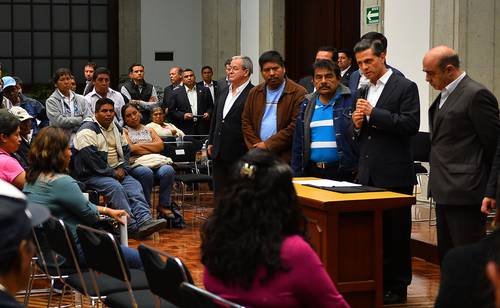
Photo: Presidencial de la Republia
Nor, canny peasants that they are, are they fools. The administration was thrown into a bit of disarray when the outraged and still dissatisfied campesinos not only wanted the minutes of the meeting published, they demanded Peña Nieto sign those minutes.
The signing of the minutes was a step on the agenda not foreseen by staff of the President’s office. Never before had the signature of commitments been demanded. But when the meeting was about to end, family members asked for it.
To the complete and utter confusion of his advisers, Peña gave way. It was agreed that a committee to draft the minutes would consist of the two Human Rights Centers: Tlachinollan and Miguel Agustín Pro Juárez. Then the draft minutes were submitted to a thorough review by the President’s advisers and, after some “minor” changes, photocopies were made. It was about 8:00 p.m.
At that hour, members of the Ayotzinapa delegation knew that Peña Nieto would deliver a message on national television. Then came a new demand: that he not do it [appear on television] before signing the bill. The transmission of the presidential message was scheduled for 9:00 p.m., and the hour was approaching. Some parents came to believe that Peña Nieto would not return to the meeting. Their nervousness grew.
Finally, at 8:30 p.m., the door opened again. Peña Nieto, Murillo Karam and Osorio Chong entered and put their signatures on each page of the minutes, together with those of Melitón Ortega and Felipe de la Cruz, on behalf of the others. Relatives of the Ayotzinapa Normal School students had managed to set a precedent in Los Pinos.
Will there be change?
With a few handshakes, and without expressing gratitude for anything, because they achieved nothing, they left the Presidential residence in time to hear the message while they were on the way to the San Rafael neighborhood, where a hundred journalists were waiting for them to give a delayed press conference.
While Peña Nieto faces criticism from everyone from the Pope to Barack Obama over the way he and his administration have handled these revelations, what those outside the country have to say really doesn’t matter. What the elites in Mexico say does, and the elites in turn are discovering it is those salt-of-the-earth underlings are no longer willing to defer to their “betters” and that ordinary people are no longer in any mood to accept promises or to defer to power. How much longer they will tolerate non-action is anyone’s guess.
Hallowe’en special: Curse of the Aztec Mummy
Curse of the Aztec Mummy… sci-fi, gangsters, a pre-Santo superhero and Aztec mythology… and even more fun with the bad English dubbing.
The Metro Vampire
It’s the time of the year for one of the better urban legends.
We have some strange names in Mexico City… a subway station named Cemeteries (Panteones) which is in front of several cemeteries… and with people carrying everything else on the subway, I wouldn’t be surprised some day to see a funeral procession, comoplete with “guest of honor” heading that way. But my favorite … and it’s the name of the neighborhood… is Barranca del Muerto… “dead man’s gulch” would be the literal translation. It sounds like something our of a bad 50s western, but it’s a nice, suburban area. There were a lot of dead men in the gulches back during the Revolution, when Emiliano Zapata’s forces occupied the area for a few weeks, and there was intensive fighting, and… there have been stories going back to the 19th century of body dumps there.
And, with the station logo being circling vultures, it’s the kind of place that if a creepy story isn’t true, it should be.
 The creepiest story, and one everyone believes, supposedly happened not too long ago … when Barranca del Muerto was the last stop on line 7. A tired commuter took the last train and fell asleep. He was in the last car, and woke up in a completely darkened car in the tunnel. While figuring out what to do, he heard moans from the other end of the car. One can, supposedly hear the moans of the unburied dead in Barranca del Muerto … and there are a couple of places on the Metro where one can hear some eerie sounds (which … given the strange geology of Mexico City might be … and probably are… natural phenomona)… and it’s an open secret that the last cars of the subway, late at night, are often where people hook up for clandestine quickies. So, it’s quite believable that the commuter would see two men embracing and some soft moaning.
When the commuter approached the couple… to try to get their help in getting out of the car… he realized those weren’t moans of pleasure, but a feeble attempt to say “soccoro!” … help me!
And… he was bleeding profusely. But the other guy was not there to help… oh no. Turing to face the commuter was a pale, pale, pale figure, with the face of a bat. The commuter screamed, as he pried open the door of the car and ran towards the station. Eventually, in the locked station, he was able to find a cleaner and … his babbling story making no sense… the subway police were sent to investigate.
Where the found… nothing. Well, a dead homeless guy who apparenly had a really bad case of anemia. And, of course, no police report exists.
Don’t fall asleep on the Metro!
Who were they?
As the saying goes “without corn there is no country”. Without our young people there is nothing.
Elena Poniatowska summed up her speech at the Zocalo last Sunday by saying:
We are facing a national catastrophe. In five states there are protests in support of the 43 missing students. Mexico is bleeding. The international community is shocked and now considers Mexico the most dangerous, non war-zone country for young people. Mutilated youngsters, youngsters without bodies, murdered youngsters. Indignation reverberates around the whole world. The mother of Guadalajara student Ricardo Esparza, who was attending the Cervantino Festival in Guanajuato said that she would be pleased to receive her son’s body so that she could lay down flowers upon it. Isn’t her resignation monstrous? Or as Gloria Muñoz Ramírez asks, “To what point has government sponsored terror been embedded in the breast of society?” In the face of terror all that is left is the unity of the people who rise up and shout as they have done for days: “They were taken alive, we want them alive.”
The likelihood that these students are alive is slim. Beyond their names, Poniatowka tried to give some sense of who these students were, beyond a name and age:
 1. Jhosivani Guerrero de la Cruz, 20 years old, from Omeapa. Thin, a slender face with almond-shaped eyes nicknamed “The Korean”. Walks 4 kilometers on his way to school to reach the public transport and 4 more on his way home because he wants to be a primary school teacher in his hometown of Omeapa.
2. Luis Ángel Abarca Carrillo, 21 years old, from San Antonio in the municipality of Cuautepec in the Costa Chica, nicknamed ” Amiltzingo”. Very affectionate, a member of “Activist House” in which students can enroll to receive political training. Inside the house the name of Lucio Cabañas resonates. The rich of Guerrero consider the students to be troublemakers because the hero they wish to emulate is the guerrilla Lucio Cabañas, who was also a teacher.
3. Marco Antonio Gómez Molina, 20 years old, nicknamed Tuntún of Tixtla. He loves rock gigs and particularly likes “Saratoga”, “Extravaganza” and “Los Angeles del Infierno”. He is also the classmate that always makes the others laugh in Activist House.
4. Saúl Bruno García, 18 years old, known as Chicharrón (Pork Rind). He’s a complete ‘disaster’, one of the students who tries to make you laugh until you cry, a big, friendly joker. He’s from Tecuanapa and is missing the ring finger on his left hand because it was chopped off by the mill when he was making tortillas. Saúl Bruno García shaved off everyone’s hair in the Activist House. A classmate had photos from the ‘shaving’ on his cell phone but the police took it off him.
5. Jorge Antonio Tizapa Legideño, from Tixtla, 20 years old, according to his mother. He has a dimple on his left cheek. He likes working the land, sowing grains and vegetables because the resources provided by the state government for the 500 students is never enough.
6. Abel García Hernández, form Tecuanapa is a 19 year old country boy. He has a mark behind his right ear, he’s skinny and he is 162 cm tall.
7. Carlos Lorenzo Hernández Muñoz, 19 years old. Baptized as ‘el Frijolito’ (The Little Bean), he’s from the coast. A chatterbox, he’s always willing to help others. “El Frijolito” was the first to stand up to donate blood when requested in Tixtla to help a sick person.
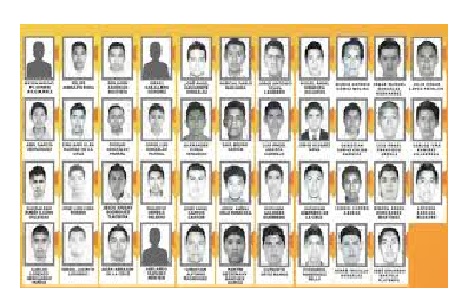 8. Adan Abraján de la Cruz, 20 years old, farm worker. He’s from El Fortín neighborhood in Tixtla, a town that looks after the Community Police. He’s a member of the Pyrotechnics football team in El Fortín. His friends consider him a good footballer.
9. Felipe Arnulfo Rosa, worker from a farm in the Municipality of ayutla. He’s 20 years old. He fell head over heels when he was little and has a scar on the back of his neck.
10. Emiliano Alen Gaspar de la Cruz, baptized as “Pilas” (Batteries) for his intelligence. A hard worker, quiet and reasons better than others. He likes everything to be in its place. Emiliano was one of 20 first year students who enrolled in Activist House two months ago.
11. César Manuel González Hernández, 19 years old from Huamantla in Tlaxcala. A disorganized youngster, he has the nickname “Panotla” but he is also known as “Marinela” because once, in Jalisco, he got a lift in the van of the cupcake making company.
12. Jorge Alvarez Nava, “el Chabelo“, 19 years old from the municipality of Juan R. Escudero, Guerrero. He has a scar in his right eye and is calm. He never upsets anyone, never swears and is so patient that he is never rude to anyone. He’s one of the most sensitive students of Activist House. His parents wait for him on the sports field of the Ayotzinapa School and hug each other while they speak of him.
13. José Eduardo Bartolo, 17 years old from Tixtla. Student in his first year at the Rural School. His father is a bricklayer by trade and hopes that his son will be a professional.
14. Israel Jacinto Lugardo, 19 years old from Atoyac, nicknamed “Chukyto” by his friends. His mother holds up a poster with the face of her son and shows it to passing motorists on the Highway of the Sun. “He’s quite strong and has a scar on his head. His skin is light brown, his nose quite flat. He’s a good boy, he came with high hopes of studying.
15. Antonio Santana Maestro, nicknamed “Copy” because he’s a very good public speaker. He is well known in Activist House where the other students also attend. Copy plays guitar and likes video games. He plays playstation but what he loves the most is to read.
16. Christian Tomás Colón Garnica, 18 years old from Tlacolula de Matamoros, Oaxaca. His father travelled as soon as the abduction of the 43 students was reported. I am a day laborer, I make 600 pesos a week maximum and that’s when there is work because sometimes there is none. My boy wants to be a teacher, that’s the profession that he wants but they put a brake on it, they put a stop to it. What are we supposed to do?”
17. Luis Ángel Francisco Arzola, 20 years old. His classmates call him “Cochilandia” but nobody knows why. He arrived with the nickname. He’s a serious young man, hard working and we are waiting for him here and we want him to know that we won’t stop until we find him.
18. Miguel Ángel Mendoza Zacarías, from Apango in the municipality of Mártir de Cuilapa. He is 23 years old and his classmates think of him as “already old”. His classmates are between 17 and 20 years old. In his town, Apango, he was a barber trying to get ahead. He’s a short guy, “awesome” according to his mates because he supports them, gives them advice, gives his all in exchange for nothing. He looked after his parents and siblings. He came to school sitting next to a classmate on the bus “but they started shooting and unfortunately he ran for one side and I ran for the other. He was arrested by the Iguala police, I managed to escape but since then I haven’t been able to find him…”
 19. Benjamín Ascencio Bautista, 19 years old, known as “greedy guts” because one day he ate, by himself, all the biscuits on the table at a conference. He’s originally from Chilapa. Before entering the Ayotzinapa Rural Teachers College he was a community educator in the National Council of Public Education. He trained volunteers to teach literacy in marginalized, isolated, rural and indigenous communities all over the country.
20. Alexander Mora Venancia, 19 years old from “El Pericón” in the municipality of Tecuanapa, Guerrero. Nobody could talk him out of his idea of becoming a teacher. He likes teaching. He started out helping in the countryside but he wanted to study… “I urge the authorities” says his father ” to do their work as it should be done, that there be no cover ups of the guilt of the Iguala Police and the town mayor who committed this massacre. Just as they were taken alive, we want them to be returned alive…”
21. Leonel Castro Abarca, farm worker from the community of “El Magueyito” in the municipality of Tecuanapa. He doesn’t have a nickname and to his friends “he is a serious person but with a sense of humor. He dreams of being a teacher to help his people move forward.
22. Everardo Rodríguez Bello, 21 years old. Originally from Omeapa. Known as “Shaggy” because he resembles Shaggy from Scooby Doo. An automotive mechanic qualified in the National College of Professional and Technical Education, he gets very angry at inequality, above all in the case of food. “If they give you six tortillas and him five, he protests”.
23. Doriam González Parral, from Xalpatláhuac, Guerrero. He is 19 years old. He’s short and “looks like a little kid” and consequently is called “Kinder”. He’s very funny and easy going. He has a brother at the school…The brothers entered together, their brotherhood is obvious and both of them were abducted together.
24. Jorge Luis González Parral is 21 years old and the older brother of Doriam, “The Kinder”. He is a serious classmate who has worked in several taco joints and although he liked the work he wanted to get ahead and decided to become a teacher just like his little brother Kinder. His nickname is “Charra” because he has a scar on his leg that looks like it was inflicted by a charrasca (type of musical instrument).
25. Marcial Pablo Baranda, 20 years old. He speaks an indigenous language and wants to be a bilingual teacher by the side of other bilingual teachers that come from even poorer towns. He’s short, good natured, cousin of Jorge Luis and Doriam and his friends call him “Magallón”, because his family has a musical group with that name which sings songs from his homelands, the Costa Chica. He spends his free time singing cumbias and playing the trumpet and drums.
26. Jorge Aníbal Cruz Mendoza, from Xalpatláhuac. Belongs to the same group as Kinder. They call him “Chivo” (Billy Goat) and he’s serious, gets on well with everyone and almost never causes problems.
27. Abelardo Vásquez Peniten, originally from Atliaca, Guerrero. He likes football. In a recent match he scored several goals. Never causes any problems. He gains respect because he respects everyone else and doesn’t go around criticizing others. Apart from football he loves studying, “he grabs one book and then grabs another and another and another”.
28. Cutberto Ortíz Ramos from Atoyac. They call him “The Commander” because he has a certain similarity to the singer of norteño ballads. He has a very strong look, he’s strong, tall, friendly and relates to others well. He is very enthusiastic about the fields of crops and he loves to tell jokes about SpongeBob. He laughs and imitates SpongeBob’s laugh to perfection.
29. Bernardo Flores Alcaraz, farm worker, 21 years old. He has a mole on his chest which resembles a little cat’s paw. He has high hopes of becoming a teacher and helping children and adults who don’t know how to read or write. In the countryside there are a lot of people who lag behind in education and it is his hope to teach them. The 43 students went out to collect funds in order to be able to complete their practical teaching. It is not just that their lives are cut short and they are left to lie in their own blood.
30. Jesús Jovany Rodriguez Tlatempa from Tixtla, nicknamed “El Churro”. He is 21 years old, the oldest of four brothers and “the only support for his mother” according to his cousin who walked for five hours holding up a placard with his picture. He is a very generous young man who has been supporting his niece for a year because his sister is a single mother and he acts as a father figure. His cousin furiously demands his return just as she asks for justice for the many youngsters of Tlatlaya in Mexico State.
31. Mauricio Ortega Valerio de Matlalapa or Matlinalpa, from near “La Montaña”, 18 years old. He is nicknamed “Espinosa” because when his head was shaved – a tradition for first year students at the Ayotzinapa School – he had a certain resemblance to Espinosa Paz, the singer.
 32. Martín Getsemany Sánchez García de Zumpango, 20 years old. He likes to play football and supports the Cruz Azul club. All his family are looking for him. He has eight brothers and during the march in Chilpancingo on Wednesday the 22nd his relatives carried a blanket with his photograph.
33. Magdaleno Rubén Lauro Villegas, 19 years old. Known as “El Magda”, he’s a calm and generous classmate that is studying to become a bilingual teacher in order to be able to teach indigenous kids who don’t speak Spanish.
34. Giovanni Galindo Guerrero, 20 years old. Known as “The Spider” because he’s skinny and has his own unique running and jumping style as if he were hanging form spiderwebs just like Spiderman.
35. José Luis Luna Torres, 20 years old from Amilzingo, Morelos. His friends call him “Duck” because he looks like Donald Duck and has the voice of a duck. He is serious, calm, always speaks well, good natured, quiet and doesn’t cause much trouble.
36. Julio Cesar López Patolzi, 25 years old from Tixtla. He doesn’t have a nickname. He is simply called “El Julio”. He’s a good natured and quiet guy, doesn’t cause problems, hangs out with just a few others but is always friendly.
37. Jonás Trujillo González from the Costa Grande in the municipality of Ticuí de Atoyác. Called “Beni” because his brother also attends the Ayotzinapa School but is in his second year and his name is Benito. Therefore that are known as the Benis. He is tall, chubby and gets on very well with his brother. They are quite similar although the younger one is taller and has fairer skin.
38. Miguel Ángel Hernández Martínez, 27 years old. His nickname is “Little Bota” because his older brother, who also studies in the school, is called “Bota” and so of course they gave him the name of “Little Bota” although he is of average height and weight. He is not at all disorganized, always friendly, healthy, good natured. He is polite, always willing to give a hand, available to others. He’s a young guy who shows a lot of solidarity with others.
39. Christian Alfonso Rodríguez, 21 years old, from Tixtla. Longs to be a teacher and likes folkloric dance. He is called “Hugo” because he always wears Hugo Boss t-shirts. His cousin, during the march on Wednesday the 22nd grew hoarse from explaining so many times that “he’s not just my cousin, he’s my friend…he’s a very diligent person, very dedicated to his studies and dance and it is unjust that someone who gives so much of himself and makes such an effort should suffer such tragic consequences at the hands of the government…”
40. José Ángel Navarrete González, 18 years old. He shares a room inside the school with two other young students in which there is not one piece of furniture, not even beds, just frayed sheets of rubber foam.
41. Carlos Iván Ramírez Villarreal, 20 years old. He is called “The Little Devil”. The truth is that he is good, doesn’t interfere with anybody, calm, he wants to be someone, but not the clown…”
42. José Ángel Campos Cantor, 33 years old from Tixtla is the oldest of the 43 disappeared students. Although he’s older he never takes advantage of the others. On the contrary he supports them in everything, he’s everybody’s friend..”
43. Israel Caballero Sánchez, originally from Atliaca, a small town halfway along the road between Tixtla and Apango. He’s called “Aguirrito”. He’s preparing himself to be a teacher in indigenous communities and when his classmates call him Aguirrito he complains ” Don’t be assholes, don’t call me that stupid name..”
(Translation by Peter W Davies for Latin America Focus)
Tlacaélel, a man of our time?
Watching an old British travelogue the other night, I was rather annoyed by the way every every indigenous Mexican (and surviving indigenous custom) was described as “Aztec”. The Aztecs themselves were simply the ruling class of the Mexica, the people of what is now metropolitian Mexico City. Given recent events and revelations, though, perhaps that 1960s travelogue wasn’t completely wrong.
In lumping everything pre-Conquest with the Aztecs, we forget they were only an “Empire” for about 100 years, and that they were less an Empire in the sense of direct control over subject peoples as they were an economic and political “superpower” that wasn’t shy about using force to maintain access to needed (and merely desirable) goods and services, or to maintain garrisons (what today we’d call “overseas bases”) to drive home the point that they can and would intervene when necessary, but prefered to rely on ideology.
And the great ideologue of the Aztecs was Tlacaelel, the very long-lived (1397 – 1487) brother of Montezuma I. Described as both an economist and a religious “reformer”, Tlacaelel’s greatest contribution to the Aztec hegemony was understanding that belief systems can be used for control. While human sacrifice was always part of Mesoamerican religious practice, it was Tlacaelel who made it central to Mexica beliefs, and who — by whatever means necessary — forced the client states and subject people to accept the general principles of that system.
 Tlacaelel not only invented the “flower wars”… the ritual fights between the “Aztecs” and their subjects … which their subjects were obliged to loose… in order to bring in captives, who were then sacrificed. And, the subject people paid tribute in sacrificial victims.
Think of it as arms control… overwhelmingly, the sacrificial victims were young men, either warriors or potential warriors from the subject or client states. In a world of human-powered weaponry, this removed the means of delivery of those weapons, and — incidentally — deprived clients and subjects of potential leaders who might become a threat to the central power.
Furthermore, part and parcel of his “reforms”, Tlacaelel reformed the educational system. With special schools for the elites … in which the children of privilige learned not only the philosophy and science of human sacrifice, but the ethical justification for it… and a lesser education meant to provide technical skills needed by the state, and to inculcate the sense that one’s lot was to be sacrificed, to feed the system.
Of course, we’re living in the 21st century, where our God is not Huizapotchli, but the Dollar, and where the purpose of education is not to convince us that we must give our lives if the sun is to rise in the morning, but rather that we must work constantly to keep the dollar strong and healthy. Why would there be a phoney war against the people… given that we think in terms of exports and imports, not sun gods? Why would anything think killing off the young, and future leaders, might be a means of preventing challenges to the system? Why… that would be unthinkable… wouldn’t it?
I keep on walking….
Sombrero tip to Yucatan Living for this four minute video tour of Mexico’s national parks, conducted by Margarita, la diosa de la Cumbia.
Still think they’re alive?
Abandon hope, all ye who see this:
¿Habla Espanglish?
Spanglish is not random. It is not simply a piecemeal cobbling-together, a collecting of scraps of random vocabulary into a raggedy orphan of a sentence. It has logic and rules, and more interestingly and importantly, it embodies a constantly shifting and intimate morphology of miscegenation. It is the mix of my husband’s innate Mexicanness and my innate Americanness, of my adaptive Mexicanness and his adaptive Americanness, in Spanish and English morphemes that come neatly together and apart like so many Legos into new and ever-changing constructions.
Sarah Mendedick on Spanglish, the language not of Cervantes*, nor of Shakespeare. Perhaps Spanglish is the language of “Mexican Americans too Mexican to be American and too American to be Mexican,” but it is a language of more and more American and Mexican familias:
At home, Jorge’s and my Spanglish has leveled the Scrabble playing field. For his güero, there’s my lonely. For my standard, there’s his deudas. The tiles intersect, English’s short consonant-stacked words overlapping with Spanish’s euphonious roly-poly vowels. Into and out of one and the other we slide, unconscious of how we have assigned parts of ourselves to one side or the other, to one idioma or the other. Unconscious of how each of us has become tangled up in both, until we are in Mexico and we miss beer and the woods, then back in Ohio and we miss corazón, calor humano, vida. Until the middle of a sentence, when I realize I cannot write the word “firework” when what shot into the southern sky was a cuete, loosed by a cuetero, an old man in an untucked white shirt who carries a passel of cuetes and stops to light them one by one, their sparks soaring up from between his cupped bare hands.
Living on the Hyphen, Oxford American.
* ¿Porque no?:
In un placete de La Mancha of which nombre no quiero remembrearme, vivía, not so long ago, uno de esos gentlemen who always tienen una lanza in the rack, una buckler antigua, a skinny caballo y un grayhound para el chase. A cazuela with más beef than mutón, carne choppeada para la dinner, un omelet pa’ los Sábados, lentil pa’ los Viernes, y algún pigeon como delicacy especial pa’ los Domingos, consumían tres cuarers de su income.
A silly, silly man
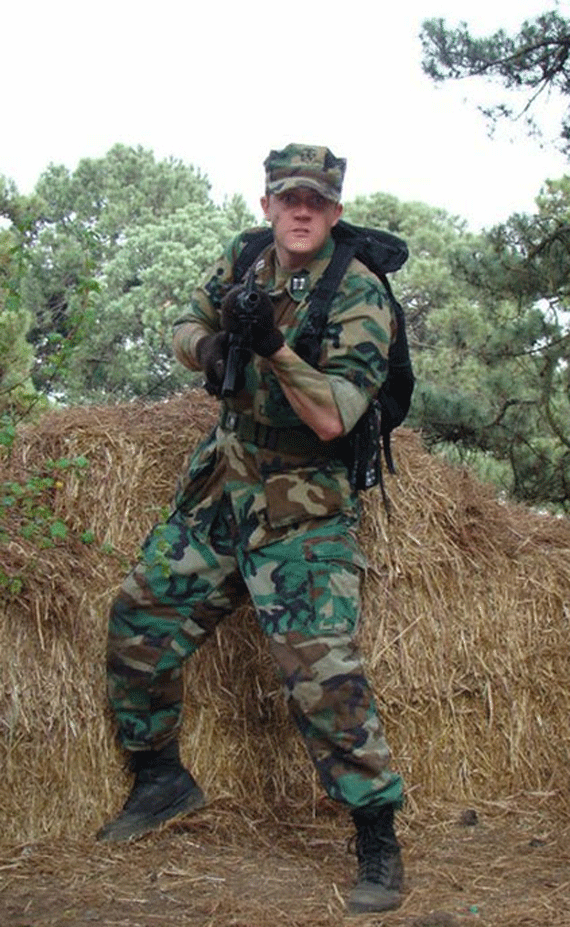
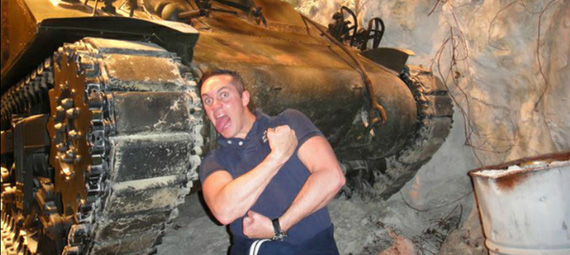 which was published in Sin Embargo in connection with a story on Adrián Rubalcava Suárez and other supposedly “Green Party” officials (the Greens and PRI are allied) who enjoy hunting, and other not-so-green activities in their spare time… of which they seem to have plenty.
Sin Embaro speculates that Adrián Rubalcava Suárez, hoping to be the PRI candidate for Jefe de Gobierno (Federal District Governor) in the next election wants to keep his private life private. But, then really, can Adrián Rubalcava Suárez honestly expect to be a candidate for public office, without photos like… oh…


 mexfiles.net