Oh, FRACK!
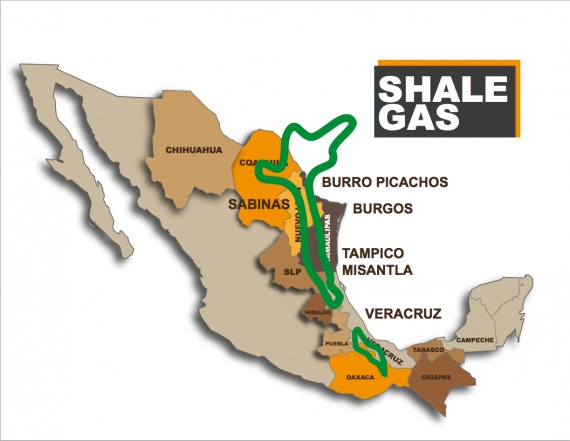
With oil reserves dropping in Mexico (and somehow we¿re supposed to buy the argument that more exploitation means more oil), PEMEX plans for facking move ahead. According to Regeneration and PEMEX documents, areas where fracking will occur spread over seven states … mostly in the water-scarce, and agricultureally dependent north, while a second fracking site is located on the earthquake-prone Oaxaca-Veracruz border.
While the connection between fracking and earthquakes is highly probable, but not proven beyond a shadow of a doubt (enough in a criminal case for an indictment in the U.S., or preventive detention here), there is no question of the dangers to the water supply. Such as it is. This in a country where people kill each other over water rights.
Why don’t you do it in the road?
Mexicans walk everywhere… heck, they’ve been know to walk across national borders. And, champion pedestrians that they are, it’s a national characteristic to develop an absolute, impenetrable fearlessness when faced with motor vehicles. Sidewalks, after all, are sometimes more dangerous in the scheme of things…when they’re not crowded with stalls and stands, and businesses, they are likely to just suddenly end…a couple of meters above street level.
While Mexico even has a day to honor pedestrian, “Dia del Peatón” (which was yesterday, by the way), it doesn’t mean everyone respects the pedestrian. While the day is not celebrated with mass walking in the streets (that’s every day… it’s called a demonstration), it does give the authorities an excuse to warn us about the dangers of walking. In Mexico City, nine pedestrians, and six traffic police officers, are hit every day by moving vehicles. It’s almost always the drivers’ fault.
(data by Fanny Ruiz-Palacios, El Universal)
Institutional narcissism
“It has been suggested by Border Patrol leadership that they are the Marine Corps of the U.S. law enforcement community,” Tomsheck said. “The Border Patrol has a self-identity of a paramilitary border security force and not that of a law enforcement organization.”
James F. Tomsheck, former head of internal affairs for the Border Patrol turned “whistle-blower”, is leveling charges that to those who have lived on the border, and those who read sites like this one should be of no surprise. Besides the “institutional narcissism” Tomsheck sees in Border Patrol’s cover-ups and denials of any wrong-doing, there is rampant corruption and a lot of agents who never should have been hired:
A former U.S. Secret Service agent for 23 years, Tomsheck said he believed that between 5 and 10 percent of border agents and officers are actively corrupt or were at some point in their career. Those crimes include stealing government property, leaking sensitive information and taking bribes to look the other way when smugglers bring drugs or people into the country.
“To a large degree, it (corruption) was an undetected problem and far more severe than the actual number of arrests,” he said.
Other high-ranking officials have backed up Tomsheck’s accusations.
Sombrero tip to Latino Rebels. Full article at cironline.org (Center for Investigative Reporting).
“Profanity Pop”
Mexican artist José Rodolfo Loaiza Ontiveros, at a showing in Los Angeles, mixed Disney characters with Mexican (and Catholic) imagery to create not just another cultural mash-up, but a succès de scandale, with polemics flying back and forth on whether or not Loaiza is an artist, or a “destroyer of childhood”. (Sin Embargo)


“Illegals” don’t pay taxes, right?
While unauthorized immigrants worked and contributed as much as $13 billion in payroll taxes to the OASDI program in 2010, only about $1 billion in benefit payments during 2010 are attributable to unauthorized work. Thus, we estimate that earnings by unauthorized immigrants result in a net positive effect on Social Security financial status generally, and that this effect contributed roughly $12 billion to the cash flow of the program for 2010. We estimate that future years will experience a continuation of this positive impact on the trust funds.
Effects of Unauthorized Immigration on The Actuarial Status Of The Social Security Trust Funds. Social Security Administration, Actuarial Note. No. 151 (April 2014)
In plain, non-bureaucratic, English, “illegal immigrants” to the United States — even if using fake Social Security numbers — end up a net asset, the Social Security taxes they pay never being paid out to them as benefits.
Migrant assistance our side of the border
E-mail from Frontera.info, August 7, 2014. Article by Guadalupe Castro. El Sol de Tijuana, August 6 and 7, 2014. Articles by Eliud Avalos Matias, EFE and editorial staff. While too often honored in the breach and not the practice, Mexico is a signatory to international agreements on the right of transit and accepts that everyone is entitled to health care.
Guatemalan and Mexican authorities have signed an agreement to provide greater assistance to Guatemalan migrants in Baja California, Mexico.
Alejandra Gordillo, executive director of the National Council for Assistance to Guatemalan Migrants (Conamigua), estimated that upwards of 3,500 Guatemalan migrants are residing in the northern Mexican border city of Tijuana alone, virtually stranded without work or adequate economic support.
“We are interested in making the problem visible, because we’ve seen the efforts of Mexico on the southern border,” Gordillo said during a visit to Tijuana this week. “Now we want to know the problem on the northern border so we can take actions.”
Reached with the Baja California Attorney General for Human Rights, the bilateral accord proposes linking Guatemalan migrants currently in Baja California with Conamigua, for such purposes as obtaining necessary paperwork and reconnecting with families back home.
Arnulfo de Leon Lavenant, Baja California human rights ombudsman, said one issue faced by Guatemalan migrants is detention by the local police for not carrying identification, an action he judged illegal in view of the Mexican Constitution’s guarantee of the right to free transit. Healthcare is another pressing problem, he said, with his office seeing on a daily basis Guatemalan migrants who require medical treatment.
“We will continue treating the migrant as he or she deserves, as a human being with rights,” the ombudsman said.
While she was in Tijuana, Gordillo also met with the Council for Migrant Assistance in Baja California, which is headed by Carlos Mora.
In comments to the Mexican press, the Guatemalan functionary recounted the litany of abuses and dangers migrants of all ages from her country encounter on their long journey across the Mexican Republic to the United States. These include shakedowns by Mexican police, sex trafficking and even violent death. Women and children headed to the United States have disappeared en route never to be heard from again, she said.
“The worrisome thing is that the person who travels does not know the contact he or she could have with organized crime,” Gordillo added. “We have seen many cases of mass graves in which the cause of (victims’) death could not be determined. The concern persists that these are territories coopted by organized crime. It is a transnational crime of different countries that covers a circle of more countries more extensively.”
According to Gordillo, 150,000 Guatemalans migrate to the United States every year. The proportion of child migrants has risen dramatically during the last five years, she said, increasing from 1,000 children in 2009 to almost 12,000 in 2014.
Gordillo said economic motivations, family reunification, generalized insecurity and domestic violence- including cases of rape, incest and physical aggression- all help explain the migrant exodus. Additionally, immigrant smugglers, or “coyotes,” assure would-be migrants that they will be granted U.S. residency once the border is crossed, she added.
“They don’t know they could become victims of organized crime,” Gordillo said.
Meanwhile, in the first major crackdown of its kind, Guatemala’s National Civil Police this week arrested seven alleged immigrant smugglers who were said to charge $6,500 for each child transported from Central America to the United States. Interior Minister Mauricio Bonilla said the alleged leader of the smuggling ring, Mauricio Lopez Bonilla, had amassed a fortune of $3 million from his illicit activities. More arrests are expected in the case. In an August 2 statement, the Obama Administration said the Guatemalan government was investigating six human trafficking rings “in coordination with U.S. officials.”
A rising tide lifts all boats
In Mexico, the mimimum wage is not calculated by the hour, but by the day. It is supposedly calculated on a “market basket” of the goods and services needed to support a family of four, assuming the worker is employed full time and there are no added expenses. Of course, those calculations are easily manipulated, and people living on the “salario minimo” have never been able to make ends meet. Just as an example, my “pied-a-terre” in Mexico City (which is a maid’s room in someone else’s house) is about 180% of the salario minimo, and my ordinary expenses, not counting “frills” like a cup of coffee, or the telephone bill, are just about the salario mimimo. I suppose with two workers living here (which would be uncomfortable) getting by at the salario mimio it would be possible, but not particularly helpful to the economy as a whole, since we’d not be spending anything outside of immediate household expenses. And, never mind that without paying for a telephone line, and having a computer, I wouldn’t be working in the first place. Everyone recognizes that the wage is much, much too low… that 67 pesos a day (the Mexico City wage, the highest of the regional wages) is at least ten pesos too low, and probably needs to go higher. But even for those like myself, who are earning more (not enough, but that’s another story), and who recognize the need, there is a drawback.
T he usual noise made about how a higher mimium wage will cause inflation, is usually silenced by the argument that it also means everyone will spend more. But spending on what? When inflation ran wild here in the 1980s and 90s, the mimium wage calculation didn’t keep up, but it was at least a meaningful number, whereas the number of pesos was not. So, rather than try to change the price of basic government services for things like licences and fines, which would mean endless revisions of the regulations, the prices were set by the miminum wage. A parking ticket, which at 50 pesos would be meaningless when there were 100o pesos to the dollar didn’t mean very much (and it wasn’t even worth offering the officer an “incentive” to resolve the issue) and there was no incentive NOT to illegally park. So… things like fines and license fees were set as multiples of the mimimum wage. And, discovering how much this simplified bookkeeping, so are a lot of salaries … including those of elected officials… and subsidies to political parties. Who seem to see the mimum wage as a number to multiply by a factor of 100 or a 1000 when they aren’t paying a 100 or a 1000 times as much for food, clothing, shelter than the rest of us.
Juliana Fregoso, Si aumenta el salario mínimo, dice la IP, subirán multas, derechos, inflación, y los partidos recibirán más dinero (Sin Embargo, 6 August 2014)
No comment
What Eduardo Galeano rightly called the largest company in Latin America NOT under foreign control is very likely to be under foreign control now:
Aug 5 (Reuters) – Mexico’s Senate gave final approval early on Tuesday to the backbone of a landmark energy reform as the government prepares to lure investment by major oil companies to stem the country’s declining oil production.
The bills, including a crucial new hydrocarbons law, govern implementation of a wider reform passed in December. They form the corner stone of a new plan to open the oil sector to private and foreign investment, aimed at attracting companies like Royal Dutch Shell and Exxon Mobil.
If I said what I thought about this, I’d probably be deported.
Rounding up the usual suspects
I’ve been distracted by real life (family and business affairs) which has meant neglecting the Mex Files … besides not writing on the massive changes to PEMEX (hint… I think they’re bone-headedly wrong) and the recent attempts to gag the media in Sinaloa, I keep running across things I MEAN to comment on, book-mark them, and never get back.
Having dumped about 100 bookmarks this weekend, at least here’s a round-up of what I would have commented on, or at least brought to your attention, was there world enough and time.
Lax Attitude Along Mexico’s Southern Border Becoming Thorn In U.S.’s Side, Andrew O’Reilly (Fox News Latino)
The favorite media source for the Know-nothings on Mexico’s “failure” to follow through on U.S. prescriptions to resolve it’s own border “issues” by exporting the types of controls that don’t work in the U.S. to Mexico. My favorite bit is where O’Reilly says the Mexican-Guatemalan border is different because a third of it is river.. overlooking the fact that two-thirds of the U.S. Mexican border is also river… and one of the most important waterways in the North American continent to boot.
Uruguayan pot marketplace may go up in smoke, Leonardo Haberkorn, (Dis)Associated Press.
I don’t know how many times I’ve had to say this, but the Latin American middle-class is not obsessed with pot, nor are Latin American particularly interested in smoking it. And middle-class people vote.
Víboras aparecen en curules del PRI en la Cámara de Diputados; están buscando su nido: perredistas,
Pinche Gringo BBQ: The Silver Twinkie in Mexico City, Mexico Cooks!
With all due respect to Cristina, the maven of Mexican food writers, the idea of a Tex-Mex airstream trailer invading Mexico City is not cultural fusion, but hipster barbarism.
Mexico’s New Gendarmerie: Security Game Changer or Window Dressing?, Patrick Corcoran, Insight Crime
On a more serious matter:
The gendarmerie was initially painted as an alternative to the armed forces being active in domestic security activities, and its creation was the first step toward lessening Mexico’s reliance on the army and the Marines. As Peña Nieto himself said in support of his proposal, “it would imply the gradual withdrawal of the armed forces to their barracks”. More recent reports indicate that the gendarmerie will have an explicit focus on protecting strategic regional industries.
Patrick (whose talents were stymed for years by the need to write about the narcotics export industry, as if that was the only business in Mexico, or the only criminal activity of note) questions whether the size of the new national police force hasn’t already been scaled back to a point where its effectiveness will be limited. I question whether yet another national police force just isn’t a rationale for more U.S. spending on weapons and “training” and services that have had the effect of increasing insecurity here, though its a boon to the U.S. “military/industrial complex” as the various overt interventionist wars (Iraq, etc.) lose political support north of the border.
Nude, Gun-Toting Frida a Photog’s Creation, Susana Hayward Soler, News Taco
 I was fooled by the photo when it started appearing a few months ago, too. I should have looked more carefully, or regarded it a bit more critically. That Kahlo was self-aggrandizing enough to have posed for a photo like this (with it’s stereotyped “dangerous Mexican woman… sexy, but capable of murder) is reason enough to question whether the recent placement of Kahlo among the pantheon of Mexican (and female) aretists doesn’t have more to do with her self-created image, and less to do with her artistic merit (or lack thereof… I think she was neither a particularly original artist, nor one particularly in the Mexican tradition… her work being more self-indulgent and based on European models).
Corruptos
Monitoring the immigration crisis requires keeping one eye on Washington and one on the U.S.-Mexico border.
One place is full of corrupt and mercenary characters who protect their interests, don’t follow the rules, play with people’s lives and who only care about making money and amassing power and ensuring their own survival.
Then you have the border.
Ruben Navarrette on U.S. political posturing over migration.
Human trafficking and economics
I’m not a “math guy” but this makes no sense to me. The figure bandied about for smuggling a person through Mexico to the United States has been quoted at US$ 4 to 5,000 US$ since at least 2009.
World Bank figures for Honduras show a GNI of US$ 2180. According to the CIA’s “World Factbook”, household consumption accounts for 79.5 percent of spending leaving the “average” Honduran with US$ 446.90 in spending money. And that figure is probably extremely higher than reality, given that these are averages, and the wealth in Honduras is even more concentrated in the “one percent” than most places (the last figures available… from 2009… show that 42.5 percent of the national wealth is in the hands of the top 10% of the population, the bottom 10% have 0.4 percent of the wealth… again CIA figures).
I understand that economic considerations are of minor concern when one is trying to save ones children’s lives, but it’s poor people who are sending their children into exile. Poor people are more likely to make risky investments, but that’s assuming they have the money to invest: poor people can buy dollar lottery tickets, they can’t put up 5000 US$s they don’t have.
Just roughly, it would require ten families to send one child to the United States, if the figures are at all accurate. My sense is that “coyotage” plays a much smaller role in migration than we image; or that the “fees” are much less than reported (while the “travel expenses” — including petty bribes along the route — for migrants wouldn’t be traceable, the receipts from organized coyote networks would presumably show up as unexplained wealth somewhere… and I’m not seeing it); or, that that media reports about the refugees are based on lazy assumptions about what is driving people to send their children abroad under the worst possible conditions and the numbers being reported in the media are pulled out of thin air.
She should have been a Mexican
.
As an unrepentent lefty and a person of mixed race (Afro-Indigenous on her mother’s side, with a “white” father), Eartha Kitt would have fit right in as a Latina artist. Then again, she might not have been seen as the exotic figure (described as “the most exciting woman in the world” by her putative lover, Orson Wells) she was to North Americans, but she’d still be remembered as a Hell of a great singer.


 mexfiles.net