American exceptionalism?
The United States is not alone in seeing this spike in refugees. There is a 720% increase in asylum claims in both Nicaragua and Belize, as people flee violence in the Northern Triangle.
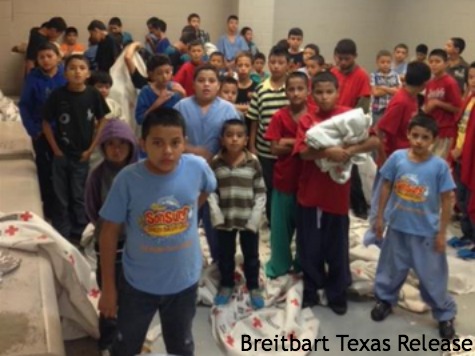
The UNHCR found that 58% of these youth coming to the United States qualify for specific international protection due to their legitimate claim of fear and violence.
(Crisis on the Border: Unaccompanied Migrant Children. Sisters of Mercy of the Americas)
Obabma could have saved himself a lot of trouble if instead of “at my direction, [having] the Vice President convene… leaders from El Salvador, Guatemala, and Honduras, as well as Mexico,” he’d first talked to the Sisters of Mercy, who like the U.S. goverment have been in the business of providing “assistance” in the region, although the nuns admittedly have much less background in sending military “advisers”, weapons and “biometric identification software” (the latter something the U.S. seems to think Mexico will install on their southern border… just because). The short (three page) document from the Sisters of Mercy is probably the best and simplest overview of the situation I’ve read.
Mexico 1935… two films
The first, from the Penn Museum (University of Pennsylvania Museum of Archeology and Anthopology) seems to be three travel films run together… of Mexican City (most of which should be recognizable to anyone with any familarity with the city today), of someone’s trip down the canals of Xochimilco, and a minute or two of men cutting agave.
The second, “Mexico Revisited” is allegedly, travel films taken by the producer’s grandfather of a road trip from Laredo to Mexico City and back. Obviously, “provincia” has changed radically in the last 80 years, but what’s fun is recognizing how many of the stereotypes still presented about Mexico were seen even then as “colorful”. It also suggests to me why the Cardenas administration (1936-42) was so concerned about modernization.
I don’t doubt that the film really was shot by tourists back in the 30s, though it crossed my mind to ask who was filming all those scenes of the car going down the road, crossing streams, etc. While the “time capsule” introduction is cute, the producer might want to re-edit . The flag supposedly filmed by his ancestor in 1935 (at 3:33) is one that didn’t exist until 1968, when the national seal was redesigned.
Going out with a song: Los Tres Tristes Tigres
Zapatismo without tears
Sombrero tip to Barry Carr (LaTrobe University [Melbourne] and Colegio de Mexico) for this critique of the Zapatista movement, found in a review of a French collection of essays on the Zapatistas (Bernard Duterme et al. Zapatisme: la rébellion qui dure. Alternatives du Sud. Paris: Centre Tricontinental and Éditions Syllepse, 2014). The entire review is posted on the New Politics website.

Outside the Mexican Embassy in London, 2012 (Photo: Zapatista Solidarity Group, Essex)
The reviewer, Dan La Botz, questions the effectiveness of the Zapatista’s anti-politics and asks whether the Zapatistasreally are operating in the best interests of those they claim to represent I’ve thought their “other campaign” … which sought more to discredit the State… accomplished nothing other than assuing the election of Felipe Calderón and hastening the downfall of the united left in Mexico. While I support the contention that indigenous peoples are the ones who need to craft solutions to the challenges they face is a belief that it is perfectly legitimate to question. At my crankiest, I often wonder whether those outsiders who come here to “learn” from the Zapatistas really have the interest of the Mayans (and rural communities in general) or are just buying into the “noble savage” myth, as La Botz hints at in his discussion of Zapatista health care.
The mythic idea held by some in the first days of the rebellion that the indigenous people were united in their opposition to the Mexican government and capitalism was, of course, never true. Many indigenous people had other stronger identifications: to their tribal group, to Catholicism or Evangelical Christianity, to the Institutional Revolutionary Party (PRI), or simply to the status quo, which, however bad, was “the devil they knew.” The Mexican PRI government in power at the time, as it deployed the army or mobilized party loyalists to harass the Zapatistas, played upon such divisions and worked to accentuate them. Indigenous communities became even more divided. To escape government attack, the Zapatistas fled to the mountain forests and established temporary villages there, even more poverty-stricken than their original homes.
[…]
The central issue that this book presents to the reader is the Zapatista strategy of building autonomous communities. What is meant by “autonomy”? Several of the chapters describe how the Zapatistas answer this question. They define autonomy as the creation of villages and ideally regions that are entirely separate from the government. They refuse to join or work for any political party, arguing that the parties are all corrupt, and they will have nothing to do with government social welfare or development programs, not wanting to become politically beholden. One has to say that their view of the political institutions is certainly correct and their fear of political manipulation well founded. So they have decided that they will not send their children to the government schools, arguing that the mestizo teachers who live in urban areas and drive automobiles to the school look down on the indigenous communities and their students. They will not go to the government hospitals and health clinics, except in extreme cases, arguing that the doctors there do not treat them well or provide them decent care. They refuse government material aid for the improvement of their homes and villages, arguing that if they take it they are expected to work for the ruling political party. Unlike the historic parties of the left, they do not fight through social movements, coalitions, and political parties to take control of these institutions and force them to serve them fairly. They reject dependency on government institutions for the alternative of community self-sufficiency.
Alternatively, then, the Zapatistas build their own homes and villages, run their own schools, and maintain their own health program. Several of the authors suggest that this is a good policy because it empowers the indigenous people, and especially women, allowing them to create their own institutions and run them democratically. Yet, in general, the authors refuse to ask what this choice means for the indigenous people in these communities. Raúl Zibechi, for example, describes the health system, explaining how each group of eight families chooses a team of three health workers who have been trained by the community, usually mostly women: a woman who prepares cures from medicinal plants, an indigenous “osteopath,” and what is described as a “wise woman.” Zibechi suggests that because women are generally the health workers, by taking on this responsibility they develop as stronger and more equal members of the community. That may be. But one would like to know, does this do anything for community health? Do autonomous community health workers keep their communities healthy? Are they able to prevent illness? Can they cure disease? Are they improving community health overall? Where is the epidemiology? How do Zapatista autonomous communities compare with non-autonomous communities in areas of inoculations, prevalence of contagious disease, chronic disease, infant mortality, and longevity? It does not even occur to […] ask these questions, much less to answer them.
How dare they!
How bizarre…
Rather than, as politicians in the United States have been demanding, the Mexicans have developed a southern border strategy that does not call for mass detention camps, or expulsions, or even something so weird as the U.S. insistence on people who enter without visa, or overstay their visas, “illegal” (it’s about the only country in the world where such things are considered criminal… maybe North Korea ).
According to a senior Mexican government official, the ”guiding principles” of the southern border strategy, developed by Mexico’s secretariats of governance, defense, navy and the attorney general’s office, are ”absolute respect to human rights; migrant protection through policies to regulate migratory flow and NOT to close the border; and a frontal fight against corruption.”
The Mexicans accept that there are serious problems (including weapons and human trafficking) but don’t see a U.S. style “solution” as anything that would meet their needs.
For good measure, the Mexicans are starting to wonder why they ever got involved in that stupid government bailout for the U.S. arms and military supply industry called “Plan Merida”.
”We don’t need the United States’ money. All of the money we’ve received from the Mèrida Initiative since 2008? Every year we spend nine times that much on security.” […] ”Of course, the United States has an interest in our security. We have an interest in the United States’ security as well, particularly when it comes to the huge market for illegal drugs there. And if the United States used the same tactics internally that they ask Latin America to use, military or street law enforcement intervention to stop crime, there would be chaos in the streets.”
Mexico officials, looking at what’s best for Mexico, and what’s the most humane way to deal with refugees from Central America. And not asking “how high?” when the U.S. says “jump”?
How utterly bizarre. And refreshing.
David McComber, NY Times Syndication. Mexico develops a border strategy, but will it suit US?
(Telegram.com)
The Pedro Infante of Gringolandia…
A few bright spots
Fox News Latino quotes the the United Nations High Commissioner for Refugees with estimates that 60 to 90 percent of the refugees from Central America now in custody in the United States may be eligible for either refugee status or political asylum.
Here in Mexico (and sorry, can’t find it on-line: La Jornada, 26 Junio 2014, page 12) a bill has been introduced in the Chamber of Deputies by PRD Deputy Fernando Zárate to slightly change the immigration laws here, to permit issuing visitor visas for “humanitarian reasons”. As “temporary residents” refugees headed for the United States would be able to travel openly on public transit and would be eligible for legal protection while in the country. IMN (the Mexican immigration service) is also looking at opening transit centers and hostels.
Ideally, the U.S. would stop exploiting Central Americans, shipping weapons and buying drugs, but in the meantime, what I’d really like to see would be passenger trains running from the Guatemalan border to El Paso and Laredo and Nogales… Mexico can absorb some refugees, and can provide some services, but it did not create the crisis, and it’s up to the U.S. to deal with their own mess.
Do the right thing?
An honest politician? That can be a problem!
Purificación Carpinteyro, a PRD Deputy was to have led her party in the upcoming debate over a new telecommunications law. However, when an illegal wiretap picked up Ms. Carptineyro discussing her own personal investments in a telecom venture, she recused herself from the telecommunications committee, and has created uncertainty not only over the form any new telecommunicatios regulations will take, but over the course of Mexican lawmaking in general. In acting honorably, the question has come up whether legislators can, or should, be allowed to take part in discussion on bills in which they have a material interest.

Purificación Carpintyro (El Financiero)
Not that there’s anything especially wrong with politicians having business investments (and, one hopes, that elected officials have some kind of “real world” experience beyond politics), and one would assume an active investor in a telecom start-up would have something worthwhile to contribute to the discussion.
Of course, it has to be noted that the PRD sought to delay passage of the telecom bills, and Carpinteryo’s withdrawal gives her party a perfectly legitimate reason to push back discussion, and to negotiate with PAN and PRI over further changes. And, to hold forth on the conflicts of interest of their opponents.
Who leaked the conversation, or why, hasn’t much been discussed. Presumably, it was meant to discredit the bills’ socialist opponents… but one has to wonder. By doing the right thing, are the Socialists deviously forcing their opponents to show their own personal interests in these proposed “reforms”, and — ultimately — to force through the changes in the bill that they’ve wanted all along.
Doing right and doing in the opposition… now that’s politics!
etc.
It’s to die for!
Dying to find a high-rise condo in Mexico City?

How about this place? Elegant and right in the heart of fashionable San Rafael… across the street from Park Sullivan, a few blocks from Reforma, shopping, bus lines and easy access to the Circuito Interior. You probably would never want to leave… which is a good thing, since it’s a high-rise cemetery.
The descent into Hell
Editorial in Wednesday’s La Jornada (my translation):
The grave situation created by waves of minors from Guatemala, Honduras and El Salvador passing through Mexico to join parents in the U.S. has forced the governments of the five countries involved to turn their eyes to a problem ignored up to now: the migratory flow of people of all ages that originate in Central America, flow through our country and pour into our northern neighbor.
From the beginning it has been clear that the central cause of the phenomenon is the asymmetry in the economies, criminal violence, and the lack of employment and existential opportunity in our sister nations, coupled with the demand for labor in industry, agriculture and services in the United States.
 Certainly the economic management in the three Central American nations, markedly oligarchic and replicating social injustices, plays a central role in the exodus. It is inevitable to compare this phenomenon to the situation in Ecuador, a nation from which people emigrated for the same reasons, but, during the successive mandates of President Rafael Correa has managed to reverse the situation and become, instead, a magnet for immigrants from many countries.
Moreover, to the extent that the U.S. government persists in the criminalization of migrants, what could be a simple solution for all parties is turned into a serious problem, leading to deaths, suffering and abuses. The government of Barack Obama – having won a second term in the White House thanks in part to his promise to push immigration reform to regularize undocumented foreign workers — has lacked the political will to fulfill that commitment.
Mexico plays a dual role: as a point of origin of migrant flows– due, in our case, as in Central America, to ruthless and devastating economic policies.
In Mexico and our neighbors to the south, the government has has failed to induce economic growth required to generate decent paying jobs and to deter those who venture to the north,. Nor has it complied with its obligation to ensure the integrity and the rights of those passing through the country, nor has taken a firm stance on the U.S. authorities to demand full respect for the human rights of our compatriots in the neighboring territory. In such circumstances, domestic migrants are subjected to all sorts of dangers, attacks and abuses by the police forces of the two countries, while for foreigners these abuses are multiplied. Their time in Mexico becomes, as a rule, something very like a descent into hell.
Neither the adoption of immigration laws or restructuring in the business units responsible have favorably altered the drama of Central American migrants on Mexican soil. If the national population has been abandoned for years to the depredations of organized crime, foreigners are even more easy and defenseless prey.
In these circumstances, the phenomenon of the tens of thousands of migrant children, exacerbated by ambiguous information issued by the U.S. Department of State, has inflamed public opinion to the extent that the authorities now have to meet to discuss the problem. Such is the context of the regional immigration meeting to be held next Thursday in the Nicaraguan capital.
Undoubtedly, the human crisismust be addressedperemptorily, andthe security andintegrity of childrenin transit must be safeguarded, butthe underlying problemwill not be resolved: these childrenrepresentmany familiesdivided by evil immigration policiesevilthat must beabandoned.This requires aregionalmigration agreementto normalizetheexit, transitand stay ofworkers in the UnitedStates,Mexicoand Central America.
Mexico 3, Croatia 1

Sickos
The always perceptive Bud Kennedy (Fort Worth Star-Telegram) on the scaremongering among right wing Texans over refugees from Central America:
In one vicious email, the McKinney-based North Texas Tea Party warned of “epidemics across the country,” as if only Central American children get sick, even though some come from countries with better immunization rates than Arkansas or Oklahoma.
[Dan] Patrick, who has ridden immigrant-bashing from talk radio to the Texas Senate and his party’s nomination for lieutenant governor, issued a statement decrying the “potential for disease” and then quoting a U.S. Border Patrol union mouthpiece reporting children found with chickenpox, staph and viruses.
So only Central American children have chickenpox or lice?
Fascinating.


 mexfiles.net