Who watches the watchers?
McClatchy (via Raw Story) reports on the investigations into wrong-doing in the Border Patrol’s internal affairs division… a sordid mess by all accounts.
I’m not in the least surprised that what had been a small federal agency, turned into a bloated paramilitary unit to satisfy the “know nothing” crowd that panicked when they started to hear Spanish spoken in places like Iowa, then into a boondoggle for federal bureaucrats and “suppliers” after the “PATRIOT ACT” gave cover to all kinds of ridiculous police state measures, it’s no wonder. Warm bodies… “boots on the ground”… whether they knew anything about the border or not (or had any inkling of what they were supposed to do) were apparently the most politically expedient “solution” to whatever the problem really was… whether or not they resolved anything being immaterial.
That the Border Patrol has only made things worse is something I expect this present administration will attempt to resolve with… more Border Patrol agents. I still say just bring back the Apaches:

Why should we not be shocked?
Today on the front page of El Universal, the declaration of a protected witness in the federal (PGR) case against El Chapo Guzman says that the US Border Patrol escorted trucks of weapons to the border, abandoned the vehicles and assisted members of the Sinaloa Cartel who then took the guns into Mexico.
“Arms Pipeline to Sinaloa Cartel” (Mexico Trucker On-line)
This is not the “Fast and Furious” scandal (which was an ordinary anti-smuggling investigation, but I expect the “usual sources” in the U.S. will be trying to spin it that way. Incidentally, it’s another excellent reason NOT to extradite Mexican gangsters to the U.S.
Descending into the borg
Resistance is futile:
On the street where I live… 10 June 1970
An “attempted quasi-coup”?
Photos of a drawn-looking Enrique Peña Nieto have been circulating lately (at least on the Mexican left) revising rumors that the President is extremely ill. Carlos Loret de Mola… a right-leaning Televisa journalist, first made the issue a national one last August when he suggested the President’s treatment for what was reported as a thyroid condition was possibly a cover for cancer treatments. Mexican media does not report, nor does the government comment on, presidential health, but it was known that Peña Nieto had been treated for a pre-cancerous prostate when he was Governor of Mexican state.
When AMLO had a heart attack last year, there were plenty of rightist twits (er… “tweets”) wishing the guy a speedy death, so I can’t blame the guy for tweeting:
“I don’t believe it, and don’t wish it on him. But, it would give us a way out [presumably of the political and economic situation in Mexico at present] if he had to resign for health reasons.”
AMLO is a master snark-a-teer and to add insult to injury, posted a photo of himself playing baseball. Presidential spokesman, Eduardo Sanchez Hernandez responded in kind, asking if AMLO could run 6.3 miles in 53 minutes and one second (as Peña Nieto was reported having done recently).
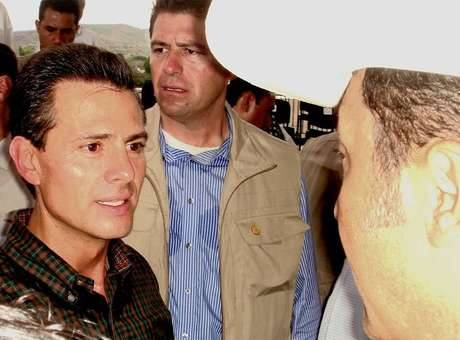 I donno.. maybe Peña Neito is ill, or maybe all that running is just making his face look thinner, or maybe he’s on some weird diet, but to go as far as “El Universal” and claim it was an “attempted quasi-coup” (designed to do what? Force congress to pick an interim president… who surely would not be AMLO?) is a bit rich.
For the record, the only time a president has resigned for reasons of health, was in 1932, and it was a “soft coup” of a sort. It’s complicated (like everything else in Mexican political history), but with Obregon’s assassination in November 1928, after he had been elected to a six year term, but had not yet assumed office, Congress… as the Constitution calls for… apppointed Emilio Portes Gil as “interim president” only to serve until the next federal election in in 1929. Pascal Ortiz Rubio was elected, but he was in extremely poor health…mostly the result of surviving an assassination attempt by Catholic terrorists on his way to his own inaugural ball.
While Ortiz Rubio probably had what is today called Post-Traumatic Stress among other ills, his removal from office was more due to his political independence from the then-controlling Calles machine than any serious concerns for his health. Reportedly Ortiz Rubio only learned how ill he was when he read in the newspaper that he had resigned for health reasons. Which… prudently … he did.
With Peña Nieto having sewn up support from his own party, as well as most of PAN, and a good chunk of PRD, it’s hard to imagine a scenario like this again. However, if he is, indeed, extremely ill, I’d expect a situation more like that during the latter part of the Lopez Mateos administration when the president’s health had seriously deteriorated but the rein of government was under the direction of Gustavo Diaz Ordaz, at the time Secretario de Gobernacion (interior minister or home secretary) and Lopez Mateos’ successor in 1964.
And a little child shall lead them?
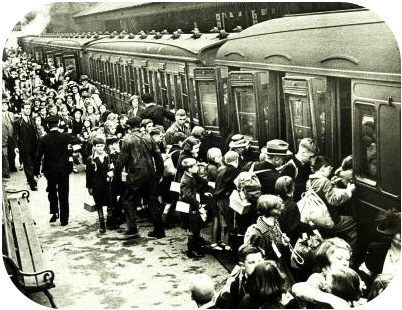
Children evacuating Liverpool during WWII (Liverpool.fluxtime.com/history)
The United States government, and the people of the United States, seem to go into shock when they come face to face with the effects their foreign wars have on people. The photo at the left, from World War Two, could have come from any number of European countries, where parents when faced with the known horrors of war — had to decide whether or not to evacuate their children to unknown (and possibly just as dangerous) locations. But, in World War II, where the people were part of the war effort, and the war was against outsiders, sending the children to the countryside… or abroad… was often as not a state-sponsored enterprise, and was considered at most, a temporary measure. In Britain, where there were also state-sponsored evacuations, 130,000 children were sent abroad, by parents with the financial means to do so.
While NAFTA’s devastating effects on agriculture, combined with the violence afflicted on rural communities by the development of the privatized tourism and mining industries, it wasn’t unusual for entire Mexican communities to be hollowed out, as men and teenage boys had to trek north to find enough to survive. Seeing an adult male under 60 or over 14 in a Zacatecan village was something of a rarity 12 years ago. With the addition of the “War on Drugs” and the crack-down on temporary migrants, families were faced with the aweful choice of whether or not to send a child (or several children) abroad, in the hopes that perhaps they would have a better chance of survival, and perhaps they might be able to rejoin the family at some point. Might.
Now that the U.S. has expanded it’s war on drugs (while dithering about its own attitude towards them at home) to the Central American republics, and has pushed through another “free trade” agreement… while incidentally propping up a repressive regime in Honduras… one should have expected war refugees. While some of the more astute U.S. commentators have noted that these people are refugees from a war zone, they’re thinking on of the rhetorical “war on drugs” and not the real economic warfare being visited upon those nations.
While the Mexicans believed they had a chance to maintain family ties if they migrated to the United States (and some are able to do that, despite the much less forgiving border today), they weren’t forced to travel though another country (or two) already devasted by those “wars” like Mexico.
I was asked “why didn’t the Mexican ‘do something’ about the refugees … often minors… passing though the country? The Mexican media was full of stories about this situation, and Church, state and private groups have been doing what they can. Certainly, many look away, perhaps thinking “There but for the Grace of God…” . But that the U.S. didn’t see the logical next step is not Mexico fault, nor the fault of the refugees, nor their parents.
Parents would like to see their children happy and successful. Failing that, at least safe. And, failing that, at least alive. The U.S. created the situation in which a war was visited upon these people, with their governments either in collusion with the invader, or doing nothing to prevent the “collateral damage” of that war.
Carlos Slim is not part of the “one percent”?
Mexico’s Procuraduría Federal del Consumidor (Profeco… more or less the Consumer Protection Agency) has devised scale of the social classes, divide by income… for the most part.
The poor-lower class (35 percent of the population) are those without regular income of any sort (temporary workers, causual laborers and those that depend on public assistance for part of their sustinance.
The poor-higher class are those that work for a living (farmers and workers) in “arduous labor for slightly above the minimum wage: about 25% of the population.
Another 25 percent of the population is “middle class”, the “lower middle” being officer workers, technicians and artisans: about 20 perent of the total population, or the bulk of the middle class. They may not have much money or consumer goods, but they can get by and can usually save some. The “upper middle class” are business managers and professionals with a steady income.
Carlos Slim is only “lower upper class”. While he’s richer than … anybody… the lower upper class is defined as those only a generation or two from their family wealth, who are rich, but not “old money”. The nuevo riche.
The one-percenters are the old rich… those who — in Profeco’s terminology — “have fortunes so old they forgot where it came from.”
Carlos at least knows where he got his money. He might be able to buy and sell the one-percenters, but he’ll never be part of their club.
Live… from the 17th century
Estudientiles in Santa Maria la Ribera. There are clubs and contests for estudiente groups, and some towns hire them as a tourist gimmick, but these guys are well in the classic tradition of college students throughout history… getting together some beer money the same way Mexican students have since the days of the Royal and Pontifical College.
Separate but not equal
Via GayPV:
While marriages in a jursidiction that allows same-gender marriage is recognized in all states, getting married in a state where the law does not specify the gender of the couple, but where the contract implies male and female, bureacratic foot-dragging (mostly a matter of simply changing the wording of the contract to be gender neutral, it is still a time consuming process, often requiring a federal injunction (amparo).
Sombrero tip to Rollie Brook.
Viva Villa
I missed posting this on Pancho Villa’s birthday yesterday. Considering the guy started his career as a bandit — which would normally make you rather publicity shy — I always thought one of the more intriguing aspects of his career was how good he was at using the media. Both the traditional media of northern Mexico… the corrido — but the then modern media of newsreels.
Produced by Cecilia Rascón, with music by Adrián Ramirez, Viva Villa:
Sombrero tip: Barry Carr
The reign in Spain… by George I’ve got it!
Mexican monarchal history is easier to deal with. There were only two, and both were shot. Spanish monarchs, and getting rid of them was a bit more complicated, but I think I have it straight now.

Felipe V: I quit… no, I take it back
Carlos II the last Hapsburg died childless in 1700, and the throne could have either gone to two candidates. Louis XIV of France’s grandson Philip of Anjou (who was the grandson of Carlos’ half-sister), or Archduke Charles of Austria, who was the nearest male Hapsburg relation.
Aragon went with Charles and Castille with Philip. The British jumped in, fearing a Franco-Spanish alliance, resulting in the War of Spanish Successon. Austria was satisfied with grabbing a chunk of Spanish ruled Italy, and Charles became Emperor of Austria, so pulled himself out of the running. Philip agreed to renounce any claims to rule France, and settled in as Felipe V… and, in the process doing away with the independent kingdom of Aragon, which had always treated their kings as more or less the first among equals (famously, the people swore their allegience to the King saying “We who are as good as you…”). Felipe V also introduced, among other things, the Semi-Salic Law, meaning that like England, the crown could only pass to a female descendent if there was no male descendent.
Felipe abdicated — either for health reasons (he was a manic depressive) or doing a take-back, there being an opening for King of France at the time, and maybe not being King of Spain would mean he was in the running — in 1724 in favor of his eldest son, who was 17 years old at the time. And who died of smallpox a couple of months into his reign. So he un-abdicated, supposedly just until his younger son was old enough to take over, but stayed on the throne another 22 years… managing along the way to grab a few chunks of Italy along with a few ports in North Africa. And invade Poland at one point (it was family business).
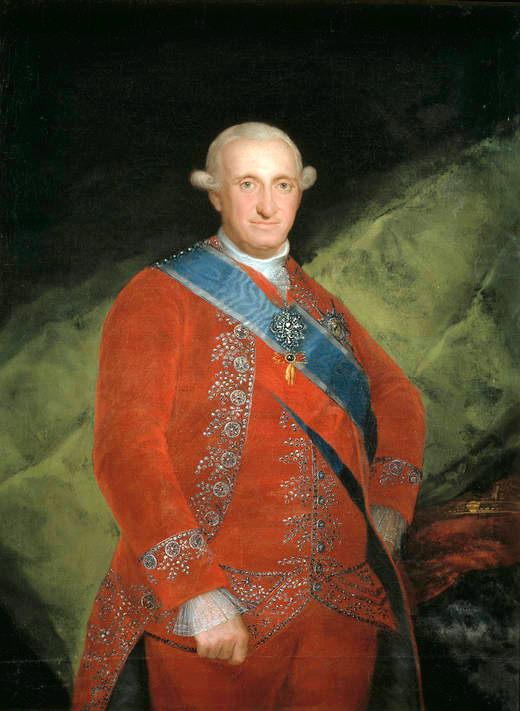
Carlos IV: “¡No Mas!”
Anyway… moving foreward a few decades … the Bourbons broke off their Italian domains into separate kingdoms, mostly so they’d have relatives to marry it appears. When Napoleon invaded the Iberian peninsula, the ruler was Carlos IV… at least in theory. The real ruler was Manuel Godoy, the toy-boy of the king’s cousin and wife, Maria-Luisa of Parma (who, was not from one of the Spanish owned hunks of Italy, but was from the French side of the family). Godoy had switched sides in the Napoleonic Wars too many times to be trusted, so Napoleon decided to just turn the place over to his own family. Carlos IV was forced to abdicate in favor of his son Ferdinand VII, who was locked up in a French Castle while Spain was ruled by Joseph Bonaparte, under the official name of José I, but better known as “Pepe el borracho” (the Spaniards never did take their kings too seriously).
With a choice between two not-so-well thought of kings (Pepe the Drunk and Ferdinand the Felonious), the Spanish ruled territories in the Americas took advantage of the situation to get rid of both of them. It was a bit more difficult in Spain itself, but with Napoleon (and Pepe) going down, they would only let Ferdinand back IF he signed a “liberal” constitition. Needing a job (and to get his hands on the national treasury), Felonious Ferdinand — then took it back — AND (a few wars and various peasant massacres later) died with only a daughter to succeed him.
This is where those pesky Argonese.. and that Semi-Salic Law comes in. Aragon had always had full Salic Law (only kings, no queens), but Ferdinand had forced through a change, allowing that daughter to ascend the throne as Isabella II. The Argonese — as much to restore their own independence, joined by liberals, “agitated” for Ferdinand’s brother (his nearest male relation) instead of Isabella, launching the Carlist Wars of the 19th century… whose slaughter puts the American Civil War and the Mexican War of the Reform of the mid 19th century to shame.

Isabella II: Adios
Isabella tried absolute rule, but those days had passed, and there had already been one liberal constitution (for a short time) and there was the Carlist alternative out there. Forced to make liberal reforms to hold on to power, she relied mostly on the Army, which had its share of reformers as well. By 1868, throroughly sick of the Borbons, Isabella and her brood were sent packing. However, with coups and counter -coups and counter-counter-coups going on, the Spanish Parliament didn’t get around to forcing her to abdicate until 1870, when she named her only surviving son, Alfonso, as her heir. By the way, whether Alfono, or any of Isabella’s other eleven children were fathered by the royal consort (yet another relative, Francisco de Asís de Bourbon y Bourbon) has been a matter of speculation for the last century and a half. Francisco was gay, and there are rumors that Isabella was regularly … ahem… drilled… by an American dentist living in Madrid. And any number of Spanish officers and courtiers.
Anway, the Spanish parliament wasn’t about to trust the family again, so brought in a relative outsider (a distant relative anyway), Amadeus of Savoy, who as King

Amadeo: You People are too much…
Amadeo I, quickly tired of dealing not just with Carlists, but with Republicans and revolts in Cuba … and abdicated in 1873 appearing before Parliament to declare the country was ungovernable.
The First Spanish Republic pretty much proved him right, lasting less than two years, by which time the infighting within the Republican leadership, coupled with those pesky Carlists, the uppity Cubans (and a muslim uprising in North Africa) convinced rightist officers to stage a coup bringing back Isabella’s son, Alfonso XII.
The deal with Alfonso was “turnismo”… the”liberal”and “conservative” parties would alternate in power, which at least created some stability in the government, and let the army get back to putting down rebellions and nationalist uprisings. Or so it would seen, though Alfonso died when he was only 28, leaving his widow, Maria-Cristiana of Austria, pregant with Alfonso XIII. Even in Spain, you can’t make a fetus the king, so Maria-Cristina stayed on as regent (and oversaw Spain’s loss of the Phillipines and Cuba in the Spanish-American War of 1898) until Alfonso was 16.
Alfonso was one of those guys who just never did the right thing, even when he tried. In selecting a queen who wasn’t a close relation, he looked to the Protestant ruling families of northern Europe, settling on one of Queen Victoria’s grand-daughters, Victoria Eugenia of Battenburg. Queen Ena, as she was known, carried the hemophelia gene which was inheritied by the oldest son, Prince Alfonso. A second son, Prince Jaime was deaf. The third son, Prince Juan would be the most likely next king… if…

Alfonso XIII… So, I fucked up a little…
In 1923, right-wing general Primo Rivera seized the civilian government… which was fine with King Alfonso. A dictatorship made for easier relations beween crown and government. Nothing had to change. The 20s, being an era of nothing but change, that hardly sat well with a lot of Spaniards. And, with the start of the great depression, economic hardships and massive unemployment the people turned on Primo Rivera and the King. Primo Rivera resigned and Alfonso did what so many other Spanish kings have done.. abdicate in favor of his sons. Not that it mattered, the Second Spanish Republic got off to a shaky start and the fact that the hemophiliac Alfonso and the deaf Jamie also abdicated their rights, and the now non-existent throne was the least of the new republic’s problems.
Prince Juan, who would always claim he was Juan III, King of Spain, had the title of Count of Barcelona. He attempted to take part in the Francoist war on the republic (which claimed, among other things, to be restoring the monarchy), but was considered too “liberal” by the Francoists to be trusted with actually being in Spain. He’d spend the rest of his life in Fascist Portugal, raising his family with the understanding while he would never actually reign, his eldest son… Juan-Carlos … might.
Whether Juan expected Franco to last as long as he did, or whether he expected the Fascist regime to continue, is a matter of some speculation. On the one hand, being considered “too liberal” by Franco, he may have groomed his son to steer Spain towards a more modern and open post-fascist government. On the other, Portugal’s fascist government was only overthrown the year before Franco died (and yes, he’s still dead), so how much practical experience he had had, or witnessed, of a transition to a democratic state is questionable. It’s assumed he continued to advise Juan-Carlos, following the latter’s appointment (by Franco) as “Prince of Spain” in 1969, when Juan-Carlos took an oath to uphold the then existing political system. It is known that the Prince met with exiles and dissidents during Franco’s “regency” and may have known of the plans to assassinate Franco’s Prime Minister, Luis Carrero Blanco. Also in his favor, one of his first acts as King after the restoration was to fire Carrero Blanco’s successor, Carlos Arias Navarro.

Juan-Carlos: Don’t, don’t you need me?
While his now-controversial role in an attempted military coup is still open to debate, Juan-Carlos generally got good marks for.. as did Alfonso XII, quietly accepting a transition in power between liberals and conservatives: in contempory Spain, the Socialists and the successor to the Francoists, the People’s Party. Unlike Isabella, he has stayed on the sidelines (at least officially) in political affairs. But, like Isabella, has the old Kingdom of Aragon (which includes the Basque Country) chafing under centralized Bourbon rule. Like Alfonso XIII (besides marrying into the Battenburg, now Montbatten, clan) he has seemed more comfortable with a rightist government, and as Alfonso XIII found out, is reigning over a country going through massive economic hardships.
And, like Felipe V, Carlos IV, Isabella II, Amado, and Alfonso XIII, he is having to abdicate. Whether there will be a Felipe VI … monarchs come and go… and in Spain, they mostly go.
Dancing in the streets…
I don’t even know if this band has a name… as long as I’ve been coming to Mexico City, “The Blind Musicians On calle Motalina Outside Metro Allende” give the sandwich stand opposite the best floor show in the city. By the way, this is about 7 in the evening on a Tuesday. Which is no excuse for turning down an invitation to dance: I don’t know if you can see it (this was the first time I ever tried filming with a cell phone), but the second couple is an elderly well-dressed cabellero, honoring the street vendor’s invitation.


 mexfiles.net