Whitewashing is not reform
As in the United States, the major news media ignore, for the most part, dissenting and independent political and social voices. And those who appear as experts and pundits have long since been suborned by the subsidies available to the media monsters and their political and financial allies. The interests of investors and the ruling political class eclipse those of the vulnerable and unrepresented: Indians, women, children, farmers, the under-employed, under-fed and public needs like meaningful education, security reform and state support for the Rule of Law.
In a disturbing development in the telecommunications reform, the President and the Secretary of the Interior will have the power to censor Internet communications, including email, Twitter, Facebook messaging and others.
In this trend, censorship poses as modernization; and dictatorial control, as democracy.
The PRI and the two media monopolies Televisa and TVAzteca—Charybdis and Scylla.
(Denise Dresser, translated by Sterling Bennett…. translation here)
Musicians of Roma Norte unite…
Via Lydia Carey (Mexico City Streets), the “Oaxaca Brothers“… this morning in Parque Rio de Janario:
My question is when are they gonna put out a CD?
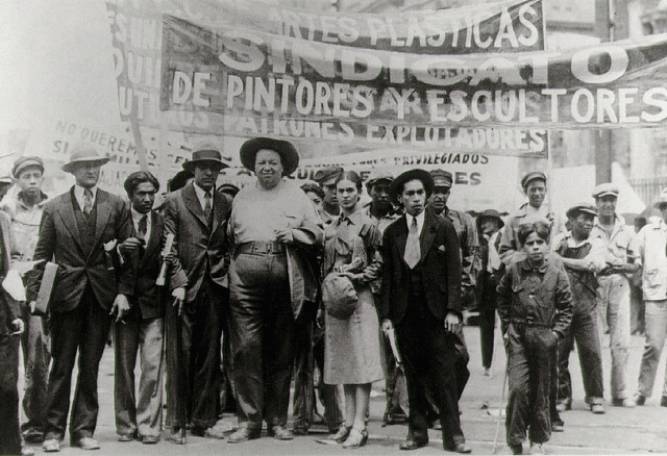
1° de Mayo
Oticpolohqueh ce hueyi nahuatlahtolmatini*
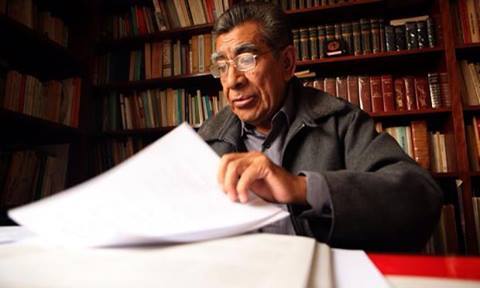
Photo: FIL/Guadalajara
Librado Silva Galeana… one of the great scholars of modern Nahuatl… has passed away. The respected Tlamatini (teacher) toiled for years not only to preserve his own native tongue, assisting in translating basic school texts and legal documents into Mexico’s second language, as well as the works of William Shakespeare.
*The Nahuatl people have lost a great teacher
Open communications
Wish I could have been there…
Opposition to the “reforms” in telecommunications which basically lock in the media monopoly held by Televisa and… much worse… give the Executive branch of the federal government the ability to censor media (and personal communications) for undefined “security” reasons from across the board. Not only conseratives (like Senator Javier Corrall), but the Cardenás family (Cuautemóc and his son Lazaro) from the traditional left, Catholic intellectuals like Javier Sicilia and mainstream journalists like Denise Dresser… along with a smattering of everyone else.
Protests in Saltillo were led by Catholic priests, and there were major protests in several major cities.
Democracy does not end at the ballot box… heck, it hardly begins there (as perhaps Andres Manuel López Obrador would remind us, though still recovering from a heart attack, he spends more time going to court than to the streets to protest the administration).
Here and there: a tale of two protests
I’m not sure how long the Washington Post’s Joshua Partlow has been in Mexico but it can’t have been very long, since his reportage had Kabul datelines late last month. At any rate, he seemed taken by surprise that demonstrations are an everyday occurance in Mexico, even in the rather pricey environs of Coyoacán:
Democracy here is practised in the street and very much out loud. Seemingly every day someone is protesting something, chanting grievances, thrusting banners, announcing “yes we cans,” even if they probably can’t.
Mexican soccer players have worn paper bags over their heads to protest unpaid wages. Topless women with blue handprints painted over their breasts have marched for women’s rights. Jugglers, dancers and clowns have raged against a new rule banning animals from circuses.
They protest Mexico’s oil policies. U.S. immigration rules. Rising subway prices. Education reform. They have marched in opposition to the drug lords’ rampant killing and kidnapping, and in opposition to the arrest of said drug lords. They block toll booths. Airports. Highways.
There are thousands of protests each year in Mexico City alone: Hunger strikes. Prayer vigils.
He needs to get used to them if he’s going to live here. People have a right to “struggle” in their common interest… and do. Every day. The A.M traffic reports not only give you the weather and accidents, but warn commuters of any planned demonstrations… just a fact of life in a capital city. This isn’t Washinton DC (which, like any national capital, can expect more demonstrations than most towns) but it is a city where drive time AM radio includes not just the traffic and weather report, but the demonstration report.
Demonstrations are much less common outside Xico, Veracruz, where — as Esther Klein Buddenhagen writes for “From Xico” — there is a “rural population of farmers and small shopkeepers and herders,” … but the principle is the same… it’s called DEMOCRACY … and sometimes the issues are similar as well.
Parlow’s new neighbors are protesting a recent decision to install parking meters. Not being famers and small shopkeepers and herders, but people who own private automobiles, some in toney Coyoacán simply can’t fathom the idea of paying “about 60 cents an hour throughout a neighbourhood where residents have been accustomed to parking free.”
Esther’s low-time neighbors are upset that the only bus company is raising its rates on local routes to about 4 dollars.. instead of an agreed upon 1.80 (US). Esther puts that in context, noting that the average minimum wage in the region is about 90 pesos a day (6.79 US), meaning a worker would be paying close to 60 percent of their daily income just for transportation from one mountain village to another. Partlow doesn’t give any indication of the income level of his neighbors, but it is included among those areas of Mexico with the highest standards of living on the planet… about equivalent to Germany (and with a lower GINI gap than the United States).
Not to say Partlow’s neighbors might not have a legitimate issue. Some object to parking meters on aesthetic grounds, given the historical signficance of the area, and, as it developed, installation of the meters has been temporarily suspected until impact studies are completed by INAH (the Spaish acronym for the National Institute of Anthropology and History) and Partlow doesn’t note that meters are being installed in similarly auto-rich, but space poor wealthy areas like Polanco and Roma Sur (also over the protests of local car owners), nor that there is a web of public transportation available at subsidized prices in Mexico City. He missed the huge (and much more disruptive) protests when the metro and metrobus fare was raised to five pesos (about .04 US) … where overall, the average income is said to be about 7000 dollars a year and despite the higher wages and standard of living… the jump from 3 to 5 pesos was a jolt to people’s pocketbook.
What I noticed also about the two protests was that in Socialist-run Mexico City, the residents are objecting to a classic capitalist, or perhaps “Libertarian”, solution to a social problem. Parking space is limited, automobile ownership has grown expontentially in Mexico, and it’s a “user fee” rather than a tax. Whereas in Veracruz, what those poor “herders and small shop keepers and farmers” are demanding is a capitalist solution The state grants concessions for the bus companies, and the protesters are favoring the classic capitalist solution… more competiton. They demand a more open market for bus service, which would, in their view, bring the cost of travel down to a more reasonable (though still outrageously high) 25% of the average daily wage.
A couple of “take-aways” from the tale of two protests: that even a very good writer like Partlow is bound to miss the “whole story” when focusing on any specific event — we learn that Mexicans tend to demonstrate for any number of reasons, and articulate their rationales for their protests quite well, but very little about the transit issues of a complex country. We can’t… when thinking about any public issue in any part of the world, depend solely on the “official” stories, but need to hear from those voices (almost literally in the wilderness) like Esther’s.
It also means that in a complicated country like Mexico, and when thinking about a broad issue like transportation, one size does not fit all, and assumptions on how a given social class will act in any given situation, when based on our assumptions about economic theory, are nonsensical…poor people might very well see a “capitalist” alterantive and richer peoople a “socialist” one when it fits their needs.
And, of course, it means that there is no one Mexico, and one should never assume that any one writer, or one source, has the whole story. Not even me.
O tempores, o mores!
For those not up on Mexican politics, the scandal de jour in Mexico City is within the PRI, where party chair in the Federal District was accused of putting prostitutes on the payroll at party headquarters. That years ago, the PRD controlled District Assembly made the area around the PRI headquarters a “zona de tolerancia” sort of makes this a “Lieutenant Reyault” type scandal (“I am shocked, shocked….”) and that Mexican classified advertisements still often include with a wink and a nudge the “other duties as required” for female workers (in which less is said about typing skills or familiarity with word processing than the age, “good appearance” and … ahem… “open-mindedness” sought), AND… that the accusations of sexual exploitation initially came not from the workers themselves but from the PRD made me dubious that this scandal would amount to anything.
After all, sexual exploitation by the powerful has long been a fact of life in Mexican politics, and tacitly accepted. As I mentioned in Gods, Gachupines and Gringos, the rather absentious Aldolfo Ruiz Cortines (who, incidentally, push through the constitutional change providing for women’s suffrage during his term in office) was ridiculed for being the kind of man so uptight, that even his mistress was respectable. And, that while U.S. presidents are never particularly popular here, Bill Clinton’s esteem among Mexicans went up noticably after the “Monica Lewinsky” scandal… in good part because it gave form to the sense that the gringos are “God’s Frozen People”… sexually up-tight, puritanical, and hypocritical.
Times change, even in Mexico. Certainly we have to factor in that Cuauhtémoc Gutiérrez de la Torre is almost a carricature of a political hack…” heavy-set as an ox” (to quote The Economist), his inheritied his other job as head of the garbage-collector’s union from his murdered father, the fabled “Trash Tzar” Rafael Gutiérrez Moreno. Gutiérrez Moreno was something of a Jimmy Hoffa figure… on the one hand, earning respect (and decent wages) for the workers he represented (and garbage-collecting is not exactly a high-status occupation) … and on the other, earning himself a sizable personal fortune by offering the workers he represented as muscle for the political establishment — which in his day, was the PRI.
But, with the PRI trying to present a “clean” image … and incidentally, break with its past as a labor party in favor of a more pro-business (and, specifically pro-foreign investment) party… the old-style union/party bosses are something of an embarrassment to the establishment. Not that corruption is so much a problem (see PEMEX union chief, Carlos Romero Deschamps), as corruption that inconveniences the party. The PRI is only the third force in Mexico City politics, and in a bid to attract the more desireable (and growing) middle-class voters, as well as conservatives, it can’t afford a physically unattractive and quasi-comical figure like Gutiérrez de la Torre leading the party, and dominating the news cycle.
The real Hoffa of Mexican unions and politics, of course, was Elba Esther Gordillo — another pol whose physical appearance was always ripe for comedy — and whose non-union activities made her a liability to the party. That she was “corrupt” was never in doubt, but that would have been overlooked (as it is with Romero Deschamps) if she had been able to keep her union within the PRI fold, but… during their decade in the wilderness after Vicente Fox’s election… she had cosied up to the wrong party, and — when forced out of the Party — founded her own, client-based New Alliance Party.
And, like Rafael Gutiérrez Moreno (and Jimmy Hoffa for that matter) she had groomed an heir.
While the New Alliance Party is not, and probably never will be, more than a minor force in Mexican politics (useful mainly for throwing votes to PAN or PRi whenever the left appears headed for a victory), it does get enough votes to hold a few proportional seats in the Senate. The Senate leader is Gordillo’s daughter, Mónica Arriola.
 As a party founded by a woman, perhaps PANAL (the New Alliance’s Spanish acronym) is more attuned to women’s issues, and perhaps as one founded on labor clientage, it does feel some obligation to support workers’ rights, but what I found interesting was that it is Senator Arriola who is pushing at the national level for a better deal for prostitutes.
Not only to avoid scandals like the Gutiérrez de la Torre mess, but all too common situations like that written about in last week’s Sin Embargo, in which three men — two of them city employees — in Tabasco State were arrested for pimping out 13 year old girls, the Senator has introduced a bill that spells out the rights of sex workers, including those that would be imposed on their clients.
It’s actually not a bad bill. The workers would be able to set their own rates, and would have to be paid in cash… and working conditions would have to be “hygenic, sufficient, and in conditions that protect the life and health of the worker”. Clients would be required to “respect the wishes of the sex worker” during any transaction, and the Secretary of Health could impose such regulations as necessary.
One wonders, given that the strongest sex worker’s union in the country (here in Mexico City) sides with PRD, whether this isn’t a clever way of bringing back union clients to the parties… after all, politics is the oldest profession.
A miner incident
We need another Lazaro Cardenas:
(From Sterlingbennet.com: “Seven Murdered Miners“)
While the organizers were being murdered, a truck with men, women and children drove by, witnessing everything. The mine management wanted to crush efforts at organizing, an activity that was necessary because conditions in the mine was terribly dangerous because of unnecessary cave-ins and the lack of ventilation—which meant miners suffered terribly from silicosis by breathing particles hanging in the air.
Some time later, a miner by the name of Vicente Uribe managed to murder Mr. Quinn at the Dolores Mine. The union whisked Uribe off to Mexico City and hid him there, protecting him from the authorities—who, it was said, accepted the murder of union organizers but not of American mine managers. As the story goes, American President Roosevelt complained to Mexican President Lázaro Cárdenas that miners had murdered an American mine manager, and Lázaro Cárdenas had replied that the American-controlled mine had murdered seven Mexicans.
Sterling is writing about the “incident” in April 1937, in which seven stike leaders at Cubo mine in Hidalgo, Guanajuato State were murderdered while trying to organize for better safety and working conditions. Conditions have somewhat improved since 1937, but not all that much. And the authorities still tend to overlook violence against labor, especially when foreign interests are involved.
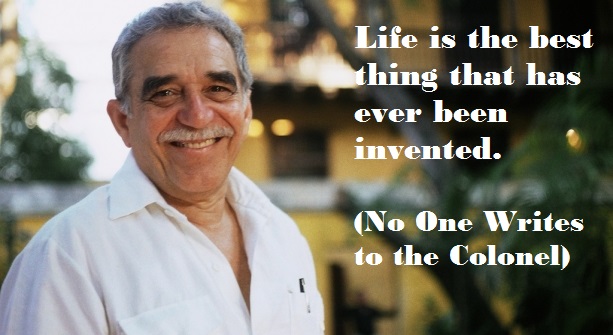
Gabo said it best
Another mestizo

Khumba, a Cebrasno” (“Cebra y asno” … Zebra and donkey), the first-born of Rayas the Zebra and Ignacio the Donkey was born at the Reynosa Zoo, 21 April, weighing in at 30 Kg. .
News from nowhere…
If you aren’t linked to Mexican Journalism Translation Project, you should be. They’re doing a bang up job of making this site rapidly obsolete. Although originally intended just as cultural and historical observations and comments, by necessity, The MexFiles often translated news stories and political commentary that was missing from U.S. and English language media… and over the years, I have occasionaly had complaints when I try to stick to the “mission statement” of writing not just about politics and news, but about “history, culture…and the general weirdness that usually floats down from the north” instead. MXJTP is designed to do what I have been doing just on the side, so really recommend that those reading this site simply for politics and news look there first.
Here is a story, originally published in Ecuador, on immigration issues largely ignored… or only mentioned in passing in the U.S. media: the unescorted (and unprotected) minor migrants passing through Mexico on their way to join family already in the U.S. Original story by Lineida Castillo for Ecuador’s El Comercio, translated by Debbie Nathan
Noemí was on her way to meet her parents, who had left her ten years earlier to look for the “American dream.” Last 11 March, two months before her twelfth birthday, Noemí was found dead in a room in a house in Mexico. A District Attorney in Mexico determined that the child had committed suicide, hanging herself with a shower curtain in a shelter where she had been taken after being caught with a smuggler who was trying to take her to the US.
The trip was her second attempt. In August, Noemí had left her native Molino Huayco, El Tambo for the first time. She lived in Tambo with her grandparents Cipriano Quillay and María Guamán. On her mother’s instruction, the little girl was put on a regional bus to Tulcán.
My favorite Colombian

This is my all-time favorite photo of Gabriel Garcia Marquez. He’d just been punched out by Mario Vargas-Llosa at a literary do at the Palacio de Bellas Artes in Mexico City (I’m across the street from the Palacio right now). Rodrigo Moya, the photographer, was the 16 year old son of one of Garcia Marquez’ friends when he took this photo in Februrary 1976.
Previous posts on GGM here:
GGM biography (with music by Oscar Chavez)
GGM (and other) Latin fiction readers
Latin American Nobel Literature Laureates
Garcia Marquez read-a-thon in rural Sinaloa
AND…
FREE GARCIA MARQUEZ WORKS FOR DOWNLOAD!!!!!!!!!!!!!


 mexfiles.net