Booby prize
Via Buzon Xalapa (my translation):
As many will recall , during his campaign for the presidency, Enrique Peña Nieto was roundly criticized by actors, musicians , people in general and intellectuals, prominent among them the late writer, Carlos Fuentes.
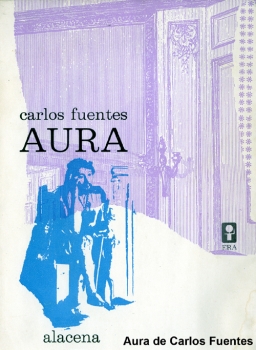 The celebrated author’s most stinging criticisms came after Peña Nieto, speaking at the 2011 Feria Internaciónal de Libros (one of the most prestigious book fairs on the planet), failed to name three books that had influenced him; and worse, confusing Fuentes with Enrique Krauze*.
The reaction by the author of the Aura (a novel every Mexican with a High School education has read at least once), was swift and stinging:
This man ( Peña ) has the right not to read me. What makes him ineligible to serve has President of Mexico is his ignorance… I’m serious.
Since then the wave of ridicule against the politico has been unstoppable. Even after a year in office, no matter what he does, the President is mocked for his lack of culture, and labeled as stupid and inept.
What has been Peña Nieto’s revenge?
According to sinembargo.com, it was the cancellation of International Carlos Fuentes Prize for Creative Writing, established by the previous administration, and first awarded to the admirable Mario Vargas Llosa admired . Peña Nieto and [Council for the Arts and Culture President Rafael] Tovar y de Teresa may argue that the $250,000 (U.S.) prize is too expensive for the country. OK… lower the award to fifty thousand dollars. Or, if economic is the issue, make the prize purely symbolic. No one would criticize that. For a any writer, an award that bearing the name “Carlos Fuentes”, even if no money comes with it, is an honor.
The Premio Internacional Carlos Fuentes a la Creación Literaria was to have been awarded on the 11th of November 11, but wasn’t… and won’t be. According to the website, this just proves that the politician, is indeed only uncultured… as well as spiteful and vindictive.
* In U.S. terms, the error was someone on the order of confusing Gore Vidal with John Jakes.
As expected, the number of companies pulling out of mining operations in Mexico due to a higher royalty tax so far has been… zero. Two typical press releases from my in-box today:
New mining taxes in Mexico will not derail Toronto-based McEwen Mining’s (NYSE, TSX: MUX) investment in the country, CEO Rob McEwen told the Cowen Group annual global metals, mining and materials conference in New York.
The charges, which include a 7.5% tax on mining sales minus certain deductions and an additional 0.5% gross revenues tax on precious metals mines, will increase the company’s costs, McEwen told the event, “but won’t slow down our exploration.”
“I am a big fan of exploration,” he added. “Companies that cut back on exploration are giving up their future.”
The company’s capex will also remain the same, he said.
While the exact impact of the taxes on McEwen Mining is not yet known, the cost is likely to be “under US$1mn” next year, McEwen said, with part of the cost “offset by contributions and investments in the local community.”
Toronto-based Agnico Eagle Mines (NYSE: AEM) aims to continue expanding its Mexican business beyond 300,000oz/y gold production despite new mining taxes, corporate director of business strategy Dmitry Kushnir said.
There is a “definite objective to grow the contribution” of the company’s Mexican business, Kushnir told the Cowen Group Annual Global Metals, Mining and Materials Conference in New York on Tuesday (Nov 12).
The continued growth plans come despite tax reforms which include the introduction of a 7.5% mining tax, based on sales minus certain deductions, and an additional 0.5% gross revenues tax for gold, silver and platinum mines.
The reforms were passed by the senate in October and are expected to become law from January 1.
So, what did you do on your Mexican vacation?
I think the tourism officials expect that at least a few tourists are going to change their plans (and, maybe their beliefs) after a few days in Mexico, so I don’t think anyone’s ever been held to strict accuracy when they fill out their forms… nor that anyone is going to check up on them any time in the near future.
Here’s Fidel Castro’s October 1955 application … in those days you had to list your religious affiliation ( “Catholic”? … meh… close enough) and your purpose in visiting the country. “For a rest” … well, the rest, as they say, was history.
While working (not the first, and not the last tourist to extend his vacation with a bit of under-the-table work) as a photographer, Castro trained and organized the M-26-7 (Movimiento 26 de Julio) … getting his men into shape by strolling up and down Refoma avenue (the high altitude was hard on those Cubans, and on that Argentine doctor they brought along with them) before moving to the gym, and then out to the country for some field training, then squeezing 89 guys into a second-hand boat… and…
Some vacation!

What’s in a name?
Now here’s an idea… changing the official name of Mexico City to “Mexico City”.
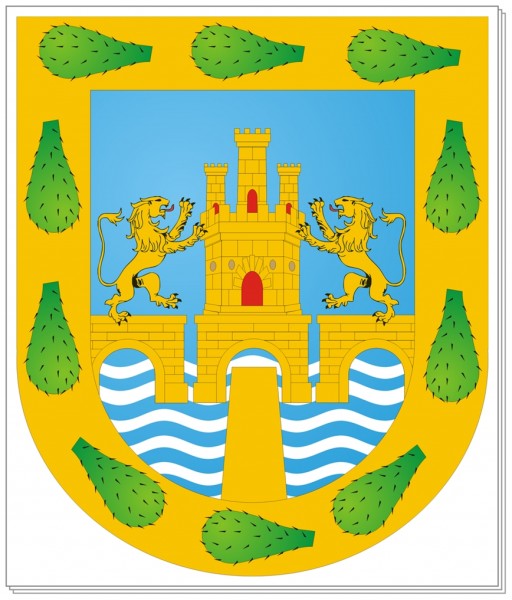
Federal District Coat of Arms. I suppose that can stay, under whatever the new name is.
Since 1824, the Capital of this country… following the custom set by the federal republic to the north, has not been in any state. While the metaphorical Ciudad de México is pretty much contiguous with the “Distrito Federal” (0r… for a short time during the Revolution, when the Capital was Qúeretaro, the Estado de Valle de México) no one has ever made a logical case for not calling Mexico City “Mexico City”.
Although, unlike the United States, at independence there were no competitors for the site of the national capital, the U.S. had set the model for American Republics … especially large ones with varied regional interests… and everyone just bought off on the assumption that the national capital should be under direct control of the central government. Thus the Estados Unidos de Mexicanos created the Distrito Federal, modeled on the U.S. District of Colombia. Like the District of Colombia in the United States, local governance of the Distrito Federal was not in the hands of local voters, although in 1996, the Distrito Federal acquired not just a locally elected administration, but — unlike the District of Colombia — voting representatives in the national Congress.
Even with that change, and despite having a larger population than several states, the Distrito Federal … not being a state and with a few local officers (notably the police chief) still appointed by the Federal Executive, a distinction was made between the Federal District and the states just… well, just because.
Unlike the United States, the internal structure of state governments (things like whether there is a bicameral or unicameral legislature, etc.) are set by the Federal Constitution. Although for all practical purposes the Distrito Federal’s governing structure is just a a cut-and-paste from the constitutional provisions covering state government, there were a few cosmetic changes: mostly just names and titles. States have “Governors” ; the Distrito Federal has a “Jefe de Gobierno”. States have “Legislaturas”; the Distrito has an “Asemblia”. States have “municipios”; the Distrito Federal has “delegaciónes”.
Which is rather silly. Proposed constitutional changes, opposed by… well, no one really… would create a 32nd state from the Federal District, with “Ciudad de México” as its capital. One glitch, and about the only thing that might be even a bone of contention is what to call the place. There is already a state named “México”, and there would have to be some better name for the one with the federal capital and the big city called Mexico.
Chilangolandia?
History comes alive… in an arrogant, arbitrary and ignorant fashion
José Ortiz Urenda, a well known impersonator of independence leader Miguel Hidalgo, was arrested in Guanajuato last Saturday.
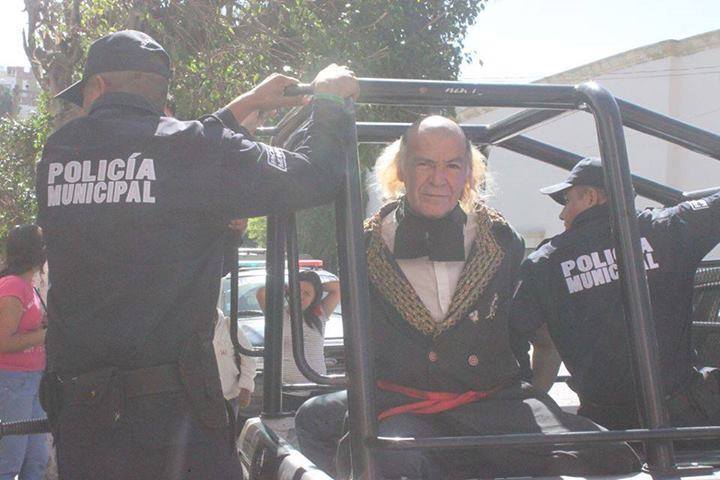 Interviewed after his release by Alberto Martinez of the regional daily, AM, Ortiz called the local police “arrogant, arbitrary and ignorant”, and stoutly denied any wrong-doing. He was arrested for “scandalizing the public”. My sense is that municipal authorities were a tad worried that a guy shouting “Death to bad government!” might be taken at his word.
After all, the original Hidalgo was… but then again, the original Hidalgo’s head was eventually chopped off and hung from the Alhondiga here, so Ortiz is probably lucky he got off with just a 150 peso fine for “brandishing a flagpole”.
Lozano, Santiago. “Nació para ser Miguel Hidalgo“, El Sol de Leon, 2 October 2011
Martínez, Alberto. ” ‘Hidalgo’ se defiende de acusaciones“, AM, 12 November 2013;)
That famous Mexican inventor, Tomás Alva Edison… ¿QUÉ?
Birther conspiracies are nothing new. The gringos have been covering up… so it is claimed… the Mexican heritage of the inventor of the light bulb, the phonograph, the motion picture camera, the voting machine, the electric chair, etc. … since at least the 1870s.
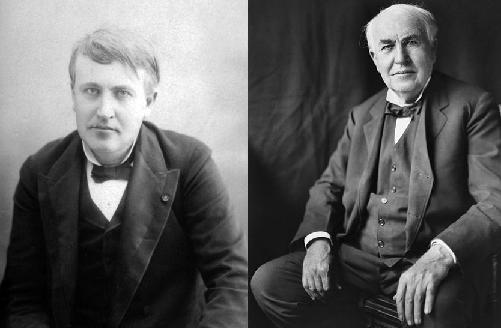
¿Soy mexicano?
Thomas Alva Edison we’re led to believe, the son of Nova Scotian Samuel Ogden Edison and his wife, the former Nancy Matthews Elliott of Chenango, New York, was born in Milan Ohio 11 February 1847. Or was he?
According to an article in the October 1956 “The Theosophist” by Alberto de la Peña Gil, the inventor was the son of not Samuel Edison, but of Samuel Alva Iztlixochitl. We do know that “Alva” is not a name one would expect Canadian or western New Yorkers with family names like Edison or Elliott (and middle names that also indicated Anglo-Saxon heritage) to give a child. However, English names aren’t uncommon in the mining regions of Mexico, and in the mid-nineteenth century there was an Alva Edison family in Sombrete, where there is (or was) a plaque on the house claiming to be the birthplace of “Tómas Alva Edison” on 18 February 1848.
A variation on the Edison birther story has Thomas Alva Edison having been born inLagos de Moreno, Jalisco and adopted by Samuel Ogden Edison. Who probably was never in Mexico, it more likely he just slipped into the United States after he fled Canada in 1837, following a failed uprising against the Crown .. . but then how much do we know about Samuel Ogden Edison? Maybe he was in Mexico, or maybe some of his relations were also involved in the McKenzie Revolt, and had fled to Mexico… and perhaps Tomas Alva was a nephew… or for that matter, was — as variations on the Edison birther story has it … born in Lagos de Morelos, Jalisco or even Pachuca, Hidalgo as Tomas Alva.
Why, if his parents were the Anglo-Saxons that have always been claimed, did Thomas Alva Edison claim his ancestry was Dutch? Why did Edison tell people he learned Spanish in preparation for a (never undertaken) trip to Portuguese-speaking Brazil , and who was Edison sending telegrams to in what was then a backwater town, San Martín de los Pyramides, receipts for which were among his papers? And why among Edison’s papers ar there no baptismal or school records and certainly no birth certificate … long-form or otherwise?
It would be irresponsible not to speculate, ¿verdad?
Sources:
Tomás Alva Edison ¿Mexicano? (Mitófago.com.mx)
Thomas Alva Edison (The First Electronic Church of America)
Thomas Alva Edison (Eddie Martinez)
de la Peña Gil, Alberto: “Edison Was Born in Mexico” (The Theosophist, October 1956, reprinted by Eddie Martinez)
Cut off your foot to spite your face…
In the politicized shouting match over changes in U.S. health-care (or rather, how to pay for health care), one issue that has been largely overlooked is avoiding unnecessary and debilitating medical procedures which could be treated more effectively if not for political issues.
Heberprot-B, widely used to treat diabetic ulcers has dramatically lowered the need for amputations… reportedly allowing up to 70 percent of ulcers to be treated at primary care clinics, and showing promise as one of the most effective (and inexpensive) ways to avoid one of the worst … and most common… side-effects of diabetes.
Diabetic foot ulcers are caused by complications of diabetes on the nerve and / or blood vessels. Nerve damage from diabetes causes loss of sensation in the feet. This condition is known as peripheral neuropathy. The nerves that carry pain sensations normally to the brain of the foot is not functioning properly. Diabetics can suffer injuries due to stepping on something, wearing tight shoes, or stumble without knowing it until days or weeks.
Diabetic foot ulcers can vary from a kind of shallow red crater that involves only the skin surface to very deep and broad that involve tendons, bones and other deep structures. In advanced stages, ulcers can develop into an abscess (pus pocket), spreading infection of the skin and underlying fat (cellulitis), bone infection (osteomyelitis) or gangrene. Gangrene is dark and dead tissue caused by poor blood flow.

Over a 100,000 patients have been treated with Herberprot-B world-wide. But not in the United States.
There are three major impediments to making Herboprot-B available in the United States, or even testing the drug: South Florida congressional representatives Mario Diaz-Balart, Ileana Ros-Lehtinen (both Republican from Miami) and Debbie Wasserman-Schultz (a Democrat also representing the Miami area). There’s no question that the drug might be a benefit to diabetics, but … in the words of Congressman Diaz-Balart, “We’re dealing with a state sponsor of terrorism that, at this time, is holding an American hostage…” the so-called “hostage” being the American spy, Alan Gross, who received a particularly lenient sentence in consideration of his health. He’s a diabetic!
While, of course, being the United States, there’s a corporate lobbying effort by one pharmaceutical company (that would substantially raise the price over what it’s sold for in most countries), the surprising thing is that is is another Miami congressman, Joe Garcia who is pushing for a bill to permit … not the importation… but testing Heberprot-B in the United States.
Something of a bellwether of change in Florida politics, Garcia is a first generation Cuban-American (his parents fled the Revolution, but he was born in the United States), who, although a past president of the often reactionary Cuban American National Foundation is a “liberal” Democrat , as supposedly, so is Wasserman-Schultz. Perhaps being Cuban-American, he’s less afraid of the old geezers… in Miami or in Havana.
And his issue has … legs.
Amisad Phillipines-Cuba Friendship Association: “Heberprot-P, a unique drug developed in Cuba for patients with diabetic foot ulcers“
Alberto Buitre: “Cuba: Heberprot-B y el satánico Joe García“
Randal C. Archibold, New York Times: “Cuba Gives 15-Year Prison Term to American” (12 March 2011)
Havana Journal: “Congressman supports efforts to bring Cuban diabetes medicine Heberprot-B to US“
Healthy Logica: “How To Prevent The Onset Of Diabetic Foot Ulcers“
Here lies Felipe Calderón…
The chickens are still coming to roost on the Calderón Administration’s attempts to create legitimacy though acquiescing in the U.S. demands that Mexico “do something” about the U.S. appetite for narcotics, even if it meant a bloodbath in Mexico. Besides the huge breaches in national security and economic damage (not to mention the human toll) caused by the Calderón Administration’s actions, we have to wait for U.S. documents to confirm what we knew.
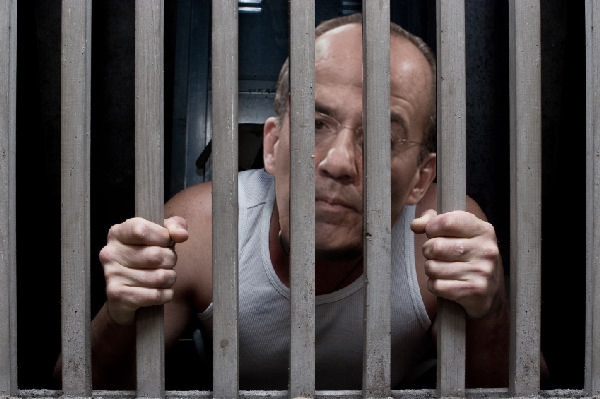 Jornada (translated by Reed Brundage for Mexico Voices) opines:
… the erratic, distorted and hardly transparent [mis]management of information by the Calderon administration was due not so much to deficiencies in public communication, but to an unacceptable desire to conceal. For six years, the public did not have clear and accurate information [from the] federal government regarding the number of detainees, the development of prosecutions and, of course, […] the tragic outcomes of the violence that occurred-and is still occurring-in the country…
A foreign CEO gets it
Samuel Williams, BN Americas:
Planned mining taxes in Mexico may help win community support for new projects, Jason Reid, CEO of US-based precious metals miner Gold Resource … said in a call to discuss Q3 results.
While the 7.5% mining tax and additional 0.5% gross revenues charge for precious metals miners will “hurt” both Gold Resource and the mining industry in Mexico, one positive from the reforms is that it may “encourage” communities to support mine development in their areas, with 50% of the taxes to be directed to mining communities or states, Reid said.
People living close to projects or deposits may “want a piece” of the tax revenues and encourage companies to develop mines in their areas, he added.
Reid said the taxes could help the company make “greater headway” at its El Rey project in Mexico’s Oaxaca state which has been affected by community opposition.
Gold Resource said in August that it was continuing talks with local people the aim of winning support for the project.
The mining companies that have threatened to pull out of Mexico have been blowing smoke out their asses (in my humble opinion). Some may pull out in a race to the bottom as far as environmental and labor regulations (and taxes) go, and the quick buck artists that are going to be selling mining operations in lower cost areas (presuming they can find areas with established mining operations and qualified employees) probably won’t be missed.
Although in some sense, Mr. Reid is talking about “selling” his projects with a little more ease, we’re also talking about making it more palatable for Mexican communities to buy into a project that is going to seriously and permanently impact their community long after the metals are extracted.
And, where there have been social “issues”, they have usually revolved around the miner’s isolation from the affected communities, and the mining operation’s unwillingness to invest in restoration or damage abatement. Think of the savings if they didn’t have to invest in “security” (i.e., hit-men and professional thugs) that seem to be a standard with some foreign firms.
The same old story … Latin American edition
It seems the noisier the professional homophobe, the more likely he’ll be … um… a bit light in the loafers… in need of more closet-space … a ringer for the other team… unable to lift his own luggage …. whatever.
In Colombia, as in Mexico, an attempt is being made to create a second class of legal relationships that are open to persons of the same gender, as a way of preventing the courts from ruling on the constitutional right of same-gender couples to marry. In both countries, equality before the law for persons regardless of sexual orientation is included in their constitutions, and the courts have signaled that they will uphold those rights when it comes to marriage equality.
In 2011, the Colombian constitutional court gave the country’s legislature an ultimatum: Grant same-sex couples the same rights as married couples by the summer of 2013 – even if they didn’t call it marriage – or else all same-sex couples would automatically get access to the right to marry.
Congress took up the issue only to vote down a marriage equality bill and the court’s deadline came to pass.
Well aware that the court had ordered same-sex couples be allowed to legalize their unions, Inspector General Alejandro Ordoñez and the director of the agency overseeing all notary offices came up with a ploy on the eve of the deadline: They invented a “solemn union” form and directed all notary officers not to grant any marriage license and instead have gay couples sign a “solemn union.” In addition, Ordoñez sent private memos to all notaries ordering them to keep track all instances in which a gay couple sought a marriage license and report them back to his office.
Marriage equality advocates saw through the strategy and took a different route: They urged same-sex couples to avoid heading to the notaries and instead they advised them to go before a civil court judge. A notary officer had full discretion in denying a marriage license without having to explain the decision while a civil court judge had to explain their decision in writing and a negative decision could potentially be appealed.
With judicial recognition of same-gender marriages on a case-by-case basis becoming more common, up popped a new organization to halt the march towards equality, Fundación Marido y Mujer (Husband and Wife Foundatin) to file injunctions against couples seeking judicial relief… and… just coincidentally, pay a salary to the founder (and only known employee) of the Foundation, Javier Suárez Pascagaza.
With the courts denying that Funcación Marido y Mujer have any legal standing in the cases involving various couples, Sr. Suárez has been garnering his fifteen minutes of fame in the Colombian media by leading noisy demonstrations outside courthouses.
No one apparently had ever heard of the Foundation, or of Javier Suárez Pascagaza until recently … if you don’t count former students of the Company of Jesus (i.e., the Jesuits) Seminary in Medellin, who remember him as the guy thrown out of the noviciate in 2003 for “openly manifesting his attraction to [other] boys.”

¡Viva Kennedy!
While in practical terms, I think LBJ did more for Mexican-Americans than anyone else in U.S. politics, Mercedes Olivara writes on the tremendous impact John Kennedy’s campaign and election had on Mexican-American voters:
The fact that JFK was Catholic, and his wife spoke Spanish, made an impact on Mexican-American voters. More important, though, Mexican-Americans seemed to have made an impact on Kennedy.
He was the first presidential candidate to recognize the importance of the now so-called Hispanic voter: Jacqueline Kennedy’s political ad asking Hispanics for their votes was the first one done in Spanish by a presidential campaign.
“He was Catholic, and an ethnic with an immigrant history,” said Andy Hernandez, a Latino politics analyst.
The similarities were striking. The Irish weren’t considered Anglo even as late as the 1960s and were known for being part of an immigrant group that had also battled discrimination similar to what Mexican-Americans had experienced.
It would prove to be a narrative that won over Mexican-Americans and may have helped push Kennedy into the winner’s column on Election Night.
Hispanic votes were crucial in several swing states, such as Texas, New Mexico, Illinois, and California, where the margin of victory ranged from less than 1 percent to 2 percent.
“Kennedy got 90 percent of the Mexican-American vote – something unlikely to be matched ever again,” said Ignacio García, history professor at Brigham Young University and author of “Viva Kennedy: Mexican Americans in Search of Camelot.”
“Mexican-Americans had never gone out to vote in these numbers before,” García said.
(¡Viva Kennedy!, The Texas Catholic (10 November 2013)
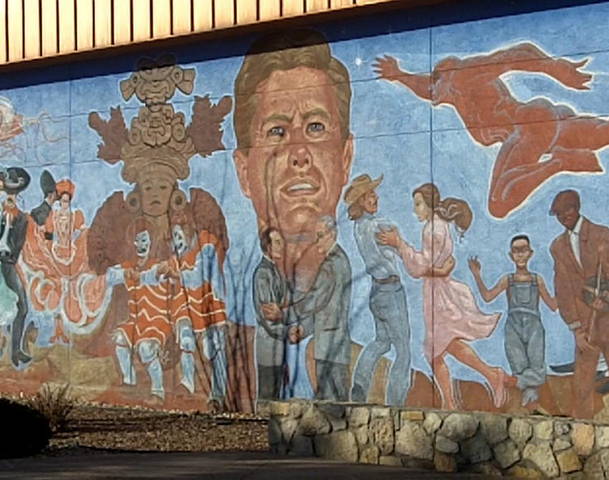
Chamizul National Monument: Although the actual handover did not occur until 1967, the JFK is credited with the Chamizal agreement of January 1963.
Stranger to depend on kindness?
Two images circulating around the internet today caught my attention. First, a video of a raving bigot on a Chicago bus, swearing away at another passenger under the impression that she is a lesbian. Unpleasant viewing, and language not safe for work:
Having taken Mexico City transit at least four time s a day for several years, I’ve seen sexual harassment of various kinds (heck, I even got felt up one time on the Metro) and serious disagreements between individuals carried over onto the public transit system (only once did I see anyone actually get violent), and any number of people making proclamations (usually mercantile, and once in a while political), but nothing like this… a verbal assault on a random passenger, carried on loud and long enough to discomfort other riders. While it’s been years since I’ve been on U.S. public transit, but from the comments on the site where I saw this (Americablog.com) this appears to be relatively common. What struck me was that so many of the commentators (and the original post) mentioned that the other riders not joining in the harassment was a positive thing… as if harassment should have been expected… or that anti-social behavior is normal in public in the United States. More than a few commentators suggested that the driver was remiss in not violently ejecting the rude passenger, or at least “kicking his ass” in retribution.
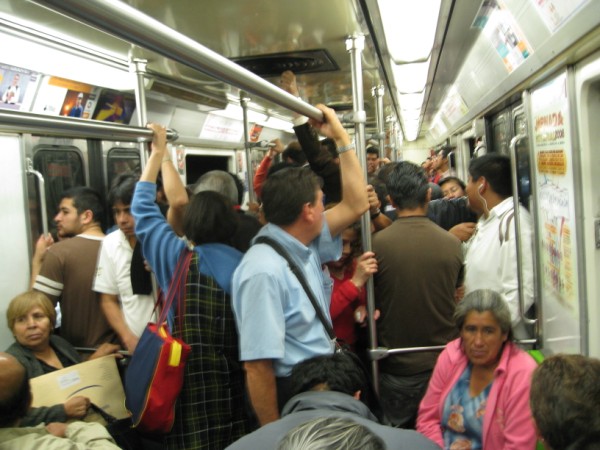
How I traveled at least four times a day for five years.
Living as I do in a society where it is said that violence and dramatic over-reaction is the norm, It’s a shocking image. I don’t mean to say that it is completely unknown for disturbed individuals to act out in public (I have talked before about being followed one afternoon by a junkie who kept throwing rocks at me for reasons best known to herself), only that this is something one would never expect to see on a public bus, or metro car. My sense is that for Mexicans — even in the anonymity of the big city — there is still a sense of community, even if that community is transitory and its members are selected at random… like being passengers together on a bus or on the same Metro car. There are rules of behavior, and we all know them… even the disturbed, the self-absorbed, and the mad.
Oh, people can be jerks on public transit … I once was practically bowled over by a fat little girl (egged on by her mother) to get into the seat I was giving up to an elderly lady weighted down with packages, and I once made a lady cry when she shoved me and I called her a “stupid cow” (vaca estupida.. much worse in Spanish than in English), but those were private disputes, not something to be carried on in public… nor would anyone think of carrying on such disputes in public. It… simply… is… not… done.
Should something like this have happened on a Mexican bus, I’m not sure what the reaction would have been. The victim, as in Chicago, might have answered back, or simply ignored the taunts, and the other passengers would have rolled their eyes, smiled at the victim and shrugged their shoulders… meaning “he’s an asshole, but don’t let it ruin your day”. Were there a few self-appointed cabelleros on board, the most likely scenario would have been a few guys standing in the aisle to protect the victim, and isolate her from her tormenter No asses would be kicked, but the message would be sent out from the passengers… YOU are not one of us. Quite possibly, the driver would stop, and the offender would be removed (exiled for the good of the community), but I doubt there would be any ass-kicking.
I wonder if it is the U.S. sense of individualism, that we are autonomous and jealous of person rights that permits people to accept such behavior as normal, and … if it needs corrected… to presume that some authority figure (the bus driver) is authorized to stop it.
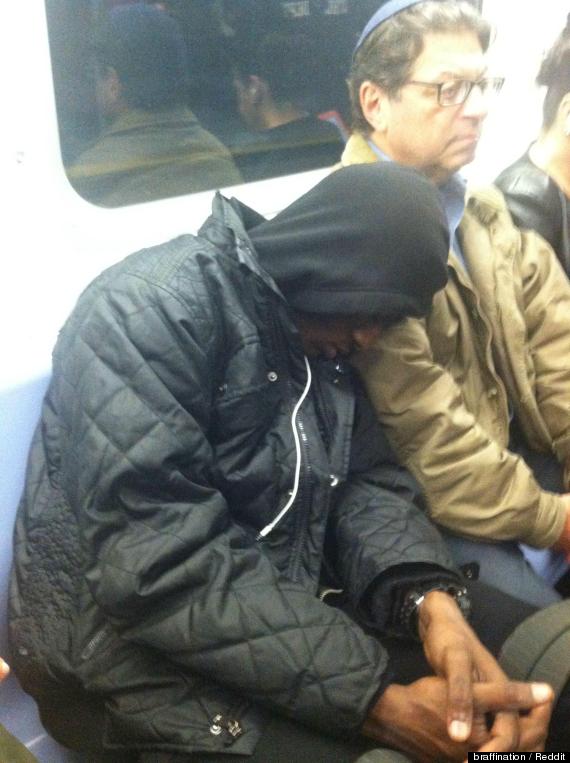 The same day, another popular image taken on U.S. public transit circulated, of a fellow asleep on a New York subway car, his head resting on a complete stranger. I recognize that complicated imagery surrounding the U.S. obsessions with race and ethnicity has much to do with the photo’s popularity (the sleeping man is black and wearing a “hoodie”, the man whose shoulder he is resting on is a Jew with a Yarmulke)… but it raises my question again, although based on a positive image. What is it that makes feeling a sense of commonality with your fellow human beings when sharing a common experience in close quarters (like riding public transit) so rare? Is it really so extraordinary for a Jewish man in New York to not be bothered by the unintentional intrusion into his “personal space” by African-American neighbor? Is that alone what makes it an extraordinary photo… or is it that people in the U.S. so obsessed with their personal autonomy that what would go unnoticed elsewhere… simple human decency… is a “man bites dog” story?
Sources:
Americablog.com, Huffington Post
(Mexico City Metro photo: Bernie’s Travels)


 mexfiles.net