Unintended consequences?
If you’re one of those people who is looking for someone to blame for “illegal immigration” and smuggling that someone is the Border Patrol… and the politicians who wanted to make a show of being “tough” on border security.
Lorena Figueroa reports for the El Paso Times on the dubious results of the 20 year old “Operation Hold the Line” and its successor programs:
Before the operation, Mexican citizens routinely traveled several times a year between the United States and Mexico or their countries of origin. For those living in Juárez, immigrants used to cross up to three times a day to work or shop, Rubio said.
That all stopped in 1993.
Instead of crossing daily, Rubio said immigrants began staying in the U.S. for longer periods of time or permanently, which contributed to the growth in population of immigrants living unlawfully in the country.
By throwing resources (i.e. agents) at urban areas, where there was media coverage (and, incidentally, a labor market that needed temporary workers, as well as benefited from additional consumers), “Operation Hold The Line” simply pushed migration routes into less populated regions, where immigrants were less likely to find remunerative work, requiring “assistance”… and creating opportunities for human smuggling operations on both sides of the border. And, of course, it’s much easier to smuggle narcotics and guns through rural outposts than through the highly-guarded urban crossings.
¡Viva Morelos!
José Maria Morelos y Pavon … born 30 September 30, 1765 (Valladolid, now Morelia, Michoacán)… an afro-mestizo cow-puncher turned priest (Miguel Hidalgo was one of his professors at the seminary) who led the independence movement after Hidalgo”s capture and execution. A more effective military leader than Hidalgo, by 1814, Morelos controlled large swaths of New Spain from Acapulco to Veracruz… and — a thorough-going egalitarian — insisted on including complete racial equality in the 1814 Constitution of Chilpancingo, the first such document anywhere to make such a statement.

“We should do away with the picturesque jargon of black, mulatto, mestizo… and etc., and instead view ourselves geographically, calling ourselves Americans for where we are from, as do the English, and the French and that other European country that is oppressing us, and the Asian in Asia and the African in his part of the world.”
Guerrero…
Via BBC:
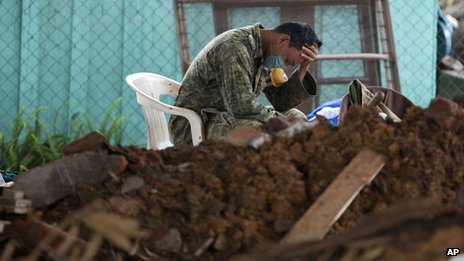
There is no doubt that the flattened adobe houses of La Pintada – just some of the more than 30,000 homes damaged in Guerrero by the storm – are now little more than a mass grave.
But the Topos say they will keep searching through the ruins so that the lost villagers might receive a proper burial.
Elsewhere in the state there are many other mountain communities which are still cut off from the outside world.
Fuera!
 <
<There is a lot to say about our recent disaster(s)… and the fallout — social, political and economic — of the double-whammy hurricanes that struck last week, but one of the weirder scandals has been the fallout over Laura Brozzo’s “rescue mission” on her Televisa program, in which the Peruvian exile (a former mistress of Peruvian secret police chief and chief torturer for the Fujimori regime, Vladimiro Montesinos) flew into the disaster zone in rescue helicopers provided by the State of Mexico… for a “made for TV” event.
For my U.S. readers Brozzo is a female version of Jerry Springer… but with all the wit and charm of Anne Coulter. REAL journalist Carmen Aristegui (CNN, etc.) questioned the ethics of both Brozzo and the officials of the state of Mexico in using rescue equipment … and taking advantage of a traumatized village’s survivors … for a television program.
Which led to Brozzo “calling out” Aristegui, claiming the acclaimed journalist just sits behind her desk in a studio while Brozzo goes into the field, as she did in Peru during an earthquake. Which led to Aristequi and other Mexican reporters checking with Peruvian rescue workers, who don’t quite recall it that way….
… and so it goes. As of this writing, there are something over a quarter nillion signatures on an on-line petition to the Secretaría de Gobernacion (the Interior Ministry) to declare Brozzo an undesirable alien, and deport her back too her native Peru… for being … welll… undesirable.
Much less amusing are the serious issues raised about the misuse of resources meabt for disaster relief for an entertainment program… and the media’s responsiblity to the nation in a time of crisis. More when I return after the first of the month…
(short precis of the controversy at ADN: ¿Por qué generaron polémica Carmen Aristegui y Laura Bozzo?
While I am gone… things to read
I’ll add to this from time to time, but I needed a break and when you live in a resort town, that means going to someplace “real” … or perhaps, “surreal” … to clear your head, So, I’m just wandering around Mexico City for a week, doing nothing particularly productive. Back the first of October:
Dudley Althaus obn the storms that fortunately only did minimal damage to my house (the roof is leaking, which was one reason to get away BEFORE the full force hit north of Mazatlán):
Mexico storms: An unnatural disaster (Global Post)
Where are immigrants going? To MEXICO!
Damien Cave, NYT: For Migrants, New Land of Opportunity Is Mexico
Double whammy
Both Pacific and Atlantic hurricanes this week. Via Latin American Herald Tribune (Caracas):
Twelve people died Monday in a mudslide in the Gulf coast state of Veracruz caused by heavy rains from Tropical Storm Ingrid, Mexican authorities said.
Those fatalities brought to 34 the number of deaths blamed on Ingrid and Tropical Storm Manuel, a system that affected Mexico’s Pacific region over the weekend.
Monday’s mudslide buried several homes in the community of Xaltepec and the death toll there could rise, the Veracruz state government said.
Ingrid became a hurricane over the weekend in the Gulf of Mexico, but was downgraded to a tropical storm before making landfall Monday near La Pesca in Tamaulipas state, Veracruz’s northern neighbor.
The storm is expected to move inland and become a tropical depression later in the day, dissipating on Tuesday.
Saul Landau, DEP
Gore Vidal called Saul Landau “a man I love to steal ideas from,” and for a scholar and defender of the Latin American left, one cannot fathom a higher compliment.
Landau, a professor emeritus at California State Polytechnic University, was primarily a documentary film maker… and, although openly sympathetic to the left was too much of a scholar to present what could be easily dismissed as propaganda rather than the uncomfortable truths about U.S. policy in Latin America.
The truths was more than just discomforting to some. In 1970, a theater in New York was bombed, and another in Los Angeles burned to the ground in an attempt to prevent Landau’s “Fidel” from reaching the public. Throughout his prolific career as a film-maker and writer (14 books and innumerable articles to his credit), Landau was forced to endure death threats and often to depend on body guards for his own protection… in the United States.
 Born 15 January 1936 in Bronx, New York, Landau dropped out of high school, but following a hitch-hiking expedition around Cuba in 1960 (which was the start of his life-long career as a Latin Americanist), her returned to high school at the age of 20, and later attended the University of Wisconsin, where he obtained both bachelor and master’s degrees in History. Moving to California he became active in a theatrical troupe, and learned the film-making craft. His 1968 “Fidel” was followed by films on torture in Brazil, the maquilador plants on the U.S. Mexican border, the Sandanista and Zapatista movements, Michael Manley the Jamaican populist leader, and any number of other subjects… from the death of Alexander Hamilton to the nuclear power industry and middle-eastern politics,
At the time of his death (9 September) Landau had been working on a new film, typical for a leftist not afraid to honestly assess his favored subjects,the film was to deal with the ticklish subject Cuban homophobia.
(Bibliography and Film credits at wikipedia; obit at The Guardian)
Narcoland
Calderón’s time in office has left Mexico ablaze. There is only one victor in his so-called war on drugs: Joaquín Loera Guzmán, El Chapo, who remains free, and more powerful and ubiquitous than ever. The US Drug Enforcement Administration says that during Calderón’s six-year term, Guzmán became the most powerful drug trafficker in history, while his enemies were decimated. El Chapo’s empire is Calderón’s chief legacy.
Now it is December 2012, and the Institutional Revolutionary Party (PRI) is back in power in Mexico. Many of the politicians and businessmen [involved] are figures who still hold positions of power, both in public office and private enterprise. As long as they remain in place, Mexico will continue to be Narcoland.

Anabel Hernandez, photo: Verso Books
Anibel Hernádez’s Los senores del narco has finally been published in an English translation (said by some to be not as good as it could be) as Narcoland (Verso Books, US 26.95)- It’s a shame it wasn’t available until now, as it would have prevented… or at least given pause to… the image painted in the English-language press both that the “drug war” was for real, and that the money being spent on it was to prop up their own war industry, and not for the benefit of anyone here… except Chapo and his minions in the government and high finance.
Not with a grito, but a torta …
According to the (conservative, pro-government) REFORMA, fifteen bus-loads of passengers from Nicolas Romero, State of Mexico were sent to hear Peña Nieto’s “grito”, courtesy of the State of Mexico PRI.
The “guests” agreed to make the trip in return for free food and a front row seat. Arriving at the Plaza of the Constitution, the Presidential staff only allowed entry into the fenced off section closest to the National Palace to those whose hands had been stamped… and were wearing PRI logo pins. (via Liberdad Politica)
Carmen Aristgui, quoted “official” numbers to report that 70,000 turned out for the Peña Nieto grito, which included a free two-hour Juan Gabriel concert .
The more free-wheeling grito at the Monument to the Revolution staged by the dissident teachers were run off the Zocalo last week, no free sandwiches and no Juan Gabriel, is said to have attracted over 100 thousand… and of course … was not shown on TV.
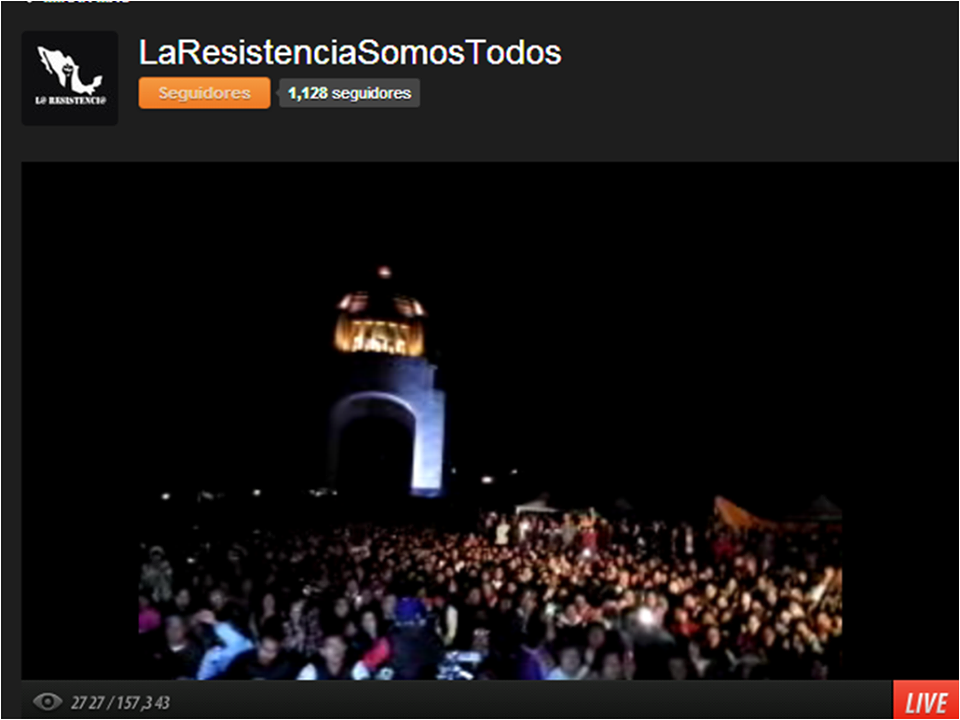
(Ni un voto al PRI, via Latino Rebels … the not for public broadcast alternative grito)
We are the mutts not them…
Romanian poet Valeriu D G Barbu writes of a push for euthanizing all the street dogs in Bucharest
Mexico City’s Street Dog Monument
Dogs are holding our souls in a leash
They’ve been training them with gentleness for millennia
The dog is the paradoxical symbol of the evil and of the friendship that
we cannot encompass, because we don’t look into the mirrors of reality, but into the ones of hypocrisy
Dogs are poor creatures that don’t want us to make them live a human life
Just as we sometimes live dogs’ lives
What is the turnover in the dog food and accessories industry?
Purebred dogs, an absurd classification, the tool of the profiteers …
We are the mutts not them… when we force them to grow wild
Kill the street dogs and there will be no street left to the leash
Dogs hold our souls in, dreaming of the little bit of Unconditioned Caress…
A video I had not seen before (made in 2008) covers the limited options available in Mexico City to provide some care for the street dogs. Left unsaid, and much to the credit of Mexico City’s local government, there hasn’t been a case of human rabies in the Federal District in well over 50 years. I was always amazed that the Health Department sent people door to door to inoculate every dog they could, including those that were technically street dogs, but had at least the good fortune to have someone claim to be their person. Of course, old Canelo — a Chow mix living around the corner from me… sometimes… and at the corner newsstand… sometimes… and at the fruit market across from the newsstand… sometimes… was jabbed at least three times that I knew of.
Best explanation of the educational reforms yet
Dr Manuel Gil Antón (Centro de Estudios Sociológicos del Colegio de  México) compares the state of education to that of a bus with broken seats, bad brakes, worn out engine on a road that needs resurfaced. The “educational reforms” proposed by the administration are like correcting the problem with those broken down buses by testing the drivers.
Just as better drivers’ training might not be a bad idea, obviously, better roads and better buses are what is needed.
The teachers’ strikes have been more a just a reaction to the politically popular (or at least endlessly pumped by televisa and the mainstream media) of teacher testing, and a few outdated union regulations that allowed for teachers to “sell” their jobs when they retire. The teachers don’t object to better training, but better schools… with electricity and running water for starters (something those of us foreigners who live here tend not to see — living as we do in the more comfortable enclaves of the country — is the deteriorating physical plants so many students and teachers have to endure), texts that arrive late (if at all) and error ridden, an outdated pedagogy that stresses rote learning rather than critical thinking and so on…
Fixing roads and buying buses is something politicians are involved in to the extent that they pay engineers and construction companies and bus manufacturers… and, yes, sometimes the politicians insist on paving one road instead of another, or building a bridge where one isn’t needed, but the work is turned over to the professionals.
Education is something that affects us all, and what is the best way to proceed might be something one argues over, but it is the kind of thing where the experts — the teachers — know much more than the politicians.
And they need to listen.
Irony anyone?
Mexico is a country of peace and social harmony… and Mexicans are fortunate to democratic institutions dedicated to ensuring the rule of law which have the obligation to ensure the rights of citizens, said the president Enrique Peña Nieto at a ceremony marking the opening of a new military education campus. (la Jornada, 13 September 2013)
… Meanwhile…
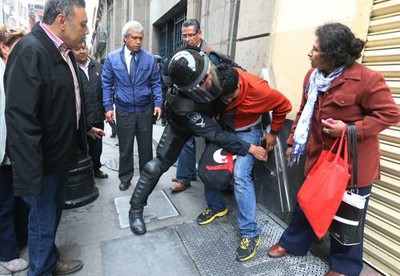
Federal Police fired teargas as protesters dislodged from the Zocalo, and commuters and others who happened to be at the corner of Eje Central and Cinco de Mayo (across from Bellas Artes) in Mexico City.
(Video: YoSoy Red; photo: La Jornada/Francisco Olvera)


 mexfiles.net