Gentrification is too much with us, late and soon…
From Alex González Ormerod in the on-line newsletter “The Rest of the World” (latam@restoftheworld.org)
Why we can’t look away from Mexico City’s gentrification
Happy 2023! Or is it still 2022? You can’t tell going by the incessant, and near identical, reporting about the gentrification of Mexico City by digital nomads. You might even remember reading my own thoughts in this newsletter about whether tech was a force for gentrification in Latin America — 11 months ago!
Only a few articles have actually moved the story forward, so why are we still talking about this? On the face of it, the gentrification of Mexico City feels like a story that has repeated across many moments in history: class conflict, migration, displacement. And yes, it is fundamentally about those things. More recently, though, I’ve been thinking that this story also reflects something very specific about the time and place we are living in right now.
Digital nomads are not your typical migrants (or even expats, if you can stomach the term). They are a specific product of the Covid-19 era — often employed and facilitated by tech, untethered by and unmarried to geography. They are a prime example of the consolidation of the new global economy, and the negative externalities it has dragged along.
Take these three issues Mexico City is facing that have come hand in hand with this tech-enabled kind of gentrification:
- Digital nomads are being accused of community displacement while still depending on the displaced. You can see it on every corner of the city’s trendiest neighborhoods: armies of last-mile delivery workers recruited to service digital nomads with the disposable income to order out for every meal. These gig workers depend on generously tipping foreigners but cannot afford to live in the gentrified parts of town that their customers have filled out.
- Startups catering to foreigners have become culture vultures. As many neighborhoods have become increasingly populated by Airbnb and other home rental platforms, properties must now appear “authentically Mexican” but may have been gutted of the most genuinely local element of them all: genuine locals.
- Social media highlights gentrification in all its glory and infamy. Migrants have always changed neighborhoods, but never before has this phenomenon been so easy to see (and call out) than in the age of digital oversharing. There is now a whole subgenre of Twitter in which foreigners will post their impressions of the city, only to get harangued for their ignorance. Internet culture has made their cultural dislocation all the more evident — and so much more cringe.
Margarita Maza (29 marzo 1826 – 2 enero 1871)

A rough, dranatic (and relatively short) life is hardly would you would have expected for the pampered daughter of a wealthy Oaxacan hacienda owner in the early 19th century. Señor Maza certainly didn’t expect, when he hired a zapoteca servant, Josefa Juárez García.
Josefa’s parents having died, and her uncle who’d taken in her youngest brother, had been teaching the boy Spanish, and recognized what little education he or his community could offer was limited. Packing 12 year old Benito off to his sister in the “big city” of Oaxaca would open some other opportunities than his limited prospects as a shepherd and “go-fer”. For a few years, Benito lived with his sister, running errands for the Mazas (and…. according to legend, once serving as a waiter when General Santa Ana came to dinner), eventually finding a job with a book-binder… who, a religious man… though Benito might have a good future (and a secure one) as a priest.
Meanwhile, Josefa had been promoted… from maid of all work, to nanny for the Maza’s newest baby, Margarita. Benito was never really cut out for the priesthood.. he liked girls — more than a priest really should — for starters. He studied law, practiced mostly bankrupty law and defending poor clients, taught in the law school and went into politics. Along the way, he managed to father at least one child. But, having gone from peasant shepherd to up and coming poolitician… and behind every successful man (and all that), he was looking for a wife.
That he was an “Indian” … albeit one that had managed to claw his way into the upper middle class… there was something unusual in marrying his one time boss’ daughter.. including that he was 37 and she was 17. Then again, this was 19th century Mexico.
Despite the age and cultural differences, the marriage worked. Margarita would have five children of ther own, as well as raising one of Benito’s “natural” daughters as her own… while Benito was busy trying to overthow Santa Ana, serving as governor of Oaxaca during the US “intervention” (and doubling the number of schools in the state despite the on-going warfare). She had to move the kids and herself several times during their various exiles, including to New York during the French invasion… where she came into her own as a politican in her own right… an unofficial, but recognized representative of the Mexcian Republic. Officially, through the Republic’s Washington Ambassador, Matias Romero, and unofficially through correspondence with Secretary of State Seward, General Grant, preparing and sending pro-Republican propaganda to the American press (a sort of “influencer” of her time), while keeping her husband’s government apprised of US policy and public sentiment during the American Civil War. All while on a miserable income that meant less than ideal housing, and the death of two of the children during a particularly cold New York winter.
Still, she charmed the American public, as a “good will ambassador” and… in a bold diplomatic move, traveled to Washington to publically make a condolence call on Mary Lincoln following Abe’s assassination. Seward made certain the press was informed of the visit, and that the Empress Carlota’s letter of condolence was returned unopened.
All while also having to outwit Santa Ana.. living in slightly more posh digs out on Staten Island… who in one of his more hare-brained schemes, planned to kidnap her and the children… the ransom to be used to help finance a coup against the Republic. Under the protection of the US Army, she, the children and the embalmed remains of the two who had died, were taken by train to St. Louis, down the Mississippi to New Orleans by steamboat, put on a Coast Guard cutter and sent to Veracruz in the waning days of the “Empire”. She was greeting as a national heroine, making her way to Mexico City while the rump of the Imperial Army was beating a hasty retreat to Queretaro. Finally reaching Mexico City in July 1867 (Maxmillian had only be executed a couple weeks earlier, effectively putting the kibosh on the whole idea of monarchy), would hardly be the end of the difficulties, nor did it mean she could just settle into a quiet life of a 19th century wife and mother.
Juarez was campaigning for a second term, and despite women not having the vote, she could take some part in that… pushing “Republican austerity” (shades of Lopez Obrador), stripping the national palace of its monarchal pretentiousness, although in high Victorian style, charming the visiting pols and foreign ambassadors, while pushing, always pushing, Benito to pay more attention to public education, was a more than full-time job.
If Juarez’ re-election would mean she could finally relax, there were the occasioal coup attempts to keep them up at night… and her health was mysteriously declining. But 1870, it was clear something was terribly wrong. Although undiagnosed, it was probably some form of cancer, passing away the 2nd of January in 1871, and although the funeral … as was the custom in those days… was a family affair, thousands lied the streets to Panteon San Fernando… where Benito would also be buried (with great pomp and ceremony) a year later.
Naughty and nice
If there was anyone arbitaring who was bad or good… be good for goodness sake when Pancho Villa came a calling. This photo, with presumably one of his many biological or adopted children taken at his “retirement” hacienda in Canatulla, Durango at Christmas time, 1922.

Daily baths… how disgusting!
Despite the title, and overlooking the narrator’s butchery of Nahuatl words… a nice overview of Aztec hygine… probably the best in the world at the time, or at least something unknown to those “barbaric” Europeans:
Qué pasó, presidente Biden?
For some reason, although the topic was Mexico’s strained relationship with the defacto government of Peru, The lightening visit of Ukrainian President Zelensky to Washgton came up. In a veiled slap at US imperialism … as demonstrated by it’s hasty support for the (ummm) “irregular govenmental reorganization” in Peru (former CIA offical and US Ambassador Lisda Kenna, tweeting out warm support for “stabilization” (i.e., shooting peasants, and declaring a state of seige) … AND the arrogance of imperial powers, riffed on that annoying faux-pas people from the US are all too prone to commit.
Yesterday the president of Ukraine arrived and “my president” – and I really love the guy– of the United States, who also constantly tells me that we must have a relationship on an equal footing, on is Twitter feed says to the President of Ukraine: ‘Welcome to America.”
What happened [more in the sense of WTF?] President Biden? With all due respect, America is all of us. It’s common in Europe and other places that when people talk of “America” then mean the United States, but America is Peru, Guatemala, Belize, Mexico… And I’m not saying that a [foreign] president shouldn’t be welcomed, what I don’t like is the asumption behind this. Welcome to where [or by whom] in America? Let’s start now to change that. We need to keep moving forward – as the old song says, “custom is stronger than love” — has been around now for two centuries, the Monroe Doctrine, and the idea that America for the “Americans”.
I doubt it even occured to Biden (or to most “USAnians”) that there was anything at all controversial about the US President’s tweet. But AMLO is making two important points. First, that the United States (ok, and Canada) are not only NOT all America, but are alone in this hemisphere in their obsession the Ukrainian situation, but more importantly, by his unwitting assumption that the US represents “America” (all 35 independent nations?) and can set the agenda and policy of the other 34, the United States is “losing” it’s hemispheric dominance, or relevance, at a time when it both trying to counter the influence of other powers (like China, Russia, the EU) when it could be strengthening mutually beneficial economic and social ties, while at the same time accepting that those 34 other American nations have their own political positions and might see affairs in their own hemisphere (like in Peru) as more their concern than those half-way around the planet.
Quetzecóatl is comin’ to town
It’s like finding a grain of gold in a pile of shit, but there is one… and exactly one… thing D.H. Lawrence got right (athough only very, very slightly) in his 1925 novel, “The Plumed Serpent”… and that by accident, having only a slight echo in an official Christmas celebration held on the Zocalco in Mexico City in 1930.
In Lawrence’s novel, the extended musings on the “savage” bloodlines of the “primitive” Indians, and the “tamed” and decadent bloodlines of “white” people, is at the heart of the absurd fantasy of a revived Quetzcóatl religion taking over a town .. of all places on Lake Chapala in what was ground-zero for the then growing “Cristero” movement… a reactionary Catholic movement that might have… if not for the Catholic bit… have perfectly fit into the world-view of a proto-Nazi like Lawrence (who had the good sense to die in 1930 before Fascism had moved much beyond economics … not his bag… into something more in his line of inquiry… racial supremacism).
That said, what Lawrence had (sorta) right was noticing the nationalist concerns of the Mexican state (represened by the “Indian” general) which… especially during the 1920s did increasingly attemt to harass and lessen the influence of the Catholic Church (considered a foreign institution), and leading up to a full-fledged counter-revolution centered in Jalisco (where, remember, Lawrence has set his story) and even today is a center of reactionary Catholicism. At the same time, or in the aftermath of the 1926-28 Cristero War, state policy was to de-emphasize the religious aspects of national holidays, while at the same time, reject the pernicious influence of the dreaded gringos and their emphasis on consumerism and capitalism.
And… in what’s perhaps the first attempt at a stike against “Coca-colonialism” the popular image of Saint Nicholas, who had been beating the Three Wise Men in gifting good boys and girls by a goodly 12 days, as reintrepeted by the purveyors of “aguas negras de los imperialistas” (“imperialist sewage”…i.e. Coca-Cola) as the jolly old fat man in the red suit, that had been flooding Mexico at the time… President Ortez Rubio — not wanting to stir up the simmering reactionary Catholics (who’d tried to assassinate him at his inaguartion and shot him in the face) — turned his attention to that other foreign institution… Santa Claus.
And, so.. having probably never read, nor heard of Lawrence (who had died the previous March) … did, in a very small way, “restore Quetzcóatl” (or even, as in the novel, Huitzilopochtli, who is not the Plumed Serpent, that being Quezecóatl), and certainly not as a fusion with a “white goddess). Ortiz Rubio sought a benign gift giver for December, one who would be neither overtly Christian, nor a product of foreign marketing agents.
Ergo: the eminently flexible god of, well whatever you want: Quetzcóatl. Who did distribute gifts to good boys and girls (at least those whose parents were good party faithfuls) at Christmas in 1930. The kids may have liked their presents, but even with the hard work of the Education Ministry to redesign a benign looking Quetzcóatl, he never really caught on, and the idea was quietly shelved by Christmas 1931.

Happy Hanukkah… Mexican style
Cantor Moishe Mendelson:
The “glories” of war
Maybe staying neutral is the only way to understand what war means. Between the “War to End All Wars” and next one, Argentinian Carlos Gardel’s “Silencio” (1933) managed better than most to capture the essense of homeland and conflict.
Silence ia the night, everything is calm,
Not a muscle stils, ambition all at rest..
Rocking a cradle, a mother sings
a lullaby the reaches to the soul.
Resting in the cradle is her latest hope. One of five brothers
They were five brothers, and she was a saint..
Five kisses every morning, five tender touches every day.
The white haired old woman, who working in her shop
sits silent in the night.
Everything is calm, not a muscle moves
A bugle sounded once, the homeland was endangered,
The war cry sounded, and men killed other men.
Covering in their blood, the fields of France.
Today all that passed, the plants reborn,
The ploughs sing forth, a sonf of new life.
And the whizend old woman, she sit at home alone
remained alone, with five medals
which for five heroes the homeland took from her.
Silent is the night, and everything is calm.
Not a muscle moves, and all ambitious gone.
A faint chorus of crooning mothers
Rock in their cradles, new hope…
Silent in the night.
with silence in the souls…
Conquistadoras… of a sort
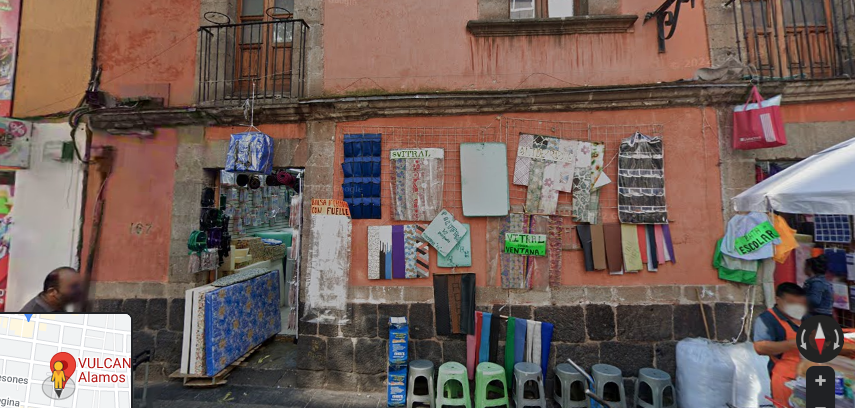
A mall plaque on this building (Mesones, 167) commorates the site’s historical significance… the first brothel in the Americas. After conquoring Tenotitchan (and, leveling the old city), when the Conquistadors set about building the new city of Mexico, care was given to city planning.
Following the conquest, and razing Tenochitlan, the Conqustidors set out to build a planned city. Having established sites for such important public facilities as the jail, the gallows, the butcher shops, they realized something had been overlooked. An area for taverns and inns was already establshed, so in 1538, Queen Juana (“La Loca” as she’d be known… which is also slang for a drag queen) graciously gave her permission for an additional… er… public accommodation… a brothel.
Where exactly it was located is nknown, but with Felipe II ordering the establishment of a “zona de tolerancia” in 1572 … “Las Gallas” (the crazy women) opened its… uh… doors to business, at what is now Mesones 167 in the Centro Historico. A plaque commemorates it as the first brothel in the Americas… some landmark!
Of course, the upright and uptight denied its existence, or knowlege of the place (yeah, riggghhhhtttt!, but “doble moral” hasn’t changed all that much in the last 500 years. Prostitution is still “tolerated” (in specific neighborhoods) here, with sporadic and sometimes reluctantl recognition given to the needs and rights of the practioners of the “oldest profession”.
The first Archbishop, Juan de Zumarraga (of the Virign of Guadalupe story) complained about the place, and tried (without much success) to forbid clerics from entering the zone. In the 1680s, under the assumption that women who liked sex (or had sex for money) were “sick”, the Archbishop of the time, Franciso de Aguiar and Sejas, campaigned to have ladies of the evening removed to the Belem… half a “madhouse” half a prison. His Excellency was something of a fanatic… opposed to cock-fighting, tight shoes and… well, women in general. It’s claimed he would never look at a woman directly, for fear a lustful thought might enter unwittingly. He even had the faces of women corpses covered during the funerals over which he presided.
With the Independence, while doble moral was still the norm, there was some recognition given to the valuable role these women had played in the nation’s war against the Spanish.
Iturbide [then on the Royalist side]… ordered Maria Tomasa Estevez de Salas shot to death after she was convicted of seducing royalist troops in the Salamanca region, and who he said had a great deal of success in her rebel activities because of “her beautiful figure.”
… Carmen Camacho… seduced a garrison of soldiers into deserting.
(Femmes Fatal)
Likewise, during the US occupation in the “Unjust Invasion of the North Americans” of 1846-48, there are reports that syphillitic women would go out of their way to infect gringo soldiers. During the short reign of Emperor Maxilian, ladies of the evening were photographed, though not so much for mug-shots as for souvenier cards (collect the whole set!) for the delactation.. or selectation… of the elites.
The Revolution brought a sense of class consciousness to prostitutes. As in the Maria Felix-Kay Jurado film, “La Bandita” (1963), the workers sometimes would throw out the management (i.e. madams and pimps) and demand better working conditions. Within Mexico City, prostitutes, arguing that they were providing a necessary and useful trade, forced the government to rewrite its laws, which — while leaving the women (and men) without the same labor protections as other workers — allowed them for a few years to operate a little less clandestinely, even outside the “zona de tolerancia”, although the NIMBY (Not in my back yard) types, even in less affluent areas, were less than receptive to such businesses. Espeically when the sex workers were “free lancers”… not connected with any brothel, but reather street walkers.
In recent times, with the feminist and working class movements both recognizing that doble moral is more about control than about morality itself, the situation for prostitutes has improved. A union (that does not encourage apprenticeships, and actually goes out of its way to find alternative economic opportunities for those who are only in the trade reluctantly, or by force) has actively pushed for both better security and recognition. Famously… or infamously, given it was widely derided in the foreign media… during the Lopez Obrador adminstation the city government, working with both the Archdiocese and major developers (notably Carlos Slim) established a retirement home for prostitutes, and there has been some progress in a movement to simply reclassify this specific sales force as licensed vendors.
Sources:
Andrea Mireille, “Las Gallas, la primera casa de citas de la Nueva España“, Chilango (10 Dec 2022)
Mexfiles.net. (noted in the text)
Gods, Gachupines and Gringos
Katherine Elaine Bliss, Compromised Positions (Pennsylvania State University Press, 2005).
Momochtli… I’m sure you’ve had some.
I’m sure there are people in this world who have never had a taco or tortilla, and have been denied availing themselves of traditional indigenous Mexican cuisine — not the grasshoppers, ants eggs and maguey worms, which for some reason some find gross, but one that has been around for at least the last 9 to 10,000 years, which very, very few people would recognize as traditional indigenous american cuisine….
Anything pop into your head? Is that first paragraph a little corny?
Yup… popcorn. Zea mays everta , one of the seven (out of 59) varieties of corn orginating in Mexico, and one of the first to be developed. There is argheological evidence of popcorn cultures in central Mexico going back to the dawn of agriculture, some nine to ten thousand years ago.
Hard to believe, but popcorn was popping (and being eaten) long before tortillas or tamales were thought of (maybe after a meal of popcorn, those ancient people just had enough… or maybe the village storyteller was about to start the second feature, and everybody just went out an got another bucketload of popcorn. They even had carmel corn: According to the Diccionario enciclopédico de la Gastronomía Mexicana not having a microwave, or a Jiffy-pop type device, momochtli was placed right on the comal to burst, then smeared with maguey honey. In Chiapas, popcorn is still made (by wise grannies) the ancient times with piloncillo honey. A candy they call puxinú — candied popcorn — is commonly still sold in Tuxtla Gutiérrez and Chiapa de Corzo.
Fast forward several millenia. In his “General History of the Things of New Spain“, Bernardino de Sahagún mentiones his amazement at seeing grains of roasted corn that in his word “flowered”into what he was told was “momochtli”.
Friar Bernadino further mentins that popcorn had some religious significance … “the women maidens danced, shaved and feathered with red feathers, all their arms and all their legs, and they wore capillejos composed of instead of flowers with toasted corn that they called momochtli, where each grain is a very white flower”. By the way, with the Feast of the Virgin of Guadalupe coming up, the are some communities that make gigantic floral (er… popcorn) displays reaching up to a meter or two in diameter, of artfully arranged popcorn around an image of the Virgin.
Surprising, the gringos, while they did manage to expropriate so much of what was Mexican over the past two and a half centuries didn’t really get into popcurn until the Great Depression… when about the only public amusement most people could afford was an afternoon at the movies. And a snack.. something cheap,warm… and more or less having some nutritional value.
Glen Dickenson began installing popcorn machnes in his movie theaters in 1938, and by the 1950s, US growers and distributers had founded a Popcorn Institute to market what had been a niche Mexican staple to the world. Microwave popcorn, introduced by General Mills in 1980, somehow became the stanard… even in Mexico.
Monroe Doctrine, RIP?
U.S. exceptionalism, the offspring of the African slave trade and the conquest of Amerindia, seeks unfettered access to the region’s natural resources and labor to serve its corporate and geopolitical interests. By contrast, decoloniality was born of five centuries of resistance to colonization. It is the critical perspective of those who have been oppressed by imperial domination and local oligarchies and seek to build a new world, one that rejects necropolitics and racial capitalism; one that advances human life in community and in harmony with the biosphere. This critical ethical attitude has been expressed over the past two years in declarations of regional associations that exclude the U.S. and Canada. All share the same ideal of regional integration based on respect for sovereign equality among nations and guided by ecological, democratic, and plurinational principles.
My computer was hacked and the hard drive having to be replaced,and this is written on a not working right machine (that’s going in for repairs when the other one is fixed). So even less posting until later this week. In the meantime, read Decolonization, Multipolarity, and the Demise of the Monroe Doctrine.
How many?
Whether the demonstation yesterday should be considered a march in support of reforms in the electoral system, a celebration of four years of the “Transformation” or a response to last week’s “march of the fifis”… sold as supporting the status quo (or, more specifically, rejecting proposed changes to the electoral system as “dictatorial”), but better remembered for those marchers who called those supporting the government “indios con patas rajadas” (Indians in ragged pants)… or all of the above… it certainly brought out the people.
By no means only “indians in ragged pants” (though many proudly proclaimed themselves as such), unions, social organizations, politicians on the left, academics, women’s groups, students, workers, etc., etc. etc. came by the…
Thousands… according to Reforma this morning.
Hundreds of thousands… according to the Associated Press.
1.2 Million .. according to the Mexico City government
From the Mexican “mainstream” (read not-pro-AMLO) news stations:


 mexfiles.net