You better treat them right… or else!

This Diana, the Avenger, is not the Diana the Avenger you seek.
Cd. Juarez bus drivers had better be on their best behavior. A letter to La Jornada, signed by “Diana, la Vengadora” published this weekend reads:
Given the lack of effectiveness of the authorities in defending workers from the abuses of those drivers, someone needs to settle accounts with these degenerates … They think that because we are women, we are weak, and yes, we are, but only up to a certain point, because although we do not have anyone to defend us, and we need to work until late at night to support our families, we no longer will remain silent about those acts that enrage us. My companions and I suffered enough in silence, we were victims of sexual violence of drivers who transport the night shifts at the maquiladora plants here in Juárez, and although many people know what we have gone through, nobody has defended us, or done anything to protect us.
For these reasons I am taking revenge on behalf of the several women who society believes are weak, but we are brave, and if those women cannot receive respect we will take matters into our own hands, because we women of Juarez are strong.
Probably not co-incidentally, two night-shift bus drivers were shot at close range by an unknown assailant this last week. The suspect is described as a woman about 50 years old, about 1.65 meters in height, brown skinned with dyed blond hair… in other words, a typical Juarez night-shift worker.
WHERE MIGHT WE HAVE SEEN WOMEN LIKE “DIANA, LA VENGADORA” BEFORE?

“Mujer y Revolucionario”, Juan Piña Gámez, charcoal sketch, 2012 (University of Nuevo Leon)
Call me, maybe?
I know, this is crazy…
Franco Ordonez, McClatchy via Modesto Bee:
Under President Barack Obama, U.S.
immigration officials have deported more than 1.4 million people, at an annual rate that, if it continuers, will exceed any other American president. Mexico-based call centers, serving the United States and other foreign markets, grew 116 percent from 8,632 to 18,701 locations from 2007 to 2010, according to research by Jordy Micheli Thirion, an economics professor at the Metropolitan Autonomous University in Azcapotzalco , Mexico.

Photo: Forbes.com
Anderson estimates that more than 60 percent of the employees at some of the major Mexico City call centers are deportees, based on conversations with managers and workers.
I’m of two minds about this. By way of full disclosure, I had a contract job with a large Mexican call-center, testing candidates for supervisory positions on their English, and working on conversational English with some managers. I know call centers suck, and the working conditions (and hours) are stressful and unrewarding.
On the other hand… I now live in a resort town, full of foreign retirees, and where I’m often running into recent deportees who are at a loss as to how to survive in a country that — if they remember it at all — has changed dramatically in the last few years, and whose culture is basically (if not completely) alien — one should never make the mistake of assuming Mexican-American culture is Mexican culture. The deportees I run into often have some sort of job skills, but having grown up in the United States, just don’t know how to navigate Mexican employment, and find that they are competing for jobs against entrenched locals who have family or other social connections that will assist them in job hunting and… for the purposes of resort town work… already know enough English to do the low level types of jobs that are available. And, the deportees, often as not, speak American English better than Spanish… or at least they speak Spanish with an American accent.
It’s a shame, but call centers do require some education, and were pushed as “job creation” (sucky jobs, but counted as jobs) in the U.S. — often to replace manufacturing jobs “lost” to Mexico.
So, between better telephone technology that makes calling to and from Mexico seamless (as Ordonez mentions, “Press 2 for Spanish” calls from the United States have been routed to Mexico for several years now). and the “export” of the resources from the United States at low cost, Mexico is becoming the unlikely competitor to U.S. businesses whose location in the U.S. could only be sold on the premise that “customers want to speak to people who talk like us”.
And, while not the best use of the resources of the returnees, not the worst, either.
The eve of the (mis) Informe
I was supposed to be in Mexico City today, to start a vacation. Unfortunately…. there were complications, and I had to indefinitely delay that trip.
… maybe not being in Mexico City today wasn’t such a bad thing. With Enrique Peña Nieto’s “Informe” (State of the Republic Address) being being first pushed back to the Second of September and moved from it’s traditional location in the Chamber of Deputies to a more “secure” location, it was already assumed that there would be push-back from the citizens to the Administration’s push to “reform” both PEMEX, widely seen as attempts to denationalize the “paraestatal” into nothing more than an oil company (and allow significant access, if not ceding control, to foreign corporate interests) and the educational system — seen not as improving education, but a backdoor attempt to undermine labor rights as well as erode support for secular public education —walking around the Centro earlier today might have been a bit difficult.
Mainstream Mexican ,edia blamed the violence, as it usually does, on “anarchists”… and I don’t doubt there were a few anarchists in the crowd, though the term tends to be applied by the government to any and all “tribus urbanos” whenever there is violence during demonstrations.
(Video from El Universal, via Despierto Mexico.
The (almost) All-American Hero
In 1918, José Mendoza López, an eight year old Mixtec orphan, slipped across the U.S. border in search of relations living around Brownsville, Texas. While living on and off with an uncle, and attending school irregularly, he worked various odd jobs and as a farm laborer. A grade school dropout, Mendoza began getting into fights… and found he was relatively good at them. As a poorly paid semi-pro boxer, he hitch-hiked around the country, eventually catching the eye of a small time promoter, who marketed the youngster as “kid Mendoza”, managing to place him in lightweight division bouts as far afield as Australia.
In Australia, Mendoza acquired forged U.S. documents under the name Jose M. Lopez, which were good enough to get him a Merchant Marine Able Bodied Seaman certificate. As Jose M. Lopez, he spent the next five years as an American sailor. December 7th, 1941 found him in Los Angeles, seeking a ship for Hawaii… when the authorities finally caught up with him… thinking he was Japanese.
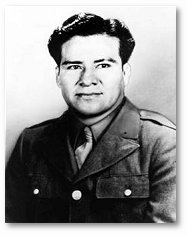 Convincing them that he was really Jose M. Lopez of Brownsville, Texas took some time, but he was allowed to return home, where he married and would have settled down as a model illegal alien, if he hadn’t been drafted in 1942. After basic training, he served in the 23rd Infantry, where — from North Africa (where he earned a Purple Heart), to England, to Normandy (where he earned a Bronze Star), to Belgium, he rose to the rank of Master Sergeant…
… and where, outside Krinkelt Belgium, on 17 December 1944 he would earn his Congressional Medal of Honor.
The soldier known as Jose M. Lopez stuck in a hole and praying to the Virgin of Guadalupe (who presumably looks out more for Mexicans than Germans) and more practically firing his machine gun, held off a German infantry and TANK advance that had caught his company, allowing his own unit to withdraw in safety. As his citation for the Congressional Medal of Honor read:
Sgt. Lopez’s gallantry and intrepidity, on seemingly suicidal missions in which he killed at least 100 of the enemy, were almost solely responsible for allowing Company K to avoid being enveloped, to withdraw successfully and to give other forces coming up in support time to build a line which repelled the enemy drive.
Although he had been awarded not only the highest military decoration in the United States, but also (under his real name) Mexico’s la Condecoración del Mérito Militar, he found that back in Texas, he was just another “dirty Mexican”.
Re-enlisting in the Army at the outbreak of the Korean conflict, he again saw combat until an officer realized they had a Medal of Honor recipient in the ranks, and transferred him to less dangerous (but perhaps more difficult) duties in graves registry (identifying dead bodies). He later served as a motor poor supervisor and a recruiter, finally retiring in 1973.
I realize that it was a different world in 1918 when young José came to the United States as an unescorted minor. And, while the “Dreamers” of today hope for permanent residency, they are talking about those who either enroll in post-secondary education or join the military. While José Mendoza López did opt for a military career, today, a twenty-five year old grade school dropout… and one who’d only obtained false papers at the age of 25, would have only one option… a detention center and a one-way trip to Mexico. And the loss to the United States would be…???
Sources:
“The President of the United States in the name of The Congress takes pleasure in presenting the Medal of Honor to LOPEZ, JOSE M.” (reproduced at: Home of Heroes (homeofheroes.com)
Todo por Mexico (“Jose Mendoza Lopez ‘El Kid Mendoza'”)
Henry Franklin Tribe, “LOPEZ, JOSE MENDOZA ,” Handbook of Texas Online (http://www.tshaonline.org/handbook/online/articles/flo62).
Wikipedia (Jose M. Lopez) … in crying need of a revision!
The Department of Redundancy Department
Everything I could have said on the upcoming “Informe” (the Mexican “State of the Republic” address), and the change in both venue and time, was said better than I could (and translated better than I would have) by Mexico 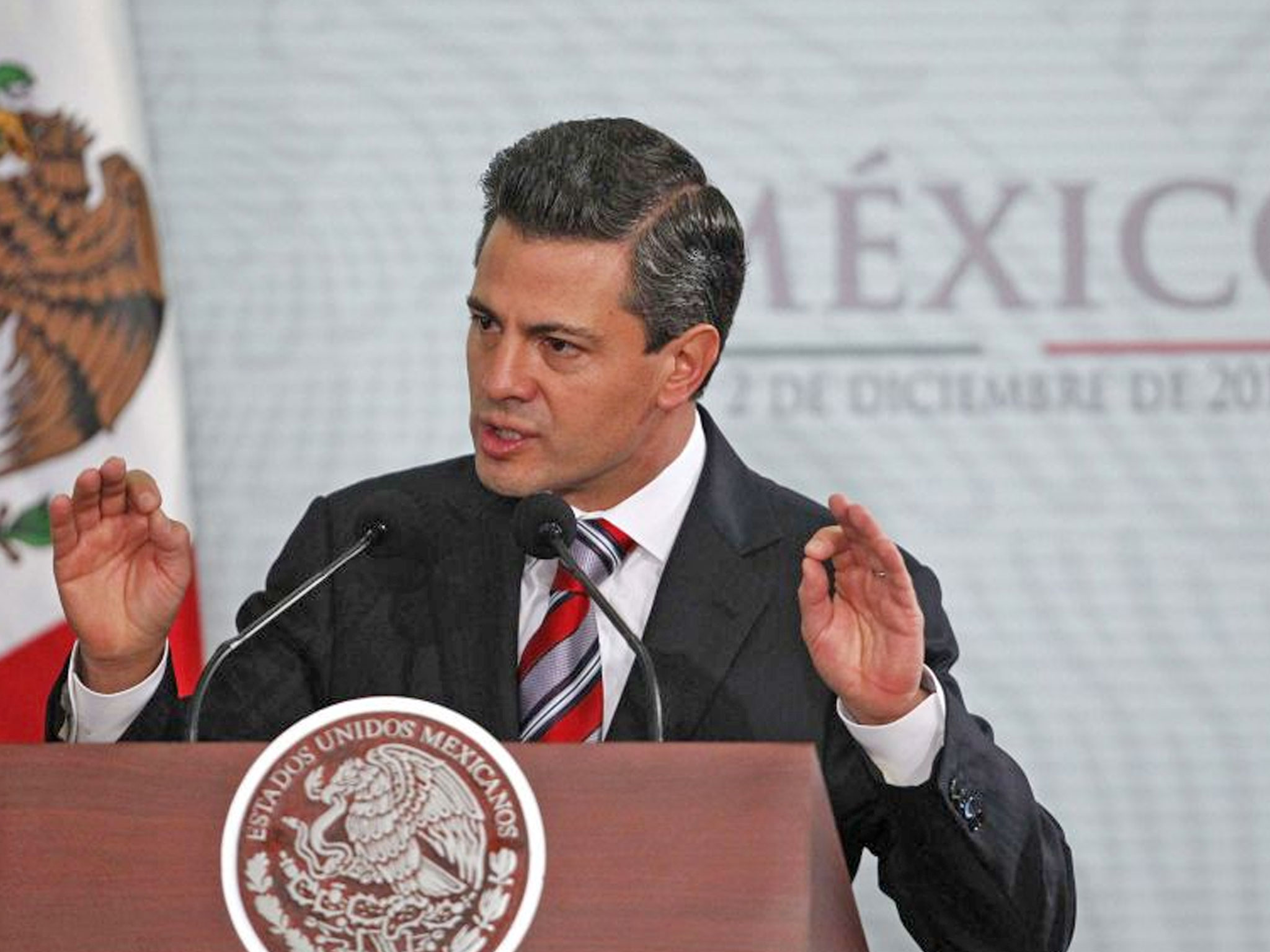 Voices. Both articles should be read in full, to begin to understand the depth of disappointment with the supposed “maturity” of a system with two very similar political parties alternating in office. Despite the U.S. enthusiasm for Peña Nieto (mostly, I think, relief that AMLO didn’t have a stronger showing, and recognition that the much-hyped Calderon administration’s “war on drugs” and kowtowing to U.S. interests, was too heavy-handed to “sell” to the Mexican people).
José Gil Olmos, in Proceso (translated by Reed Brundage) notes that
In a country of symbols, the change of venue so that Enrique Peña Nieto can quietly and safely give his first Report of Government is very significant. in the the [Campo Martes] Military Parade Grounds and not in the Chamber of Deputies or National Palace, as he surely [he] had in mind.
The presence of thousands of teachers in the Plaza of the Constitution Square, in front of the National Palace and their latest protests and blockades of the Chamber of Deputies, the Senate, the International Airport of Mexico City, in the two main television networks,Televisa and TV Azteca, and their march to Los Pinos, forced Peña Nieto to choose the safest place to present his report on September 1.
For CNNMexico, Hector Villareal writes on the eroding legitimacy of the Peña Nieto administration:
If the media strategy of the federal government is dedicated to motivating citizens to move forward with calls of “Yes, we can” and appealing to national pride instead of complying with its duty of reporting and accountability, to me this is an indicator that things are not going well .
The First Report of President Enrique Pena Nieto, which must be delivered on Sunday to Congress [when it opens its regular fall session], contains much good news and little positive data. He has been a good politician, but that is still not sufficient to qualify as a good president based on results .
Mexico Voices is doing a wonderful job of finding and translating the mainstream Mexican press… or the left side of the mainstream… and if it seems I’ve been just referencing them a lot lately, it’s because I am. Mexico Voices is doing a much better job than I can do with my limited resources and makes much of my work redundant.
Their translations aren’t necessarily the ones I would make (I often slightly rewrite to fit U.S. news conventions), but with Mexico Voices filling the need for access to Mexican media for English-speakers without the filter of U.S. media assumptions, and doing it regularly, I’ll cede that territory to them. With gratitude.
Mining investments? Oh, by the way…
Via Inca Kola News, which manages to find the news from Cabacora, Sonora that might just be of impact to those of you north of the border with mining investments:
Last week the representatives of a 77 person strong landowner group (ejido) ‘El Bajío’ won an important court ruling again the La Herradura mine owned by the Penmont JV (Fresnillo/Peñoles 56% and Newmont 44%). The ejido owners filed their suit in 2009 that said the mining company had illegally occupied 3,025 hectares their land area, which has always been disputed by Penmont who said that their actions only affected 300 hectares of the disputed area and that they had obtained all permits to use that area.The ruling last week came after appeal, is immediately actionable and upheld the argument of the ejido landholders who now have the legal right to evict Penmont from their property as of this week, as well as being awarded compensation. That eviction of all Penmont assets and operations may begin in some symbolic manner this week, but the landholders have already indicated that they prefer to come to a full financial compensation deal and not threaten the jobs of the 5,000 or so workforce at La Herradura than carry out their legal right of eviction. The bill may be eye-popping too, as in the words of the legal representative for the El Bajío ejido, the estimate for the damage already caused to the 3,025 hectares is around U$100m and that “Today the mining company is condemned to total eviction and the payment of damages”.A deal needs to be reached and the likely size means that it’s one that neither Fresnillo or Newmont will be able to sweep under some regulatory carpet.
Inca Kola News (and the IKN Newsletter) come out of Peru, but are required reading for anyone investing or interested in Latin American commodities, especially in the mining sector*.
 The problem for investors is that they don’t read the local Spanish-language press (the original story appeared in the Mexican daily Reforma, but was picked up by the Inca from the Hermosillo, Sonora on-line news-site, Dossier Politico.com),,, not likely reading for the English-speaking investor.
The problem for those of us in Latin America is that English-speaking investors all too often don’t have a clue as to what their investments involve here. They may, on some level, understand that land theft, labor abuses and environmental degradation are by-products of their investments, and it might be an acceptable risk to them — or they may even justify it as “job creation” — but they shouldn’t be surprised if sometimes there are consequences, or the jobs they’re creating aren’t appreciated, and they find themselves holding the bag.
* The Sonoran story was a freebie, reprinted in Inca Kola News. The IKN Newsletter is only 400 USD a year… a bargain as these things go, and while there’s no guarantees the Inca’s advice will make you rich and handsome, it cuts through the bullshit found in most mining reports, and reports on those situations (like that in Sonora) conveniently overlooked by the companies.
¡Viva México! Last Friday, outside the Russian Embassy in Mexico City…

By choice — and necessity — México has historically avoided interfering in the domestic affairs of other nations. Although the Mexican government has it’s own history of criminal stupidity and cruelty, that government steps aside when the people themselves … including those whom they have oppressed in the past… stand up for the respect for the rights of others.
Why they fight
Without our land, we cease to be a people. Our lands and identities are critical to our lives, our waters, our forests, our culture, our global commons, our territories. For us, the struggle for our territories and our commons and our natural resources is of primary importance to preserve ourselves as a people.
I am glad to see the plight of the Honduran Garifuna people receiving attention. As with other cultural minorities in Latin America, their rights to their land and resources is being threatened by outsiders eager for natural resources (in the Garifuna region, the land is wanted for growing palm oil) and political forces find rationales to sell this to the outside world.
Closer to home here, the Yaquí nation… which has a long history of resistance to the state (it fought a number of wars against both the Spanish colonial forces and the Mexican government, including the last major “Indian uprising” in North America, in the 1920s) to preserve their historic farming communities. While the 19th and 20th century wars were for control of the land for cotton production, today’s battles are over something even more basic… water.
Like the Garifuna, the Yaquí are under a triple threat from attempts to control resources, the international narcotics trade and tourism.
The City of Hermosillo has quadrupled in size in the last few years “thanks” to NAFTA giving a huge boost to corporate agriculture at the expense of the Mexican rural economy, refugees  from the narcotics “war” and the growth in Pacific Coastal tourism and the service industry associated with that growth, is short of water. Always a precious resource in northern Mexico, the city … DESPITE a ruling from the Mexican Supreme Court recognizing the legitimacy of the Yaquí Tribe’s claims to water from the Yaquí River (going back to the treaties signed in the 1930s ending 400 years of tribal warfare) … has been going ahead with building an aqueduct that will effectively cut the flow of the Yaquí river to a trickle. Even now, with the water the city is (illegally) taking from the River, the Yaquí are left with only sewage runoff to water their crops… and obviously, cannot sell and are reluctant to even feed to their livestock.
The Yaquí have their reasons, and … presumably… the State of Sonora has theirs. The situation being at an impass, and on-and-off highway blockades around Hermosillo having only gained some attention, I expect there will be large protests in Sonora, and at least some in Mexico City and elsewhere around the Republic. Whether there are international protests I can’t say. However, given that there will likely be some protests… and they are planned as scattered protests, one should at least be aware of what it is the Yaquí and their supporters are saying.
 The Mexican state via their official and criminal institutions, hand-in-hand with the large capitalists, has begun a war against the indigenous communities, trying to evict them from the native lands, and deprive them of their resources. A clear example is the despoliation of the Yaqui Tribe in the Mexican State of Sonora, by means of the so-called mega-project “Acueducto Independencia”, which will extract 75 million cubic meters of water a year of the Yaqui River. Even in the test phase of the project, it has already caused serious damage to Yaquí lands, altering the ecological balance and leaving the tribe without water.
In light of this situation, we are calling for an International Day of Protest Against Acueducto Independecia for 30 August 2013.
Places: The Federal District offices of the State of Sonora: Paseo de Las Palmas No.1005, Col. Lomas de Chapultepec
… and on public plaza, in the streets and wherever your imagination takes you.
We also propose you protest outside Mexican consulates or representations in other countries.
In order to demonstrate your solidarity with the Yaqui Tribe, send, videos, audio, photographs, etc. to demonstrate to the great capitalists and their allies that the role of the government is to return to the Yaquí Tribe the water that belongs to them
Send your material to: yaqui.namakasia@riseup.net
More information at namakasia.jimdo.com
Succes de scandale
Unlike the U.S. Consumer Protection Agency, which is just part of the Federal Trade Commission, Mexico’s counterpart, Profeco, — in theory — is a much more powerful agency. The acronym stands for Procuraduría Federal del Consumidor,,, Federal Prosecutor for the Consumer… and it is part of the Attorney General’s office.
While it generally had a decent reputation for resolving individual consumer complaints, it has been generally reluctant to take up class actions, until recently. The change seems to have come earlier this summer, when the “Lady Profeco” scandal forced mass resignations in the Mexico City office, and made what had been a government agency that actually was liked a laughing stock.
“Lady Profeco” was the daughter of Profeco’s director, Humberto Benitez. When the daughter, denied the table she wanted at a Mexico City restaurant, used her family connection to have the restaurant briefly shut down for bogus violations, the outcry from the public — mostly over the tendency of the politically connected to demand special treatment — forced Benitez into early retirement, and several high level PROFECO officials to … uh… “decide to spend more time with their family”.
Last month, PROFECO shocked Mexico City’s elites by briefly closing several high-end hotels, which were indeed violating a basic consumer protection law… posting the room price, and adding “hidden charges” to hotel bills.
Not that all that many Mexican consumers are staying in elite hotels, and discover hidden charges on their bill at check-out, but quite a few (one would say most) Mexican families have faced “hidden charges” when educating their kids. With the push for privatization and a shortage of slots in the public universities, more and more middle-class families are sending their kids to private schools and universities, which haven’t been up-front with their costs. Several of the elite private universities (including Tec de Monterrey) have been charged with not revealing charges, hidden contractual costs and making changes in programs without notice. Even public schools, often controlled by “Parents’ Committees” are being investigated. Several profit from a form of kickback, whereby the students are required to buy supplies and/or uniforms from a specific vendor, again without revealing the costs up-front.
In all, administrative processes have been started against 51 private schools and 89 businesses.
Not a bad way of restoring institutional credibility.
Sources: SDPNoticias, Informador (Guadalajara)
What’s the point?
Porter Corn (Mexico Trucker) … uh… points me to this video. About a year and a half old, but a nice reminder that cultural synthesis and rural folk dances don’t necessarily have some deep sociological significance… and — in San Luis Potosí — maybe THAT is the point:
Funny numbers and wacky-weed
Washington Post this morning (Mexican drug cartel activity in U.S. said to be exaggerated in widely cited federal report):
In its 2011 report, the center used the phrase “transnational criminal organizations,” and said they included seven cartels based in Mexico, the well-known Sinaloa and Zetas syndicates among them. The report broadened the definition in a footnote to include traffickers who purchased drugs from cartel associates.
Under such definitions, the analysts said, anyone from Mexico caught selling a small amount of marijuana in a U.S. city could be counted as a Mexican drug organization or cartel presence.
“These definitions are interchangeable and indistinguishable,” said Peter Andreas, a drug policy analyst at Brown University who has written a book about the politics of drug policy called “Border Games: Policing the U.S.-Mexico Divide.” “This is a particularly egregious example of a pattern that unfortunately has not gotten a lot of scrutiny.”
That “2011 report” was from the now defunct National Drug Intelligence Center (NDIC), another of those huge security bureaucracies that U.S. policy makers (and tax money spenders) are addicted to. Set up in 1993 (under George Bush the first), it’s initial “mission” was to:
… provide strategic drug-related intelligence, document and media exploitation support, and training assistance to the drug control, public health, law enforcement, and intelligence communities of the United States in order to reduce the adverse effects of drug trafficking, drug abuse, and other drug-related criminal activity.
In other words, what a couple of dozen U.S. agencies already do. And… once “terrorism” became the rationale de jour for government funding, the NDIC developed a new sales pitch:
NDIC supports national-level policymakers and the Intelligence Community by preparing strategic analytical studies on the trafficking of illegal drugs and on related illegal activities that pose a threat to the national security of the United States. In addition, NDIC partners with the Department of Homeland Security Office of Counternarcotics Enforcement to provide critical intelligence to identify, track, and sever the nexus between drug trafficking and terrorism. NDIC also produces strategic money laundering reports that help policymakers and senior law enforcement decisionmakers implement national-level anti-money laundering initiatives. NDIC reports address the methods wholesale-level traffickers use to launder drug proceeds. NDIC supports the National Money Laundering Threat Assessment and the National Money Laundering Strategy–interagency projects that enhance the nation’s ability to counter international money laundering.
Conflating plain old smugglers of goods and services for which the U.S. population has an insatiable demand with “terrorism” (like any addict, the U.S. seeks to blame some nebulous “other” for their powerlessness over their substances of choice) the NDIC are the people who came up with that scary-sounding, but frankly ridiculous term, “Transnational Criminal Organization” to mean, for the most part, Mexican gangsters with a substantial market share in the United States.
NDIC did huge amounts of damage. Conflating narcotics smugglers with “terrorists” gave “aid and comfort” to policy makers in the U.S. financing the moves to place large parts of this country put under quasi-military control … in effect, forcing Mexico into a proxy war on “terrorism” (“A war both on an unknown enemy and an abstract noun,” to quote the late Gore Vidal). Whether NDIC fed off. And by claiming “Mexican cartel activity” in a thousand U.S. cities (Middletown, New Hamshire? Corinth, Mississippi?) fed into and fed off of, already rampant and corrosive xenophobia.
While some recognized (or now claim that they recognized) problems with the NDIC report (“They say there are Mexicans operating here and they must be part of a Mexican drug organization,” said Peter Reuter, who co-directed drug research for the nonprofit Rand think tank and now works as a professor at the University of Maryland. “These numbers are mythical, and they keep getting reinforced by the echo chamber.”), one senses that the numbers came from local law enforcement people who simply assumed any Mexican (or perhaps any Latin@) involved in any way with any drugs was  somehow part of a “cartel”. From the comments on the article, I noticed a lot of mention of MS-13, the Salvadorian-American gang, known more for extortion than narcotics smuggling). And — although I can’t prove this — I wonder if some of that “cartel activity” wasn’t just immigrants (or children… or grandchildren of immigrants) assimilating to U.S. culture and smoking a few joints, or snorting meth, like “good Americans” do.
The NDIC has been folded into the DEA (one less acronym for the paranoia-industrial complex to contend with), and better late than never that the stupidity of the whole exercise is starting to come to light, but the damage is already done, and will continue to be done.
It happens
I’m appreciative of the donations that have come in after news that the Inca Kola News — Mex Files summit meeting had to be canceled.
I’m more upset about having to cancel my trip to Ecuador and Peru than losing material goods in a burglary.


 mexfiles.net