Trust the media?

Kinda gross… even if they were selling “rat cheese”, it shouldn’t come with a rat, after all. The photo was taken on a cell phone by a customer at the Supermercado Guaraní in Fernando de la Moya, Paraguay and appeared in that country’s largest daily, ABC, on 11 September 2012.
Strangely enough, the same rat, in the same food counter, with the same clerk … although with a change in the a logo on his shirt to that of the government owned supermarket chain, PDVAL, appears in today’s TalCualDigital.com site… a Venezulean opposition site. Besides changing the logo on the employee’s shirt, the photo was cropped to cut out the Paraguayan prices and a sign identifying the store as Guaranì.

I’m all in favor of an unfair and unbalanced media… TalCualDigital is perfectly free to claim that Government-owned groceries have hygiene problems (though, of course, they could be sued for libel). That’s how a free press rolls. Still… when you’re talking about the Venezuelan media… I smell a rat.
Montezuma’s Revenge?
The once-upon-a-time rich are not like you and I.
I suppose it’s only right that, having raped Tecuichpo Ixcaxochitzin, Hernan Cortés at least provided some monetary compensation… but whether Mexico should be paying the 15th generation descendants of the victim is another thing altogether.
The daughter of Tlalani Motecuhzoma Xocoyotzin had gone through three husbands by the time she was 16. As a child, she had been married off to one of Motecuzoma’s courtiers, Atlixcatzin, who had died early in 1520. When her father was assassinated in June, she was married to his successor, Cuitláhuac. Cuitláhuac died of smallpox within a month, and the twice-widowed Tecuichpo then married Cuauhtemoc. At least that marriage lasted a little longer, Cuauhtemoc being forced to surrender to Cortés on 13 August 1521, but not being executed by the Spanish until February 1525.
Cuauhtemoc had extracted promises from Cortés to respect his family, but, Cortés was not exactly known for keeping his word. I suppose, it showed respect in the medieval thinking of the time, to have her prostelytized and baptized in the Catholic faith, and then married off to a Spaniard. Who, of course, left the now Doña Isabel Montezuma a four-time widow within a couple of months. At least she got a encomienda out of the deal… the profits from forced labor extracted from the then village of Tacuba.
Like the peons of Tacuba, Doña Isabel was seen as a valuable commodity. Thinking of the Triple Alliance of the Mexica as an “Empire”, to the Spaniards, who like other Europeans placed a high value on hereditary monarchy, she was an especially important commodity. A child of hers could claim the Mexican “throne”, if only as a vassal of the Spanish king.
Perhaps with that in mind, or perhaps just because he was a shithead, Cortés raped D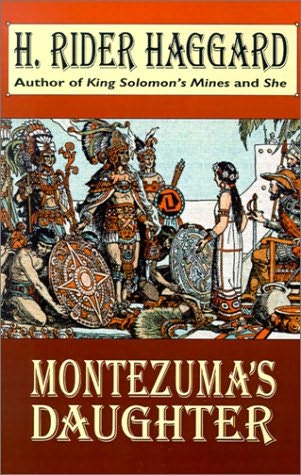 oña Isabel, who gave birth to a daughter, Leonor Cortes Moctezuma. It was probably a relief to the King of Spain, Carlos I, that Cortés “royal” child was a girl. Spain haonly been united under a single ruler since 1492, and Carlos was less King of Spain than King of Castile, AND King of Aragon AND King of Granada AND King of León AND the feudal lord of various entitites on the Peninsula like the County of Barcelona.
The various Iberian kingdoms had been ruled by women, and some had been ruled illegitimate children of previous rulers, but none by illegitimate daughters of king’s widows. So, the chances of Cortés trying to claim New Spain as his own, or to rule it through Leonor were probably nil (his illegitimate son, Martín Cortés would try to make himself King of New Spain, but Martín’s mother, “La Malanche” had no ties to the Aztec royal family” and, thus, no valid claim in the thinking of the time).
Still, recognizing that Doña Isabel Montezuma, or her descendants, could be a potential headache for the Spanish monarchy, Carlos had her pensioned off, making her a dependent of the Crown, and not of Cortés. Leonor was farmed out to another Spanish family and Doña Isabel managed to get through a few more husbands before she died in 1550. Her will left 20 percent of the Tacuba pension to Lenore, twenty percent to the Church and the remainder to her oldest son (by husband #5), Juan de Andrade Gallego Moctezuma. Her two sons by husband #6 received lesser amounts and the two daughters (also by husband #6) received substantial dowries, but both entered a convent.
Naturally, Lenore’s son-in-law, Juan de Andrade Gallego Moctezuma, and her grieving widower, Juan Cano, all sued each other and the dispute has been passed down as a family heirloom ever since. Juan de Andrade’s family did pretty well for itself, becoming counts of Mirville, seeding a number of royal families with the Montezuma genes with a family seat in Granada. At least one Cano son also married into the titled class, leaving descendents scattered around Europe. Leonor’s descendents are mostly still in Mexico City. The only thing all the various descendents agree on is that, given that Carlos I promised a perpetual income, they should still be getting their cut of the annual payout of 250,284 ounces of gold… about 15 million pesos at today’s rate.
Mexico had assumed payment at independence, and kept paying up until 1934, when somebody finally noticed the expense and — with both the Great Depression and the Spanish Civil War as rationales — decided to stop payments. Franco’s government was never recognized by the Mexicans, and Mexico City hosted the exiled Republican government — the Republicans weren’t going to press for payment to a bunch of reactionary aristos, and the Mexicans would have ignored the (non-existant) Franco regime had they bothered to even ask.
Which doesn’t mean the Acostas of Mexico City, the Counts of Miraville and the various heirs of the Canos aren’t still hoping for a windfall. A Mexican lawyer, Alejandro González, representing the Miravilles said “Mexico MUST recognize their error in suspending the payments.” And why, exactly? Because… “Those Spaniards always think of money. We Mexicans don’t give a damn,” as Mexican historian Blanca Barragán Moctezuma — a Montezuma, but not one of the hopeful heirs of Isabel — succinctly put it.
¡Sin maiz, no hay país!

INTERNATIONAL DAY AGAINST MONTSANTO
Whether you like it or not, chances are Monsanto contaminated the food you ate today with chemicals and unlabeled GMOs. Monsanto controls much of the world’s food supply at the expense of food democracy worldwide.
In Mexico, where corn originated, there has been an attempt by the U.S. multinational to patent OUR seeds and quite possibly destroy varieties that have been bred for milenia to meet the special needs of different soil and environmental conditions.
Find the illegal…

One of these guys was a dope-smoking illegal alien. The other one is Cheech Marin.
In the video below, one of these guys is making sense. The other one works for Fox News. Happy birthday, Tommy Chong!
Lead us not into telenovelas

Photo: Puente Libre (Chihuahua)
On the heels of a polemical discussion about the role of telenovelas… set off by a column last month in Milenio by Álvaro Cueva, defending the trashy long-running “teen market” soap, La Rosa de Guadalupe comes the story of three girls, 13, 14 and 14, who find themselves facing very serious federal charges, based on a plot they hatched — they claim — inspired by the Televisa program. The issue is not so much whether a drama featuring “unprotected anal sex, drug consumption, the loss of virginity, kidnapping, bullying, abortion, human trafficking and the worst news in the papers” is suitable for a young audience (although Mexico, like other countries, has it’s conservative “concerned parents” type groups who complain about television programming) as it is why television — and one network — is setting the social agenda, and whether Televisa can — or even should — claim to have a pedagogical purpose. That is, is television — or rather, Televisa — educating, or simply entertaining and using social issues as a vehicle to sell programming? And… perhaps more importantly… why has the State allowed one television network to become the de facto baby-sitter and educator of a generation of young people (and not just in Mexico: Televisa dominates the entire Latin American market for programming aimed at young adults).
Televisa itself goes back and forth on this. On the one hand, Cava claims that television is educational, and telenovelas always justified their existence by adding a sub-plot designed to highlight a “social issue”, but on the other, Emilio Azcárraga Jean, Televisa’s CEO, in a recent speech to the International Association of Women Executives said that “television is not a baby-sitter“.
The three girls conspired in an “autosecuestro” — a self-kidnapping — for the rather modest purpose of raising 25,000 pesos (about 2000 US Dollars) for a shopping spree in Chihuahua. While this sounds like a juvenile stunt by spoiled rich kids (and it was), kidnapping is generally taken by the public as more serious than murder, and although the girls are minors, videotapes of their confessions were distributed to the press. In the past, the show has been blamed for a couple of suicides (statistically rare in Mexico, and always newsworthy) and unwanted pregnancies (all too common here, despite constitutionally guaranteed access to birth control and sex education).
I expect we’ll be hearing more about this…. but not on Televisa. Despite initial promises to open the television market to alternative programming, the “reforms” that have been passed merely open the door for more commercial networks (including foreign ones), it doesn’t appear that programming will improve.
Line forms to the rear
This was posted last September, so I can’t say if it’s more a comment on the sorry state of the British economy that Londoners queue up for a free meal, or that British food is so horrible it’s worth the wait for fake Mexican food.
Making money the old fashioned way… theft
During Andrés Granier Melo’s governorship, about 1.6 billion dollars “disappeared” from the State of Tabasco’s treasury. About 6.5 to 7 million U.S. dollars) of the missing funds seem to have been found, just sitting around in cash in a closet of a house belonging to the Granier administration’s State Treasurer. While I’m sure it’s all just a misunderstanding (doesn’t everyone have a closet full of boxes of 500 and 1000 peso bills ?) it is suspicious, given that Granier himself rather disappeared his last day in office. Not that anything happened to the Gov, but it doesn’t look good when he resurfaces in the a den of thieves… otherwise known as Miami.

Show me the money! State prosecutors present the evidence to the press. EFE photo
Enrique Peña Nieto seems to be backing the state’s investigation of the Granier Administration, as the new Socialist (PRD-PT-MC) Adminstration of Tabasco Governor (and economist) Arturo Núñez Jiménez tracks down missing funds (much of which seems to have gone into business ventures in the United States and into beachfront properties in Tabasco). While being spun as a serious anti-corruption campaign, but one wonders if it isn’t more payback for Granier having been the first Tabasco Governor from the PRI to lose his state to the opposition. Granier was taped bragging about owning 400 pairs of shoes and 300 suits (and whining that he couldn’t wear them around Villahermosa, it not looking right for the Governor to be too turned out), which makes me think it’s less that he’s just a bigger crook than some others, but that, like Elba Esther Gordillo, but was too ostentatious a crook to be quietly allowed to slip away.
Afternoon delight?
From São Paulo, Brazil…
A well ordered militia?
With all the spin being put on every news story about the right to carry firearms, in a way I’m surprised the U.S. media hasn’t picked up on the controversy here over “communal police” in Guerrero and Michoacán. On the other hand, north of the border, while the story does involve the gringo’s favorite Mexican obsession (narcotics traffickers), it doesn’t feature any of the blood and gore that is so essential to U.S. reportage from Mexico, so maybe it’s not surprising at all that this has been ignored.
From yesterday’s Milenio (my translation):
A 24-soldier military patrol was detained by residents of the municipio of Buenavista Tomatlán, Michoacán for over five hours today.
The Michoacán state government had reported this morning that the army had captured the four armed community police men at a roadblock the communal self-defense force had mounted at the outskirts of Buenavista Tomatlán to prevent drug traffickers from passing through their town.
The four community police officers were taken to Morelia, where they were handed over to the Attorney General of the Republic, sparking anger from their peers and inhabitants of the municipality.
The protesters blocked the road linking Tomatlán Buenavista road to Apatzingán, paralyzing traffic for more than eight hours.
The military patrol, part of a federal operation that began this week in the Tierra Caliente region of Michoacán, asked members of the self-defense force to clear the road and to participate in a dialogue in the center of town.
After several [failed] attempts to justify the arrest of the four community police officers, the soldiers opted to set up a base in the Municipal Police office, where they agreed to remain until the detainees were released shortly after 9 P.M.
The 24 soldiers never gave the protesters their radio equipment, guns or rifles, and had received orders stand down because of the presence of women and children among supporters of community policing.
I haven’t been following the Communal Police story all that closely myself, but Frontera NorteSur wrote about (and I pasted into this site) a story on what they called “anti-crime uprisings” last November:
This year’s uprisings in Michoacan and Guerrero happen in a rural Mexico where erosion of governmental support for small farmers and the increased integration of the country into the global economy has created power and justice vacuums.
In many places, formal state authority has been largely supplanted by parallel governments involved in drug trafficking and other criminal enterprises. Indigenous communities are also increasingly resisting threats to their community integrity and social fabric from over-logging, new highways, mines and other large development projects imposed by outsiders.
Analysts and close observers had mixed reactions to the surge in armed citizen uprisings. Tlachinollan’s Abel Barrera said it was a positive development that the people were standing up, but that a danger existed of bloody confrontation and the “law of the jungle” prevailing if grievances were not seriously addressed by the authorities.
Columnist and legal consultant Alfonso Zarate wrote that the Michoacan and Guerrero uprisings presented the incoming PRI administration of Enrique Pena Nieto with the challenge of “strengthening municipal authorities” and crafting public policies that “reverse the profound social dislocations which the communities live in and that constitute fertile ground for the interests of criminal bands.”
In addition to the threats to communal resources (and lives) from outside economic forces (including narcotics traffickers), indigenous communities have a right to “apply their own standards in regulation and solution of their internal conflicts” , which many feel is best served by local communal defense groups rather than state or federal police who are likely to be outsiders, unfamiliar with the folkways and traditions of the community they are supposed to protect and serve.
Even when the communal police serve the modest purpose of resolving disputes in a traditional fashion and preserving peace among neighbors the self-defense and communal police units are being seen as a challenge to the authority of the State. Much was made by the mainstream media (especially Televisa) of masked communal police dragging in reluctant defendants before “people’s courts”. That the justice was swift and generally not all that harsh (normally fines, or a few hours in an improvised jail), suddenly was a human rights violation to a government that never has much concerned itself with the slow legal process and often barbaric conditions of incarceration in the “official” system.
And, while the allegations of collusion between official police and gangsters (including the multinational corporations and mining companies) are widespread, rather than respond to the allegations, the critics… i.e., the communal self-defense organizations… are blamed for violence (and sometimes accused of collusion with the gangsters themselves).
Add in on-going dissatisfaction with the “reforms” — including the educational “reforms” that have led to rioting by student teachers in Michoacán — and you have an uprising waiting to happen. And should that happen, the Army has more guns… and airplanes… and a U.S. government itching to find a new “insurgency” to put down in the name of preserving “stability”. Which doesn’t mean the armed units in the rural areas don’t have an issue, but does mean the Army showed good sense in backing down this time.
Number one with a bullet (to the head)
Commenting on the suicide of Fascist apologist and right-wing writer Dominique Venner (supposedly as a protest against same-sex marriage) in Paris’ Notre Dame Cathedral, the rector apparently mis-spoke in saying it was the first suicide in the church in 850 years. It wasn’t even the first right-wing suicide.

Antoninetta Rivas Mercado, a well known figure in Mexican post-revolutionary intellectual circles (besides her literary salon, she was a founder of independent theatrical troupes and the Mexico City Symphony) was the daughter of architect and sculptor Antonio Rivas Mercado. She was the model for the Angel that sits atop her father’s Monument to Independence. An extremely wealthy man, Antonio’s death in 1927 left Antonetta with the money to argely underwrite her lover, Josè Vasconellos during his presidential campaign in 1928., hich he sought to campaign to move the Revolution to the right.
Having rather spectacularly lost that election, Vascocellos chose to exile himself to Paris, where he would move increasingly towards the fight politically (ending up as the editor of a pro-Nazi newspaper in Mexico city). Antonetta followed him, where she had neither money, nor influence… nor a lover. Spurned by Vasconcellos, she shot herself sitting in a pew in Notre Dame on 11 February 1931.
Rivas had been briefly married to an American citizen, Albert Edward Blair, in 1919, and had a son, whose would marry Katherine Skidmore, who under her married name (Katherine Blair) wrote the fine novelized biography of her tragic mother-in-law, In the Shadow of the Angel (Tuscon, Globe River Images, 2011)
Where the wild things are
Mexico never has been a dull place.
Via Inexplicata: The Journal of Hispanic UFOlogy
In 1792, Juan Vicente Guemes, Count of Revillagigedo, Viceroy of New Spain, decreed that a scientific mission should be sent to the northern Pacific coast: not to challenge the Russian whalers and hunters, but to compile an extensive ethnography on the inhabitants of those distant lands and a catalogue of the surrounding flora and fauna. The expedition, officially called the “Expedición de Límites al Norte de California” (Expedition of the Borderlands North of California)would include naturalist Jose Mariano Moziño Suárez de Figueroa, born in Temscaltepec, Mexico, whose writings on the culture of the nuu-cha-nulth would appear in the document known as “Noticias de Nutka” (News from Nootka, currently kept at Yale University’s Beineke Library.
It is believed that the first mention of the controversial creature known as Sasquatch or Bigfoot appears in this 18th century scientific work: Pages thirty-four to thirty-five of “Noticias de Nutka” include remarks by Moziño Suárez concerning an unusual beast given the name “matlog”.
“No sé qué decir de un matlog habitante de la Serranía de quienes todos tienen un temor imponderable. Figúranle un cuerpo muy monstruoso, poblado todo de rígidas cerdas negras, la cabeza semejante a la humana pero con los colmillos más grandes, agudos y fuertes que los del oso, larguísimos los brazos, y los dedos de pies y manos armados de largos y encorvadas uñas. Sus gritos solos, dicen ellos, derriban por tierra a quien los escucha, y que hace mil pedazos al desdichado cuerpo sobre el que descarga alguna manotada. Presumo que la historia del matlog tenga el mismo fundamento que la de la creación del hombre que acabo de referir, o que desde una época antiquísima haya recibido la tribu de que deben estos naturales su origen a algunas noticias de la existencia de Demonios […]
(“I do not know what to say about a matlog, a resident of the mountains, who fills everyone with unspeakable dread. They describe it as having a monstrous body, covered in all manner of rigid black bristles, with a head similar to a human’s bu with larger, sharper and stronger fangs than a bear’s, very long arms, with its fingers and toes armed with long and curved claws. Its screams alone – they say – can topple anyone who hears them, and it can shatter any unfortunate body into a thousand pieces in a single blow. I presume that the history of the matlog has the same basis as the creation myth of which I have just spoken, or that members of the tribe received word long ago that these entities owe their existence to demons […]) [translation by SC]
Moziño’s writings languished in oblivion unitl 1913, when they were translated into English by Iris Wilson. This translation would appear in a work by early researchers of the Sasquatch mystery – Don Hunter and René Dahinden – in the prologue to their classic book Sasquatch (NY: Signet Books, 1975).
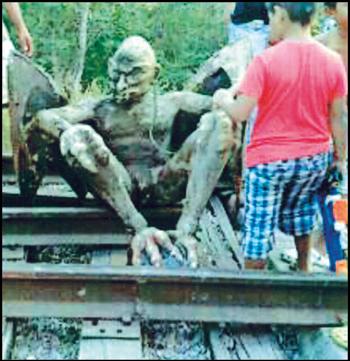
Ok, Moziño didn’t bring back any evidence, but only was reporting what he heard about the mythical creature. In Alaska… where the locals sometimes, er, stretch the truth (“I can see Russia from my house”) and scary critters like Sarah Palin are just part of the landscape. Not nearly as inexplicable as this story from Notiver (Veracruz, Veracruz) , where photographer Joel Soriano claims to have the proof that a Paso del Toro fisherman, identified only as “Juan”, caught a gargoyle. The media would never make shit up, would they?
Back to nature
Axolotls … ajolotes in Spanish and Nahautl … native only to Like Texcoco, are nearly extinct in the wild, “thanks” to drainage over the last half millenia, competition from introduced species like Tilia, and by being tasty little critters. Widely bred in captivity for scientific research (they have big embryos besides a few odd features like not rejecting transplants from others of their own species, regenerating lost organs and… best of all for them… able to extend puberty indefinitely — unlike humans, axolotl adolescents eat less than adults, which has some advantages; like humans, the teenagers are perpetually horny and can reproduce, creating a win-win for the species even in lean times). And, for an added bonus, they drive “intelligent design” folks nuts… they have both gills and lungs…. sometimes.
A thousand captive bred Axolotls were released back into Lake Xochimilco (about the only part of Lake Texcoco still extant) this week, with another five thousand to be released over the next year.

(Jornada: Liberan mil ajolotes jóvenes en canales controlados de Xochimilco)


 mexfiles.net