Borderline sanity
Imperial Beach/Tijuana:
Still radical after all these centuries
¡No soy marinaro, soy capitán! might have started as a slogan shouted in 18th century Veracruz in protest of the Spaniards impressing locals to serve in anti-piracy operations, but given it’s bouncy, upbeat rhythm, we often forget that “La Bamba” is, and always will be, a celebration of the fight against injustice.
A sombrero tip to Sabina Becker for this version by Los Cafeteras, who interpret for our day in the spirit of those 18th century draft evaders:
Happy Cinco de Mayo…
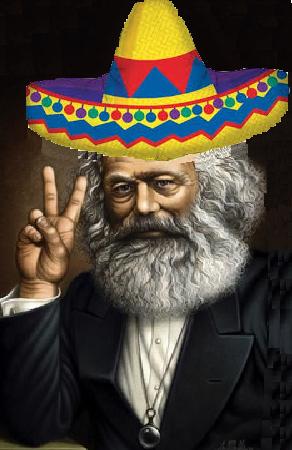
aka Karl Marx’s birthday (5 de Mayo de 1818).
Via Guerrilla Comunicacional México is the story of a investigation by the Mexican business daily El Financiero on retail employment.
Among the companies looked at was one with low wages … always.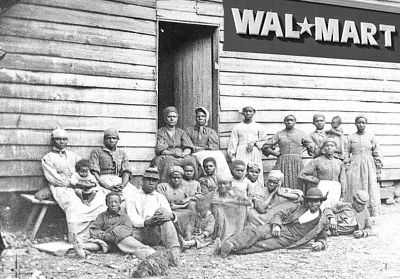
Walmart offers to pay cashiers 14.67 [$1.23 US] pesos per hour for a 7-hour day (with one hour for lunch ), equivalent to 2,000 pesos a month [$165.50], or a nine hour day for 3,400 pesos [$282.00 US] per month (but with lunch included) *.
In both cases, the retail company gives food voucher and pays social security benefits. This year, the chain, the largest employer in the country, plans to create 15,000 jobs, most as a result of opening new outlets.
For José Luis de la Cruz, director of research and business economics at Tecnológico de Monterrey, these jobs not of any benefit to the nation, despite the thousands of positions created, but cannot be considered exploitation or abuse, at least legally, since the employer is complying with the law.
Walmart is hardly the most worst of the chain store employers. El Financiero found that employees at chains like Oxxo, KFC, El Globo and others generally earn between 2000 and 3000 pesos a month, and work nine or ten hour shifts. Most at least provide the minimal legal venefits (including Social Security, which in Mexico includes basic health insurance), but at least one of the majors, Electra, has a 13 hour workday (although there is a two hour dinner break) and provides no benefits for the first five months of employment, “thanks” to new laws making it legal to pay new hires less during a “probationary period”.
Jorge de Presno, of the law firm of Basham, Ringe y Correa, said that in general the IMSS payments (the Social Security national health progam) and legal benefits are something that should not be subject to probationary periods, and the work day is not supposed to exceed 8 hours during daylight hours, 7.5 hours during a “mixed shift”, or 7 hours on a night shift.
He added that workers may exceed these limits, but not more than 48 hours on a day shift, 45 on a “mixed shift” and 42 hours on a night shift.
A worker may work up to 10 hours four days a week, and eight hours on a fifth day… if they have two days off.
“To answer your question, ‘is a work day of over ten hours legal?’, the answer is yes, but only under the condition that it benefits the worker,” he said.
* I won’t discuss my personal finances here, but I will say that this is about what I pay just for rent on a two bedroom house in a lower-middle class neighborhood, in one of the lower-cost regions of the country… not including utilities.
A Peronist Pope?
Having been called on several occasions a Mexican anti-clerical (and the hurache kinda fits, so I’ll wear it), I don’t know which is weirder… sticking up for the Pope, or sticking up for Argentina. But here goes:
The “liberal” Huffington Post reprinted AFP’s report on the Pope’s St. Joseph Day sermon under the headline “Pope Francis Condemns ‘Slave Labor’ In Bangladesh: ‘Goes Against God‘ … seizing on the specific mention Francis made of the fire in Bangladesh at a factory producing cheap clothing for U.S. retail outlets (i.e. Walmart). The commentari at HufPo mostly seemed more interested in dissing the Pope by noting serious problems with the Catholic Church (pedophilia is a favorite, along with the subordinate role of women) that don’t have much to do with a sermon giving a religious defense of calls for better working conditions and living wages.
Of course pedophilia is a chronic problem for the Church, and it hasn’t been dealt with effectively (see Sabina Becker’s post on an apparent cover-up of a pedophilic priest by the new Pope here), but it was off-topic (and more on that below).
Surprisingly, the far-right wing U.S. news site, NewsMax, caught what was important… writing up their spin on the sermon under the headline “Pope Francis Rails Against Sweat Shops and Unemployment in May Day Message”.
May Day Message? Well, sorta. The Feast of St. Joseph, Jesus’ step-dad, technically is the 19th of March. But, Pius XII, back in 1955, added a second feast day to the liturgical calendar, for St. Joseph the Worker (the guy was a carpenter, after all), just happening to fall on International Workers’ Day… and giving the clergy a shot at equal time with the Communists and Socialists at putting out the spin on labor issues.
The HufPo.. or rather, AFP’s last two paragraphs formed the lede in the NewsMax story: “A society that fails to pay a fair wage or one that seeks only personal profit is unjust and goes against God, Pope Francis said in a May Day message Wednesday.” Also, NewsMax did not even mention the Bangladeshi factory fire.
In other words, while AFP and the mainstream press went with the “Pope does Popish thing, and expresses sorrow for tragedy”, the right-wing press got the message… “Pope weighs in on labor rights” .
The comments, or rather the ONE comment on the NewsMax site caught something worth noticing:
Another socialist Pope. This one adopted a milder form of Peronism. Mixing spirituality and economic issues in concrete terms of specific obligations through government is the big mistake any religion can make.
There is no basis in the Bible or Jesus’ teaching for state coercion, confiscation, and redistribution.
Historically, Protestants have been more faithful to the Bible, and have produced more prosperous societies without Obamanomics.
I have no idea what “Obamanomics” might be… or how it differs from any other corporate capitalist economic system… and it’s obvious that the commentator prefers some other flavor of the world’s largest religious body, but perhaps the Pope IS a Peronist.
Peronism, while unique to Argentina and Uruguay, is based in indigenous Latin American ideology … that is, Peronism is one of any number of variations on political traditions in Latin America, that only seem contradictory when European/North American labels are slapped on them.
I see four basic Latin political themes:
- Nationalism
- Bolivarianism or Pan-Latinamericanism (not necessarily the opposite of Nationalism. A Bolivarian might, like Hugo Chavez, see active participation in Pan Latin affairs as furthering the national interest)
- “Indigenism” * (Generally “left wing populism” in the foreign media, my made up word is meant to suggest politicians like Andres Manuel Lopez Obrador in Mexico, or Evo Morales in Bolivia … or Juan Velasco, the Peruvian strongman of the 1970s… who are identified with movements meant to open the system to traditional outsiders, often the majority in their countries)
- “Criollism” (in a sense a false opposite to Indigenism… assuming a rule by the traditional elites, or at least by those who have co-opted the elites… paternalism on a national scale).
None of these are mutually exclusive, and several may be elements in any one political movement. The Mexican PRI, for example, was nationalist, used Indigeninist rhetoric and a leadership that, while taking inordinate pains to avoid being tarred with criollo ancestry, governed through a paternalist, top-down political machine. One could same the same about Fidel Castro, who also sees himself as Bolivarian.
In discussing the presumed Peronsim of Jorge Mario Bergoglio — who grew up in a blue-collar Buenos Aires family during the Peronist era — R.R. Reno, in the right-leaning U.S. religious affairs publication “First Things” try to place the Pope in Argentine political through, but in European/North American political terms, rather than Latin ones:
Juan Domingo Perón is the defining personality in modern Argentine history. He was a protean figure, hard to categorize. Some regard him as a proto-fascist, others as a proto-socialist. But all agree that he smashed the old oligarchies that dominated Argentina, setting in motion the many convulsions of populist and anti-populist movements that have roiled Argentine society.
In Latin American political terms, Peronism is nationalist, indigeninst (although the “indigenes” in Peronism tend to be of Italian and German and East European origin) AND Criolloist. I think Perón’s fascism is somewhat over-stated, as well as his socialism. He was a nationalist indigenist, which is neither left nor right. Nationalism meant a not so much a pro-Axis foreign policy as an anti-British one, and to some extent, Peronist indigenism was more likely to favor the homelands of the German and Italian ethnics who were less likely to be the old elites than the Anglo-Argentines.
As they say in Texas about politicians, “ya gotta dance with them that brung ya.” And Perón stepped into a governance traditionally “criollo” in outlook, meaning that governance by a self-defined elite was expected. But, he also had Eva… and when you come down to it, the Pope sounds a lot like Eva Peron:
Eva introduced social justice and equality into the national discourse. She stated, “It is not philanthropy, nor is it charity… It is not even social welfare; to me, it is strict justice… I do nothing but return to the poor what the rest of us owe them, because we had taken it away from them unjustly.”
(Joseph Page, Perón, Random House, 1993)
Of course, besides not having Eva around (“Don’t cry for me, Vatican”?), a Pope — even an Argentine Pope — is governing a world-wide organization, and the days when the Papacy was an Italian operation are over. He can hardly be a nationalist. If he is a Perónist, it is in the sense that he has given charge of a traditionally “criolloist” government, which, as an “indigenist” … or as an Evaperonist … one can expect him to use to promote not philanthropy, nor…charity… not even social welfare; [but]…strict justice.”

About that pedophilia coverup:
Perón, in the end, was overthrown by conservative (or, “criolloists”), with the connivance of the Catholic Church. There is no denying that Perón … especially after Eva’s death… turned increasingly intolerant of dissent. In addition, his political enemies (and those with an economic interest in seeing Perón gone, like the United States and Britain) attacked his regime for systemic problems in Argentina, and Perón himself for perceived (or real) personality traits that had little to do with governance. Of course, that’s not uncommon… think of the way Eva Peron is remembered outside of Latin America: as a clothes horse and a gold-digging hooker, which is much less trouble than considering her as a working class heroine and feminist politician. Or, for a more recent example, Hugo Chavez. Not that these people are “saints” (even in the secular sense), but — being mostly on the side of the poor — they are a threat to the criolloist order and subject to attacks based as much on class and assumptions about their nation… and even their most mundane human quirk (like Ms. Perón’s taste in hats, or Chavez’ fondness for earthy humor) is offered as evidence of their movement’s illegitimacy.
With an “indigenist” Pope threatening to roil the “criollo” interests not just of the Curia, but of economic elites around the world, a push-back should be expected. Not justifying the coverup of pedophilia by any means, but it wasn’t all that long ago when it was seen as a not-particularly serious matter (and, when it involved girls, was a regular subject of comedy, as when near the end of “Animal House” when we find out Dean Womer’s “slutty” daughter is only 14). If Francis didn’t deal with it as well as he should have, he wasn’t the only one, and he’s head of an institution that’s going to have to deal with the situation of a lot of bishops in the same position. The guy’s new at the job.
The Church’s retro attitudes towards woman and gays make it easy for “progressives” to dismiss the Pope on grounds that have nothing to do with his social policy. And the corporate media knows it. But, it’s like attacking Hugo Chavez’ housing programs because he made crude jokes about George W. Bush. Or Eva Peron’s social work because she and had slept around (even as a minor!) and wore designer dresses as First Lady.
Otto, at IncaKolaNews, questions my use of “Indiginism”, and I admit it’s a klutzy term. I tend to see the rest of las américas through a Mexican lens, and was at a loss for a good word to contrast with “criolloim”. In Mexico, and in Central America, what is usually called “populism” is often expressed in terms of celebrating the traditional values of the commons. While indigenous Mexicans are a shrinking minority within a “mestizo” society, the indigenous are symbolic of — and in reality are — the “bottom of the heap” of citizens. Criollos don’t really exist in Mexico any more (anyone of purely European ancestry probably being not more than two generations from immigrant stock), but the sensbilities of a class born to rule have been with us since the 18th century.
Better terms are always welcome.
Was ist das?
“We do not shout ‘Olè!’, much less eat ‘chile-con-carne’, nor strum guitars, don boots and sombreros and walk shouting through the streets,” say Mexican residents of Berlin. They have asked their nation’s embassy to intercede on their behalf to complain about this U.S. company’s attempts to foist on Germans a false impression of Mexicans.
Día del Trabador…

Detail of a fresco in the style of Diego Rivera, “California Industral Scenes” (1934) by John Langley Howard, Coit Tower, San Francisco
It’s something of a mystery to U.S. pols and pundits why the rest of the hemisphere fails to listen to the U.S. when it talks about the dodgy human rights record on the Island. The Republic of Cuba may be a police state, and dissidents get themselves arrested now and again, but everyone in the Americas knows one thing about Cuban prisons. The worst of them isn’t Cuban:

… the decision to transport captured individuals in the Global War on Terrorism (GWOT) to Guantanamo did not happen because of some popular fear or anxiety amongst Americans after 9/11. That may have insulated the administration of President George W. Bush from immediate criticism, but, as Mark Mazzetti shows in his book, The Way of the Knife: The CIA, a Secret Army and a War at the Ends of the Earth, it was torture tapes destroyer and torture advocate, former CIA Counterterrorism Center head, Jose Rodriguez, who suggested holding individuals at Guantanamo Bay.
During a CIA meeting, where Rodriguez and then-director George Tenet were present:
Everyone around the table laughed, thinking about how much it would anger Fidel Castro if the United States were to jail the prisoners of its new war on the American military base in Cuba. But the more they thought about the prospect, the more everyone thought Guantanamo actually made sense. It was an American facility, and the fate of the prison would not be jeopardized there as it could be in another country if the government changed leadership and decided to kick the United States’ prisoners out. And, the CIA officials figured, a prison at Guantanamo Bay would be outside the jurisdiction of American courts. A perfect location, it seemed…
CIA officers dubbed it “Strawberry Fields” because “prisoners presumably would be there, as the Beatles sang, ‘forever.’”
(Kevin Gosztola, Obama’s Deluded Remarks Ignore His Role in Keeping Prisoners at Guantanamo, Firedoglake.com)
General discontent with Plan Merida
In anticipation of the up-coming state visit of Barack Obama, where the U.S. President — without much to show in the way of progress on controlling the illegal arms trade from his country — is expected to double-down on demands that Mexico continue it’s involvement with the “Merida Plan” by which Mexican law enforcement and military personnel have been largely co-oped by U.S. forces, in a “war on drugs” in this country.
While it is expected that the Peña Nieto administration will largely accept whatever it is the U.S. is proposing, one Federal Deputy from the President’s own party (the PRI) is publically questioning the entire premise of the drug war, and the government’s cooperation with the United States. This would be easy enough to ignore if Deputy Roberto Badillo Martínez was just a cranky back-bencher, but Badillo sits on both the Chamber of Deputies committees on Public Security and National Defense (and is the Secretary of the latter)… and — he is not just some politician from Veracruz — but a retired General Diplomado del Estado Mayor (in the Mexican military hierarchy, one rank below “Comandante Supremo de las Fuerzas Armadas” i.e., Commander-in-Chief: the President of the Republic), who in addition to field commands, 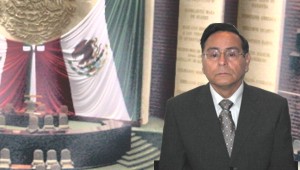 was in charge of the Army’s national service program, was military attaché to Argentina, Uruguay and Paraguay, and has written widely on military and political subjects. With active duty military officers not permitted to make political pronouncements, General Badillo is often the semi-official voice for one of the key “stakeholders” in U.S.-Mexican relations.
My translation of the key parts of that letter (as published in SDPNoticias):
When you [Obama] were elected President of the United States, there was genuine euphoria here in Mexico and throughout the western world. Some in Mexico foolishly said your country was the undisputed creator of democracy. Many commentators and political scientists treated you as a Messiah.
[But, at the time] I said that the U.S. government is like an orange cut in half, with the Republican Party to the right and the Democratic Party to the left. For the rest of the world, it was the same whether the Presidential Chair was held by a Democrat or a Republican, the two halves being separated only by your internal differences and nuances.
In the years that followed [your first election], you have not lived up to your promises to lower — even for a moment — the level of U.S. war-mongering in the world, as demonstrated by more 600 military bases on every continent (and including those in allied and friendly countries, sometimes also complicit in your war-mongering, like Germany, Italy and Spain) and have not touched a military budget of over 600 billion dollars … [and]… when the Merida Initiative engulfed my tragic country… and when no one would listen to Latin American leaders’ who aired their grievances about your country’s interventionist and militaristic history, all you said was “Well, I’m not guilty”, throwing away our concerns as surely as you threw the book Open Veins of Latin America*.
…
Through a miscalculation rooted in the anxiety of a governor whose election was considered dubious, my country permitted the government of George W. Bush’s to implement the infamous Merida Initiative, which you have allowed to continue. It is the Merida Initiative that is the responsible for the current tragedy. … The Merida Initiative is accountable to the people of Mexico to:
The death of more than 70 000 youth, children and women.
The disappearance of more than 20,000, who will never be seen again.
The depopulation of large areas of northern Mexico — and in some cases, not so far north, but hundreds of kilometers from the border — thereby causing untold family tragedies and indescribable, yet adequately known and studied , human drama.
The flight of thousands of millions of dollars from the border towns and some places not so near the border, where Mexicans with solid financial the border towns of his country and some not so border, where Mexicans had substantial financial investments in houses, apartments and businesses but were forced to flee the generalized violence caused by hundreds of thousands of weapons of all kinds and the millions of cartridges, clandestinely, or in operations authorized by your government such as “Fast and Furious” poured into Mexico, socially and economically destroying large areas of the Republic .
As I have said at the time in the Chamber of Deputies and in other media: the Merida Initiative was a national tragedy, that would further divide the Mexican Armed Forces. As we know from U.S. history, it does not help other countries, destabilizes other governments and nations. The U.S. has no friends, it only has interests as Dean Rusk said in the 60s of last century, echoing the English Prime Minister Palmerston…
President Barack Hussein Obama: your first and second terms do not deceive me. You are part of orange democracy the Democratic and Republican parties have implemented in their country, to deceive your people, and the peoples of the world.
Now the plan is to intensify the Merida Initiative, by other means, we’re told. Surely, those other means will also end in more tragedy, “help” you call it, as was the “help” given to the naive President Calderón to “combat narcotics trafficking and organized crime.” Time will tell.
Personally, I would hope the phrase “Merida Initiative was erased from the Mexican vocabulary.
In general, I agree with the General. I see nothing productive coming out of the U.S. President’s visit, nor in maintaining the close relationship with the United States either militarily or economically. Should the U.S. (most likely for domestic political reasons) cut back on its “investment” in the middle east, it depends on its war industries to keep its economy humming, and the “narco war” is going to offers an irresistible opportunity to continue spending, at a lower domestic cost. It’s nonsense to say that “legalizing drugs” (or, rather, decriminalizing marijuana) will change that situation. First, since any legalization would only mean U.S. coporations like Montsano or Archer-Daniels-Midland would control the market, and would either freeze the Mexican producers out, or — under the excuse that the “gangsters” control the production here, seek to make this country safe for U.S. democracy (i.e., corporate control of agricultural exports).
Economically, I have always seen the over-dependence on the U.S. market as a weakness. Mexico can grow it’s own middle class through increased internal marketing, and by doing business with the faster growing South American and Asian markets, none of which are militarily invested in this part of the world.
I don’t expect Brigadier General Badillo will be invited to meet with Obama, nor that he’ll finally read Open Veins… nor that the U.S. will, or can, change the way it sees Latin America (and Mexico specifically). But, the assumptions that the Mexicans — and perhaps the military forces in Mexico — are likely to resist a continued penetration of the market and control of national security here is a huge mistake. Mexico, like the United States, has interests. But… not being a world power, nor seeking to dominate the world… it does have friends.
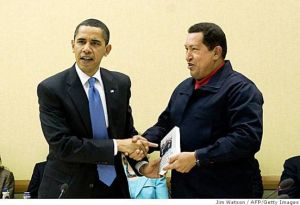
* Eduardo Galeano’s 1971 Las Venas Abiertas de América Latina is considered the essential work in any discussion of foreign exploitation of Latin America. While leaders at the Summit of the Americas in April 2009 were not all in agreement with the policies of Venezuelan President Hugo Chavez, they instinctively understood the reason — and quietly or otherwise, applauded — when Chavez presented the book to Obama. Obama’s indifference seemed another sign that U.S. leaders had no knowledge of, and no interest in learning about, Latin American issues and grievances. And appallingly bad manners.
You don’t need no education…
Sombrero tip to Porter Corn for this latest bit of Arizona stupidity as reported by Three Sonorans:
… Tucson High School has just banned Advanced Spanish Classes (7,8) for all of its students!
One of the Spanish teachers said that Dr. Clash said these classes are « too exclusive. »
 Now get this; French 7-8 is still being allowed!
And here we have the same history being replayed one year later after TUSD bans American History / Mexican American Perspectives but allows European History to be taught for American history credit.
Clash seems to have justified this by allowing one class to remain, the AP Spanish class. There’s one major problem though; the school of nearly 3000 students will only have one section of it available, and it coincides with mariachi class.
One freshman student was concerned at how her advanced bilingualism would actually hurt her chances of going to college thanks to Dr. Clash.
« I’m taking Spanish 5-6 right now, and there’s nothing left for me to take next year since I’m in mariachi which is offered at the same time as AP Spanish which is all that is left. The UA requires at least two-years of foreign language classes, and because of Dr. Clash’s policy I don’t know what I will do. »
The student added « This is unfair because French 7-8 is still being offered. »
Indeed, living one hour away from the border, Spanish is crucial in the Old Pueblo. Perhaps that is why TUSD continues to ban Mexican American History, our books, and now our language. That will keep us behind long enough until either ICE deports us, or our youth fall into the private-prison pipeline.
Somebody had to take the picture
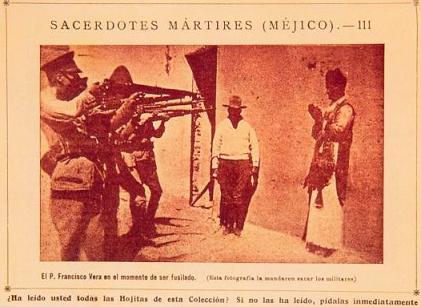
I’ve written about this photograph before, which received several comments, mostly supporting my contention that it is a doctored photo. While perhaps not quite the intention of one correspondent, who seemed to dismiss the idea that this was a propaganda photo (and not a historical document), I appreciate his taking the time to write me with definitive information about this iconic work.
While the earliest printings I can find are from Spain, my correspondent was right: the photographer was a Mexican, Manuel Ramos Sánchez (1874-1945). Relatively forgotten until recently, Ramos’ work had been displayed at the Museo de la Ciudad de México in early 2012 where my correspondent saw it. Which does not mean it wasn’t a manipulated propaganda photo. On the contrary, it was Ramos’ work as a propagandist that makes his work interesting to us today. In the words of the collection’s editor, Elia del Carmen Ramírez:
He was not afraid to experiment as a photographer. Regardless of beliefs or political opinions, [what’s remarkable is that] he presented the idea of the image not as a document but as a creation. That’s pioneering photomontage, we are talking about the pre photoshop: he sought the ideal image and therefore did not care if he broke up the essential structure of the picture.
He was a militant Catholic, not merely a believer. His devotion led him to join the Cristero army, perhaps not with gun in hand, but with his camera. One of his great documents comes directly from within the Cristro movement, which he understood as a legitimate defense of his perspective…
On a secondary matter, my correspondent thought I erred in assuming the spelling of Mexico as “Mejico” did not mean the photo wasn’t of Mexican origin. As it was, the copy of the photo I used was printed in Spain, but he is right that the Castilian variant “Mejico” is used in Mexico. He thought it was common, and as proof, offered up the 1960 edition of “Mejico Cristero” by Antonio Rius Fascius. Which only proves that it’s used in a very limited sense in Mexico.
In an undated interview by Luis Humberto Espinosa Díaz for the Autonomous University of Guadalajara’s Centro de Estudios Cristero Ancleto Gonzalés Flores, Ruis makes a point of not only referring to himself as the son of Spaniards, but of writing “Mejico Cristero” as a defence of “Hispano-Catholic culture” (“Me propuse recuperar la cultura hispano-católica…“) and of his intentions, in that book, of revitalizing the “cultural traditions of Mexico, to which Mexico has historically conformed” (“En este sentido, mi libro Méjico Cristero trató de ser la revitalización de la cultura tradicional de México, con la cual México se había conformado históricamente.” Note the spelling of the country’s name).
Perhaps, half right. The copy of the photo I posted came from a set of cards published in Barcelona. The only other spellings of Mexico as “Mejico” I was I could find from Mexican sources outside of references to anything later than about 1880 were in Cristero studies or defenses of Franciso Franco… or both … in which the author — like Ruis — sought to explicitly identify Mexican culture to Iberian traditions.


 mexfiles.net