Are “Free markets” necessarily free?
While that’s not particularly the subject of the recent post on Tim’s El Salvador Blog, a recent, unheralded (except by Tim, as far as I can tell) event in the Central American nation does make one wonder about the “freedom” of free markets.
Under the General Medicine Law, approved at the Legislative Assembly in February, prices for at least 6,200 medicines will be reduced by a minimum of 30%, and up to 60% for those most often prescribed, reports Prensa Latina.
El Salvador is currently considered one of the countries with the most expensive medication worldwide.
Low income groups and left wing political party Farabundo Marti National Liberation Front support the legislation, but domestic pharmaceutical groups claim the law is a violation of the right to economic freedom for drug companies.
According to activist organisation the Committee in Solidarity with the People of El Salvador, transnational companies such as Pfizer and the local pharmacies that carry its products have threatened to abandon the Salvadoran market, citing the law.
Approval of the policy was also a severe blow to former Nationalist Re[pu]blican Alliance party President Alfedo Cristiani, who owns domestic pharmaceutical company Droguería Santa Lucía.
With the death of one of the great champions of the individualist “free market” in the news, perhaps it’s time to ask whether “freedom” can be defined in purely market terms… and that if we do chose to define “freedom” in economic terms, whether or not the economy needs to concern itself with the people as a whole, or with those who invest their money in an enterprise… and if the enterprise itself is in the interest (economic or otherwise) of the people.
In the crudest terms, healthy Salvadorians are “worth” more than sick ones, and even those who rely on medication, if they are spending less on pharmaceuticals, presumably have more money available for other purchases.
Is there economic freedom when “free markets” limit economic ability?
The genius in his cyber-labyrinth
¡VIVA GABO!

85-year old Gabriel García Marquez has authorized release of his work as free eBooks…
I can’t get Cien Años to download (it’s a win-zip file, as are most of the longer works available… the shorter pieces are in word documents), but I’ve already got that in dead tree editions in English and Spanish… so maybe I’ll try again later, but wow… just WOW!
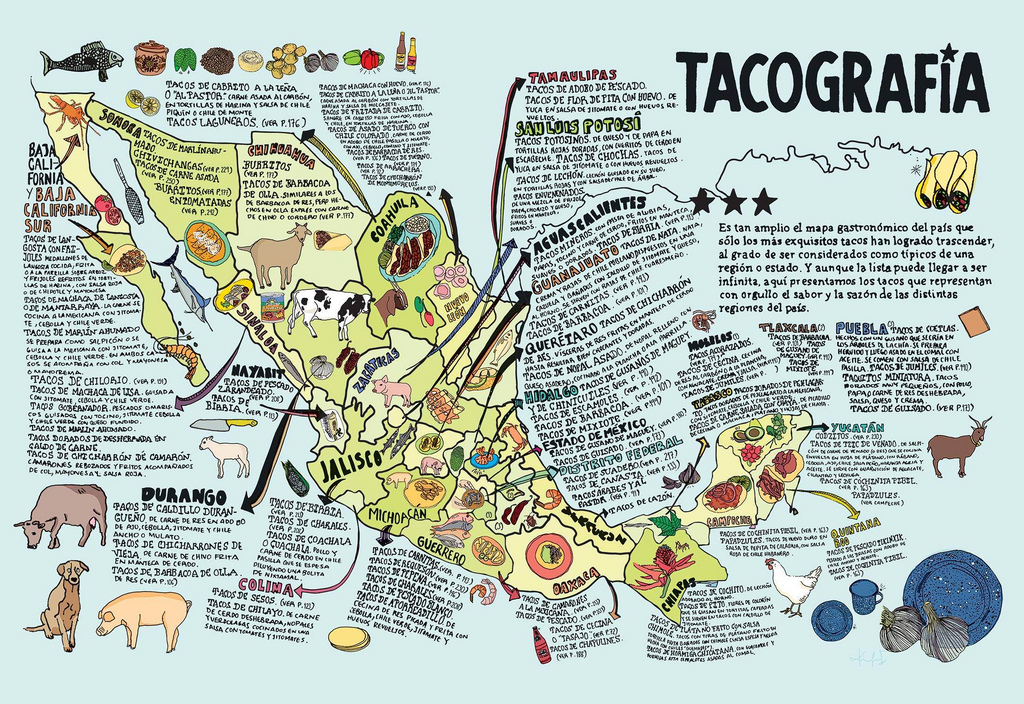
A tally of tacos…
Charles de Gaulle, exasperated by his countrymen, once asked of France: “How can you expect to govern a country which has 246 varieties of cheese?” If culinary diversity is an indicator for political instability, then there can’t be much hope for Italy, with over 350 different pasta shapes, or Mexico, with its innumerable varieties of taco.
(Frank Jacobs, “Strange Maps“)
Here’s a guide to at least some of the tacos of Mexico… a bigger version of which is here:
Sounds all too plausible
Roberto D’Aubuisson, son and namesake of the El Savladorian right-wing death squad leader of the 1980 and 90s… and presently a congressman in El Salvador representing the party founded by his father, ARENA, is now accused of conspiring with the Venezuelan opposition to disrput that country’s upcoming presidential elections, and … according to Venezuelan government spokesmen… to assassinate Interim President (and front-runner for the 14 April elections) Nicholas Maduro.
The accusations are being taken seriously in both Venezuela and El Salvador. Salvadorian Vice-President Salvador Sánchez Cerén is calling for investigation, though there is some political motivation, as Sánchez is a presidential candidate for Salvador’s ruling FLMN party. D’Aubuisson rejects the accusations, claiming they are a “smoke screen” to divert the attention of the Salvadorian people from problems in Salvador. Which sounds kinda convoluted to me.
I won’t say “the apple doesn’t fall far from the tree”, but when your dad’s nickname was “Blowtorch Bob” (in honor of his favored instrument of torture) and he openly talked about killing 300,000 of his fellow countrymen (and was the “intellectual author” of Archbishop Romero’s murder) … AND… when your brother was killed apparently because of ties to organized crime, the lame rationale given by D’Aubisson Jr. is hard to accept at face value.
29 January 1990… a day that will live in infamy
So, now we know who really inspired Margaret Thatcher… not Reagan, not Churchill, not Pinochet. Carlos Salinas!

I don’t think it’s a mistake that he looks like Lex Luthor
We first met, Mr. President, in Paris—a very good place to meet, in Paris—it was on a certain date, 14 July, there were something like 34 Heads of Government there and a lot of business was done that had nothing to do with Paris. And I remember your telling me then of your plans for tackling the problems of Mexico. They included deregulation, privatisation, encouraging foreign investment into Mexico, and of course dealing with Mexico’s debt. All along true private enterprise lines, all along putting power back to the people, deregulating and having orthodox finance.
You will understand when I say the message had a familiar ring and I can assure you that it would be successful and I know since then that you have pursued it very, very vigorously and already it has had great success as confidence in your country has been restored and many people who had previously taken their currency and their wealth out have now brought it back to Mexico, and industry is now going in there to invest for the first time for a long period and that you are privatising things and the people are realising the advantages of doing that.
So impressed was I that I actually obtained and read your first “State of the Nation Report”. It is indeed a very, very meaty document but also shows how your policies, in a very similar way to ours here, have been founded on your true beliefs.
If I might read from it, I am sure it would do our audience here a great deal of good to hear what other people believe in, as they have heard it so often from me.
It said this. “Mexico’s crisis showed us that a larger state is not necessarily a more capable state. A state that owns more is today not a fairer state. The reality is that in Mexico a larger state has resulted in less capacity to respond to the social demands of our fellow citizens. The size of the state was growing while the well-being of the people was deteriorating.” I think I will have to do a State of the Nation Report and put similar things also into writing.
Of course it was absolutely fundamentally sound and we rejoice that you set out your beliefs and then followed them sturdily and that they are meeting with such good results.
(Margaret Thatcher Foundation, “Speech at dinner for Mexican President (Carlos Salinas) 1990, 29 January“
In “honor” of Margaret Thatcher
If there is an afterlife, she’s sharing a room in Hell with her boyfriend General Pinochet.
No gurls allowed!
The Roman Catholic Church isn’t the only one to prohibit women from participating in certain religious rites. Even the sacrificial chicken is a cock, not a hen…
Via Frontera NorteSur (Center for Latin American and Border Studies, New Mexico State University, Las Cruces, New Mexico):
Barring any last minute changes in policy or wind conditions, an iconic landmark of the Paso del Norte borderland will literally come tumbling down early on the morning of April 13. That’s the day when a demolition team using explosives is scheduled to bring down the remaining two smokestacks of the old American Smelting and Refining Company plant in El Paso, Texas. Shut down since 1999, the historic facility has since been stripped of its salvageable assets, put to an environmental remediation and readied for the history books.

Photo by Rudy Gutierrez/El Paso Times
Overlooking the Rio Grande and still flashing red night lights like a foreboding frontier sentry, the former Asarco plant is located across from working-class neighborhoods in Ciudad Juarez, Mexico, and about two miles down the road from Sunland Park, New Mexico. Nearby is the campus of the University of Texas at El Paso and its surrounding neighborhoods. The tallest stack slated for destruction towers at 828 feet above the border, while the smaller one hovers 612 feet over the borderplex.
[…]
… the smaller stack could conceivably topple across the border into Mexico under certain circumstances.
[…]
…former El Paso Asarco worker Carlos Rodriguez warned of the stacks’ proximity to the American Canal, which delivers drinking and irrigation water to El Paso and Juarez, and the Rio Grande which runs parallel to it.
“When the stacks are imploded, this will shake the ground and who knows what and how this will affect the chemicals already in the ground let alone the questionable material that remains in the stacks,” Rodriguez said.
The Asarco property is a horrendously toxic waste site now (smelters are among the dirtiest of dirty industries), and getting rid of it is of benefit to the people on both sides of the border. Bringing down the remaining stacks is essential to the cleanup, but we shouldn’t just let them disappear without noting one thing of value that will be lost when the plant goes … any reminder of its role in the Mexican Revolution.

Francisco I. Madero, who was doomed to never understand that the Revolution he was about to start was a social upheaval, had the rather modest goal of a political change, and some tweaks in the labor code that he was able to sell to corporate sponsors as a better way of bringing Mexico up to date than waiting for Porfirio Diaz to croak, and risking violent upheavals that would interfere with U.S. business interests. Like those of Meyer Guggenheim, at the time the CEO of the American Smelting and Refining Company, who generously loaned the shed on the Juarez side of the ASARCO plant for use as the Provisional Capital of what was to be a transition government.
Notice the telephone company logo hanging on the wall (on the right hand side of the photo). Madero was a master of, if nothing else, finding corporate sponsorship and probably was the only revolutionary in history to hit on selling product placement rights. In return for Bell Telephone running a line from the ASARCO plant out to the shed, thus giving the Provisional Capital what at the time was a high-tech link to the outside world, Bell Telephone got their sign seen in news photos throughout the United States and around the world.
Even if that chimney comes crashing down the wrong way, landing with a loud thud in Juarez, it won’t be either the first, nor the last, time that U.S. corporate interests have landed on Mexicans with violent and unpredictable results.
When it rains…
191 mm in two hours? That’s 7.5 inches of rain for the metrically challenged, and that is a lot of rain. And more of that severe weather some in the U.S. pretend isn’t happening.
La Plata, Argentina (with a population of about a half-million) is experiencing what local officials are calling “an unprecedented catastrophe” with at least 40 dead and 2200 homeless according to early reports.
Photo from La Nación:

Girls just want to have guns… more than jobs
Now this is interesting. Lilia Varenka Torrealba Lecuona until today had a rather cushy job with the Federal District government as “directora de Coordinación, Apoyo y Supervisión de la Subsecretaría de Gobierno” (i.e., the sub-secretary’s appointment manager and events coordinator) when her facebook photos were splashed across the pages of Reforma and other Mexican dailies.
 Although the weapons she is … uh… modeling? brandishing?… are all legal police weapons (the photos apparently taken by a police official), she was forced to immediately resign.
What’s interesting is the different attitude towards firearms taken here than what you’d find in the U.S. Torrealba was obviously mugging for the camera, and posting the photos, captioned “One of my other passions”, might not be taken seriously in the U.S. (and in some places, might get drafted as a candidate for political office), but it is definitely taken as an extremely serious matter here.
Ms. Torrealba’s defenders (and there are a few) claim her forced resignation was sexist. Nah… never mind that this photo was taken in a police official’s office… you don’t mess around with tools you’re not supposed to be using. Those aren’t toys, and if this was meant to be cute, or funny, nobody’s laughing.
F&ck#ng great language lessons!
First as tragedy, then as farce
Paging Herr Zimmermann…
When Imperial German Foreign Secretary Arthur Zimmermann sent off his telegram in 1917 to his Ambassador in the United States for delivery to the Mexican government (or, rather the government of Venustiano Carranza), how seriously he even took the proposal is of some doubt.
Zimmermann was an idea man… and, unfortunately for him, sometimes his brain farts got the better of him. If war is politics by other means, than political sabatoge is war by other means, too. Undermining the governments of enemy nations (or, in the case of the United States, potential enemies) made sense… and Zimmermann’s proposals to assist Indians and the Irish in rebelling against the British, and the Russian Communists in overthowing the Tsar all made perfect sense. None of these two way plots having quite worked out to German advantage (although the Russians did overthrow the Tzar, and the Irish finally did start their long-delayed war of liberation, both were too late to really prevent the German defeat), offering German assistance in “reconquering” regions ceded to the United States after the War of 1846-48, though, depended on a three-way (or rather four way) conspiracy that was just too complicated to work.
The Germans would have to convince the Japanese (who were on the Allied Side in that war) to switch sides and join… the Mexicans, who were in the middle of a civil war… and were supposed to work with African-Americans in the Southern U.S. to force the United States into a defensive war that meant it would be unable to supply the British. Or something like that.
Zimmermann himself later admitted (and quite cheerfully, making a joke of it that Germans always have a hard time making friends,and sometimes just don’t  know how to talk to people), that the plan wasn’t really supposed to work, but only to keep the U.S. on edge, and make them less likely to interfere in the European War. Which, as we know, didn’t work… the British using their purloined copy of the telegram as the basis for propaganda painting the Mexicans as a threat and the Germans as devious, and the British (never mind that they were oppressing the Irish and the Indians) as the victims of aggression. Woodrow Wilson fell for the British line, and the rest, as they say, is history. Tragic history.
Venustiano Carranza, who had the best claim to heading a government in Mexico, was supposedly the one receiving the telegram, but whether he ever saw it is conjecture. I tend to think he didn’t. It’s not clear who did, most sources (even those who tend to take the whole thing as a serious offer) only mention “a Mexican general” having seen it. Whoever did would have realized how ridiculous it was, Carraza not even having the title of President (but only Chief of the Constitutionalist Army) in January 1917, and more than one claimant (and more than one Army) claiming to be the government.
But, I guess one bad idea deserves another.
Not quite in Arthur Zimmermann’s class when it comes to deviousness is Spaniard Alejando Cao de Benó, self-elected dear leader of the Korean Friendship Organization, which has an international membership, but their meetings have more in common with a Star Trek convention than Communist International:
… KFA members are awarded badges and posters, and jostle to outdo each other with their trainspotters’ grasp of the minutiae of North Korean life.
Like other followers of niche enthusiasms – medieval role players, American Civil War re-enacters, Japanese anime obsessives – the KFA’s members seem not completely at home in their own world, seeking instead a deeper affinity with a distant, idealised time or place. For them, North Korea’s isolation, its status as a mysterious, forbidden kingdom in an otherwise globalised world, is the source of its unlikely mystique. “It’s the only exotic country,” explains Frank Martin, a 49-year-old Parisian bank manager and KFA member, who has twice visited North Korea on KFA solidarity tours.
In his role as “Special Delegate for Cultural Relations with Foreign Countries, Democratic Republic of Korea” (which, weirdly enough, the weird government

Photo by Xavier Cervera (Independent, UK)
of North Korea apparently has actually allowed the Spaniard to claim), Cao de Benós has sent his fraternal greetings to Mexico. Not exactly calling for Mexican participation in whatever the Hell that supposed state of war between North Korea and the United States is, but — Zimmermannesquely (to coin a word) — seems to be in the spirit of Zimmermann, meant to stir up trouble in the U.S. over possible Mexican support for an “enemy power”.
Naturally, right-wing loons in the U.S. take this seriously being predisposed to assume Mexicans want to invade the U.S. anyway, but this is no more likely to be even read by anyone in authority or merit any sort of consideration. Cao de Benós addressed his letter to the “Partido Comunista de México”… which has a website, but hasn’t been a party since 1989.
Cao de Benós claims “Sarcasm doesn’t exist in DPRK,” but it sure does on MexFiles… but whether to direct it towards the Special Delegate for Cultural Relations with Foreign Countries, or the Free Republic and other useless idiots who “want to believe” the Mexicans are coming for them (and their guns and religion and women… especially their women) is a difficult decision that probably needs to be seriously considered. Or not.
Read it and tremble, oh ye sarcastic running dog imperialists:
Mensaje de la RPDC dirigido al pueblo mexicano a través del Partido Comunista de México


 mexfiles.net