¡COMO MEXICO NO HAY DOS! Mexico's hsitory and culture, the Real, and the surreal, Mexico. Politics, economic, news sometimes here, but regularly posted at mexfiles.substack.com. Copy and quote freely, but be respectful, and acknowlege the source. And, of course, monetary donations help keep the site going.
“Mexico City will be receiving the first automatic containers to compost dog and cat droppings for future use as biogas or energy…”
Jornada, 13 June 2022
While no government funds are involved (supposedly), the system is supposed to collect poop, and when 70 percent full, send a signal to an electric vehicle which will collect the compost.
Ok.. fine. But this depends on people (I can’t see the dogs cooperating… and cats? Forget it!) uh… dumping… the stuff, which I don’t imagine they’d be willing to save up to make a trip to the composter all that worthwhile. In other words… unless they get their shit together, I’m afraid the eight experimental installations is gonna end up in the crapper.
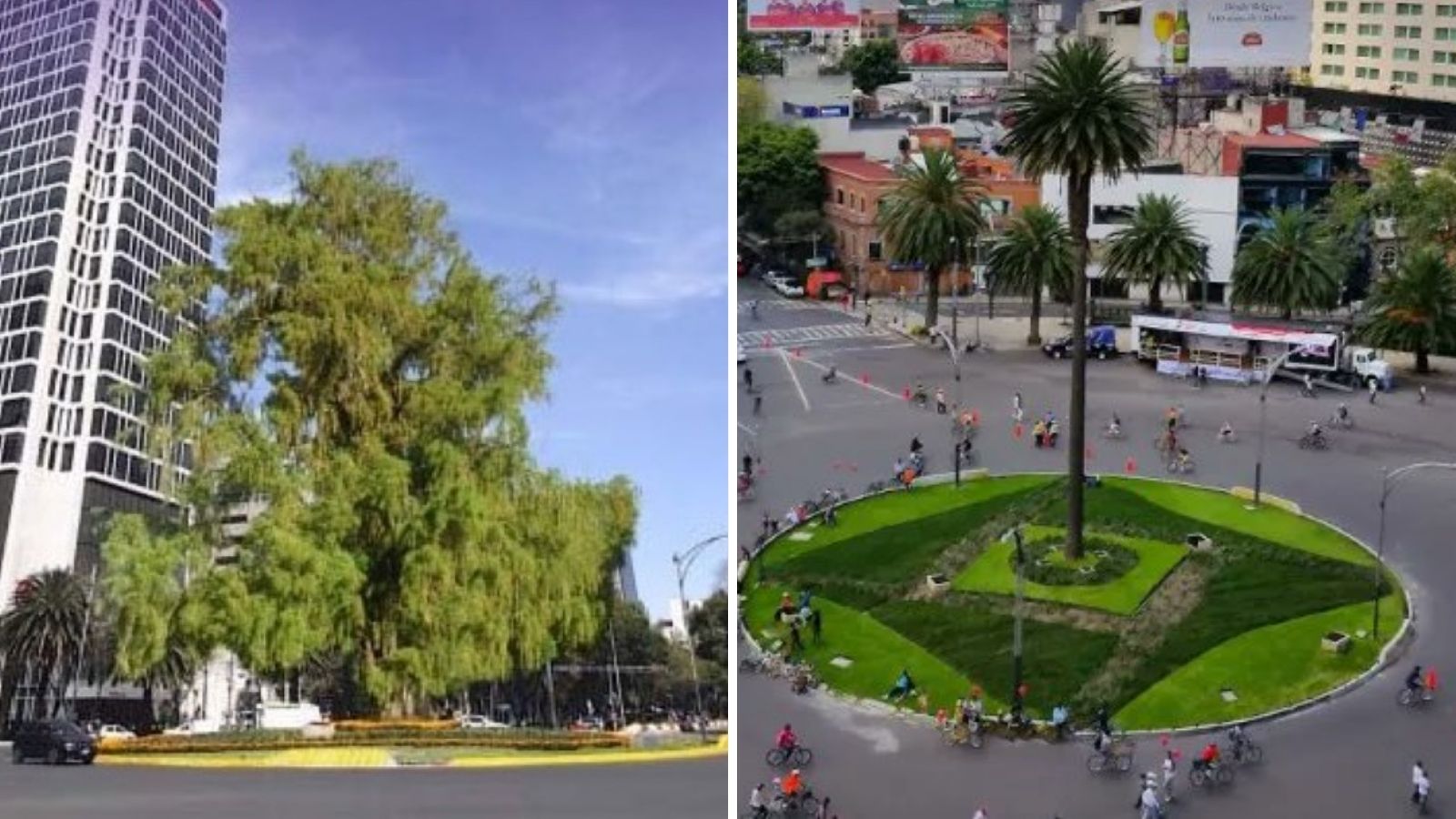
The palm tree that stood in the round-about in front of the Mexican stock exchange died at… what for Canarian palm trees… is the perfectly respectable age of 100 or so. It’s been replaced by a relatively youngster… a 20 year old ahueheute (a-who-WHA-tay), aka “Montezuma Cypress”, aka “Taxodium mucronatum” that should be around for a while… they live somewhere between 800 and 1500 years.
Left: Ahuehuete. Right: the palm before it came down.
Even at the age of 80, one thing you can say about Don Porfirio: the man knew how to obfuscate better than just about any politician ever.
In 1908, the President was interviewed by Filomeno Mata, and asked about a statement published earlier that year in which he had hinted of a possible retirement at the end of his term. Don Porfirio gave a master lesson in how to avoid a straight answer:
The main topic, to which you refer is one which, in my opinion, should not be discussed just now, and if on a recent occasion I made a statement with respect to that subject, it was only the expression of a mere personal desire of mine. You will, therefore, not take it strange if, in answer to your request to be informed as my resolution, I forbear to make it known seeing that so long a time has elapsed before the prospect time for manifesting it arrives.
“President Díaz Makes Statement on Rumors of Coming Candidacy,” Mexico Herald, 28 October 1908
My response to a person who asked why those of us who chose to live in countries like this, with a high firearms murder rate, still feel “safe” and are reluctant to go to the US:
It’s cynical to say this, but gun violence in Latin America generally is “rational”… or, perhaps, “transactional”. That is, against those threating some economic or power interest (not just including criminal enterprises, but against those like human rights workers, labor organizers, ex-wives, or environmentalists who threaten those interests. In the US, it’s random, or motivated by less comprehenible personal reasons.
And, it comes down to access to the weapons. Here, they’re limited to those that can afford to get them on the black market and state security appachiks, and there, it’s a free-for-all.
The president of the United States, Joe Biden, “personally wants” his Mexican counterpart, Andrés Manuel López Obrador, to attend the Summit of the Americas, to be held next week in Los Angeles…
Juan Gonzales, US National Security Director for Hemispheric Affairs
Joe, it’s your party, but you can’t order people to attend.
Reforma reported this morning that two US Senators, Chuck Grassley (Republican) and Dick Durban (Democratic) have demanded information from the DEA regarding the DEA “investigative unit” closed down at the request (or…demand) of the Mexican government this last year.
Specifically, the Senators want to know the exact dates the unit was in operation, and the details of what led to its closure. They write:
Provide the number of reports of misconduct, broken down by crime category and including reports of waste, fraud, abuse, mismanagement, or corruption, received by the DEA associated with the above unit from the date it was opened to the date it was closed.
According to Grassley and Durban, there are “conflicting” stories about why the unit was closed. DEA “anonymous sources” are saying the closure “destroyed … bridges they we were building over several years”, while the Mexican government claims the unit was infiltrated by criminals.
Also mentioned is a DEA airplane that was taken out of the country after requests from the Toluca airport authorities. Allegedly the DEA needed the plane for their activities (unspecified)
Which raises a question not asked very often. What exactly was the DEA up to in Mexico. Presumably assisting Mexicans in the US sponsored “war on drugs” though… given the record of US government involvement (specifically CIA involvement) in narcotics shipments, and the drop in narcotics exports from Bolivia when that country threw out the DEA, let’s just say, “inquiring minds want to know”.
Two things I’d like to know. Who buys bones (witch doctors?) and who is buried with a bag of pot?
A 30-year-old man was arrested by Auxiliary Police officers for transporting human remains that he illegally unearthed from a grave in a Iztapalapa cemetery.
According to the Mexico City Prosecutor’s Office, the man identified as José “N” was transporting human remains and other stolen items.
The police officers were on a routine patrol of the cemetery when they observed the man removing objects from a grave. When the officers approached him to ask if he had authorization to be in the place, the man claimed to be a cemetery workers, but was unable to verify it.
After searching his belongings, officers found 12 possibly human bones, seven metal crosses and a plastic bag with apparent marijuana.
According to some testimonies, the events occurred on April 26. One of the three criminal groups that steal and sell human remains in cemeteries in this demarcation could be responsible for the events.
Inquiring minds want to know: Who buys bones? And was somebody buried with a bag of pot?
For those with short term memory loss, 2006 was the start of “Plan Merida”, the US sponsored and financed “War on Drugs” meant to shore up the (probably illegitimately elected) Calderón Administration. Crime rates have been slowly dropping since 2018 under the present administration, although… obviously… still much too high.
MEXICO CITY (appro).- The Secretary of National Defense (Sedena), Luis Cresencio Sandoval González, announced that the possibility of the institution manufacturing weapons for state police in the country is being analyzed.
In this way, control of the institutional arsenal can be guaranteed and the dependency they have on foreign companies that sell long and short weapons, as well as ammunition for police corporations in the 32 entities that make up Mexico, can be avoided, he said.
“There is a project within our military industry that in this administration has increased the capabilities of our military industry and we have thought as a project that at some point, once all the infrastructure in Oriental, Puebla is completed, we could do the analysis to have the possibility of manufacturing weapons, as we currently do for our institution”, explained the military chief.
In the morning conference, Sandoval González said that in the event that the weapons manufacturing project in Sedena materializes, the main objective will be arms control and cut dependence on foreign manufacturers that sometimes take up to a year to supply requests from the Mexican government.
There might be some real benefits to this… besides reducing dependence on foreign imports. Mexico had a munitions industry up into the 1970s and was known for innovative and particular lethal arms: the “automatic rifle” (grand-daddy of the AK-47 and M-16) are just variants on the Mondragon 1910 gas-powered rifle that saw use from the First World War up through its use by some units of the Viet Cong in the 1970s); the Obregon rotating pistol; the Trejo pistol (Trejo is still in business, making tricycles and farm machinery) taken out of production because it was too good.
So it’s not like the technical ability isn’t here, and like it or not (and no one does) there is going to be a need for some people to have some firearms.
But controlling the manufacturing might have some advantages. Mexico¡s lawsuit against US arms manufacturers seems to have dropped off the radar, and might not go anywhere. HOWEVER, if Mexico’s legitimate market is limited to those manufactured by the state, there is no reason to allow the import of ANY foreign weaponry, one assumes, “legitimate” imports being diverted accounts for at least a percentage of the illegal weaponry floating around. And, there would be nothing to making the only legitimate weapons in Mexico incompatible with foreign weapons (I donno… different sized ammunition?) could make it more difficult for those with “off-the-books” weaponry to use them.
In the Americas, we’re forced… or rather in the habit… of thinking of “race” in broad terms, “white”, “black”, “indigenous american”, “asian”… though for most of the hemisphere, it’s a mix and match. A very different interpretation… and catagorization… of who was what “race” when what we call “white people” first appeared in this part of the world. For them, being a Castilian, or Norman, or English, was a different “race” than being a Basque, or a Gascon, or Irish. While the various colonial states (Spanish, Portuguese, English, French, Dutch) might lump their migrant class together (and expand the definition when it suited them), and lump the indigenous people into a single “race” as “Indians”, to justify not including those “migrants” who came against their will required a new way of thinking of people, new categories of (mis)understanding.
“Bad Empanada” (an Australian? in Argentina) is not my favorite commentator on Latin America, but his lecture on the “invention” of the white (and black) “races”… and “race” is well argued, and worth considering:
Originally posted in 2015. Reposted (with changes) for Mexican Teachers’ Day
Although the first Conquistadores were followed by more than its share of profiteers, rogues and outright psycopaths (like Nuño de Guzmán), the “apostles” ( 12 Franciscan monks chosen to lead the efforts to proselytize the “indios”) were not the only Spaniards who found a higher calling in the New World.
Catalina Bustamante, one of the first European women in the Americas, had emigrated to Santo Domingo (Haiti and the Dominican Republic) was secure enough in her position as a “lady of quality” to bombard King Carlos with letters demanding justice… and a better education… for the indigenous survivors of the Conquest in the Caribbean. Widowed young, with several children, she used the one sure skill she had, literacy in an era when it was rare for even a wealthy woman to read and write, to support her family as a teacher. Cortés hired her to educate his own children, bringing her to Mexico.
While teaching the children of the elite was renumerative, Catalina became friendly with Motolinia, who had been teaching the sons of the former Aztec elites. With no one educating their daughters, Catalina took on the task, and opened her school to any indigenous girl. As a condition of receiving support from the Church, she of course had to add religious instruction to her curriculum, but daringly, began instructing the girls in Spanish law, and encouraging them to speak up for their rights. As one might expect, this wasn’t exactly what the “founding fathers” of the Colony had in mind, but… backed by Isabella of Portugal (Queen of Spain and Empress of the Holy Roman Empire) she was not only able to find funding for her school, but returned with the backing and money needed to expand her programs, and to start start training her girls to become teachers themselves. The only restriction ever put on “The Mother of Mexican Education” was that the Crown expected education to be controlled by the Church. Becoming a member of the “Third Order of Franciscans”, which bound her to follow the religious precepts of her superiors… the monks running the boy’s schools… she remained free to live independently of a religious community, to manage her own personal affairs, and to claim her school (and, later, schools) were officially religious institutions.
With the present government here trying to impose educational “reforms” by force, sending in federal police to prevent teachers from making a mockery of “testing” programs designed not to highlight weaknesses in the educational system, but to force public school teachers out, and pave the way for more privatization; and with teacher training having become potentially fatal (remember the 43?), a little bit on the history of education in Mexico. A bit from the draft of my revised “Gods, Gachupines, and Gringos” (maybe Gods and Gringos Reloaded?).
The “apostles” I mention were the twelve Franciscan monks sent by Carlos of Castille and Aragón (aka, Holy Roman Emperor Charles V) with a mission to convert the Aztecs.
Although the first Conquistadores were followed by more than its share of profiteers, rogues and outright psycopaths (like Nuño de Guzmán), the “apostles” were not the only Spaniards who found a higher calling in…
The Mexfiles has never expected to turn a profit, but personal funds only go so far. Miscellaneous expenses (telephone, internet connection, subscriptions, spyware, hardware repair, etc.) run about 600 pesos (35 US$) a month, and donations are gratefully accepted. Please note that your donations are in Mexican Pesos (18 pesos to the US Dollar as of February 2019). A 25 US$ donation is 450 pesos.
The background of Mexican anti-clericalism and the "atheist" general who led the Catholic counter-revolution of the 1920s
128 pp., Editorial Mazatlán, 2012.
An oral history of the World War II experiences of Gilberto Bosques (1894 – 1997), Mexico 's Consul General in Marseilles, France, who saved tens of thousands from the Nazis.
36 pp. Editorial Mazatlán, 2007 $35 MXP (click the image)
While "The Mex Files" authorizes and encourages non-commercial use, such use must include a link including the words "Mex Files" hyperlinked to either "https://mexfiles.wordpress.com" or "http://mexfiles.net". Printed material must reference the original post.
Non-commercial re-publication is allowed for copyrighted material, provided it is "fair use" as defined in 17 USC § 107.
Commercial re-publication and all other use without the express written permission of the author is prohibited.
Information at richmx2 (at) live (dot) com



 mexfiles.net