Leonora Carrington, Anglo-Mayan Zen Alchemist
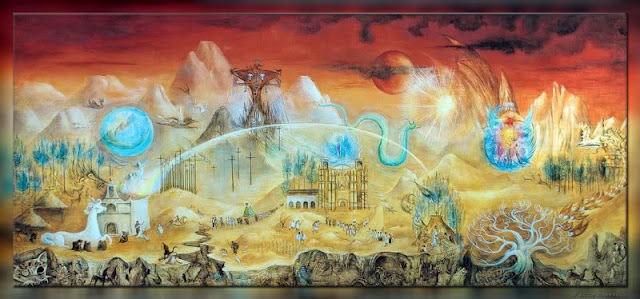
El Mundo Magico de los Mayas (1963)
Accept my friend Leonora Carrington as your teacher. She doesn’t know any koans, but she has resolved them all.
(Zen master, Ejo Takata quoted in The Spiritual Journey of Alejandro Jodorowsky)
Thanks to a small link, I discovered U.S. poet Christian Gholson’s website, noise and silence. In three parts (here, here and here) Gholson presents a well-worth reading short (and complete) biography of the British born Mexican artist Leonora Carrington.
In Gholson’s biographical sketch, Carrington is presented as a “counter-culture” figure, which I suppose she appeared to be to the outside world… although it seems more just that she abandoned Europe and the west to embrace the contradictory culture of Mexico. Or cultures, Mexico being a place where European and indigenous modes of thinking and seeing have co-existed and co-opted each other since the 16th century, and where what was shocking to the North in the 1960s (drug-induced vision quests, for example) or were simply old ideas passed off as post-modern (Zen, Kabbalah, alchemy) were something already known, or a slightly variant coloration of things that already were part of the cultural whole and seen simply as one more pigment on the cultural palette to be blended into the ongoing work that is Mexico.
[In the 1960s] Carrington received a government commission to paint a mural for the Museo Nacional de Antropologia, located in Chapultepec Park in Mexico City. Her mural was for the section in the museum dedicated to the state of Chiapas and so she travelled there in 1963 to study the region and the culture.
“In San Cristobal de las Casas she stayed with the Swiss anthropologist Gertrude Blom, whose fieldwork focused on the Lacandon Indians who lived in the area. Through Blom she was introduced to two Chiapas curanderos (healers) from the village of Zinacantan (called ‘House of the Bats’) and, although wary of foreigners, they were so impressed by her knowledge of and respect for traditional healing that they allowed her to attend some of their ceremonies.” ([Susan L.]Aberth, [Leonora Carrington: Surrealism, Alchemy and Art] p 97)
For the next six months Carrington worked on preliminary drawings of the villagers and local animals. When she returned to Mexico City she began to study the Popul Vuh, the sacred book of the ancient Quiche Maya, in order to better understand the pre-conquest belief systems of the Chiapas Indians, descendents of those who wrote the Popul Vuh.
The result was the mural El mundo magico de los mayas.
The sporting life
“Some people believe football is a matter of life and death… I assure you it is much, much more important than that.”
There are three topics of conversation in Mexico: futbol, futbol, and everything else.
Carlos Monsiváis
Serious sport is war minus the shooting
George Orwell
Perhaps the biggest problem with political reporting is that the media sends out political reporters to cover political events, when they should send out sports writers, like Proceso’s Beatriz Pereyra, who manages very nicely to turn Orwell on his head, showing that unserious sport (The outcome was never in doubt). And, to follow up on Orwell, unserious sport (like Mexico v Guyana) can be politics by other means, thankfully minus the shooting.
My translation:
Screams of “Fuck You, Peña!” spread through the stands of Estadio Azteca throughout the first half of the World Cup Brazil 2014 qualifying match between Mexico and Guyana.
The anti-Peña Nieto demonstrations were impossible to miss. Televisa commentator Javier Alarcon said on air: “We are hearing a loud shout against the presidential candidate Enrique Peña Nieto accompanied by an obscenity that we are not going to repeat.”
Traffic had slowed to a crawl on Calzada de Tlalpan [the main route to Estadio Azteca] Friday evening before the start of the first World Cup Brazil 2014 qualifier. The outcome of a game featuring Mexico against weak opponent Guyana was not in doubt: the biggest attraction was finding out if how many people would respond to calls on social networks for a demonstration against PRI candidate, Enrique Peña Nieto.
The opening ceremonies, the playing of the national anthems, went smoothly. At the first block, by Guayanese goal-keeper, Ronson Williams, a shout of “Fuck you!”, but without adding “Peña” was messaged by the twitterers. Within five minutes, in the stands behind the visitors goal, a young couple held up a red sign with black lettering, in support of Peña Nieto, as a group of adults in the same seating area were encouraged to raise bright orange placards, also in support of the PRI candidate.
The private security guards for Azteca Stadium soon reached the area, and asked the fans to remove their signs. Reluctantly and under protest, all folded their cards which then served to fan them or put under their seats to avoid soiling their clothes.
Minute 16: The score was 2-0 thanks to goals by Salcido and Giovani: goals that nobody much cheered… “no one is cheering Peña”. The fans lolled in their seats, though happy enough to applaud the players, while on the north side of the stadium, in the empty seats just under the giant screen, a giant green shirt was unwrapped, bearing the number 132, and the logo “Mexico”.
The few kids who had been in hitherto empty stands were joined by others who left their seats and # YoSoy132 debuted in Mexican soccer.
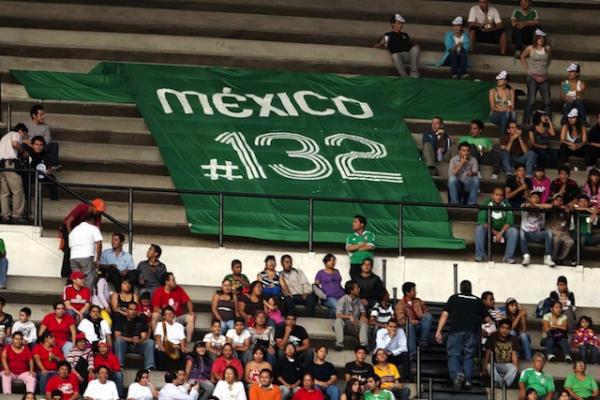 To the right of the jumbotron, a few moments after the giant shirt appeared, a giant banner reading “Mexico does not want Peña Nieto” made its appearance as more and more youngsters, ant-like, poured into the unoccupied seats around the banners.
Halftime ended shirtless … and the banner came down. The stadium security guards, in their florescent orange shirts, pressured the fans into taking them down. The rest of the crowd could not raise them again.
At halftime the fans woke up from their siesta and began to make some noise. On the left side corner of the south end, a group of boys, men and women, one with a UNAM Pumas shirt who had been quietly watching the game, without any fanfare, raised a white placard with red lettering, reading “# YoSoy132” and the crowd responded.
A man in civilian clothes, carrying a range of communications equipment, and staffers who identified themselves as Federal District police, came up and politely asked the group to take down their sign. “There are Peña Nieto supporters up there, and they could attack you.” The kids took their sign down for a moment, only to raise it up again, higher than ever, as they climbed on their seat.
This caught the attention of the curious who came to see what was going to happen. Those who just realized that there were other “Yo Soy 132” people in the crowd started calling out to each other, and clustered around the kids as if they were rock stars.
“Fuck you, Peña!, Fuck you, Peña!, OUT!”, one belted out. As in cascade, the tribune was joined by a chorus. One, then those in the seats behind, then those further away. The sign was passed from hand to hand, as the holders posed for their photos on smartphones, each posing with fingers up in the “V for Victory” sign, smiling ear to ear and rejoicing in the shout out of “Fuck you, Peña!”
But the spell was broken by the cops. Six officers poured out of a tunnel, swiftly and hostilely glommed on the boys, to pull the sign away. The kids played defense, passing the sign back and forth, until one officer managed to grab it. Filled with hate and anger, the officers retired with their booty. For his trouble, he earned a chorus of “repressive asshole!” From the kids, laughter and much celebratory mischief.
Throughout the second half of the game, new fans never stopped coming. Whole families with children and even grandparents, appeared in an unusual way. The preferred seating area, where tickets cost more that 1200 pesos each, filled up. So did the 600 and 200 peso seats. The stadium was nearly full by the end of the game, and people were still pouring inn when the referee blew the final whistle.
In the cheap seats, bored with the game that the Aztecs ruled 3-1, a girl pulled out of her back pocket a white sheet with black lettering, and the now famous silhouette of Peña Neito and his “copete” surrounded by a red circle with a slash through it, asking the question “Do you really know the truth about Enrique Peña Nieto?” And the answer came back in the thousands … little signs above and below and around her, all bearing the message “# YoSoy132”.
A reporter from Televisa was dispatched to the scene. His questions didn’t take more than two minutes. His questions were straight-foreward: “who told you to do this, and where?” but the shouts of “Televisa out!, Televisa out!” distracted the fans from the game, and the reporter’s concentration, who preferred to terminate the interview. And then, just when the shout went up “No cheers for Peña! No cheers for Peña” there were cheers, when Mexico nearly scored a fourth goal.
In the by now nearly full stadium, fans cheered the slick hands of Mexican goalkeeper Jesus Corona who swatted away the ball in an easy motion, setting off waves of excitement as people enjoyed the game for the first time.
By the end, the peñanietistas in the lower seats, who had kept their cards, got them out again. Defiantly, they raised before the eyes of police and private security personnel who gave up in its efforts to remove them. Spontaneously, fans of the south grandstand yelled “Peña Nieto out!, Peña Nieto out!” and glared at them, throwing trash, soda and beer bottles. Whistles, insults and echoes of “Assholes!, Assholes! “did not cease until, under police protection, they were escorted out of the stadium before the end of the game.
Where, dozens of buses from the State of Mexico were lined up to return them home.
MUST READ: Another election surprise
Mexico’s biggest television network sold prominent politicians favourable coverage in its flagship news and entertainment shows and used the same programmes to smear a popular leftwing leader, documents seen by the Guardian appear to show.
The documents – which consist of dozens of computer files – emerge just weeks ahead of presidential elections on 1 July, and coincide with the appearance of an energetic protest movement accusing the Televisa network of manipulating its coverage to favour the leading candidate, Enrique Peña Nieto.
The documents, which appear to have been created several years ago, include:
• An outline of fees apparently charged for raising Peña Nieto’s national profile when he was governor of the state of Mexico.
• A detailed media strategy explicitly designed to torpedo a previous presidential bid by leftwing candidate Andres Manuel López Obrador, who is currently Peña Nieto’s closest rival.
• Payment arrangements suggesting that the office of former president Vicente Fox concealed exorbitant public spending on media promotion.
And it gets worse: The Guardian (U.K.)
Your tax dollars at… work?
The Border Patrol became part of the Department of Homeland Security in 2003 and was placed under the wing of Customs and Border Protection, now the largest federal law enforcement agency in the country with 60,000 employees. In the process, its “priority mission” became “keeping terrorists and their weapons out of the U.S.” Since then the Border Patrol has not netteda single person affiliated with a terrorist organization nor a single weapon of mass destruction.
Todd Miller, “Fortress USA” (Salon via Tom Dispatch)
Mixed messaging

Unfaithful to his family. Faithful in his promises to the country.
Marital fidelity has never been a particular political issue for Mexican politicians, so one assumes the Ashley Madison billboard (on a main street in Mexico City) is more than slightly tongue in cheek. Ashley Madison, after all, is a website that “helps married people arrange affairs” (and they don’t mean financial ones).
While the Reuters article on this billboard (and a doff of the sombrero to IncaKolaNews.blogspot.com for posting on this) mentions that Peña Nieto hasn’t been hurt by admissions that he has fathered children out of wedlock, and that he has some female support supposedly based on his good looks, the Ashley Madison ads are obviously meant to undercut Peña Nieto’s support. While there may be a pro-adultery voter bloc, it’s hard to see this as pro-Peña Nieto advertising.
Under the rather stringent rules laid down by the Elections Commission (IFE), candidates cannot engage in “personal attacks” on their opponents. So, the lingering questions surrounding the death of Peña Nieto’s first wife and the accusations raised by one-time campaign supporter, Dr. Agustín Estrada Negrete (the campaign issue that dare not speak its name) have been off the table. So far, even the bitterest anti-Peña Nieto campaigners have been reluctant to openly make these campaign issues. Though, I expect, with adultery being openly … um… flirted with… in the campaign (even in the context of an opportunistic commercial venture) I expect we will hear more about them.
Of course, there may be a pro-adulery
Our fine cultural ambassadors
Via Guadalajara Reporter:
Out working the beat at Chapala’s main intersection on Thursday, May 24, [Hector Magaña Rios] flagged over a woman behind the wheel a Jalisco-plated car who wasn’t wearing her seat belt. He says the driver nearly ran him down as she pulled over toward the curb and then cussed him out when he approached to check her documents.
He took greater umbrage when she tried get out of a ticket with a 200-peso bribe, on top of calling him an epithet referring to a part of the human anatomy. “She threatened to report me to the commander. I answered, ‘That would be me.’”
… the driver admitted that she knew buckling up is required by law, that she offered a mordida which Magaña refused and indeed gave him quite an earful. “He called me a rude American and I fired back, ‘no, I’m a rude Canadian.’
Told that the mordita-ee claimed she was “racially profiled” (is “Canadian” a race?), Chapala’s Traffic Police COMMANDER Hector Magaña Rios (indeed, it was he on patrol that day) produced the last 500 traffic tickets written in Chapala and only two or three were written for foreigners. Maybe the rest paid bribes… or… maybe the complaint is just that foreigners really don’t like it when honest coppers do their job.
I met a man who wasn’t there
 Fascinating! Juanita Jean, not only proprietor of the world’s most dangerous hair salon is a by-God Texan, but she’s also Cajun, and sometimes ventures across state lines in search of the best in southern political weirdness. Louisiana, being sorta kinda Latin America has always had a peculiar streak, but this ad, from the Lafayette Daily Advertiser is something I’ve never seen before… honest to goodness U.S. right-wing tin-foil hat conspiracy theories “proven” with right wing Mexican propaganda.
Honestly, I’m still too marginally sane to follow the logic of whatever it is the this Acadian Patriot are is against*, but seeing how they’re sort of recommending the the U.S. film “For Greater Glory” — which in turn lets me drum up sales for “Gorostieta and the Cristiada: Mexico’s Catholic Insurgency 1926-1929” — I’ve taken a stab at trying to figure out what the ad is about.
They’re opposing “Agenda 21” some United Nations statement of goals on sustainable development. Somehow sustainable development is a threat to religion, and apparently United Nations pronouncements on the subject will lead to zoning ordinances, which will be used by Barack Obama to … oh… (and here’s where I get lost) have non-existent priests in the non-existent “Town of Jalisco, Mexico” shot. And sap us of our precious bodily fluids, no doubt.
Father Francisco Vera’s photo has become quite popular of late with a whole new generation of conspiracy theorists: 85 years after he didn’t die, since he never lived, in an execution that never took place, in a town that didn’t exist.
* Sombrero tip to Jason Dormady, who spoke with the director of Acadian Patriots. The ad was placed by a member of the organization, which thinks Democrats and Republicans are both likely to “shoot Catholics and Christians”.
Fair trade for narcotics?
From Monday’s El Financiero (Mexico City) — my translation:
The vast profits generated by Latin American drug smuggling benefits consumer countries like the U.S. and the European Union, returning little to the economies of Colombia and Mexico, says a new study from the Universidad de los Andes, in Bogotá (Colombia), the most comprehensive of its kind to date.
As an example, the analysis quotes statistics from Britain’s Sunday Observer, showing that only 2.6 percent of the total black market value for cocaine produced in Colombia remains within the South American country, while 97.4 percent of proceeds go to criminal groups and are laundered through “first world” banks.
Alejandro Gaviria and Daniel Mejía, the study´s authors, emphasize that the lowest possible street value of cocaine (one hundred dollars or 65 euros per gram), even after increased cargo seizures rose in 2008 to 300 billion dollars, of which only 78,800 dollars remained in Colombia.
The figure, Mejia said, “is a miniscule proportion of GDP in Colombia, which has a disastrous impact on society and political life, but not in its economy. The economic value of Colombian cocaine is outside the country. The legal restrictions on export transfer the cost of the drug problem of consuming countries to the producers.”
Last year the Guardian revealed that Wachovia admitted to U.S. authorities that it transferred to the United States 110 billion dollars resulting from drug trafficking, in addition to failing to “properly monitor” the sum of 376 billion dollars over four years that entered the United States through Mexican currency exchanges. Mejia said that no official was imprisoned and that the institution, absorbed by Wells Fargo, is still in operation.
“Overall, there is tremendous reluctance to go after big business and to attack the links in the chain where there is some much value added. In Europe and the United States, the money is dispersed through the economy and once it reaches the consumer, it filters into the system of every city and state. There’s a preference for going after the finances of the little guys, the coca leaf plantations in Colombia, even though the economic impact is tiny,” Mejia said.
The UK, The Observer stated, already exceeds the United States and Spain as the largest per capita consumer of cocaine. Research showed that Wachovia in the City of London (the British financial district) laundered large amounts of narcotics money. However, Martin Woods, the official in change of the banks’s anti-laundering division, was ignored by Washington, when he raised the alarm about money laundering.
Gaviria and Mejía assert that the U.S. and British governments know more than they let on; “They discover things about people who might be moving money for drug trafficking, but the DEA (Drug Enforcement Administration in the United States) only acts on a fraction of that information. It is taboo to move against the big banks, and would be political suicide in this economic climate, given the very high amounts of laundered cash in the banking system.
I’ve speculated what would happen if countries like Colombia and Mexico, rather than fighting a “war” against narcotics producers and exporters, simply gave the exporters and growers amnesty in return for repatriating their proceeds.
Perhaps it’s better to ask what would happen to the consumer countries. With their citizens already in debt, the financial impact of moving billions of dollars from in New York and Frankfort and London and Zurich to Mazatlán or Juárez or Medillin or Bogatá would be potentially devastating. On the other hand, if the consumers of the “rich north” were left with just enough for the bare essentials of life, maybe they’d stop buying luxury items, like cocaine and heroin.
I’m afraid the latter is unlikely (but I DO try to make lemonade out of lemons) given that narcotics, like oil and gas over the previous century and a half, and minerals before that, have become the real units of currency in the “rich north”. Depriving the rich north of their markers (i.e., dollars or Euros or Swiss Francs) would probably not lessen demand for the product. And, they’re in the same pickle they are with metals and oil… having to deal with whomever controls the allocation of the resource.
Dame Rebecca West bravely defended allocation control by those in the “rich north.” Speaking of the gold and silver looted by the conquistadors, she said:
…This is not altogether the plain peculation that it appears, for [the Conquistadors] had an ingenuous belief that, as the native populations had no monetary system, these were wasted on them, and they were doing the only sensible thing if they took the minerals away and put them to useful purposes. It has to be remarked that these predators were actually conferring a huge benefit on another part of the world, on the Old World, by relieving its currency famine.
Today’s “Old World” being the “rich north” (The U.S. and Canada, Europe, Japan, Australia and New Zealand), and I suppose, not having much of an internal market for narcotics in Latin American producer nations, there is some validity to extending her observation to include “new currencies” like oil and narcotics to the nutrients making up a rich economic diet. And that, perhaps, is the truly frightening fact… that narcotics have become as essential ingredient to the banking and financial systems of the rich north.
Murder by the numbers: 1930 – 2010
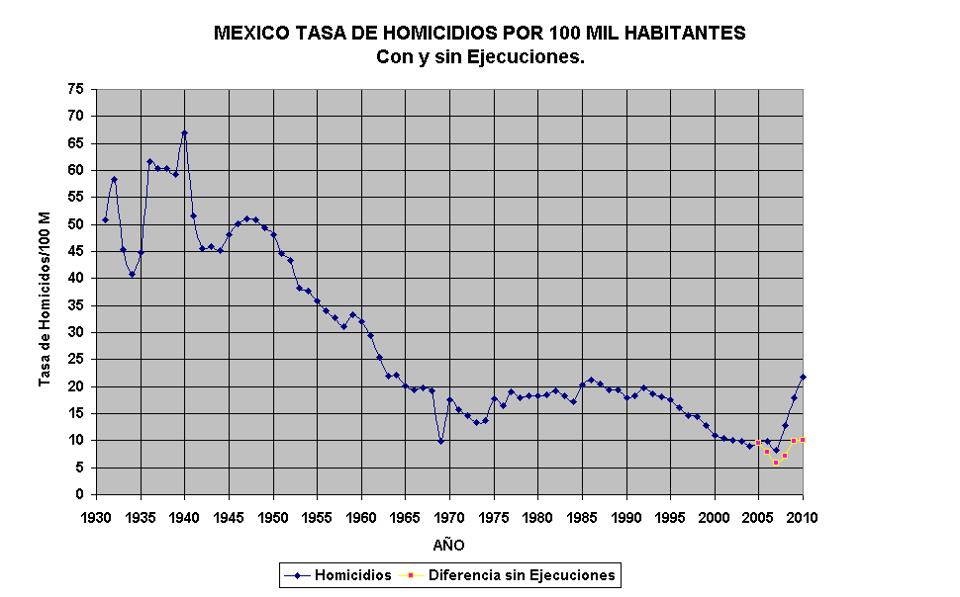
Dutch journalist (and resident of supposedly unsafe Nezahuacoatl, State of Mexixo) Jan-Albert Hootsen comments on this graph of the Mexican murder rate since 1930:
1. As much as the international media tend to state that Mexico is in chaos, with ´an unprecedented amount of bloodshed´, in comparison to the 1950´s and 1960´s the current murder rate is significantly lower.
2. True as the above may be, the murder rate has risen steeply since 2006, with the only years showing a comparable rise in homicides in recent memory being 1974 and 1984[1].
3. The orange line at the far right of the graph indicates the murder rate without executions related to organized crime, which shows us that the ´general´ murder rate has actually been relatively stable, and that the vast majority of murders since 2009 have been drug war/organized crime related.
If you take into account that the majority of victims of execution are members of organized crime groups, as well as taking into account that executions on a large scale are relatively localized, this graph suggests that for most Mexicans the risk of being murdered isn´t considerably higher than, say, 2005. Unless, of course, you´re in a crime group.
Still, that does not at all mean that the country is ´about as safe as, say, 2005´. Safety isn´t just about the risk of being murdered or not. It´s about stray bullets, extortion, kidnapping, et cetera. One thing that is clear, is that the perception of safety has gone completely down the drain over the last few years. And not just in the drug war hotspots.
My note on this:
[1] The murder rate fell dramatically after the 1940s, as Mexico both demilitarized the government, and as the middle class increased and unions were strong. The rate jumped in the mid-1970s and remained relatively high (between 15 and 20 murders per 100,000) until the late 1990s, as the PRI turned conservative. This was an era of declining buying power, high inflation, and “privatization”. The rates dropped dramatically during the “democraticization” of the late 1990s and early 200s, but rose dramatically under the Calderón Administration.
We Want Our Country Back

Notice the difference? It took me a minute, too. The Mexican protesters are flying the national flag.
As elsewhere, people (especially students) are taking to the streets to protest what they see as the state’s sacrifice of the needs of its citizens to the exigencies of corporate power. But, in Mexico, it isn’t seen as the protesters AGAINST the system so much as protesters demanding to be let into the system, and for the system to be allowed to operate correctly.
What has been most unusual, and unremarked about the “Yo Soy 132” protests is that they began among the elites … students at a prestigious private university, who could reasonably expect to be the nation’s leaders, are not accepting what seems to an attempt by the political class to reject national values. That the issues raised on the IBERO campus found resonance throughout the country is very much in the Mexican tradition. Think of the Queretaro Literary Society, with its self-appointed provincial elites like Hidalgo and Allende… or the poets and teachers who gathered around that shrewd lawyer, Benito Juarez. Or the very wealthy country gentleman, Francisco Madero.
We heard a lot from the TEA Party about wanting to “take my country back” … and, in a way, that’s what Yo Soy 132 is also saying. But unlike the TEA Party, with its shadowy corporate sponsors, its close ties to a television network and one political party (or rather, a substantial wing of one political party), for the Mexicans “taking their country back” means stopping the shadowy corporate sponsorship and television network support of one wing of a political party.
It strikes me that the protest signs one sees are less likely to show a picture of internationalist figures like Che Guevara and more likely to feature national heroes… Benito Juarez and his call for respect for the rights of others above all. And where the U.S. “TEA Party” defined their nationalism in rather narrow terms (claiming Barack Obama was unAmerican, in good part because he has a “funny” name… and doesn’t look like the kind of Americans they consider “true Americans”… ok, because he’s non-white), the Yo Soy 132 protests define their nationalism in inclusive terms: certainly, they could do a better job of broadening their coalition to include workers and street vendors and miners and farmers and… but tying their movement to justice for the vendors abused in Atenco and the victims of the insane U.S. sponsored “drug war; the demands of the Wikiruta to their traditional lands; and, the rights of sexual and religious minorities, is a damn good start.
That is the country they want back… not a false vision of a society that never was, but one where there was a fair fight, and a vision of decency and equality… the country they want back is the country envisioned (but never quite delivered) by Morelos, Juarez, Madero, Villa, Zapata, Lazaro Cardenas and the martyrs of Tlatelolco.
A date to (almost) remember
Michael Forbes (The Guadalajara Reporter) did remember, and much thanks for reminding everyone of something we missed. The fortieth anniversary of Mexico’s entry into the “Guerra Contra Nazifascismo“:
Following the attack on Pearl Harbor, Mexico cut diplomatic relations with Japan, Germany and Italy and authorized U.S. tankers to enter Mexican waters to transport oil.
At the beginning of May 1942, Germany warned Mexico of the “dire consequences” if it continued to supply oil to the Americans. Within the space of a week, German submarines torpedoed two Mexican vessels, the Potrero del Llano (May 13) and the Faja de Oro (May 20).
On May 28, President Manuel Avila Camacho declared war on Germany, Italy and Japan.
The Germans sunk four more ships in Mexican waters that year as the country moved, albeit slowly, on to a war footing.
President Manuel Avila Camacho (1940-1946) took Mexico into World War II after German submarines torpedoed two Mexican oil tankers in May 1942.
Civil defense measures were wracked up, military service was made obligatory and the properties and businesses of all Germans, Italians and Japanese in the country were put into public administration.
Rather than send ground troops into the European conflict, where there might be language problems, Avila Camacho decided to contribute an airborne squadron.
Most of Mexico’s contributions to the war were in the form of food, fiber, minerals, oil (especially oil), manufactured goods and the labor that allowed the United States to keep railroads, farms and factories functioning.
Mexican Escuadron 201 may have been flying U.S. planes and may have trained in the United States (mostly in Texas, but also in Pocatello Idaho and in California), and attached to a U.S. air unit (the 58th Fighter Group of the Fifth Air Force) but were not under U.S. command. It would have been a tad difficult to convince the Mexican people that their soldiers (or airmen) would be serving under the command of the Army that had attacked them at least three times in the previous 100 years. Douglas MacArthur was in overall command, but he was also Field Marshall MacArthur of the Philippines, and Field Marshall MacArthur — not one to give praise lightly, unless it was to U.S. General Douglas MacArthur — considered the Mexicans fine soldiers.
The Escuadron’s fliers and crewmen certainly went above and beyond the call of duty in not mentioning that MacArthur claimed he deserved a Congressional Medal of Honor for his actions in the Veracruz Occupation of 1914 for being attacked by the Mexican Army and shooing four soldiers. That could never be verified (although MacArthur could show off the bullet holes in the seat of his pants). What could be verified was that he was stealing railroad locomotives at the time.
Escuadron 201, did not actually win the war in the Pacific all by themselves, of course… but don’t tell that the the Mexican Air Force. The 30 pilots and 270 ground crew member of the Escuadron 201 have since the war been feted as some of Mexico’s greatest modern heroes, and although they only lost five men in combat (and one in a training mission) , they have been highly honored, and honored with an appropriately heroic memorial in Chapultepec Park for their services in liberating Luzon.

Escuadron 201 at a mission briefing in the Philippines, 1944.
There is a good article on the Escuadron 201 and the war in the Philippines by Santiago A. Flores, here.
Earl Shorris, D.E.P.
Earl Shorris — educator, social critic, novelist and probably Mexico’s only gringo Jewish matador (for a very short time in the late 1950s) — passed away last Sunday at the age of 75. His obituary, in today’s New York Times, deals mostly with Shorris’ many accomplishments as an advocate for, and educator of, the least among us . Though the Clemente Course in the Humanities Shorris developed after long study and work among socially marginal groups, a program though which…
… several thousand have tackled […] rigorous readings and explications of Aristotle on logic, Plato on justice and Kant’s theory of morality. The program is free, and books, carfare and baby-sitting are provided. In every outpost, the target audience is the same: the poor and unemployed, low-wage workers, ex-convicts, addicts and the homeless.
Shorris was raised in El Paso, which may account for his life-long fascination with Mexico and the Mexicans. He left the University of Chicago without taking a degree to work in Juarez as a reporter and matador until he “settled down” as an all-round urban intellectual.
IN addition to his several works on poverty and education, he was a popularizer of Mexican history… Besides his 1968 novel The Boots of the Virgin — not surprisingly about a gringo Jewish bullfighter — Shorris wrote a novel about Pancho Villa (Under the Fifth Sun), as well as In The Yucatan. A more scholarly side emerged when he co-edited In The Language of Kings: An Anthology of Mesoamerican Literature, Pre-Columbian to the Present with the dean of Meso-American Studies, Miguel Miguel Leon-Portilla.
Shorris was also the author of The Life and Times of Mexico (W.W. Norton, 2004) which is an excellent companion to the somewhat shorter (by about 300 pages) Gods, Gachupines and Gringos.


 mexfiles.net