The Black Palace
When the Palacio de Lecumberri opened in 1888, a Porfirian official gushed to the press that “this is the latest, and most modern in punishment technology”… the Porfirians were big on having everything up to date in Mexico City.
Tha Palacio has been the home of some of the greatest names in Mexican politics and the arts: General Bernardo Reyes taught Pancho Villa to read here, Herbierto Catillo and other leaders of the 1968 protests (and future national leaders) spent time here, David Alfaro Siquieros painted a mural in his cell, José Revueltas wrote one of his novels here. Distinguished foreign guests included wife-killer William S. Burroughs and Trotsky’s assassin, Ramon Mercador.
Closed in 1976, it only makes perfect sense that a place where so much of Mexico’s historical figures were locked up is now the National Archives.
Schoolhouse Rock: Mexipunk style
Mexicas are not (as Jorge Castañeda seems to argue in Mañana Forever) imprisoned by their history as using it as an sustainable natural resource. Desahoga Personal Valores Culturales:
No mass debating in public, please!
David Agren, who knows his way around Mexican politics better than anybody (and has the stomach to talk to the politicos) wrote on his facebook page last night
He was referring to the “fuck you” statement by TV Azteca’s CEO, Ricardo Salinas Pliego, to the Election Commission’s condemnation of his network’s decision to NOT run the scheduled presidential debate this coming Sunday, and instead show a futbol game.
I don’t see that as “third world” so much as First World… as in Fox News in the United States. Salinas Pliego, although not related to Carlos Salinas de Gotari, certainly is closely tied to the PRI.
When the two national television networks were privatized, Salinas Pliego’s successful big was financed with 29 million U.S. dollars loaned by Carlos Salinas’ brother, Raul. Raul, of course, is the most likely suspect in
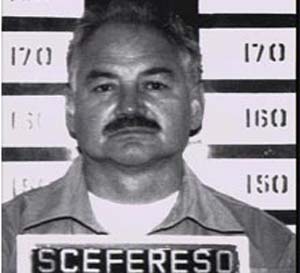
Raul Salinas
a series of high-profile murders (including that of a former brother-in-law who happened to be the prosecutor looking into the sources of Raul’s dubious wealth) and even the Swiss government had to admit that at least 74 million of the 110 million dollars Raul had stashed away in the Alpine nation’s banks were stolen from the Mexican government. The rest probably came from narcotics dealers, but that’s never been proven.
The dubious financing may be “third world-ish” although the amounts of money is more in the neighborhood of a first world inside job theft. What is very “first world-ish” has been the close cooperation between the media corporation and the party to which they owe their allegiance. Think of Fox News and the Republican Party in the United States, or the Canada Post and the Conservatives in Canada. Or the Murdock empire and the Tories in Great Britain.
While it isn’t unheard of for a television network to lean one way or another politically (I know, MSNBC is said to be the mouthpiece of the Democratic Party, but that seems to be more just an attempt to carve out an image as the anti-Fox network for corporate branding as anything else), in Mexico we only have two networks… and Televisa is also closely tied to the Salinas wing of PRI.
Televisa, which suddenly decided not to run the debates on its “premier” channels, but only on its secondary ones (I think here in Mazatlán, three out of the five local channels are Televisa) had, even as an “independent” network controlled by the Azcárraga family showed a marked preference for the PRI:
Even as other media outlets, principally the press, were breaking from state control, Televisa remained firmly under the control of the PRI and the president, in particular. In the hotly contested 1988 presidential elections, Televisa refused to broadcast the rallies of opposition candidates Cuauhtémoc Cárdenas and Manuel Clouthier, despite a growing tide of popular support for Cárdenas’ candidacy. Even as late as 1994, Televisa could be counted on to slant its political coverage heavily in favor of the PRI.
Less overly political… or more opportunistic (or simply corporate) than Azteca, Televisa was able to switch loyalties to the Fox Administration when PAN captured Los Pinos in 2000. When Mexico City’s then Jefe de Gobierno, Andres Manuel López Obrador became a credible replacement for the PAN government, Televisa’s news division devoted extra time to  even the most minor of Mexico City crimes, attempting to show the the Federal District administration as incompetent. Even the entertainment division was pressed into service. The popular “Brozo the Scary Clown” morning chat show was the venue for unveiling (by a PAN Senator) of videos of a Federal District official receiving cash payments from a wealthy business executive. Also shown were tapes of the official gambling in Las Vegas, presumably part of evidence in an unrelated U.S. case that was supposed to be in the possession of the FBI. López Obrador’s presidential run was, of course, not covered in nearly the detail of any of his opponents, and the protests that followed López Obrador’s loss in the disputed 2006 Presidential elections were covered by Televisa from the perspective of those inconvenienced by the protests, and little was said about the protesters, nor their issues, themselves.
Nor was the “alternative presidency” allowed to buy (even at normal rates) air time on Televisa. Its loyalty to the political ruling class was what has been dubbed “el ley Televisa” of 2006: a supposed “reform” proposed by the left, which would have opened the door to competition and market choice in television (and, yes, it is the left that has been pushing anti-monopolistic capitalism here), that was turned on its head to allow Televisa (and, to a lesser extent, Azteca) to further consolidate their hold on the television market, and take over the few independent broadcasters.
Loyalty to those in power, yes…but, looking out for its stockholders (i.e. the various Azcárraga family members) … not above switching loyalties for a price:
In 2005, then PRI candidate for governor of the State of Mexico Enrique Peña Nieto’s supporters (which, in turn, were the Carlos Salinas faction of the PRI)
… signed a long-term, multimillion dollar deal with Televisa, the country’s dominant TV network, to buy air time for the governor to promote his programs, provide coverage of his activities, and boost his presence in national news. Along the way, Peña Nieto married a star of Televisa’s soap operas, Angelica Rivera, which provided extra coverage from the Mexican popular press and television media, with magazines such as Cara, Quién, and Hola! carrying multipage photo spreads of the wedding. Their marriage even received the personal blessing of Pope Benedict XVI as the couple visited Rome accompanied by senior ranking bishops from the Mexican church.
The wedding, the visit the the Pope, etc. all earning lavish coverage on Televisa’s news programs. Less savory incidents involving Peña Nieto… even when well known… were ignored.
López Obrador, of course, has no reason to trust Televisa, nor Azteca. His party has always been a threat to their monopoly and the left is anti-monoplist. It’s perhaps a side issue, but Televisa and Telmex have been in competition for the rights to cable access in the Federal District for years. The cables were owned by LyF, the union-owned electric company for the Federal District that was forcibly taken over by the Calderón Administration and turned over to CFE (the state owned electric company) with the understanding that the cable rights would be sold.
However, with the left having managed to push the Calderón Administration to accept an anti-trust bill, and to go after monopolies, Televisa launched a crusade against TelMex… claiming that if their rival for cable access got those rights, THAT would be monopolistic, not if the television company did.
Now with PAN having to at least give lip service to breaking up monopolies, and the left against going with Lopez Obrador, who has pegged both the Azcárraga clan and Salinas Pleigo (as well as Carlos Salinas de Gotari) as part of the “Mafia of Power” that run Mexico (and they do), Televisa — which let us not forge has been well paid by Enrique Peña Nieto — and Azteca both have a stake in not just keeping Lopez Obrador and PAN candidate Josefina Vásquez Mota out of Los Pinos, but in keeping their parties from having enough members in the Chamber and Senate to force through either more anti-monopoly bills, or real media reforms.
Add to all this, that the Elections Commission — relatively independent — has been forced to make decisions that cut into the revenue stream of the television networks… specifically, that the networks have to show political party advertising at a set rate, regardless of the party, and in rotation (no one party getting the better air time than any other, and all parties receiving equal access to viewers). Televisa notoriously flaunted the rules (running the political ads as a bundle during a futbol game in an attempt to infuriate viewers into demanding political ads be removed from the airwaves) in 2009, and has continually demanded to be treated not as a means of providing information to the public, but as a partner to the judicial organism that makes the rules regulating the democratic process… in short, it wants to decide what is, and is not, democratic.
Azteca’s Salinas Pleigo, a la Fox News and the U.S. right, turned the language of protest upside down, claiming an infringement of his special rights to run a television network was state oppression. He called it “authoritarian” to force television viewers to watch the debate when they could be watching a futbol game. Needless to say, the viewers are “forced” to see the commercials on the futbol game. That is, unless, like a one of the early 20th century’s greatest defenders of civil liberties and public speech (Mae West) said about those who objected to her risque language on the radio, “if you don’t like it, turn it off”.
“Turning off” voters is what the networks seem to want to do. While Televisa, as I suggested, has managed to serve both PAN and PRI, the chances of a return to Los Pinos by PAN are somewhere between slim and none… and besides, it’s heavily invested in (and is receiving massive revenue from) PRI and would like to continue doing so. But Peña Nieto — although ahead in the polls — has yet to face his opponents. As Aguachile wrote about his debating skills (or lack thereof):
It is not an irrelevant fact that PRI frontrunner Enrique Peña Nieto is desperate to avoid exposure of unscripted appearances, and the anti-democratic decision of the two chains are of tremendous help.
Note as well that Peña Nieto again bailed out of a debate: The woefully unprepared PRI frontrunner refused to participate in a presidential debate organized by Milenio, as did the inept PAN candidate Josefina Vázquez Mota, with the latter again declaring she would participate in no debate unless Peña Nieto appears.
Vásquez Mota is no real threat, having so far shown about the same intellectual depth as the presumed front-runner. Quadri (PANAL) comes across as a somewhat amiable, but clueless dork, and his party seems only to hope to maintain its registration. Which leaves AMLO. With about 40 years of rabble-rousing and public speaking experience, a sharp wit and … whether voters approve of it or not… a coherent program that is coherently presented… if voters are turned on, he would be a real threat, not only to the other campaigns, but to the networks themselves.
Corporate interests molding public opinion, and changing the democratic process to suit their own interests, vilifying grassroots opposition and creating plastic candidates carefully is hardly the sign of a “third world” media campaign. It is first world, and we’re all the worse off for that.

The nays of Texas aren’t upon you…
Despite scary warnings from the State of Texas, the number of “spring breakers” in Mexico was up by 7.2 percent this year. Those spring breakers included the Dallas Cowboys Cheerleaders, and you can’t get more Texas than that.
Overall, U.S. tourism rose by 7.3 percent last year.
(Source: Fox News, AP)
Stripped of your rights? Fight!
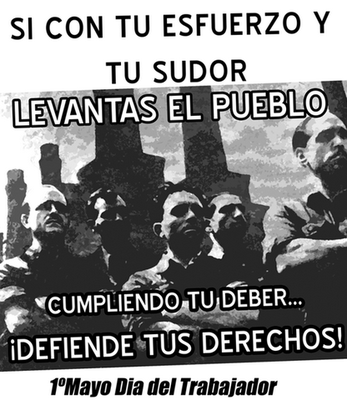
source: http://antoniotoriz.blogspot.mx/
In preparing The Table Dancer’s Tale for publication, we added some footnotes. The pseudonymous author was in this afternoon, to check over our translation and edits. Noticing that we had footnoted her mention of one club’s attempts to pay employees with vouchers that such a practice is illegal, “Lupita” said “but everybody in Mexico knows that.” In Mexico, probably most workers do know their basic rights, and we are proud here (and justly so) of being the first country to include a basic labor code in its constitution (Article 123). Still, as elsewhere, that doesn’t stop some employers from trying to deny them, or to strip their workers of their basic dignity as human beings. That’s not unique to Mexico, and it’s not only Mexicans who remember those who fought (and often died) for those rights.
May Day commemorates the martyrdom of Albert Parsons, Samuel Fielden, Oscar Neebe, August Spies, Adolph Fischer, George Engel, Louis Lingg and Michael Schwab, (about whom José Martí prophetically wrote, “The working class of the world will bring them back to life every first of May”) and the on-going struggle (and increasing to defend what progress has been made) in creating a more equitable society. While it is a time to show renewed support for those workers are still exploited or coerced into tolerating assaults on their rights as human beings, it is also a time to honor those who resisted those assaults… who said no to abuse, and yes to their basic human rights, even at great risk.
Heroes and heroines like the nearly forgotten Carmelita Torres. From Rudy Acuña (yes, THAT Rudy Acuña: Rudolfo Acuña, PhD)´s “Facebook Page”:
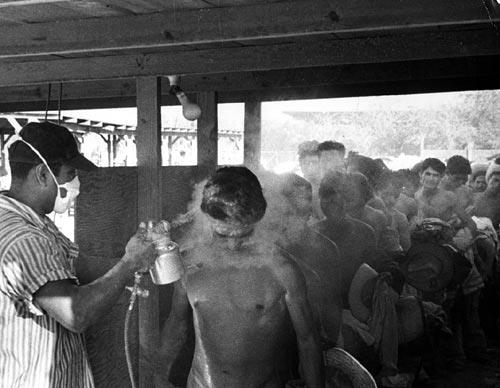
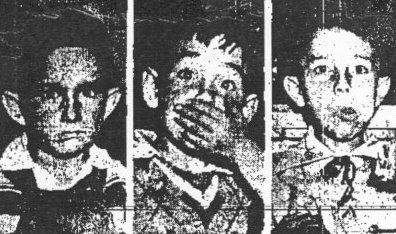
Mexican workers were still subject to "health inspections" in the mid 1950s... here, being sprayed in the face with DDT, by a guy who at least is wearing SOME protection.
There have been countless acts of courage by minority women who refused to suffer indignities. The border is full of incidents where people stood up and said yá basta! That’s enough! In El Paso, Texas Mexicans were routinely forced to undergo strip searches and were fumigated with toxic gases. In 1917, Carmelita Torres, age 17, refused to take a gasoline bath when she entered the United States. The excuses for administering baths was that Mexicans spread typhoid or that Mexicans had lice. Often the soldiers would stare at the disrobed women as they were forced to take the DDT baths. The year before, Mexican inmates in El Paso were given a similar bath with gasoline and were burned to death when a fire ignited the gas. Carmelita, tired of suffering this indignity, agitated the other passengers on a trolley. Thirty trolley passengers joined the protest…
David Dorado Romo, in his Ringside Seat to a Revolution (Cinco Puntos Press, 2005) picks up the story: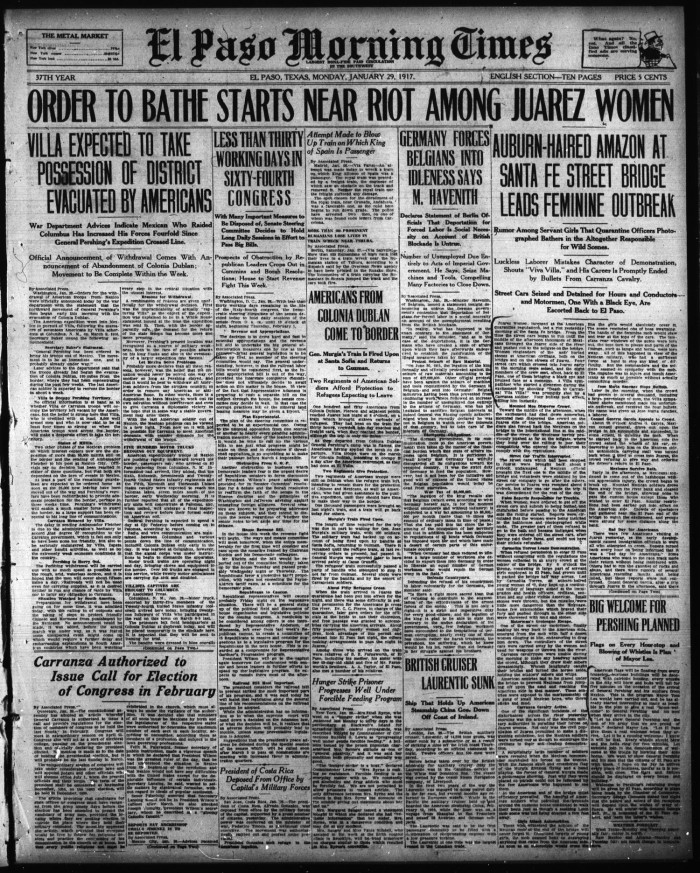
… By 8:30 a.m. more than 200 Mexican women had joined her and blocked all traffic into El Paso. By noon, the press estimated their number as “several thousand.”
The demonstrators marched as a group toward the disinfection camp to call out those who were submitting themselves to the humiliation of the delousing process. When immigration and public health service officers tried to disperse the crowd, the protesters hurled bottles, rocks and insults at the Americans. A customs inspector was hit in the head. Fort Bliss commander General Bell ordered his soldiers to the scene, but the women jeered at them and continued their street battle. The “Amazons,” the newspapers reported, struck Sergeant J.M. Peck in the face with a rock and cut his cheek.
The protesters laid down on the tracks in front of the trolley cars to prevent them from moving. When the street cars were immobilized, the women wrenched the motor controllers from the hands of the motormen. One of the motormen tried to run back to the American side of the bridge. Three or four female rioters clung to him while he tried to escape. They pummeled him with all their might and gave him a black eye. Another motorman preferred to hide from the Mexican women by running into a Chinese restaurant on Avenida Juárez.
Carrancista General Francisco Murguía showed up with his death troops to quell the female riot. Murguía’s cavalry, known as “el esquadrón de la muerte,” was rather intimidating. They wore insignia bearing a skull and crossbones and were known for taking no prisoners. The cavalrymen drew their sabers and pointed them at the crowd. But the women were not frightened. They jeered, hooted and attacked the soldiers. “The soldiers were powerless,” the El Paso Herald reported.
You don’t put up with lousy treatment for lousy reasons…
Another boy of mystery
No… Alfalfa was not a Mexican. This kid grew up to be one of the most important people in 20th century Mexico, and still is one of the most powerful individuals in the country, though there are some who never mention his name (and that’s a clue).
Only right
¡Viva las chicas!… er ¡SEÑORITAS!
What are the rights of youth?
At least in the Federal District, where there has been a remarkable string of good faith efforts to create fairness and equality among citizens, one assumes the rights of youths are simply the right to a decent home, enough food and an education, recreation and … for every 15 year old making the transition from girl to woman… a quinceañera?
In a place where the laws against discrimination go beyond “race, color and creed, age, disability, gender, and sexual orientation” to include economic condition why should economically disadvantaged young women be denied one of the essential rites of Mexican womenhood?
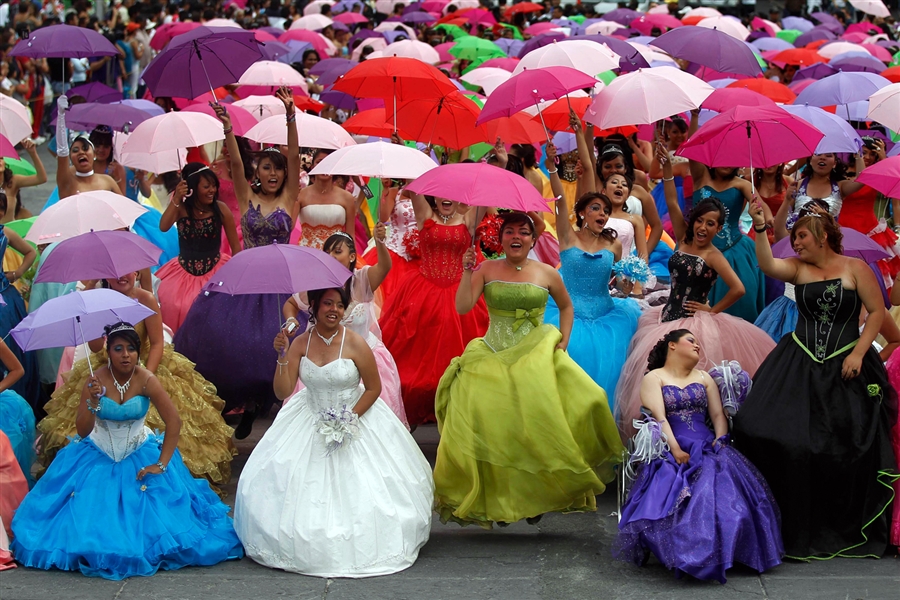
Zocalo. Photo by Eduardo Garrido/Reuters
IN 2007, the Federal District held a rather modest quinenañera for disadvantaged young women, mostly girls who were wards of the district courts or social service agencies. Being a program sponsored by the socialist PRD administration, of course the rich sniffed about it, and the conservatives wanted to complain, but the Army was called in… or, rather, the military academy’s cadets… in full dress uniforms: young women from group homes and juvenile halls and orphanages need a properly turned out escort as much as the young lady from Polanco or Lomas, and perhaps is more deserving.

Alma Rodríguez/El Universal
While I suppose there are a few who still complain about the expense of a few city buses, some traffic cops, museum, the Auditorio Nacional, most of the costs are picked up by the capital’s florists, couturiers (one dressmaker created a dozen of his 4000 peso confections for this year’s event), hair-dressers, shoe-makers, musicians, seamstresses and ordinary people who see their way to right a bit of the inequality in society, giving the girls the right to enjoy the one one rite at which we must all stop and admire her as she is saluted as a unique and promising young woman.

Alma Rodríguez/El Universal
And when the people themselves embrace not their own daughters, but three hundred and forty-six unique and promising young women who would otherwise be the anonymous poor, it’s … well… true magic realism.
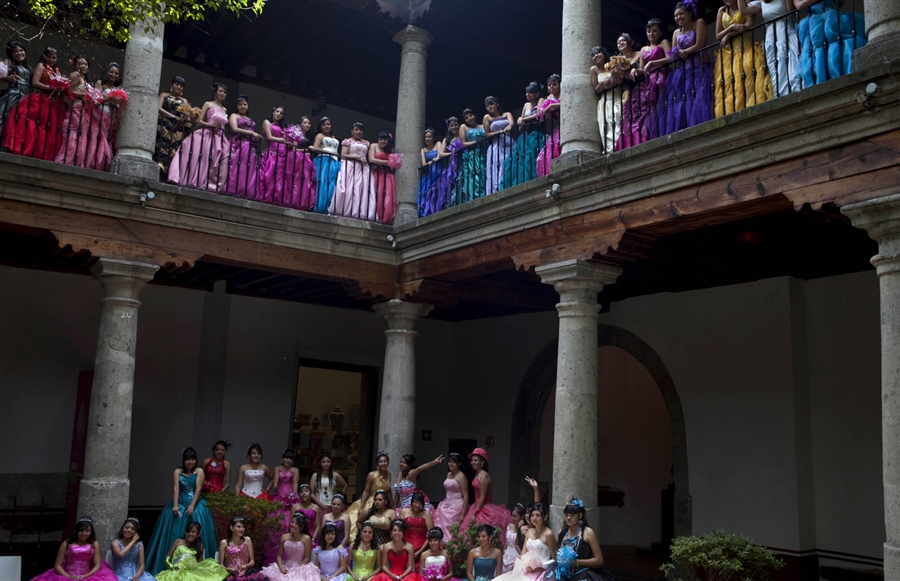
At Museo Franz Meyer. Photo by Dieu Nalio Chery / AP
Breaking all the rules
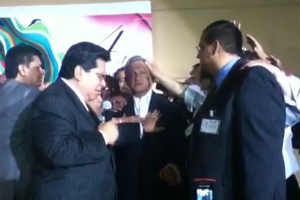 This photo (from last Wednesday’s el Universal) would be unremarkable in a U.S. election but is extremely unusual for Mexico. Two reasons:
First, until this year, I don’t think I’ve ever seen a photograph of a Mexican presidential candidate at a religious service. Of any sort.
Given the rancor that followed the separation of Church and State in 1854, the appearance of a legitimate Mexican leader at a Catholic Church service had been a taboo from the time of Benito Juarez until very recently. While illegitimate leaders, hoping to benefit from the Church’s support (Maximiliano and Victoriano Huerta) were seen publically in the company of clerics, even acknowledged believers, like Manuel Avila Camacho went out of their way to insure that in public, the traditional avoidance of even the near occasion an appearance of clerical influence was avoided. If Avila Camacho attended Mass, it was privately and no photographs would have been allowed.
Carlos Salinas, who believed in Carlos Salinas, met with the Pope John-Paul II as head-of-state to head-of-state. But somehow I don’t think John-Paul, misinformed as he was about Mexican Catholicism — seeing his own personal popularity as popularity for his office and the Vatican’s dictates — would have taken Salinas as a good Catholic. Salinas, though, certainly recognized the political advantage of better relations with the Roman Catholic Church.
Of course, Mexican intellectuals and leftists were appalled, but there was little they could do when they were forced into the opposition. Salinas counted on party loyalists (and the politically apathetic, who only supported the party because it was the only power in town) and openly courted the right, including the pro-clerical elements in PAN and the remaining synarchists.
Salinas having split his own party, left the door open for the PAN victory in 2000. Vicente Fox, with his wife’s adherence to the “piety wing” of her party could, of course, greet John Paul II as Pope, and not just the reigning monarch of a European mini-state. Still, it has to be pointed out that Fox wasn’t running for office, and was widely criticized.
Calderón, when running for the presidency in 2006 made little mention of his own piety in the campaign, but his campaign certainly encouraged support from the clergy and the overtly pious.
I thought it was newsworthy that all the candidates were at the Papal Mass last month, although none were expected to do anything more than suit up and show up. While the hapless Gabriel Quadri has ignored religious issues altogether, it is unusual to see the historically anti-clerical PRI challenging PAN for the piety vote, at least with Enrique Peña Nieto (so far sucessfully) giving the appearance of a believing Catholic in good standing. AMLO, representing the left and the old anti-clerical tradition, also attended the Papal Mass and even met with the Pope, but the novelty of the event went largely unremarked.
That AMLO later attended an evangelical service (where he was blessed by the various ministers) is highly unusual. In the 2006 campaign, besides the claims that AMLO was a “danger to Mexico” because of his leftist ideology, there was a quieter campaign to label him “unMexican” because of his rumored Prostantism. Protestantism has been growing, exponentially since the 1980s, and — although only about 15 percent of Mexicans are other than Catholic — an even bigger taboo than being seen as overtly pious in Mexican politics would be to be seen as other than conventionally Catholic.
While Mexican Protestants, as in the U.S. range from socially liberal to extremely puritanical, they tend to be on the left politically, if only because the left is associated with Juarez (who, by disestablishing the Catholic Church effectively legalized non-Catholic beliefs) and the high wall of separation between Church and State that is seen as protection against the tyranny of the majority. If leftism can be painted as “a danger to Mexico,” then it would almost follow that Protestants were, as lefties, also likely to be a danger.
In the 2006 election, it was specifically claimed that AMLO was not only a Protestant, but a Presbyterian. I suppose there is a theological irony in that a sect founded on the idea of individual salvation finds some of its most ardent members among communalists (but then, in the U.S. its not unusual to find ardent Catholics who supposedly believe in salvation by good works and humility admiring Ayn Rand). At any rate, Presbyterianism is particularly popular in AMLO’s native Tabasco, especially among the indigenous communes among which the future candidate worked and lived as a young state social worker. And whose clergy he often relied upon to assist with with providing social services. That he acknowledges having attended Bible study groups (something not usually done by Catholics) and that he speaks openly of the value of austerity only serves to further the presumption that he holds some sort of Protestant beliefs.
Which he may. But having Evangelical ministers pray for him in some sort of “laying on of hands” service adds a new wrinkle. Obviously, the taboo against appearing at a religious service has been broken. But, with the two largest party candidates slugging it out for the Roman Catholic pro-clerical vote, appearing at a minority religion’s service (and perhaps being a believer in one of the minority religions) either underscores the seriousness of the candidate’s pledge to treat all beliefs equally — which may resonate with the large number of Mexicans who want religious issues left off the political table, or… perhaps… he finds such spiritual exercises of personal benefit… or, it’s a horrible mistake that the photo has become public.
Human rights… back and forth
One step back:
Early Saturday morning, Michoacán state police stormed a student dormitory in Morelia and arrested 204 students in connection with a disturbance supposedly involving 20 students. Better the guilty get hauled off to the slammer rather than the possibly guilty go free, apparently.
And one step forward:
The Chamber of Deputies overwhelming approved legislation that finally gives some enforcement power to the CNDH (National Commission on Human Rights). Although CNDH is a judicial body, and has investigators, it doesn’t have any prosecutors, andhas no way of enforcing its rulings.. or, as they tend to be called, “recommendations.” It’s a small, but important change: the CNDH will not longer make “recommendations”, but will order changes in procedures, and if civil servants aren’t willing to make the changes, CNDH can file charges against the civil servant or agency refusing to make changes. The change is not to the Human Rights laws, but to law covering Civil Service Adiminstrative procedure.
Everyone rides the Metro
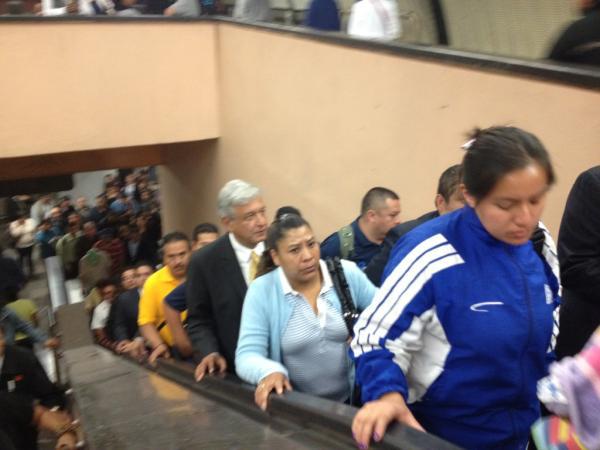
I suppose one could say something snarky about this photo of AMLO in a metro station. He’s cutting expenses on campaign travel, or he’s really having to look for campaign venues (and he did give a speech on his train). But I think there’s something more that should be said…
…there’s a cop next to AMLO and for all I know, there may be snipers and guys with machine guns just outside camera range, but think about what this picture says. For all the foreign (and domestic) reports of rampant crime, and violence and political instability, a presidential candidate can be in a crowd without being surrounded by a phalanx of handlers and, whatever else is happening around them, regular people are going to go about their regular daily business. I don’t think anyone would have thought of closing down the station, or even clearing the escalators just because an internationally important politician (and major party presidential candidate) was passing through.
In the U.S., we seem to make a big deal out of …. everything. On reason I moved to Mexico is that there are no big deals… people just live their lives. And, unlike the U.S., where the theoretical possibility of something bad happening creates a logic of its own when it comes to public figures interactions for the public, here it’s a sense that “we have nothing to fear but fear itself”.
Ripple effect
Esther (From Xico) on the less talked about, but more damaging, effects of WalMart´s corrupt business practices:
We know reasonably well some local shop owners. Needless to say, they are very, very worried. Two own dress shops. I mentioned to a Gringo acquaintance that the monster was likely to eat them alive. The Gringo said,”I don’t see why. Mexicans don’t buy the artisan items. They are too expensive.” I said, well they buy regular clothes! That hadn’t occurred to her. Xico, being a tourist town (now a Pueblo Magico) has a main street with shops selling what you’d expect. But all you have to do is walk a block in either direction and you come upon fruit and vegetable stores, butchers, grocers, shoe stores, bakeries, hardware stores, flower shops, cheese shops, a local market, and so forth. Sometimes the stores sell jumbles of all these things. A lot of the produce, meat and dairy is local so that not just shop owners but producers are likely to suffer.
I suspect that the mayor of Xico (El Presidente) got a good deal for allowing the Wal-Mart. The mayor is in deep trouble with his constituents …
From Xico: always good writing… always.
Tell… and show
Of Enrique Peña Nieto’s reluctance to debate his opponents, Gancho writes:
El Universal says Enrique Peña Nieto is bailing on the debates. That’s a weak, anti-democratic move, but if I was advising a airhead with a 20-point lead and was not concerned about the intellectual quality of the campaign per se, I’m not sure my advice would be different.
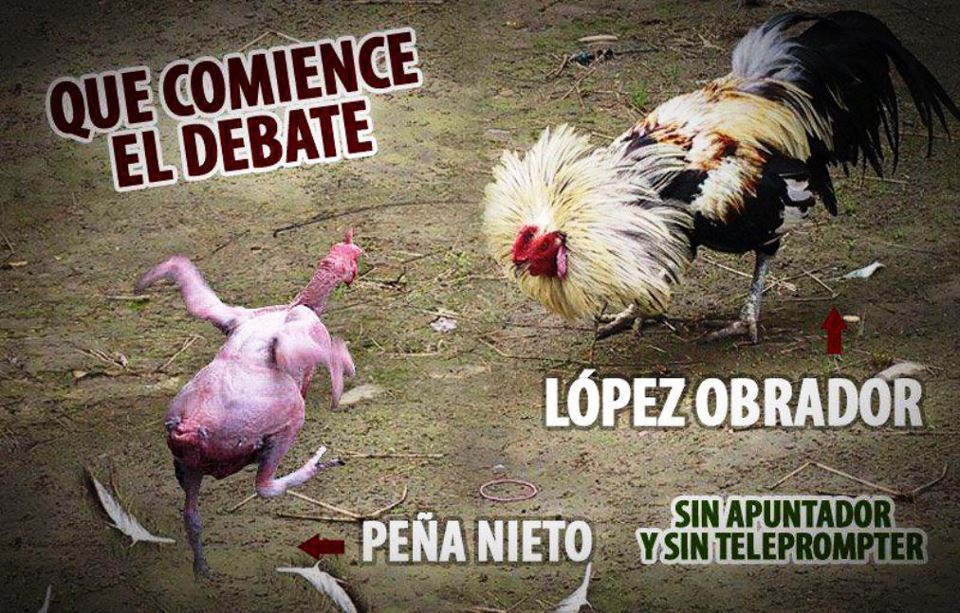
Aguachile goes futher, calling EPN not just an airhead, but a coward. Given who he’ll have to face in the two official debates, where the hapless Josefa Vásquez Mota is going to be irrelevant, Karl Monter goes Aguachile one better. He thinks EPN is .. well… chicken!


 mexfiles.net