Ex-President Vicente Fox is considering becoming a “talk show” host… really!
“Common Run” would be a weekly program featuring various world leaders, and is being marketed to U.S. networks, according to the former President’s press release.
I’m not sure how much attention U.S. audiences pay to foreign affairs, but perhaps it could work.
Maybe an Oprah/Dr. Phil type program… a nice touchy-feelie meeting and some attempt at resolution between Barack Obama and Bashar al-Assad. Perhaps a step towards world peace and love, but that’s more Lopez Obrador territory, and I don’t think U.S. audiences would particularly buy it.
Fox could go with a Jerry Springer type format — maybe a couple beefy and (borrowing from the highly successful Peruvian television personality Laura Bozzo) scantily-clad U.N. blue-helmets to stand by as the audience cheers on Cristina Fernández de Kirchner with shouts of “¡Los Malvinas son Argentinas!” as she attempts to rearrange David Cameron’s face.
Fox is a really dull speaker, so an opening monologue might be hard to pull off… though maybe he can get a peppy sidekick. Fidel Castro is kinda old, but still has a pretty good delivery style, though if you give Fidel a microphone, it’ll be next Thursday by the time he stops talking. And they could always bring in Silvio Berlesconi for comic relief.
The possibilities are endless.
Won’t somebody think of the adults?
As David Agren reported in today’s USA Today, the strict regulations on negative advertising and third-party political advertising limit the political conversation*.
Bloggers and on-line videos are largely unregulated, so there are some hard-hitting political messages getting through. While not directed for or against any of the candidates, this sort of third-party “issue ad” might even merit a link in the regulated media:
(via Milenio)
* Of course, David did manage to negate the negativity in a small way, opening with an “example” of the kinds of information that normally would be potential campaign fodder,
Another pilgrimage

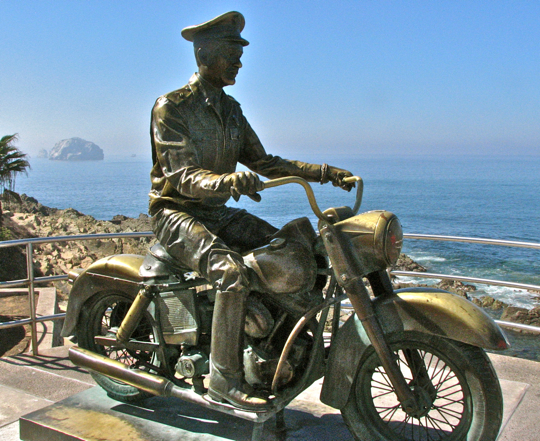
Mazatlán native, San Pedro de Harley
- Celebrating Easter week in Mazatlán as we do with the annual Biker rally, it might not be a bad idea for you to learn the proper hymn for the occasion:
Parece que va llovar:
The last Dorado
As far as I can tell, Capitan Guillermo Flores Reyes is still living in Ecatepec, Mexico State. As the the last surviving officer of Pancho Villa’s Dorados and the oldest man in Mexico (born 25 July 1898 in Amanalisco, Jalisco), his death would be national news. In December 2009, when he was the subject of an El Universal article, he was a perennial bachelor living independently in Ecatepec.
There were some very young soldiers in Villa’s army. Don Guillermo was only twelve years old when, mistaking the sounds of battle for fireworks, and assuming there was a fiesta somewhere, wandered into the May 13-15 Battle for Torreón. Mistaken for a spy, he was taken before Villa, who remarked to Rodolfo Fierro that the boy had eyes like a cat — he didn’t miss a thing. Guillermo Flores Reyes would stay with Villa until the end of the Revolution.
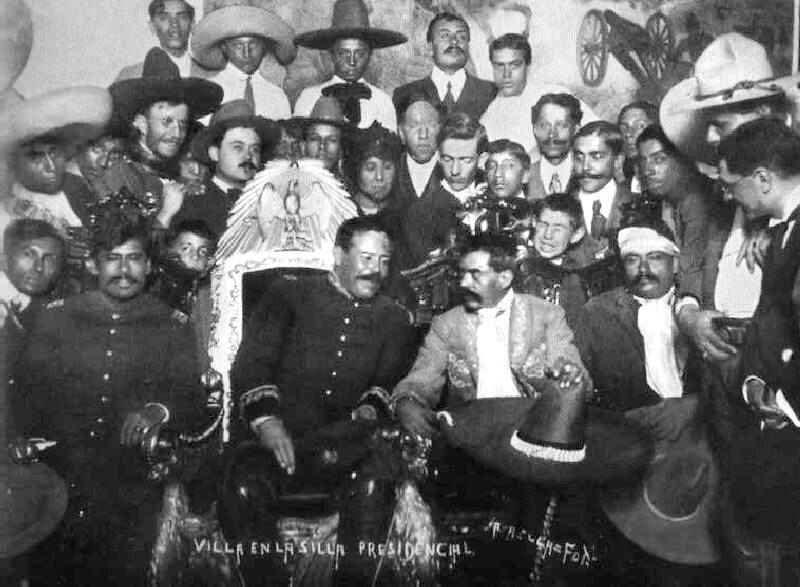
He also met Zapata. In this iconic photo (taken 16 December 1914) the sixteen year old Guillermo on the far right in the hat, standing next to the guy with the bandaged head.
Interviewed by Jaquelin Coatecatl of La Razon (published 20 November 2010) Flores recalled his military service as a time of “…llenos de piojos, y los pelos los teníamos como el pedorro del puerco: parados de puras liendres. Andábamos mal vestidos y hambreados” — which sounds rather poetic if you don’t know Spanish, but translates as “… we had lice in our hair and smelled smelled worse than pig-farts: lousy, poorly clothed and hungry”.
Still, he preferrered the mí general Villa — “one smart motherfucker, with the brains and power to control 50,000 men and screw around those gringo mothers up there in Columbus” — to today’s leaders: “lizards in suits,”without the sense of justice he felt motivated his own comrades.
One small injustice of the Revolution still rankles him: his promotion to Colonel (very late in the Revolution, and was never officially recognized.
A new generation of Mexicans meets with the old revolutionary in this short video from Proyecto Trotamundos:
Gringolandia: a nice place to visit but…
Sara Miller Llana writes in The Christian Science Monitor about an overlooked change in U.S. immigration patterns. “Illegal immigrantion” from Mexico is statistically non-existent for the first time since the 1960s. While anti-social conditions (not just the anti-immigrant legislation and politics, but the “American way of life and the declining U.S. economy) have convinced many to return to Mexico, improving social conditions, more access to education and better infrastructure, are convincing more and more people to stay home.
“We can turn on the water and wash our clothes,” says Pedro’s uncle, Rodolfo Laguna, who spent 12 years working illegally in a chicken plant in Athens, Ga., before returning home in 2010 after both he and his son lost their jobs.
This is the new face of rural Mexico. Villages emptied out in the 1980s and ’90s in one of the largest waves of migration in history. Today there are clear signs that a human tide is returning to towns both small and large across Mexico.
One million Mexicans said they returned from the US between 2005 and 2010, according to a new dem-ographic study of Mexican census data. That’s three times the number who said they’d returned in the previous five-year period.
And they aren’t just home for a visit: One prominent sociologist in the US has counted “net zero” migration for the first time since the 1960s.
Experts say the implications for both nations are enormous – from the draining of a labor pool in the US to the need for a radical shift in policies in Mexico, which has long depended on the billions of dollars in migrant remittances as a social welfare cornerstone.
Separate pieces of a separate peace
A historic meeting of Latin America’s leaders, to be attended by Barack Obama, will hear serving heads of state admit that the war on drugs has been a failure and that alternatives to prohibition must now be found.
The Summit of the Americas, to be held in Cartagena, Colombia is being seen by foreign policy experts as a watershed moment in the redrafting of global drugs policy in favour of a more nuanced and liberalised approach.
The Guardian (via Raw Story)
While I have argued, repeatedly, that there is no “war” in Mexico, we certainly are deploying the weapons of a war, and have the body count to show for it. Although the United States supposedly ended the “war on drugs” Officially, the death toll is somewhere upwards of 50,000 (when the government last released figures) … not counting “disappearances” … and the economic and social costs have yet to be reckoned.
In 2009, the Obama Administration said it was no longer going to talk about a “war on drugs”, although it’s obviously still on their collective lips, more so than ever. What was meant to be a three year project designed on the U.S. side to transfer government funds to Bush supporters and on the Mexican side to boost the credibility of the Calderón Administration’s claims to be fighting organized crime, the Merida Initiative has been endlessly expanded, without ever quite managing to even start doing what it is supposed to accomplish.
That is, the funding intended to assist in reorganizing the Mexican justice system, and make criminal prosecutions possible has never come through. Monies are available, for those things — weapons and “security technology” purchased in the United States and for paying the U.S. spies working in Mexico. Improving the justice system, making it efficient (or even reasonably certain to impart justice) takes a back seat to throwing armed (and hooded) police with new U.S. trucks and guns at a problem not of Mexico’s making.
With elections this July and a new government taking office in December, it’s clear that no matter which party wins, the incoming Mexican administration will have to redefine its role in this “war”. The U.S. government seems resigned to this change, and — while continuing to pressure Mexico — is seeking to expand the theater of operations. Bloggings by Boz, which follows (and supports) U.S. military activity in Latin America wrote recently on statements made to the U.S. House Armed Services Committee by General Douglas L. Frazier, Commander of the United States Southern Command. Frazier’s “posture statement” includes remarks like:
In many parts of our hemisphere—but most acutely in Central America—transnational organized crime has evolved into a volatile and potentially destabilizing threat to both citizen and regional security.
And [in what Boz considers] probably the most important sentence in the entire 30 pages:
Our goal is to support partner nation and U.S. government efforts to improve citizen safety by reducing the threat of transnational organized crime from a national and regional security threat to a public safety problem.
Or, to strip out the “mil-speak”… having tried unsuccessfully to use force to stop a trade financed by U.S. consumers, and in the process having financed the growth of organized crime… the U.S. now wants to expand it’s military “solution” throughout the region.
It appears the General may face an uphill battle. Colombia (where U.S. military and mercenary contract employees have been embroiled in the model “drug war assistance” for much longer than anywhere else), which comparatively has suffered the most from drug war “assistance” wants out. El Salvador is looking at just negotiating a truce with its gangsters (and why not? The narcotics are not much for internal sales, but mostly for export, and Salvadorians have better things to do than kill each other over this one export) and — most surprisingly of all — old fashioned military politico Guatemalan President Otto Perez Molina is openly calling for states to rethink “the prohibition paradigm that inspires mainstream global drug policy today.” That Perez Molina’s government is simultaneously angling for more U.S. financial and military aid suggests that Guatemala is merely using the U.S. obsession with fighting by proxy this “drug war” that the Obama Administration says is not a drug war to bolster his own regime (as many suspect Calderón was doing when he entered into the Merida Initiative agreement with the Bush Administration).
Whatever his motive was, just by raising the issue, Perez Molina has guaranteed that the drug war, the rationale for it, and the future of it, will be a top priority at the Caracas Summit. There are alternatives, and to continue with the same program, on an expanded front, is simply not sustainable, and certainly not in the best interests of the affected nations.
Ask a stupid question…
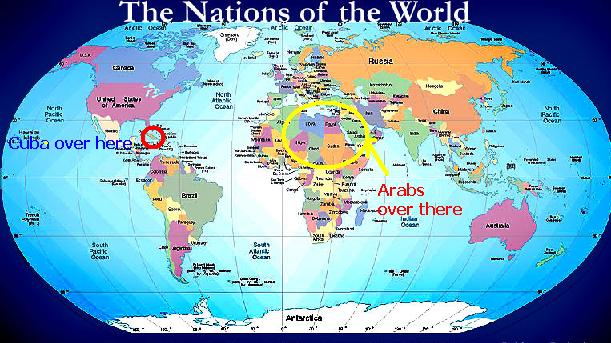
Recently, various reactionary ideas have been spread on the media, presenting some absurdity as a logical question. For example, every day some idiot wonders why Cuba has not been a “Arab spring”.
Cubadebate.com points out that the Arab countries that recently saw people’s uprisings, were U.S. client states or doing business with the United States and, besides…
And a Happy Easter to you…

Semana insana
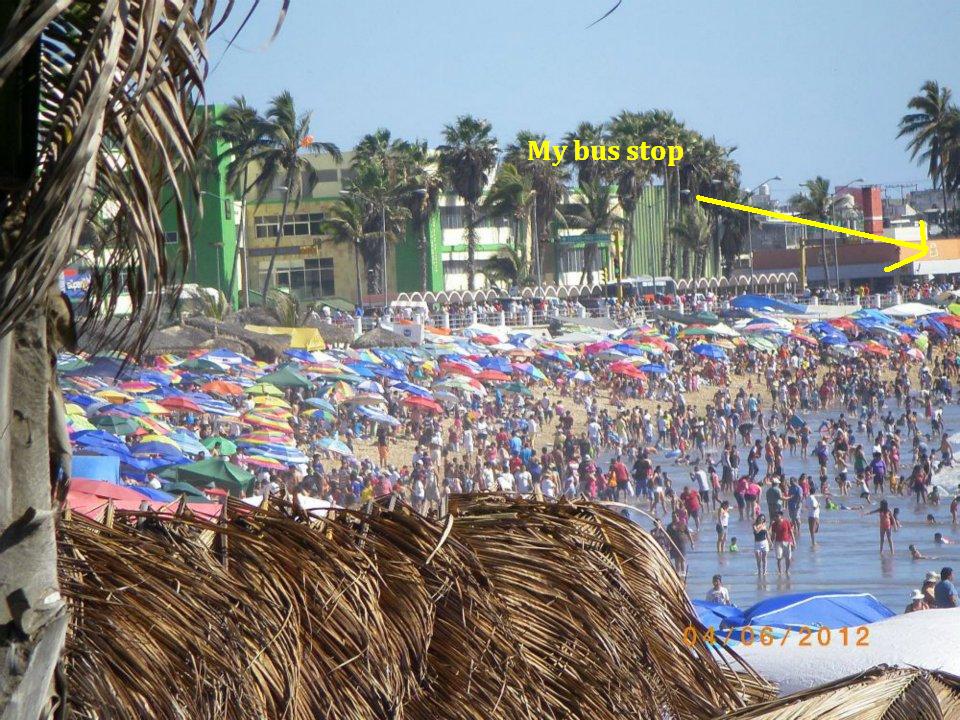
This photo (by Trish Banner Waddell) shows the usually uncrowded beach down the street from my house, where I usually can let my dog run off her leash without bothering anyone and where I catch the bus to our office and bookshop in the tourist zone. Having to hold down the fort (and chase off the students who think my warehouse is a public pissoir) and on-going editing (Editorial Mazatlàn has about a dozen works in process right now) has sorta cut into the time I have to write Mex Files for a couple of days.
This one’s easy…
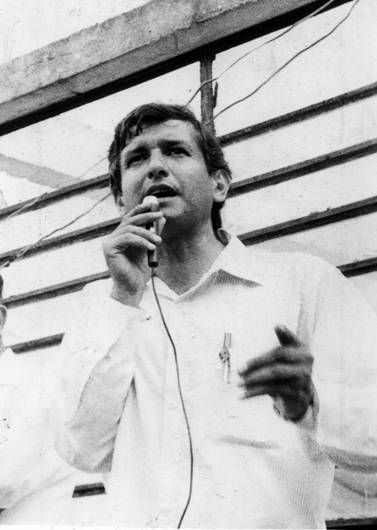
Easy enough to figure out who this is, but when and where was this photo taken?

Sharecropper, 1968 Lithograph
There’s a different attitude toward art in Mexico. As an artist you’re greatly admired rather than looked at as something strange.
(Elizbeth Catlett Mora, 1992)
A “different attitude”, not only to art and artists, but to human dignity and worth is what led Elizabeth Catlett to Mexico. Despite her talent and formidable education, Catlett — as the grand-daughter of slaves — had few options in the “material world” of the late 1920s and early 30s. Teaching art in a segregated high school was unrewarding, both artistically and financially. The pay for “colored teachers” was so low, in fact, that it was a step up when Catlett was hired by the federal government’s emergency employment program, the Works Progress Administration. Through her work with the WPA, she met the Mexican artist and anthropologist Miguel Covarrubias, who introduced her to the works of Diego Rivera.
Although, like most African-American intellectuals, she saw racial and social injustice as part and parcel of economic inequality, the Mexican artist showed Catlett a means to be politically relevant while actively making art.

Woman Fixing Her Hair (Mahogany and Opals, 1993)
Although she continued to work in the United States (and married another U.S. artist in 1940), she was more and more drawn to Mexico, where the artist and the citizen were never considered separate beings, and where her “race” might be seen as justifying a political attitude towards her homeland, but not seen as a social impediment.
Divorced from her American husband, she married Francisco Mora (and “Mexicanizing” her own name by adopting his apellido paterno as her apellido materno), a fellow member of the left-wing populist art collective, Taller de Grafica Popular. From 1949 onward, Catlett’s art memorialized not only the African-American and feminist experience, but that of the Mexican worker and campesino as well.

Malcolm X Speaks For Us (Linoleum cut, 1969)
Catlett’s artistic strength, in light of her never-secret political views made her a suspicious person to the government of the United States. Her support for the 1958 Mexican railway workers strike (which, under pressure from the United States, the Mexican government considered a “Communist” provocation and put down with violence), the artist was denied a passport, making her, in effect, a political exile in Mexico. She became a citizen of the Republic, and an honored one, in 1962.
Although, in the 1970s, she was again allowed to travel and work in the United States, she had no intentions of returning to her birth country permanently. Like the British born Leonora Carrington, Catlett in her old age found herself “greatly admired” by the very establishment she’d rejected, who saw her, not as a natural resource that flourished in Mexico, but something wonderful and strange.
Revenge is sweet… and fast
So much for stereotypes… Take that Top Gear Brit-twits!
On Sunday the Mexican-made Mastretta MXT became the world’s fastest production car with a top speed of exactly 268 miles per hour. The Mastretta thus beat by nearly 0.2 miles per hour the previous record set by the Bugatti Veyron Super Sport in 2010.
Add one of these to my wish-list:


 mexfiles.net