The politics of change
If Diana Maroquín Bayardo was just another lawyer, maybe fifty years ago it might have been newsworthy that she was seeking a seat in the Federal Chamber of Deputies. That she is also a well known TV Astrologer slash Fengshu consultant slash lawyer makes her no more eccentric than many Mexican politicians. Having run from lower office as a PT/Convergencia candidate , coupled with her name recognition both as a performer and a political activist might very well make the prospective PRD candidate if she was running in a safe district in Mexico City a shoe-in. From the state of Hidalgo, it’s more of a gamble. Still, nothing particularly notable in all this … except….
She has previously predicted the Southeast Asian tsunami in 2004, and a coal mining disaster in northern Mexico in 2006. Offering to turn her supporters into millionaires through Feng Shu, Diana Marroquín Bayardo — popular for her television, radio and newspaper Chinese horoscopes and predictions — underwent the arduous process of being the first person in Mexico to force the state to recognize her transformation from male to female…
“I’m not so much a person who changed their sex and wants to be a candidate… [Rather] my priority … is to represent all vulnerable groups,” Bayardo told Reuters…
 In a country where the Catholic Church has a strong influence, the clergy has decried reforms in the Capital District, decriminalizing abortion, legalizing same-sex marriage and legalizing sex change, Bayardo wants to focus her work in the Chamber of Deputies on raising awareness and promoting reforms that protect minority of homosexuals, lesbians and transsexuals, she said.
“We are in a state of helplessness (…)the Federal District is the only place where we have some respect and legal protection, but not so in any other state,” she said.
Bayardo is one of the few transgenders in Latin America to make a foray into poltics. In many countries of the region, including Nicaragua, sex changes are not legal, and only in 2008 was homosexuality stricken from the criminal code.
The sex-change process was not easy, but she is excited to show her new identity, preferring to leave her past history behind, and not even wanting to remember her old name
Bayardo began hormone treatment at the age of 17 to remove body hair and refine her voice among other things, undergoing a gender change operation shortly after she turned 20. But that was only the beginning of her transformation.
She was “legally born” in 2003, at the age of 29. She received a birth certificate with the new name, but only as a marginal note, registering the sex change, and leaving intact her former, male, identity, something considered discriminatory by experts.
This could be removed only in 2008, following a reform of sex and gender diversity laws in the Federal District, which allowed a complete change of the birth certificate and required state agencies to recognize the new identity and gender.
After that, she began a year long journey through the bureaucracy, changing her identity on everything from school records to her voters registration. Had she lived outside the Federal District, the task would have taken even longer.
She is the first, but not the only transgender to enter politics in Mexico this year. Diana Sanchez is seeking a seat in the District Legislature.
Bayardo’s application to be her party´s candidate should be approved later this week.
One man’s trash
OK, boy bands are “plastic”… but, damn, this Guadalajara group has a unique style:
No country for old canucks?
On average, three Canadians for every 100,000 visiting Mexico are killed or assaulted per year, according to more than a decade’s worth of data from the Department of Foreign Affairs.
However, when looking at Canadians most popular travel destinations, China topped the list for the rate of assaults and murders involving Canadian visitors. About seven Canadians out of every 100,000 travelling to the country came under attack, though most were assaults.
Jamaica was second to China, with about five out of every 100,000 Canadian travellers assaulted or killed on average per year.
The rates are based on the number of assault and murder cases reported to the Department of Foreign Affairs from 2000 to 2010, compared with visitor figures for overnight trips from Statistics Canada.
Even Australia is more dangerous for Canadians than Mexico, though not by much:
If you’re a Canadian, you have a slightly lower risk of being assaulted in Australia (2.207 vs. 2.089 assults per 100,000), but a slightly higher risk of being murdered… the Aussies doing in 0.269 of every 100,000 Canadians, and the Mexicans only 0.268.
However, if you get drunk and stupid and squashed by a taxi in Mexico, or fall off a balcony while coked to the gills, your survivors will get a shitload of sympathy from the Canadian media and you’ll be considered the victims of a horrid conspiracy.
Another mining tip
Via Inca Kola News:
… On Tuesday March 6th José Alfredo Flores Flores, 29 years old, was killed by underground rockfall at the AuRico Ocampo mine in Mexico. The accident occurred as Flores was collecting samples in a disused shaft area of the complex. The two people accompanying him were also injured, one with serious head injuries. The body of Flores has not yet been recovered from the accident zone because the company says that the rock in the zone is still unstable and it’s too risky to go there for a while (16). None of this has been reported by AuRico, not by the company (17) to its shareholders, not to the press and the only way that your author knows about it is that he can read Spanish and makes a point of watching for news on mining companies in the LatAm region. Even worse, AUQ did put out a NR after the incident that made no mention at all to the Ocampo fatality but preferred to give shareholders the warm and fuzzy about its development at the Young-Davidson property.
Good eatin’!
Half the fun in editing is the research. My author, when faced with words new to him, had to write phonetically, and when a Mayan uses a Nahuatl word in speaking to a Bulgarian, sometimes I just have to flounder around til I figure it out… which becomes an education in itself. What I thought might be a local word for a chachalaca, the common jungle fowl of central America, was something else entirely.
From Lacandon Journal (© 2012, Dimitar Krustev… to be published later this year by Editorial Mazatlán):
August 15, 1969 – Nueva Esperanza
…
In the afternoon I worked on a painting with another model. The work did not go well. I had not spent enough time with the Indians and did not “feel” them yet. The creative part of the day ended at 4 p.m. and Gary and I took a bath on the muddy edge of the river. I saw fantastic cloud formations in the north sky and thunder rumbled over the jungle.
The women made tortillas again. Then there was a flutter of paddles in the river and I heard mens’ voices. Carmita whispered “Kin” and told me that her husband was returning. In about 20 minutes the three Lacandones appeared behind the hut, with Kin carrying a wild boar and three turkeys and Chan Bor a tepezcuintle[1].
 This was good news. The Indians had been eating tortillas for days and now they would have a feast. In the evening they lay in the hammocks and talked about the adventure of the day. As the women shelled corn under the light of burning wood ocote, a wood similar to the pine tree and highly saturated with oil, the Indians went to sleep about 9 p.m. Rain started around midnight…
August 17, 1969 – Nueva Esperanza, The Day of the Hunt
Last night as we gathered around the smoke from the kitchen fire to keep the bugs away, Carmita suddenly jumped up as if bitten by a wasp. She said something to me and pointed toward the ground. When I flashed a light down there I saw thousands of ants devouring hundreds of dead cockroaches. Based on their size, I judged the ants to be fire ants. I left for my tent as Carmita poured fire over the mess. During the night a sound awoke me and when I turned on the flashlight I saw cockroaches crawling over the walls of the tent.
In the morning the three Lacandones went hunting again. Before leaving, they announced that they would stay in the jungle overnight. When they returned the next day, they were loaded with three monkeys (mikos, as they call them) and one wild turkey. The sight of the dead monkeys, which looked so like humans, upset Gary.
The Indians offered us either turkey or monkey and we chose turkey. Kin Yuk said the monkeys have human blood.
The animals were butchered in the afternoon on the bank of the river where we usually bathed. On the way back from the river, … Kin lifted one of the monkeys to my nose and said “You should eat monkey. Very delicious.”
[1] Cuniculus paca, a large tropical rodent, usually weighing between 6 to 12 Kg. Similar to the much smaller guinea pig, tepezcuintles and the closely related agoutis (genus Dasyprocta) are indiscriminately referred to as “Pacas” in English. While commonly raised in captivity as food animals (Domestication and husbandry of the paca (Agouti paca), Food and Agriculture Organization of the United Nations, 1995), farm-raised tepezcuintle is said to have an inferior taste to their wild cousins.
Decyphering the phonetic “pepesquintly” as “tepezcuintle” was the easy part. Finding a Mexican recipe is harder. I don’t think Cristina Potter (Mexico Cooks!) … who can hold her own with a kitchen-full of abuelas …has one for jungle rat, but they’re a regular part of Caribbean cuisine. Trinidadian food writer, Felix Padilla (Simply Tini Cooking) has a nice Paca curry recipe.
Maybe Cristina’s got one for monkey.
Pay now, clap later
PAN’s Josefina Vásquez Mota tries some old-style Mexican campaigning. She might want to check with the old PRI pols, but if you’re bringing in a rent-a-throng, you probably don’t want to pay them until the candidate is finished speaking.
Rarely pure and never simple: Part II
In Part I, I speculated that Maquito Jr.s entry into the Presidential race (or the enthusiasm for his candidacy shown by unusual sources like Cronica del Hoy) might be prompted by growing concern among the political class that López Obrador is starting to win over the business class… not that they will, as a group, support him, but that they won’t oppose him.
Given that in 2006, in a five candidate race, he captured a third of the vote (or possibly a little bit more), despite high negatives from the business community, this is extremely important. López Obrador was always going to have high negatives with a faction of the voters. Anthing that reduces the negatives before the opening bell of the campaign season is all to the good for him, especially if (as I expect) support for Peña Nieto starts to plummet once the PRI candidate starts actually having to present himself to voters.
Working with a coalition (and all the major parties are, more or less, coalitions of competing interests), the organization, MoReNa is going to have to make strategic choices. PAN’s choice of a “piety wing” candidate may have cost them some pragmatists (especially if Manuel Clouthier Carrillo is allowed to run), and Peña Nieto’s transparent bid for clerical support will eat into the traditional PRI anti-clerical votes.

Not how elections are won.
López Obrador, being — like Barack Obama in the United States — not the perfect choice, but the better choice for the left of center, may have to jettison or disappoint some of his party purists if he is to garner enough support from the middle to win election. The PRD candidate, is the candidate of the disunited left, and … perhaps the only alternative for those who reject politics as usual, but haven’t given up on electoral politics.
Although a traditional pol, he’s always enjoyed major support from the fringe — but, with both a voter abstention campaign AND traditional rivals to deal with, a move towards the center (if only rhetorically… I think he’s always been a pragmatic leftist rather than an ideologue) and concentrate on traditional ballot-box oriented citizens if he is to win (and he could) this election. That requires some messy compromises.
Aguachile, who makes the PRD his academic specialty (and skewering AMLO his hobby) is appalled that the “AMLOistas” are supporting the very guy who made PRD necessary in the first place:
PRD was founded on the back of the July 6, 1988 fraud. One man greatly responsible for the election outcome was Interior Secretary Manuel Bartlett, who then also doubled as head of the commission organizing the election (if there ever was a fitting fox-guarding-the-hen house analogy, that’s the one). Now, however, in an irony of ironies – I really don’t know how to express this – AMLO’s Morena movement is putting forth Bartlett to head its senator formula from Puebla. That’s right. The man responsible for the 1988 fraud that soon gave birth to the PRD, will now run as its candidate.
That was then, this is now. All true what Aguachile says about Bartlett, but AMLO defends Bartlett’s candidacy for the Senate on a MoReNa ticket (even if Bartlett himself remains a PRI member) on the basis of his continued defense of PEMEX as a national institution.
And, you have to remember that in 2006, Bartlett backed AMLO over his own party’s hapless Roberto Madrazo. I don’t see this really costing AMLO all that many votes, even among the far left, given that for the far left preventing foreign infiltration of the state oil company is more in line with their ideology than a theoretical concern for the history of party politics.
And, for a lot of the near left, the center, and even some on the right, a defense of the nation’s control of natural resources isn’t seen as a bad thing at all. Bartlett, while widely despised as one of the more wily and devious of PRI pols, is admired for the same skill-set.
López Obrador may be running a campaign based on Love and Respect, but Obama ran one on Hope and Change… which are lofty and worthwhile goals, but getting there sometimes is messy and dirty and nasty work.
Rarely pure and never simple: part I
The political landscape could get slightly more confusing this week if the Elections Commission (IFE) blesses Manuel Clouthier Carrillo ‘s petition to enter the four person contest.
Clouthier, as the namesake son of “Maquío” — Manuel Clouthier Rincon — is heir not just to a fabled name in not only Mexican conservatism, but in the struggle for a more democratic Mexico, as well.

Maquio the Father...
Maquío, as a prominent and progressive Cuilicán businessman as well as a socially conservative Catholic, was a credible PAN leader, as the conservative party sought to present itself not as an amalgam of counter-revolutionaries (the old rich, the Catholic Church and fascists) but as a modern rightist party defending capitalism and “traditional values” in the name of individual liberty.
While, of course, PAN then — and now — has always had to make room for its less-savory factions, Maquilo’s 1988 Presidential campaign presented PAN as a pragmatic conservative alternative to the ruling PRI and Cuauhtemoc Cardenas’ National Democratic Front. That PAN came in third was no surprise, but making common cause with the parties in the Democratic Front who had their probably victory stolen from them, forced the administration of Salinas Gourtari to accept massive changes in the political system that spelled the end of automatic PRI dominance.
That Maquío was killed in an auto accident less than a year after Salinas de Gotari was sworn into office, blessed PAN in another way too… giving the party a democratic figure to add to their pantheon of dead heroes, one less troubling to the voters (and historians) than previous leaders, sincere but ineffectual theorists or bug-eyed enthusiasts for some of the darker strands within the party fabric. Clouthier’s post election “shadow cabinet” (a forerunning to Lopez Obradór’s “alternative presidency” after the disputed 2006 election) brought into national leadership PAN pragmatists like Diego Fernández de Cevallos and Vicente Fox, at the expense of the ideologues.
Mexico has become a multi-party state, although PAN less-pragmatic elements have, if anything, been emboldened by their party’s success. While Felipe Calderón is from the pragmatic wing, he — like Vicente Fox — has depended on support from the ideologues. Manuel junior (Clouthier Carrillo)’s sister, Tania, left the party in disgust over its tolerance of fascists and religious bigots a couple of years ago.
Clouthier Carrillo,representing Sinaloa in the Senate, is also owner of the state’s most important newspaper, Noroeste. Though his paper, and his political clout, he pushed the PAN-PRD coalition ticket that pushed PRI out of the state governor’s office… only to find (as did the rest of the state) that the compromise candidate (a PRI defector to PAN) hasn’t lived up to the expectations of either party, or, rather, or, as in Mazatlán — where the coalition backed a PAN staltwart — there is less a progressive/pragmatic coalition than one reflecting the more reactionary elements in PAN, coupled with a reluctance to change the political culture that flourished under PRI.

... the Son...
His break with the party, well covered by his own papers, as well as the national press, was a much bigger news story than his sister’s defection. After all, he carries the fabled name, and his open flirtation with MoReNa (the Lopez Obrador leftist coalition), and the possibility that he would run for office on the Workers Party (more or less the old Communist Party) would have been something like George Bush III suddenly deciding to run for office as a Socialist (if they had socialists in the United States, that is).
That might have been too much to swallow (although it would have been fun to watch his paper’s editorial changes, especially in my favorite section, the society pages), and now Clouthier Carrillo is seeking to run for President as an independent candidate.
This is a problem. Thanks to those PAN pragmatists and the PRD (born from Cardenas’ National Democratic Front and now the main party in the MoReNa coalition), the political system was opened up to opposition and change, though political parties. There is state funding for PARTIES, and plurinomial seats in the Chamber of Deputies and the Senate are based on PARTY support in elections, as is the revenue doled out to media by the election commission. IFE, the elections commission, has consistently rejected the idea of independent candidates, simply because there is no mechanism for providing for their equal access to media, or for preventing the independent from conducting a campaign outside the strict ground rules set out for electioneering.
That IFE is considering Clouthier Carrillo’s request — based on a novel interpretation of the Mexican constitution’s guarantee of all rights recognized by international treaty — to my mind suggests something else is going on.
The PAN candidate, Josefina Vásquez Mota, appears to be too much in the pocket of the “piety wing” of the party. PANAL, the usual spoiler that seems designed to draw off votes from any challenger to the status quo, has put up an environmentalist, Gabriel Quadri de la Torre, possibly to draw some votes away from the Green-PRI coaliton (PANAL’s party president is Jorge Kawagi, formerly the Green Party President, and the publisher of Cronica del Hoy), possibly from MoReNa, supposedly for the benefit of PAN.

... and HOLY COW!
So, it’s not too much of a stretch to see Clouthier Carrillo’s proposed candidacy (which seems to be supported by Cronica del Hoy) as possibly designed to peel off some PAN pragmatists from Vásquez Mota… or… given the growing support for López Obrador, who has been working mightily to woo the business community (and may be enjoying more success than is otherwise reported), perhaps Clouthier Carrillo’s bid to enter the race is an attempt to cut support for a socialist willing to work with capitalists… a pragmatist.
It’s MISTER to you…
Homophobia seems to causing an outbreak of foot-in-mouth disease among Mexican politicians right now, not just among the young and the moronic, either.
In the Puebla state legislature, PANAL Delegate Héctor Alonso Granados referred to the chief legislative aide for the MoReNa coaliton as “miss” (señorita). Considering that chief aide is a gay man, he naturally took offense… as did his party’s legislative leader, who has called for Granados to be censured. And, the legislative aide, with the backing of several legislators, is filing a discrimination complaint with Conapred, the federal anti-discrimination agency. AND, the PANAL central committee is going to meet next week to reconsider allowing Granados to be the substitute candidate for the federal Chamber of Deputies for a PRI candidate (normally, one elects both a deputy and a substitute, who steps into the job if — or when –the deputy resigns before the end of his or her term).
Granados — who after shoving around newspaper photographers last week isn’t about the get much sympathy from the media — isn’t so much in trouble for his original remark as for his “Limbaugian” apology, which took the form of saying to the legislative aide: “Exuse me… MISTER offended homosexual”.
Didn’t work.
Young, dumb and full of … it
Our young conservatives in action:
The Federal District Assembly hosts the “Parlamento Juvenil” every year, a moot assembly for the various political party’s youth wings to not only present some talking points to their party elders, but to audition for a possible future role as potential candidates for public office.
Juan Pablo Castro, a PAN activist from Jesuit-run Universidad Iberoamericana, certainly made an impression… but probably not one that bodes well for a future career. Yeah, attacking Lopez Obrador is good for your PAN creds, but his diatribe on abortion and same-sex marriage, laced with words like “faggot” (jota) got him pulled off the podium. Maybe he does have a future in politics, managing to tweet a non-apology for using words that”may have been” offensive… although I think young Señor Castro may have a a better future in another field of political endeavor… with his mouth, he might make … oh… Cardinal of Guadalajara some day.
Slim and slim-chance
Two rich guys, who inherited fortunes from their immigrant dads and turned it into real money… compare and contrast:
Kerry A. Dolan (Forbes) on Carlos Slim:
His biggest goal is a fight against poverty—but not for the usual reasons. “It’s good economically. In the past it was something ethical and moral,” he asserts, speaking like the rational capitalist he is. “To take poor people out of poverty and put them in the modern economy is very good for the economy, for the country, for society and for business. It is the best investment.”
It’s not something that should be left to the government, either. “I think that businessmen and entrepreneurs have more experience managing resources, and we can more easily solve the problems than politicians, who have other views. They are thinking about elections, they are thinking about popularity,” says Slim. “I don’t think that giving money should be something done for personal popularity.”
But how to do so? Slim is skeptical of traditional charity. “I am convinced that the private sector needs to give support, not money, because charity has not solved poverty in hundreds of years.” He believes the best course for chipping away at poverty is using digital tools for education to, as he says, “create human capital.” That’s where Telmex, the Carlos Slim Foundation and the Telmex Foundation come in.
The latest endeavor of Slim’s two foundations and Telmex is a system of digital libraries. “Now, instead of going to the library, you go to a digital library where you can navigate [computers] completely free,” says Slim. “Instead of lending a book, we’ll lend a laptop for 15 days.” There are some 3,500 digital libraries. Slim’s aim is to enable 60% of Latin America to have access to computers by 2015—the same timeline set by the United Nations Millennium Development Goals. So far these newfangled libraries are only in Mexico, which means he’s got a lot of ground to cover.
Slim won’t say how much of his fortune he plans on giving away eventually. So far he’s put a total of $4 billion into the Carlos Slim Foundation—via $2 billion installments in 2006 and 2010, funded by dividends. Its main areas of focus are education and health. “It’s about the development of people’s potential. He wants to make it easier for people to generate wealth,” explains Alejandro Soberón, the chief executive of entertainment company CIE and a longtime América Móvil board member. “I travel all over Latin America, and I don’t think there’s another businessman who’s had the impact he’s had on health and education.”
David Firestone (New York Times) on Mitt Romney:
The high school senior who stood up at Mitt Romney’s town hall meeting here today was worried about how he and his family would pay for college, and wanted to hear what the candidate would do about rising college costs if elected. He didn’t realize that Mr. Romney was about to use him to demonstrate his fiscal conservatism to the crowd.
The answer: nothing.
Mr. Romney was perfectly polite to the student. He didn’t talk about the dangers of liberal indoctrination on college campuses, as Rick Santorum might have. But his warning was clear: shop around and get a good price, because you’re on your own.
Empower the poor, or forget about them…
Earn your fortune from investing in goods and services, or from moving money around?

(21 June 2013: The photographer, Manuel Ramos Sánchez (1874-1945), and his pioneering work in the art of photo manipulation, discussed here: Somebody had to take the picture).
I had run across this photo before, while researching Gorostieta and the Cristiada: Mexico’s Catholic Insurgency 1926-1929 . At the time, I considered using it, or… rather… passing it along to our book designer who has produced some amazing book covers from old photos before. Michelle’s cover used a photo of Gorostieta himself, but I still had the photo at the top of this post somewhere in my files, and was surprised to run across it again last night.
I was looking for something else entirely, and the context in which it was posted — on a “traditional Catholic” website in 2009, carping about the alleged wimpiness of post Vatican II priests — wasn’t particularly of interest to me. But the photo? One commentator, rather perceptively, managed to identify it as a Cristero era photo, although he didn’t seem to know much about it. However, his comments were well worth reading, even if his perception of that event differs from mine.
The commentator was Sean Dailey, editor of Gilbert Magazine, published by the American Chesterton Society, which “works tirelessly to promote the writings and  thought of G.K. Chesterton”. The British author has never been one I paid much attention to, but as a Catholic apologist and witty defender of his intellectual and religious positions (he and George Bernard Shaw were the best of enemies), Chesterton is still appreciated by his readers, and has a fervid following, especially among Catholic intellectuals.
Since, IT JUST SO HAPPENS that not being up on Catholic apologetics myself, I had my manuscript looked over by a writer who… IT JUST SO HAPPENS, is a regular contributor to Gilbert Magazine and a member of the American Chesterton Society. Small world, or small miracle?
As it is, I think the photo is staged… I can find no reference to the priest (identified in the photo as Francisco Vera) having been executed by the Mexican Army. And, I have my doubts he would be wearing clerical garb at his execution, since Mexican priests during the Cristero era generally didn’t even during Mass. The Catholic Church, up until the 1960s, had extremely detailed rituals regarding clerical garb, which were relaxed (under special dispensation by the Vatican) in Mexico to allow the clergy to continue functioning in the anti-clerical atmosphere of the 1920s. A priest at the time would wear a biretta (the square hat Father Vega has on in the photo) if wearing his vestments outside the church, but … if he was being executed… he wouldn’t be in his vestments, unless he had been dragged out of church, in which case, I don’t think he would have been wearing his hat.
Secondly, Father Vega’s pose… giving a benediction to his executioners… is just too perfect. There were Cristeros who blessed their killers (Miguel Pro — beatified by Pope John-Paul II in 1988 — supposedly thanked his executioners for giving him a one-way ticket to Heaven) and there were executions that were photographed (famously, Miguel Pro’s). But, cameras being what they were in those days, the “perfect moment” photo has to be regarded with suspicion.
And, finally, given that the spelling of Mexico in the caption (“Mejico”) would not have been used by a Mexican printer, but would by a Spanish one. My guess is that the photo was staged for propaganda in Spain, where the Second Republic would pass anti-clerical legislation similar to Mexico’s in the 1930s, and where anti-clerical violence would also lead to reaction and a counter-revolution (which, obviously, succeeded in Spain).
Mr. Dailey, being the good sport that he is, wrote back almost immediately. He is quite correct in pointing out that the anti-clerical violence was particularly virulent in Spain (quite true), but was thrilled to get some background on the photo. And, would be interested in having Gorostieta and the Cristiada reviewed by his publication.
I am extremely gratified that Gilbert Magazine is taking an interest in my little book. I don’t see what might be read as an “anti-clerical apologetic” being reviewed in a magazine dedicated to a Christian apologist as a way of setting up a clash between “friendly enemies”, but simply good scholarship… and good manners.
It’s odd, but tonight I had another on-line conversation (perhaps there are no coincidences!) with a right-wing friend of mine who posted something to the effect that lefties were people who just hadn’t read enough. Yeah, right. I don’t think it’s 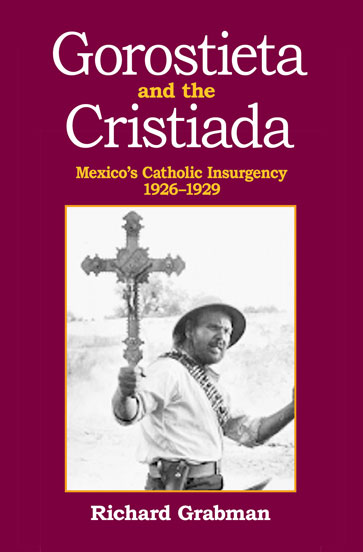 that, as my right-wing friend contends that the well-educated tend to work for the state (and that wouldn’t account for the tendency of the well-educated in right-wing states to also be lefties), nor of the meme going around a while back that “reality has a liberal bias”. I don’t know that there’s any particular single cause for the well-educated and well read tending towards the left end of the political spectrum, other than the simple fact that well-educated people ARE well-educated, and tend to read more than most people. And, that even the most retro of writers and intellectuals — the honest ones anyway — are willing to test their own assumptions.
Reading Chesterton hasn’t made me a right-winger, or even a defender of tradition, and I don’t think reading Gorostieta and the Cristiada is gonna send Gibertarians (Chestertonians?) running amuck and beating up priests.
Of course I appreciate the work done by scholars with their more traditionalist, or politically right-wing spin. I couldn’t have written on the Cristiada without reading Jean Meyer’s work, or traditionalist Catholic writers, or even in one particular instance, a study that appeared in racist and pro-fascist publication.
An honest and intelligent writer, Chesterton famously wrote “The whole modern world has divided itself into Conservatives and Progressives. The business of Progressives is to go on making mistakes. The business of the Conservatives is to prevent the mistakes from being corrected.”
And the business of scholars is to discover where the mistakes came from in the first place.


 mexfiles.net