Police-state averted (for now)
Thank goodness for political gridlock!
The Calderón Administration’s push for a Mexican version of the PATRIOT Act (or, rather, one that would allow for peacetime “states of exception” — i.e., military occupation in civilian areas) is off the table for now, the PRD opposing it, and PRI not wanting to back the administration on this to give the PRD a campaign issue. And PAN, smelling a rout in the next election, desperate to partner with PRD where it can, not all that enthusiastic either.
And, then too, at least a few Mexicans realize this was a very, very bad idea.
Orlando Bosch Ávila, P.ee.I*
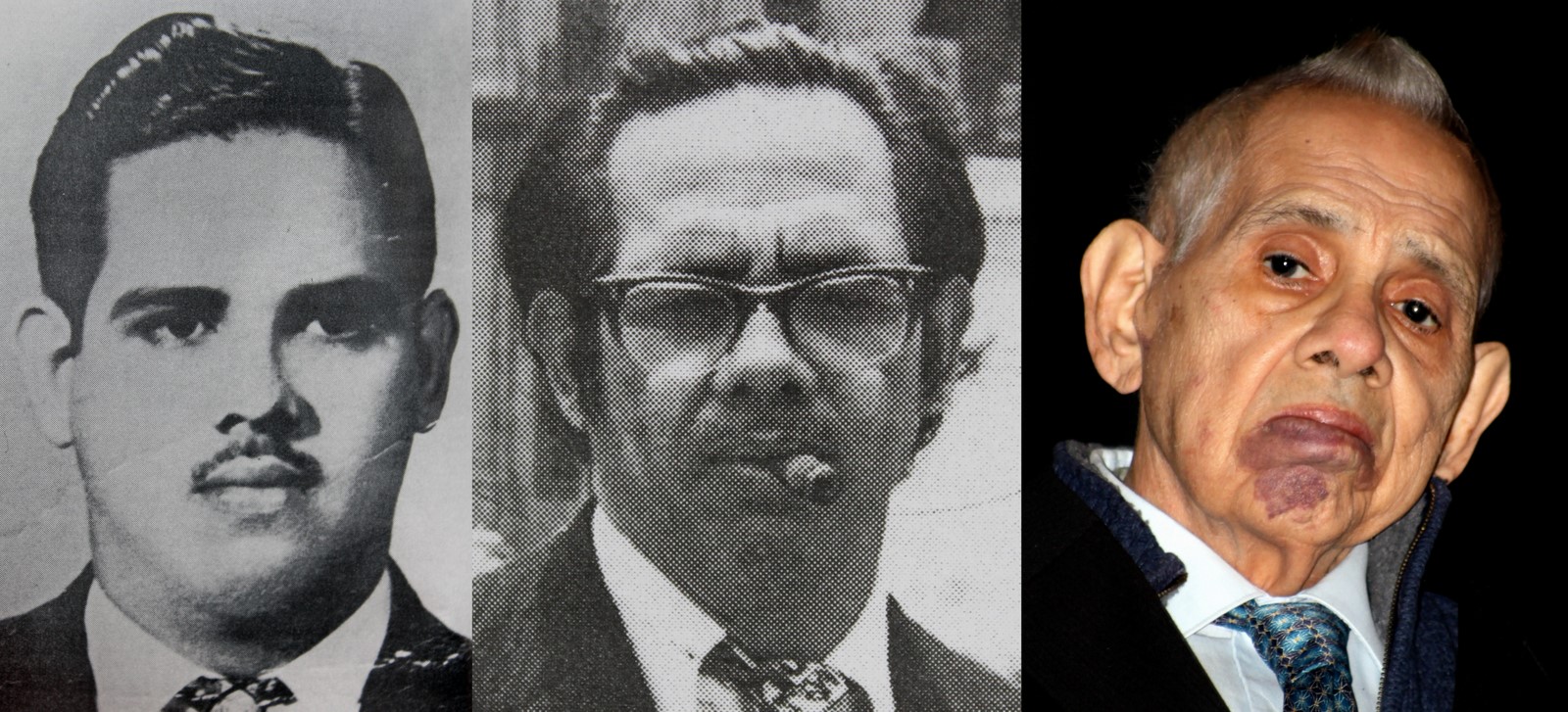
Three undated photos of Bosch, from "Along the Malecon"
Orlando Bosch, who died yesterday at the age of 84, was one of those minor historical figures that popped up throughout late 20th Century Latin American history… leaving behind a trail of corpses.
Trained as a medical doctor (he was the president of the University of Havana’s Medical Student body when Fidel Castro was president of the school’s Law Student organization), Bosch abridged the Hippocratic Oath to read “First, do no harm.” Bosch, who moved to Miami after an internship in Ohio, took no active part in the Cuban Revolution, but briefly returned to his native land in 1960. In 1961, he was involved in attempts to foment an uprising on the Island, which — obviously — failed.
He always claimed that the lack of U.S. support for his own invasion was the rationale behind his non-participation in the botched “Bay of Pigs Invasion”, athough, beginning in 1962, he maintained ties with Cuban terrorist cells and the C.I.A. through his role as coordinator of the “Insurrectional Movement of Revolutionary Recovery.”
Bosch pops up as the intellectual author, or a co-conspirator, in a number of murders, the best known being the bombing of a Cubana Airlines Flight 455 over Barbados on 6 October 1976, killing all 73 persons aboard, at the time the most deadly terrorist attack in the western hemisphere. At the time, Cuba’s population was about 9.5 million people: “9/11” led to 3,000 immediate deaths over two air attacks and the collapse of the Twin Towers, in a country with a population of about 350,000,000. In other words, the Cubana Airline attack was proportionally about as devastating to Cuba, as the “9/11 attacks” were to the United States.
Bosch, at the time, was in Venezuela where he had fled in 1972 while on parole from a prison sentence for his 1968 rifle attack on a Polish freighter in Miami. “Rifle attack” seems rather like a gesture, unless you realize he was using 45 pound 57 mm recoiless rifles, a portable cannon.
In Venezuela, Bosch was employed at a “private security company” owned by fellow Cuban terrorist, Luis Posada Carriles, although the two of them, and Bosch in particular, seem to have maintained ties (or done contract work) for a number of foreign intelligence services, as well as engaging in free-lance mayhem. Bosch is know to have been involved in murders in Argentina, Chile, Mexico, the United States, Central America and Europe and various bombings throughout the hemisphere, (including the Mexican Embassy in Guatemala and possibly the 2007 bombing at the Mexican consulate in New York). And, of course, various bombings in Cuba.
Otto Reich, the … uh… “controversial” (though some prefer the word “sinister”) U.S. diplomat — at the time U.S. Ambassador to Venezuela, Assistant Secretary of State for Western Hemisphere Affairs during George W. Bush’s presidency, and later a lobbyist for the Honduran coup leaders) arranged for Bosch’s return to the United States in 1987. Despite suspicions of having been the brains behind a series of bombings in Florida throughout the 1970s, Bosch served only six months in prison for a immigration violation.
President (and former C.I.A. Director) George H.W. Bush, over the objections of his Attorney General, gave Bosch a general pardon in July 1990.
Among the many secrets Doctor Bosch took to the grave is one particularly intriguing mystery. If, as many claim, and he hinted, the “dark complected man” in a famous photograph was he, what he was doing sitting on the “grassy knoll” in Dallas on 22 November 1963?
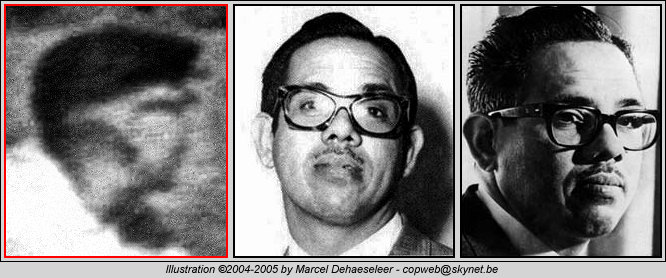
"Dark complected" Grassy-knoll guy (left) and Bosch in the 1960s
* ¡Pudran en el infierno!
APLA?
The Alianza del Pacífico Latinoamerico — a free-trade agreement between Mexico, Colombia, Peru and Panamá — is the latest in these types of international trade groups. I have been saying that Mexico should have joined the already existing Mercosur (Argentina, Brazil, Chile, Paraguay, Uruguay and Venezuela), which is further along in creating a common market of the type that led to the European Union. I would have preferred a wider “Bolivarian” economic union, meant to spur everyone’s internal markets. but don’t have any strong objection to a second pan-Latin organization. While it is true that APLA creates an economic zone larger than Mercosur, I don’t see that it particularly creates any new internal markets for anyone. None of the four (except Panamá) are all that different in their exports. Mexico has more manufacturing than the other three, but it comes down to mineral, oil and agricultural exporting countries.
And narcotics. Maybe they can form a dope “cartel” (a la OPEC) to rival the various national and regional cartels whose internecine warfare is said to be the common scourge of our various nations.
Snark aside, I get the feeling that APLA is meant as a political counter-weight to Mercosur. The APLA countries all, for now, have conservative with a neo-liberal bent to their economic policies, while Mercosur countries have leftist, or socialist, presidents right now. Politics might explain the presence of Panamá, which (at least in its legitimate economy) provides services, rather than manufactured goods and commodities, like the other three.
Una rebelión de Atlas?
 (Leopoldo Ramos, “Empresarios amagan con no pagar impuestos por crimen de socio de Lala”, Jornada, 24 de abril de 2011. My translation)
Saltillo, Coah. If there is no resolution by this Friday of the murder of Grupo Lala executive Carlos Valdes Belanga, shot down last Sunday by at least three gunmen, Lagunera [the Torreón-Gomez Palacios-Lerdo metropolitan area], businesses will stage a work stoppage and tax strike.
The ultimatum he was released Tuesday morning, by local representatives of the Employers Confederation of Mexico (Coparmex) and the Lagunera Council of Private Initiative (CLIP, for its initials in Spanish). Also demanded is that the Federal and State governments provide a security plan for employers, workers and their families, within one week.
“In the Laguna nobody feels safe, at home or on the job, and we’ve had it,” said Oscar Sanchez Soto, president of the public safety committee of the regional Coparmex council.
Coparmex president, Roberto Cruz Rodríguez, said the escalation of insecurity in the area where more than 250 people have died violently in 2011, “there is fear among employers” and new investments are at risk.
“Enough already! They [the government] either gets to work, or they resign. We want a safe community. We’re putting the authorities on notice that every one of them is responsible, and if they don’t respond to our demands, we will act,” warned CLIP President, Ernesto Llamas Sotomayor.
He said that given the current uncertainty “Employers cannot stand idly by and do nothing.”
Going Galt? Not hardly, but classic Capitalism á la Mexicana:
The man whose whole life is spent thus … naturally loses the habit of exerting his understanding or invention, and generally becomes as stupid and ignorant as it is possible for a human creature to become … [hence] not only incapable of relishing or bearing a part in any rational conversation, but of conceiving any generous, noble, or tender sentiment, and consequently of forming any just judgment concerning many even of the ordinary duties of private life [as well as] of the great and extensive interests of his country … This is the state into which the great body of the people must necessarily fall, unless government takes some pains to prevent it.
(Adam Smith, The Wealth of Nations, 1776)
Thus the “father of Capitalism” describes those forced by circumstances into a narrow world-view, mistaking their economic activity for their life… sort of like the Ayn Rand groupies, who are seen here (in the words of one almost admirer of her work) as:
… teenagers or radical right, those who hate communism. Objectivism is linked with the rebellious attitude typical of teens. Overwhelming naivete and innocence are the great assets required to believe in what Rand says…
It would indeed be naivete and innocence to assume that rugged individualism is going to resolve the violence. If anything, the narcos are the Randian heroes of Mexico. As it is, Mexicans tend to speak of “individualism” as a negative trait, one associated with Randian “values” like selfishness, amorality and the pursuit of personal satisfaction (in other words, our stereotype of a narcotics user). Not that Rand is much read here. The economic theories of the last 25 years have been associated with government leaders educated in the United States, not Mexico. While there are problems with Mexican education, higher education usually begins with the classics… for business students, that would be Marx and Smith. Being capitalists, and all, we can assume our business leaders are more attuned to Smith than Marx, but more than either of those two European worthies, they are grounded in Mexican tradition.
 Mexico remains, as it was officially up the Salinas Administration, and still is in most senses, a communitarian society with a capitalist economy. Even at its most socialist (in the 1930s and up through the 1970s), private capital for the most part saw the state as their protector, and the source of their collective prosperity. This does not mean unblinkered support of the state. While Mexican business executives, like everyone else, is loathe to pay their taxes under normal circumstances, at least in theory, they adopt the grown-up attitude of Adam Smith:
The subjects of every state ought to contribute towards the support of the government, as nearly as possible, in proportion to their respective abilities; that is, in proportion to the revenue which they respectively enjoy under the protection of the state.
Despite twenty-five years of the largely Anglo-American theories of neo-liberalism ( savage Capitalism on a global scale), Mexican, even Mexican capitalists, remain good communitards at heart, defining their interests collectively. Unlike the permanent adolescents of Atlas Shrugged, when Mexican don’t withdraw, or “go Galt”.
The threatened Lagunera business strike is another action in the growing ¡No mas sangre! movement — the demand for radical change in politics and for a more effective judicial system in response to weaknesses and downright failures exposed by the Calderón Adminstration’s bungled and bloody “war on drugs” — is not just a lefty intellectual exercise. While I don’t fault foreign commentators for their narrow focus on the day-to-day mayhem that has resulted (“if it bleeds, it leads” and most of the foreign commentators are trying to sell a product), I’ve been bothered by the “un-Mexicanness” of the whole “drug war”, the entire prosecution of which has seemed more in the spirit of Anglo-American individualism (witness all the “Brave President Calderón, facing opposition… blah, blah, blah leads in U.S. and British publications about Mexico), rather than the traditional Mexican sense of community and compromise.
I don’t see the narcotics war (or the narcos) as outside Mexican history any more than 19th century social banditry or the history of commodities exploitation in this part of the world, and am not surprised so much by the reaction, but am surprised (and pleasantly so) by the creative non-violence of people in response to a situation that in the course of Mexican history, has too often led to a violent response.
(And besides, flinging snark in the direction of the Rand-roids is a lot of fun!)
Trump card
Given the fact that U.S. political campaigns go on way, way, way too long, it’s close enough to the November 2012 Presidential election that the parties are already ramping up their various pleading for bribes (ooops… “private campaign contributions”). With absolutely no credible candidates on the Republican side (yet), the most creative of those potential bribees… and, thus the presumed front runner in the party at this time … is Donald Trump.
Trump is independently wealthy, so I assume he has a leg up in his campaign to raise even more money (and that may be the whole point of his campaigning… to generate a revenue stream for some other project). Still, I suppose it’s worth starting to look at U.S. candidate’s foreign policy experience, especially in regard to Latin America.
Trump has given some thought to foreign policy. He already promised to commit a war-crime (of the kind people were hanged for at Nuremburg) in the Middle East, and he does have some Latin American experience.
In Panamá, Trump attached his name to the soon to be open (or, so they say) Trump Ocean Club International Tower. While the Panamanians have a reputation for putting up with … er, shall we say… “colorful” business types, some things even they can’t accept. Trump’s statements about the Panama Canal convinced the Panamanian capital’s municipal government to declare the Republican candidate “persona non grata”… which will make cutting the ribbon rather a chore. It seems Trump, in addition to his proposal to steal Iraqi oil, has floated the idea of stealing back The Canal.
At least those were only potential thefts. In October 2006, Trump was…er… trump-eting his then latest venture, this one in Mexico:
The Trump Organization CEO Donald J. Trump and Irongate have announced plans for Trump Ocean Resort Baja Mexico, a luxury condominium-hotel resort located in North Baja, Mexico, just 30 minutes from downtown San Diego.
Developed as a partnership between the Trump Organization and Los Angeles-based real estate development and investment company Irongate, Trump Ocean Resort Baja will bring a new level of excellence in design and service to the North Baja peninsula. Trump Ocean Resort Baja will be the first resort along the peninsula to combine luxury resort amenities and services with real estate ownership.
“Trump Ocean Resort Baja will redefine the standard of premier property ownership and service excellence for all of Northern Mexico,” said Trump. “I’ve always said, ‘location is everything,’ and being just 30 minutes from downtown San Diego makes this an ideal locale for a premier resort property.”
The Marketwire release went on to make the case that Trump “is the very definition of the American success story,” with a good investment record:
From project development to construction, sales and property management, The Trump Organization and its affiliates have carried out a variety of complex real estate deals.
Er… uh… well… um. Like so many U.S. politicos before him, when it comes to Mexico, white man (with weird hairpiece) speak with forked tongue. In February 2009, business papers were reporting:
There is no joy in Trumpville today. The mighty Donald has struck out – again.
New York entrepreneur Donald J. Trump’s planned 526-suit Trump Ocean Resort Baja – 30 minutes south of Downtown San Diego – is nothing but a deep hole in the ground today.
The condo-hotel project in North Baja, Mexico, could not obtain financing from a German bank to start construction.
Investors who had rushed to plunk down 30 percent deposits on suites priced from $300,000 to $3 million, are out their money.
Trump Entertainment Resorts Inc., through a Mexican entity, PB Impulsores, informed investors there were no funds to refund deposits totaling $32.2 million.
Trump Entertainment Resorts maintains a clause in the buyers’ contracts gave the developer a right to spend their deposits.
Several lawsuits have already been filed in Los Angeles Superior Court.
Trump Baja condos went on sale in October 2006. S&P Destination Properties sold 188 units for a total $122 million on the first day of the sale.
Trump and his partner in the project, Los Angeles-based Irongate Capital Partners LLC, had retained S&P Destination to handle sales and marketing.
Given the crappy field of contestants (including the incumbent) when it comes to Latin American relations, I suppose we have to give Trump some credit, at least for undertaking a Mexican venture in which he screwed over a heck of a lot more gringos than Mexicans.

Trump Baja: a big hole and a bigger asshole
¡Aguas!
Guatemala
On Tuesday, Alvaro Colom’s government declared a nationwide “nutritional risk alert” to avoid a food crisis in the country’s poorest areas. The goal of issuing an alert is to prevent an “emergency.” The country’s “dry corridor” and southern coastal communities (heavy rains) are the areas that have been most affected by extreme weather.
According to the UN, 49% of Guatemalan children under the age of five suffer from chronic malnutrition. Guatemala has the highest percentage in all Latin America and the fourth highest rate in the world. Unsurprisingly, chronic malnutrition approaches 70% in indigenous communities.
Mexico
On Sunday, deputies and pundits said that the war over water rights had already begun and pointed out that if governments fail to act in the short term, this war will entail dire economic, social and environmental consequences for Mexico.
The president of the Special Commission of the Lerma-Chapala-Santiago Basin, National Action Party (PAN) Deputy César Madrigal Díaz, said that every single region of the country was experiencing scarcity of this vital resource, as evidenced by decreasing water levels in the nation’s rivers..
He noted that water pollution in human settlements near water bodies had added to the problem, as well as agriculture, commercial and industrial activities that are not duly certified. “These people use polluted water for irrigation or industrial purposes,” he said.
The war over water usage is a reality the country is currently going through, said Avelino Méndez Rangel, Democratic Revolution Party (PRD) Deputy. He urged the government to create programs that generate sustainability of the resource.
“This is a matter of preserving life,” he noted…
Victor Mayan, The (Mexico City) News
Peru
Ica, 25/04/2011 (CNR): The model region of Ica, with the highest accumulated GDP growth in all Peru over the last five years, has achieved its significant GDP growth by having a strong presence in the export market thanks to its good quality soils and hours of sunshine which achieves good production levels for its main activity, that of agriculture. …
…
However, this apparent economic growth is not reflected in the quality of life of the region’s population. According to data provided by the Ica Regional Health Authority, Ica has the third largest number of cases in Peru of tuberculosis and has seen an increase in the number of cases in children under five years old, from 44.9% in 2009 to 53.8% in 2010, according to ENDES.
Added to these official data are other indications that generate a poor quality of life, such as the numbers of abandoned children and numbers of children of working mothers. Above all, a latent risk for regional development and economic growth and sustainability for the lifestyle of Ica residents is the scarcity of water.
CNR (Peru), translation by Inca Kola News (25 April 2011)
And back in the U.S.A.:
I attended a hearing at the House Subcommittee on Western Hemisphere yesterday where Assistant Secretary Arturo Valenzuela and USAID Assistant Administrator Mark Feierstein testified about budgetary issues.
After the testimony, the first question was asked by the chairman of the subcommittee, Rep Connie Mack. After making the administration repeat its priorities in the hemisphere (security, democracy, prosperity), he asked why $100 million in taxpayer dollars are being spent on the Global Climate Change initiative in the hemisphere. He indicated that the money doesn’t fall under the three priorities and that given the current violence in Mexico and Central America, spending this money on climate change hurt the administration’s focus on security.
Dollars to doughnuts
It never fails to amaze me that even people who live here think we can handle their dollars the same way a bank can.
With inflation and the general slow business climate here, I’m not unique in looking to save a few pesos wherever I can. I rent a spare room in my house to tourists occasionally. Rather than post the same pictures and answer the same basic questions again and again, I just threw together a little website, and posted links to the site in ads on craigslist and the like. When I wrote the ad, the dollar was a tad weaker than today, so I guess if my latest renter had made the deposit in dollars (via paypal) he would save … oh… twenty pesos (well, actually nineteen pesos and 79 centavos)
Of course, renting a room in my own house, I prefer people congenial to my own way of life… quasi-hippies (the kind who bathe regularly and don’t smoke marijuana) or surfers or artists or free-spirits… who are likely to be a little more financially challenged than the usual run of tourists. I just don’t expect them to be quite as financially anal to follow the day to day rate exchange, especially when we’re talking about less than a thousand pesos (ok, 600 pesos to be exact). The latest renter wanted to make the deposit in pesos, at the dollar exchange rate.
It’s been a while, but one sign that I was going native was when some tourists thought I was helping them negotiate some street purchase. I was helping… the vendor: negotiating the price upwards to cover the her hassle factor. It’s not that we (and note that when you live here, you’re a “we” not a “they”) want to cheat tourists, or soak them for the yanquí dollar, but that all of us, even us  free-spirited regularly bathing quasi-hippie types, have to deal with the annoying money laundering regulations here like everyone else. Dollars in Mexico aren’t real money, but only as potential money. I can’t spend them anywhere except in tourist joints (at a discount) and — “thanks” to money laundering regulations — can only make the deposit at certain hours, and won’t see the deposit in my account for about a week. A lot of trouble for about the price of a a couple doughnuts.
(Dollars given to the MexFiles, however, are always welcome, since they are used to cover server costs, domain registration and the on-line purchase made in dollars. A thank you to “Craig” who recently sent 26 US$ … or is it 301.25 pesos? )
Un unholy mess

A small group of women (and one man) began shouting during Cardinal Norberto Rivera’s Easter Sunday sermon. There was a scuffle with the cathedral security guards (which have been there since a political protest turned violent there last year). Armando Martinez, who, as head of the Catholic Lawyers Association, pops up in the news regularly to embarrass himself and/or the Church, blames the PRD for the interruption.
The Cardinal’s mouthpiece Msgr. Hugo Valdemar was blathering on about the insult to the Virgin — a Virgin of Guadalupe statue being broken during the scuffle. Of course, the PRD denies having anything to do with all this, protests against “idolatry” and demands to read “the Blue Book of the Prophets” not usually being on the PRD agenda. And, it looks as though the iconoclast in all this was Martinez, who was wielding the Virgin statue as a cudgel against the protesters. At least he was gentlemanly enough to only bop the guy, and not the women (one of whom was faking a pregnancy).
(Photo: María Luisa Severiano/La Jornada. More in Jornada, Milenio, Cronica de Hoy)
The “Cathedral Five” were later released… apparently there’s no proof that the Virgin-cudgel that figured so prominently in all this belonged to the Cathedral (which would technically make it government property) nor that the protesters broke it. And there is no law against shouting “idolatry” in a crowed church. Of course, the Church still wants to blame the PRD.
A killer of import?
I seldom use “Borderland Beat” as a source, considering it simply narco-war porn, but I was fascinated by the comments on an article on the arrest of Martin Omar Estrada Luna, aka “Comandante Kilo”, described by that site as “leader of the Zeta cell in San Fernando [Tamaulipas] “, and fingered as the intellectual author of the serial and mass murders in that community.
Commentators noted that “Kilo’s” tattoos (reprinted in Borderland Beat from “Blog de Narco”  photos) are those associated with a northern California prison gang, and … in the words of one anonymous poster:
He looks like some pocho from LA or NM. Wack ass vatos. Fat overweight and tattooed. he thinks he is sooo hard. This guy is a chicano bitch trying act hard in MEx.
The tattoo in question is “NORTEÑO” across his (paunchy) stomach. Not knowing a thing about the composition of various California gangs (nor, really, much interested in the subject), I’ll assume another commentator, “Cuete”, has more knowledge on the subject:
Yeah I read Norteno which makes me wonder too where he is from.. Im here in Ea$t Oakland shakin my head at this piece of shit…Iʻm Nue$tra Familia (if you know what a Norte is you know what I am) and Im just tryin to figure out why if he is a homeboy is he down there doin shit with the Zetas (whom usually fuck with $ureno$ or The Barrio Aztecas) but con$idering hes in trouble for killing civilians I could only assume hes been around too many $krapa$ that shit dont fly in the Northern Califa$
It didn’t taken the press long to figure out exactly where “Comandante Kilo” was from: although Mexican-born, was made in the U.S.A. — Tieton, Washington (population about 1500) to be exact. As Mark Morey and David Lester of the Yakima Herald-Republic report:
Tieton police Chief Jeff Ketchum said he has known Estrada since Ketchem started working for the police department in 1994, about a year after Estrada started racking up his first criminal charges in juvenile court.
…
Acquaintances said Estrada left the Highland School District well before he would have graduated in 1995. That year, he pleaded guilty to second-degree burglary in connection with the theft of a Ford Taurus from the school district. The sentencing judge ordered him not to have any contact with district schools as part of the plea.
Yakima County Superior Court records listed him as unemployed; the friend says Estrada supported himself in the drug trade.
…
Besides the burglary charge, his adult felony convictions in Yakima County involved a burglary and for brandishing a knife in Tieton.
When he was sentenced in 2006 for an immigration violation, federal prosecutors pointed out that he had managed to amass 16 felony and misdemeanor convictions.
…
Estrada was ultimately sentenced to 41 months for returning to the United States a third time after being deported twice before.
Immigrations and Customs Enforcement said Tuesday that he was deported in 2009 from Reno, Nev., after completing his sentence.
The ICE database shows no contact with Estrada since that last deportation.
However, the friend of Estrada said the last time they had contact, Estrada was living in Laredo, Texas, just across the border from Nuevo Laredo.
“Fat, overweight and tattooed” doesn’t jive with our popular image of the Zetas as super-soldiers gone bad. But, than, as I’ve said before, those Zetas paraded before the cameras tend to have a closer resemblance to the Bimbo Bear than Dolf Lungren or Jean-Claude van Damme. If anything, the 34 year old Estrada is a sorrier-looking physical specimen than other supposed Zetas I’ve seen in previous perp-walk photos.
Estrada’s gang-connections raise a question or two about the supposed role of the Zetas and other “cartels” in the U.S. narcotics trade. While cooperation (or at least equal employment opportunity) for gang members from the United States in Mexico by the Zetas sounds more than plausible, and it’s been well-reported that Mexican “cartels” recruit U.S. criminals for their retail distribution (well… duh!), that these gangs are bitter rivals in the United States indicates that there isn’t some huge international criminal network involved in the narcotics trade, but that it works like any other commodities market… selling to various retailers who fight it out among themselves for market shares.
Estrada’s supposed residence in Laredo, Texas — hometown of Edgar Valdez Villarreal, aka “El Barbie”, is interesting. El Barbie, as you’ll recall was said to be the Zeta’st another “cartel top hit man and their leader. After his capture (which itself was dubious, other “kingpins” not being taken alive) he was to be extradited to the United States last November and then disappeared from any mention in the press (presumably he is in the United States under “protective custody”… or not).
Although it’s not all that surprising that Mexican-Americans would be involved in exploiting Mexicans in the commodities growing and export trade, the Zetas are the only one of the so-called cartels where U.S. export “kingpins” have surfaced born or bred gangsters have regularly surfaced. *
And, all this assumes he is, as said, the mastermind of these killings. I must admit that the rapidity with which the crime was solved — not when people were being extorted, or began to disappear, or when migrants reported problems, or even when it first became clear that people were being murdered in San Fernando, but only when it became a political liability to the Calderón Administration — makes me question whether the “wack ass vato” is the intellectual author of the slaughter in Tamaulipas, and whether or not the real criminals are sitting across the border, simply writing off Estrada as “collateral damage” in their own war on the Mexican people.
* Boz pointed out in his comment a egregious mistake on my part, which — as it stood — suggested the Zetas were a U.S. controlled gang. They could be, although only in the sense that that’s where the money (and weapons) ultimately are. Edgar Valdez so far is something of an out-lier among the Mexican gangster community, in that he really was a faction leader of some importance, and a foreigner.
Street crossing
Good Friday in Iztapalapa: El Universal photo by Roberto Armocida:

An old story
The leadership and elites in client-states survive as long as they can demonstrate that they provide the “stability” that allows for indirect control by their imperial masters. When there has been a on-going resistance to the imperial system, any populist movement is a threat to be dealt with severely. However, to preserve the client-regime’s legitimacy, populists cannot simply be eliminated by the imperial power, but their elimination by the client regime has to be spun as upholding the state’s relative independence, or upholding national values.
Even if not directly connected with the anti-imperialist movement, especially when, say, a worker gains prominence as a teacher and is calling for radical reorganization of the status quo, with “special rights” for the poor, action is required. Should such a proletarian leader start to attract a following, the elites are well advised to trump up some charges on which to discredit the leader and the movement, or — if necessary — eliminate him, even if it means turning him over to the imperialists for some sort of “extraordinary rendition”.
Like… crucifixion.
The fire this time
All but unreported in the North American media has been the “minor” fact that a huge chuck of the continent is on fire… from Queretaro to Oklahoma, fires have been consuming rangeland, farms and forests… and homes.
Alberto Tomas Halpern, of the Big Bend Sentinel and Presidio International/Internaciónal, took this photo near Fort Davis, Texas (which nearly went up in flames last week):

The causes aren’t exactly rocket science… or perhaps they are. By way of a comment, the Sentinel reprinted a cartoon from their files:
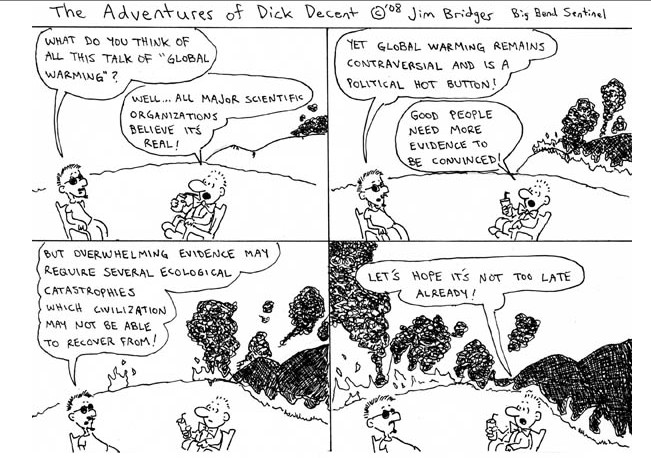
The “stop the violence from crossing the border!” crowd might want to note that the violence against the planet is responsible for this situation, and no fence, no Border Patrol, no “show us your papers law” is gonna stop the destruction that results from the continued plunder of natural resources and over-indulgence.


 mexfiles.net