Of arms and the Gringos: an old story
More evidence, if I need any, that in dealing with Mexicans one needs to understand the nation’s history. Rafael Cardona nicely encapulates the growing fury at both the U.S. and Mexican government’s role (by commission and omission) in gun-running by reference to the most famous action against U.S. gun-runners into Mexico of all time.
(From “La vieja historia de las armas gringas.” Metáforica Política”, 13/03/2011, my translation, which takes some liberties with Mexican metaphors):
Today, let us stir the dust of time.
A near mythic example — almost a parable — of the national imagination is personified by the name Pancho Villa, the only successful invador of the United States who tried to turn back the borders to those we had before the 1840s.
The magic words seem to encode our subconscious and secret desire to change the uneven relationship we have endured and seen throughout the years. Everything is encapsulated in a single name, “Colombus.” But we misunderstand Villa’s raid. It was a response to the historical and overt role of the United States in arms trafficking to Mexico.
If the raid by five or six hundred furious Dorados in March 1916, with its sequel of murder and arson had any motive (not the sole one, but an important one) it was to capture arms dealer Samuel Ravel, who had stolen money from Villa, a scenario repeated today in New Mexico and beyond.
But, this time, it’s not one mercenary arms trader at the heart of the story.
Today’s traffic in assault rifles (like that in the age of Mausers) show the United States government in its best role: simulating a false fight against the very crimes it is perpetrating; infiltrating spies and agents onto Mexico soil with the complaceny and gratitude of a government too distracted by protests as the situation spins out of control, and only touching public opinión there, because here (where there was a tsunami 8000 Km away to distract them) it just doesn’t matter.
The United States government releases try to lessen the severity of the situation, by recasting it as a local problem. Columbus officials have been ensnared in a long list of irregularities and corrupt practices, all related to a larger issue: the failed ATF operation, the size of which we are told is none of our business. we are told. Si no le gusta la sopa, plato doble. If you do not like the soup, double.
On Friday, 11 March, the wire services told us: agencies gave us this information:
“The mayor, police chief and a councilman in the border community of Columbus, New Mexico, were accused yesterday of participating in a network traffic of firearms, said the federal prosecutor in that state, J. Kenneth González.
“In a statement issued hours after the arrest of three officials, the prosecutor reported that they, along with seven others, are accused of belonging to a criminal group that acquired and smuggled weapons.
“Mayor Eddie Espinoza, 51, police chief, Angelo Vega, 40, and Councilman Jose Blas Gutierrez, 30, face various charges of arms trafficking, which were presented to the New Mexico Grand Jury.”
This information is generated in a tense atmosphere by the supposedly offended Mexican government, sounding like a cuckolded husband who was the last to know how those arms ended up under his bed, as his wife fantasized about the Merida Initiative.
“We knew nothing,” said the ever-vigilant Office of the Procurador General.
That same Friday, dropping a handkerchief on the carpet (so to speak), the U.S. Embassy signals its intention to end discussion, and posted an official statement that stands as a monument to cynicism and manipulation. Yes, the PGR knew of Operation “Fast and Furious,” but not of its international scope and only of its existence on American soil (as if that would be of use to the Mexicans), which meant the chance to see felons punished.
Which led to this, from Pascual’s people:
“Because of the attention has been given to this issue, the United States Embassy in Mexico want to make public the following clarification. The parentheses are mine:
“There is no contradiction between the statement of the Mexican government (“We know nothing”) and information provided by the United States (“Yes they did”) regarding an operation called” Fast and Furious ” which dismantled a major arms trafficking ring (of which they were the instigators). The operation took place on U.S. soil (and also Mexican soil) and resulted in the arrest of 20 defendants on January 25, 2011. “
That was meant to pacify us. “Operation Fast and furious” was uncovered when arms, provided by the United States and introduced into Mexico were used to against two of their own: Jaime Zapata here, and Terry Bryan there. That led to John Dodson, an ATF agent, confessing on CBS News on 4 March: “I am in Phoenix to tell what we have done every day since I got here. Tell me now that I didn’t do the things I ordered to do, tell me I did not do what I did. “
“After the arrests of 25 January (quoting from the Embassy press release) reports surfaced claiming that the operation could have included the transfer of U.S. arms to Mexico. Attorney general Eric Holder has requested an investigation. He has stated unequivocally that such actions, if true, “would not be acceptable” (“by whom and where would that disagreement would lead us?). He also stated that has made this clear to the prosecutors and agents in charge of the ATF (Bureau of Alcohol, Tobacco, Firearms and Explosives).
“The Government of Mexico has declared that it was “not aware of the existence of an operation that included the transfer of weapons or controlled traffic into Mexican territory. ” Briefings were held between for United States and Mexican law officers that focused on operations in U.S. territory designed to disrupt weapons smuggling operations.
“The alleged transfer of weapons into Mexico is, at present, only an allegation (that is, an assumption unlikely, according to them). Attorney General Holder has made it clear that he takes such allegations seriously. He is quoted as saying, ‘That is why I asked the inspector general to conduct an inquiry into this’. “
The text is a tricky one, the reality going far beyond an allegation. Why use that word, “alleged“?
In English “allegedly” is not the same as “alegato” — for us, a philosophical argument… in the sense of a thesis or proposition. Rather, it means “as stated, as intended. Implied without reason.” In other words, a presumption.
Understanding that, the Gringo statement seeks to condemn the Mexico one for being presumptious. “You were told about the local scope of an interal operation, which automatically makes Fast and Furious a fantasy, an urban legend, a story, a game.
And worse: the government will accept that it is a fantasy, a game of mirrors. And it is all under control.
Whether Cardona’s “alegato” is correct or not, fair or not, is rather beside the point. The Mex Files receives more than its share of comments seeking to “challenge” points of view expressed, and when the Mex Files is presenting a point-of-view by another author, any disagreements or challenges are misdirected if sent here.
The larger point, and one that IS open for discussion is the alegato that Mexicans, especially when challenging the “official” story, mine history and legend for their political metaphors and that such metaphors matter. That the United States government was involved in arms-smuggling into Mexico is undisputed. That the United States’ government’s response to the furor released by the revelation of this fact failed to take into account how Mexicans process and interpret these kinds of revelations I allege is a failure to comprehend the most basic facts about Mexican society and culture. And that is worse than a crime, it is a blunder.
Topos to Japan
The mole-men, those extraordinary ordinary Mexican men and women whose only requirement is tremenous balls (that goes for the women too), better known as la Brigada de rescate Topos Taletelolco, are on their way to Japan today. 
Dig they must, as they have since their spontaneous appearance following the 1985 Mexico City quake, and dig they do… anywhere, any time earthquakes, fires, floods, tsunamis, volcanic eruptions (or even nuclear plant melt-downs) require digging though unstable and dangerous debris — preferably with construction equipment, but with pick and shovel, or by hand if need be.
They are not paid by their government nor their employers for their services. Nor do they charge for them, but these men and women are volunteers — ordinary Mexicans (well, ordinary Mexicans with extraordinary balls), with ordinary jobs, and ordinary family responsibilities and expenses, as well as providing for their own food, lodging and supplies when at a disaster site.
PAY PAL (this means YOU, gringos… and Germans, Canadians, Peruvians, et. al.) to donativos@brigada-rescate-topos.org
Direct Deposits within Mexico to:
Cuenta Santander: 92-00070929-4
Sucursal: 0479 San Fernando. Referencia: Brigada de Rescate Topos Tlaltelolco, A.C. CLABE: 014180920007092942
Guilty, one presumes
One of the more indelible moments in “Presunto Culpable” was police inspector José Manuel Ortega Saavedra’s testimony, or rather non-testimony, to the effect that he didn’t remember arresting Toñio Zúñiga. Ortega recently retired from the Mexico City police, though his sons are still in the cops and robbers business… presumably:
(A “nota roja” from El Universal, 12 de marzo 2011. My translation)
Two of sons of the commander who appears in the movie “Presumed Guilty” were arrested on charges of theft, while a third son remains at large.
Former capital prosecutor’s office commander Jose Manuel Ortega Saavedra’s three sons are well known in their neighborhood, La Raza, Azcapotzalco, for their arrogance and delinquent behavior.
The suspects now work in franeleros (free-lance windshield cleaners) around the Hospital La Raza.
Manuel Ortega Mayon, alias “Manolo”, King Theling, aka “Freckles”, and Yoshio Lee, aka “Yosio”, 32, 30 and 24, respectively, have been arrested before on several occasions, their father intervening to secure their release.
Neighbors, who said they are fed up with the antics of the three sons of the commander made famous by “Presunto Culpable” describe them as a “addicts and thieves”.
This Saturday they were stopped by police patrols after they were identified by the owner of a gray Jetta while in the act of removing the car’s stereo speakers.
The victim had parked his car on the street, and paid the trio to watch it, but upon returning saw one of them in the car, trying to steal a speaker.
The three of them fled towards their house, King and Lee, being caught outside. Family members attempting to thwart the arrest beat up officer Rodríguez Yáñez. (no personal name available).
Taken before Public Ministry #55, they were released at the request of their recently retired father.
The presumably guilty suspects claimed their father worked until a few days ago as director of the Hidalgo Public Security Ministry.
Perhaps I’m right that police reforms begin with better police officers, and that family services are a legitimate security investment. I can understand children wanting to take a different career path from their parents, but it sounds as if social services should have paid a home visit to Commander Ortega a long, long time ago.
Think before you toke
Jonathan Clark (Nogales International) on socially conscious consumers.
Like to enjoy an occasional toke on the reefer? If you didn’t grow it yourself, or get it from someone who did, you might want to stop and consider where it came from. Someone may have left a pile of headless corpses outside a schoolhouse in Mexico or opened fire on a U.S. law enforcement official so that you could get your buzz on.
Jonathan is being nice… it’s not that “someone may have…” but that someone did.
Secret Agent Dude: License to surf
Tekkie/surfer dude has a neighbor looking for some help with a small project, that combines two of his interests nicely … computers and boogie boards. Though, as it quickly becomes clear, as it becomes a project for a friend of the friend, that it isn’t boogie boards at all, but satellite dishes disguised as boogie boards that need attending to. That, and a small bit of assistance in setting up a couple of integrated networks operating out of different sites — “in case something happens to one of them” — capable of sending out encrypted data through proxy servers in other countries.
So our hero contacts the national security folks (somehow), and “operation surf” is on, turning an ordinary cyber geek surfer guy into a secret agent, or double agent for the other guys, who manages to infiltrate the nefarious cyber-spy ring and bring down the baddies. It might make a a decent Hollywood movie… except for the small scripting problem… the surfer dude hero being a Cuban commie, and the bad guys being United States agents.
Dalexi González Madruga, is the sufer dude. His neighbor, “Marcos”, who’d been working in Spain, asked González for “some help” in January 2007. The “help” was for Robert Guerra, in acquiring some satellite dishes, disguised boogie boards, and in setting up the encrypted communications network.
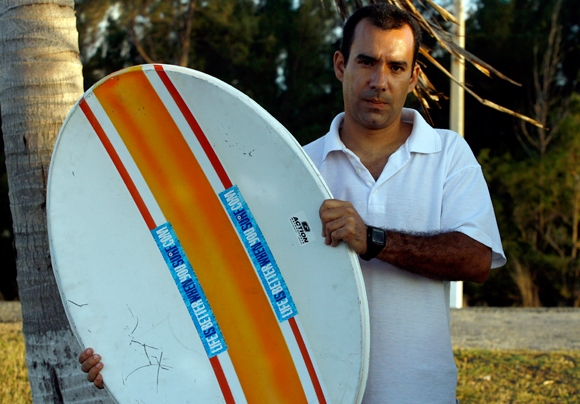
Spy dude Dalexi. Photo: Ismael Francisco, Cuba Debate
Dalexi González Madruga as agent “Raúl” to Cuban Intelligence, and “Alejando” to his foreign handlers was on the job… er, jobs. Robert Guerra, depending on your source (I’m getting this from Along the Malecon, Cuba Debate and Communist party paper Granma) either works for Freedom House, which receives U.S. government funding, or the Canadian-base “Privaterra” (described as working “with nongovernmental organizations to assist them with issues of data privacy, secure communications, information security, internet governance and internet freedom”. Privaterra’s website is password protected but I found Robert Guerra listed as “Managing Director” of the Canadian organization on a PDF slide presentation on data security given to the 2nd Dublin Platform for Human Rights Defenders in 2003. If Guerra was giving lectures on data security, and Privaterra is, as it claims, a data security specialist, one wonders why he needed González’ assistance… which is a big plot hole for anyone attempting to Hollywoodize the story.
The whole thing got more cloaky-and-daggery when the guy Cuban intelligence thinks was a CIA agent (he’s described as a good looking blonde foreigner… which sounds like the CIA’s idea of the kind of guy to pass off as a harmless surfer dude) finally met with “Alejandro”. Naturally the meeting involved hokey secret passwords, in this case, “How’s the surf in the South of France?”. Apparently, whatever “Alejandro” replied (Hey, I’ve read my share of spy novels… probably something appropriate like “the ducks fly north early this year”) meant whatever it meant. N this case, that “Barry” should deliver the boogie-board satellite dishes and other computer equipment for Guerra’s clandestine computer center.
And enough evidence to nail the spies… THE END.
Come to think of it, maybe this wouldn’t be such a hot movie. The whole thing sounds some amateurish, and — having reached its denouement last year, makes the trial of supposed “internet consultant” (and computer hardware smuggler) Allen Gross make sense. Gross, like Guerra, worked for U.S. government funded NGO’s involved both in Cuban “regime change” issues and are connected to groups that provide computer assistance to dissident groups. Gross appears to be more a salesman than a tekkie, and Guerra — supposedly an expert on cyber-security — required local assistance to set up his network. Granma’s article on “Operacíon Surf” doesn’t end with the downfall of the surfing spies, but goes on to give a brief overview of USAID and “contract agency” activities in Cuba, and claims that the U.S. is funding the dissident groups.
It probably is (a good number of the dissident groups at any rate… although it’s naive to think there aren’t legitimate dissident in the country, as there are in any country) and — given the U.S. propensity to “outsource” government activities, my guess is that the U.S. government’s real interest is not so much in regime change in Cuba as in buying off the “Cuba Lobby” with some kind of activity, even if it means hiring the less than best and brightest — who weren’t exactly James Bond…
A Japón
Ten rescue dog teams, three structural engineering specialists and twenty rescue workers — pulled together from the Jalisco Civil Protection Unit, the Mexico City Fire Department, UNAM, Cruz Roja and CENPRED (the Center for Disaster Preparedness) are on their way to Sendai… one team having left Friday afternoon, the rest to follow on Saturday.
Whatever you might think is wrong with Mexico, when there is a disaster (especially an earthquake, something we’re all too familiar with here), it is usually the first country to respond with practical assistance.
Mozart goes Latin: Friday Night Video
Un poco música para la noche… arranged by Sverre Indris Joner (on piano) performing in Oslo (where better for Latin music?) with the Hovedøen Social Club & Kringkastingsorkesteret.
(Sombrero tip to Cuba Journal)
Tsunami warnings…
… wow, first time I’ve been in a place that got a tsunami warning. I’ve been through hurricanes, blizzards, tornadoes, volcanic eruptions (a very small one… I’d just hung my laundry out to dry when the volcanic ash came down in hailstones. Try getting lava out of your skivves), earthquakes, floods.. but no tsunami’s — yet. I don’t expect to get washed out to sea (I’m at least a few blocks from the Pacific, and one the second floor… on a hill), but we might get some high-ish tides here in Mazatlán.
(And. as I seem to be getting an inordinate number of hits on this post. RELAX… the Tsunami warning is for the entire Pacific coast of the Americas… the entire Pacific, including Antarctica. Waves could be one to four meters at most, sometime noonish onward — which might do some damage to coastlines, but it’s not like hotels are going to be washed out to sea or anything. Probably good surfing, but I make no recommendations about that.)
For those who like to fret, here’s the link to the Pacific Tsunami Warning Center site, where you can get updated messages on expected landfall in various parts of the Pacific (in GMT).
Where’s Pancho Villa when we need him?
And only a few days shy of the 95th anniversary of the last time someone came in and kicked ass in Colombus, NM (buy the book already!) for gun running into Mexico (although, in that instance, it was probably for shutting off the “iron pipeline”):
The mayor, the police chief and a city councilman in the small New Mexico border town of Columbus were arrested on drug trafficking and firearm charges Thursday morning. The arrests were part of raids by agents for the Bureau of Alcohol, Tobacco, Firearms and Explosives and the Drug Enforcement Administration.
So far the exact charges on mayor Eddie Espinoza, city council member Ross Gutierrez and police chief Angelo Vega have not been released to the press. KOAT reported, “According to the US Attorney’s office, the men face firearms violations and drug trafficking charges.”
A total of eleven people were reportedly arrested.
KOAT also reported that New Mexico ICE is also conducting operations in Columbus, New Mexico.
NMPolitics.net notes that this came a day after high profile gang indictments in El Paso.
The arrests in Columbus come a day after prosecutors indicted 35 members of the Barrio Azteca gang in El Paso and Southern New Mexico. Among those indicted were 10 charged in connection with the killing of three people – including two Americans – linked to the U.S. Consulate in Juárez last year.
Columbus is a town just miles north of the United States and Mexico border. It is best known as being the town that Pancho Villa raided in 1916.
Maybe Mexicans need to do the job gringos can’t…
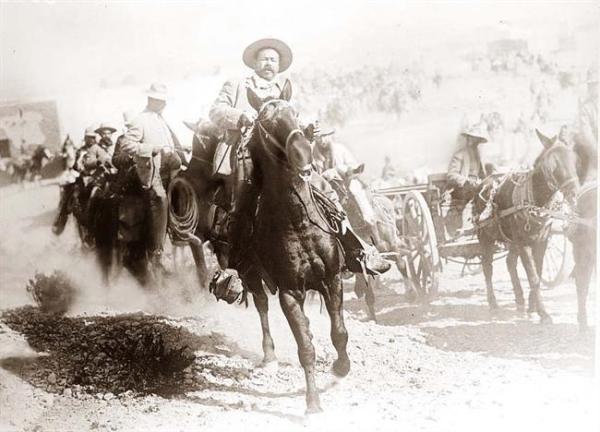 ¡Sí se puede … y sí lo hicimos!

Cartels ready to rumble

More on this later today (or tomorrow), but lookie here… TelMex calls the two TV networks (really, one and a half networks, having pretty much an overlapping ownership) of being a monopoly … and the television guys say “it takes one to know one”. As the various cartels fight it out for cable access and internet carrier rights, it’s gonna get downright ugly. And probably a lot of fun to watch.
Alligator clip
A raid at a Southern California house has turned up nearly 2,300 marijuana plants and a 50-pound alligator.
Brian Link, a commander with a state narcotics task force, said Tuesday that agents found the 4-foot-long gator in a back room of the indoor grow house surrounded by pot plants.
He said the house was a front for an unlicensed medical marijuana dispensary.
An animal rescuer who picked up the alligator said it wasn’t aggressive. Joel Almquist of Forever Wild Exotic Animal Sanctuary in Phelan described it as “very, very mellow.”
I wonder if alligators use people-clips to hold their roaches.


 mexfiles.net