Ladies’ first
Two women having declared themselves candidates for their country’s presidency, and there was a rather sourly tongue-in-cheek suggestion that a third may be in the offing,
 Sandra Torres, presently married to Guatemalan President Alvaro Colom, announced a week ago Tuesday (2-March) that she will run for president in September’s general elections. Torres, who is a politician in her own right, being one of the founders of the ruling UNE (National Unity of Hope) party, hopes to profit not just from Colom’s relative popularity, but from the power-base she has built up among municipal leaders as president of the Consejo de Cohesión Social (Social Cohesion Council), a government umbrella organization coordinating “social investment” program (literacy campaigns, food assistance and the like). Shades of Eva Peron”
There is a problem: while she may be extremely popular (or at least she says she is), the spouse of a sitting president cannot be a candidate for president. Torres is the third Mrs. Colom (the President was widowed once, and divorced his second wife) and the Colom-Torres marriage is largely a political one. While there is always the possibility of changing the Guatemalan Constitution, or of “convincing” the Supreme Court to rule in favor of her candidacy, the country also has rather simple “no fault divorce” laws.
 Josefina Vásquez Mota, Felipe Calderón’s campaign manager in the 2006 election, announced her intentions to seek the PAN candidacy for the July 2012 Presidential elections. While Vásquez Mota has a respectable enough political record (she was the Fox Administration’s Secretary of Social Development, and was expected to be named Secretary of Interior (Gobernacion) by Calderón (whose string of Gobernacíon secretaries have become more and more non-entities through his administration) , but was shuffled off into the “women’s work” of Secretary of Public Education… which she left to run for a seat in the Chamber of Deputies. Presently, she is PAN party leader in the Chamber.
She’s probably as qualified to lose the 2012 election as any other PANista you could name, but — with Calderón himself suggesting the party might better pick someone from outside their own ranks (perhaps Calderón smelling defeat absent a marriage of convenience with the leftist PRD) — Andres Manuel López Obrador offers an intriguing third woman Presidential possiblity: Elba Esther Gordillo, sometimes known as “Mrs. Jimmy Hoffa” — not because she slathers on  enough makeup to hide the disappeared U.S. labor leader, but in recognition of her skills as Teachers’ Union President, like those of Hoffa, lay in preserving personal power (even if a few dissident local leaders have… um.. accidents) and managing to thrive despite repeated corruption scandals… and for putting her union at the disposal of conservative politicians, much as Hoffa was willing to back Richard Nixon to further his own power in the U.S. Teamster’s Union of the 1970s.
Lopez Obrador made the comment during a speech in Culiacán, where he was mention Gordillo as one of what calls the “mafia of power” — the tight-knit circle of conservative economic and political leaders who he believes work “hand-in-glove” to prevent genuine economic and social change in Mexico. Elba Esther’s “PANAL” party is largely credited with throwing the elections in Oaxaca State to Calderón, probably costing Lopez Obrador’s “Benefit of All Coalition” a clear-cut victory in 2006. His suggestion that Calderón was thinking of Gordillo as a candidate isn’t totally nuts, but it sounds like he was simply engaging in some hyperbole, his humor tending to run that way.
As it is, I wonder if Calderón, as I suggested, hasn’t concluded that he really screwed the pooch as far as his party’s chances go in 2012 and the only way PAN can remain viable at the national level is either to form a coalition with PRD against PRI (the price presumably being a non-PAN candidate
¡No mas sangre!
MexicoReporter.com has actually been around for some time, but I’d lost track of it and am happy to rediscover both the site (which you should bookmark for excellent Mexico-based English-language reportage) and the site’s editor, Deborah Bonello, who perhaps should not be referred to as a “foreign correspondent”: she’s a foreigner, and a correspondent, her by-line appearing over the last several years in several British and U.S. “mainstream” publications. But, Deborah Bonello isn’t some fly-in reporter who relies on the “usual suspects” to explicate a news story, but one who understands how Mexican cultural trends affect the news, or the news the cultural trends.
Sinaloa, perhaps because it’s a main target of the Calderón “war”, has been slow to join the “¡No mas sangre!” movement, but traveling around the country recently, it’s impossible to miss the banners going up everywhere, even in conservative places like Jalisco. One thing I think it’s imperative to note in the video is John Ackermann’s observation that while Mexican politicos follow polls — in making statements (and don’t all politicos everywhere do that?) — they tend to act when there are social movements that take to the streets.
By the way, did I mention that you should bookmark MexicoReporter.com?
Presunto Cupable… now showing (for now)
The Sexto Tribunal Colegiado en Materia Administrativa (the Sixth Court of Appeals for Administrative Law) vacated the temporary injunction issued by Magistrate Blanca Lobo Dominguez’ against theater presentations of Presunto Cupable earlier today (8 March)
The unanimous ruling by the three judge panel hinged on Art. 6° of the Mexican Constitution which says (in translation) “The freedom to write and publish on any matter is inviolable. No law or authority may establish prior censorship, or require bond from authors or printers, or abridge the freedom of printing, which has no limit but the respect of private life, of morals, and of public peace…”
While Judge Lobo’s ruling theoretically rested on the phrase “…no limit but the respect of private life…” in response to a complaint by the witness to the murder in the film— a minor at the time, and supposedly filmed without parental consent — the appeals court, found that the injunction “damaged social interest” and that the producers had the right under Article Six to “publish” without prior restraint.
“El Oso” covers the legal and ethical issues surrounding the censorship… and the irony of the legal actions by co-director Roberto Hernandez to block on-line videos that sought to break the attempts to censor the film.. in a well-thought out, well researched post here.
Miliary madness …
I check in on MercoPress now and again, just to see what our friends away down south are doing. Spending a lot on military expenditures, it seems. Argentina’s military expenditures are expected to grow to an astonishing 1.3 percent of GDP by 2015. But then, eventually, they might have to re-take the Malvinas, or at least Corbeta Uruguay Naval Base in the South Sandwich Islands. The United States’ spending is about 4.3 percent of GPD, but then, again, they like to think the best defense is a good offense… against major military powers like… oh… Afghanistan, Panama, Iraq, Grenada, Bosnia… Mexican immigrants… you know, superpowers. And supplying weapons to keep everyone fighting in Mexico, which also has had to up its military expenditures… to an entire half a percent of the GDP.
You’ll go far with us
 The first new Fiat 500s starting rolling off the assembly line in Toluca, yesterday. Fiat hinted at a press conference that they may start producing Alfa-Romeros at the former Chrysler plant in Saltillo as well.
The “real Mexico” is the world’s 10th largest automotive manufacturer, exporting about 80 percent of the cars and trucks built here. It also is a major producer of automotive parts, and any car you drive in the United States more than likely is Mexican or partially Mexican.
Now it’s serious
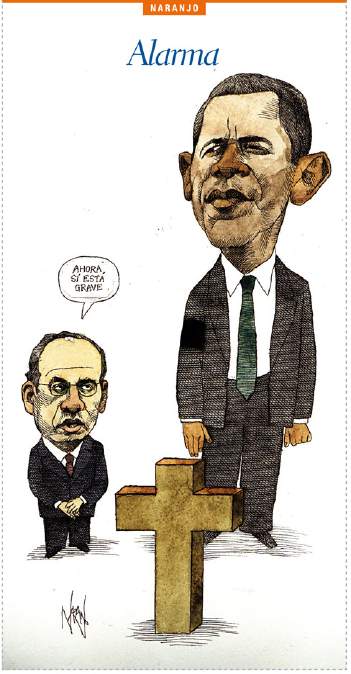 “Now it’s serious”
A couple U.S. agents get killed with U.S. weapons smuggled into Mexico with the assistance of the United States government, and they expect Calderón scamper off the Washington to explain the situation. And scamper off he does. Which hasn’t gone over at all well here.
So, after closing on on 40,000 deaths in Mexico to fight the U.S. proxy war on drugs, people in the U.S. are shocked, shocked I tell you to finally figure out that their government is doing absolutely nothing to rein in weapons smuggling, but actually abetting it — what some in the United States accuse the Mexican government of doing with narcotics.
The kindness of strangers
Thursday’s New York Times had an essay by Justin Horner, a Portland Oregon resident who seems to have had particularly bad luck with his cars. And the good luck to meet with a family of Mexican migrant workers … and the grace to write about his experience, originally for a “reddit” thread entitled “Did you ever pick up a hitch-hiker“.
Horner’s touching story seems to amaze the Times’ readers, who aren’t used to how we, in what too many of their country-men think of as a “failed state” treat our fellow human beings. From the same “reddit” thread comes a comment by “sozeldt” of the real Mexico, and it’s unfailing people:
I never have a reason to tell this story but I think it fits here. I was traveling in Mexico, one of my first times outside the U.S., and at the time I spoke essentially no Spanish. I scratched my cornea, which for the lucky among you who don’t know is indescribably painful. After literally 72 hours with no sleep due to the pain, I finally deliriously admit to myself I’m going to have to see a doctor, and thus cut my super low budget trip short. I walk into a sunglasses shop, best thing I could think of in my state, and with the help of a phrasebook, I clumsily convey that something is wrong with my eye. The sunglasses guy puts me on the phone with a friend who’s an eye doctor and who speaks some English. The doctor gives me detailed directions on how to get to his office on the subway from where I am, and tells me he can see me. When I get there, I realize he’s not normally open on Sunday, and in fact he has interrupted family Sunday dinner to see me in his office which adjoins his house. From the table next door where everyone else is still eating his very young daughter peeks her head in a few times, and he tells me she’s learning a little English and wants to eavesdrop, but she ends up being too shy to converse. He gets me completely patched up (literally; turns out an eyepatch is step one in stopping the pain), and gives me a prescription for some drops. I ask him “What do I owe you”, sort of already bracing for what I assume will be the “off-hours” price and wondering if I’ll have bus fare back to the States. He says “Some day, someone in your country will be in a jam, maybe they won’t speak the language too well, and they’ll need some help. That’s what you owe me.” It’s been years and I still can’t think of that story without tearing up a little. It immediately pops into my mind whenever I’m faced with the question of whether to make a little extra time for somebody in a jam.
(Sombrero tip to “bournmouth” for linking to the NYTimes essay on the MexConnect message board).
Presumed guilty… presumably legal
The injunction against showing “Presunto Culpable” in theaters does not affect youtube repostings on websites run on Canadian servers… and so…
Also recommended viewing is the 2005 “El Túnel”, a short documentary on judicial procedures, which brought to public attention the chaotic nature of our judicial and prison system, and — by comparing it to the Chilean system — led to serious calls for change. The trial in “Presunto Culpable” is under the reformed procedure, but — as we see — legal reforms have a long way to go.
Reforms in the justice system (which in no way mean scrapping the Napoleonic Code or adopting the trappings of foreign courtrooms), to my thinking, together with police reforms, was a slower, but more effective way of restoring security (and the sense of security) in the country than the heavy-handed, badly managed (and increasingly bloody) focus on narcotics smuggling.
Much as I despise the phrase “political correctness” (which is normally expressed in the negative, as in “this is not politically correct, but…” — meaning one is intelligent enough to know the right words, but justifies bad manners as a politically protected right… a rather dubious and stupid proposition, to be sure), Keith Dannemeyer did make a good point in his comment below about depriving the film-makers of their income.
About 150,000 viewers have looked at the youtube versions of “Presunto Culpable”. Profits from theater showings in Mexico were earmarked for the justice reform society, RENACE. Donations can be made directly to RENACE in Mexico through Bancomer.
 |
0167203489 |
| Clabe: 012580004473504731 |
Outside Mexico, if one wants to indirectly donate through my paypal account, I will bundle such donations on the 15th of March, when I do my banking. Note that the donation is for RENACE.
No news is good news
Alexis Okeowo, whose great strength as a foreign correspondent, has always been her keen perception of everyday life, and the smaller events that illuminate the headlines, has been in Sub-Saharan Africa, but recently returned to Mexico City… where, in what has to be a tough assignment, she sets out to find… not much is happening.
Few things have transfixed the collective Mexican imagination like secuestros expresses, or express kidnappings. From the startling abduction and eventual release of former presidential candidate Diego Fernández de Cevallos, to the kidnapping (and, often, murder) of less high-profile Mexicans and Central American immigrants, no one has felt immune. There are stories of people hailing cabs on the street, only to be taken for a drive out of town, robbed, and sometimes beaten. Still, on my first day back in Mexico City, a friend and I stepped out into a wide avenue after crisscrossing through the sunlit side streets and green parks of the neighborhood La Roma, a cab pulled up, and without much hesitation, we got inside. Then and during the rest of our trip, we were fine.
Deja vu, again
This is hardly the first time some Canadian commodies firm has been accused of running rough-shod over some rural community’s traditional rights and is being seen as land grabbers and environmental despoilers. But, what’s different about Trans-Canada’s plans to pump crude from Alberta tar-sands to the Gulf of Mexico is that the tribesmen are a bit hard to write off as a bunch of “socialist dupes” and “starry eyed environmentalists” the the Canadians come up against east Texas “Tea Party” and handgun owners. From The Guardian:
…environmental concerns alone did not turn Daniel’s neighbours against the pipeline. They claim that bullying did.
Locals in east Texas accuse TransCanada’s agents of threatening them with compulsory purchase and of dismissing their concerns about safety in case of a leak.
“They just laid some papers down on the table and said: ‘Read these papers. We have eminent domain.’ That scared me nearly to death,” said Susan Scott, who blames her heart attack on the stress.
Daniel said the company did not bother to notify him when it sent the first survey team to his property in 2008. A neighbour told him outsiders had been on his land. He found surveyors’ stakes with flags reading PL. “My heart was just falling,” he said. “I knew that meant pipeline.”
The anger spread to Tea Party conservatives, the local chapter of Hawks – which stands for Handguns Are Worth Keeping Sacred – and even those who owed their fortunes to oil. “I had nothing against it at first,” said Eleanor Fairchild. Her late husband headed international exploration for Hunt oil, and she has an abandoned pipeline on her 300 acres of land, which is wooded with oak, pine and sweetgum trees and fed by its own springs.
“It was later I found out about the pollution and I got involved with this environmental stuff. They don’t tell you it is not a regular pipeline, or that the pipeline is so thin, or that the grit going down there is going to wear out the pipeline.”
Fairchild said she got angry when TransCanada’s lawyers told her she had no choice but to agree on their terms.
My “crowbar award” submission
I don’t know who it is who came up with the “Crowbar Award” (for the most gratuitous mention of narcotics-gangsters in a story from Mexico), but here’s my baaaaaaaad entry:
El Heraldo de Chihuahua (via Inexplicata) reports that over the last two weeks of February, there was a series of attacks in Estación de Terrazas, Chihuahua, by an “unknown assailant” who drained the blood from 36 sheep and wounded several others. Ana Luisa Cid notes that there was a similar attack on sheep near Tapachula, Chiapas, near the Guatemalan border, also in late February.
Earlier this week, El Debate reported from Los Mochis, Sinaloa, that two sheep were found hanged at the side of the Mochis-Topolabampo highway with a “threatening message” left at the scene.
The trail of dead sheep from the Guatemalan border, to Sinaloa to Chihuahua (a state bordering Texas) leads to only one conclusion: chupacabras are working with the drug cartels to smuggle Muslim terrorists into the United States to sap American sheep of their precious bodily fluids.


 mexfiles.net