Justice unviewed is justice denied
MEXICO CITY – A judge has ordered theaters to stop showing the highest-grossing documentary in Mexico’s history, “Presunto culpable,” a film that tells the story of the arrest and conviction of a young man who was innocent, the Government Secretariat said.
“The order issued by a district judge temporarily halting the authorization to show the documentary ‘Presunto culpable’ will be obeyed,” the secretariat said.
Members of the public and some legislators have expressed outrage after watching the documentary, which tells the story of Antonio “Toño” Zuñiga, who was arrested, convicted and sentenced to 20 years in prison for a murder he did not commit.
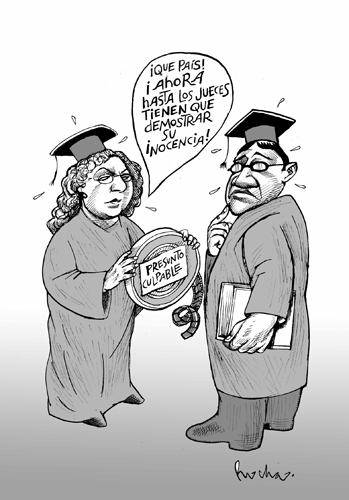
The judge’s restraining order is based on a claim by Victor Daniel Reyes Bravo, who was a witness in the trial (the ONLY witness, as it happens) — a minor at the time who claims his parents never authorized the filming. Whether the order will stand isn’t clear, but what is clear is that there is a vested interest in NOT reforming the justice system, and keeping the Mexican public in the dark about the dismal court procedures here.
There is an argument that implementing the reforms would interfere with prosecution of the U.S. proxy war on Mexicans (er… war on drugs… er… “battle against organized crime”. This seems a nonsensical issue to me. The reforms are modeled on the Italian court system, which is also based in Napoleonic Law and was updated to allow for more open public trials while Italy was simultanously prosecuting a violent war against the Mafia (which, by the way, made the mayhem here look minor by comparison… the Mafiosi going in for things like blowing up entire apartment blocks to kill single government officials).
That it turns out a U.S. agent was killed with guns “let through” the border by his own agency — leading to calls by the United States to give their agents diplomatic status and the special protection granted to diplomats is… well… shall we just say “in need of more work”.
While at one time, the Mexican government did acquiesce in demands that U.S. agents be allowed to carry their guns while in the Republic, that was back when the amount of guns flowing in from the North was a trickle, and there were only about 50 DEA agents (and ICE hadn’t been thought of yet) running around Mexico… or, rather, sitting in offices, around Mexico. As it is, there may not be a causal relationship, but it seems the more U.S. agents in Mexico, the more guns come through, and the higher the likelihood of some U.S. agent getting killed. But, I suppose, if they do have diplomatic protection, it at least means they won’t be running around undercover (undercover with diplomatic police around them?) and might just keep them out of harm’s way.
Anyway, Obama is in full Woodrow Wilson mode — demanding the extradition of the alleged shooter of the U.S. agent to the United States (although it might make more sense to extradite whoever allowed the gun that killed the agent to pass through to Mexico to be extradited here for smuggling, if not being the autor intelectual of the murder), and I wouldn’t be too surprised to see this outrageous demand condemned by all political sectors, left, right and center within Mexico.
I t’s not that I think there was any intention on the part of whomever thought it was a good idea to let weapons through the border, and see whose hands they’d end up in. There’s nothing particularly wrong with tracking contraband to trace the network by which it is smuggled. But we aren’t talking about antiquities or currency, which can — at least in theory — be returned to the rightful owners. The problem is they never considered, and for which there should be severe retribution, was the negligence in assuming that firearms smuggled into Mexico weren’t going to be used against human beings. What is called murder — and was a foreseeable consequence of the “intelligence” [sic] operation. It didn’t matter that the bullets from that particular gun happened to kill a United States secret agent… they killed a human being in Mexico, the same as other guns, which the United States government could, and should, have stopped.
This is another fine mess you’ve gotten us into…
Salvador Escobedo, head of the hugely successful poverty-alleviating program Oportunidades, said that the number of poor in Mexico increased from 42.6 to 47.4 million in Mexico, in the years 2006-2008.
Also, more people moved into the “extreme poverty” category- the figures went from 13.8 to 18.2 million – and Oportunidades are reporting a very disturbing increase in malnourishment and anemia.
These are some brutal and shockingly high figures, as they don’t even reflect the full impact of the economic crisis that began in 2009 and lasted almost through 2010…

Baja Arizona?
There is an apparently serious movement in the small, sane slice of Arizona (basically Pima County, Tuscon and the surrounding cacti) to secede from the Failed State of Arizona,
… free of the un-American, unconstitutional machinations of the Arizona legislature and to restore our region’s credibility as a place welcoming to others, open to commerce, and friendly to its neighbors.
Attorneys Peter Hormel and Paul Eckstrom recently launched “Start Our State” (SOS” —with, naturally, its own Facebook page ) — to help jump-start an idea that in light of the present situation in Arizona actually makes a lot of sense. E.J. Montoni of the Arizona Republic writes:
Co-founder Eckerstrom, who has been active in the state Democratic Party, told a reporter: “We’re tired of the extremism that’s been portrayed to the rest of the country, and we feel we’re different down here.”
It sounds crazy, right?
Then again, is the idea of creating a new state from Arizona’s southern counties any more bizarre than a Legislature trying to pass bills that would allow lawmakers to “nullify” any federal law they didn’t like?
Essentially, seceding from the union.
“We send up a group of moderate representatives from Pima County, and they just get overwhelmed by zealots,” Hormel said.
Pima County is bigger than most of the New England states and has more people than Alaska, Montana or the Dakotas.
In the name of self-preservation, and self-respect though, with the word “Arizona” basically a synonym for “insane assholes” these days, probably another name than Baja Arizona might be considered. How about “Alta Sonora”?
No country for ICE men
Per the comment from “gtoden”, I double-checked a few sources. My edits are in green Tahoma typeface. Not that it significantly changes my thinking about foreign agents and their role in escalating this situation, nor that this site has any claims to be the final word on anything, but I don’t like to use dubious information when I can avoid doing so.
Since U.S. officials are not supposed to travel without an official escort Mexico per previous State Department warnings in the area where Jaime Zapata was murdered last week, I have more than a few questions about the attack on ICE agents Jaime Zapata and Victor Avila last week.
According to the BBC, Zapata was “assigned to the agency’s human smuggling and trafficking unit, and was recently on attachment to the ICE office within the US embassy in Mexico City.” That he was in San Luis Potosí in an unmarked black SUV (the de rigueur motorized conveyance of the higher criminal classes in Mexico), and was allegedly armed, which means he was no diplomat, but was either impersonating a gangster, or was more than likely to be taken for one.
That Zapata was working in a clandestine fashion for U.S. Immigration and Customs Enforcement (ICE) — which doesn’t have any jurisdiction outside the United States — means that even if the Mexican government was aware of his activities, he was just a foreign spy. And spies dealing with criminals tend to get themselves killed, or, like fellow secret agent, Victor Avila, seriously wounded.
At Zapata’s funeral last week ICE Director John Morton said:
Together, the United States and Mexico will bring the long, hard arm of the law down on Jaime and Victor [Avila]’s shooters,” Morton said. “Together we will look after our people. Together we will continue to see that Jaime and Victor’s work is done and that the rule of law triumphs over lawlessness and empty violence.
Suggesting that a unit of U.S. Homeland Security (which is not a Mexican police unit by any means) assumes it has the right to pursue criminals in Mexico, for crimes committed in Mexico… which is what used to be called extra-territoriality, the hallmark of imperial domination. Under this reasoning, I would expect CISEN (the Mexican intelligence service) and PFP (the Federal Police) agents to operate in Arizona and Texas against gun runners, and in New York against money launderers.
And, if one of those CISEN or PFP agents are killed, will the United States arrest …. oh, somebody? Preferably somebody more plausible than a gangster called “Tweety-bird,” which — if the U.S. newspapers bothered translating their reports on Julian “El Piolín” Zapata Espinoza’s arrest — sounds ridiculous, as does the miraculously quick resolution of the crime. As the Brownsville Herald reports:
In regard to the arrest and charges brought before El Piolín, both American and Mexican officials close to the Brownsville Herald question the true role of El Piolín in the murder.
A Mexican law enforcement official stated that Zapata Espinoza is not a top lieutenant but merely the leader of a strike group that acts under orders of the true plaza boss in the state of San Luis Potosí with influence in the states of Tamaulipas, Coahuila, Yucatán and Quintana Roo, Jesus Enrique “El Mamito” Rejón Aguilar one of the ranking members of the Zetas. Rejón Aguilar is named in a U.S. federal indictment with various counts of drug smuggling and has various arrest warrants in Mexico.
I’m trying not to be snarky about this, and the United States government police agencies have every right to kick ass and take names in their own country in retaliation for this — even if it does raise the question of why if the United States already had criminal information based on Mexican sources, they didn’t act on them until they had a sacrificial victim — Agent Zapata I mean, Tweety-Bird undoubtedly just offered up as a scapegoat.
If there is consternation over U.S. secret policemen getting killed in Mexico, a modest suggestion from John Ackerman:
Although drug consumption is clearly damaging, simply transporting illegal substances does not, in itself, create violence, economic crisis or human suffering. And even the harm of drug consumption pales in comparison to the effects of kidnappings, beheadings and human trafficking, especially when the consumption involves marijuana, sales of which make up two thirds of the profits of the Mexican cartels.
Nevertheless, due to pressure from the US government, the Mexican authorities have been forced to concentrate their scarce law enforcement resources on pursuing the least harmful crimes. This strategy has had the obvious consequence of pushing the criminals towards more dangerous and violent activities. The result: a stratospheric increase in violence, with over 35,000 assassinations in the past four years, 15,000 during 2010 alone. The problem in Mexico is, therefore, not a lack of firepower or support for the “war on drugs”, but the very strategy of “war” itself.
The real priority should be on punishing violent crimes, not the transportation of drugs. By turning the typical strategy on its head, Mexico would slowly start to separate the violent, dangerous criminals from those drug traffickers who are in the business principally for the money. Although this might not bring down the prices of illegal drugs on the streets of US cities, it would help end the violence, which today is paramount and may at some point spill over to the US.
This proposal should not be confused with either legalisation or negotiation approaches. Increased liberalisation of marijuana consumption would reduce the urgency of controlling transportation routes, but this strategy is by no means dependent on the legalisation of drug use…
…Such a change in strategy would immediately receive vigorous applause from the Mexican people. A growing number of Mexicans have come to the conclusion that peace and prosperity are more important than stopping the flow of drugs towards eager consumers in the United States. A broad new citizen movement has even emerged, rallying around the cry of: “No more blood!” Movement leaders agree that the drug cartels need to be controlled – but in a way that does not destroy the very fabric of society. It makes no sense to win the war, if it leaves the country in shambles.
Simple… if the United States wants to criminalize narcotics use, or undocumented entry, do so… but leave us out of it… for your sake and ours… yanquí go home!
Barbarous Mexico? An alien concept
On Wednesday, Institutional Revolutionary Party (PRI), National Action Party (PAN), and Democratic Revolution Party (PRD) Senators said that the fact that the Arizona government passed a law that criminalizes immigration is deplorable. They said that not giving illegal immigrants the rights they deserve and denying them access to public education is also regrettable.
The legislators demanded that the Foreign Affairs Secretariat (SRE) intervene in this situation and make sure that the integrity and respect of illegal immigrants are safeguarded.
(Victor Mayén, The [Mexico City] News)
In Mexico, illegal entry is only a regulatory violation, but “illegal immigrants” have been horrendous mistreated (especially those just passing though on their way to the United States), so — under the influence of the Arizona legislation —
The Senate unanimously passed the new Immigration Act that recognizes the legal status of migrants. The upper chamber excluded virtually all of Article 26, which empowered the Ministry of Public Security (SSP) to monitor the entry and exit of persons into the country in any form or means of transport, and conduct verification visits to check compliance with the Immigration Act. The initiative turned over to the House of Representatives recognizes that foreigners have the right to education, emergency medical services, civil registration and the administration of justice regardless of their immigration status. In addition, sets of eight to 16 years in prison for so-called “coyotes”, increasing the penalty by up to 50 percent when the accused is a public servant, and the victims are children or adolescents.
It also sets the minimum conditions for migrants, such as avoiding confinement in prisons, preserve the family unit and separating men from women. It also prohibits the verification visits to places of humanitarian assistance to migrants.
(Milenio, 24-02-2012, translation by M3 Report)
It doesn’t add up
Secretario de Hacienda (Finance Minister) Ernesto Cordero must have missed a few classes in personal finance. Last week, he was quoted as saying
[W]ith an income of 6,000 pesos a month there are Mexican families that have a credit for their own house, that have a credit for a car that have the time to send their children to a private school and are paying the tuition.
Either Cordero is clueless, or it was a joke: one that didn’t go over very well with finance student Cristina Michel García, who sent the following letter to La Jornada de Jalisco (my translation)
In one of my classes last semester, the professor assigned us to draw up an account of our personal monthly expenditures: rent, transport, food, entertainment, clothing… everything. For me, it wasn’t at all difficult, as each month my parents sacrifice 12,000 pesos for my monthly expenses, every one of which I spend over the month.
5,000 pesos go directly for my tuition at TEC (and I might mention that I have a scholarship paying 60 percent of that), 3,500 pesos for rent (including all services): approximately 500 pesos for transport, leaving me 3000 for food, school supplies and copying, an occasional movie and a few gifts for special occasions.
In our next class, we discussed what we spent. I kept quiet when I listened to classmates talk about needing 25 to 35,000 pesos per month to “live”, and one classmate who said he needed 50.000.
Cordero said that “with an income of 6,000 pesos per month, a Mexican family can get the credit to buy a house, a car and pay their children’s tuition at prívate schools,” while I am barely getting by on 12,000 just for myself.
I am not a party-girl, nor do I go to bars. I do not dress in the latest fashions, nor buy designer sunglasses and handbags. I only spend what I need. Some of my friends say I’m cheap, but I just say I’m money-conscious. My justification for that is that I’m studying financial administration, but in reality, there is much more than that to consider.
I considered taking a job, but my parents have told me “study now, you have the rest of your life to work.” But, having realized I need 12,000 pesos a month just to get by, I began researching my potential earnings upon graduation. To my surprise, the well-paying jobs require extensive experience. For recent graduates in my field, the average income is around 7,000 pesos per month.
And so I’m thinking, “O.K., with 7,000 pesos, I could survive for a year, not having to pay tuition,” but basically I would be in the same financial condition I am in now with a 12,000 peso a month income.
My parents have expended an enormous effort into helping with my education, in the hope that I will be self-sufficient… I hope I share.
Some of my University classmates have the good fortune to work for Daddy’s company. Or Mommy has an important friend who can make “accommodations” for a higher-paying position. But “mortals” like myself and my friends — from middle class families without contacts —are more likely to find our employment in sales or telemarketing where we will be left wondering what the point was to studying financial administration, spending sleepless nights studying and depending on parents wiling to sacrifice for our education.
In order to achieve my goals, I am expected to compete for a seven thousand peso a month job and refinance my debt with the University for another three years, while hoping to gain the experience that will get me the salary I need to pay both my college expenses and the refinanced debt.
Having a degree does not guarantee finding a good job, at least not in Mexico. But six thousand pesos to cover housing, a car, and tuition? Hahaha! Very funny, Cordero.
Secretario Cordero might — if he really believes his own nonsense — try living on 6,000 pesos a month. Better yet, maybe the rest of his salary could go to hire people like Ms. García, who seem to know a thing or two about the real world of Mexican finance.
A snark-o-bit …
I’ll write on the Writers’ Conference, San Miguel, car problems, etc. later. In the meantime, this tidbit Raw Story, as published:
This report was originally filed Feb. 15, 2011, but has been republished today due to a general lack of US media coverage
Argentina and the United States are engaged in a diplomatic spat after Buenos Aires authorities seized what they say are undeclared weapons and drugs on a US military aircraft last week.
The Argentine government on Monday said it planned to lodge a formal protest with Washington, while the US State Department said it was “puzzled and disturbed” by the seizure of what it claimed was routine equipment for training the Argentine federal police.
I wonder what’s considered “routine equipment for training” under Plan Merida….
Roads scholar
 No posts until at least next Tuesday (22 February). I will be driving (in a 25-year old half-Volvo/half Ford) to Guadalajara and San Miguel Allende (and points in-between and around) to see some of our authors and booksellers.
Thursdays through Sunday I will be at the Sixth Annual San Miguel Allende International Writers’ Conference where Editorial Mazatlán, Mexico’s only English-language book publisher, will have our books available for sale, and our acquisitions editor (that’s me) available to speak with authors and consider manuscript proposals.
Allegedly good news… or not?
A troubling item by Naxiley Lopez appeared in Sunday’s McAllen Monitor.
REYNOSA, MEXICO — Twenty-three alleged cartel members were killed this past week, while 31 others were arrested, according to a news release from the Mexican military
Officials from the military’s 8th zone, which includes Reynosa, did not specify how or where the alleged criminals were killed. They simply noted the deaths and listed items collected during a seven-day span from Feb. 5 to Feb. 12. The names of the dead were not released.
Soldiers seized more than 11,000 pounds of marijuana, more than 2,24 pounds of cocaine and a small amount of crack cocaine, according to the release. They also recovered 76 “long guns,” 10 handguns, 11 grenades, three grenade launchers and one grenade launcher attachment.
More than $75,000 in both U.S. and Mexican currency was seized, along with 42 vehicles, two of which were armored, officials added.
Soldiers also obtained two tractors, two bullet-proof vests, four cell phones and nine radios.
No other information was provided.
First off, despite the cheers from the commentators on this story in the Monitor, I’m wondering if this is “good news” that there were 54 “cartel members” at large in the Reynosa area. More worrisome is that the military is just killing people, who even if “alleged” cartel members should be standing trial. Assuming, of course, the allegations were anything that would even make it into a courtroom.
What made me notice this item was that there was another post, in Raw Story this weekend (which was positioned as a major item) of a minor demonstration in Mexico City in favor of stricter narcotics controls. The story itself was just a round-up of the mayhem unleashed by the gangster fights, coupled with news of “several hundred” demonstrators in the Capital. Of course, “several hundred” is a small demonstration in Mexico City, and the little bit of coverage it received (in the local sections of the Mexico City papers) showed photos of the demonstration that featured commercially produced placards… suggesting this was a small, organized group, not a mass movement.
What seems to be going on is a push (probably not consciously designed, and certainly not a “conspiracy”) to legitimize state violence, or to suggest that it’s more accepted than it might actually be by the Mexicans. Given the continued attempts by United States officials to paint the “drug war” as an “insurgency”, or as a U.S. national security issue… or, even more ominously, to justify U.S. hegemony over Mesoamerican law enforcement (seemingly making U.S. priorities the priorities of the other nations) it is worth noting these kinds of minor events, while also paying attention to the “big picture.”
There is plenty of background information to suggest the Obama Administration wants to escalate (or expand) the “drug war” throughout Mesoamerica, and is trying to build a case for doing so.
Descontento ante la lucha contra el narco (El País)
Duda cónsul de EU de eficasio del Ejército (Jornanda)
U.S. Report cites deficiencies in Mexican Anti-Drug Fight (Fox News Latino)
Mexican Drug War an Insurgency? (Christian Science Monitor)
Toward a Mesoamerican Security Corridor? (Hemispheric Briefs)
A New Regional Security Plan (Bloggings by Boz)
Plan Central America or Perhaps More? (Hemispheric Briefs)
Fuerza armadas no son responsable de la violencia: Calderón (Milenio)
Of course, there is much more to say on this, and on the reaction to Obama Administration — but it will have to wait.


 mexfiles.net