In other news, the sun rose in the east…
Looks like the ridiculous Homeland Stupidity intrusions into personal lives along the border has finally paid off. I used to have to stop for the silly border patrol checkpoint in Sierra Blanca about four times a week (I was driving railroad workers to El Paso) and never could figure out what it was really supposed to do, until now… lay in wait for Willie Nelson:
Don’t you feel safer knowing that Border Patrol checkpoints are catching septuagenarian music stars with pot? I’d like to meet the genius investigator who figured out there might be marijuana in Willie Nelson’s tour bus. Perhaps he thinks this will teach Shotgun Willie a lesson and henceforth he’ll abstain?
Drug cartels are all but running parts of Mexico, while large quantities of drugs continue to successfully make their way north, with guns flowing south. None of these checkpoints, unmanned drones or other over-hyped tactics seem to make a dent in that problem, but at least they caught Willie, making him wait a few hours…
Hell, it was only six ounces (which probably just meant Willie hadn’t had a chance to brush out his hair in that morning). OK, so he leans on old familiar ways — the guy is pushing 80 after all — and still crazy after all these years.
Nostalgia
A guy on one of the local expat message boards — his wife having recently been carjacked — is apparently moving back to the United States because:
I want my wife and daughters to live in a place that is like what Mazatlan used to be when I first came here in the eighties.
While not making light of the guy’s real sense of fear or anger or bitterness I doubt there’s a place on planet earth that is “what it was like” thirty years ago. While presumably with less of a tourist footprint, and a hell of a lot less foreign residents, thirty years ago expats were relatively isolated from the slings and arrows of outrage and misfortune.
The 1980s is remembered in Mexican history as la decada perdida (“the lost decade”). Mexicans, especially the middle- and working-class Mexicans were wiped out financially, social reforms were at a stand-still and the political system ossified. Life sucked, but that was a great opportunity for foreigners with ready money. Thirty years ago there weren’t many private automobiles, supermarkets, container ships, cruise ships or condos here… which may be a good thing, but those foreigners selling a “paradise” south of the U.S. border were selling to people who wanted both to flee change in their own countries of origin and to maintain a lifestyle suitable to more affluent societies (air conditioning, big houses, massive water use, etc.).
Some statistical studies would say violent crime has dropped since the 1980s, but then again, media coverage of Mexico (always crappy and sensationalistic) was even spottier then, and 24-7 news coverage wasn’t the norm. There was only one television network back then, and violent crime simply wasn’t reported much.
And, while rural Mexico was in trouble in the 1980s, this was the pre-NAFTA era, when subsistence farmers could at least survive, or at least expect leaders to pretend to give a shit about their concerns… a situation long gone with the “new economic order” or whatever it’s called these days.
Thirty years ago, our … ahem… “unregulated agricultural export market” was pretty much ignored by the media (and everyone else for that matter). The so-called “War on Drugs” was still a U.S. domestic issue although George Bush the First began calling for military and CIA involvement in 1982 and cocaine was entering the United States through other venues back then. Even so, the trade was flourishing then, perhaps under “better” rules, but any complaints about the present situation should be directed to the present U.S. and Mexican administrations and not some website for grumpy gringos.
Change happens — where, in 2010, is there anyplace “like it used to be” in 1980? And, is the past really any better, or were those of us who were around just forgetting we were a lot younger and our lives and concerns were a lot different then?
I wanna be a macho man
UNESCO recently named Mexican food as an “intangible cultural heritage” — which just goes to show you that there’s nothing effete being a cultured person.

My vegetable love should grow
Vaster than empires, and more slow…
¡Feliz día de accíon de gracias!

Peace through strength?
This is from an email I received from one of my border-dwelling friends:
Here in Ojinaga it is actually quiet. The Sinaloa boys got control so at least there is some policing action. A prominent woman business woman got kidnapped in May a few months ago. The cartel went in and found her, shot the dumb asses and proceeded to let the word out that this won’t be tolerated. There have been a few dead bodies but always outside of town.
Organized crime is better than disorganized crime.
“That was no heart attack”
Or so said Peter Clemenza to federal officials Willie Cicci to Frank Pentangeli* “The Godfather” about the convenient demise of one gangster. While he isn’t dead, Bishop Onésimo Cepada — under indictment for a mega-million dollar (much mega-million peso) fraud involving allegations of forged wills, stolen art treasures and other activities decidedly at odds with his profession’s rather simple code of conduct (things like “thou shalt not covet thy neighbors’ goods,” and “thou shalt not steal”) — had a rather convenient health emergency that will, for now, keep him out of an enforced stay at Mexico City’s vertical bar Hilton.
… [G]iven a reform to the article 55 of penal code in Mexico City in 2004, which stipulates that those over 70 with health problems may be placed in “house arrest” rather than in the dock, the bishop’s heart attack – if there ever was one – may have saved him from prison. His own sister, Lily Cepeda, angrily denounced her bishop brother, claiming he faked it as a ploy to avoid prison or evoke sympathy.
Dishonor among thieves? In his defense, Onésimo is only accused of robbing from the very rich, while his sister is suspected of being the master-mind behind a bizarre ponzi scheme involving pre-need sales of burial plots to civil servants (not the best paid people, and not those with a a few million in oil paintings that might not be missed). I guess — like the Pope’s statement that condom use by prostitutes to prevent AIDS at least show moral awareness that one’s behavior is sinful, and is something in the way of a mitigating circumstance.
Or, perhaps, it is easier for a camel to enter the gates of heaven, than for a rich man (especially with political ties to Mexico State governor, and presumed PRI Presidential candidate, Enrique Peña Nieto) to pass through the gates of Reclusio Sur.
* OK, so I’m not up on my fictional gangsters (there’s so many non-fictional ones to choose from here) Many thanks to those who made me an offer I couldn’t refuse to correct the post.
Mexfiles’ donors save millions of lives (well, indirectly)
This morning’s New York Times:
In a development that could change the battle against AIDS, researchers have found that taking a daily antiretroviral pill greatly lowers the chances of getting infected with the virus.
In the study, published Tuesday by the New England Journal of Medicine, researchers found that the hundreds of gay men randomly assigned to take the drugs were 44 percent less likely to get infected than the equal number assigned to take a placebo.
But when only the men whose blood tests showed they had taken their pill faithfully every day were considered, the pill was more than 90 percent effective, said Dr. Anthony S. Fauci, head of the division of the National Institutes of Health, which paid for the study along with the Bill and Melinda Gates Foundation.
“That’s huge,” Dr. Fauci said. “That says it all for me.”
The large study, nicknamed iPrEx, included nearly 2,500 men in six countries and was coordinated by the Gladstone Institutes of the University of California, San Francisco.
The results are the best news in the AIDS field in years…
Not Mexfiles, but donors to Mexfiles had an unsung role in this important development. Without having kept the lights and telephone on, this study might not have been completed.
Being always short of cash, Mexfiles Central (aka, the other bedroom) moved out of the second bedroom to the corner of the main room so the room could be rented for the winter to a woman from Seattle whose priority wasn’t so much a cheap place to live two blocks from a tropical beach, but 24-7 internet access.
Medical breakthroughs depend on more than just scientists and the test participants (who all are being deservedly celebrated). To make sense of a study — especially one covering six different countries — somebody has to look at mounds of data. Which means someone has to put the data together. Which is done in Seattle, by under-paid data crunchers.
Seattle is expensive — and wet, and gloomy, in the winter … so…
I guess this is one of those time From each according to their ability... might translate into a value-added product far beyond our expectations.
Marching boldly into the past
Álvaro Corcuera, the Director-General of the Legionaries of Christ, has received Papal assurances that he can stay on as head of the Roman Catholic order, which — following revelations of the rampant sexual abuse and large scale financial frauds perpetrated by the order’s founder, Mexican priest Marcial Maciel Delgollado — has been in what amounts to a religious version of receivership and restructuring.
Corcuera, like Maciel, is a Mexican from vaguely aristocratic lineage (Maciel’s uncle was Rafael Guizar y Valencia, the “Scarlet Pimpernel Bishop” of Xalapa now considered a Saint of the Roman Catholic Church). Conuera’s “Wikipedia” entry makes note that his grandmother is the 13th Marquise of Cilleruelo, and his aunt is the Duchess of Medinaceli (which, in the dwindling word of European aristocracy, actually is a somebody). Of course, this implies that the Legionaries — having been formed out of the more reactionary strains of Hispanic culture — are not undergoing much of a change. That the Church, especially the more conservative members of t he clergy (like Cardinal Sandoval of Guadalajara) are actively seeking to “engage” the State and push back against social changes, confirming Corcuera in his position may signal an attempt to restore the Legionaries influence within the inner circle of the country’s business and political leadership.
One indication that the Legionaries are looking to return to an active role in Mexico is Concuera’s willingness to “study” the possibility of providing financial compensation for Maciel’s victims. While this would probably run into a sizable chunk of change, the order is not hurting for assets it can dispose of, and by compensating at least Mexican victims, could tamp down media assaults and continuing questions about the group’s motives.
Nothing to see here…
From “Blog del Narco”
The Federal Prosecutor’s Office (PGR) has responded to Senate requests for information by stating that “there are no shock-troops or rapid response teams being substituted by individuals as replacements for military troops in federal security operations.
The federal agency reported that, after “a thorough investigation”, it has no record of any armed group called a “death squad.”
When one sees local news reports on some petty criminal showing up dead, the assumption — implicit or otherwise — is that the departed was somehow connected with the “wrong” set of gangsters… or violated some clause in his own gang’s code. But it’s completely plausible that these minor “social inconveniences” were simply disposed of (permanently) by those who have some assurances that the murder won’t be investigated. I suppose it’s possible that organized crime groups , which work like any other large industry, seek to dominate a market and drive out the independent operators … much as Starbucks would seek to close down “Joe’s Cafe”, I suppose Chapo Guzmán y Asociados might seek to remove José’s Mota-2-Go street corner sales operation.
And, consider La Familia Michoacana, which regularly dumped corpses (or at least heads) with a “public service announcement” saying they were merely getting rid of those that were a danger to Michaocan residents — “socially cleansing” the state of narcotics retailers.
Very likely the Federal Prosecutor’s office is right… that the military is not using “death squads.” The rush to privatization of governmental services and agencies that swept this country (nearly into bankruptcy) never quite got to public security, but this says nothing about the unregulated private security business… nor about the gangsters, nor state or local governments… nor private individuals.
Travel advisory
Safer here than there, it seems…

This chart — picked up by Colombia Reports from Maplecroft (a European “Risk Assessment” service, something like Texas-based Strafor, though without George Friedman sending you paranoid emails a couple of times a week) — shows only one country really at “extreme risk” of terrorism in the Americas. It ain’t Mexico, which shows minimal risk… although it borders two countries (the United States and Guatemala) with at least a “medium risk” of terrorist activity.
Apropos of my post just below this, I’d add that when gangsters do something spectacular like blow up someone in a car, or chop off a head, not very bright people (including, it seems, the United States Secretary of State) resort to sloppy logic. “Terrorists” (whatever they are, exactly) sometimes use car bombs or chop off heads. So do governments, and spies, and angry ex-spouses and gangsters. Since it was gangster doing those things in Mexico, ergo, it follows the gangsters are terrorists.
Family Values, or, close to the edge
Worth a read is the BBC’s “Families recall key figures of the Mexico’s 1910 Revolution“, portraits of four contemporary Mexicans — historian Guadalupe Villa (Pancho’s grand-daughter), PAN leader Gustavo Madero (Francisco’s great-nephew), social activist Margarita Zapata (Emiliano’s grand-daughter) and “leadership consultant” Luis Porfirio Diaz (three guesses who his great-grand-dad was). While all feel the burden of carrying on the family tradition, the most surprising to me is Guadalupe Villa’s sense that her illustrious grandfather is somewhat over-rated:
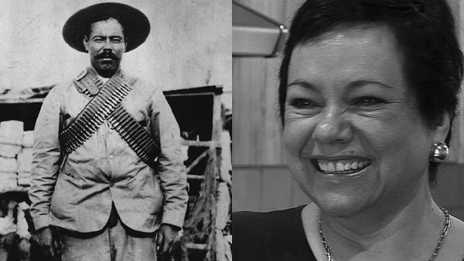
Villas: abuelo y nieta. Photo: BBC
“He was a bandit, a womaniser and a fugitive and he wasn’t that important in military terms,” she says.
She says Villa remains a Mexican popular hero because “he was a man who emerged from the people, a peasant” and also, due to basic geography.
“Since he was based in a state (Chihuahua) that borders the US, then all the journalists, photographers and cameramen that came to cover the revolution talked to him, and he became a superstar known all over the world.”
In some ways, this finds echoes in our own time, the mayhem of the present anti-narco drive being magnified simply because it is close to the United States. I was taken aback by the vehemence of comments on Huffington Post on an Associated Press story Huffington had linked to. It dealt, more or less factually, with an all-too-familiar story here — a couple of gangsters were killed by other gangsters, and some heads were removed, and other corpses hanged from bridges — talking about “failed states” and the necessity of U.S. military intervention and the usual nonsense. I couldn’t figure why this particular bit of gangster mayhem was so shocking, until I realized it happened in Tijuana… just across the border from San Diego.
Mexico is only real to the United States (and most English speaking media) when it is within a few kilometers of the U.S. border. The Revolution was more than Villa, and Mexico is more than a fight between (and against) various narcos along the border. But, what happens on the border, to the United States (and — by extension — to the English-speaking world) is what happens everywhere in Mexico.
It’s not that Villa, or the narco-war, wasn’t or isn’t important, but they are more symbols of a larger truth than the center of the story themselves.
Pornographers and peyoteros
I’m cleaning up the usual over-accumulation of bookmarks.
Snowbirds gone wild!
Dawn Paley (Quotha) on irresponsible behavior the Canada Post probably won’t cover:
Canada’s “Porn King” has found an unlikely second career building retirement homes in Honduras. While Canadian snowbirds snap up paradise at $85 per square foot, the locals say the developments are illegal—and they intend to get their land back.
…
North American baby boomers have proven to have a boundless appetite for vacation or retirement homes in sunny, cheap places that aren’t too wracked by crime or war. It’s been a global windfall for many other countries, and now the people who run Honduras want a cut. Canadian entrepreneur Randy Jorgensen, developer of the Campa Vista complex, is happy to oblige. Jorgensen sells this tropical dream over the internet and in hotel conference-room seminars held in grey-skied Canadian locales: Regina; Etobicoke, Ontario; Duncan, B.C. His basic pitch: Honduras is the latest, best bargain available to Canadians wanting to own their own piece of a developing country.
But—as you might have guessed—this sunny picture doesn’t tell the whole story. Just off the beach in Trujillo, six men sit around a peeling wooden picnic table. They’ve agreed to meet me here to discuss their concerns about the Canadians they say are squatting on their ancestral lands.
…
José Velasquez, the current president of the two Garífuna communities in Trujillo, hands me a photocopy titled “Pronunciamiento No. 3.” It outlines the Garífuna peoples’ desire to reclaim their ancestral territories, and demands that the Honduran government nullify all land sales to Jorgensen.
…
Canadians who choose to ignore the long-standing conflicts over rural land do so at the expense of all who have lived there before, and put themselves at risk as well. Consider the advice of the U.S. State Department: “U.S. citizens should exercise extreme caution before entering into any form of commitment to invest in real estate, particularly in coastal areas and the Bay Islands.” Instead of buying into a smooth sales pitch, Canadians would do well to ask themselves why they expect to land in one of the hemisphere’s poorest countries, which is also one of the most dangerous countries in the world, and be treated like gods.
Hard time for drug dealers
Texas Department of Public Safety spokeswoman Tela Mange said peyote distributors sold more than 1.5 million buttons worth approximately $483,000 last year, up from nearly 1.48 million buttons with a value of $471,000 in 2008. But that’s down sharply from the mid-1990s, when distributors sold more than 2.3 million buttons, according to Morales and another licensed peyote dealer, Salvador Johnson.
Mange said the number of licensed distributors in Texas has declined as the job has gotten harder. Experts have noticed the same changes.
“The cactus grows slowly, and the peyoteros are forced to go back too early and harvest re-growth buttons,” said Martin Terry, a biology professor at Sul Ross State University in Alpine, Texas. He co-founded the Cactus Conservation Institute to safeguard several species, including peyote.
Harvesters once routinely uncovered 100- to 150-year-old plants but now usually settle for cacti that are less than five years old, said Johnson, who deals peyote in Mirando City, about 90 miles north of Rio Grande City, otherwise known for its thriving mesquite tree population.
Teodosio Herrera is spiritual leader of the 30-member Rio Grande Native American Church and calls peyote “the medicine,” a monicker used by everyone who deals legally in the cactus. He said the problem of cutting away buttons too early is exacerbated by poachers who harvest peyote incorrectly, harming the roots so the plants cannot regenerate.
“If we don’t do something to ensure survivability, it may not be around for my great-grandchildren,” said Herrera, 62.


 mexfiles.net