40 years ago
If it wasn’t for noticing an unusual number of hits on this old post, I would have forgotten what happened 23 October 1970.
A religious fanatic crashed an airplane into a crowded building for the first time in U.S. history. What makes this relevant to the Mex Files was that Francis B. Alexander, wasn’t so much a terrorist as a “tea-bagger” before his time… his inchoate rage against social change in south Texas being taken out on la Virgen de San Juan del Valle.
Dame Rebecca and the Seven Dwarfs: Exploiting history
The theory of the European invaders of the New World (insofar as they had a theory) was that they were conferring benefits on the native populations by inviting them to participate in international trade, and there they might have claimed to be genuine economic benefactors. But unfortunately they also felt compelled to confiscate both the accumulated wealth of the native populations and their natural resources, so far as these were mineral. This is not altogether the plain peculation that it appears, for they had an ingenuous belief that, as the native populations had no monetary system, these were wasted on them, and they were doing the only sensible thing if they took the minerals away and put them to useful purposes. It has to be remarked that these predators were actually conferring a huge benefit on another part of the world, on the Old World, by relieving its currency famine. This is not a moral universe.
Rebecca West (Survivors in Mexico, 2003)

Photo of Rebecca West, Jezebel.com
Dame Rebecca (1893-1982) only “discovered” Mexico in her mid-70s, only as a by-product of her role as a chronicler and participant in European history (she had an assignment with the New Yorker Magazine to profile Esteban (Sacha)Volkov, Leon Trotsky’s grandson). For various reasons (he husband’s declining health and death, her own increasing debility and — perhaps overwhelmed by the task of making sense of the “many Mexicos” she encountered) the book was never finished.
What we have, stitched together from several incomplete drafts, is rooted in West’s immersion in the Old World, as a writer, journalist, a scholar of European history (especially of the European middle ages), and polemicist.
Surviving Mexico often repeats thematic discussions in slightly different contexts. In some ways, it’s like reading a blog… but a blog by a genius who returns to the same themes over and ov er, whatever the context. Mining — exploitation in both the literal and figurative sense — is one theme. Elsewhere in the book from the quote above, she mentions in passing that “Old World” miners in the late Middle Ages (the same time as the Conquest) were a highly respected independent social class. West didn’t mention it, but there’s a hint of the medieval attitude toward miners as magical, mystical beings who could draw wealth from isolated places under the ground lingering in our modernized, sanitized European folk tales: think of those Central European miners Bashful, Doc, Dopey, Grumpy, Happy, Sneezy and Sleepy.
Perhaps she would have noticed, had she finished the work, that the discovery of mineral resources in the “New World” — “relieving the currency famine” of the Old — knocked the European miners off their pedestals as masters of a skilled art, reducing them to a rural proletariat. Even with the higher costs of transportation, there was no way the free miners of the Holy Roman Empire could compete against the peons and slave labor of the Americas. “This is not a moral universe,” as she rightly said.
A not moral universe still very much with us, although the “Old and New Worlds” have undergone a tectonic cultural shift to “North and South”. It’¿s great that 33 Chilean miners are suddenly celebrated as heroes, but the four Ecuadorian miners given up for dead with nary a word in the press, are completely overlooked. As it is, we seldom think of miners, unless — as News of the Restless notes, we want to preserve some fantasy of a moral universe.
If Franklin Lobos had died in the San Jose mine, would we care? Other than as a former pro-soccer player, would it even have been newsworthy? Lobos seems to hold some of the mysticism of the old Holy Roman Empire miners, in seeing the mine as a living thing, but — with West — accepting the immorality of the universe, or at least the masters of it:
… “The mine didn’t want to take us, the the mine wanted us alive, because we weren’t the bad guys, we were victims of the businessmen who made millions and didn’t think of the suffering of the poor people,” says Lobos, who had been at work in the San José mine for four months at the time of the accident.
… Lobos might as well point the finger at capitalism itself; it made the disaster inevitable. Not so much the cave-in, which could have happened anywhere to anyone, as the inability of the miners to free themselves; recall that there were no escape races in place for the San José miners to use. The mine owners were so fixated on profit that they skimped on safety.
Sabina (who deserves your votes as Canada’s Best Feminist Blog) takes to task those who — like the Conquistadors — are of the ingenious belief that THEY are doing a favor by taking away the mineral resources. After taking the Wall Street Journal’s Daniel Henninger to task for his ridiculous assertion that the rescue somehow proves the modern version of the Conquistador’s ingenious belief system, she quotes, among other, William K. Black’s response to Henninger (from Huffington Post):
… the miners wouldn’t have had to be rescued but for the perverse incentives of that unregulated capitalism inherently produces …
Once the mine shaft collapsed in Chile, the private mining company declared that it not only could not pay to rescue the miners — it could not even pay their wages. The private company threatened to file for bankruptcy. The rescue was paid for by the State-owned mine (i.e., the Chilean government had to bail out the private mine owner to the tune of an estimated rescue cost of $10 to $20 million in order to rescue the miners). A $25 ladder apparently would have prevented the tragedy, but the private owners’ profit motive led them to avoid that expense. The Chilean mine had gold and copper ore. Both of those minerals are selling for record prices. This makes the private mining company’s failure to provide another exit and a ladder all the more outrageous. Where did the profits go?…
The profits are relieving the “currency famine” of today’s empires and emperors… the sense still being that today’s “native populations” can’t or won’t have any use for those profits (something even so-called “progressives” like Matt Yglesias seem to believe about natural resources — especially mineral ones — from this part of the globe).
Here in Mexico, as elsewhere, our miners have been losing ground in their struggle since the Revolution to achieve at least a modicum of the status enjoyed by their medieval European forebears, as labor unions and laborers face competition not only from the new peons of the world in places like China but from a state beholden to “these predators” who put the minerals to “good use”. Our mines are still sending out the profits though. But, perhaps the frightfully intelligent Rebecca West was right that resource exploitation and being dragged into the global economy was to the ultimate benefit of the Mexicans. Not that minerals are the only resource.
 West’s drafts only touch on Mexican agriculture — coffee and chocolate (more as a metaphor than as items of commerce) and maize — in passing. Writing in the late 1960s and 70s, it may not have occurred to her that a new commodity from Mexico might come to be seen as “conferring a huge benefit on another part of the world, on the Old World, by relieving its currency famine.” Or at least, lusted after, much as Cortés and company “lusted for gold like pigs” (to quote one Aztec observer). Inca Kola News unearths a fascinating example of competing commodity exports:
(Reuters) – Mining firms have shuttered a handful of exploration projects in remote areas of Mexico as the industry grapples with threats from drug cartels and rising security costs, Mexico’s mining chamber said on Thursday.
Cartels are threatening mining operations not just in the violent corridor along the U.S.-Mexico border but in isolated, mountainous regions in other parts of Mexico, where traffickers grow marijuana and heroin poppies, the chamber said…
What’s fascinating about this conundrum — resource exploiter v resource exploiter — is less in the problem of defining which of the two interests (if either) are a “moral” industry , but in how much the narcotics growers fit very nicely into the whole historical framework. Or subvert it.
If one believes that narcotics “enslave” the user then we need to ask if we are seeing a repeat of history, in which labor from the exploited South (the New World) is degrading the North (the Old World), or is this “Montezuma’s Revenge” on the labor front — the “native population” degrading the Conquistadors?
First off, just in passing, West mentions that the medieval belief was that mining minerals created more minerals, much as farming creates more crops. And, at the time she was writing, the idea of a resource scarcity (at least for the “haves” — her “Old World”, my “North”) wasn’t a consideration. Now, with genuine concern, even among the “haves” (especially among the haves) what does it mean that a renewable resource — which is basically a luxury item — is driving away a resource industry that is not renewable, but is no longer considered a luxury? Is it in Mexico’s interest to control what resources are made available to the “predators”, or are we now the “predators” although not conferring benefits on the “old world,” reaping benefits FROM the “old world”.
West’s discussion of the New World minerals talks about the massive economic changes wrought in Europe as a result of more currency in circulation — new wealth destroyed the old system and the old wealthy classes, something she saw as ultimately beneficial. The narco-wealth here is bringing in money we never had before, perhaps creating new wealth, too. Will “having been “invited into world trade” prove ultimately beneficial to Mexico and the “south”?
Or… as I suspect, the control of narcotics is in the hands of the same people (well, not the same individuals — one hopes — but the same groups of people from the same parts of the planet) who control the mineral wealth.
The Aztec calendar is a cyclical one, with history repeating, but with infinite variations on a theme. It makes, over the course of time, for a predictable, but not a moral universe.

High times
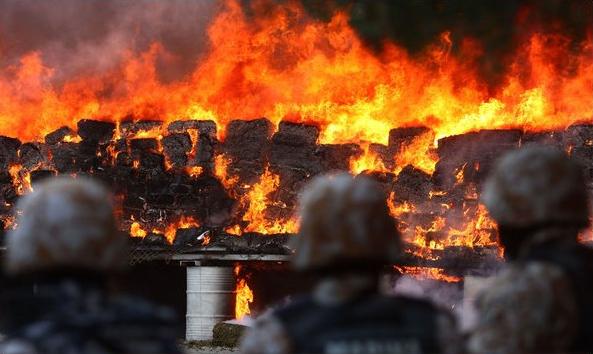
Reuters photo by Jorge Duenes
Randal C. Archibald of the New York Times might be excused if he had motor coordination trouble sending in his latest report:
TIJUANA, Mexico — Tons of marijuana — 134 tons, in fact — sat on a makeshift platform Wednesday on a military base here. And then, after a military band, after speeches by Army and police commanders, after a laborer sprayed fuel on the verdant, pungent bales, after college students and dignitaries and a throng of journalists took aim with their cameras, it was lit on fire.
And so up in smoke went the equivalent of a few hundred million joints in what Mexican authorities called the largest seizure of the drug in the country’s history…
How may joints is that exactly? Based on calculations by people with too much time on their hands, I came up with the Woodstock Unit (WU) for mass consumption. This is based on a rough calculation of marijuana consumption at the 1969 Woodstock Festival of one joint per person per day. People in those far off days smoked skinny joints, and generally passed their joints around, so my rough calculation is 1.5 grams per person (500,000) over three days. Assuming the 134 tons was metric tons, that’s 0.75 tons, or — using the U.S. units (although Mexico uses metric weights and measures, the press reports aren’t clear on which measurement is being used here) 0.826 U.S. tons.
So, 134 tons works out to between 110 and 111 Woodstock Units. The band didn’t play “Stairway to Heaven” but there were a couple of classics they should have included in their repertoire:
We are the world
Jason Dormady (who hails from a western mining family) takes these things personally:
Globalized corporations have the power to reach across oceans and bring together markets and maximize profits, but they also tie together labor in a way the labor (outside of the internationals) has no idea about. Miners in Butte – especially in the increasingly conservative unions – had little understanding of how they fueled an empire that reached into the heart of South America and squeezed out the life blood of labor there with brutal practices. Workers in Chile had little understanding that their nationalization would create a spiral in prices and stocks that would pull the legs out from underneath a poor, extractive area on the other side of the globe. And of course, you can be sure that the owners in the middle weren’t flipping burgers at Mickey D’s when the smoke cleared.
They all look alike to her

Questioned about her claim in a television ad that the MEXICAN farmers in this photograph (by British photographer Chris Floyd for GQ Magazine) were “illegal aliens”, candidate for United States Senator from Nevada, Sharon Angle, said “I’m not sure that those are Latinos in that commercial,” adding “what we know is that our northern border is where the terrorists came through. That’s the most porous border that we have. We cannot allow terrorists, we cannot allow anyone to come across our border if we don’t know why they’re coming. So, we have to secure all of our borders and that’s what that was about, is border security.”
She later elaborated on those confusing remarks by telling her audience (of Latino students) that some of them “looked Asian” to her.
So, being worried about Canadian terrorists, Ms. Angle illustrates the issue with a picture of Mexican farmers, labeled as “illegal aliens”. Maybe Ms. Angle is referring to Nevada’s northern border with Oregon and Idaho… or, Asians from Idaho… or — more likely — Ms. Angle is a complete idiot.
And — given that she is the front-runner in her race for the Senate — so are are a sizable chunk of the population of the State of Nevada.
Marisol Valles — tal vez puede
The Municipio of Guadalupe Distrito Bravo Praxedis G. Guerrero* in northern Chihuahua (bordering Texas) has more than it’s share of insecurity. The sprawling, sparsely populated municipality (more or less equivalent to a county in the United States) has been the scene of heavy fighting between the Sinaloa “cartel” and the “La Linea” gang for control of smuggling routes. Three Guadalupe Distrito Bravo municipal officials have been murdered since the gang-war broke out in 2008.
The only candidate to step forward to command the public security force was Marisol Valles García, a twenty-year old criminology student. The new sheriff in town (and the youngest police chief in Mexico) oversees a tiny department that at most can provide two shifts of patrol officers per community. Chief Valles points out that her brief doesn’t call for her to fight the “drug war”, but that her force of local patrol officers, who at most can ameliorate the ravages of criminality associated with the smuggling rings, are often the only law and order available to rural residents.
Her goals are modest — crime prevention programs for schools and neighborhoods, “neighborhood watch” type patrols and possibly more bicycle police. And, I wouldn’t wonder, high grades on her criminology tests.
* Thanks to Gio Acosta for correcting this. I was working from a news brief, and — though the geographic name didn’t look right, I ran with what seems to be a police district code name for the area. Still, it’s my fault for not checking the municipio name. (26-October-2010)
Yes, they did say that…
Hard to believe that even a British commentator could get away with mentioning “white power” in a sportscast, but this was 1968 and things have changed since then. What really struck me about this news-reel was that it was in black and white. The Mexico City Summer Games — in addition to the “victory ceremony, unfortunately overshadowed by politics” and what was going on outside the stadium — marked the beginning of live transmissions of moving images, and in color, making news-reels obsolete.
I took this video from The Guardian, but British Pathé has an online archive of their newsreels from 1896 to 1976 (color finally coming in the 70s, too late to save the news-reel as a media).
A “sue-nami” hits la blogahemisferá?
Send me your tired, your poor, your bloggers receiving summons …
At last count:
- Okkie, at “Bananama Republic” (for referring to scumbag, conman and arms trafficker Donald Winners as a “scam pimp … who consistently lies and makes up childish shit, but it shows clearly that smoking crack of questionable quality is not good for you.”),
- Otto at Inca Kola News (who — having noticed an important article on mining by “Mercenary Geologist” Mickey Fulp was pulled off the Rare Metals Blog — probably because Fulp — being an honest guy — noted problems with some of that less than reliable site’s recommended investments … which just happen to be the same folks who pay for it … posted the article on his own site, earning him a personal attack by one Tracy “Goldilocks” Weslosky. aka “another loudmouthed blowhard bully enslaved to the corporate site sponsors who pay for [her] blog”), and
- Maggie Drake at Maggie’s Madness (for referring to Borderlands Beat as “morons who just steal from other sites, nothing original,” when referring to the unethical behavior, reactionary politics and general scuzziness of that site’s administration)
… are all being threatened with law suits over the character of their content. Not that they take the threats toooo seriously (my considered advice, having dealt with the idiots who think that telling you they’ll sue is a sensible legal strategy is to tell them to fuck off and die).
OK, Okke has to put up with the Kafkaesque vagaries of Panamanian “law”, with judges and prosecutors who make Mexican legal authorities as wise as Solomon by comparison, but the likelihood of his being shut down is slim to none. Still, it’s a hassle and could run into some expenses to make the idiots go away, and he depends on that site for his income, so give what you can.
What “authorities” some corporate shill for foreign mining companies can appeal to when she thinks a Peruvian business writer is not nicey-nice to her, or why Maggie thinks a bunch of yahoos north of the border are even going to be given the time of day by the Ministerio publico, or why the ministerio would care one way or another what one gringo thinks of another gringo’s website content is beyond me… but, then, she’s got some “fans” who are, shall we say, a few cards short of a deck.
… still.. weird things have been known to happen in the pursuit of justice this way, and it’s best to have a plan “B”.
Mexico has always welcomed refugees, especially those threatened by bullies (think of the Jews fleeing Hitler) and crazy people (Trotsky, avoiding Stalin). Mex Files trying to live up to the best traditions of Mexican hospitality (mí blog es su blog) and , what the heck… it’s basically bullet-proof when it comes to lawsuits (besides the jurisdictional tangle of serving a U.S. citizen living in Mexico for something written on a website hosted in Canada by a third person… especially one in Peru or Panama), I have the advantage of almost no assets (hint).
So, for any of our fellow Latino blogasferá comrades in need of asylum… not listed — YET — the Mex Files “Refugee Center” page (not listed, but it’s there, and can be added any time) awaiting the hassled masses yearning to spew snark.
¿Por qué no te callas?
Best decision ever made by a U.S. court:
Friedrich Katz (1927 -2010) D.E.P.
Friedrich Katz was one of the innumerable humans who, owing his life to Mexico’s unprecedented, heroic (and too little known) effort to provide a haven for those persecuted by the Nazis, more than repaid his debt to the nation that saved him from the concentration camps.

Photo: University of Chicago
Born in Vienna in 1927, the Katz family — then living in France — as Jews faced certain extermination in 1940, when they attempted to find refuge in the United States. Friedrich’s father, however, was a Communist (and a veteran of the Spanish Republic’s International Brigade) which meant the family could not be granted permanent residency, and risked deportation to Austria. The Katz’ were granted asylum by Lázaro Cárdenas both as victims of the Nazis and as Spanish Republicans.
Friedrich attended the prestigious (and still extant) Liceo Franco-Mexicano and began his studies at the Instituto Nacional de Antropología e Historia during the “War Against Nazi-Fascism”. His own role, as a minor witness to Mexico’s role in that struggle, was the beginning of a life-long career as one of Mexico’s most distinguished historians.
Katz is credited with almost single-handedly changing the world’s understanding of the Revolution, writing an authoritative biography of Pancho Villa as well as extensive studies of Emiliano Zapata, not as a “bandits” or even a rogue military geniuses, but as a 20th century ideological warriors and social revolutionaries, comparable to Mao, Lenin or Fidel Castro… but lacking the luxury of a pre-existing political framework on which to build their movements.
In addition to his “The Life and Times of Pancho Villa” (and several lesser books on the Centaur of the North), he wrote extensively about foreign diplomatic and military maneuvers during the Revolution (Secret War in Mexico: Europe, the United States and the Mexican Revolution), the Porfiriate, the Aztecs and other Mexican subjects during his academic career at Humbolt University in what was at the time East Berlin, and later at the University of Chicago and Colombia University. He also taught at universities in Mexico and Texas.
Never having become a Mexican citizen, the most his country could do for him was award him the Orden del Aguila Azteca — the highest honor Mexico can bestow on a foreigner — in 1988. He died Saturday in Philadelphia, Pennsylvania, at the age of 83.
Now is the time for all good Mexicans … to dance
While cutting the ribbon at a new vaccine production facility in Ocoyoacac, Estado de Mexico, Felipe Calderón took time to announce another public health measure. For the good of the nation — and to bring down the alarming obesity rates in this country — we should all spend a half hour dancing to cumbia.
To quote “Tlahuac,” a commentator on the Milenio story on this important socio-politico-nationalistic pronunicamento, “You know, Mexicans — between shoot-outs, kidnappings, miners being buried, children burned to death in day care centers, immigrants massacred, indigenous people dying of gastritis, airlines going broke, companies forceably liquidated, narco-blocades, the CFE, corruption and the other messes, we all need to dance to cumbia.”
Not Aztec dancing, not the Austrian-influenced (via Cuba) danzon, not the Germanic and U.S. style Tejano waltz … but the Colombian/Panamanian Euro-Afro-Indigeno-rooted CUMBIA. I suppose there could be some hidden political message in that: the Calderón adminstration has shown a tendency to downplay our indigenous past; has been reluctant to restore Mexico’s traditionally excellent relations with Cuba; and — despite the administration’s continued reliance on appeasing Washington — has been nudged by the left towards a more Bolivarian, pan-Latin outlook.
So… Mexicans unite. We have nothing to lose but our fat asses. Forward… comrades! From Toluca, Adriana Vargas and Léon Carlos (Club universitaro de baile de salon) are our new drill instructors:


 mexfiles.net