Yo ho ho… oh no?
Wonkette, a Washington-based website that specializes in political stupidity (boy, talk about having too much low-hanging fruit to select from!) in the snarkiest terms possible, on the latest “border incident” to make the news:
It was bad enough when the Messicans came across the border to steal our economy and manufacturing (migrant farming) jobs. But now they have turned into Horrifying PIRATES who ride around on JET SKIS killing Americans for no reason at all. This is according to Fox News, who had some dead guy’s wife on Fox and Friends this morning. Mexican authorities say this event never happened, but that’s probably because every single Mexican is a pirate currently on the water searching for Americans to kill.
Wonkette, and it’s even snarkier commentators, note that the “grieving widow” has been all over Fox News programs, with this story of an alleged pirate attack (silly me, I thought pirates operated on the high seas, not resevoirs) echoing Mexican officials who are more than a little dubious about the story of a guy being chased by “pirates” and then for no particular reason while wearing a life vest and not even sinking.
Wonkette and the commentators note that recent “widows” (if she is a widow) don’t immediate go on national television programs (where they mention the host is the presumed victim’s favorite TV personality!) and that there has been a pattern in the United States of women who murder their husbands, then claim the minority de jour done the deed, all the while pumping the right-wing media for sympathy.
Fox News has a history of presenting dubious border incident stories, and one is right to be sceptical. I can’t post the Fox clip (or even view it here), since FOX blocks viewers outside the United States and no one has …er… pirated … the clip yet.
Arrrgh!
Update: While the presumed widow goes national, I suggest you go local. The Brownsville Herald and McAllen Monitor (be sure and check out the comments) report the facts… the facts including the doubts being raised by both Texas and Mexican investigators.
Watchful waiting
GUADALAJARA–President Felipe Calderón on Monday announced that Mexico will launch three new satellites, not just for security reasons, but to bolster the country’s telecommunications industry and L-band international frequency.
As he inaugurated the Plenipotentiary Conference 2010, Calderón defended the granting of concessions of 1.7 gigahertz and 1.9 gigahertz bands, known as Bid 21, and said that the telecommunications market had been enhanced “without privileges” to certain groups”.
María del Carmen Martínez, The [Mexico City] News (10-05-2010)
In April I wrote about the Mexican space agency’s re-creation and the country’s need for new satellites. The 1968 Olympics, which led to the political upheavals that changed what is communicated in Mexico also was the beginning of a radical change in HOW Mexico communicated. The Summer Games demonstrated the practicality of satellite television communications (a Mexican invention, this allowed for the first “live” transmissions of moving pictures) and was essential to the NASA moon landing a year later.
Within Mexico — where the challenging terrain has always made communications difficult — the importance of sending moving images in real time meant it was possible to create truly egalitarian education even in remote areas. And, with the democratic changes after 1988, to create a modern electoral system with “real-time” voter ID checking. Of course, beaming television programs — not just the nes, weather and hurricane warnings — but telenovelas and advertising has had an immense impact on Mexico since the first satellites were launched in the early 1980s.
Unwisely, satellites were seen as one of those government functions ripe for privatization, the predictable results being to minimize the educational and citizenship functions, and maximize the profit-making potentials. And, promptly started to go broke, requiring government bail-out after bail-out. In April, Agencia Espacial Mexicana (AEXA) was created to take over “SatMex”, the private company that had taken over the satellite system from the Secretariat of Communications.
While there are some fierce political issues surrounding the consessions granted for new transmission bands (suprisingly, the big television and telephone companies get the best channels, leaving the proposed indigenous and community programs, and educational channels, in the wilderness), there is no question that Mexico needed new satellites.
None of this is really new, but the lead-off in article, quoting Calderón as taking about “national security” is, however, startling. I’m hard pressed to think of any national security needs for satellites: Mexico doesn’t have any foreign enemies, so what “national security” concerns is Calderón talking about? I wish I had saved the article from Reforma I saw several years ago, but the gist of it was that Mexico has only three potential foreign invaders… two, Cuba and Guatemala, would be more likely a refugee crisis, rooted in political collapse or civil war in either of those two neighbors, or… at the outside … military invasion from the United States.
Internally, a better communications system would allow police to better coordinate their actions, and it would allow for more efficient court and criminal record keeping, but that would be presented as perhaps “justice” issues and not “national security.”
Not that there aren’t national security issues where satellite overview would be immensely useful… finding where forests are being illegally logged, where water is stolen, where oil lines are breached, and the like are national security concerns (so, to my mind, are providing education and access to public health for the citizens). But I found it very odd that this was the first thoughts about increased satellite coverage to come out of Calderón’s mouth.
We’ll have to wait to learn more, but I get the sense that “national security” means U.S. national security — tracking Central American migrants crossing the southern border, possibly (as Malcolm Beith once proposed) sending in drone attacks on suspected narco dealers (and likely incinerating a busload of tourists here in Sinaloa) and gathering data for the United States on “unfriendly” (i.e., not cooperating with the “Free for US Trade, A Heavy Price For you” economy — Venezuela, Nicaragua, Cuba, etc.). I don’t see that as some lefty paranoid theory. There is a long history of CIA and other U.S. “covert” operation in Mexico designed to infiltrate less friendly neighbors, and to tamp down internal dissent that might upset the prevailing “neo-liberal” trend.
Unless, as a quid pro quo Mexico can launch missile attacks on border gun dealers and the U.S. banks that launder the loot, I’m vwery much afraid that “national security” is a nice way of saying spying on the citizens and on third parties that don’t have anything to do with Mexico’s security.
I just hope no one has the bad taste to name the new satellites for Morelos or Juarez.
Yup, my title is from the U.S. policy during the early stages of the Revolution, when the U.S. Army was on stand-by along the border, ready for a more “down to earth” form of political interference.
HIC! transit gloria…
It might not have superceded 100,000, the number the organizers behind Thursday’s march in Guadalajara, Jalisco, hoped to surpass, but the march to protest Governor Emilio González Márquez’ education policies, or lack thereof, was nonetheless a stunning success. González Márquez, a notorious alcoholic and public drunkard who tightly allied with the most reactionary elements of the Mexican Catholic Church and has been involved in scandals to numerous to recount here, has faced barrages of criticism for starving the UdeG, or Universidad de Guadalajara, of hundreds of millions of pesos in federal that González Márquez refuses to release.
Apparently, as González Márquez became aware of the magnitude of the march against him, he showed up drunk unexpectedly at the home of former rector of UdeG Raúl Padilla López to threaten and beg him to cancel the march, without success, and promised to finally release the money the university is entitled to from the federal government. Excerpt from the dialogue:
González Márquez: “Raúl, are you drunk yet”?Padilla López: “Me, no. You are!”González Márquez: “No man, this is the way I work”
Having just written that I prefer to write on historical trends, I guess this illustrates the historical trend among the reactionary Catholics of Jalisco in making public nuisances of themselves, as well as drawing attention to the cultural importance Mexicans give to education … important enough to make the masses take to the streets, or drive some to drink.
A rising tide… Nafta, narcos and negative reviews
Mexico’s stocks, bonds and currency are beating the U.S. and Brazil for the first time since 2002, data compiled by Bloomberg show. Dollar debt issued by Mexico is returning 16 percent in 2010, more than the 14 percent for Brazil bonds and 8.8 percent for U.S. Treasuries, according to JPMorgan Chase & Co. and Bank of America Corp.
The IPC stock index is up 5.3 percent, compared with a 2.8 percent advance for the Standard & Poor’s 500 and 2.4 percent gain for the Bovespa. The peso rallied 4.5 percent against the dollar this year, surpassing the Brazilian real’s 3.2 percent increase.
“The reality is that you will continue to see companies making long-term investments,” said Guillermo Osses, who helps oversee $50 billion in emerging-market assets at Newport Beach, California-based Pacific Investment Management Co., the world’s biggest bond fund manager. “We still have significant exposure in Mexico.”
(Tal Barak Harif and Jonathan J. Levin, Bloomberg, 4-Oct-2010)
I happened to look at the Amazon reviews of my book, Gods, Gachupines and Gringos. There is a highly negative review, which I don’t mind, since it’s obvious the reviewer was looking for some other kind of book. The reviewer carped my book had “[l]ittle or nothing about the maquiladoras, the drug cartels, and the border issues”.
I only touched on the “drug war” in the last few pages (and maybe gave it half a sentence), since it doesn’t seem all that historically important, and I was writing a history. And — while I think the “drug war” (or, as I’ve called it “the U.S. proxy war on drugs”) is going to continue to rack up a body count, ultimately, it’s only meaning is going to be as another U.S. intervention in Mexican affairs. Something I’ve decided to stop writing about regularly, since I want to leave the daily news to others, and look at historical and cultural trends.
So why am I talking about it now? Bloomberg’s report was headlined “Mexico Boom Biggest in Americas as Drug Criminals Lose to Nafta”, as if everything in Mexico is a reflection of U.S. concerns. First off, criminality is not an either/or proposition — “NAFTA v Drug dealers”: the U.S. and Italian (to name but two) economies have flourished at various times despite major epidemics of criminality — or perhaps concurrently with growth in the crime sector: crime, at least as a business, is no different than any other business, and — as Ronald Reagan (not someone I usually quote, though maybe it was John Kennedy, another right-winger by Latin American standards) said, “a rising tide lifts all boats”… including those carrying what seems to be a necessary Sinaloan agricultural commodities north of the border.
Secondly, I call the present military/police operations as a “proxy war” for a simple reason — it is. The funding comes from the United States, the market is in the United States, and it is investors in the United States who are profiting both from actions against, and distribution by, the narcotics export gangs. And, don’t forget, the reason so many Mexican work in that trade is that employment in traditional economic activities — especially in agriculture — were decimated by NAFTA. The drug criminals wouldn’t exist without NAFTA: if it is an either/or, it’s a wash.
My negative reviewer thought my book was “flip, glib and not up to date.” OK, starting with the Ice Age and the crossing of the Bering Sea, it is hard to give more than a passing glance at any one time period, and perhaps I am a bit flippant about some events. So?
In writing the history covering several millenia, one doesn’t get into more than footnotes when it comes to events which may have seemed significant at the time, but are more symptoms than conditions. If the drug war has any meaning, with or without comparison to stock market reports, it may simply be that Mexico is enduring, and will continue to endure, the “drug war” being a temporary event and at most a footnote to a discussion of NAFTA.
¡2 de octubre no de olvida!
As elsewhere throughout Mexico, students at the University of Sinaloa in Mazatlán took to the streets to remember — or rather NOT FORGET — what happened to an earlier generation of students on the second of October 1968 at the Plaza de las Tres Culturas in Tlatelolco.
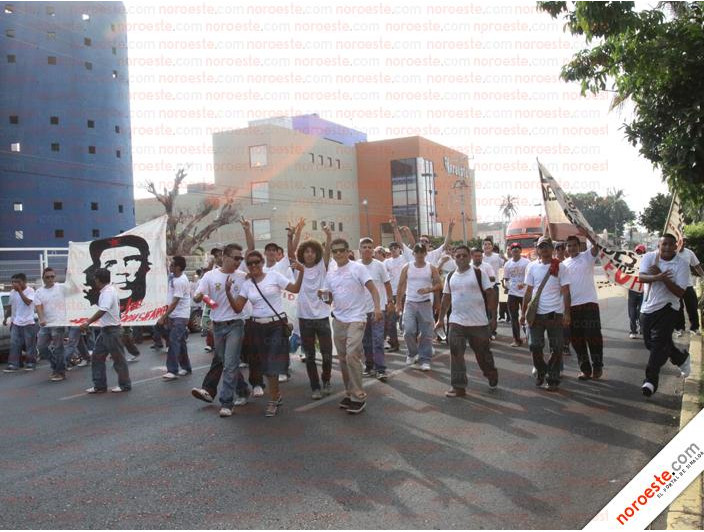
Earlier posts on the Tlatelolco Massacre here, here, here and here.
In Mexico, the tragedies of history have always found their expression in our music, as in Cuiliacán poet and musician (and survivor of the “slaughter of the innocents”) Pedro Calderón “Ni perdon ni olvido“:
Hamac Caziim: Fuego Divino
Corresponsals indigenas has a new post up about the Second Annual Festival de Rock Indígena Bats’i in Chiapas, which brings together rock bands from throughout Mexico and Guatemala. One of the better known groups, Hamac Caziim, are Seri — a people mostly living on the islands in the Sea of Cortés who speak a language unrelated to any other and have maintained their unique culture… adapting to their own uses the ways of the wider world when they can be adapted to the Seri way.
Cantina etiquette 101
I live in a navy town, where our more “autentico” local cantinas still post signs prohibiting entry to minors, uniformed service personnel and unescorted women. There’s some logic behind the signs, not that it stops the sailors or unescorted women — or minors for that matter — from stopping in, and while there might be something in the military code about hanging out in a cantina while in uniform, the prohibition on unescorted women is definitely illegal. But, the signs are more just tradition in a country that honors tradition than any attempt to flaunt the law.
Of course, by tradition only one kind of unescorted woman would be in a cantina anyway. Something that — as Mexico conquers the world, one taco, tamale and tequila at a time — may require a bit of explanation when exported to other tradition-rich cultures.

¡Muchimos gracias a Dee Hulen!
Ecuadorian coup attempt — God knows?
“It started in Honduras, then Ecuador…it has to stop”
Argentine Ambassador to the United States, Héctor M. Timerman (via Twitter)
The Inca has the best coverage of the attempted (and as of 22:00 Thursday night on the Pacific Coast of Mexico , apparently aborted) coup in Ecuador, with postings here, here and here.
Piecing the time-line together from the Inca, BBC and Apporea.com it appears that what happened was not a national police strike (initially reported as a military uprising), now being quashed by the military, but an attempted subversion like that in Honduras a year ago in July, that could be sold as a “constitutional” change.
As the Inca noted, and others are hinting at (and President Correa, after military commandos rescued him from the hospital where he was holed up after being tear-gassed and roughed up by mutinying police officers, is openly saying) is that disgraced and self-exiled former president Lucio Guitierrez is either the master-mind of the uprising, or is the front-man for an attempt to return Ecuador to the “neo-liberal” fold. More likely the latter: Machetera offers a plausible “who,” (are argument bolstered by who is remaining loyal to the elected government) though the “why” may be a bit harder to sort out.
A strike by police officers protesting changes in benefits calculations would be disruptive, and perhaps a crisis in any nation. But, the strike was NOT about civil service benefits but an attempt to make the country ungovernable — creating a rationale for a “constitutional” change. As the Inca writes:
Today, speaking from Brasilia, Guitierrez called for the dissolution of parliament and a new election “to avoid bloodshed“. And thus his tips his hand. Also, his lawyer was spotted as one of the crowd of officers that stormed and cut off the transmission of Ecuador’s State TV channel tonight., which is what you call a dead giveaway in this game. Here below is the translated money quote from Guitierrez, meanwhile Correa has just said he’ll either leave the hospital where’s he’s holed up “as President or as a cadaver”. He has a good turn of phrase, gotta be said.
“(New elections) could be the constitutional solution to avoid the possibility of bloodshed in the country”, said Guitierrez.
That is to say, that while police benefits might be a legitimate campaign issue in a future election, what Guitierrez is up to is creating a situation (or taking advantage of a situation) to force the President to call for elections during a manufactured crisis — something “constitutionally” the President of Ecuador can do.
As Ambassador Timerman almost said, “it’s deja-vu all over again”. But it’s not only been Honduras and Ecuador where the same thing has happened.
Except for failing (or so it seems), the Ecuadorian coup isn’t all that different from what happened in Honduras in July 2009, or perhaps in Mexico in 2006. While both Honduras and Mexico were holding scheduled elections, neo-liberals (what in the U.S. are called “Free Traders”) worked overtime to create crises. In Honduras, apologists for the tragedy that followed were forced to somehow explain how hustling the President out of the country (still in his PJs) and installing the clown Micheletti, was a “constitutional” — and thus legitimate — response to attempts to move the social and political system away from the “neo-liberal” economic model now in place. I’m one of those who believes the dubious results of the 2006 Presidential election in Mexico — which required a certain amount of constitutional fancy footwork — were grounded in the fear that this country might also eschew the neo-liberal economic policies that have been in place since the 1980s, replacing the earlier vaguely socialist system.
Certainly, there are economic and social forces opposed to the change and willing to use violence to prevent a change (“The Shock Doctrine“), there’s a hint that another force — one beyond our simple economic and political terms can deal with — at work here.
Lopez Obrador (who maybe should have been President), Zelaya in Honduras and Correa in Ecuador had much in common. While Lopez Obrador was a social worker turned union organizer, Zelaya a land-owner and businessman, and Correa an economist (with a PhD from the University of Illinois, I might add), the three were also strongly rooted not so much in socialism as in Liberation Theology. Although Lopez Obrador is thought by many to be a Protestant (and he did his early social work in Protestant indigenous communities), his coalition ticket ran under the lengthy title of “For the Good of All, First the Poor,” a quote from Liberation Theology texts. Correa was a lay brother in the Salesian Order, working with Quecha speaking community. Zelaya, of course, while educated by the Salesians, was originally considered a conservative, but adopted a “First the Poor” policy, and was supported by the Liberationists and Christian Base Communities during his truncated tenure as President.
I might also point out that Hugo Chavez of Venezuela and Fernando Lugo of Paraguay (both of whom faced attempted coups by the representatives of the old political/economic elites) are also from liberationist backgrounds. Not that there is a “Great Awakening” or return to religion in the Americas (not that I can see anyway), but only that political and economic policies may not be entirely based in “rational” theory. After all, Capitalism owes as much to John Calvin as it does to Adam Smith.
Chavez, Lugo, Zelaya, Lopez Obrador, Correa… “leftists”, “Bolivarians” or something else? Too often, we look at the upheavals within Latin America in terms of “left” and “right” — or, perhaps, “Bolivarian” and “Monrovian” or “neo-liberal” and “21st Century Socialism” when we may be dealing with a more profound vision of the political as human than our labels allow.
Be afraid, be very afraid
From “Secret History“:
A travel advisory has been issued for Texas. Travelers are urged to use caution due to recent violent behavior in this border state – the largest known export point of weapons to Mexico and a major hub for human trafficking and narcotics consumption / production. Of particular concern are institutions of higher learning and military establishments in the state, though mothers and infants possibly possessed by demons may be strangled, bludgeoned to death, or drowned in mud puddles. Women married to men are at particular risk, both on military bases and in the region of East Texas. Cross burnings and white supremacist kidnapping / murder schemes also make travel in East Texas inadvisable. Travelers should be wary of all people and locations while in this former breakaway republic.
There is a distinct possibility of spill-over violence in the north of Mexico, which should concern us all. Given the instability of the U.S. border region — with the failed state of Arizona, separatist gangs in Texas, and shootings on university campuses, perhaps it’s best to avoid the United States altogether.
Mexico Lindo
I’m still tied up with other things for a few days, but in the meantime, here’s yet another Mexican worker abroad… tenor Rolando Villazon commuting on the Paris Metro.
Crash
A hard-drive crash (as in complete self-destruction)… losing several files, settings, etc…. the usual … took me off line last week. Going dark for a few days has actually been good for me. I’ve done more reading (of books… on paper… the old-fashioned way) and had to spend some “quality time” just catching up on my neglected personal life.
Which doesn’t mean it wasn’t a hassle. I have commitments beyond the Mex Files that also require more time than is probably healthy sitting in front of a computer.
 The Mex Files is only supported by donations (and the odd occasional grant). I have been able to economically justify the time it takes for posting every day in that this site builds “brand recognition” for Editorial Mazatlán and has been a tool for doing my job as “gestor de projectos” for my company — keeping me in touch with writers about, and in, Mexico.
One of those writers is Joanna van der Gracht de Rosales, whose “Magic: Made in Mexico” we are working overtime to prepare for publications, and have every hope will be in print and available by late November.
The Mex Files has also given me some name recognition as a relatively knowledgeable person about Mexico and Mexican culture. Although my “real job” pays a livable wage, I’m conscious that I work for a start-up company, and have personal obligations that may not always be met from my present salary. So, I’ve had to take a second job, as the “local expert” with a travel and tourism site. As the “local expert” I am contractually obligated to post regularly on their site, about travel in this corner of Mexico, and have to invest time and effort in that. Fortunately, I have a researcher to help with some of the work on the travel site (yeah, a rough job, checking out the margarita specials at the local watering spots), but still will have to edit and send out a couple of regular posts on that site, as well as daily updates.
I don’t write about tourism normally, and there shouldn’t be much conflict of interest, although there are a few areas I just will have to avoid writing about here. As it is, the Mex Files was always meant as an extension of other writing, not an end in itself. When I started posting, there wasn’t much available in English on Mexican political and contemporary cultural trends, a situation that maybe The Mex Files helped change. At any rate, The Mex Files is hardly unique, and there’s really not much need for my own commentary on things like the “drug war” or inter-party political squabbles that are covered in-depth (and probably better) by many others.
My interest has been, and continues to be, not so much the daily news, but how contemporary events fit into, or reflect, Mexican history and … for lack of a better phrase… “deep culture”. It’s impossible to reflect on those concerns, though, when distracted by self-imposed expectations that I will write about some ephemeral event like the capture of the gangster of the week, or whatever. I catch myself obsessing over my stats and the number of daily hits (which have been very good over the last year or so), but recognize that most are people only vaguely interested in some news event or looking for something that really doesn’t interest me, and I don’t have any particular insight into in the first place. Or much interest.
And… finally… my personal life has always been outside the concerns of this site (and I purposely avoided writing a “My Life in Fulanotitlan” type site), but I do have one. Feeling that I am obliged to post on a regular schedule interferes with that. I considered just dropping this site, for many of the same reasons Jim Schultz dropped his Blog From Bolivia gave in his “farewell post”. Mostly, too much writing is not good writing, and this kind of writing gets old. It’s not as much fun any more.
I don’t have any immediate plans to discontinue The Mex Files, but I’m putting it aside for the rest of the month to catch up on other things. I plan to be back in October (don’t lose those bookmarks and feeds), but I’ll be updating as the spirit moves me. In the meantime, there’s over 3000 previous posts to explore (and some worth my rewriting into a book form).
Good news for Sinaloan agricultural exports
Via Associated Press… which I really don’t like to use, but it’s too late in the night to translated from a similar article in El Universal:
WASHINGTON — The rate of illegal drug use rose last year to the highest level in nearly a decade, fueled by a sharp increase in marijuana use and a surge in ecstasy and methamphetamine abuse, the government reported Wednesday.
…
The annual report from the Substance Abuse and Mental Health Services Administration found marijuana use rose by 8 percent and remained the most commonly used drug…
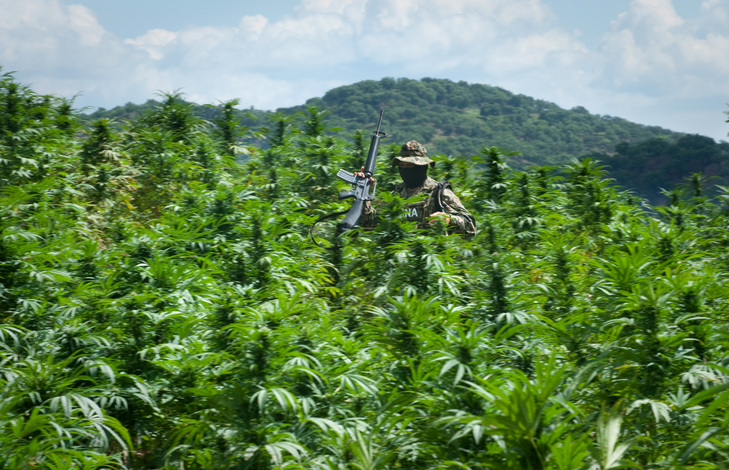
Badiraguato, Sinaloa. Photo by Sarah L. Voisin, Washington Post


 mexfiles.net