Your loss is our gain?
It’s ghoulish, perhaps, but the Mexican tourism industry and our major (legal) export may be getting a shot in the arm, thanks to the Governor of Arizona and British Petroleum.
The Governor said, in a FOX News interview that “You know Arizona has been under terrorist attacks”. Taking her at her word, it might not be safe to visit Arizona, even if you are a white guy.
Might I suggest Sonora and Chihuahua for those who like cactus and deserts or Grand Canyons:
Strictly speaking, the Copper Canyon is only one of a number of interlocking canyons or barrancas in the area. Not only are these barrancas deeper and narrower than the U.S. Grand Canyon, they are also longer. Whereas the Grand Canyon is desert-like, with virtually no vegetation, the Copper Canyon is thickly wooded in most places and a beautiful green, especially in the rainy season from June to October.
And Sonora also has beaches…

The huge oil slick from the B.P. well blow-out is headed for the United States. Cancún anyone?

Oh, and with the United States NOT drilling in the Gulf for a while, the U.S. is going to keep buying “foreign oil” from somewhere… supposedly, the economy has been restructured to depend less on oil revenue, but with a need for a quick infusion in education and infrastructure, a U.S. oil shortage will mean a nice extra chunk of change in the National Piggy Bank.
There’s an added bonus for the lefties and the greenies in this too. The Calderón Administration was swearing up and down that PEMEX had to be privatized, or opened up to private investors, specifically so that BP could do deep water drilling in the Gulf. I’m sure the lefty’s will have great fun reviewing the recent government statements on this.
Making an ass of you and me…
Midwesterner in Mexico went to the annual Otumba Burro Festival last weekend where one of this year’s rules was “No burro with problems of alcoholism or drug addiction will be able to participate, this is why there will be a Breathalyzer”.
Apparently, there was no requirement to check the burro’s passports:

¡Sí se puede … beber!
El DeFe says it will be almost like going to the United States:
… after getting there, you will be visually scanned, asked to take off your belt, rings, earrings, panties, empty your pockets of coins , keys, cell phone and any metal objects to pass through the metal detector, smile for the camera … and show ID, go. It will be like when you have to travel and leave two hours early to make time for the security lineup.
It, being going out to party.
The furor surrounding the shooting of Federico Cabañas in an after-hours club last January made bar hours a polemical issue, that — with the usual polemics and posturing politicians provide, and the usual heavy-handed response to what was perceived as a social problem — led to restricted bar hours… which only meant that if someone was going to pop a futbal player, he had to do it elsewhere (or earlier in the evening), and just inconvenienced a lot of Mexicans who have always been night-owls.
I thought the earlier closing time was likely to create more problems than it would resolve. What taco vendor wants a customer rush at two A.M.? A five A.M rush at least means they’ve been able to get some sleep the night before. And, besides, with the metro not opening until 7 on Sunday mornings, it meant the majority of Mexico City’s nightlifers had a reasonable time to get something in the way of breakfast, and maybe reconsider those unfortunate late-night … er…. coyote dates (as in you wake up in the morning, and like a coyote in a trap, will gnaw off your arm to slink away) before heading home.
Anyway, under the new regulations, in return for going back to the five A.M closing time, clubs have to install metal detectors… and have medical personnel in attendance… and install breathalizers… and provide two hours free parking. They can recoup the costs through a cover charge or drink minimum, but that creates a second problem.
One of the twenty-three new requirements for a five A.M closing license is abiding by the Federal District’s non-discrimination policies, which among other things forbids discrimination based on economic status. And if you’re poor, you can’t afford a car, and having to pay a cover that recoups the costs of parking for the ricos seems a bit of an imposition.
Too big, to jail?
I always counted one of the greatest of the Juarez reforms the abolition of “Corporations.” While it was aimed at breaking up the temporal power of the Catholic Church and was also used to break up the native communal lands (which may not have been an accident, Juarez and company being good “liberals” which in Latin America means the political theories of John Locke and Adam Smith… you know, what used to be called “Capitalism”).
While, somehow, Capitalism has allowed corporations to worm their way into the economic and social system over the last 150 years, unlike the United States, they have never been seen as persons in their own right. What passes for a “corporation” in Mexico is a “Sociadad Anonimo” of one kind or another… whatever their size and whatever their complexity, they’re just a partnership. This makes me wonder if Carlos Slim really is the “richest man in the world” or whether Forbes isn’t counting the wealth of the various corporations under the CARSO group as Slim’s personal wealth.
Of course, SOMEBODY — who is a real person — is entrusted with the overall management of the funds contributed by the various partners. Anyway, I always thought the big advantage of the Mexican system was that businesses aren’t disembodied beings (like vampires) but simply the activities of living, breathing humans.
As such, they can — and do — commit criminal acts. Where a corporation in the United States, say Massey Energy Company, commits acts that cost people their lives, kills people through its actions or inactions, the State cannot physically punish a being that doesn’t physically exist. The most it can do is force it to turn over some money. However, the socios of a Sociadad Anonomo can — and on some occasions are — tossed in the pokie.
Of course, it’s usually the low level guys that get sent for social readaption and it doesn’t happen very often, but it’s worth noting that the Chamber of Deputies on 21-April a new anti-trust law:
… that seeks to strengthen competition among companies by imposing stiffer fines on firms that act as monopolies and jail terms on their managers.
The bill, which now moves to the Senate, beefs up the power of the Federal Competition Commission, known as Cofeco, by allowing it to fine companies that collude on prices 10 percent of the revenue they report in Mexico. The legislation would also allow for sentences of as long as 10 years for officials whose companies act as monopolies.
Unexpectedly, the Senate ratified the bill two days later. Carlos Slim, naturally lobbied against the bill, as the present structure of the telephone companies he heads will be affected, but the opposition within Congress came, surprisingly, from the left. The reason — the penalties are too mild.
Not that they think Slim belongs in jail (and I don’t think he’s a villain — just a really smart rich guy who would have gotten very, very rich no matter what the political or economic system), and he has and does work with leftist governments. Maybe some on the left want Slim in jail just because he’s a rich guy, but the leftist objections were to loopholes that allow for “concessions” like our one and a half television networks (Azteca and Televisa — both controlled by the same family) that are in reality monopolies, but may be unaffected by the new legislation. The other objection is that this opens the door to foreign companies, which … even with a “Mexican jurisdictional personality” (agreeing that in Mexico they are bound my Mexican law) … are controlled by those vampiric creatures called “Corporations”.
Still, it might be satisfying to see a few rich guys sent to a new executive suite with bars on the windows.
¡Todos somos Arizona!
In protest of the recently passed immigration law in Arizona that many believe will lead to racial profiling, Alpha Phi Alpha fraternity has moved its annual convention out of the state. The fraternity’s leadership announced this decision through an email to members, saying:
” … the Board of Directors of Alpha Phi Alpha Fraternity voted unanimously to rescind the location of Phoenix, Arizona as our meeting location of the 104th Anniversary/ 90th General Convention in July, and to denounce the egregious immigration act signed recently by the governor of Arizona. It was the full opinion of the board that we could not host a meeting in a state that has sanctioned a law which we believe will lead to racial profiling and discrimination, and a law that could put the civil rights and the very dignity of our members at risk during their stay in Phoenix Arizona.”
Props to Alpha Phi Alpha. Though the only Greek inter-university organization I ever joined was Tappa Kegga Bud, and have never had any interest in these kind of organizations, nor spending my post-graduate life going to relive the follies of youth, Alpha Phi Alpha is not your average Animal House frat.
 Since its founding in 1906 for African-American university students, Alpha Phi Alpha members have been groomed for leadership within both the African-American and larger U.S. communities. The history of the last hundred years would look very different if it hadn’t been for Alpha Phi Alpha members like W.E.B. Dubois, Thurgood Marshall, Duke Ellington, Jesse Owens, Paul Robson, Martin Luther King, Jr., and a long list of mayors, cabinet officers, generals, business executives, scholars and cultural figures. These guys may not run the United States, but they sure have a lot of pull in saying how it’s run.

Photo from Atlanta by John Amis/AP
More important perhaps than any economic loss to the State of Arizona from this one protest against S.B. 1070, the decision by Alpha Phi Alpha to boycott Arizona helps drive a stake through the heart of the old meme that African-Americans and Latinos are competitors in the American dream, or are part of each others American nightmare.
Ethnic cleansing
The Governor of Arizona suggested the other day that her “non-ethnic” “papers-please” law was a response to terrorism. I assume she was talking about Shawna Forde’s paramilitary organization’s attack on people in her state, but somehow I don’t think so. And, as with Felipe Calderón’s over-reaching response to the narcotics-export problem, it seems to be engendering more, not less, of the very activity it’s meant to control:
 Supporters see passage of the stop-and-shake law as an invitation to ramp up their Forde-style military assault on border jumpers–party time for Minutemen. One group, the Cochise County Militia (CCM), has just announced it is reforming itself into a local Blackwater–style organization–something Forde, according to what her brother told Seattle Weekly last year–envisioned for her Minutemen American Defense group, MAD. She at times also referred to herself as the “Delta Force” leader. According to Southern Poverty Law Center, CCM’s founder, Bill Davis, just told supporters via email that his Tombstone, Ariz.-based militia will be forming a private military company, which is “completely legal!!!”
Davis said he prefers combat veterans for his venture but will consider others. There is no pay. “We can be considered paramilitary, but not vigilantes, mercenaries, etc.,” Davis wrote in the email. That’s in sharp contrast to his website’s discussion of weapons, which says that “we don’t want to appear as a para-military group in any way.”
Actually, the website’s contrast is much sharper. “Thirsty Illegals Are Just Dying To Be Caught,” it says over photos of men armed with combat rifles. And in a newsletter, Davis outlines some of his rules of engagement, including: “Be polite…be professional…be ready to kill all you Meet!” Or as Forde might add, at least the “filthy” brown ones.
Of course, the Legislature, in its infinite wisdom (with a collective IQ slightly above that of the temperature of a Minnesota parking garage in January), is taking steps to control future terrorism too:

Arizona’s supporters of the state’s draconian new immigration law insist that it has nothing to do with race and isn’t meant to discriminate against certain ethnic communities. Their claims are undermined, however, by what else the state government is trying to do to target recent immigrants. Today, the Wall Street Journal reports that the Arizona Department of Education “recently began telling school districts that teachers whose spoken English it deems to be heavily accented or ungrammatical must be removed from classes for students still learning English”
I guess the law isn’t all bad: A guy who says “waar ownla giben this tessen Engles” probably shouldn’t be allowed to claim proficiency in the language. But…
Adding insult to injury, the Arizona legislature passed a bill yesterday outlawing ethnic studies programs:
HB 2281 would make it illegal for a school district to have any courses or classes that promote the overthrow of the U.S. government, are designed primarily for students of a particular ethnic group or advocate ethnic solidarity “instead of the treatment of pupils as individuals.”
It also would ban classes that “promote resentment toward a race or class of people.”
The measure is directed at the Tuscon Unified School District’s popular Mexican-American studies department, which school officials say provides only “historical information” — not “ethnic chauvanism” as the state school superintendent has alleged. One state lawmaker tried to show how ridiculous the legislation is by proposing that schools be barred from teaching about 9/11 because it would result in hatred toward Arab-Americans; the measure failed.
 Thankfully, Arizona is close enough to Mexico to allow for refugees to easily escape to a civilized country where the law still refugees from fascist states automatic residency. And, we have the shining example in our history of of Gilberto Bosques, the Mexican consul in Marsailles who rented out a castle and a summer camp in Vichy France as annexes to give diplomatic protection to those in unable to escape the fascists. With real estate prices plummeting in Arizona perhaps the Secretaría de Relacíones Exteriores can make a good deal for a few resort complexes that are likely to be sitting empty, both for a shortage of employees and guests.
May First
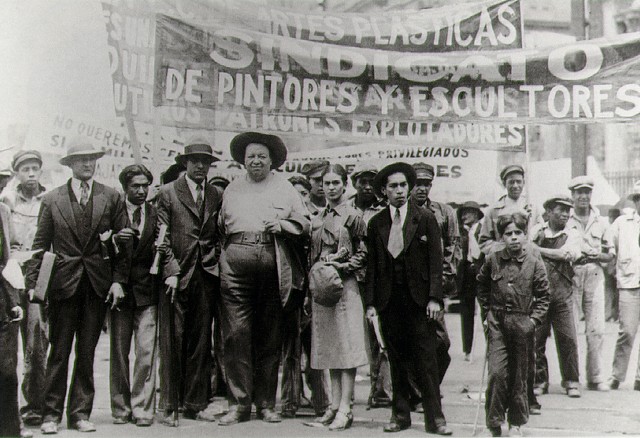
Off the computers and into the streets!

A little help from their friends…
The failed state of Arizona round-up:
From the Arizona Republic:
… a handful of neo-Nazis showed up at Montgomery’s news conference Friday morning claiming they were there to back Sheriff Joe Arpaio.
The members of the National Socialist Movement, decked out in riot gear and wearing rifles slung over their shoulders, said they were there to “support Sheriff Joe’s candidate for County Attorney,” according to ringleader J.T. Ready.
More on the Sheriff and his goose-marching buddies here.
The World Boxing Council, which is headquartered in Mexico City, has prohibited Mexican boxers from bouts in the State of Arizona — for their own protection. Meanwhile, in the United States, a boycott of the Arizona Diamondbacks Major League Baseball team is picking up support.
Twenty-seven percent of the players in Major League Baseball are Latino. Even if those players wanted to remain blissfully unaware of Arizona’s new policy, the law’s opponents aren’t about to let them. As the face of Major League Baseball in Arizona, the Diamondbacks have been drawing protests on the road in Denver and Chicago this past week.
Entertainers, as well as sports figures (and trade groups in the United States and Latin America) have also begun to boycott. Comedian Paul Rodriguez (a naturalized U.S. citizen) was the latest.
The boycotts are going to help, but the real fun is going to begin when the Arizona farmers have to bring in their cotton and fruit. Can you see those flabby ol’ viagra vigalantes and “tea-baggers” out in the fields?
Another foreigner, another tragedy… for Oaxaca
Tuesday afternoon a convoy of Zapatista “sympathizers” was attacked by an unknown armed group. According to Kristen Brinkler (“My Word Is My Weapon”), the convoy
… was carrying food, water, and other basic necessities to San Juan Copala, which has been subject to a paramilitary blockade that has prevented anyone from entering or leaving the community since January. In addition to carrying much-needed supplies, the caravan was meant to accompany teachers who were returning to classes after paramilitaries denied them access to the community nearly five months ago. The caravan included representatives from the Popular Assembly of the Peoples of Oaxaca (APPO), Section 22 of the teachers union, the Center for Community Support Working Together (CACTUS), Oaxacan Voices Constructing Autonomy and Liberty (VOCAL), two reporters from the Mexican magazine Contralinea, and international observers from Belgium, Finland, Italy, and Germany.
San Juan Copala is a Triqui “autonomous municipality” under ELZN (Zapatista) control. The attack occurred leaving an area under control of another Triqui organization, UBISORT, said by Ms. Brinkler to be tied to the state PRI. UBISORT, according to La Jornada, blames another Triqui political faction, MULTI for the attack.
Although I think the Zapatistas are a pernicious influence in Mexican politics, they are, for better or worse, a legitimate faction in Oxacan politics. As are UBISORT and MULTI. Given the recognition of “usos y costumbres” in Oaxacan politics, and the role the ELZN has played as a spoiler (by refusing to participate in electoral politics), what had been an inter-Triqui feud between various factions over other matters like religious practices and water rights — often takes on a revolutionary and political dimension with disputes settled by armed gangs.
As always, there is no way to ascertain who is “right” in any of these struggles. With the ELZN and other groups opting out of the ballot box and the court system, the traditional method of resolving disputes is going to be armed warfare.
Ms. Brickler may be a Mexican citizen, and she may even be a Triqui. I am not a citizen, nor a Triqui, but have supported the rights of the various factions in Oaxaca to fight against the state government. However, I recognize that there is no perfect side, and expected even an improbable victory by the opposition to be an imperfect compromise by competing factions.
What bothers me is that the situation in Oaxaca only seems to come up when foreigners are killed. One of the victims of the attack was a 25 year old Finn, Juri Jaakkola.
As with the death of another “foreign observer”, American Brad Will, in October 2006, there are the usual questions about the foreigner’s legal status in Mexico (it appears Jaakkola, like Will, were traveling on tourist visas). What exactly an “international observer” is doing in this inter-tribal faction fight is also a question.
As Brickler quotes a local human rights worker as saying, “the government will use this as a pretext to militarize the region.” Which may be what the government wants, or what the people the ELZN is supposedly fighting want, and is the usual result of foreign meddling in Mexican politics.
Do the math: migra and migracíon
In following the Arizona story, I’ve been struck with how many commentators on MEXICAN based sites have echoed the arguments of their North of the Border brethren in using the “they can come ‘here’ [meaning the U.S.] legally” argument. I’m assuming (always dangerous) that these immigrants are “legal residents” of Mexico, although — from their political and social thinking — obviously aren’t those who have come here to pursue the Mexican dream and “adopt our system of values”. And that’s fine, but, I’m wondering what these people know WHY there are illegals in Arizona, and wonder what would be the result if Mexican immigration worked like U.S. immigration does. Just looking at the equivalent costs of a Mexican following the same legal path to reach the same immigration status in the United States that I have in Mexico is pretty much amazing.
The entire procedure for foreign residency is being simplified here in Mexico on the first of May — making the annual renewal process something done mostly on-line, with all U.S. and Canadian residents entering Mexico, whether as tourists or workers, paying the same fee (about US 20.00) for a 180 day visa. That fee is either included in the price of a plane ticket or paid at the border crossing, or paid into any bank (the bank just deposits the funds into a government account).
The fees for a residency permit run about 200 USD a year. My old residency permit was basically like a US H1-B visa, showing that I was a foreign employee of a Mexican firm. I could have added other employers, paying additional fees. My new immigration card allows me to work anywhere, and puts me into the status of a potential naturalized citizen. The cost … with an attorney (which I really didn’t need to have, but with the law changing within the same period I had to renew anyway, it was worth it) for the documents is about $275 USD, and the attorney’s fees about $175 USD: say $450 USD in round figures, about 90 salarios miminos (based on the minimum wage in Mexico City for unskilled labor and used as a base number for setting regulatory fees and fines. For example, a traffic ticket might be set at 10 “salarios” which keeps the price of the fee or fine relatively even with inflation, and doesn’t require changing the legal code). A bit pricey, but immigration doesn’t come cheap.
In other words, it costs part-time residents about 20 bucks for to enter Mexico as a tourist for up to six months, and about 200 bucks a year for the right to live and/or work here.
Leaving aside the question of how complicated and bureaucratic the immigration process is in the United States, there’s a simple reason so many Mexicans are “illegal” in the United States. They’re not working the big bucks jobs, and entry into the United States is damn expensive.
For a Mexican to enter the United States — even as a tourist — they must first obtain a visa from one of a handful of U.S. consulates (or the Embassy in Mexico City) after going through an interview. For people here in Mazatlán, that means either going to Hermosillo or Guadalajara, both a full eight hours away. And standing in line, and then returning. That’s a minimum overnight trip. Just to apply for an interview is a 150 USD non-refundable fee. That’s 30 salarios minimos, not counting transportation, hotel stay and lost work time.
And that interview doesn’t guarantee a person will receive a visa, nor that they won’t be called back for a second interview. Nor, that they’ll be admitted into the United States. The border agent can refuse entry and doesn’t have to give a reason.
But, assuming all goes well, and the Mexican is allowed to enter the United States.
If they are applying for an H1-B visa (which are limited to specific trades and occupations) which allows them to work for a single employer the cost is $320 for the visa application and $500 for “fraud prevention and detection fee” for the first application or when one adds a second employer — $820 dollars, or 164 salarios minimos. That doesn’t count the 1500 USD the employer must pay into a training fee for U.S. workers.
I don’t think there is an equivalent to our FM3-Rentista classification, which is what most full-time foreign residents hold, which only requires that they show proof of income equal to something like 250 times the salario minimo — in other words a pension or remittances of some kind of about $1250 USD a month.
The closest thing in the United States both to the FM-3 and to my new Mexican immigration status is the so-called “green card” which, with attorney’s fees, which are probably necessary is a relative bargain at only around 1200 salarios minimos — about $6000 USD.
I wonder what these foreigners who complain about Mexican “illegals” would do if Mexico had an immigration system and fees similar to the United States.
The minimum HOURLY wage in the United States is $7.25. It isn’t an exact equivalent to the salario minimo (which is the minimum daily wage, even if the daily job is only an hour or two. And an employee is entitled to vacation pay, a two-week end of year bonus and employer paid social security, plus a pro-rated payment based on the length of service when they leave a job), but it’s a starting point. And being hourly, we’ll assume a eight hour work day: 58 dollars. Let’s call it 50 just to make the math simple. So, if gringos had to pay an equivalent fee to reside in Mexico to what Mexicans pay in the United States, the schedule would look like this:
The fee for standing in line: $ 1,500 USD
Working residency permit: $ 8,200 USD
Monthly income requirement for retirees: $12,500 USD
Fees for normal residency card: $60,000 USD
Suggesting whiny gringos shut the fuck up: PRICELESS!
Undesirable aliens…
And here I though Michael Moore was one of the good guys… seems like he just wants to treat Mexico as a dumping ground for the toxic waste products of the United States.
Maggie’s Madness sees some logic in the idea, though:
…that to me wouldn’t be such a bad idea, after all they would fit right in with all the other crooks and swindlers down here. I think they would be great selling condos in Rosarito Beach, heck they could even start their own “BAJA IS PEACHY” forum. I mean, these are the masters of deceit, they would fit right in …
Nah, send ’em to us here in Sinaloa. We have major investors with a lot of cash, although if you screw them over, heads will roll… literally.
Aliens profiled in Coahuila?
I’m surprised Patrick (Ganchoblog), who lives and writes from the great state of Coahuila, hasn’t weighed in on the “El Alien de Monclova”.
Inexplicata’s regular Mexican correspondent, Profa. Ana Luisa Cid writes that several reports have been filed with the police by residents of Colonia Chinameca and colonia Alamo of encounters with a “alleged monster of humanoid characteristics and four legs”. Dubbed by the press “El Alien” psychoanalyst Camilo Ramirez believes El Alien is a projection of social tensions created by the “drug war” and the resulting militarization of northern Mexico:
… when those at hand do not provide assistance, it is necessary to ask the aliens – meaning foreigners – for help. If authorities cannot help, there are the aliens. It provides meaning within the socio-cultural context when there is a lack of order, authority is fragmented, and the need for meaning arises. Perhaps children or teenagers can give meaning in these features,” he says.
He adds: “Beyond the alleged smokescreen created by the authorities to distract the public, or the fuel boycott on the weekend, or the registration of cellphones and the fear that these records will be misused, we are in a world of foreigners. When someone launches a deluded idea, if we perceive it the ravings of a madman, we are not measuring its social scope. A link exists.”
Alien, he says, means foreign. “To humans, aliens are extraterrestrials, the strangest or more remote. That which is most remote is the closest, because humans constitute themselves from the outside: another who acknowledges us, another determines our usages and customs, and we exist as a result of others. Our existence is therefore artificial, even though we occupy biological bodies.”
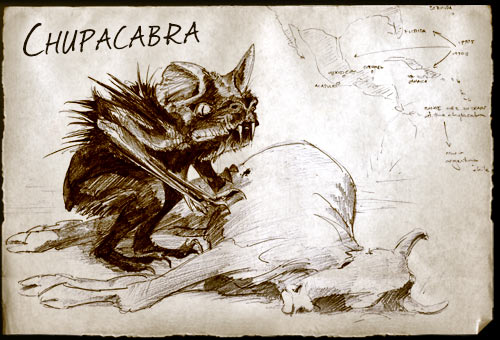
On the other hand, perhaps the good doctor is projecting himself — basing his assessment on his own prejudices and there is some unnecessary profiling going on here. Goatherd Jaime Cruz, among others, has seen the unknown “monster” several times in the southwestern section of Monclova, where ten goats have been mysteriously killed over the last six months. Cruz and others who have seen the monster don’t believe the creature is an alien, but a indigenous Mexican monster… .


 mexfiles.net