Intolerance: usos y costumbres
Two separate stories from Corresponsales Indíginas on the intractable frictions between communal and individual rights. Jason at Secret History also wrote on this, a post I hadn’t seen until after this was written Wednesday night for posting today.
In the Traditionalist Catholic Tzotzil commune of Shulvó, Zinacantán municipio, Chiapas, eight evangelical families were expelled and their children thrown out of the local school. According to the families, who fled to the state capital, San Cristobal, they were told by the village school director that — as non-conformists — they had no right to attend classes. The State Humans Rights Commission’s “Defensor de Pueblo” has sought the Governor’s personal intervention, and the Commission has issued a recommendation that teachers in the federal system “abstain” from sanctioning students for their religious beliefs. And… oh yea…by the way, teachers should be reminded that the right of religious association is in the Mexican Constitution and the Universal Declaration of Human Rights.
Evangelicals were the oppressors in Jicaral, Oaxaca where local authorities bulldozed eight sacred rocks, and took a chainsaw to a sacred tree, destroying a shrine to the local rain god. In this instance, it appears municipal leaders took the action without consultation with the community, whose inhabitants’ religious beliefs are a combination of both pre-Hispanic and Roman Catholic ones.
I’m one of those who thinks the “usos y costumbres” clause in the Mexican constitution was badly written and codifies abuses of individual rights, as in the Chiapas incident. The destruction in Oaxaca, however, seems to have been instigated by people with no respect for “usos y costumbes”, which doesn’t make anyone even… what Mexico got right was separating religion from public life, though — given the complexity and multi-cultural nature of this country, one legal code does not fit all.
Another success for FeCal…
A total of 2,593 kidnapping complaints were filed during conservative President Vicente Fox’s 2000-2006 term, while 2,455 kidnappings were reported in 2007-2009, the first three years of the Calderon administration, which started on Dec. 1, 2006.
The number of kidnappings reported annually nearly doubled from 595 in 2006 to 1,181 last year, reaching an average of just over three per day, “well above the level registered in countries known for their high incidence of this crime, such as Colombia…”
(EFE, via Latin American Herald Tribune)
The big “Vivir Mejor” logo the Administration is slapping on everything these days is getting a slight work-over around the country (even in the Chamber of Deputies) as a result of the administration’s successful “mano duro” towards social unrest and crime.


There hasn’t been much in the national press on it, and nothing at all in the foreign press, but there is a growing movement mostly conducted on line — and even a non-binding citizen referendum in Mexico City in May — to demand Calderón’s resignation. I don’t have any feel for how widespread support for this is (it seems to be mostly a student and AMLOista movement) but the frustration and anger over the present Administrations handling (or mishandling) of not just crime, but the economy, public education and social development is very real.
To boldly go where Mexico has been before
By a vote of 28o to 2, the Chamber of Deputies has approved creation of a Mexican space agency, Agencia Espacial Mexicana (AEXA). As Gancho reminds us, the Senate voted back in 2008 to also create an agency, but that measure eventually died in the Chamber. This new agency is likely to pass… just in time.
The sky … or rather… SATMEX is falling. The immense geographical challenges of communications in this country have always led to a search for creative solutions, especially in providing education in hard to access locations. Building on the success of the first color television satellite transmissions (of the 1968 Summer Games), and one small step for man and one giant leap for Mexican space exploration when Mexican invented technology sent back live images of the 29 June 1969 moon landing, Mexico had the scientific capability to utilize satellite technology, and the potential was realized. But unlike the great military powers the country had no way to launch or build its own satellites.
The Secretariat of Communications and Transport financed the first generation of Mexican satellites, Morelos I and II, in the late 1980s. Both were built by Hughes Aircraft and launched from NASA space shuttles but controlled from a Mexican command center. In the early 1990s, Solidaridad I and Solidaridad II followed.
While satellite communications revolutionized telephone and television service, two government services — the satellite schools (literally… these are the rural schools too isolated to be served by regular teachers, and classes are though satellite communication) and the elections system — also changed the way Mexico works. With instantaneous communications, election officials anywhere in the country — even if they can only access the polling station by canoe or by riding a mule up the side of a mountain — can upload voter identification, and receive confirmation of the voter’s status (and at the same time, prevent the same voter’s identification being used anywhere else in the country) in real time. For the first time it was possible to provide isolated communities an education equal to that of the cities, and to guarantee with some certainty voter integrity.
In a real sense, Mexican education and democracy — as well as the control over the banking and telecommunications system — depended on Mexican satellites remaining under Mexican control.
So, of course, in 1997 in the rush to privatize, Carlos Ruiz Sacristán, then Secretary of Communications and Transport, said that “a new era of investment, international competitiveness, economic and social profitability, quality and operational efficiency, meant a better future” and the government sold the entire operation at a loss to the private sector.
SatMex (Satélites Mexicanos), more interested in the lucrative business of providing Mexican television to South America and South American programming to Mexico than in furthering education or providing voter services — and returning a profit to its stockholders — has been going broke for years. The satellites launched by the privatized Mexican space company — SATMEX 5 and SATMEX 6 (the latter designed mostly to carry internet traffic) are losing money. In 2005 SATMEX had to be bailed out by the government to get SATMEX 6 off the ground (literally… SATMEX didn’t have the money to pay the French for including it in an Ariane rocket payload) and was back — cap in hand — to ask for another bailout this year.
Mexico needs its satellites, more than SatMex needs to make a profit. Even for die-hard libertarians, this is one of those no-brainers. It’s just cheaper to own than to rent, and a government agency doesn’t need to turn a profit or even break even. Whether it’s to their taste or not, it looks like even the conservative, “free market” Calderón Administration is going for renationalization. Of course, expect them to try selling concessions for transmission rights at below market value to favored customers.

Chicken-shit “progressives”
I shouldn’t be surprised that even the U.S. “progressive” websites never get anything from Latin America even remotely correct. On “Americablog” I read a post “Bolivian president says genetically modified chicken can turn you gay“. I’m naturally skeptical of most U.S. media when it writes about Latin America, and this is not the first time U.S. “progressive” sites have spun quotes from Evo Morales to misrepresent the man, simply bought the U.S. imperialist spin on Latin American and presented it (just because the present U.S. administration is domestically more to their taste) unchallenged, nor that John Aravosis posted arrogantly anti-Latin American (mis) information.
Of course, the commentators on Americablog were all going on about cocaine and having a grand time, never bothering to look at the source: Noticias24, not exactly the most reputable of news outlets, even by Venzuelan standards.
What the President of Bolivia said was, and I quote:
Cuando hablamos del pollo, el pollo que comemos, está cargado de hormonas femeninas, por eso los hombres cuando comen este pollo tienen desviaciones en su ser como hombre”, entre otras deficiencias, tales como la calvicie prematura, como así aceleraciones irregulares en el metabolismo en las mujeres al nacer a la vida reproductiva.
I don’t think there’s a reputable scientist in the world who would disagree with Evo that hormonal-laden meat may be bad for you and may affect ones metabolic system. As to causing baldness, I think the jury is out on that one, though the 50-year old Morales doesn’t look bad for his age.
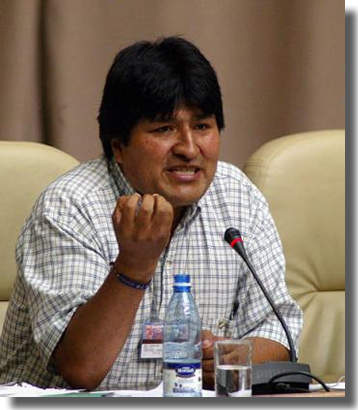
Good genes or free-range chicken?
His remarks were made in Tiquipaya, at the climate warming and environmental summit that the U.S. media is ignoring in favor of “talks” among the policy honchos of the big countries that don’t follow the U.S. line on climate change about possible common agreements that might be expressed at a later climate change summit that will be held in air-conditioned rooms in Cancún. The Bolivian summit is a gathering of farmers, indigenous groups, environmentalists, and representatives from the countries undergoing the worst of climate change, and is meeting outdoors and living in tents.
A suspiciously reasonable idea for Arizonans…
With the Governor of Arizona probably going to sign a particularly stupid piece of legislation that authorizes police officers to arrest anyone they suspect may not be a legal resident of the United States, 7th District United States Representative Raúl Grijala is taking the unprecedented step of calling for a boycott of his state by organizations and groups representing what he believes will be the most affected people by this “papers, please” law.
Good idea, but maybe Arizona police officers like these …

could decide that people who look like this…

raise reasonable suspicions. After all, everyone knows what REAL ARIZONANS look like:

Democracy ain’t for sissies
The campaign season for the July elections has officially kicked off with the usual flurry of dirty tricks, threats and confusion.
In Hidalgo, Xochitl Galvez, a former Fox Admistration cabinet secretary (Indigenous Affairs) from one of the minor “social democratic” coalition parties that ran with PAN in the 2000 Presidential campaign, is — or isn’t — the candidate of a PAN, PRD, PT, Convengenica fusion ticket. With Vicente Fox stumping for Galvez, the PT (with is Maoist, Cheguevarist or Carlosalinasist… or maybe Andresmanuallopezobradorist, depending on who you ask on what day in what state) threatening to pull out of the coalition as a result.
In Quintano Roo, Gregorio Sanchez, the Presidente Municipal of Cancún is the PRD heads the left to right anti-PRI coalition ticket (PRD-PT-Convengencia-PAN) candidate for Governor. He’s claiming to have received death threats, which may, or may not have anything to do with last week’s arrest of one of his campaign aids, Manuel Vera Salinas who had a houseful of illegal bugging and spy equipment… and, incidentally, used to work for the Oaxaca State Police and was muscle for the entrenched PRI party machine there.
And, here in Sinaloa, where the PRI candidate is said to be tied to the Sinaloa Cartel, but is running as a backer of the Calderón “War on Drugs”, the anti PRI coalition candidate was a PRI politico up until a few weeks ago, when he joined PAN — backed by PAN leaders who quit the party complaining that the Calderón Adminstration isn’t fighting the Sinaloa Cartel. So that he can run as a PAN candidate with PRD and PT support. That PRI turned PAN guy’s teenaged son was pulled out of a car and beaten up yesterday by masked gunmen of unknown political (or narcotical) persuasion. And there’s still 89 days to go until the election. A long 89 days.
Bishops: What you don’t know, can’t hurt us
AHA… the Catholic Bishops’ Conference of Mexico (CEM, Conferencia del Episcopado Mexicano) have identified the real culprit when it comes to the problem caused by the uproar over child-molesting clerics: free school books.
How can anyone argue with that? If Mexican students weren’t given free textbooks, less of them would have knowledge about sexuality … and fewer kids would know they were molested. No complaints, no problems.
Showing how far Mexican education has declined because of free textbooks, the SNTE (State Teachers’ Union) rejects the logic of that out of hand.
*******************

Patron Saint of Corporate Immunity?
One thing that occurred to me about the whole clerical/pedophilia scandal — and Mexico, “thanks” to Marcial Marciel and Cardinal Norberto Rivera’s coverups of pedophile priests is at the center of several of the more alarming scandals — is that the Church, as an institution, is better positioned to weather the storm here than in most countries.
Not because Mexicans are particularly devout (they’re not), nor because the present administration is full of believers, but because of the radical separation of Church and State that has existed since 1857. As an institution, the Church owns very little property in Mexico — church buildings erected prior to 1992 are owned by the state, as are the artwork and other objects. In a civil suit, there isn’t much actually owned by the Catholic Church, as a corporate body, that could be attached to pay damages. Large properties, like universities, and various Church organizations are separate “Asociationes Religiosas”. Church investments are “technically” separate from the church. Proving they are the property of an offending cleric, or the “intellectual author” of a tort would be nearly impossible. In short, one can’t — for the actions or inactions of the Bishop or the Church as a whole, punish anyone but the actual individual wrong-doer — who probably is not worth suing in civil court, although they could face criminal charges.
While, since Juarez, the State has recognized the Church’s rights to its internal governance, the Church and clerics have always been subject to secular law. Clergymen — even Bishops — have been jailed or exiled without significant harm to the institutional body. Secondly, with a shortage of priests throughout history, and, at time — notably during the Cristero Wars when the Church had to operate clandestinely, a more or less underground clergy — the faithful managed to muddle through.
However, the Bishops have, since 1857, continually pressed their luck, trying to undo the law, or skirt it, and have always ended up losing the rights they have won. Returning the country to its normal tension between the maestros and the curas is not a smart move.
19 de Abril de 1810
Mexico isn’t the only former Spanish colony that took advantage of the confused situation in Spain caused by the imposition of Joseph Bonaparte on the Spanish throne, and the squabbling resistance movements on the Peninsula that — all claiming to be THE legitimate Spanish government — left colonial loyalists in doubt as to who they really served.
Venezuela dates the start of their Independence from the Caracas Junta of 19 April 1810. The Junta originally swore its allegiance to Ferdinand VII, the heir of the despised and deposed Carlos IV, but — persuaded by Simón Bolivar — set their sights on self-determination.

Between Mexico and the United States… the desert
Xico raises a good point when she points out that the New York Times’ alarmist headline “Fleeing Drug Violence, Mexicans Pour into the US“ is more than slightly misleading. Xico says “Headlines like the one I mention above, if they were written about the US would say, US RIDDLED BY VIOLENCE when referring to stories about Baltimore.” Actually, I think it would be more like saying US RIDDLED BY VIOLENCE when writing about somewhere like Marfa, Texas or West Branch, Iowa. The gist of the Times’ story is that “drug violence” has led to several residents El Porvenir, Chihuahua (last census, slightly over 1000) moving across the river to Fort Hancock, Texas (last census, slightly over 1700). You really have to read carefully to get the numbers:
Fort Hancock has had a surge in applications in March and April, officials said. All told the number of people asking for asylum at ports of entry along the border alone has climbed steadily, to 338 for the federal fiscal year ended last October, from 179 two years before.
I’ve said before that the violence in the border communities (El Porvenir has had more than it’s share — a church burning and other arsons, several murders) is more a symptom of social dislocation than the cause of it.
I’ve written about social collapse in Juarez, and why I don’t think the drug war — by itself — is the reason 30,000 residents are said to have moved a few kilometers north into El Paso during the Calderón Administration (which the Times always refers to as “the start of the drug war”… being one and the same thing). I haven’t paid much attention to the rural regions, but maybe I should.
Closing the border was itself, a disaster… both to Fort Hancock (where the Border Patrol is now the largest employer in town) and to El Porvenir. Smuggling is one of the few viable industries around. The border rural communities are facing not just the pressures that the border towns face, but the added problems rural Mexico faces in general, and the situation is disastrous in small towns like El Porvenir.
The violence in rural border communities is more serious than is being reported. The Army saying it needs ten years to “win” the drug war; the United States threatening to covertly intervene intervene in the Mexican theater of operations AND… over the weekend at the Pentagon there was a sit down between the U.S. Joints Chiefs of Staff and the Mexican and Colombian military leadership which seemed to focus on means of “containing” narcoviolence on the producer side of the border it’s no wonder I’m starting to hear conspiracy theories being floated.
The Associated Press story on the exodus of El Porvenir mentioned a typewritten note to residents, telling them to flee and signed “Sincerely, The Sinaloa Cartel.” That doesn’t smell right: its not their style, and they’re usually not so polite in their correspondence. Given FeCal’s callous remarks about “collateral damage” this last week, coupled with the military pow-wow and the general tenor of U.S. border policy and it’s no wonder conspiracy theories, mostly involving U.S. or Mexican military plans to clear large swaths of the border are being floated.
Return to sender
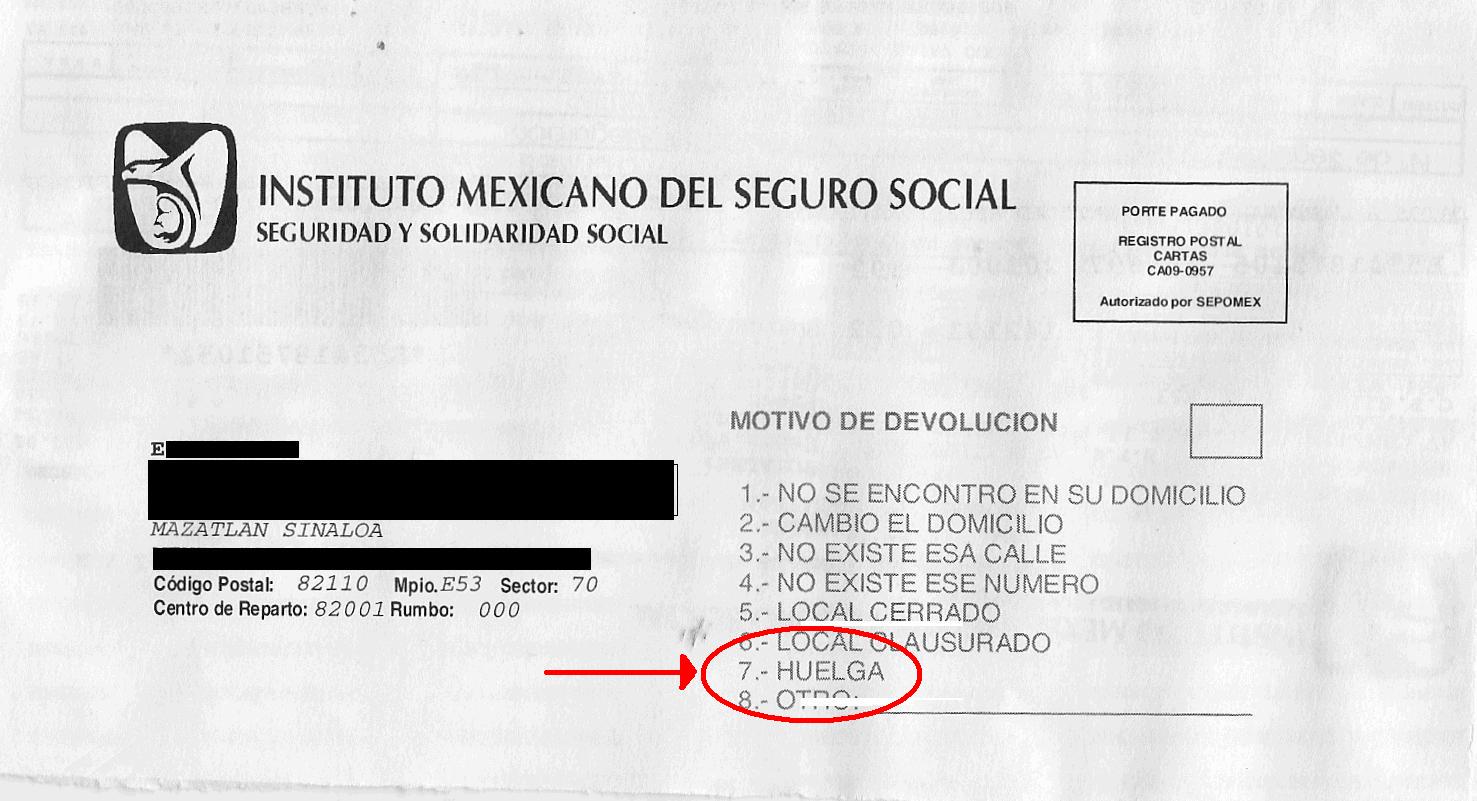
There has been talk of “reforming” (which doesn’t necessarily mean making better, just changing) the labor laws in this country. Like most Administration proposals it generates a lot of promises and but promises to eventually peter out.
Roubani Global Economics gives the pro-administration spin to the issues leaving out the drawbacks (like making it nearly impossible to form a union… which would require permission from the Secretary of Labor AND the employer… good luck with that!) and, of course, Roubani is looking at Mexico as a “competitor” with countries like China where labor rights boil down to if you labor the way we tell you, we won’t kill you.
I’m not going to get into my usual “what sucks about NAFTA” riff — which was supposed to create a North American common market, but isn’t working in good part because the United States buys much of its goods from Chinese and other cheap labor (and no labor rights) states, destroying well-paying jobs throughout North America. I am going to note that in a country where streets and colonias are named “Articulo 123” for the clause in the Constitution that gives labor the right to strike — and where the right to strike is recognized by government agencies and is considered a normal enough event that the mailman isn’t expected to cross a picket line — I wouldn’t put any more stock into the proposed “reforms” than into any other administration-backed “reform” which seems designed NOT for the benefit of Mexicans, but for foreign interests.
Get married for fun and prizes!
Mexico City’s Delegacion Gustavo A. Madero sponsored a mass wedding Saturday, at which 765 couples — five of which were of the same gender, if you were wondering — tied the knot.
Besides just doing the right thing, there are practical benefits for even childless couples and those without property to get married rather than forming a “union libre”. One of the more important is the “social credits” given to residents for socially responsible actions that are used to determine elgibility for some benefits programs. A carrot, rather than a stick, if one does the right thing — registers for the draft, gets a voter ID, finishes high school, or gets married — you accrue points that are counted when determining things like government loans. The “social credits” count as other forms of collateral and credit-worthiness for various government loan programs. Friends of mine finally tied the knot legally when they started house hunting and realized they could afford a nicer place if they invested in a marriage license which would substantially lower the down payment and mortgage on the apartment they wanted.
But given that a marriage license in Gustavo A. Madero costs 797 pesos plus 33 pesos for a certified copy of the marriage certificate, and a lot of couples don’t have 830 pesos to spare, people are locked out of qualifying for benefits without free mass weddings like the one in GAM.
AND… for a limited time only! … there were lovely parting gifts. The couples received a china set as a wedding gift from the Delegacion, and tickets on a drawing for various kitchen appliances.
Congratulations to the bride and groom, bride and groom, bride and groom, bride and groom… bride and bride, groom and groom…
Just desserts
Yesterday was the anniversary of another great event in Mexican history… the start of the Guerra de los Pasteles — the world’s longest, and messiest argument over a restaurant bill.
In 1832, the French proprietor of a Tacuba pastry shop owner — one Monsieur Remontel — complained to the his government that Mexican military cadets had stiffed him for a dessert bill. OK, maybe the cadets had coffee, and it’s not unknown for teenage boys to scarf down massive quantities of food, but the 600,000 peso claim seemed, oh, shall we say, rather fanciful, even to then President Antonio Lopez de Santa Ana.
But it seemed logical to the French… but then, what the French want is logical. With Napoleon Bonaparte having sold off the last French possessions on the American mainland, and post-Napoleonic France looking for new markets, and some way to open trade with the new American republics, shooting your way in was as logical as anything. It wasn’t right that the Mexicans also shot a Frenchman in 1832, but he was a pirate, so that was an absurd reason to make demands on Mexico. But, upholding the honor of French pastries… making that logical is easy as pie a la Descarte.
Stiffly worded notes meandered back and forth for a couple of years (punctuated by breaks for lunch, dinner, siestas and — of course, dessert: diplomatic crises moved slowly in those days), the French finally giving Mexico a deadline of 15 April 1838 to pony up for the dessert tab. To which the Mexicans said, “mañana“.
The French took that literally. On 16 April the French fleet blockaded Veracruz. And on 17 April 1838, La guerra de las pasteles commenced.
After a few months of shouting insults at each other, punctuated by occasional cannonball, the French had the… er… gall… to send a negotiator who not only demanded the 600,000 pesos again, but also demanded a Treaty of Friendship Commerce and Navigation Rights. And special rights for French businesses (they wanted to sell more pastries). Don Luis G. Cuevas responded by suggesting that Vice-Amiral Charles Baudin should engage in an improper and violent relationship with his female parent. Or words to that effect*.
 Pour la gloire de pâtisseries, 30,000 French sailors and marines were called to join the fray. On 27 November, it got serious. The French occupied San Juan de Ulúa and President Anastasio Bustamante declared war. General Santa Ana, down the road at Mango de Clavo, Veracruz state, was laying low after managing to lose Texas and looking to rehabilitate himself showed up in Veracruz offering to join in driving the pesky bill collectors out. I don’t know if the Prince de Joinville had studied the Battle of San Jacinto (when the Mexican Army was caught napping… literally … by the Texans, which the Texans claim was the battle that won their independence) but Santa Ana never made the same mistake twice (he made new and different ones every time). The French amphibious assault was before dawn on 5 December 1838 when the Mexicans were asleep. Santa Ana was ALMOST caught, but, still in his underwear, escaped from a French ranger team sent to capture him and even had time to grab his his uniform and sword as he escaped from an upstairs window.
Santa Ana found time to get properly dressed, and rally the Mexican troops to drive back the French landing. The French ships covered their men’s retreat. A cannon-ball killed the horse Santa Ana was riding and the five guys next to him. He’d lose his left leg below the knee and a finger to shrapnel, but his reputation was restored, and he was set to return to power and lose even larger chunks of Mexico in the future.
The French — with Cartesian logic — gave up on landing, but figured a artillery bombardments would do the job, so the Mexicans just withdrew out of cannon-range and waited. And waited. Until…. 9 March 1839 when a British fleet — probably looking for a decent place to get a meal — came sailing into Veracruz. Thinking the whole thing very, very silly, Admiral Richard Packenham managed to sit down the French and the Mexicans and hammer out an agreement. The Mexican paid the 600,000 pesos (they’d get it back with interest from foreign tourists over the long run), the French sailed home vowing revenge for being made to look like fools, and… Mexico City pastry shops are run by the Chinese.
* Based on what is known about the intrigue surrounding la guerra de los pasteles, the following is a reasonable accurate recreation of the event:


 mexfiles.net