When FDR stood up for Mexico: April 20-21, 1943
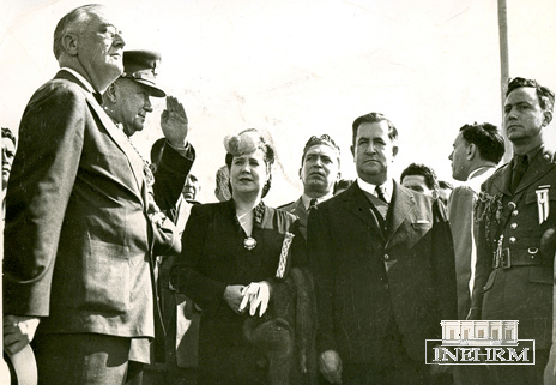
It ‘s rare to see a photograph of Franklin Roosevelt standing unaided, but he did, recognizing the sense of occasion when he and Manuel Ávila Camacho met in Monterrey on April 20 to discuss Mexican contributions to the US war effort.
Although Mexico had been openly anti-fascist since 1934, and had declared war on the Axis in May 1942, it had only been 20 years since the “official” end of the Revolution, followed by a series of counter-revolutionary uprisings, the most recent being the Nazi financed rebellion of Saturnino Cedillo in 1938-39, while at the same time working mightily to demilitarize the country and decrease the amount of the woefully meager Federal budget that had to go the military spending.
Although Mexico would contribute an air wing (it was proud of having the first military air force in the Americas, and Escuadron 201 would become the public “face” of the Mexican war effort), the Monterrey meeting (and the next day’s meeting in Corpus Christi, TX) set the stage for Mexico’s less noticed role, not just in providing workers to fill jobs in agriculture and production in the United States, but a long term effect, opening the United States to Mexican manufactured goods, and Mexico to US manufacturing plants.
Also, as a result of the U.S. recognition of Mexico’s importance to the war effort, official propaganda in the United States… which had up to then referred to the country as “Bolshevik Mexico”. or painted it as simultaneously a country of credulous peasants and bloodthirsty atheists, produced newsreels praising the country as a modern democracy (never mind the de facto one party state) with exciting cities and colorful folkways.
For better or worse, the April 20-21 presidential summit set the stage for both the interlocking US-Mexican business relationship and Mexico’s post-war tourism industry.
Trans-actions
With their regular jobs considered “non-essential”, Las Famosas, the trans* sex workers who normally work the streets around the Mercado Juarez in Toluca, have found a way to not only earn their living during the pandemic, but continue their … er… public service.
Serving up complete meals (soup, rice, a main course, and even dessert) to the incredibly low price of only 25 pesos (about one dollar, US), their small “cocina economica” has a growing clientele from the mercado’s workers, as well as the temporary out of work and elderly neighborhood residents.
Las Famosas consider the venture more a way to pay back their community than as a money making operation, receiving assistance from, among others, the state Secretary of Labor, and donations. Paying customers regularly buy two meals, one for themselves, one for the less fortunate customers unable to afford even the nominal 25 peso bill, or for the displaced working girls(?) and their dependents.
For more information, see their Facebook page here: https://www.facebook.com/untoquedeayuda/
Let my people go (out)? Much ado about nothing?
In the United States, what resistance there has been to quarantine measures have largely come from the right side of the political dial, or from the far right, while in Mexico, opponents are on the left. Or so it seems.
A survey, of attitudes towards the quarantine by ideology (broken down as “left”, “right”, and “center”, conducted by El Financiero (chart below) shows much more dissent from the “left” than from the “right” to various measures, from voluntary “stay at home” orders, to closing bars and restaurants, to closing the borders.

With no idea of how the survey was conducted, nor its margin of error, even assuming it is relatively reliable (as reliable as any polling in Mexico), what this means — if anything– is open to more than the usual speculation.
The poll defined ideology on a numerical value of one to ten, ten being the furthest right… based on what? Questions elicited by the Bloomberg company publication, or self-identification?
Is the “left” more concerned with human rights (including the right of free transit) than the right, or is it that people on the “left” are less likely to have the resources to be “socially isolated” than those on the “right”? Or that those on the “right” are more comfortable with authoritarian responses to emergencies than those on the “left”.
Or… depending on how the ideological bias was determined, was it just that those on the right are more likely to be those already agreeing with measures imposed elsewhere. That is, those identified as being on the “right” are more likely to follow foreign press reports which endlessly have encouraged Mexico to follow the example of other states than those on the “left”?
Not being exactly AMLovers, one wonders if this poll wasn’t meant to prove there is large dissatisfaction among the government’s supporters with its response to the pandemic (or perceived non-response). If so, so what?
Socially isolated? Tired of Netflicks?
It”s the anniversary of Pedro Infante’s death (bad), but a good evening to enjoy his best film: Los Tres Garcia (1949).
When it comes up saying “Not Available”, press the link to “watch on youtube”. Thanks for catching this, Esther.
Colonialism and coronavirus
Translated (loosely) from Francisco López Barcenas, “Pandemia y pueblos indígenas” (Jornada, 14 April 2020)
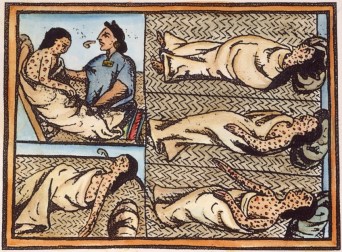
In April 1520, exactly five centuries ago, a smallpox pandemic in Anahuac [the Aztec Empire] profoundly affected the native peoples of the region changing their immediate and future history.
According to the testimonies of the time, the pandemic appeared a year earlier on the island of Santo Domingo.  From there it passed to that of Cuba, spreading to the Yucatan peninsula and Cozumel, transported by the indigenous people that Pánfilo Narváez brought to those lands with the intention of capturing Hernán Cortés, by orders of Diego Velásquez. From Cozumel the Spanish advanced to Cempoala, where upon their arrival in March 1520 the pandemic began to spread among its inhabitants; Hernán Cortés, having gone to Cempoala, captured his persecutor, taking him prisoner, and tranferring him and his smallpox infested troop to Tenochtitlan. From there it spread among the towns of the valley and by September of that year it was already whipping its inhabitants.
The pandemic affected indigenous people more than Spaniards. To the indigenous it was an unknown disease, while the Spanish had plenty of information about it. As a result, while the Spanish took what precautions they could to prevent the spread among themselves, the indigenous were paralyzed by the “surprise attack” and allowed it to spread unchecked. While the indigenous considered it to be a punishment from their gods, the Spanish took advantage of their bewilderment to strengthen themselves as an occupation army and subdue them. The smallpox pandemic was used as an instrument of conquest by the Spanish and in the end sealed the fate of the invaded peoples.
 The conclusions of the pandemic that hit Anahuac 500 years ago should be taken into account now that Covid-19 pandemic is raging in our country. One is that it must be taken seriously, that it cannot be played with; that true and accessible information is required to regulate our behavior presented in such a way that it neither paralyzes nor causes inappropriate behaviors or assumptions that allow it to spread. It is also important to prevent interest groups from manipulating the social needs imposed by the situation for their own ends. The pandemic must not be used by the dominant groups to perfect their control and worsen its effects upon the most vulnerable population.
Unfortunately among indigenous peoples actions and attitudes are far from what is needed. . Imbued by the lack of, or excess of, information, or by false information disseminated in the media, in some indigenous communities the pandemic is still thought to be a political invention with undeclared political ends. Official pronouncements, aimed at an urban-mestizo audience rather than an indigenous and rural population are not fulling comprehended. Indigenous linguists and communicators are doing an important job generating culturally appropriate information, but they are still insufficient. This activity needs to be strengthened so that people become aware of the seriousness of the problem. The lack of permanent economic income to meet the needs of families and the absence of a government program that covers them if they stop working, is a factor that prevents people from staying at home, as officially recommended. Given the choice of moving about and able to eat, or staying home and protecting themselves, they opt for the former.
Official measures meeting the economic, social and cultural situation of indigenous peoples are urgent. But when they arrive, if they arrive, the peoples cannot be paralyzed, as happened 500 years ago, because if they are, such measures would be undone by the pandemic. It is important that indigenous authorities, the organizations to which they belong, and their advisers seek solutions to the pandemic with their own resources. Family solidarity and collective work for the common good must be employed. Indigenous professionals must receive the support of our scientific knowledge acquired in the universities but without assuming that they are the only or the most important factors in decisions on the best practice to fight the pandemic, but rather combined with those of the communities.
Information and collective action is the formula. That the correct measures are taken and in time it depends on the indigenous peoples overcoming the crisis and emerging stronger from it. Defeat will only dampen the 500 years of colonial rule over them.
What’s a girl to do?
 Today is the birthday of Leona Vicaro (María de la Soledad Leona Camila Vicario Fernández de San Salvador), born 10 April 1789 in Mexico City. The “Founding Mother” of the Republic, she was a wealthy heiress under the control of her uncle (and lived next door to the Inquisition) when she took up a career as a spy for the independence forces (flirting with her uncle’s chosen… Spanish… suitors and passing off information via his clerk, Andres Quintano Roo), which she varied with setting up an underground newspaper, gun running, and hiding out revolutionaries on the lam.
When at last, the Spanish caught on, her little pranks she did not deny (to paraphase Tom Leher), and was tossed into the Belem… a convent cum women’s penitentiary. With an assist from Andres Quintana Roo, she went over the wall to join Padre Morelos in the field, helping draft the “Sentiments of the Nation” (Mexico’s “Declaration of Independence”, fighting with the troops (still finding time to give birth to two daughters), and developing a career as Mexico’s first professional journalist.
Be thankful I don’t take it all/’Cause I’m the taxman…
 The SAT (Mexico’s version of the IRS) is going after 1.1 Trillion pesos in unpaid taxes, the equivalent of six years of social spending funds, or two years of the national health systems. Yesterday, AMLO mentioned that 15 companies that between them owe 50,000,000,000 are “negotiating” with SAT, trying to weasel their way out of litigation and additional penalties.
Skinflints! All taxes paid in Mexico only account for 16 percent of GNP, and has the lowest tax rates among OECD ( Organization for Economic Cooperation and Development) nations, which average 34%. On the other hand, it has (maybe up to today) the lousiest tax collection rate in Latin America. It’ estimated that if Mexico just collected its taxes as well as Chile (which doesn`t do all that great a job either), it would increase state revenue by 4%.
As you might expect, the CCE (basically, the chamber of big time commerce) is screaming foul.
Keep the numbers low
In the case of the country governed by Donald Trump, the analysis points out that 21 days after the outbreak began at the contagion rate, it has not decreased significantly because the control measures were applied late.
“One of the complications of the United States is that it is a very heterogeneous model, this model works well with outbreaks located in regions, so when we have a very large country, with different outbreaks, with different regional policies, what we are observing may be the result average of the country, which is not telling us if a mitigation measure located in the New York area or in the California area is working, “says the scientist.
The situation is different in Mexico, where a strategy was in place before the arrival of COVICD-19, which has mitigated the intensity of the outbreak. Although it is premature to measure the impact of those policies adopted y the Secretariat of Health, it can be expected that, assuming the citizens follow recommendations, the contact rate would be 0.319. If social distancing measures are maintained, the contagion rate would be even lower.
“In Mexico (the virus) came much later than in all other countries, we have data that the outbreak began to have a significant number only a short time ago, it is on March 19 with 118 infected. The containment measures began long before we even reached a number of one hundred people, we are well ahead of other countries, “said Mariana Vargas Magaña, researcher at the UNAM Institute of Physics.
Information from Forbes Mexico (“
Científicos pronostican aplanamiento de curva de contagio en México“, Maria Fernanda Navarro, 7 April 2020)Garcia Lorca’s guide to New York

The terrible, cold, cruel part is Wall Street. Rivers of gold flow there from all over the earth, and death comes with it. There, as nowhere else, you feel a total absence of the spirit: herds of men who cannot count past three, herds more who cannot get past six, scorn for pure science and demoniacal respect for the present. And the terrible thing is that the crowd that fills the street believes that the world will always be the same and that it is their duty to keep that huge machine running, day and night, forever. This is what comes of a Protestant morality…
What’s changed since the 1929 crash?
I’m afraid I kind of cyber-lost it the other day when one of those instant epidemiologists (some guy who had spent a whole five months in Mexico, making him an expert on social life and politics and everything else here) was yakking on (er… typing on) suggesting AMLO was “corrupt”… specifically for not closing all the hotels in Mexico (by dictatorial decree, apparently). That I know people who live in hotels for one reason or another (generally, older adults with no immediate family, or those who have families, but some “issues” that don’t require institutionalization, but would make it difficult to live with reluctant relatives), and others…

Photo shows recipient at an ATM. Photo by José Antonio López and Fernando Camacho
Well, whether by local decree or not, the hotels are tossing people out, and there is a whole group — one I admit I hadn’t thought about — who not only are losing their homes, but their workplaces, and their livelihood. Street walkers.
We can argue about the ethics or “fitness” of their profession all we want (as if we couldn’t do that about other less socially acceptable trades — hedge fund managers, for example), but these are people in need, and if we’re serious about helping out the exploited workers and keeping people off the streets and in shelter, we need to talk about the needs of street-walkers.
The Alianza Mexicana de Trabajadoras Sexuales and the Centro de Apoyo a las Identidades Trans have put together funds to assist out of work prostitutes, passing out debit cards they can use to find what housing is available. It’s not much, and several are living in the streets, or in rooming house without cooking facilities. Non-perishable food, and ready to eat food… as well as money… are desperately needed.
Given the sensitivity surrounding the workers, and those that might be charitably inclined, donors need to call a phone number for information on where, and how to donate:
55-8439-4070 or 55-6039-6518
Not a virus…
A BIOS issue… with my computer down, will be posting later. On something or another.
Stage 2
Via El País, and others:
Monday afternoon Mexico declared a state of health emergency and extended the suspension of non-essential activities in the public and private sector until next April 30, 10 days more than previously announced.
Officially mandatory, the measures are being communicated as an appeal to citizens to act responsibly, leading to some confusion as to whether the restrictions are to be enforced, or merely suggested. More details will be forthcoming in Tuesday’s Diario Oficial de la Federacion (https;//dof.gob.mx)


 mexfiles.net