The Revolution will be twittered
For the last several months, Mexico has been discussing new taxes. The original proposal from the Calderón Administration, for a two percent increase in the sales tax, spun as a beneficial to the poor, was widely derided. There were the usual bombastic speeches by the politicians, the outraged editorials in the media and a few street demonstrations… but it was clear the proposal was doomed in Chamber of Deputies (the lower house of the Mexican Congress) where the President’s party, the conservative PAN, lacks the votes to pass any bills without support from one of the main opposition parties.
Some tax bill had to be passed, and — several compromises and alternatives later, one did make it through the Chamber last Wednesday, just after five P.M. The bill only raises the sales tax one percent, and exempts food and medicine, but to make up the difference in revenue, includes several other taxes, including a three percent tax on telecommunications and internet connections.
 By six PM, la revolución online — led bya vanguard “movimiento twittero” — had an organized resistance underway. Mexicans, even the most avant-garde cybergeek, tend to assess their present though the lens of their history. With the centennial celebration of the 1910 Revolution gearing up, it’s natural los twitteros and their allies have looked to that Revolution for guidance.
In 1908, Porfiro Diaz, who had been elected president every four years since 1884 with only token opposition and was dictator in all but name, made the mistake of mentioning to a foreign reporter that he might consider retiring in 1910. Diaz had no intention of actually giving up power, but Francisco I. Madero, a wealthy landowner and eccentric, took it upon himself to publish and distribute La sucesión presidencial en 1910 — in effect, going outside the traditional media to launch what would, indeed, be a revolution.
José Merino, a doctoral candidate, sometime newspaper and TV journalist and founder or director of several web-based sites, writes in “El Defe”:
Madero launched a revolution with a book in a country where 72.3 percent of adults were illiterate.
Why can’t we initiate a change in the relationship between the people and their legislators over a three percent tax on internet use in a country where only twenty-five percent are regular users?
…
Within a day, without blocking streets or resorting to mass media (print and electronic), Twitter and Facebook users had generated so much noise that the Senate — the revenue bill is now in the upper house — held hearings on the issue today.
And, in less than twenty-four hours created two sites dealing with the topic: internetnecesario.org that summarizes the Twitter activity on the issue and the marvellous internetnecesario.info — showing that creative people, despite the ridicule of the “mainstream media”, can synthesize the relevant information clearly and .. for lack of a better word… beautiful manner.
The Senate Science and Technology Committee heard from internet industry executives, academics and the users… in the hearing room, and several thousand more who participated in the first ever interactive hearing in Mexican legislative history. An estimated five thousand twitters were received opposing the tax increase.
The Committee President, Francisco Javier Castellón Fonseca said the anti-tax movement’s spontaneity demonstrated the ability of the internet and social network to bring together thousands of people for consultations.
About the unprecedented structure of the hearing, Castellón was quoted as saying “This meeting was designed for sending messages on the network, mainly in Twitter, on the prevailing situation in the discussion of the Revenue Act, especially as it applies to telecommunications excise taxes.”
The Senator needs to learn to limit his statements to 140 characters, but it’s a start. His party, the leftist PRD (Revolutionary Democratic Party) is apparently ready to join “la revolucíon online”. Livestreaming Internet Necesario protests are being posted on Noticieros SPD , a website originally set up in support former PRD Presidential candidate Andres Manuel López Obrador’s “alternative presidency”, but has become an alternative media source for several progressive and leftist causes.
 Moviemento Internet Necesario — so far — has been limiting their action to killing the communications excise tax. But, as José Merino noted, Mexicans have the among the slowest broadband access speeds, and highest access rates in the world. La revolución online may spread well beyond the narrow concerns of the twenty-five percent of Mexicans who use the internet, much as Madero’s revolution — concerned only with the specifics of presidential succession — spread when the instigator failed to recognize the thirst for radical social change.
The Movement is already starting to go viral, showing up on Global Voices. Today, the internet tax… tomorrow, free WiFi. Geeks of the world unite… you have nothing to lose but your web-links!
¡Pinche policia!
If you think it’s just Mexican coppers who make shit up, think again.
Via “Crooks and Liars“:
Although it’s admirable that Dallas Police Chief David Kunkle has admitted that issuing the ticket was an error that needs to be corrected, it’s not a “rookie mistake”, when at least 38 tickets have been issued for the same non-existent offense in the past three years.
The United States is the third largest Spanish speaking country in the world (after Mexico and Colombia) and Spanish has been spoken in Texas since at least 1598, when Don Juan de Oñate showed up on a mission from Dios (to slaughter the non-Spanish speaking locals), if you don’t count any private conversations Álvar Núñez Cabeza de Vaca and Estaban the Slave might have had during their sojourn on Galveston Island in the 1530s.

Fight fiercely, Kyle, fight…
I don’t know when Kyle de Beausset finds the time to actually go to classes up there in Cambridge, Massachusetts. De Beusset runs Citizen Orange and is one of the brains behind the on-line immigrant rights network, The Sanctuary. He’s also a valued regular MexFiles reader and sometime commentator.
Going on Fox News’ “The O’Reilly Factor” — which seems to exist for the sole purpose of letting the eponymous presenter, Bill O’Reilly, refer to those being interviewed as “stupid” or “pinheads” or “left-wing kooks” when they challenge his … shall we be polite and say… dated ideas about the world?
Kyle was supposed to have five minutes to explain exactly why he took time out of his already overloaded schedule to take on Jim Gilchrist, fuhrer of the “Minute Man Project,” known associate of neo (and retro) Nazis and — in de Beausett’s main complaint — ally and supporter of terrorist Shawna Forde.
In early October Kyle began using different university mailing lists to build support for uninviting Gilchrist to speak at Harvard:
“It might be an interesting intellectual exercise for Harvard students to hear extremist views,” de Beausset wrote in one of these e-mails, but he added that the “broader implications of legitimizing these extremist views with the Harvard name” were more important.
While another presenter — arguably saner and better mannered — was substituted for O’Reilly — Kyle was cut short when the presenter failed to rile him, or to shake his obviously correct sense of the law and civil rights.
On Citizen Orange, Kyle explains the points he was not able to make:
The only way to truly understand the consequences of hateful speech like Gilchrist’s is to hear the audio of Brisenia Flores’ mother when she dialed 911 to report that her husband and her daughter were shot and killed. (WARNING: Listening to this audio might be traumatic for those who have suffered violence. I have only listened to it once and that was enough.) Jim Gilchrist is a close associate of Shawna Forde’s and has defended her in the past.
Writing about his immersion into the snakepit of cable television opinion shows, Kyle thought he “messed up.” Not at all… the program was meant to pit crass v. class. Crass had to fight dirty, and still didn´t win. Kyle, in the true spirit of the Harvard undergraduate, he impressed them with his prowess, and did not let the Crimson down, to use the phraseology of Harvard Class of 1947’s immortal Tom Lehrer.
Porking Honduras
TEGUCIGALPA (Reuters) – Honduras’ de facto leaders blasted loud music outside the embassy where Manuel Zelaya is sheltering on Wednesday and refused to buckle under increased pressure from Washington for the ousted president’s return.
Talks to resolve the political crisis in Honduras sparked by a June 28 coup are deadlocked over whether leftist Zelaya can be reinstated to power.
“One side of the dialogue has all the privileges and advantages and the other legitimately elected side is totally repressed,” Zelaya told local radio station from inside the Brazilian Embassy where he took refuge last month after returning from exile.
…
Overnight, the caretaker government sent the army to play loud rock music, military band tunes, church bells and recordings of pig grunts over loudspeakers outside the embassy, a Reuters photographer inside the embassy said.
While I might disagree with Mica Rosenberg of Reuters in her assessment that there is any particular new pressure from Washington “to resolve the political crisis” (a rather novel way of saying “wiggle out of initial support for a “coup d’etat”), it is all to the good that Reuters has a person inside the Brazilian Embassy to balance out the media over-reliance on “official” sources in a country where “protests… must be authorized by the government…”. And, based on Ms. Rosenberg’s generally accurate reporting from Mexico (her usual beat), she’s a good reporter, who is unlikely to be mislead by spin.
What she cannot report… or what her editors are leaving out… is calling the claim that there are serious negotiations what they are: total bullshit. Continual harassment of the legitimate government (annoying an embassy being a technique pioneered by the United States when they started disturbing the Papal Nuncio’s peace in Panama when Manuel Noriega took refuge there), and stalling this long (the elections… which will be recognized by absolutely no one… are scheduled for 29 November there is absolutely no time for anything resembling a free and fair campaign. As has been pointed out before, Mel Zelaya is not that important. His tenure ends (and would have ended without the coup) on 27 January 2010… or not, depending on how the pig oinks.
What matters, in a country where the Cardinal told David Agren of Catholic News Service, even “the Church is poor” (His Eminence was complaining about having to pay the new minimum wage.. the raising of which many feel was the real reason for the 28 July coup), is that “There are people here starving to death because of the political crisis.”
“The electoral process for a new president doesn’t magically just resolve these problems,” [Mauricio Díaz Burdett, coordinator of the Honduras Social Forum on Foreign Debt and Development] said. “Many other things are required that have to do with the social and economic policies that the country needs.”
>
A forgotten hero: Charles Young
In editing the (now very far behind) daybook of the Mexican Revolution (I’m still not happy with the working title “The Mexican Revolution Day by Day”), I admit my first fact checking source is Wikipedia… which is generally sufficient for most minor details, but when I run across huge gaps, I’m always tempted to write an entry myself… and trust someone else will pick up the slack.
So far, no one took the hint I dropped in my highly biased post on the career of the important (to the Mexican Revolution) United States writer and diplomatic hostess, Edith O’Shaughnessy. So, I’m afraid the entry for the maddening Mrs. O’Shaughnessy is probably not exactly a paean to an American woman who managed balance marriage, family and a successful career as a journalist, travel writer and screenwriter, but a portrait of a early 20th century reactionary and the kind of imperialist that — outside of dolts like T. Boone Pickens — one hopes are less overt in their statements these days.
Tom Dogget from Reuters, quotes Pickens, an Oklahoma oil man (and well-remembered “corporate raider” of the 1980s, and, of late, a hedge fund manager… i.e., one of the guys who got the world into the mess in which it finds itself), as telling the United States Congress that
U.S. energy companies are “entitled” to some of Iraq’s crude because of the large number of American troops that lost their lives fighting in the country and the U.S. taxpayer money spent in Iraq.
The “War Against Iraq” (as Mexican newspapers labeled it) has its parallels to the Punitive Expedition of 1916. If you remember, the United States had already intervened in Mexico to protect oil resources. And… having sustained what was perceived as a “terrorist attack” when Pancho Villa rode across the border into Columbus, New Mexico (9 March 1916), invaded the country.
Admittedly, it was on a much smaller scale than the U.S. invasion of Iraq, and at least targeted the country where the “terrorist” actually lived. But — like Iraq — the invasion was supposedly for the benefit of the invaded, who don’t see it quite that way, and are largely seen as historical failures.
The Punitive Expedition included legendary military figures — John Pershing, George Patton, Douglas MacArthur: but their fame would rest on other wars, other more worthy military ventures. The only genuinely heroic figure among the invaders is, as far as Wikipedia (and just about every military history of the United States is concerned), forgotten. The best I could do was add some information about Young in Mexico from a “free use site” written by Standford L. Davis for the Buffalo Soldiers Net

"Cadet Charles Young", . W. Shannon, Courtesy of the National Afro-American Museum and Cultural Center, Wilberforce, Ohio
Charles Young, the son of slaves, was only the third African-American to graduate from West Point (in 1889). In the segregated Army of the time, more settled parts of the United States were a bit uncomfortable with the idea of armed black men (especially in the South after the Civil War!). African-American officers were almost unknown at the time — most officers were white *(including “Black Jack” Pershing — how do you think he got his nickname?).
Although he was willing for a time to be “loaned” to the National Parks Service (overseeing road building in Sequoia National Park, and as acting superintendent, becoming the first African-American to run a National Park, Young was a career military man, who knew the only way to promotion was a combat officer’s posting. Although the Indian Wars had ended by the time he was commissioned, the “Buffalo Soliders,” the 9th and 10th Cavalry which had chased various Indians throughout the far west, were the only real options he had. He would serve in the two units for a total of 29 years.

1916: Black Archives of Mid America, Kansas City
Even in 1916, the United States still had a need for a frontier Cavalry, especially when it came to invading northern Chihuahua, where there were few roads, and few settled communities. As frontier Cavalry, the “Buffalo Soldiers” performed well. On April First, now Major Young (the highest ranking African-American soldier in any service at the time) led the 10th Cavalry in their first formal engagement with Villista forces, at Agua Caliente. This was the stuff of legends… the Cavalry riding over the hill, bugles blaring, pistols blazing (just like in the Westerns) to rescue the besieged troopers. Young’s charge — the last of its kind in American history — “routing the opposing forces without losing a single man. The swift action saved the wounded General Beltran and his men, who had been outflanked.”
His action, leading a small squad of 10th Cavalry troopers to the rescue of the 13th Calvary pinned down in a skirmish at Parral on the 12th of April were factors in Young’s promotion to Lieutenant-Colonel.
Ironically, though, it was a white officer, Captain Charles Boyd, who put the 10th Cavalry’s actions in Mexico on the front pages of American newspapers, and made the African-American soldier “one of ours” in the eyes of most gringos. Boyd, supposedly hunting down the “insurgents” loyal to Pancho Villa, got into a firefight with his nominal allies, the Mexican Federal Army at Carrizal (21 June 1916). As I wrote in Gods, Gachupines and Gringos:
An arrogant U.S. officer [Boyd] followed up a correctable misunderstanding (his soldiers had taken several lost Mexican soldiers prisoner and abused them) by insisting on free passage though the town and firing on the Mexican army when they refused. The result was a rare mexican victory, with ten dead U.S. soldiers and twenty-three taken prisoner. A later inquiry was complicated by the fact that the U.S. was using ammunition then prohibited by international treaty.
The first reports on the battle came from Captain Boyd.
Concern for the fate of the prisoners (twenty-two black troopers and one white “contract employee” from the local Mormon colony) pushed aside the usual pattern of racial anomosity of the time. Interestingly enough, the Mexicans didn’t seem to notice the “race” of their prisoners, although the contractor — was a “white man” to the gringos, and a renegade Mexican to the Mexicans. Lem Spilsbury, the local Morman hired as a scout:
… later described how the prisoners’ dark skin merited no special consideration. Originally lining up the “gringo dogs” for execution, the Mexicans instead stripped all the captives naked and marched them to a nearby rail line for incarceration in Chihuahua City. Mistaken for a Hispanic, Spilsbury claimed several Mexicans favored shooting him as a traitor…
Outrage in the United States over “our soldiers” being taken prisoner put pressure on President Wilson to order General Pershing to retaliate against the Mexican Army. Pershing had no illusions of success, and every reason to expect a disaster, but the best man for the job was Young, whom he insisted be put in command. However, it became clear that Boyd’s version of events was not the whole truth, the prisoners were returned and throughout the next month, opinion changed as the United States government began the withdraw from Chihuahua.
Now Lieutenant Colonel, Young commanded a border post, and should have led the 10th, or all “Colored” units during the First World War, but a medical examination showed he had high blood pressure, and was prematurely given a medical discharge in 1917. He was able to return to the Army in 1919, but — with his combat career behind him, had to settle for a post as United States Military Attache in Nigeria (then a British protectorate), where he died at the relatively young age of 58.
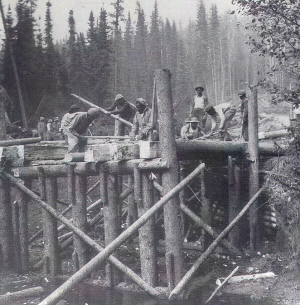
95th Engineers in the Yukon. Photo from National Archives, not the Grabman collection, though I think my father designed this bridge
* A rare personal note. The U.S. Army was segregated until 26 July 1948. Until desegregation, the officer corps, even in “Colored” units was mostly white, including my father, who was commissioned as a second lieutenant in the 95th Engineers in 1938, which worked on the Al-Can Highway in 1942-43 as a military road, and as combat engineers in Britain before D-Day and then built roads (or rebuilt them) through France, Belgium and Germany. He left the Army (as a Captain) in 1946, and even though I’d seen his photos [the Al-Can highway photos are now in the South Peace River Historical Society of Dawson Creek, British Colombia; the wartime photos went to various African-American Studies and military archival collections] I had to be 16 before I realized all the soldiers were black.
Banamex sale back on?
Jornada (my translation):
The Supreme Court of Justice (SCJN) could force the U.S. bank Citigroup to sell its profitable and highly regarded Mexican subsidiary Banamex, according to today’s (19 October 2009) Financial Times [registration required].
The case before the court is of vital importance because Banamex is estimated by the Financial Times and others to be worth at least 20 billion U.S. dollars, and accounts for 15 percent of Citibank’s net profits.
At issue before the court is a challenge to a finding by Secretarío de Hacienda (Treasury Secretary) Augustín Carstens, that the laws forbidding foreign GOVERNMENTS to have a major stake in Mexican banks “does not cover emergencies derived from the global crisis.” Well, no… the law was written back in the early 1990s when Mexican banks had collapsed in part BECAUSE the government had followed the same policies that the United States pursued, but was able to continue for another several years, heedless of the warning signs from the south.
Although Carstens claimed — on his own authority — in March 2009 that “government aid” (even when the government in question did become a major shareholder of the institution) was different than direct ownership, the Administration sent to Congress a bill that would regularize the Banamex exemption, but would force Citibank to offer 25 percent of the Banamex shares on the Mexican stock exchange IF the United States government was still a shareholder of the parent company after three years. And an additional 25 percent in six years. Of course, there were no guarantees that those purchasing Banamex stock would be Mexicans.
Mex Files was not the only one to question the logic of the ruling. Inca Kola News predicted “this story will create open season on a Felipe Calderon (allegedly) selling out la patria to the gringos. Lopez Obrador and company will milk this one for all it’s worth; and it’s worth a lot.” The Inca was ALMOST right.
It was seen as selling out la patria to the gringos… but then again, everything the Calderón Administration has done, is doing, or ever will do, is selling out la patria to the gringos, per “Lopez Obrador and company”.
But, Lopez Obrador, et. al. are only one (although a major) political force in what is still a largely leftist and nationalist country — the “leftiest” of the bunch, but that bunch includes about 2/3rds of the electorate. The PRI — usually described as “centerist” by foreign papers, simply to suggest it isn’t quite as lefty as the better known Lopez Obrador groups — has surged in recent by-elections, in good part because the former ruling party has consciously set out to reclaim the leftist and nationalist vote.
Now in the legislative majority, it’s no surprise that the PRI, with the backing of the parties to the left brought the case to the Supreme Court.
Guillermo Ortiz, governor of the Bank of Mexico, (and Secretary of the Treasury during the financial crisis of 1994 which led to the strict Mexican banking regulations) has suggested that ALL foreign-owned banks should be listed on the stock exchange, not just the one that in theory will be 25% listed in 2012, “if present trends continue”.
It’s not just the lefties that are rooting for a forced sale of Banamex in this instance. The Financial Times says “some influential bankers” (from Mexico or elsewhere isn’t clear) claim a partial sale (via stock listings) would also benefit Citibank, which claims it is focusing on repaying the U.S. taxpayers who bailed it out.
My own quasi-lefty take is that a forced sale has a possible secondary positive effect. If you look at Latin American economies, the ones with the best growth (Brazil, Ecuador, and — surprisingly enough — Bolivia) are those that have broken out of the mindset that sees the United States as the only possible market for their goods and services. Those economies still in the dumper — Mexico and Peru — are those that still follow the discredited “neo-liberal” line and have seen the United States as their main (and often only) foreign market. Breaking the most visible symbol of U.S. financial dominance (even though the banks are mostly controlled by Spanish and British companies) — especially if there were a Brazilian or Mexican-Brazilian corporate buyer (as mentioned last time there were rumors of a Banamex sale), it might convince Mexican business to look south for their financing, or… like those successful (and mostly leftist-led) other Latin countries, begin focusing on internal markets and diversified trade (Asia, Europe, the rest of the Americas).
The irony is that the economic cliche was that when the United States got a cold, Mexico got pneumonia. But, this very severe cold was caused by poor U.S. banking oversight, and Mexican banks are in good shape. But, dependence on the United States for export sales, and for financing are have left Mexico seriously weakened and isolating itself from the vector of its infections might not be such a bad move.
Illegal aliens severely punished: 20 dollar fine
“Peter” in Morelia, recently had some dazed and confused visitors, who entered Mexico without papers:
I just had some visitors from the US … a bit naive about crossing the border and what is required to do so.
The … gringo friend ended up here in Michoacán without an FMT …
… As it turned out the airline in Morelia asked for his FMT and he paid $515mx for not having it. That is not a terrible fine but still about twice the cost of an FMT.
Well, yeah. Entering a country without obtaining a visa is known in some quarters as being an “illegal alien”. It’s a good thing it wasn’t the other way around, or the guy could have ended up in a prison camp… or dead. And, even if you have a visa, coming from Mexico to the United States, you might be detained for no reason at all.
Consider the plight of Gustavo de la Rosa Hickerson, who works in Juarez for the Chihuahua State Human Rights Commission, and receives death threats regularly. De la Rosa — like a lot of our snowbirds and “permanent” residents — doesn’t really live on the other side of the border, but legally goes back and forth. However, for no particular reason anyone can fathom, he was detained for seeking political asylum (which he never requested)!
I don’t think “Peter”‘s guest is complaining about his 515 peso fine (which, minus the 20 or so dollars a tourist visa costs, works out to about a 20 dollar fine. At least I hope the guy isn’t complaining, and I hope he lets everyone know that civilized countries don’t jail people for illegal entry… at most they give them a reasonable fine.
¡No mames, güey!
According to polling firm Consulta Mitofsky, Mexican adults curse an average of 20 times a day, serving up about 1.3 billion swear words daily.
The survey, reported this week by AP, also found that upper class citizens swear more than the poor, while people in the heavily Indian southern part of the country curse less than northerners.
Fuckin’ Laura Martinez … that cabrona finds the best shit on the damn internet.
Down and out in el DeFe
The Federal District census of homeless residents reveals some startling information.
Some is about what you’d expect: Eighty one percent of the homeless are men; fully two-thirds are alcoholics and about 40 percent use illegal substances of one kind or another. Only about five percent are children, but nearly a quarter of the homeless are over 60.
Surprisingly, only ten percent are completely unschooled and only one in three are without any employment at all. The working homeless are mostly in casual trades like street vending, cash washing or running errands for small businesses.
(all figures via El Defe.com)
What was the most amazing statistic — and one I have a hard time believing — is that only 2759 individuals in the Federal District are classified as homeless. Certainly, you see more persons we would assume are homeless, but assumptions are often wrong.
Even beggars often have a regular place to sleep in a society where family connections fill in gaps in the social safety network. It may be done begrudgingly, but the mentally ill, the alcoholic, the lost souls, wandering the streets, often have an aunt, a second cousin, a brother of the best friend of their sister’s high school sweetheart, who will let the person squat in a utility room, or hallway or empty warehouse.
The survey does not seem to include these quasi-homeless, nor — like the “niños de la calles” I wrote about last March — those who were “socially cleansed” from the streets, forced into prostitution to avoid being jailed when District administrators unwisely accepted some of the recommendations made by former New York City mayor Rudolf Guiliani which made sleeping in public a criminal offense.
Granted, it’s better that Mexican society can provide a roof over the heads of nearly all of the poorest of the poor, but there is still a need for social services and charity beyond what the state can reasonably provide. Creative solutions, like Casa Xochiquetzal, the home for retired (and aging) prostitutes are unlikely to be expanded, nor — with the present Federal Government — is there much support for “make work” projects that would build shelters for difficult populations like alcoholics and throw-away minors.
And, homelessness is hardly the only measure of extreme poverty in the Federal District.
A poll made public last week by the National Council for the Evaluation of Social Policies (Coneval) the number of persons in the city who can’t make ends meet rose between 2005 and 2008 by 184,000 from 902,000 to 1.86 million.
…
The Mexico city government alone spent 37 billion pesos in anti-poverty programs to benefit those who do not even meet the 31 pesos minimum the government considers a persons has to spend on food for basic feeding, excluding meat, according to the Coneval poll.
…
For instance, the Communal Dining Halls program launched this year by the city government is said to reach only 10 percent of the 614,000 registered dire poverty recipients.
That is, only 60,000 get at least one solid full meal a day at a cost of 10 pesos.
Sure, you can “teach a man to fish”, but unless he has a pole, and a line (and access to a fishing hole, and a knife to gut the fish and….) and isn’t so malnourished he needs to eat the bait to stay alive long enough to pay attention, it’s foolish to fuss about potential economic distortions of global markets due to statist interventions, or express concern that one may be fostering a “culture of dependency” or develop some Calvinistic scruple to assisting the “undeserving”.
And, if a person must beg, even if they’re drunk, they are still a person: at minimum everyone deserves a safe, warm place to sleep and the minimal nutritional intake required to stay alive.
Welcome, Rick… it’ll be a moving experience
Assuming Hurricane Rick DOES hit Cabo San Lucas sometime in the next 48 hours, and doesn’t continue to weaken (as it has been) we may be in for a good rain … but that’s about it… here in Mazatlán. Or a lot of rain (which we can desperately use). Or a hell of a lot of rain (which we can still use, though there is too much of a good thing). It’s only a hurricane… it’ll pass.
The surf is great, but the non-surfing tourist-dependent types (and tourists) worry about temporary highway closings between here and the U.S. border at the start of the annual migration of the “snowbirds” and possible cancellations of cruise ship sailings out of San Diego (they dock here on Wednesdays), but — then again — a lot of them just live to worry. Any disruptions in posting over the next few days are more likely due to my moving a couple doors up the street (which will be a hassle if it’s wet), though that’ll be an on-going disruption in my life for a while.

They came to bury, César
Given the wide-spread rejection of a two percent rise in IVA (the value added tax), PAN President César Nava has been whistling past the rapidly filling graveyard of dead Calderón Administration proposals when he said yesterday that
We have not yet received a formal proposal, nor received a final and formal refusal to the our proposed “two percent anti-poverty contribution” and are waiting for PRI to define their position and give us their final approval.
Nava’s comments (my translation) were posted on El Universal’s website shortly before 10 PM (Mexico City time). Just after 11 PM, the same paper published a statement from the Secretaría de Hacienda (Treasury Department) reading (again my translation, both from Spanish and trying to tone down the bureaucratic bullshit):
After reviewing various proposals, there is no viablity to any government submitted plan to combat widespread poverty through a two percent tax rise, that the PRI will accept.
Any alternatives? Some trouble-maker running around in rural Oaxaca is hinting at one, noting there are four hundred companies in Mexico that each have a net profit of at least five billion pesos a year, but collectively paid only paid 80 billion in taxes, when “under a normal system, they should have paid 800 billion. Tax evasion on this magnitude is a privilege reserved for the wealthy in Mexico.
As with other Calderón Administration “take it or leave it” proposals, the two-percent tax hike (weirdly, and, perhaps Orwellianly (if that’s a real word), described as an anti-poverty tax, has led the opposition to says “no thanks”. With Calderón’s party in a minority (and rejected more and more, as in Sunday’s PRI sweep in Coahuila state and municipal elections), and the PRI both needing the leftist parties to pass legislation as well as needing to brand itself as a true alternative to PAN (and not, as the left likes to sneer, just part of a larger PRIAN neo-liberal front that still follows the conservative Washington tune), radical solutions like higher corporate taxes and a “normal system” are likely to get a second look.
They shot a man in Rio Blanco, just to watch him die
Any wonder why so many communities around Latin America really don’t want foreign mining companies around?
PERU:
In a case that will highlight growing tensions between powerful mining interests in Peru and alliances of poor subsistence farmers and environmentalists, the high court in London is to hear harrowing accounts of people held for three days at the remote mine near the border with Ecuador.
When the protesters marched to the mine they found armed police waiting for them. They say the police were being directed by the mine’s managers – although its owner, Monterrico Metals, disputes this. After firing teargas at the protesters, the police detained 28 people and bound their hands behind their backs.
The detainees say noxious substances were sprayed in their faces before they were hooded, beaten with sticks and whipped. Two of the protesters were women who say they were sexually assaulted and threatened with rape.
A further three protesters were shot and wounded by police, and while there is no suggestion the mining company was responsible for this, the protesters claim one of those shot was left to bleed to death at the mine site. A postmortem examination found that he took about 36 hours to die.
Although Monterrico says it had no control over the police operation, lawyers for the protesters have taken statements from eyewitnesses alleging that the mine’s manager was directing the police…
On Friday Richard Meeran, a solicitor with Leigh Day, the London law firm bringing the high court case, obtained a freezing injunction which obliges the company to keep at least £5m of its assets in the UK.
(full article by Ian Cobain in The Guardian, U.K.)
GUATEMALA:
(AFP)
GUATEMALA CITY — Tens of thousands of indigenous people took to the streets across Latin America to protest the anniversary of Christopher Columbus’s 1492 discovery of the Americas.
Columbus Day is celebrated as the Day of Hispanic Heritage in Latin America, but protesters marked the holiday on Monday as a reminder of the atrocities Spanish conquistadors wrought on indigenous people throughout the region.
In Guatemala City, 19-year-old demonstrator Imer Boror was killed and two were wounded as Maya Indians blocked entry points into the capital to protest their government’s mining policies.
Protesters were marching on what they called the Day of Dignity and Resistance of the Indian People, protest leader Juana Mulul told AFP, saying the movement “is purely in defense of Mother Earth and our territory.”
…
Aparicio Perez of the Farmers Union Committee (CUC) said representatives would ask the government to annul mining, hydroelectric and cement concessions because “multinational companies are taking over natural resources, which have long been the source of life for rural families.”
MEXICO:
(The Dominion, via Upsidedownworld.org)
CHICOMUSELO, MEXICO—On August 17, 2009, masked men carrying high caliber rifles forced anti-mining activist Mariano Abarca, 52, into an unmarked car as he was leaving the primary school in his hometown of Chicomuselo, Chiapas.
Held without contact to his family, it was feared he had been kidnapped. But although the detention had all the hallmarks of a kidnapping, it turned out to be a state sanctioned arrest.
For the next eight days Abarca, a father of four, was held on charges that included “criminal association and organized criminal activity.” The detention was based on accusations made by Mexican employees of Calgary-based mining company Blackfire Exploration Ltd, and supported by vice-president Brad Willis’ statement to police.
Blackfire has been operating a barite mine in the town of Grecia, in the municipality of Chicomuselo, for approximately two years. In Mexico, Blackfire operates through its subsidiary Blackfire Exploration Mexico S de RL de CV.
(entire article by Dominique Jarry-Shore here)


 mexfiles.net